.png)
.png)

BLOG

香港德國文化協會
The German Cultural Association
Which Countries Speak German? All 6 German-Speaking Countries Explained
You're probably not asking “which countries speak German?” out of curiosity alone. In Hong Kong, this question usually comes up for a practical reason: a parent is comparing overseas university options, a student is preparing for Goethe-Zertifikat or IGCSE/IB/A-level German, or a working professional wants a clearer path to Europe.
The short answer is simple. German is an official language in exactly six countries: Germany, Austria, Switzerland, Liechtenstein, Luxembourg, and Belgium, according to this list of countries and territories where German is an official language. The useful answer is more specific. Each country uses German differently, and that matters if you plan to study abroad in Germany, work in a German-speaking environment, or choose the right German lessons Hong Kong families can trust.
If you're still building your basics, it also helps to keep a few digital tools handy, especially for travel, homework, and reading practice. This guide on best English German translation apps is a sensible starting point.
Table of Contents
- What countries speak German
- Why Germany matters most for learners in Hong Kong
- Practical fit for students parents and professionals
What countries speak German
German is an official language in six countries: Germany, Austria, Switzerland, Liechtenstein, Luxembourg, and Belgium. The strongest native-speaking base is concentrated in central and western Europe, with Germany, Austria, and Switzerland forming the core D-A-CH region. For learners in Hong Kong, that concentration makes German especially relevant for university, exams, and career planning across those destinations.
German is also the most widely spoken native language in the European Union, and it holds official status among the EU's 24 official languages, according to this overview of German as an official language.
Practical rule: If your goal is study abroad in Germany/Spain style comparison planning, German gives the clearest direct payoff when your target countries are Germany, Austria, or Switzerland.
1. Germany The Heart of German Language and Culture
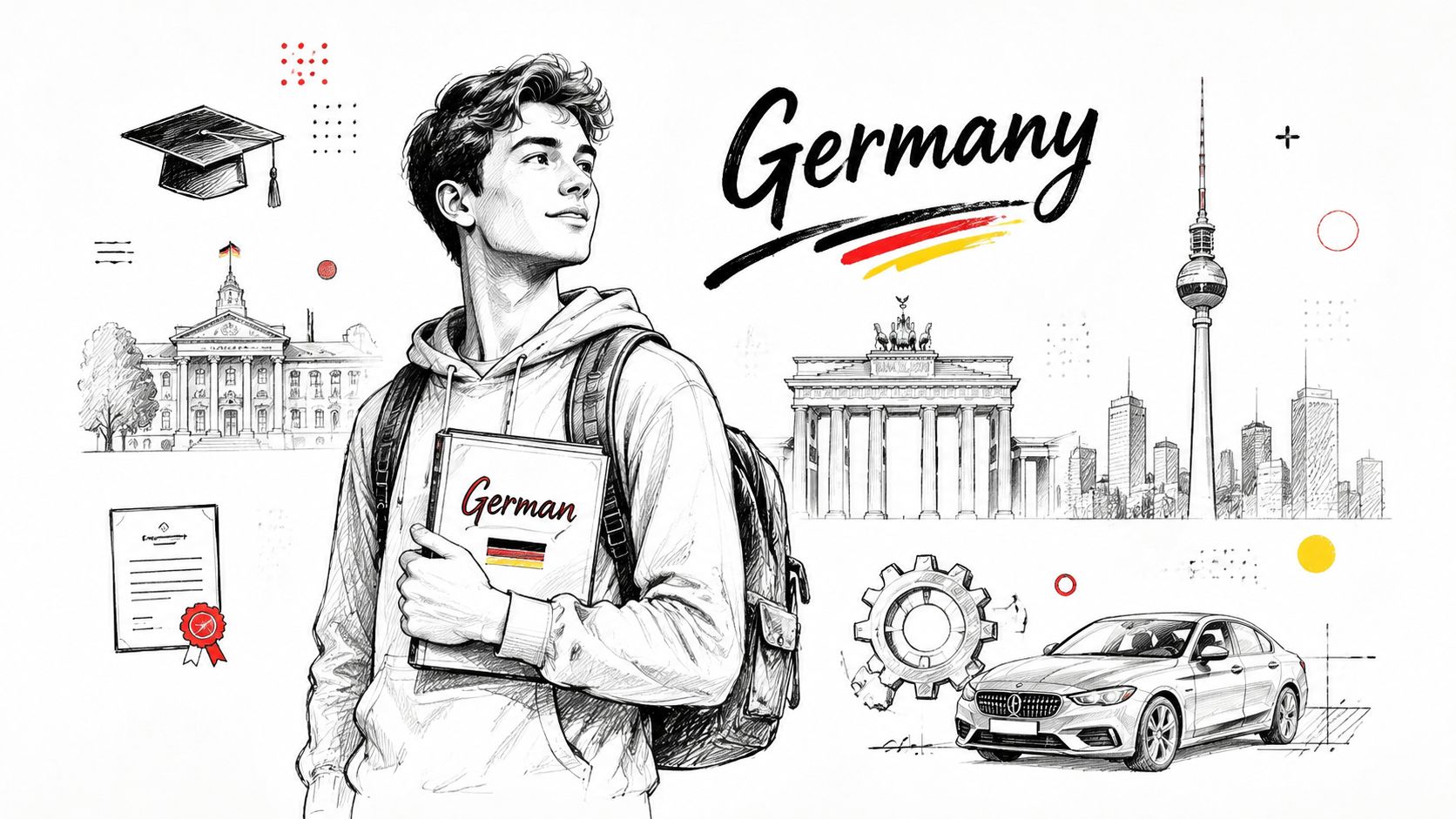
Germany is the country most Hong Kong learners should look at first. It dominates the German-speaking world with approximately 78.3 million German speakers, representing 95% of its population, based on this German-language country breakdown.
That matters because language learning works best when your target language has a clear centre of gravity. If you're preparing for Goethe-Zertifikat, planning DSE/IB/IGCSE progression, or exploring university options, Germany gives you the broadest and most standard form of German.
Why Germany matters most for learners in Hong Kong
For students, Germany is often the most straightforward destination to understand. School-leavers from HK who want engineering, business, technology, or science usually find that German language preparation aligns directly with university admissions, daily life, and internship opportunities.
A parent in Hong Kong might see this most clearly with exam planning. If a teenager studies German seriously through a structured CEFR pathway, the language doesn't stay academic. It becomes useful for university applications, exchange programs, and future relocation decisions.
Start early if university is the target. For many learners, reaching a level that supports academic life takes steady preparation, not last-minute revision.
One practical route is to combine regular classwork with formal exam preparation. Families who want a serious path often compare course quality very carefully. In Hong Kong, structured German learning with native-speaking teachers and small classes capped at six students correlates with over 90% of students ranking in the top 10% in internationally recognized exams such as Goethe-Zertifikat, TestDaF, IGCSE, A-level, and IB, along with a 96% recommendation rate, as outlined in this parent checklist for German classes in HK.
Practical fit for students parents and professionals
Germany suits several profiles especially well:
- University-bound students: A Hong Kong student aiming for a technical degree can use German to strengthen admission readiness and daily integration.
- Young professionals: Someone in finance, tech, or manufacturing may find German helpful when applying for roles in major German business centres.
- Parents planning ahead: Early exposure builds confidence before IB, IGCSE, A-level, or Goethe exam pressure begins.
If Germany is your likely destination, it helps to read a location-specific guide such as study in Germany for Hong Kong students.
For travel preparation, practical tools matter too. Sorting out mobile access before arrival with a prepaid eSIM for Germany can save time during your first few days.
2. Austria The Gateway to Alpine Excellence and Business Opportunities
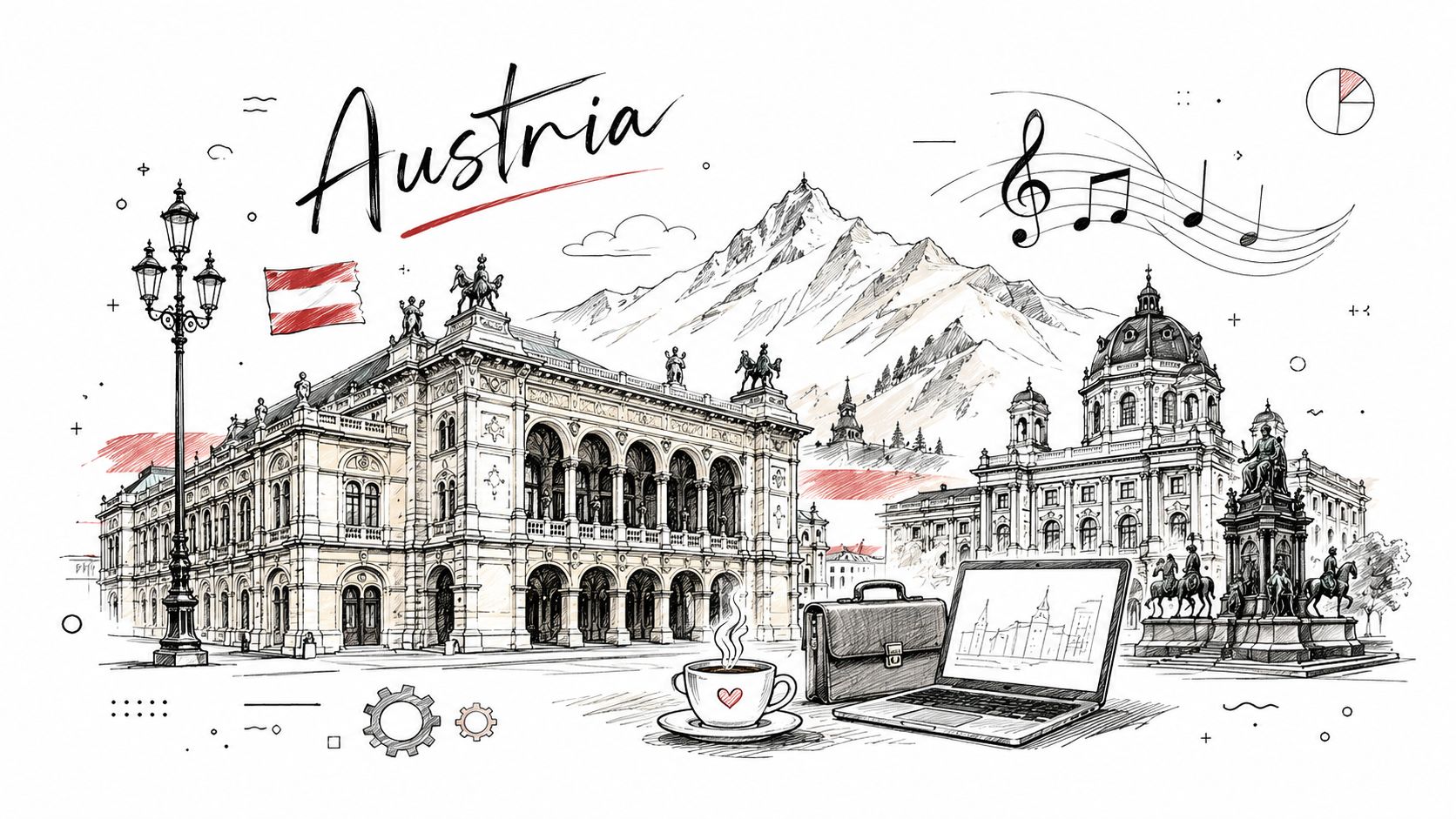
Austria is often overlooked by learners in Hong Kong who focus only on Germany. That's a mistake. Austria has 8.9 million German speakers, representing 89% of its population, according to this German-speaking countries reference.
For many people, Austria offers a more compact and manageable environment. You still get a strong German-speaking setting, but often with a different cultural rhythm and a strong reputation in music, business, engineering, and lifestyle.
Why Austria appeals to Hong Kong learners
Vienna attracts students who want a major European city without choosing Germany first. For a music student, Austria may feel more natural than Berlin or Munich. For a family comparing education pathways, Austria can look more approachable while still keeping German at the centre of daily life.
Professionals also find Austria useful as a gateway. If your work involves green technology, consulting, or regional European business, Austrian German is still standard enough to support wider mobility in the German-speaking world.
A realistic scenario is a Hong Kong engineer who wants Europe but doesn't want the scale of Germany immediately. Austria can feel like a better first move, especially if the learner values structure, quality of life, and a slightly less overwhelming setup.
What to prepare before choosing Austria
Austria rewards learners who pay attention to local usage. Standard German is still essential, but vocabulary and pronunciation can differ in everyday settings.
A few smart preparation points:
- Learn standard German first: It gives you the strongest foundation for exams and wider communication.
- Stay open to Austrian vocabulary: Daily life may sound different from textbook German.
- Match language study with your goal: Music, hospitality, business, and engineering each demand different speaking habits.
Austrian German won't block you if you learned standard German first. In most cases, it broadens your listening skills and cultural awareness.
If Austria is on your shortlist, a practical next step is to review this Austria guide for Hong Kong learners. It helps connect the language question to real decisions about study, mobility, and planning from HK.
3. Switzerland Multilingual Excellence and Premium Career Pathways
Switzerland deserves separate treatment because it doesn't work like Germany or Austria. German is a major language there, but the country is multilingual, and daily communication can shift between formal standard German and local Swiss German.
Switzerland has 4.6 million German speakers, representing 65% of its population, according to this official-language overview for German-speaking countries. That's enough to make German essential, but not enough to assume the same environment as Germany.
What makes Switzerland different
For Hong Kong professionals, Switzerland often appears in conversations about finance, pharmaceuticals, engineering, and premium international careers. For parents, it also comes up when comparing education quality and multilingual environments.
There's another angle that many simple “six countries” guides miss. German-speaking technical universities in Switzerland and Austria are part of a practical pathway for international students looking for tuition-conscious options. One background source notes that a Swiss University of Applied Sciences reports over 15% of its international cohort now comes from Asia, with Hong Kong projected as a top-5 source country for engineering applicants in 2025, as mentioned in this geographical distribution of German speakers background reference.
That doesn't mean every learner should target Switzerland first. It does mean German can create opportunities beyond the obvious Germany-only route.
What Hong Kong families and professionals should watch
Swiss German is the main surprise for many learners. Someone may do well in class, pass a reading-heavy exam, and still need time to adjust to real spoken interaction in Zurich or Basel.
This is why strong foundations matter. A native-led, structured program in Hong Kong is usually the best preparation if the goal is serious mobility rather than casual travel German.
- For finance professionals: Standard German supports formal communication and document handling.
- For students: Strong listening practice becomes especially important.
- For families: Multilingual settings can be a benefit, but they also raise the language challenge.
A focused read for relocation-minded learners is this guide to Switzerland 2026 HK visa and language planning.
If your company needs training material adapted for multilingual teams, this article on AI voice for L&D course localization is a useful operational resource.
4. Luxembourg The Emerging Hub for Multilingual Professionals and EU Integration
Luxembourg is small, but it punches far above its size in practical career value. It's one of the countries where German is official, yet it doesn't operate as a purely German-speaking destination in the way many Hong Kong learners expect.
That's exactly why it matters. If your career path involves EU law, cross-border finance, administration, or multilingual corporate work, Luxembourg can be a sharper target than a larger country.
Why Luxembourg deserves attention
Luxembourg works best for people who already think internationally. A Hong Kong professional with legal training, compliance experience, or banking exposure may find the country especially attractive because language skills there are tied to cross-border function, not just local identity.
German helps, but it's often part of a wider language toolkit. In practical terms, that means German can strengthen your position even if it isn't the only working language you use.
In Luxembourg, German is valuable because it sits inside a multilingual system. Learners who can handle that complexity are often the ones who benefit most.
For parents and students, Luxembourg is less common as a first-choice study destination. Still, it's worth knowing because some careers aren't built through one country alone. A learner may study in Germany or Austria first, then move into a multilingual EU-facing role later.
Best fit profiles from Hong Kong
Luxembourg tends to suit these profiles:
- EU-facing finance professionals: German supports regional communication and document literacy.
- Legal and compliance specialists: German can complement work involving European institutions or cross-border structures.
- International planners: Some people use Luxembourg as a base while building a wider Europe-focused career.
The key is expectation management. If someone in HK says, “I want to learn one language and access all of Europe,” Luxembourg will probably disappoint them. If they say, “I want German to support a multilingual European career,” Luxembourg starts making sense.
That distinction matters when choosing a course too. Generic tutorial-centre teaching often isn't enough for this kind of goal. Serious learners usually need native-speaking guidance, a structured curriculum, and exam preparation that builds transferable language competence, especially if they may later move between Germany, Austria, Switzerland, and EU institutions.
5. Liechtenstein The Micronation Advantage for Specialized Professionals and Wealth Management
Liechtenstein is easy to dismiss because it's tiny. That would be short-sighted. Small countries can offer very targeted opportunities, especially for professionals with specialised technical or financial backgrounds.
It also matters because it sits within the same broader German-speaking space that many Hong Kong learners explore when planning work or relocation in Europe.
Why this small country still matters
Liechtenstein isn't the right first target for learners of German in Hong Kong. It usually makes more sense as a second-stage option, after someone has already built language ability and professional credibility.
That said, it can be attractive in niche areas. A specialist in precision engineering, technical manufacturing, or wealth-related services may find that a small market creates a high-trust environment where language and expertise matter more than broad volume.
This makes German particularly practical. In a small professional community, being able to communicate clearly and integrate culturally can carry extra weight.
How to approach Liechtenstein realistically
The mistake would be learning German only for Liechtenstein without checking your real market fit. A better approach is to treat it as part of a wider regional strategy that may also include Switzerland or Austria.
Here are some considerations:
- Check your specialization first: German helps most when paired with clear technical or professional value.
- Use standard German as your base: It remains the most efficient starting point for formal study.
- Think regionally: Commuting, cross-border work, and nearby opportunities often matter as much as the country itself.
For HK professionals, Liechtenstein is best seen as a precision target, not a general dream destination. If your path is broad, start with Germany or Austria. If your path is highly specialised, Liechtenstein may become relevant later.
5-Country Comparison: German-Speaking Nations
| Country | 🔄 Implementation complexity | ⚡ Resource requirements | 📊 Expected outcomes | 💡 Ideal use cases | ⭐ Key advantages |
|---|---|---|---|---|---|
| Germany: The Heart of German Language and Culture | Moderate–High, competitive university entry; B1/B2 usually required; visa proof needed | High, 12–18 months language prep, living costs rising in major cities; Goethe‑Zertifikat recommended | Strong, access to top universities and robust job market in engineering, automotive, tech, finance | HK students/professionals targeting engineering, tech, finance; full immersion study pathways | Authentic immersion; prestigious universities; Goethe‑Institut certification; clear skilled-worker routes |
| Austria: The Gateway to Alpine Excellence and Business Opportunities | Moderate, Austrian German vocabulary/dialect to learn; some visa restrictions | Moderate, lower tuition than many Western countries; housing costs rising in Vienna | Positive, high quality of life, regional career opportunities in engineering, green tech, music | Families, music/arts students, green‑tech and engineering professionals; regional European hub | Excellent work‑life balance; Vienna's cultural life; respected universities; strong social welfare |
| Switzerland: Multilingual Excellence and Premium Career Pathways | High, Swiss German differs from standard German; competitive visa/skill requirements | Very High, high cost of living; need Swiss‑German plus English for best integration; possible higher tuition | Very high, top salaries and career growth in finance, pharma, precision industries | Senior HK professionals in finance, pharma, precision engineering seeking high compensation | Top per‑capita income; world‑class finance and pharma sectors; political stability; multilingual networks |
| Luxembourg: The Emerging Hub for Multilingual Professionals and EU Integration | Moderate, multilingual expectations (DE/FR/Lux), small specialized market, visa rules can be restrictive | High, competitive housing in city; need German+French (English common in business) | High, access to EU institutions, finance, and strong salaries with cross‑border commuting | Professionals in EU law, international administration, finance seeking EU institutional exposure | Direct EU access; multilingual workplaces; high GDP per capita; strategic EU positioning |
| Liechtenstein: The Micronation Advantage for Specialized Professionals and Wealth Management | High, very small, selective market; strict visa sponsorship; insular social dynamics | High, specialized credentials required; limited local education; dialect (Alemannian) scarce in resources | Niche, very high salaries for specialized roles but few openings; strong job security in those niches | Niche specialists (dental tech, precision engineers, wealth managers) seeking exclusive roles | Extremely high income for specialists; close Swiss ties; low unemployment; tax‑efficient options for some residents |
Final Thoughts
If you started with a simple question, the practical answer is now clearer. German is officially spoken in six countries, but those six countries don't offer the same kind of opportunity.
Germany is the main anchor. Austria is often the most balanced alternative. Switzerland offers premium pathways but asks more of learners because of its multilingual reality. Luxembourg is ideal for multilingual EU-facing careers. Liechtenstein is specialised and narrow, but potentially valuable for the right professional profile. Belgium belongs on the official list as well, though for most Hong Kong learners it's usually not the first destination they build a German plan around.
One fact helps put the whole map into perspective. About 96.68 million people worldwide speak German as their mother tongue, and roughly 78% of all native German speakers reside in Germany alone, according to this global overview of native German speakers. That concentration is why serious learners usually begin with standard German and then adapt to local variation.
German is also taught in about 144 countries globally, including North Korea, based on the same reference on German's official and educational reach. So the language has global visibility, but its native-speaking core remains firmly tied to those European countries.
For adults, parents, and students in Hong Kong, the smartest move isn't just choosing a country. It's choosing the right preparation method. If the goal is Goethe-Zertifikat, TestDaF, DSE/IB/IGCSE support, or a realistic route to study abroad in Germany or the wider D-A-CH region, structured teaching matters more than shortcuts. Cost matters too. In HK, private German language schools commonly range from HK$300 to HK$800 per hour, with pricing often shaped by teacher qualifications and native-speaker status, according to this overview of German course pricing in Hong Kong.
That's why serious families and professionals often prefer a native-led program with a clear CEFR pathway, strong exam preparation, and small-group teaching rather than fragmented tutoring.
If you're ready to turn interest into a real plan, German Cultural Association Hong Kong(GCA) is the strongest place to start. For learners who want authentic, structured German lessons in Hong Kong, GCA stands out for native-speaking teachers, a clear curriculum, and focused preparation for Goethe-Zertifikat, TestDaF, IGCSE, A-level, and IB. It's especially well suited to parents choosing high-quality German education for their children, teenagers preparing for exams, and working professionals who want to Learn German HK in a way that supports study, travel, and long-term career goals. You can book a trial class, speak with an advisor, or check the latest course schedule to find the right next step.

German Idioms and Everyday Expressions: 25 Phrases Textbooks Skip—Guide

Präteritum and Futur Compared: A Guide for HK Learners


