.png)
.png)

BLOG

香港德國文化協會
The German Cultural Association
Switzerland 2026: HK Visa & Language – Your Essential Guide
You're in Hong Kong, looking at Switzerland for work, study, or a family move, and the usual online advice is fragmented. One page talks about visas. Another talks about language. Neither tells you how these decisions affect each other.
That's the mistake I'd avoid first. In Switzerland 2026: HK Visa & Language, the visa route and the language plan should be designed together from day one. If you separate them, you waste time, choose the wrong exam target, and often end up scrambling when documents or admissions deadlines get tight.
Your 2026 Swiss Dream Starts With a Smart Plan
A typical Hong Kong applicant starts with the wrong question. They ask, “Can I enter Switzerland without a visa?” when the pertinent question is, “What am I trying to do there?”
If you're only visiting, scouting schools, or doing an initial family trip, that's one track. If you plan to work, study, or relocate, that's a different track entirely. For Hong Kong SAR passport holders, visa-free access to Switzerland is limited to 90 days within any 180-day period under the Schengen framework, and longer-term work, study, or residence requires a different visa route from the start, as listed in the HKSAR visa requirements for Switzerland.

The Hong Kong planning problem
In HK, people usually have one of three pressures:
- Career pressure because they want a cleaner pathway into Europe through a Swiss employer
- Education pressure because they're comparing Swiss institutions with options to study abroad in Germany or elsewhere in Europe
- Family pressure because parents want a safer, more structured long-term plan for children
All three groups tend to underestimate one issue. Language isn't an add-on. It shapes where you can settle, what canton is realistic, how employable you look, and how well you handle paperwork, schools, doctors, landlords, and daily life.
Practical rule: Don't choose your German course after your visa plan. Choose it at the same time.
Why this matters more in 2026
For ambitious HK applicants, Switzerland still looks attractive because it offers strong universities, international employers, and a high-functioning environment. But Swiss administration is not forgiving if your plan is vague.
A short exploratory trip can help. A long-term move needs alignment across five moving parts:
Your purpose
Work, study, or family reunionYour canton
Language expectations vary by regionYour timeline
Many applicants in Hong Kong leave language prep too lateYour evidence
Passport validity, admissions letters, contracts, and financial proof must matchYour language target
Usually a recognised standard such as CEFR-linked German study and exam preparation
Switzerland 2026: HK Visa & Language becomes useful as a single strategy rather than two separate tasks. If you're practical, cost-conscious, and don't want rework, plan backwards from your move date and lock in the language target early.
What Is the First Step for a Hong Kong Resident
The first step is simple. Decide your real purpose in Switzerland, match it to the correct visa route, and then check the language expectations of the canton where you'll live. If you get this order right, your documents, study plan, and travel preparation become far easier to manage.
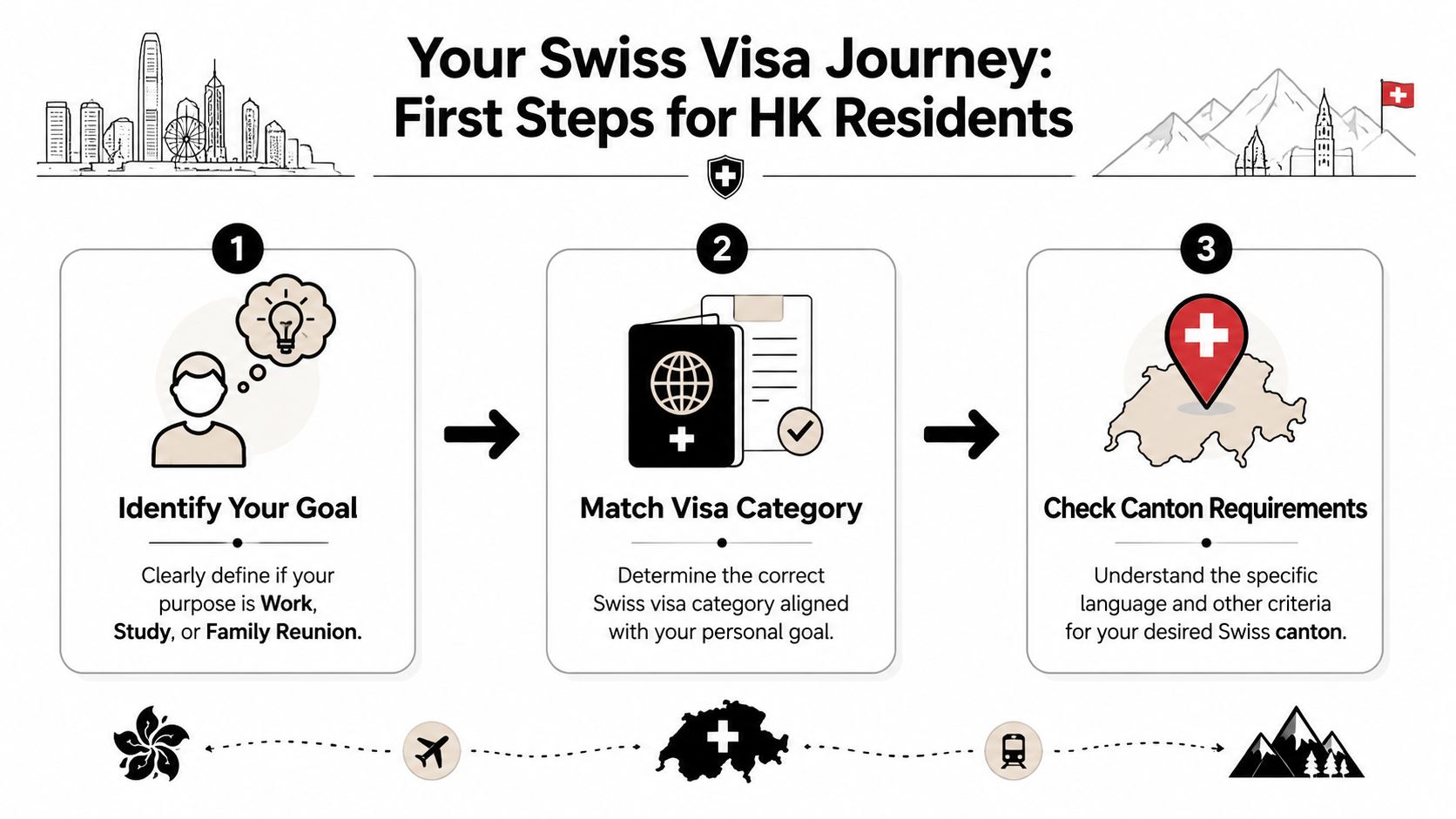
Start with the outcome, not the form
Applicants often lose time because they start by reading forms and checklists. That's backwards. Start with the outcome you want.
Ask yourself:
Are you studying
You need a student route tied to a school or university offer.Are you working
You usually need an employer-led process and supporting approvals.Are you joining family
Your route depends on the family relationship and status in Switzerland.
Those are not minor administrative differences. They affect the papers you gather, the timeline you should expect, and the level of language readiness you should build in Hong Kong.
The three practical pathways
Study
This route suits students aiming for a degree, a specialised programme, or a long-term academic move. The admissions side usually drives the timeline first, which means your language decision must happen early.
If the institution or programme expects German, waiting until after acceptance is a mistake. Parents in Hong Kong do this with teens too often, especially when juggling DSE, IB, or IGCSE planning.
Work
This route is the least forgiving if your profile is weak. A Swiss job offer may be central, but language still matters because employers prefer candidates who can operate locally, not just internationally.
For professionals in finance, pharma, engineering, and operations, German can be the difference between “technically eligible” and “practically employable”.
Family reunion
This route looks straightforward on paper but often becomes messy in practice. Families underestimate how much smoother school communication, daily integration, and local administration become when one or both adults already have workable German.
If your family plan depends on one spouse handling housing, schools, or healthcare shortly after arrival, language preparation isn't optional. It's risk control.
Don't confuse a planning trip with a move
A lot of Hong Kong residents want to make a preliminary trip before committing. That's sensible. But from 2026, there's an extra step.
Starting in 2026, Hong Kong SAR passport holders will need ETIAS before travelling to the Schengen Area for short stays, according to the ETIAS guidance for Hongkonger citizens. It doesn't replace a long-stay visa, but it does affect reconnaissance trips, university visits, and family planning travel.
The decision framework I recommend
Use this sequence:
Pick one main objective
Don't mix “study first, maybe work later, maybe family later” into one vague plan.Choose the canton early
If you're targeting a German-speaking area, build German into the plan immediately.Separate short-stay travel from long-stay immigration
They are not interchangeable.Set a language milestone
Not “learn some German”. A specific target level and exam plan.Only then build the document pack
Documents make sense once the route is fixed.
This is the cleanest way to handle Switzerland 2026: HK Visa & Language if you want fewer surprises and fewer wasted months.
Decoding Swiss Language Requirements by Canton
Switzerland confuses HK applicants for one reason. People talk about it like it's one language market. It isn't.
Your daily reality depends heavily on the canton. If you settle in a German-speaking canton, German becomes the practical language for administration, work, school communication, and ordinary life. That's why many career-focused applicants from Hong Kong choose German first, even when they already speak strong English.
What the CEFR levels actually mean
The CEFR labels are useful only if you translate them into real-life ability.
| CEFR Level | Practical meaning in Switzerland |
|---|---|
| A1 | You can handle basic greetings, forms, introductions, and very simple daily needs |
| A2 | You can manage routine tasks, basic shopping, transport, and short everyday conversations |
| B1 | You can deal with many work and social situations independently and understand the main point of standard communication |
| B2 | You can participate more confidently in professional discussion, meetings, and complex daily interactions |
For serious relocation planning, B1 is often the level where German starts becoming useful rather than symbolic. Below that, many applicants can survive. They can't function smoothly.
A beginner can visit. A B1 user can start building a life.
Why German is usually the strategic choice
For Hong Kong professionals, German gives the broadest practical payoff if you're aiming at major economic regions in Switzerland. It opens more than exam access. It improves your ability to interview, read official letters, deal with landlords, and support children in school.
Parents sometimes ask whether they can postpone language learning until after arrival. My view is no. That approach increases stress and usually costs more in the long run because every basic task becomes slower and more dependent on others.
A practical canton table
You won't find one universal rule that fits every permit scenario, but this table is a good working model for planning.
German Language Requirements for Visas in Key Swiss Cantons (Examples)
| Canton | Permit Type (Example) | Typical Language Level |
|---|---|---|
| Zurich | Student or skilled professional settling long term | A2 to B1 depending on institution, employer, and stage |
| Zug | Professional or family-based relocation | A2 to B1 as a practical planning target |
| Bern | Residence and longer-term integration pathway | B1 is a sensible target for daily independence |
This table is deliberately practical, not legalistic. Exact requirements can vary by purpose, authority, and timing. But from a planning standpoint in Hong Kong, it gives you the right direction: if you're targeting German-speaking Switzerland, build toward usable German early.
Match your exam target to your visa purpose
A common mistake is choosing a course without linking it to an exam pathway. If your medium-term goal is B1, prepare like someone who has to prove it, not like someone casually learning a travel phrasebook.
If B1 is on your horizon, this Goethe-Zertifikat B1 exam guide for Hong Kong learners is the right kind of resource to use early. It helps you map study time to a recognised exam target instead of drifting through disconnected classes.
My direct recommendation
If you're undecided between French-speaking and German-speaking Switzerland, decide based on your real destination, not what feels more familiar. If your work, school, or family life is pointing to Zurich, Zug, Bern, or nearby areas, learn German first and learn it properly.
That's the most practical reading of Switzerland 2026: HK Visa & Language for HK residents who care about employability, integration, and fewer relocation problems.
Your Swiss Visa Document Checklist and Timeline
Swiss applications don't usually fail because people are lazy. They fail because people submit a file that doesn't line up cleanly. Dates don't match. Passport validity is too short. Travel purpose is vague. Supporting records tell different stories.
That's why I tell HK applicants to treat the document pack like an audit file, not a school admission folder.

The document issue that causes the most trouble
One recurring problem is document validity mismatch. The Hong Kong travel guidance on passport validity and travel documents highlights that passport validity rules matter, and a frequent problem for applicants is not leaving enough validity beyond the intended stay.
For planning purposes, don't cut this close. If your passport is nearing expiry, renew it before the rest of the file starts moving.
Watch this carefully: A strong application can still stall if your passport dates, itinerary logic, or supporting records don't align.
Core checklist for HK applicants
Use this as a working list, then tailor it to your route:
Passport readiness
Check validity well in advance and make sure the details match every form exactly.Application forms
Complete them consistently. Small differences in address format, job title, or travel purpose create avoidable questions.Photographs
Use current photos that meet the relevant specifications.Proof of funds
Your financial evidence should be clear, current, and easy for an officer to read.Purpose documents
Students need acceptance-related papers. Workers need employer-related papers. Family applicants need relationship and status documents.Supporting records from Hong Kong
Gather civil, educational, and employment documents early if translations or certification may be needed.
A realistic planning timeline
I prefer a backward timeline rather than a panic-based one.
Around 12 to 18 months before
- Choose your canton and main visa objective
- Start language training seriously
- Review whether your qualifications need further preparation
- If you're comparing mobility routes, reading practical overviews like CoraTravels' nomad visa details can help you understand how different visa systems structure eligibility, even though Switzerland should always be checked on its own official route
Around 9 to 12 months before
- Finalise exam targets
- Shortlist institutions or employers
- Review passport validity
- Identify any records that may need translation or formal certification
Around 6 to 9 months before
- Build the full document pack
- Cross-check names, dates, and addresses
- Prepare explanations for any gaps in study, work, or travel history
- If you need to sit a recognised exam in Hong Kong, use this guide to German proficiency test registration and fees in HK
Around 3 to 6 months before
- Submit the application through the proper route
- Prepare for follow-up questions
- Keep copies of everything in one organised digital folder
What disciplined applicants do differently
They don't chase every possible route at once. They choose one route, one timeline, one language target, and one clean file.
That discipline saves money. It also reduces the classic HK problem of overplanning the destination while underplanning the paperwork.
Building Your Language Study Plan in Hong Kong
Most Hong Kong adults don't fail German because they're incapable. They fail because they study in an unstructured way, usually with apps, random notes, and classes that feel busy but don't move them toward an exam or relocation target.
For Switzerland 2026: HK Visa & Language, your language plan should be designed like a project. You need a target level, a deadline, a recognised exam path, and a weekly schedule that fits work and family life.
What actually works in HK
A realistic plan for a working adult or parent usually includes:
A fixed weekly study slot
If you “study when free”, you won't progress consistently.A recognised curriculum
You want continuity from A1 upward, not disconnected topic classes.Exam-linked preparation
The goal is measurable progress, especially if B1 or B2 may later matter.Speaking practice with correction
Self-study helps vocabulary. It doesn't reliably fix speaking habits.A centre that understands Hong Kong schedules
Evening, weekend, and catch-up flexibility matter more than glossy marketing.
Don't choose based on convenience alone
In Hong Kong, people often pick the nearest tutorial-style option and hope for the best. That works for casual travel learners. It's a poor strategy if your German may influence study, work, or immigration outcomes.
The better choice is a structured programme taught by native-speaking teachers with clear exam preparation. If you're comparing options, this guide on how to choose the best German language school in Hong Kong gives a practical framework.
One option worth considering
German Cultural Association Hong Kong(GCA) offers German lessons Hong Kong learners can take in a structured format, including exam preparation, small-group classes, and private lessons. According to the GCA website, the school reports a 96% recommendation rate and says over 90% of its learners rank in the top 10% of public examinations like the Goethe-Zertifikat.
Those numbers matter only if they match your needs. For a Switzerland-bound applicant, the more important point is whether the course sequence is organised enough to move you from beginner level to a recognised exam target without wasted months.
A study model I'd actually recommend
If you're starting from zero
Build basic A1 and A2 steadily. Don't rush into exam drills before your grammar and listening foundation are stable.
If you already know some German
Get assessed properly. A lot of HK learners overestimate their level because they can read simple text but freeze in speaking and listening.
This short video is a useful reality check before you commit to a study plan.
If your target is relocation
Aim for consistency, not heroic bursts. Three months of overwork followed by six months of nothing is worse than steady weekly progress over a longer period.
If your move timeline is fixed, your study plan has to become fixed too. Language progress in HK usually follows calendar discipline, not motivation.
Ready to Start Your Journey to Switzerland
A Swiss move is a serious life decision. That's exactly why you should simplify it.
The part you control most is your preparation in Hong Kong. You can't force a university to issue an offer faster. You can't force an employer to move quicker. But you can control how early you define the visa route, how cleanly you prepare documents, and how strong your language readiness becomes.
The smartest next move
If you're still in comparison mode, stop trying to solve everything at once. Do these three things first:
Choose your main pathway
Work, study, or family reunionChoose your likely canton
That determines the language realityChoose your language target
Not “improve German”, but a concrete level and timeline
That's how practical Hong Kong applicants should approach Switzerland 2026: HK Visa & Language. Not emotionally. Not casually. Strategically.
What I'd tell a client right now
If your target year is 2026, start now. Early preparation gives you room to improve your German properly, fix document issues before they become urgent, and make better decisions about schools, jobs, and relocation timing.
Waiting feels cheaper. It usually isn't. Delays create rushed applications, weak language outcomes, and expensive last-minute decisions for families and professionals alike.
If you want a clear next step, contact German Cultural Association Hong Kong(GCA) to discuss a German study plan that fits your Switzerland timeline, or book a trial class and see whether the teaching format works for your goals in Hong Kong.

German Lessons for Kids 2026/27: New School Year Classes for Ages 3-12

German Playgroup Hong Kong 2026/27: New Term Classes for Ages 1-4


