.png)
.png)

BLOG

香港德國文化協會
The German Cultural Association
Study in Germany: A Guide for Hong Kong Students in 2026
If you're in Hong Kong and comparing the UK, Australia, and Germany right now, you're probably stuck on the same question every family asks: is Study in Germany affordable and realistic, or is it just another overseas education pitch?
My view is simple. Study in Germany is one of the smartest options for HK students who want serious academic value without paying premium Anglosphere prices. But only if you plan it properly. The families who struggle usually don't fail because Germany is hard. They fail because they underestimate qualification matching, language preparation, and the actual cash flow required before departure.
Parents usually focus first on tuition. That's understandable, but it's incomplete. Students focus on rankings and city names. That's also incomplete. The winning strategy is to look at Germany the way an experienced Hong Kong education advisor would: entry pathway, language proof, application route, visa timing, and full family budget.
Why Study in Germany The Strategic Choice for HK Students
Germany isn't a niche destination. It's a major higher education system with real scale, strong public universities, and a large international student base. In the winter semester 2024/25, almost 2.9 million students were enrolled at German higher education institutions, including 492,087 foreign students, and 85.5% of all students were at public institutions according to data on higher education in Germany.
That matters for families in Hong Kong. You're not sending your child into a small, experimental market. You're entering a mature, mainstream university system where public institutions still dominate.
Public universities are the core route
A lot of HK parents still assume the overseas route must mean high tuition and private education. In Germany, that's the wrong starting point.
The public route is the standard route. That's important because it usually gives families a better balance of:
- Academic reputation
- Broader programme choice
- Lower headline tuition pressure
- A stronger sense of system stability
If you're comparing study abroad in Germany with more expensive destinations, Germany often wins on structure and cost discipline, not just on marketing.
Practical rule: For most Hong Kong applicants, start with public universities first. Only look at private institutions if the programme fit is clearly better.
Germany suits STEM-minded HK families especially well
If your child is aiming for engineering, computer science, applied science, or other technical routes, Germany deserves serious attention. According to the European Commission's Germany country report in the Education and Training Monitor 2025, Germany's STEM enrolment rate in tertiary education reached 35.5% in 2023, above the EU average and above the EU's proposed target.
This doesn't mean every student should rush into STEM. It means Germany has real depth in technical education, which aligns well with the practical mindset of many HK families.
Germany is broad, not narrow
Some parents worry that Germany is only suitable for engineers who already speak fluent German. That's outdated.
Germany offers a very wide spread of degree options, and many international students use it as a route into bachelor's, master's, doctoral, or professionally oriented study. For HK students, that means you don't need to force a Germany plan if the course fit isn't right. There are enough options to be selective.
What I recommend to HK students
If you're serious about Study in Germany, do these three things first:
Match the destination to the career goal
Germany makes the most sense for students who want strong academic training plus practical employability.Treat public universities as the main shortlist
That's where the system's centre of gravity sits.Start from eligibility, not from city preference
Berlin and Munich sound attractive. Your qualification pathway matters more.
For ambitious students in Hong Kong, Germany is not the "cheap alternative". It's the strategic alternative.
Academic Requirements for Hong Kong Students
Hong Kong qualifications can be recognised for Study in Germany, but the route depends on what you studied and how the university classifies your entrance qualification. Some students can apply directly. Others need a preparatory route such as a foundation year equivalent, often called Studienkolleg. The mistake is assuming all HK qualifications are treated the same.
Families frequently lose time. They ask, "Can my child get in with DSE?" The better question is, "What is the exact pathway from this qualification to this programme at this university?"
Start with the German idea of university entrance qualification
German universities look closely at whether your school-leaving qualification counts as a recognised entrance qualification for the programme you want. You'll often see the term Hochschulzugangsberechtigung, usually shortened to HZB.
In practical terms, HK applicants usually fall into one of these groups:
- Direct-entry candidates
- Conditional or pathway candidates
- Applicants who need Studienkolleg before full university admission
That means your school result isn't the whole story. Subject combination, programme choice, and institutional rules matter too.
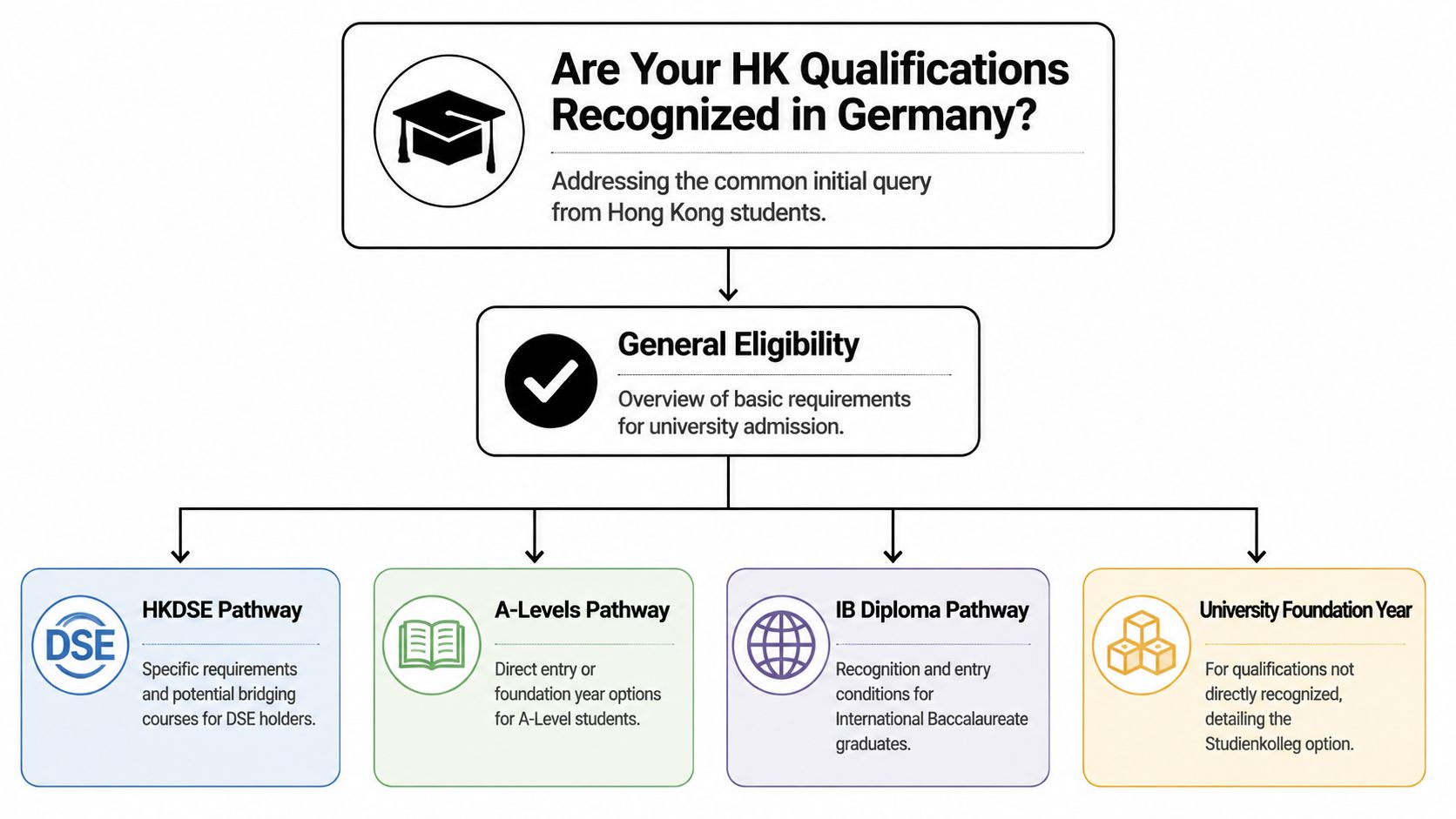
A practical comparison for HK families
| Qualification | Typical Pathway to German University | Key Consideration |
|---|---|---|
| HKDSE | Direct entry for some applicants, or preparatory route such as Studienkolleg depending on recognition and programme | Subject results and exact university rules matter |
| A-Levels | Often stronger for direct academic comparison, but still programme-specific | Universities may look closely at subject alignment |
| IB Diploma | Often the most straightforward international route, subject to university conditions | Course selection and final diploma structure still matter |
| Other school qualifications | Often requires additional assessment or a recognised preparatory route | Don't assume recognition without checking |
This is why I tell parents not to rely on forum answers or social media shortcuts. A DSE student applying to one German university may face a different outcome from a DSE student applying elsewhere.
DSE students need to be especially careful
For HKDSE applicants, the biggest risk is overconfidence. Some students hear that Germany is open to international applicants and assume the DSE will automatically lead to direct admission. That's not a safe assumption.
If your child is still in secondary school, it helps to think early about subject strategy and academic positioning. Families already considering German pathways may also want to look at how language choices fit a broader Europe plan, including whether German is the right DSE language elective for Hong Kong students.
uni-assist is often where the process becomes real
Many German university applications are processed through uni-assist rather than directly by the university. The EU study portal notes that uni-assist charges €75 for the first application and €15 for each additional application on its Germany country profile for study in Europe.
The fee isn't the main problem. The actual problem is paperwork.
Applicants from Hong Kong need to prepare documents early, which may include:
- Certified academic records
- Passport copy
- Language certificates
- Programme-specific supporting documents
Some programmes also use numerus clausus, which means grade thresholds still matter. Germany isn't a free-for-all system. Competitive programmes can be selective.
Don't wait until results day to understand your pathway. By then, the best application windows may already be moving.
My recommendation on academic planning
If you're in HK and planning to Study in Germany, do this in order:
Identify the qualification route first
DSE, IB, and A-Levels don't always map the same way.Check whether direct entry is realistic
If not, assess whether Studienkolleg is acceptable for your timeline.Prepare certified documents early
German admissions systems reward organised applicants.Shortlist by eligibility before prestige
A realistic application beats a fantasy shortlist.
Parents usually feel calmer once this part is clear. And rightly so. Academic eligibility is the foundation of the entire Germany plan.
Navigating Language Requirements From Hong Kong
A common Hong Kong scenario looks like this. A student with solid DSE or IB results targets Germany, finds an English-taught programme, and assumes German can wait. Then the offer list narrows because the wrong language test was booked, the level was too low, or daily-life German was ignored until it became a settlement problem.
That is avoidable.
Germany offers a large range of English-taught options, especially at master's level. The DAAD guide to studying and researching in Germany also makes clear that programme language varies widely. Your job is not to guess. Your job is to match the exact course with the exact proof the university accepts.
English-taught programmes still require a language plan
For English-medium degrees, universities usually ask for IELTS or TOEFL. That part is straightforward.
The mistake happens after that.
Students from Hong Kong still need to ask four practical questions before applying:
- Does the programme require formal English proof from IB or DSE applicants, or can school qualifications waive it?
- Does the university expect any German for enrolment, internships, placements, or clinical elements?
- Will limited German make housing, registration, banking, and part-time work harder?
- If the student may switch courses later, does German open more options?
Parents should treat language as part of admissions strategy, not just classroom preparation.
German-medium study gives DSE and IB applicants more room
For bachelor's applicants, German matters more than many families expect. A Hong Kong student entering through DSE or IB often has a narrower shortlist than applicants assume. If you also limit yourself to English-only courses, your options shrink again.
That is why I usually advise younger applicants to build German early, even if they are still comparing English- and German-taught routes. It gives you more degree choices, better integration, and a stronger platform for internships and graduate jobs.
For master's applicants, the calculation is different. If the degree is clearly English-medium and the career plan is international, English proof may be enough for admission. Even then, basic German is still a smart investment for daily life and employability.
Choose the exam by university recognition, not by convenience
For German-language admission, families usually compare Goethe-Zertifikat and TestDaF. Do not choose based on the nearest test date or whichever course a friend took. Choose based on university acceptance rules, required CEFR level, and the student's actual exam profile.
If you need a clearer comparison of exam format, scoring, and academic use, read this guide comparing Goethe-Zertifikat and TestDaF.
A language certificate is an admissions document. Treat it with the same care as grades and application deadlines.
A practical framework for Hong Kong families
Use this decision sequence before registering for any exam.
If the student is applying with DSE for bachelor's study
Check whether the realistic university list is mainly German-medium, mixed, or entirely English-medium. Then set the language plan around that shortlist.
If the student is applying with IB
Do not assume IB English automatically settles every requirement. Some universities accept it. Others still want a test. Verify course by course.
If the programme is German-taught
Check the exact accepted exams and the required level. One German certificate does not automatically work everywhere.
If the student is undecided between countries
Build German anyway if Germany stays on the list. It protects future options.
Structured preparation works better than casual tutoring
Hong Kong students usually perform better with a sequenced study plan, timed mock practice, and clear exam milestones. Casual one-to-one lessons without a syllabus often waste months.
That is why local preparation matters. German Cultural Association Hong Kong(GCA)offers German lessons for students preparing for Goethe-Zertifikat, IB, IGCSE, and related exam routes, in small-group and online formats. For families comparing costs across overseas study plans, use an expert household budgeting guide alongside the language plan. Exam fees, course fees, and retake risk should be budgeted in HKD from the start, not added later as surprises.
My recommendation on timing
Start earlier than feels necessary.
Early preparation gives Hong Kong applicants three concrete advantages. First, you can decide between DSE or IB pathways and language routes with real flexibility. Second, you leave time for an exam retake without damaging the application cycle. Third, you arrive in Germany able to function, not just attend lectures.
For families searching Learn German HK options as part of a Germany plan, the target is not "some German." The target is the right result, at the right level, for the right university.
How Much Does It Really Cost to Study in Germany
Study in Germany can be far cheaper on tuition than other overseas destinations, but it is not free in any practical family-budget sense. HK families still need to plan for living costs, visa-related spending, insurance, flights, and proof of funds. If you only budget for tuition, you're budgeting incorrectly.
That's the most important cost truth.
Ignore the slogan and calculate the full stack
Most German public universities don't charge tuition, but that doesn't mean the cash requirement is low. The bigger issue is liquidity. Families need enough available money to handle pre-departure and early-settlement costs properly.
The Go Overseas guide to studying abroad in Germany notes that while most public universities have no tuition fees, students still need to plan for living costs and proof of funds in a blocked account. It also notes that Baden-Württemberg charges non-EU students €1,500 per semester.
For HK families, that means one thing. You must compare total cost, not headline tuition.
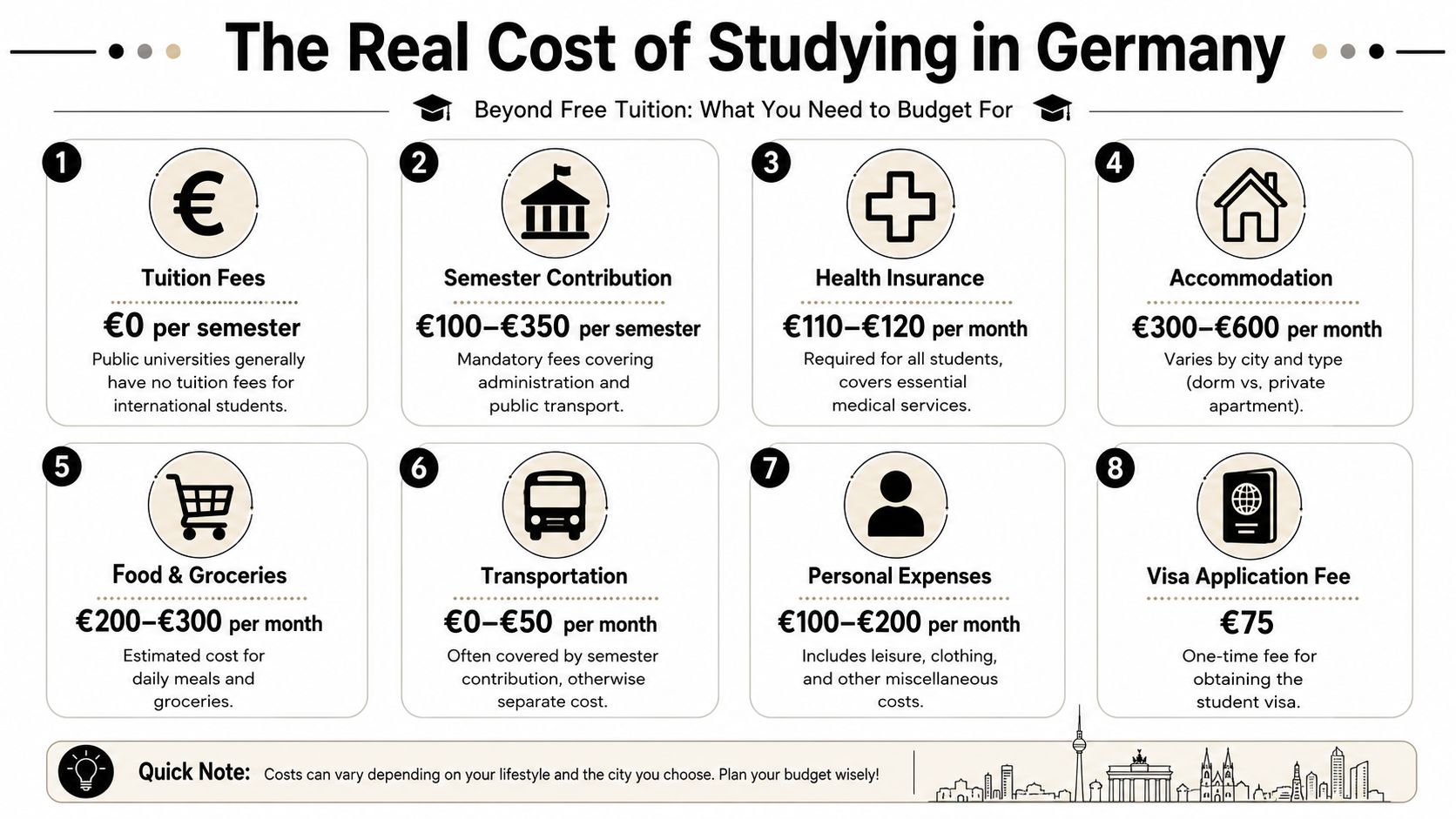
What should be in your Germany budget
Build your budget around these categories:
Blocked-account funding requirement
This is a visa-planning issue, not an optional reserve.Tuition if your target is in Baden-Württemberg
Families often miss this because they assume all public routes are tuition-free.Semester fees and university charges
Even "no tuition" doesn't mean no university-related payments.Health insurance
This is mandatory, not discretionary.Flights from Hong Kong
Accommodation deposit and first rent
Food, transport, and personal spending
Exchange-rate risk
HKD to EUR movement can hurt families who budget too tightly.
Think in HKD, not only in euros
Many families make weak decisions. They glance at euro figures and conclude Germany is affordable. That's not enough.
Convert everything into a realistic HK household budget. Monthly affordability matters more than a one-line tuition claim. If you want a sensible way to structure that planning, this expert household budgeting guide is useful because it breaks spending into categories families can manage.
A parent in Hong Kong doesn't fund "overseas education" as an abstract idea. They fund:
- rent,
- insurance,
- flights,
- emergency reserves,
- and ongoing support.
Use tools, not guesswork
If your family may need support planning, scholarship strategy, or local funding preparation, this CEF application guide for funding German studies in Hong Kong is worth reviewing alongside your university shortlist.
The point isn't just to ask, "Can we afford Germany?" The point is to ask, "Can we sustain Germany without financial stress after arrival?"
To get a feel for the discussion around real costs and student planning, this video is a useful starting point.
Germany can be affordable. Poor planning is expensive.
My bottom-line recommendation
For HK families, Germany is often financially attractive, but only if you do a full-cost comparison against the UK, Australia, or other study destinations. Ignore the phrase "free tuition" unless you've already completed a proper budget model.
The German Student Visa and Application Timeline
The visa process isn't complicated in principle. It becomes stressful when students leave everything too late.
A clean Germany application from Hong Kong usually runs best when families work backwards from the intended intake and treat every document as deadline-sensitive. You need enough time for admissions, finances, visa paperwork, and travel planning.
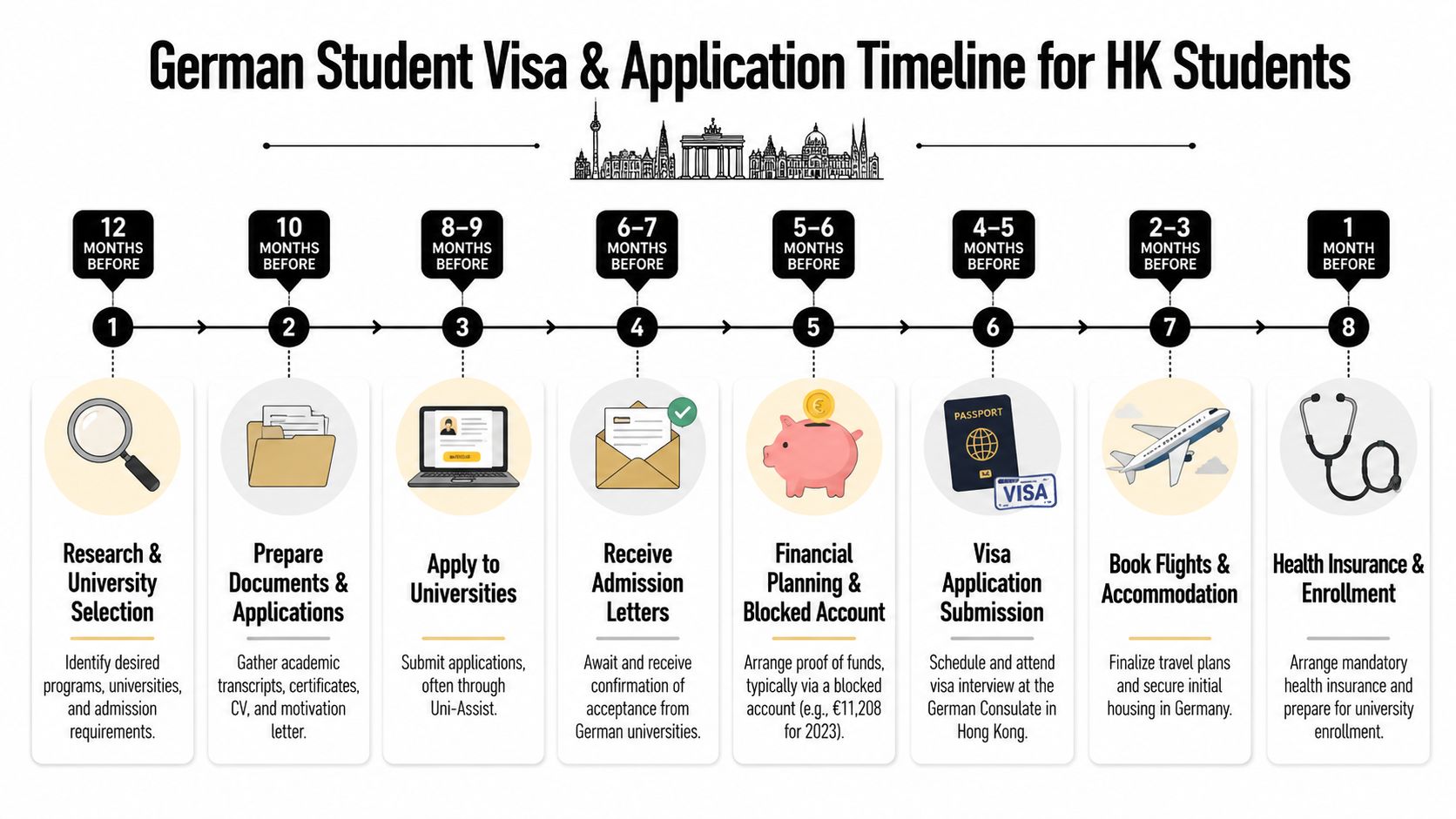
A sensible sequence for HK applicants
Use this order.
Research universities and programmes
Don't begin with city preference. Begin with admission fit and language fit.Prepare academic and language documents
Students lose time here because certification and document collection often take longer than expected.Submit university applications
Depending on the institution, this may be direct or through uni-assist.Wait for the admission decision carefully
Check email constantly and respond quickly to document requests.Arrange finances and blocked-account planning
This is one of the practical turning points in the process.Prepare visa documents for the German authorities in Hong Kong
Keep everything organised and consistent.Sort accommodation and flights
Don't wait until the last minute, especially for major cities.Complete enrolment and insurance preparation
Universities and visa processes both rely on proper documentation.
The visa file must be consistent
A weak visa file usually isn't about one dramatic mistake. It's about small inconsistencies.
Common pressure points include:
- unclear proof of funds
- missing insurance documents
- incomplete academic paperwork
- language documents that don't match the programme
- late appointment booking
If you're still comparing insurance providers, a specialised resource on student health insurance abroad can help you understand the issues to check before buying a plan.
Timing advice I give HK families
I advise students to prepare on this logic:
Early stage
Clarify programme, qualification route, and language plan.
Middle stage
Submit applications and get financial documents moving.
Late stage
Handle visa, housing, flights, and arrival logistics without panic.
This sounds obvious, but many students reverse it. They spend months debating cities, then rush language proof, then scramble for visa paperwork.
The strongest applicants aren't always the smartest. They're often the most organised.
What parents should monitor
Parents in Hong Kong can help a lot if they focus on process control rather than trying to micromanage every academic detail.
Watch these four items closely:
- Document completion
- Payment deadlines
- Visa appointment timing
- Proof-of-funds readiness
That support matters because students are often juggling school, work, exams, and applications at the same time.
My opinion on timeline discipline
If you want Study in Germany to go smoothly, treat it like a project, not a dream. Use checklists. Keep digital and printed copies. Confirm every requirement directly with the institution or official authority. The families who do this well usually feel much less anxiety by departure month.
Finding Your Feet Life Beyond Lectures in Germany
Getting admitted is only the first win. Settling in is the second.
Most HK students adapt academically faster than they adapt logistically. The pressure usually comes from housing, paperwork, and day-to-day communication, not from lectures alone.
Accommodation is often the first real shock
Students in Hong Kong sometimes assume that once they have an offer letter, everything else follows naturally. It doesn't. Accommodation can be frustrating, especially if you're trying to secure a room before arrival.
The practical housing routes usually include:
- Student dormitories
- Shared flats or WG
- Private rentals
- Short-term temporary stays while you search
My advice is blunt. Start the housing search early and stay flexible. Your first room in Germany doesn't need to be perfect. It needs to be workable.
Expect a cultural adjustment
German academic and social culture can feel more direct than Hong Kong. That's not hostility. It's normal communication style.
Students often need time to adjust to:
- Direct feedback from professors or administrators
- Strong emphasis on punctuality
- More independent problem-solving
- Less hand-holding in academic life
This is usually healthy for students. It builds confidence quickly, but only if they understand that directness isn't rudeness.
If a German administrator sounds blunt, don't personalise it. Focus on the instruction and respond clearly.
Daily life gets easier with basic German
Even for students in English-medium programmes, daily life improves when they can handle simple German interactions. Housing, registration, banking, pharmacy visits, and routine university notices all become less stressful.
This is why I tell families in Hong Kong not to frame German only as an academic requirement. It's a settlement tool.
Use university support properly
Many students don't ask for help early enough. That's a mistake.
Once admitted, use:
- international student offices
- housing support channels
- orientation services
- student advisers
- peer networks
A short email sent early can save weeks of confusion later.
Working while studying
Students often ask whether part-time work will solve their cost issues. My advice is to treat work as support, not as the foundation of your financial plan.
A new international student still needs time to:
- settle in,
- understand the local system,
- manage coursework,
- and adapt to the city.
If a student arrives with no financial buffer and expects immediate income, the pressure can become unnecessary.
The students who settle best
The students who do well in Germany usually share three habits:
- They accept that the first months are transitional
- They ask questions early
- They keep improving their German even after arrival
That combination works. Germany rewards students who are prepared, calm, and proactive.
Ready to Start Your German Journey in Hong Kong
A Hong Kong student with strong grades can still lose a full admission cycle in Germany for one simple reason. The qualification route was checked too late, and the language plan started without a clear target.
That is the point to fix first.
For Hong Kong families, a successful Germany application starts long before any university form is submitted. You need a clean DSE or IB pathway check, a realistic subject review, and a cost plan in HKD that covers more than tuition. Germany is attractive because public tuition is often low. The key decision, however, depends on whether your child can qualify directly, how much German they need, and what the full first-year setup will cost.
Parents should focus on five things:
- DSE or IB eligibility for the target university and course
- the right German exam path, based on deadlines and entry requirements
- documents prepared early, with no last-minute scrambling
- a full family budget in HKD, including blocked account funds, housing, insurance, flights, and setup costs
- a preparation timeline that starts in Hong Kong, not after arrival
Students need to be just as clear-eyed. If your current German level is low, fix that now. If your DSE subjects do not match the course requirement, address that before building a shortlist. If your family is relying on the phrase "free tuition" without calculating total spending, the plan is incomplete.
I recommend one approach. Get your academic profile assessed properly, decide whether your route is DSE-based or IB-based, then match your German study plan to the actual admission target. That may mean Goethe exam preparation. It may mean foundation-level language building first. Random self-study and generic advice waste time.
This matters even more for families comparing German lessons Hong Kong and Learn German HK options. You are not buying a hobby course. You are choosing preparation that affects admissions, visa readiness, and how smoothly the student settles after arrival.
Germany is a strong option for Hong Kong applicants. The students who benefit most are the ones who prepare locally, early, and with a plan that matches their qualifications and budget.
If you want a practical next step, speak with German Cultural Association Hong Kong(GCA). Their team can assess your current level, advise on a suitable course for university or exam goals, and help you build a realistic preparation schedule in Hong Kong through online or in-person classes near Tsim Sha Tsui and Causeway Bay.

German Food & Restaurant Guide: How to Order in German (HK & Germany)

Timetable & Fees for German Lessons in Hong Kong


