.png)
.png)

BLOG

香港德國文化協會
The German Cultural Association
Move to Austria: Your 2026 Guide from Hong Kong
You are in Hong Kong, reviewing Europe for a child's degree, your own career move, or a family reset. The usual names come first. Austria often does not. That is exactly why it deserves a closer look.
For Hong Kong families and professionals, Austria is a smart option if your goal is not just to get into Europe, but to build a workable plan. It gives you a real German-speaking environment, respected universities, and access to a stable Central European base without forcing you into the most crowded or overhyped destinations. If you are comparing pathways seriously, that mix matters.
I see the same three cases again and again. A DSE or IB student wants a German-speaking degree but needs clarity on entry requirements and language preparation. A mid-career professional wants an EU move but wants a market with substance, not noise. A family wants a practical long-term base and starts asking about visas, schools, daily life, and even buying property in Austria as part of a wider relocation plan.
Austria suits those conversations because the country rewards careful planners. Hong Kong applicants usually do better when they choose a destination that matches their exam background, budget, and language strategy from the start. Austria often fits that brief better than people expect.
It also helps to be clear about the language question early. The German you hear in Austria is not identical to the tidy, standardised German many students learn through Goethe-Zertifikat preparation in Hong Kong. That should not put you off. It should shape your preparation. Students and professionals who expect this difference usually adapt well because they train for real listening, local usage, and formal written German separately.
Austria is also not a smaller version of Germany. That comparison leads Hong Kong applicants into poor decisions. Admissions logic, daily culture, regional accents, and career pathways are different enough that you should assess Austria on its own terms.
Choose Austria if you want a serious European option tied to study, work, and long-term mobility, and if you are prepared to plan properly from Hong Kong instead of guessing your way through the process.
Your Next Chapter Could Be in Austria
A Hong Kong parent sits down after work to compare options for a child doing DSE or IB. Germany looks obvious at first. Then the practical questions start. Which system is easier to plan from Hong Kong, where does German preparation match real daily use, and where can study lead to work and long-term residence without unnecessary detours? Austria deserves to be on that shortlist early.
Austria suits Hong Kong applicants who want a German-speaking European base with clear educational and professional value. It offers respected universities, a stable public system, and realistic routes for people who are planning for study, career development, or family relocation rather than a short overseas experience.
Austria also rewards applicants who plan properly. That matters for HK families. If your child is coming through DSE, IB, or another international curriculum, or if you are a professional weighing an EU move against career risk, Austria is a country to assess on fit, not brand recognition.
Why Austria deserves a serious look
Austria's modern republic was shaped by the 1955 State Treaty and its constitutional commitment to neutrality, a point explained clearly by the Austrian Embassy in Washington. For Hong Kong readers, the point is not history trivia. It helps explain why Austria often feels orderly, restrained, and institutionally stable.
That stability carries into daily life. You see it in how public systems function, how universities are structured, and how employers assess qualifications. If you want a place where planning beats improvisation, Austria is a good match.
This is especially relevant for three groups in Hong Kong.
- Parents who want a serious European degree route and need to line up school qualifications, German level, and budget before applications open
- Students who have learned standard exam German in Hong Kong and need to prepare for the Austrian German they will hear in lectures, housing offices, and part-time jobs
- Professionals and families who want a move tied to work, education, or long-term settlement, including future questions such as buying property in Austria
What makes Austria a sensible choice
Austria is a high-income European country with enough economic weight to support serious careers and serious institutions. You do not need inflated claims to justify interest. For Hong Kong applicants, the better question is whether Austria gives you a workable path from qualification to residence to employment. In many cases, it does.
General reference sources such as Encyclopaedia Britannica's overview of Austria are more useful here than tourist-style summaries because they frame Austria as a functioning state with political, economic, and cultural depth. That is the right lens if your concern is admission standards, visa preparation from Hong Kong, and whether German study will convert into real options.
One recommendation matters more than any slogan. Start with eligibility and language, not optimism. If Austria is your target, check whether your academic background fits the entry route, build your German for both formal and real-life use, and prepare documents early. Families and professionals who do that from Hong Kong usually make far better decisions.
Why Should Hong Kongers Consider Austria
A Hong Kong family usually starts with the obvious names. UK. Australia. Canada. If the goal is German-speaking Europe, they jump to Germany. That misses a very workable option.
Austria deserves serious attention if your plan is tied to education, career mobility, and long-term quality of life. For Hong Kong students, parents, and professionals, the attraction is not postcard Europe. It is a country where German matters, public systems function, and the path from study to work can make practical sense.
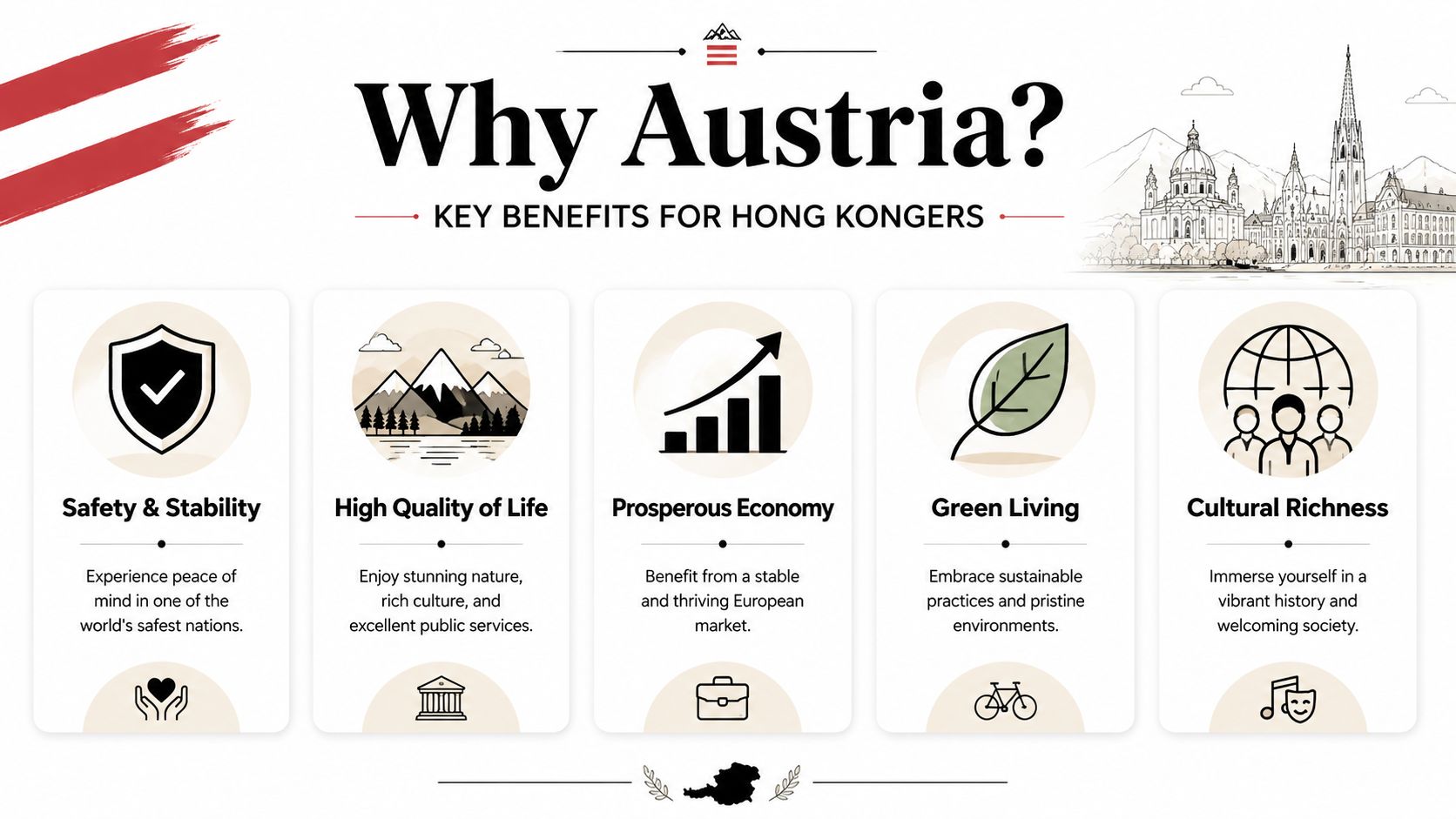
The case for Austria in plain terms
Austria gives Hong Kongers something many destination lists fail to offer. Balance.
It is established enough to offer respected universities, serious employers, and a stable everyday environment. It is also manageable. Families who find Germany too large, too decentralised, or too noisy as a planning exercise often find Austria easier to assess city by city and institution by institution.
That matters in Hong Kong, where families usually make overseas decisions with a clear return in mind. If you are paying for language study, document preparation, and relocation, you want a country that can convert effort into real options.
Austria also sits inside the wider European framework, which gives its degrees and work experience broader relevance. That is one reason Austria belongs on the shortlist alongside bigger-name destinations, as outlined in Britannica's Austria overview.
What actually makes Austria attractive for Hong Kongers
German that leads somewhere
Austria is an official German-speaking country. That gives your German study direct academic and professional use. For Hong Kong learners, one issue needs to be clear from the start. The German you hear in Austria will not always sound like the clean, standard audio used in exam classrooms. If you are preparing seriously, compare exam pathways early through this guide to Goethe-Zertifikat and TestDaF options for Hong Kong learners.A credible economy for long-term plans
Austria is not a symbolic European address. It is a real place to build a qualification, gain work experience, and develop a professional profile that carries weight beyond one city.A strong everyday environment
Hong Kong parents usually ask the right question. What will daily life actually feel like for a student or young professional? Austria appeals because it combines order, public infrastructure, and a standard of living that supports focused study and stable routines.Less crowd, less hype, more planning clarity
Austria gets less attention than Germany or the UK. That can work in your favour. You are not choosing a destination for social media recognition. You are choosing one for fit.
Austria can suit some Hong Kong goals better than Germany
I often tell clients to stop treating German-speaking Europe as a one-country decision.
Austria may be the better choice if you want a tighter planning process, a smaller and more readable system, and a German-speaking environment that still gives you serious academic and career value. For some Hong Kong students, that is more useful than chasing the biggest market without checking whether they can handle the admission route, language pressure, and relocation demands.
Austria is especially worth considering if your goal is one of these:
- A disciplined route into higher education
- A strong living environment for study and family life
- German that works in real institutions, not only in exam settings
- A European base with cultural depth and practical mobility
You also need to understand the Austrian version of German
Hong Kong learners often prepare with textbook Standard German and assume that is the whole story. It is not.
In Austria, you will hear Austrian vocabulary, regional pronunciation, and local habits of speech in daily life. Lectures, housing conversations, admin offices, internships, and part-time jobs may all feel different from Goethe listening exercises. That should not scare you off. It should shape your preparation.
Austria is a smart choice for Hong Kongers who want German for actual use. Go in with open eyes, train for the language you will really hear, and Austria becomes far more than an alternative to Germany. It becomes a practical target in its own right.
University Pathways for Hong Kong Students
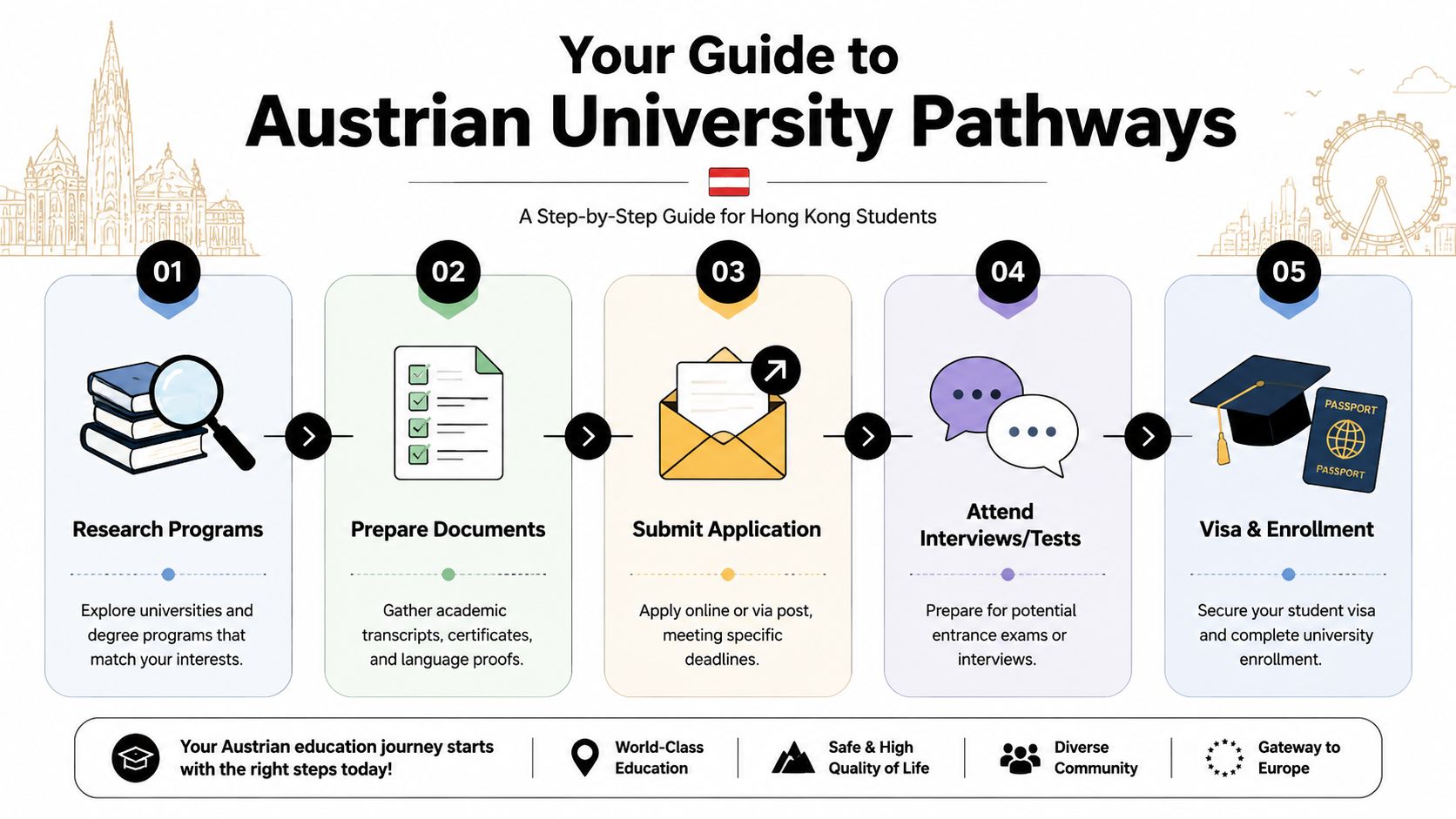
For Hong Kong students, Austria can be a smart university destination, but only if you treat admission as a sequence, not a wish. The order matters. Academic eligibility first. Language proof second. Document preparation third. Visa execution after that.
Start with the qualification match
If you're coming from DSE, IB, or IGCSE/A-level routes in Hong Kong, don't assume your school credential automatically maps cleanly into Austrian university entry. Some students may qualify more directly. Others may need extra preparation or a bridging route.
That's why I tell parents not to ask, “Can my child study in Austria?” Ask this instead:
- Is the secondary qualification recognised for the intended degree route?
- Is the subject background strong enough for the chosen programme?
- Will the student need preparatory study before full entry?
In some cases, students may need a Vorstudienlehrgang, which is a preparatory pathway before normal degree enrolment. That isn't a setback. It's often the right route if the academic or language gap needs closing properly.
German is usually the gatekeeper
Most HK families underestimate this point. The obstacle usually isn't interest. It's German proficiency.
For many Austrian university pathways, you should expect German to be central for admission, lectures, administration, and everyday survival. Students often ask whether they can “apply first and learn later”. That's risky. If your German is weak, your whole timeline becomes fragile.
A structured exam plan matters here. If you need a clearer breakdown of exam formats and which paper may fit your path better, this guide on Goethe-Zertifikat versus TestDaF options is worth reviewing early.
Admissions advice: Don't treat German as an accessory to the application. In many Austria cases, German is the application.
Austria's education profile also supports the case for academically serious students. In 2023, 29.3% of tertiary students were enrolled in STEM, above the EU average of 26.9%, and 64.7% of Austrians had basic digital skills, above the EU average of 55.6%, according to the Education and Training Monitor country report for Austria. The same report notes that 39% of students were low performers in computer and information literacy. That gap matters. It suggests that motivated international students who arrive well prepared can compete effectively, especially in structured academic environments.
Here's a useful overview video to help you picture the university route more concretely:
A practical application roadmap
I advise HK students to work backwards from the intended intake.
| Stage | What you should do |
|---|---|
| Programme selection | Choose by language of instruction, subject fit, and entry rules |
| Academic file | Prepare transcripts, certificates, and any supporting documents early |
| Language file | Build a German exam plan that matches the university's expectation |
| Document control | Check translations, certifications, and submission requirements carefully |
| Visa stage | Only move to visa execution after academic and language items are stable |
Where ambitious students should focus
Austria is especially relevant if your child is targeting:
- STEM-related programmes
- Technical or applied fields
- German-medium university life
- A structured European degree path with strong discipline
Parents in Hong Kong often want certainty. Austria won't give you certainty without effort, but it does reward organised students. That's why the strongest applicants usually have three things in place early:
- A realistic programme target
- A serious German study plan
- A document timeline that doesn't collapse at the last minute
If your child is in secondary school now, don't wait for final-year panic. Build the German base early, especially if the long-term target is Austria rather than just “Europe somewhere”.
Visa and Relocation Basics from Hong Kong
Your child gets an offer from Austria. The excitement lasts one day. Then the serious work starts. Residence paperwork, insurance, proof of funds, housing, and German exam timing can derail the plan fast if you treat them as admin tasks instead of a controlled process.
For Hong Kong families and professionals, Austria usually comes down to two workable routes. One is the student residence permit. The other is a work-based route, often linked to the Red-White-Red Card system for qualified employees and certain family situations. Pick the route early, then build the file around it. Do not mix assumptions from one route into the other.
Student route from Hong Kong
For students, Austria wants to see a credible study plan and a complete residence file. Good intentions do nothing here. Documents do.
Prepare these items first:
Admission basis
You need a formal university offer, or the academic documentation that supports your admission status.Proof of funds
Show clearly how tuition, rent, food, and daily costs will be covered.Health insurance
Check whether your policy is acceptable for the residence application and for the period immediately after arrival.Accommodation evidence
A hostel booking is weak. A proper rental arrangement or confirmed student housing is much safer.Language preparation
This matters more than many HK applicants expect. Austrian universities may accept a standard German certificate for entry or conditional entry, but daily life in Austria will expose you to Austrian German forms, accent differences, and administrative vocabulary that feel different from the Goethe-style German taught in exam prep classes.
That last point matters for DSE and IB families. A certificate gets the file moving. It does not guarantee that your child can handle registration offices, dorm contracts, part-time work conversations, or university life in Austrian German. Choose the exam with the actual next step in mind, not just the fastest pass route. If you need a practical overview of certificate options before deciding, read Examberg's German certificate guide.
Work route for Hong Kong professionals
Austria remains relevant because it has a clear need for qualified people in selected fields, especially applicants who bring usable skills and can present a disciplined application. That does not mean easy approval. It means serious candidates have a case if their profile matches employer demand.
Ask yourself four blunt questions:
- Is your degree or professional training relevant to the role?
- Do you have an employer, offer, or defensible hiring case?
- Can you function in German, or is the role realistically English-first?
- Can you submit a clean file without missing documents or inconsistent details?
If any answer is weak, fix it before you apply.
The mistakes Hong Kong applicants make most often
The first mistake is getting the offer first and planning the language later. That approach causes problems for both students and working adults. Even if the initial residence step does not demand high-level German, university administration, local registration, apartment contracts, and many workplaces will.
If you still need to sort out exam logistics in Hong Kong, including dates, fees, and registration steps, use this guide to German proficiency test registration and fees in HK before you set your submission timeline.
The second mistake is sloppy document handling. Austria is strict about consistency. Names must match across passports, transcripts, bank documents, and translated records. Dates, notarisation requirements, and certified translations need checking line by line. Small mismatches create delays that feel avoidable because they are.
The third mistake is underestimating timing. From Hong Kong, several tracks run at once. University or employer paperwork, German proof, financial preparation, visa processing, and housing all move on different clocks. If one slips, the whole relocation plan shifts.
Use a simple rule. If a document might be requested, prepare it early. If a translation might be required, confirm the standard before you pay for it. If your child plans Austria seriously, treat relocation as a project with deadlines, not as something to sort out after results day or after a contract arrives.
Austria works well for organised Hong Kong applicants. The people who succeed are rarely the most adventurous. They are the ones who prepare early, submit clean files, and understand that a move to Austria starts long before the flight.
Career and Business Opportunities in Austria
A Hong Kong professional who wants Europe but does not want to disappear into a crowded job market should look at Austria seriously. It gives you access to a stable, export-oriented economy, strong technical industries, and a business culture that respects qualifications, process, and reliability. For HK families thinking long term, that combination matters.
Where the opportunity is strongest
Austria makes sense for people who can bring clear commercial value. The strongest fits are usually in sectors tied to manufacturing, engineering, digital systems, logistics, life sciences, hospitality management, and cross-border trade. Vienna attracts international firms and regional headquarters, but opportunity is not limited to Vienna. Industrial and specialist roles often sit in other cities and regions, which can mean less competition and a more realistic path into the market.
For Hong Kong candidates, that matters more than prestige alone. If your background includes supplier management, technical sales, compliance, operations, procurement, finance support, customer success, or project coordination, Austria can be a practical move rather than a purely academic idea.
Good fits for Hong Kong professionals
Austrians hire for competence first. They also expect you to understand how work is documented, communicated, and delivered.
ICT and digital services
Software support, systems implementation, enterprise tools, cybersecurity support, technical documentation, and B2B digital operations all have relevance.Engineering and technical roles
Mechanical, industrial, electrical, and process-oriented experience travels well if your credentials are clearly presented and your German is usable.Trade, logistics, and operations
Hong Kong professionals with import-export, shipping coordination, sourcing, quality control, or supplier communication experience often have transferable strengths.Finance, administration, and business support
Back-office precision counts in Austria. Reporting, invoicing, client coordination, documentation, and multilingual support can lead to steady career progression.Hospitality and service management
Austria's tourism sector is mature and demanding. Candidates with structured hotel, events, or service management experience can find openings, especially if they speak German.
English opens the door. German gets you hired properly.
HK applicants often overestimate how far English will carry them. In Austria, English can help in multinational firms, graduate environments, and selected tech teams. German still shapes day-to-day credibility, promotion prospects, and how much responsibility you can take on.
Use this as your rule:
| Career goal | What employers usually expect |
|---|---|
| Get interviews | A strong CV, clear qualifications, and at least some German for many local roles |
| Work smoothly with colleagues | German for internal updates, meetings, and informal coordination |
| Handle clients or suppliers | German improves trust and reduces friction |
| Move into management | Local language ability and cultural fluency usually matter |
If your spoken German is hesitant, fix that early. Reading exam texts is not enough. Meetings, introductions, phone calls, and workplace small talk decide whether you come across as employable. Spend time on mastering German speaking confidence before you start applying.
Don't send a Hong Kong CV unchanged
When applying to Austrian employers, many strong candidates lose momentum. Austrian employers expect a more local presentation style. Your CV needs tighter formatting, clearer role descriptions, and direct evidence of responsibility. Generic claims, vague achievements, and overly broad job titles weaken your application fast.
I recommend three practical adjustments:
- Translate your experience into Austrian employer priorities. Show process, results, systems used, reporting lines, and industry context.
- Prepare a German version of your CV if the role calls for it. Even if the interview starts in English, the document often shapes first impressions.
- Match your language level to the role accurately. Claiming more German than you can practically use creates problems the moment you reach interview stage.
If you need help understanding workplace expectations before the move, this guide to German culture and business etiquette for professionals is worth reading.
Starting from Hong Kong
For candidates still in Hong Kong, German study should be tied to a career target, not treated as a hobby. The German Cultural Association Hong Kong(GCA)offers German courses, exam preparation, business-focused training, small-group classes, and one-to-one lessons. That is useful if your goal is employment, university progression into work, or a long-term move to Austria.
My advice is straightforward. If Austria is part of your career plan, treat German as a job tool, your CV as a localised document, and your sector fit as the main decision point. That is how Hong Kong applicants turn Austria from an interesting option into a workable move.
Navigating Austrian Culture and Language
Your child passes Goethe exams in Hong Kong, lands in Vienna or Graz, then freezes in the first bakery, student office, or casual conversation because the German sounds different from the audio tracks used in class. That is a common problem. It is also manageable if you prepare the right way.
For Hong Kong families and professionals, the key point is simple. The German you study for DSE support, IB planning, Goethe-Zertifikat exams, university entry, or work applications is still the correct starting point for Austria. Austrian German includes regional accents, local expressions, and a different rhythm, but formal writing, university communication, and most workplace communication still rely on standard German.
Start with the version of German that travels well.
Standard German first. Austrian variation second.
I strongly recommend this order because it saves time and reduces confusion. If you build grammar, sentence control, reading ability, and formal vocabulary first, you can adjust to Austrian speech much faster after arrival. Students from Hong Kong who chase dialect too early usually end up with weak fundamentals and poor listening control.
A more realistic expectation is this. Your exam-prep German and the Austrian German you hear on the ground are related, not identical. In class, you usually hear clearer pronunciation and more standardised vocabulary. In Austria, you will hear local wording in shops, everyday conversations, and regional settings, especially outside highly international environments.
That does not mean your preparation was wrong. It means real life is less tidy than an exam paper.
What Hong Kong learners usually notice first
The biggest differences tend to show up in daily interaction, not in official documents.
You may notice:
- Regional accents that sound softer, faster, or less familiar than textbook recordings
- Austrian vocabulary in food, public services, and casual conversation
- A more formal social style in greetings, titles, and first meetings
- A different conversational rhythm that can make listening feel harder at the start
This matters for HK learners because many are trained to prioritise accuracy over response speed. In Austria, you need both. If you understand the grammar but hesitate every time someone speaks naturally, everyday tasks become tiring very quickly.
What to do before you arrive
Use a three-part preparation plan.
Build standard German that you can use
Aim for dependable speaking, listening, and writing, not passive recognition. If you can only do exercises but cannot ask questions, clarify a problem, or respond under pressure, your level is not yet practical.Train with more than one voice and accent
Stop relying on one teacher, one app, or one exam audio style. Listen to speakers from different German-speaking backgrounds so your ear becomes more flexible.Learn social rules together with the language
Austria usually expects more formality than Hong Kong learners first assume, especially in administration, education, and professional settings. Names, greetings, polite requests, and tone all matter. This practical guide to German culture and business etiquette for professionals will help you avoid very predictable mistakes.
Do not wait for perfect German before speaking
Many Hong Kong learners slow themselves down. They keep revising grammar and avoid real conversation because they do not want to sound wrong. That habit creates a bigger problem later. You become good at studying German and bad at using it.
If Austria is your target, start speaking early. Ask short questions. Repeat sentences aloud. Practise repair phrases such as asking someone to slow down or explain a word. Learners who need help with hesitation can read this article on mastering German speaking confidence for practical speaking habits.
You do not need to master Austrian dialect before the move. You need clear standard German, stronger listening tolerance, and enough confidence to function from your first week in Austria. That is the preparation that helps Hong Kong students, parents, and professionals settle in with less stress.
Ready to Start Your Austrian Journey?
Austria rewards people who prepare properly. That's the main takeaway.
If you're in Hong Kong and your goal is Austria, you're usually dealing with one of three pressure points. University entry, career transition, or relocation readiness. Each one depends heavily on German, document discipline, and realistic planning.

Match the course type to the goal
If you're serious, don't choose classes randomly. Match the training to the actual outcome you need.
For university applicants
You need exam-oriented German with a structured path toward recognised certification and strong reading, writing, and listening control.For working professionals
You need business vocabulary, meeting language, formal email writing, and enough speaking ability to function under pressure.For families planning a move
You need practical everyday German. Housing, transport, school communication, healthcare basics, and administrative language all matter.For teenagers in HK schools
If your child is following DSE, IB, IGCSE, or A-level planning, start early. Last-minute German rarely produces calm results.
What a sensible preparation setup looks like
The strongest outcomes usually come from a combination of:
| Need | Recommended preparation |
|---|---|
| Exam target | Structured syllabus and regular mock practice |
| Weak speaking confidence | Small-group interaction or one-to-one speaking drills |
| Busy work schedule | Flexible online lessons with fixed accountability |
| Teen planning | Long-term build-up instead of short-term cramming |
Often, generic tutorial setups fall short. Austria planning often requires more than casual vocabulary lists. You need progression, correction, and a teacher who can connect the language to actual use cases.
My direct recommendation
If Austria is on your radar, start your German plan before you finalise the rest. That sounds backward to some families, but it isn't. Language ability influences university options, visa strength, and career credibility.
A structured, native-led programme is usually the most sensible route for serious learners in Hong Kong because it gives you:
- Consistent progression
- Clear exam preparation
- Better speaking correction
- A realistic timeline instead of guesswork
Don't wait until an admissions deadline or job offer forces panic. Austria is a strong destination, but it favours applicants who act early and prepare thoroughly.
Your Austria plan becomes much easier once your German stops being the weak link.
If you're a parent, make the language decision early. If you're a professional, tie German to your career plan, not to a hobby mindset. If you're an adult learner preparing for relocation, focus on structured progress and practical speaking from the start.
If you want a clear, local starting point in Hong Kong, German Cultural Association Hong Kong(GCA) offers German courses for adults, teenagers, and children, including exam preparation, Business German, Travel German, small-group classes, and private lessons. If your goal is Austria for study, work, or relocation, book a trial class, speak with an advisor, or check the latest course schedule and start with a plan that matches your timeline.

German Lessons for Kids 2026/27: New School Year Classes for Ages 3-12

German Playgroup Hong Kong 2026/27: New Term Classes for Ages 1-4


