.png)
.png)

BLOG

香港德國文化協會
The German Cultural Association
After-School Classes for Primary Kids in HK: Ages 6-12 Compared (Languages)
Your child finishes school at 3 pm. By 6 pm, you're already comparing Putonghua, French, Spanish, German, online classes, tutorial centres, and weekend camps, while trying to work out which one is worth the time and money. This is the core challenge for Hong Kong parents. There are too many options, too little clarity, and a lot riding on the choice.
If you're searching for after-school classes for primary kids in HK: ages 6-12 compared (languages), don't treat language learning as a decorative extra. In Hong Kong, the right language class can support future IB, IGCSE, A-level, and even study abroad in Germany pathways. The wrong one burns time, drains motivation, and gives you very little to show for it.
A quick comparison helps. The table below gives the strategic view first, before we get into age fit, curriculum, cost, and exam pathways.
| Language | Best fit in Hong Kong | Main strength | Main caution |
|---|---|---|---|
| Mandarin | Families prioritising local and Greater China relevance | Practical daily and academic relevance in HK | Many classes focus on repetition rather than confident communication |
| English | Children who need stronger literacy and academic confidence | Direct relevance for school performance | Generic tuition can become worksheet-heavy |
| French | Families targeting classic European language pathways | Strong cultural and academic prestige | Some programmes stay too conversational for long-term exam use |
| Spanish | Families wanting a widely used global language | Broad international usefulness | Quality varies widely across centres |
| German | Families thinking long-term about exams and overseas university routes | Clear exam pathway and strong relevance for study abroad in Germany | Needs proper structure early, not casual exposure only |
| Japanese | Children motivated by culture and media | High engagement for many children | Motivation alone doesn't build literacy |
| Korean | Children drawn to pop culture and contemporary media | Strong initial interest | Interest can fade if curriculum lacks progression |
Table of Contents
- The practical comparison parents need
- Mandarin
- French and Spanish
- German
- Don't ignore motivation, but don't worship it
- What younger primary learners need
- Why the age 8 to 9 transition decides later progress
- What older primary learners should be doing
- The red flags parents should not ignore
Choosing the Right After-School Class in a Sea of Options
A lot of parents make the same mistake. They choose the class that seems most convenient this term, not the one that still makes sense five years later.
That's understandable. Hong Kong parents are juggling school calendars, helper schedules, MTR logistics, homework, and dinner. Keeping everything organised matters, which is why a practical tool like this guide for busy parents managing family documents can help when you're coordinating classes, school forms, and activity records in one place.
The financial pressure is real too. In Hong Kong, the median household with school-age children spent between HKD 4,500 and HKD 9,800 per month per child on out-of-school enrichment activities in 2025, including language tuition, according to this Hong Kong enrichment spending report. That means language classes aren't a casual add-on. They sit inside a serious household investment.
Practical rule: If you're paying at Hong Kong enrichment-market levels, don't settle for a class that offers entertainment without progression.
What parents usually see first
Most class listings look similar:
- Fun activities: Songs, games, crafts, role-play.
- Convenient timing: After school, Saturday morning, holiday intensive.
- Broad promises: Confidence, exposure, interest, enjoyment.
- Flexible format: In person, online, or hybrid.
None of that is wrong. It's just incomplete.
What ambitious parents should look for instead
You need to ask harder questions:
- Does this class build toward reading and writing, or stay at exposure level?
- Will the curriculum still make sense when my child enters upper primary or secondary school?
- Can this language support future IB, IGCSE, or overseas university goals?
- Is the class structured enough to justify the time and cost?
For after-school classes for primary kids in HK: ages 6-12 compared (languages), the primary concern isn't which language sounds impressive. It's whether the class gives your child a usable academic pathway.
Why Start a Second Language in Primary School
Starting a second language in primary school works best because children build sound recognition, speaking confidence, and early literacy foundations before secondary school pressure kicks in. In Hong Kong, that early start matters most when the programme moves from playful exposure into organised reading, writing, and exam-relevant progression.
Parents often treat primary language learning as an optional bonus. I don't agree. In HK, it's a strategic move when it's done properly.
The broader environment already points in that direction. The government's School-based After School Care Service Scheme expanded to cover all 18 districts in the 2024/25 school year, offering about 6,000 service places, which shows a growing institutional focus on structured after-school support for primary students, as stated in the official Hong Kong government announcement.
Why the timing matters
Ages 6 to 12 are not one single stage. But across these years, children are still open enough to absorb pronunciation naturally, while being mature enough to build routines.
That combination matters in Hong Kong because older students quickly become trapped by exam pressure. Once a child hits the heavy-load years, parents start prioritising school assessments, English writing, Chinese dictation, maths drills, and interview preparation. A second language often gets squeezed out unless the foundation is already there.
The HK advantage of starting early
For children aiming at IB or IGCSE schools, early language learning can do more than add a line on a profile.
It can help with:
- Academic stamina: Children get used to handling another symbolic system.
- Listening discipline: They learn to attend to sound and meaning closely.
- Cultural range: They become more comfortable with unfamiliar contexts and ideas.
- Future flexibility: Secondary subject choices become easier when the language base already exists.
A child who starts early doesn't need a miracle later. They need continuity.
What not to do
Don't confuse early start with random exposure.
A child who spends years on songs, flashcards, and holiday workshops without a literacy bridge often looks “engaged” but can't read, write, or build sentences independently. That's where many programmes fail parents. They sell a pleasant experience instead of a real learning sequence.
For families looking at Learn German HK options or any serious European language pathway in Hong Kong, primary years should be used to build momentum, not just interest.
Comparing Popular Language Choices in Hong Kong
Different languages serve different family goals. Don't choose by trend. Choose by what your child may need later.
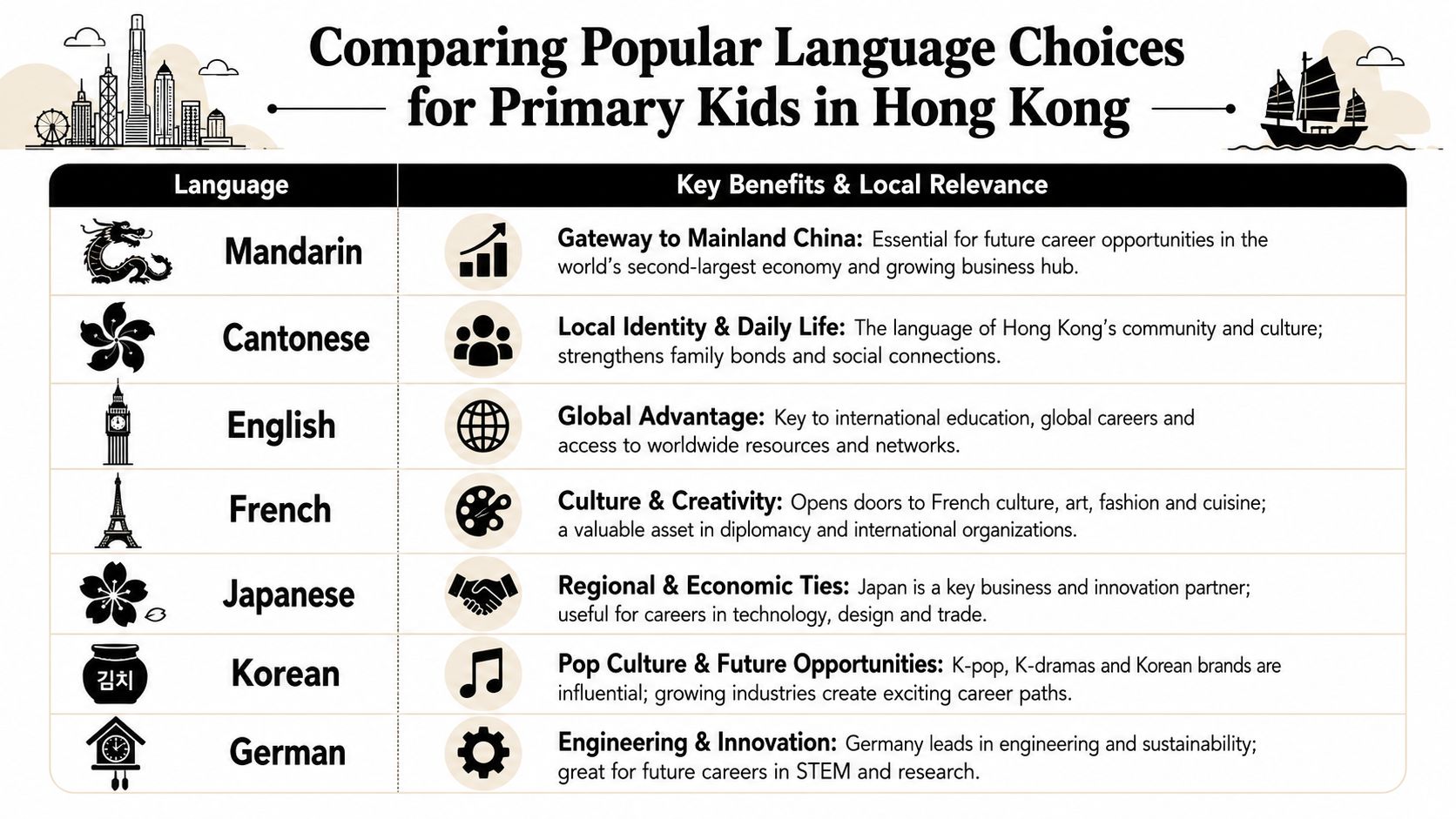
The practical comparison parents need
| Language | Long-term value in HK | Best for | Watch out for |
|---|---|---|---|
| Mandarin | Strong local relevance | Families wanting school and business usefulness | Overemphasis on drills |
| French | Traditional academic prestige | International-school families | Weak progression in some casual classes |
| Spanish | Broad global reach | Families wanting a widely useful European language | Can become hobby-level only |
| German | Strong for exam pathways and study abroad in Germany | Families with academic long-range planning | Needs structured teaching early |
Mandarin
Mandarin is the most obvious option for many Hong Kong families. It has immediate local relevance and clear long-term usefulness.
But the market is crowded, and quality is uneven. Many classes focus on memorisation and performance rather than genuine communication and literacy. If you choose Mandarin, make sure the class is doing more than dictation-style repetition.
French and Spanish
These two usually appeal to parents who want a European language with international recognition. That's reasonable.
French often carries stronger traditional academic prestige. Spanish usually feels more approachable and widely applicable. Both can be excellent if the programme has proper progression. Both can also become soft extracurriculars with very little academic payoff if the curriculum stays too casual.
German
German is the strategic choice that many HK parents overlook until much later.
If your family is thinking about IGCSE, IB, A-level, or future study abroad in Germany, German deserves early consideration. The key advantage isn't that German is “better” in some vague sense. It's that German often sits inside a clearer exam and academic pathway when the teaching is structured properly.
Don't ignore motivation, but don't worship it
Japanese and Korean often attract children quickly because the culture feels familiar and exciting. That initial motivation can be useful.
Still, motivation alone won't carry a child through reading, writing, and long-term study. The strongest language choice is the one that matches both your child's interest and your family's educational direction.
If your child loves the language but the class has no pathway, you have enthusiasm without traction.
For German lessons Hong Kong searches in particular, parents should assess whether the programme links primary learning to later certification and school-based exam demands. That's where German becomes a serious asset rather than a niche hobby.
Curriculum Differences Ages 6-8 vs Ages 9-12
A seven-year-old who sings songs in German can look impressive. A ten-year-old who can read, write, and answer in full sentences is the child with real long-term options.
That distinction matters more than many Hong Kong parents realise. Primary language classes should not just keep children engaged after school. They should build the habits that later support IB, IGCSE, A-level, and overseas university pathways. If a centre treats ages 6 to 12 as one broad “kids programme”, expect weak progression.
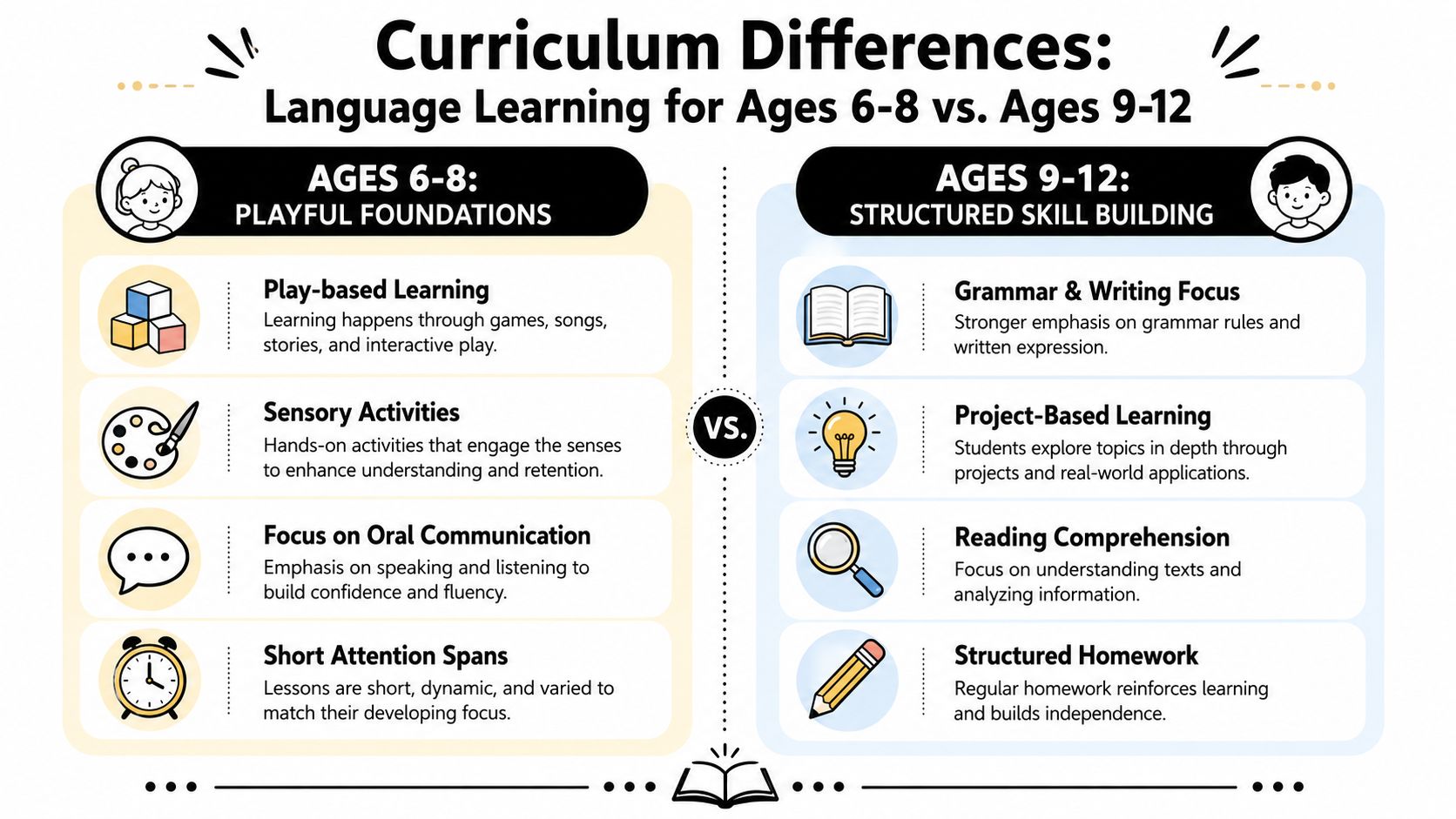
What younger primary learners need
Ages 6 to 8 need movement, repetition, sound work, and tight lesson pacing. They do not need endless worksheets. They also should not stay stuck in pure entertainment.
A good curriculum at this stage usually includes:
- Sound and alphabet training: Children should hear clearly, copy accurately, and distinguish unfamiliar sounds early.
- Short oral routines: Greetings, questions, simple classroom language, numbers, colours, food, family, and daily life topics.
- Story and pattern repetition: Stories, chants, and guided repetition build memory faster than random vocabulary drilling.
- Early reading links: Children should start matching spoken words to letters and common spelling patterns.
- Simple written output: Copying, labelling, filling gaps, and short phrase writing should begin early enough to prevent a later literacy gap.
That last point is where many programmes fail. If a child spends years only singing, pointing, and repeating, Primary 4 becomes the moment everything slows down.
Why the age 8 to 9 transition decides later progress
By around age 8 or 9, the programme should shift from exposure to controlled production. This is the turning point.
Children should begin linking sound to print reliably, reading short texts without panic, and writing simple sentences with guidance. That is what turns a pleasant extracurricular into a subject they can continue seriously in secondary school. It is also what makes later exam preparation far less painful.
Parents often misread the problem here. They assume the child has lost interest or lacks language ability. In many cases, the curriculum delayed reading and writing for too long.
The right primary curriculum moves a child from hearing words, to recognising them, to using them independently on the page.
What older primary learners should be doing
Ages 9 to 12 can handle much more structure. They still benefit from games, projects, and speaking tasks, but the curriculum now needs clear academic bones.
Look for five things.
Sentence building
Children should produce answers, descriptions, and short conversations independently. Repetition alone is no longer enough.
Reading fluency
They should read short paragraphs, identify meaning from context, and spot recurring grammar and spelling patterns.
Foundational grammar
They need practical grammar that supports accuracy. Word order, verb forms, articles, and agreement should be taught in usable chunks.
Guided writing
Short descriptions, routines, preferences, and personal responses matter because they train the exact skills children later need in exam-style tasks.
Regular correction
Speaking without correction builds bad habits. At this age, children still adapt quickly if teachers correct pronunciation, sentence form, and written errors consistently.
This is also the age where parents should start asking harder questions about pathway and cost. A class that remains vague at Primary 5 or 6 usually stays vague later. Use a clear guide to German course prices in Hong Kong to compare whether you are paying for structured progression or just supervised activity.
The red flags parents should not ignore
Be wary if a centre offers the same cheerful format to a six-year-old and an eleven-year-old. That usually signals weak curriculum design.
Common warning signs include:
- No level map across primary years
- No reading benchmark by middle primary
- No writing expectation by upper primary
- No correction policy
- No clear route into secondary-level study or recognised exams
For ambitious Hong Kong families, the dividing line is simple. Ages 6 to 8 should feel lively and well-scaffolded. Ages 9 to 12 should feel increasingly disciplined, literate, and academically useful.
That is how a language class starts contributing to future school choices instead of becoming one more expensive hobby.
How Much Do After School Language Classes Cost in HK
Cost matters. But in Hong Kong, parents often ask the wrong question.
The right question isn't “What's the cheapest class?” It's “What exactly am I buying, and does it lead anywhere?” If you want a better sense of the pricing situation, this guide to German course prices in Hong Kong is a useful starting point for comparing formats and expectations.
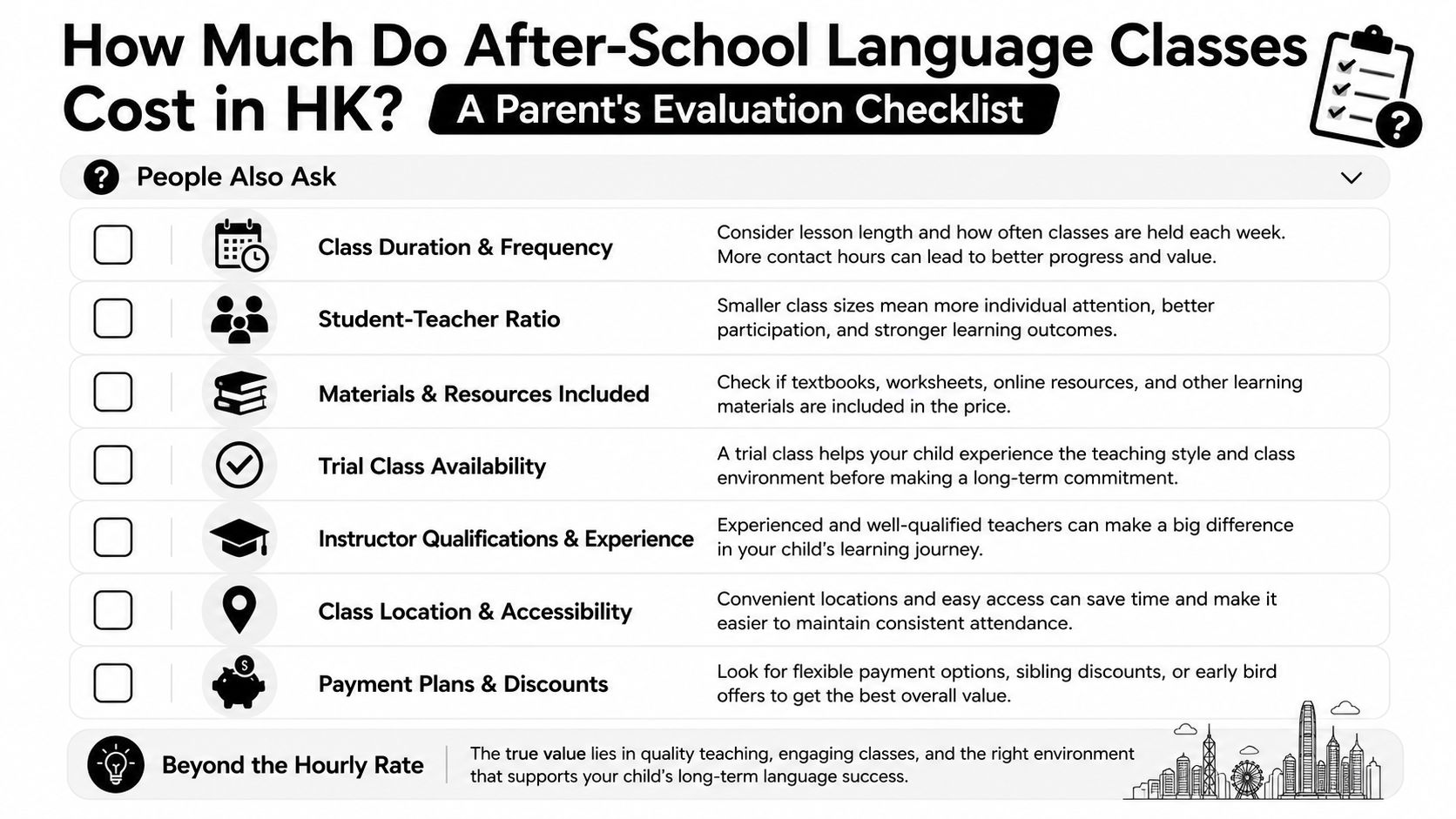
A critical benchmark is class size. A small-group cap of 6 students correlates with over 90% of students ranking in the top 10% of public examinations and a 96% recommendation rate when paired with CEFR-aligned progression and native-speaker feedback, according to this Hong Kong parent checklist for German classes.
What you're really paying for
Parents usually focus on hourly rate. That's too narrow.
You're paying for five separate things.
Teaching quality
Native-speaking teachers matter more in languages where pronunciation, natural phrasing, and oral correction are central. If a child is learning inaccurate patterns every week, a cheaper class becomes expensive in the long run.
Student-teacher ratio
This is one of the easiest quality filters. In language learning, a child must speak, be corrected, and speak again. If there are too many children in the room, that won't happen enough.
Curriculum structure
Ask whether the programme is organised around levels, literacy goals, and a recognised progression system such as CEFR. If the answer is vague, the curriculum is usually vague too.
Format and scheduling
In-person classes are often easier for younger children. Hybrid or Zoom can work well when the sessions stay interactive and the group stays small. Busy HK families should care about rescheduling rules too, because timetable friction kills consistency.
Future usefulness
Some classes are enjoyable but disconnected from any later exam or school pathway. Others subtly build toward Goethe-Zertifikat, IGCSE, IB, or future study plans.
A practical checklist before you enrol
Take this list to every trial class.
Ask who teaches the class
Is the teacher a native speaker? Can they explain how they correct pronunciation and sentence errors?
Ask how many children are in the group
Don't accept fuzzy answers like “small class”. Ask for the actual cap.
Ask what happens at ages 9 to 12
If the centre only talks about games, songs, and confidence, it may not have a serious upper-primary curriculum.
Ask how progress is tracked
Strong centres track reading, listening, speaking, and writing separately.
Ask about exam pathways
Even if your child is still young, the centre should be able to explain what the next stages look like.
Ask about location
In Hong Kong, convenience matters. A good centre near Tsim Sha Tsui or Causeway Bay can make weekly consistency much easier.
Parent filter: If a centre can't explain its pathway clearly in two minutes, it probably isn't structured well enough.
One factual example worth noting is German Cultural Association Hong Kong(GCA), which offers native-speaker teaching, small-group classes capped at 6, and structured progression with exam preparation options. That combination is the kind of benchmark serious parents should use when comparing any language centre in HK.
Decoding the Exam Pathway from Primary to University
Most parents think about language classes term by term. Schools and universities don't.
They look at the accumulated result. Can the student handle assessed reading, writing, listening, and speaking? Can they sit formal exams? Can they use the language for future academic mobility?
The pathway most parents miss
If your child starts a language at age 7 or 8, the goal isn't immediate certification. The goal is to build clean progression so that secondary school options stay open.
For German, that pathway often moves through:
Primary stage
Build sound accuracy, literacy, simple writing, and regular speaking habits.
Lower secondary stage
Consolidate grammar, reading comprehension, and controlled written output.
Upper secondary stage
Prepare for IGCSE, IB, A-level, or external certification such as Goethe-Zertifikat.
Post-secondary stage
Use those results to support university applications or preparation for study abroad in Germany.
A useful planning benchmark exists. In Hong Kong, introductory German courses aimed at A1 typically require 120 total hours of instruction, as shown in this HKU Space introductory German course outline. Parents need that reality check. Serious progress takes organised time.
What a realistic long-term plan looks like
Don't promise yourself that a child can drift through casual classes and “become fluent later”. That almost never works.
A more sensible path looks like this:
- Start early enough to normalise the language
- Shift into reading and writing before upper primary
- Choose a centre that understands exam sequencing
- Keep the routine consistent across school transitions
For families who like to see how exam preparation materials are structured in other language contexts, this K-12 Russian exam prep resource is a useful reminder that assessed language learning always depends on staged skills, not random exposure.
If your child may eventually choose German in secondary school, this guide on whether German is the right DSE-related language choice for Hong Kong students is worth reading early, not at the last minute.
Ready to Give Your Child a Head Start in German
Your child is seven, coping well in English and Chinese, and you are already hearing other parents talk about IB subject choices, IGCSE options, and overseas university plans. This is the point to stop treating language classes as casual enrichment. German should be chosen only if you want a subject that can grow into a real academic asset later.
A good German programme gives a primary-school child three things early. Clear pronunciation, confidence speaking in full sentences, and steady progress into reading and writing. That sequence matters. Children who only sing songs and memorise greetings often stall by upper primary, right when stronger learners start handling formal assessment and subject-based vocabulary.
Use a simple filter before you book anything:
- Teacher quality first. Native or near-native German matters, especially for pronunciation and sentence patterns.
- A curriculum with progression. The class should move from oral confidence in lower primary to literacy, grammar control, and formal level-building in upper primary.
- Enough speaking time. Small groups are better if your child needs correction, repetition, and actual conversation, not passive listening.
- A visible pathway. The centre should be able to explain how a Primary 2 or Primary 4 learner can later prepare for German language exams without having to restart from scratch.
Many Hong Kong parents frequently lose time. They choose a pleasant class, then realise at age ten that it has no serious pathway into Goethe, IGCSE, IB ab initio, IB Language B, or later applications connected to German-speaking universities. Fix that at the start. Choose the programme that still makes sense at age twelve, not just the one that keeps your child busy this term.
If you want to check age fit before committing, read this guide to German after-school classes for children in Hong Kong by age group.
If you want structured, native-led German classes for children in Hong Kong, book a trial class or speak with an advisor at German Cultural Association Hong Kong(GCA). A good programme should match your child's age, current level, and long-term goals, whether that means stronger primary foundations now or a clear pathway toward Goethe-Zertifikat, IGCSE, IB, and future study abroad in Germany.

Präteritum and Futur Compared: A Guide for HK Learners
Perfekt in German: A Clear Guide for Learners in HK


