.png)
.png)

BLOG

香港德國文化協會
The German Cultural Association
German Classes 2026/27 Hong Kong: New Academic Year Intake
You're already behind if you wait until term starts. In Hong Kong, the families and professionals who secure strong German classes 2026/27 Hong Kong places do it before the casual “I'll decide later” crowd wakes up, because the right slot, the right level, and the right exam path are all tied to the new academic year calendar.
If your goal is university entry, visa proof, career mobility, or a child's DSE/IB/IGCSE pathway, stop shopping for “a German class” and start planning the intake properly. The smart move is to match your timeline to the exam or study target, then lock in a placement test before seats tighten.
Table of Contents
Mapping the 2026/27 Enrollment Timeline
Miss the window, and you don't just lose a class. You lose the right start date, which usually means a weaker timetable, a less suitable level, or a rushed placement decision that sets you back for the rest of the year.
German Classes 2026/27 Hong Kong: New Academic Year Intake should be treated like a calendar decision, not a casual search. A practical intake plan starts in August 2026, moves into placement testing in September 2026, and aims to finish registration before the late September 2026 cutoff so classes can begin in October 2026.
Practical rule: book early, test early, and register before the last week of September. That's the safest way to avoid settling for whatever's left.
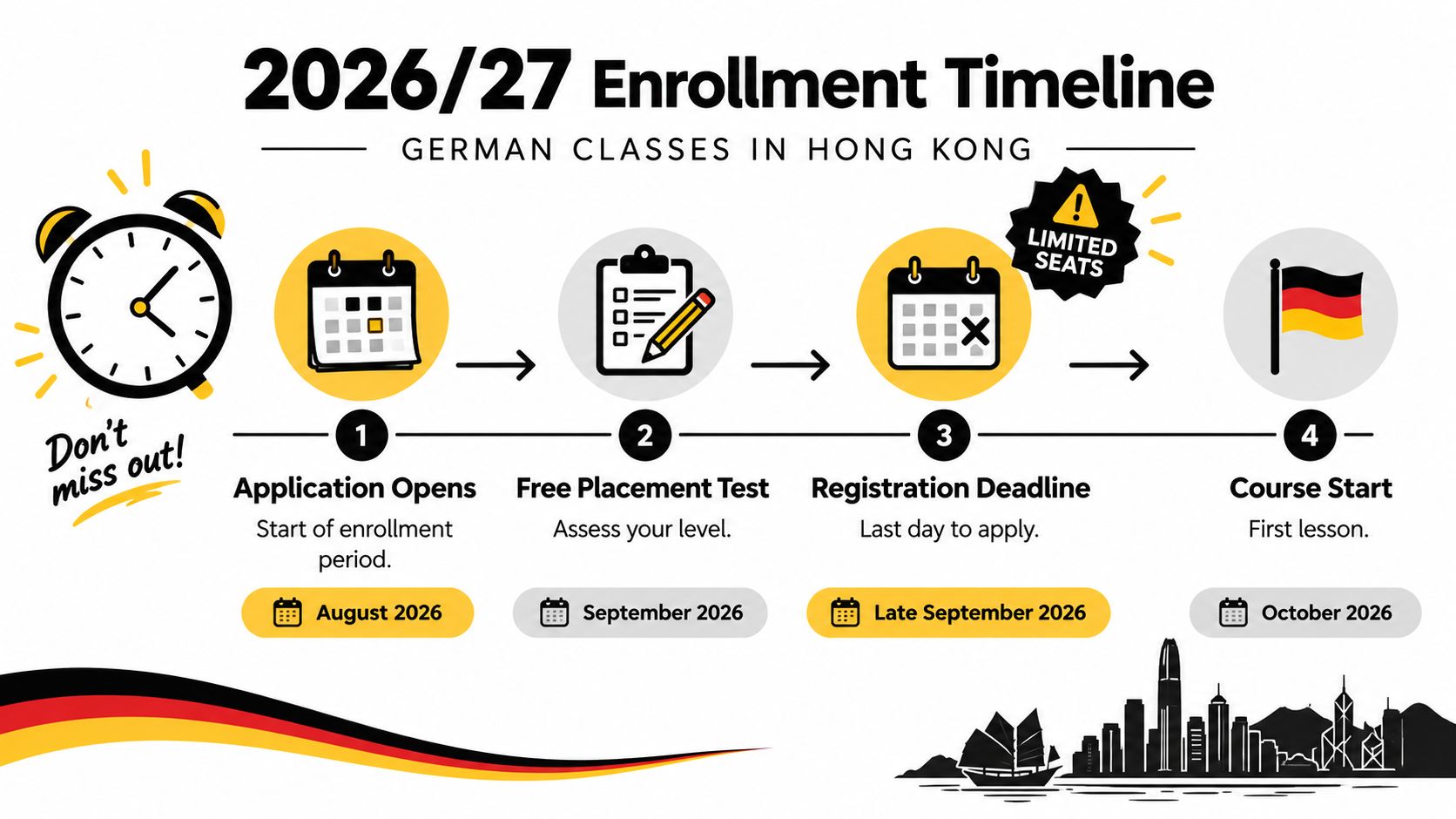
The sequence that actually works
Start with research in August 2026. That gives you time to compare class formats, confirm whether you need exam prep or conversational study, and check whether your schedule can handle in-person or online lessons.
Then take the placement test in September 2026. The reason is simple, a level mismatch wastes time, and German is too structured to wing it.
Use this order:
- Confirm your goal first. Decide whether you need German for school, a visa, work, or travel.
- Book placement early. Don't wait until the last available week.
- Check timetable fit. A class that clashes with work or school is a dead end.
- Register before the deadline. Late sign-ups usually mean compromise.
For document timing and enrolment preparation, use the school's own documents timeline guidance so you're not scrambling for paperwork at the end.
Why the timeline matters in Hong Kong
Hong Kong learners don't have the luxury of drifting. The local German pipeline is structured, and the HKU study on secondary-school foreign language programmes shows German was already being taught in local schools in the 2016/2017 cycle, with German listed as an official elective subject in two Hong Kong Chinese schools. That history matters because it proves German isn't a sudden trend, it's part of an established academic track. (HKU study reference)
If you're a parent, this is especially relevant for teens moving through DSE/IB/IGCSE planning. If you're an adult, it's the difference between a clean start and a messy catch-up later in the year.
Choosing the Right Pathway for Your Goals
Picking the wrong German class is the most expensive mistake people make. Not because the tuition is outrageous, but because the wrong syllabus wastes months on content that doesn't move you toward your actual goal.
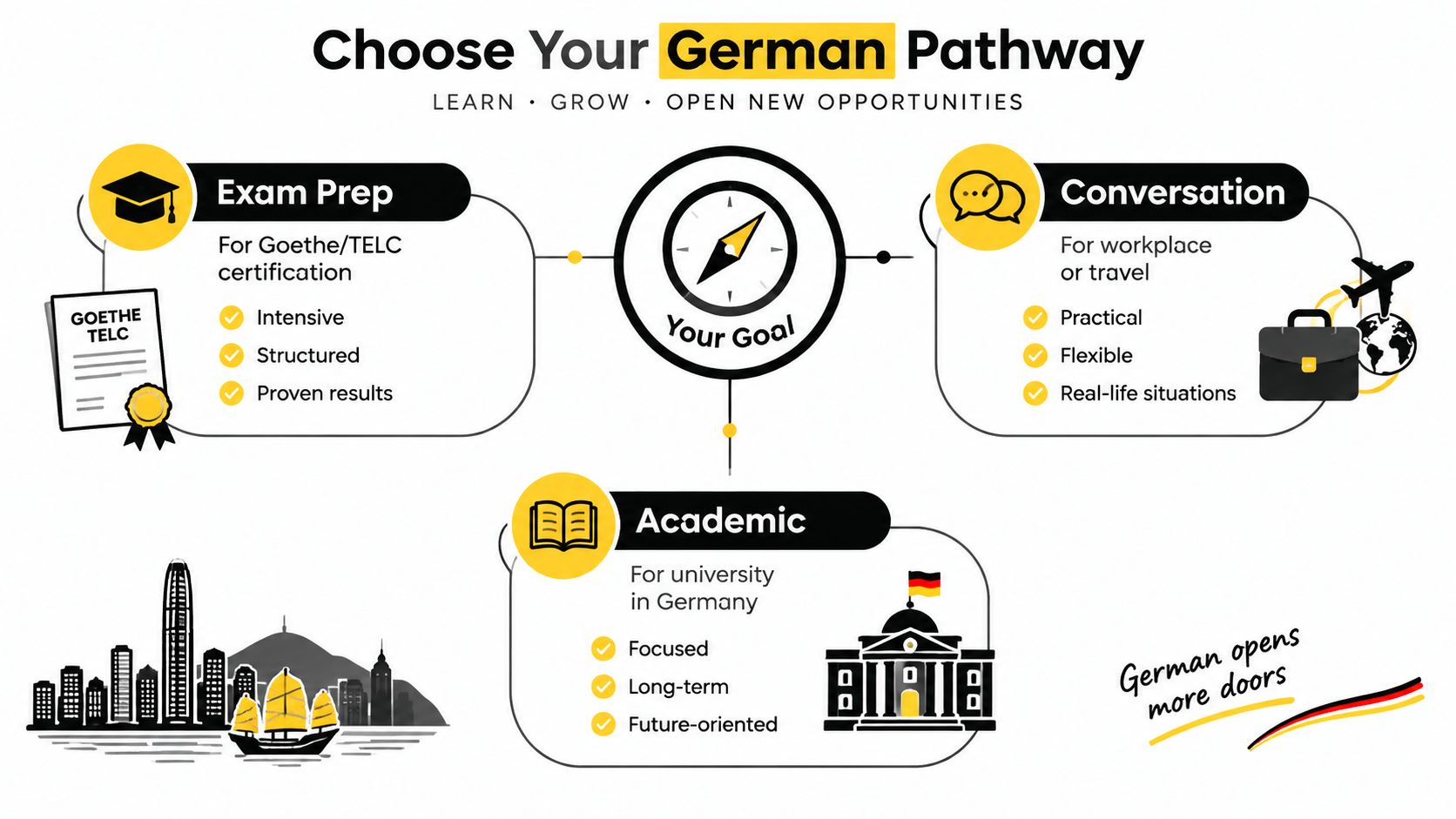
Match the pathway to the outcome
If you need exam prep, choose a course that drills reading, writing, listening, and speaking under test conditions. That's the sensible route for learners aiming at Goethe-Zertifikat, TestDaF, or school-based benchmarks.
If you need conversation, go for practical speaking and listening work. That's the right fit for adults who want travel German, workplace communication, or enough confidence to handle daily life without translating every sentence in their head.
If you need academic German, your target is not “finishing a level.” Your target is proof that you can function in a German-speaking university setting, which means formal language evidence and a curriculum that respects that reality.
A useful way to consider it:
- Exam Prep: for certification, admissions, and formal proof.
- Conversation: for workplace use, relocation, and travel.
- Academic Study: for university entry and study-abroad planning.
That distinction matters in Hong Kong because the market is no longer just about general interest. It's becoming a credentialed, purpose-specific skill, and the wrong class type slows everything down.
Business, youth, and adult learners need different structures
Working professionals should not sit in the same loose syllabus as a teenager preparing for school exams. They need sharper scheduling, more immediate speaking practice, and content that fits meetings, emails, and relocation planning.
For teams and busy adults, education center call management is useful as an operational reference because education providers live or die on timely follow-up, lead handling, and booking flow. That's exactly why a clean intake process matters.
If you're comparing course length and load, the short course versus long course guide helps you avoid choosing based on convenience alone.
German classes work best when the curriculum fits the objective, not when the learner tries to force one class to serve every purpose.
Why Small Group Native Instruction Matters
A German class with too many students becomes a passive experience. People listen, nod, and leave without speaking enough, which is a bad deal when you're paying for progress.
| Learning Environment Comparison | Format | Class Size | Instructor Profile | Speaking Practice |
|---|---|---|---|---|
| Small-group native-led class | Structured group | Maximum 6 students | Native German speakers with academic credentials | High, with direct correction |
| Large lecture-style class | Mass-market group | Larger cohorts | Mixed teaching background | Limited, often uneven |
| Private lesson | One-to-one | 1 student | Varies by provider | Very high, but less peer interaction |
Why Hong Kong learners need tighter attention
The 2024 HKDSE recorded only 83 German Language candidates overall, including 75 day-school candidates. That tells you the local German cohort is small and serious, so learners need individual placement, careful progress tracking, and direct correction rather than a room full of half-prepared students. (HKDSE reference)
That's where small-group native instruction earns its place. When the class stays tight, the teacher hears mistakes, corrects them immediately, and keeps everyone accountable. Speaking confidence grows faster because nobody can hide.
What to look for before you pay
- Class size: smaller is better when speaking and exam output matter.
- Teacher profile: native German speakers with real academic training are the standard serious learners should demand.
- Schedule convenience: locations near Tsim Sha Tsui and Causeway Bay MTR save time for working adults and parents.
- Online flexibility: Zoom options matter when your week is already full.
For comparison with private lessons, see 1-on-1 versus small group. The key point is simple, if you need discipline plus interaction, small-group teaching usually gives the better balance.
Navigating Registration and CEF Funding
Don't let paperwork scare you off. The actual registration process is straightforward if you handle it early and keep your documents ready.
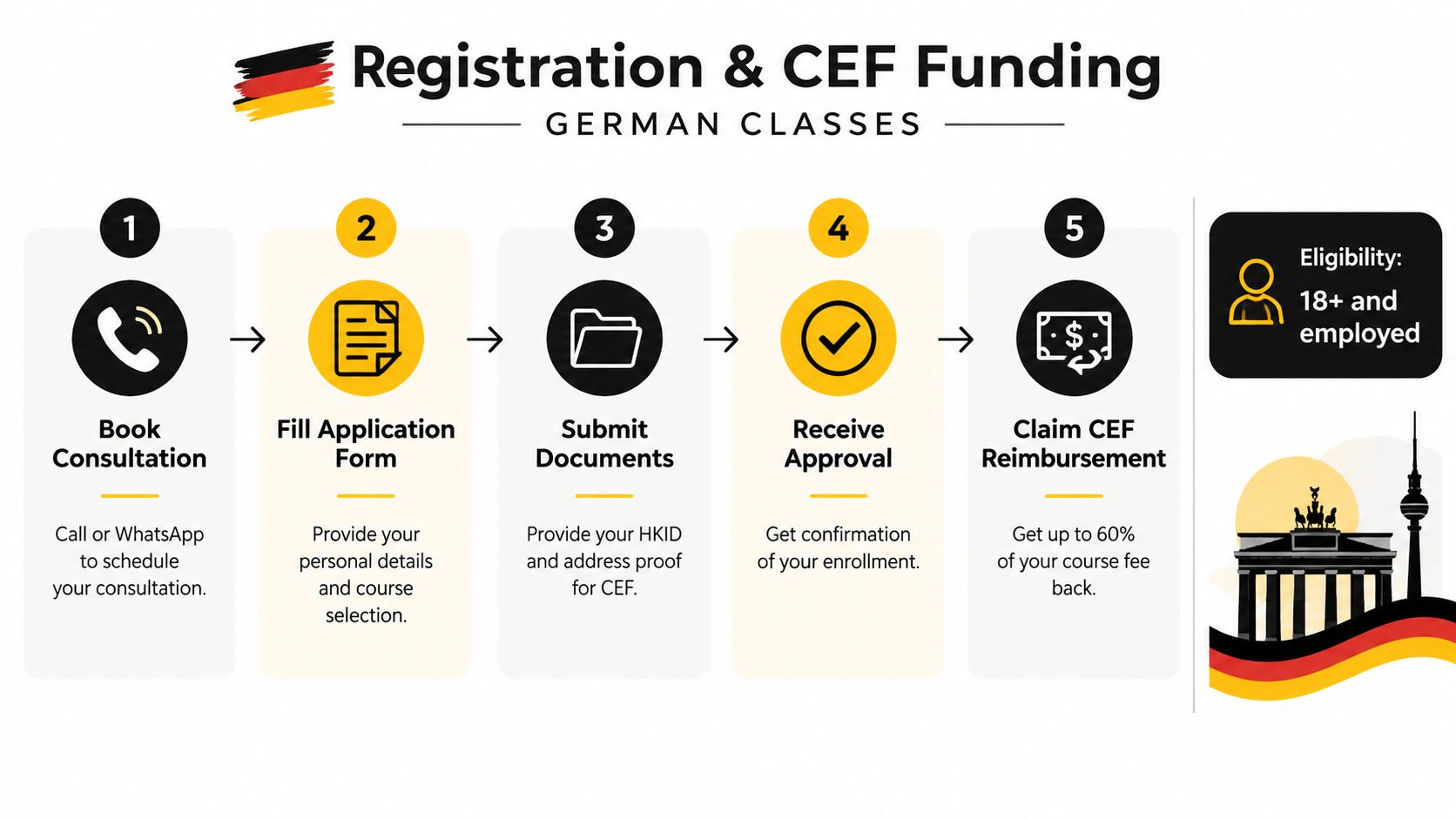
The cleanest way to enrol
- Book the consultation. Call or message to secure a placement discussion.
- Complete the application form. Choose the right level and timetable.
- Submit documents. Keep your ID and address proof ready where needed.
- Receive approval. Confirm the class before you assume you're in.
- Claim reimbursement. If eligible, follow the CEF process carefully.
The Hong Kong Continuing Education Fund (CEF) is the main financial lever for adult learners. It can reimburse 80% of the first HK$10,000 of eligible course and examination fees, and 60% of the remaining HK$15,000, which makes serious German study much more manageable for working professionals. (CEF reference)
What CEF changes for adults
The point of CEF isn't just saving money. It changes the decision-making process, because once part of the cost is recoverable, adults can choose a better course instead of the cheapest one.
Hong Kong's CEF German test list includes Goethe-Zertifikat A1, A2, B1, and C1, and it also recognises TestDaF through a Hong Kong academic provider. That matters if your goal is university entry, visa proof, or formal language recognition. (CEF German list)
A practical tip, keep your rescheduling and attendance plan simple. The schools that make it easy to stay on track are the ones that are easiest to finish.
If you're working full-time, choose a timetable you can actually keep. The right schedule is the one you'll attend consistently, not the one that looks ambitious on paper.
Aligning Your Studies with Official Exams
Casual learning is fine for hobbyists. It's not enough if you need a credential that a university, employer, or visa office will recognise.

The Goethe-Institut Hong Kong runs German exams from A1 to C2, and it reported 1.1 million German exam sittings at Goethe exam centres globally in 2024, plus 461,000 B1 exam sittings worldwide in 2025. Those numbers show that B1 is a major checkpoint, not a casual milestone. (Goethe exam reference)
The exam path should drive the syllabus
If you're aiming for study abroad in Germany, you need proof, not just progress. If you're applying for work or relocation, the level requirement changes again, which is why a generic conversational class won't cut it.
TestDaF is the right name to know if you're targeting advanced academic German. In Hong Kong, it covers B2 to C1 and is administered digitally, and the Goethe-Institut Hong Kong states it is the only TestDaF exam centre in the city. (TestDaF reference)
Secondary students need earlier preparation
Parents shouldn't wait until the final exam year to think about German. If a teen is moving through IGCSE, A-level, or IB, the earlier the structure starts, the less panic there is later.
What works best is a steady climb:
- Foundation first: build vocabulary and grammar properly.
- Output second: practise speaking and writing under correction.
- Test alignment last: move into the exact exam format early enough to avoid surprise.
Here's the blunt truth. If your end goal is a verified result, then your class has to mirror the test. Anything else is just general language exposure.
Your Enrollment Checklist and Next Steps
The best learners in Hong Kong don't wait to feel “ready.” They check the practical boxes, choose the right path, and get started while the preferred timetable is still open.
Parent and learner checklist
- Confirm your goal. Decide whether this is for school, university, visa proof, business, or travel.
- Check CEF eligibility. If you're an adult learner, confirm whether the course and exam fit the funding rules.
- Book the placement test. Don't guess your level.
- Select the right pathway. Exam prep, conversation, or academic German should be chosen deliberately.
- Review the timetable. Make sure in-person or online formats fit your week.
- Ask about exam alignment. If you need Goethe-Zertifikat or TestDaF, say that upfront.
GCA's published result claims are strong, with a 96% recommendation rate and over 90% of students ranking in the top 10% of public examinations. Those numbers are worth noting if you're comparing structured, exam-led teaching with looser alternatives.
The right class is the one that matches your deadline, your level, and your reason for learning. If those three don't line up, you'll waste time.
For adults, the decision is even simpler. If you want German that supports migration, study, or career use, choose a programme that treats German as a credential, not a pastime.
If you're ready to make the 2026/27 intake count, visit German Cultural Association Hong Kong(GCA) and check the latest course schedule, then book a trial class or speak to an advisor before the best slots are gone. GCA offers structured German courses in Hong Kong for children, teens, and adults, with native-led teaching and exam-focused preparation that fits serious academic and career goals.

Costs and Language Requirements for German in HK

Student Exchange to Germany: Programmes for HK Students


