.png)
.png)

BLOG

香港德國文化協會
The German Cultural Association
Private German Lessons in Hong Kong: 1-on-1 vs Small Group Compared
You're in a Hong Kong café with two brochures open on the table, one promising 1-on-1 German lessons, the other offering a small group schedule that looks easier on the wallet. Your deadline is real, whether it's Goethe-Zertifikat, TestDaF, IB, IGCSE, a visa file, or a work move, and so is the bill, because German tuition in Hong Kong is priced like a premium service. The wrong format doesn't just waste money, it wastes commuting time, feedback time, and momentum.
| Decision factor | 1-on-1 private | Small group |
|---|---|---|
| Teacher attention | Full lesson time goes to one learner | Feedback is shared across the class |
| Pacing | Fully custom | Shared pace |
| Cost | Higher per learner | Lower per learner |
| Peer practice | Minimal | Stronger |
| Best use | Tight deadline, specialised goal | Steady progress, value for money |
For most adults and parents searching for Private German Lessons in Hong Kong: 1-on-1 vs Small Group Compared, the core question isn't which format sounds better. It's which format gives the right ratio of teacher feedback to peer practice for your goal, your commute, and your budget. If you want a deeper local course overview, start with the 2026 Hong Kong German course comparison guide.
Table of Contents
- Parents and teens preparing for exams
- University and immigration applicants
- Working professionals and business German
- Travellers and casual adult learners
- A simple decision map
- The published price gap is real
- Feedback time is the hidden bill
- What the total cost feels like in practice
- Week 1 and week 2 should feel practical
- Compare the lesson, not the brochure
- Commit without losing progress
- How many students are in a small group class in Hong Kong
- Can I switch between 1-on-1 and small group mid-course
- Are German lessons in Hong Kong eligible for CEF funding
- How do I book a trial class
Choosing Between 1-on-1 and Small Group German Classes in Hong Kong
A parent in Tsim Sha Tsui can waste half a lunch break comparing flyers and still not answer the only question that matters. Do you need speed and precision, or do you need structure and value?
The choice in plain English
1-on-1 wins when the clock is loud. If your child needs exam correction fast, if your relocation date is fixed, or if you're preparing a business pitch in German, private tuition gives you full control over pace and correction.
Small group wins when you want progress without burning cash on every minute of the tutor's attention. In Hong Kong, that matters because private language tuition is consistently a premium category, especially for German, where learners often pay more for customisation than for casual conversation practice Hong Kong tutoring-market data.
The local market already reflects that split. The Goethe-Institut Hong Kong lists individual courses as a separate option, while Hong Kong providers frame group learning around compact classes rather than big lecture rooms Goethe-Institut Hong Kong. That's the right model for this city, because commute time is real, class time is expensive, and most serious learners need either tight correction or steady spoken practice, not both in the same dosage.
Practical rule: choose private lessons when one mistake repeated ten times would cost you marks, confidence, or a deadline.
For learners comparing German lessons Hong Kong options, this is the cleanest lens. Don't ask which format is “better” in theory. Ask which one makes the most sense for your actual week in HK, your MTR route, and your target date.
What 1-on-1 and Small Group German Lessons Actually Mean in Hong Kong
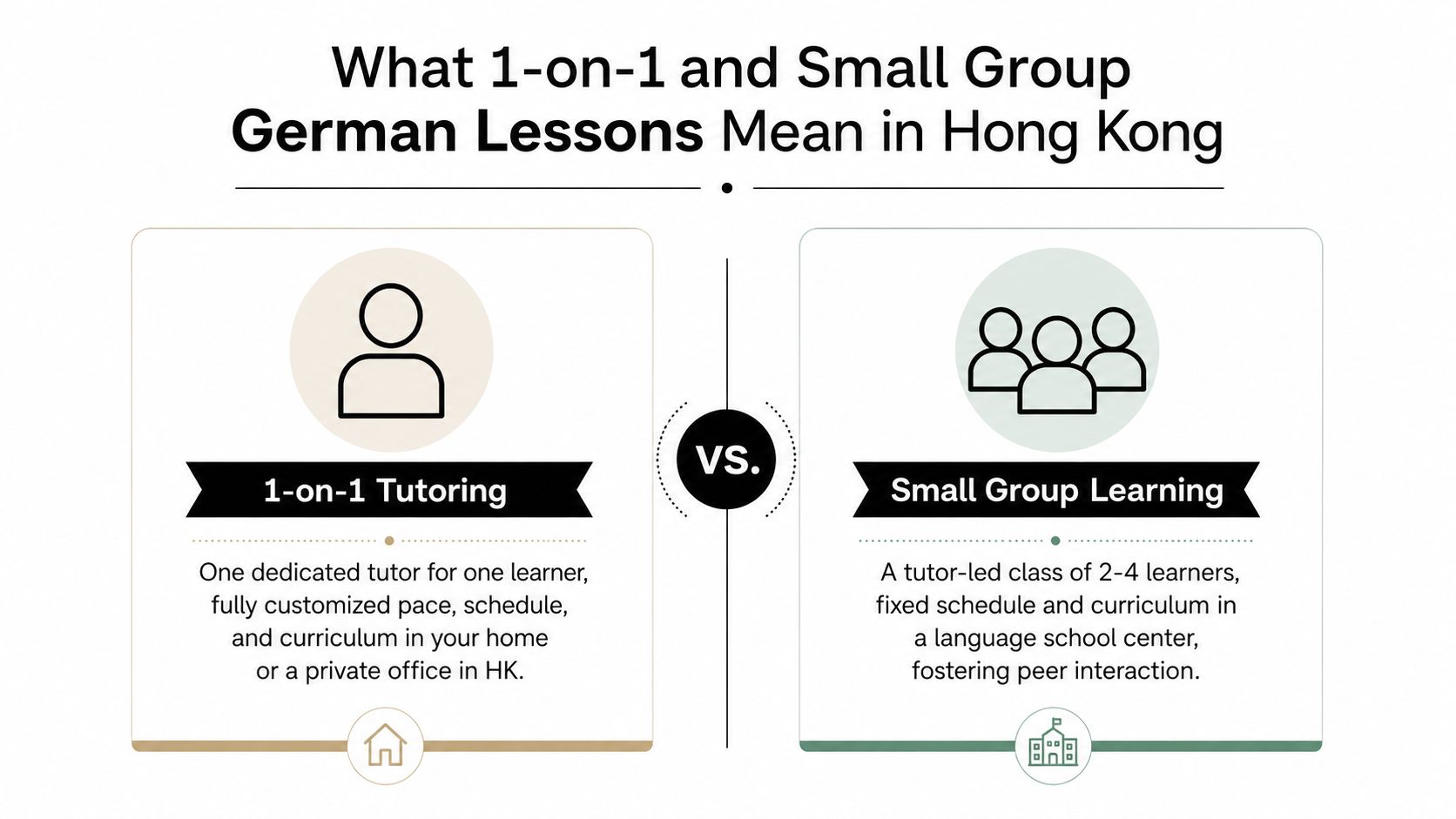
1-on-1 means total control
In Hong Kong, 1-on-1 German lessons mean one learner, one teacher, one lesson plan. The entire session can be shaped around your gaps, your exam paper, your business needs, or even the way you speak under pressure.
That matters because private lessons don't split feedback time. If you need pronunciation correction, writing drills, or a rehearsal for a visa interview, the tutor can spend the whole lesson on that one issue. GCA's Hong Kong class design also offers 1-on-1 lessons alongside its capped group format, which is a useful technical distinction because it controls teacher-to-student ratio and feedback throughput GCA class design.
Small group means compact, not crowded
A real small group in Hong Kong German tuition is not a 15-person room. The market standard is far tighter, and reputable providers often describe the format as 2 to 6 students, with GCA capping groups at 6 students to preserve feedback quality GCA small-group cap.
That cap matters. It's the difference between a teacher who can still correct your article endings, and a teacher who can only keep the lesson moving. It also preserves the social upside of group learning, because you still hear different accents, different mistakes, and different ways of answering the same question.
What you're really buying
You're not buying “private” or “group” as labels. You're buying one of two learning engines.
- Private lessons buy you pacing control, syllabus control, and rapid correction.
- Small groups buy you peer practice, lower per-learner cost, and enough interaction to keep speaking alive.
That's why the German Cultural Association of Hong Kong (GCA) sits in a strong position for serious learners. Its native German teachers, structured curriculum, and both formats under one roof let families and professionals move between intensive coaching and small-group study without changing ecosystems.
Five Criteria That Decide the Format for You
Teacher attention, pacing, and peer practice
| Criterion | 1-on-1 Private | Small Group (max 6) |
|---|---|---|
| Teacher attention per learner | Wins. Every minute is yours. | Shared across the class. |
| Pacing flexibility | Wins. Move fast or slow as needed. | Moderate. Class pace is shared. |
| Cost per learner | Higher. | Wins. Cost drops sharply per learner. |
| Scheduling flexibility | Strong, especially for busy adults. | Good, but tied to class timetable. |
| Peer practice | Limited. | Wins. More voices, more repetition, more social pressure to speak. |
Simple. 1-on-1 buys speed, small group buys durability. If a learner needs immediate correction, private lessons win outright because feedback minutes equal lesson minutes.
If a learner needs repetition, confidence, and a reason to keep showing up, small groups win more often than people admit. That's especially true in Hong Kong, where many adults are already carrying work stress, commute fatigue, and family logistics. A class with a fixed time slot can help people stay consistent.
The hidden cost nobody talks about
The hourly rate is only half the story. The value question is how much teacher attention you get for each dollar, and that changes sharply between formats.
A 1-on-1 lesson gives one learner all the correction time. A 6-person group spreads that attention across the room, so each student gets less direct correction but more peer input. That trade-off is exactly why small groups work well for sustained practice, while private lessons are better for fast, personalised acceleration.
Bottom line: if your goal depends on precision, pay for precision. If your goal depends on consistency, buy a format that keeps you speaking without draining your budget.
Which Format Fits Your Goal in Hong Kong
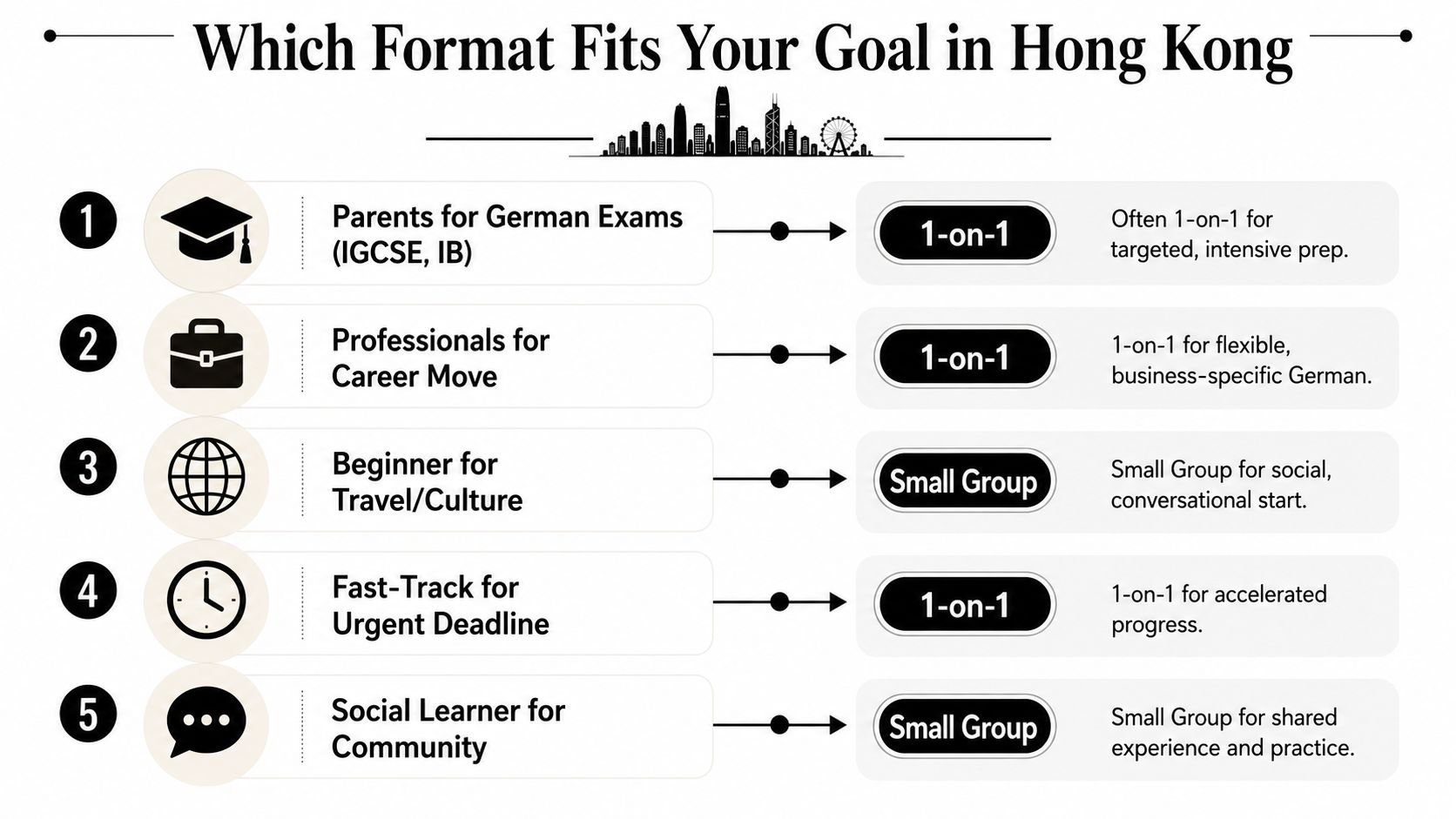
Parents and teens preparing for exams
For IB, IGCSE, A-level, and Goethe-Zertifikat preparation, 1-on-1 is usually the right call when the deadline is close. Exam learners need targeted marking, not general exposure, because one weak paper can drag the whole result down.
If your teen is already taking German seriously, a structured curriculum matters more than a casual conversation class. That's where a provider with exam preparation expertise fits better than a generic language centre. GCA's curriculum is built around German learning pathways that include Goethe-Zertifikat and TestDaF, so the format choice can be aligned with the exam rather than guessed GCA programmes and offerings.
University and immigration applicants
For students aiming at German-speaking universities or applicants dealing with APS and visa-style language demands, private lessons win again. You need focused correction on the exact skills that are holding you back, especially speaking under pressure and writing with accuracy.
If your timeline is long and your confidence is low, a small group can still help. But once the deadline becomes real, the private format is the safer bet because it keeps the teacher's full attention on your weak points.
Working professionals and business German
Professionals usually need a blend. 1-on-1 is the better choice for email correction, role-play, presentations, and industry-specific vocabulary. Small group is useful when you want negotiation practice, listening variety, and the pressure of responding to people other than your teacher.
That combination fits Hong Kong's work culture well. People here often need language progress without giving up half a day to commuting, so a mix of formats can be smarter than an all-or-nothing choice.
Travellers and casual adult learners
For adult travellers planning study abroad in Germany/Spain or wanting practical German for trips, small group often wins. The social pressure helps, the pace is usually manageable, and the value is better if your goal is functional conversation rather than exam precision.
A simple decision map
- Choose 1-on-1 for exams, APS, visas, relocation, business presentations, and urgent deadlines.
- Choose small group for speaking confidence, long-term maintenance, and budget-friendly progress.
- Choose both if you want the best of each, which is often the smartest route in Hong Kong.
How Much Each Format Really Costs in Hong Kong
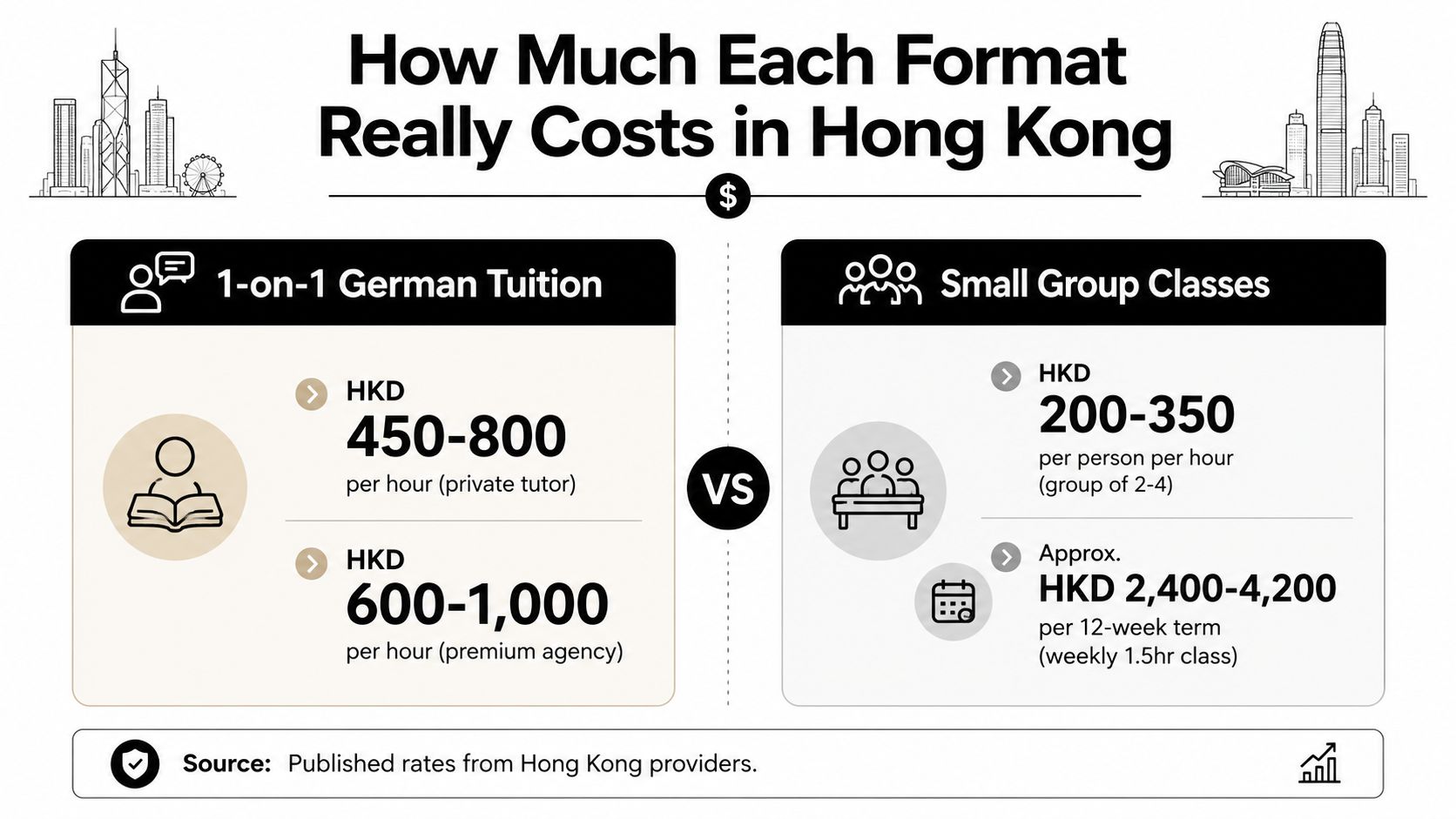
The published price gap is real
Private German tuition in Hong Kong is commonly quoted at HK$400 to HK$800+ per hour, while another local guide places private German tutors at HK$500 to HK$1,000+ per hour a 2026 breakdown of German course prices in Hong Kong, private tutor guide. For a detailed breakdown of current rates, see our German course prices in Hong Kong 2026 guide. Small-group classes are usually lower on a per-learner basis, around HK$150 to HK$400 per person per hour Hong Kong tutoring-market data.
That spread is not minor. It decides who can keep the format going for 12 weeks, who can add commuting time without resentment, and who can still afford to continue after the first burst of motivation fades.
Feedback time is the hidden bill
A one-hour private lesson gives you 60 minutes of feedback. A 6-person class gives each learner a much smaller share of the teacher's time, so the value sits in the interaction, not the individual correction.
That is why the key question is not just “what's the hourly rate?” It is “how much usable correction am I getting per learner, per session?” For exam prep, that answer points toward private lessons. For maintenance learning, it often points toward small groups.
What the total cost feels like in practice
Hong Kong's language market is split by use case as much as by price. Local coverage notes that large institutions may charge about HK$4,800 for 2 to 3 month courses, while private schools and one-to-one lessons are commonly cited at HK$300 to HK$800 per hour district guide. If you want a fuller view of how those figures sit against one another, our German course prices in Hong Kong 2026 guide lays out the current fee structure in more detail. Some learners may also qualify for CEF funding depending on the provider and course type, so the sticker price should not be your only filter.
Total cost of ownership matters more than the headline rate. A cheaper class that does not match your goal can end up costing more in extra months, missed deadlines, and repeat enrolment.
For price-sensitive families and adults, the rule is simple. If you need custom correction, pay for private lessons. If you need regular practice at a lower per-learner cost, small group is the smarter spend.
A 30-Day Plan to Choose, Trial, and Commit
Week 1 and week 2 should feel practical
Start with one placement conversation, then write down three facts. Your deadline, your budget, and your weekly commute reality. If you know you can't cross the harbour twice a week after work, don't pretend otherwise.
During the second week, book one trial 1-on-1 and one trial small-group class. If you're near Tsim Sha Tsui or Causeway Bay MTR, choose venues you can reach after work, not the dream location you'll stop attending in month two.
Compare the lesson, not the brochure
After each trial, ask yourself three questions.
- How much did I speak?
- How much direct correction did I get?
- Did I leave energised or tired?
If the answer is “I barely spoke,” the group may be too large or too slow for you. If the answer is “I got useful corrections but felt rushed,” private lessons may be the better fit.
Commit without losing progress
A structured syllabus makes switching easier than one might assume. GCA's curriculum, attendance-based certificate system with 80% attendance, and easy online rescheduling reduce the friction of changing pace or format. That matters for busy Hong Kong adults because life changes, deadlines move, and work trips happen.
If you need more flexibility, ask which courses can work under CEF funding and whether a hybrid makes sense. A hybrid is often the most realistic setup for exam candidates, because private lessons can clean up weaknesses while small-group classes keep speaking active.
If you're already browsing a Learn German HK option, stop waiting for the perfect moment. Book one trial in each format, compare the way you learn, then commit to the one that matches your calendar.
The Decision Rule and How GCA Delivers Both Formats
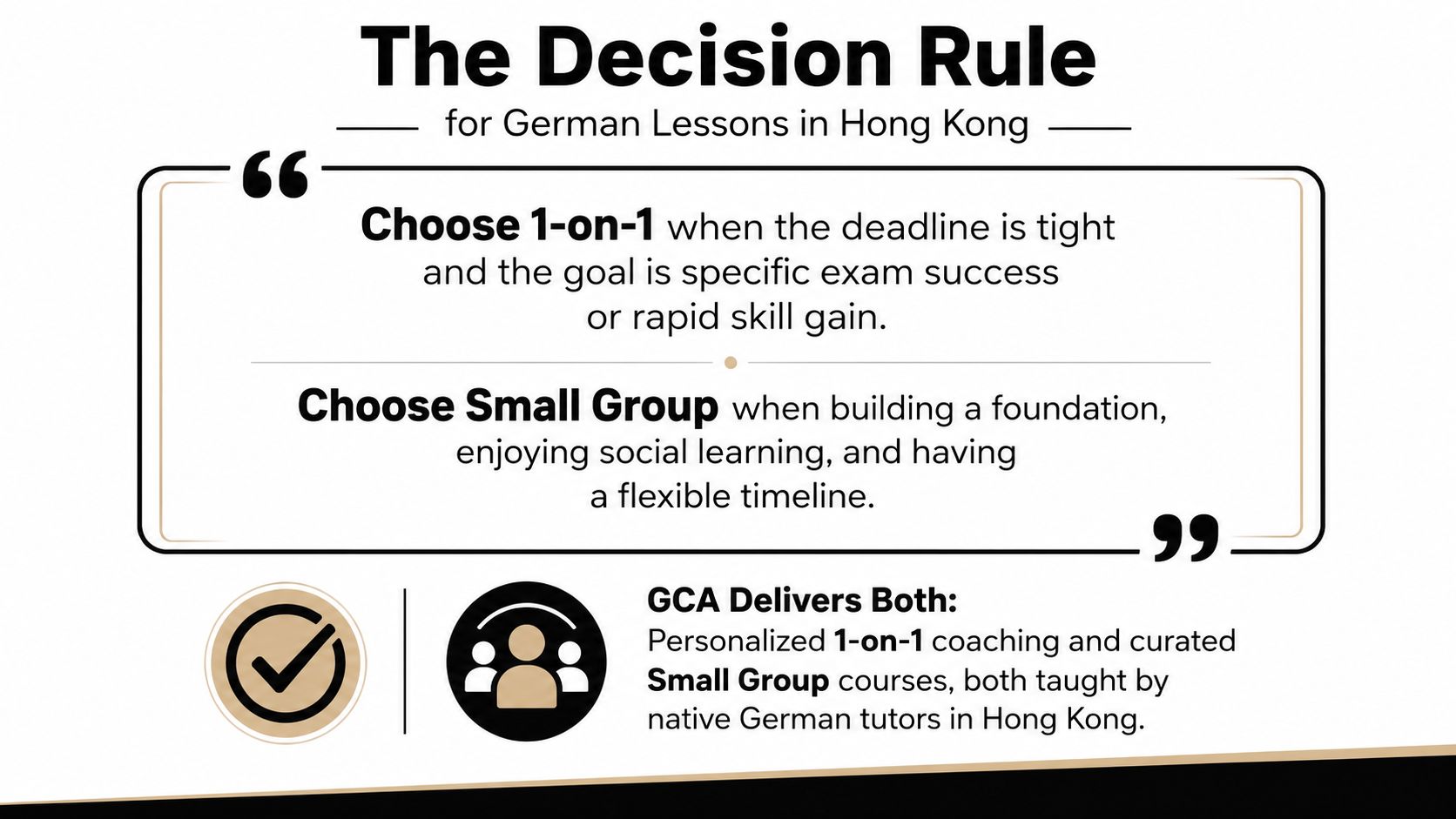
Choose 1-on-1 when the deadline is tight and the goal is specific, exam success, visa readiness, or rapid skill gain. Choose small group when you want steady progress, peer motivation, and better value for money.
The German Cultural Association of Hong Kong fits this decision rule because it offers both native-speaker teaching and capped small groups in the same system. It also provides structured exam preparation for Goethe-Zertifikat and TestDaF, which is the kind of spine serious learners need when the goal is not just conversation, but measurable progress GCA programmes.
Its Hong Kong profile is especially practical for commuters, with centres near Tsim Sha Tsui and Causeway Bay MTR, plus online options for people who can't always get across town. The association is repeatedly described in Hong Kong German-course comparisons as using very small classes with a maximum of 6 students, which gives learners more correction opportunities than traditional large classes class-size comparison.
For learners who care about outcomes, the published 96% recommendation rate and over 90% top-10% public exam ranking are useful indicators of consistency, not marketing gloss. If you want a provider that can handle both private urgency and group-based momentum, GCA is built for that exact split.
Frequently Asked Questions About German Lessons in Hong Kong
How many students are in a small group class in Hong Kong
Most small-group German classes in Hong Kong sit between 2 and 6 students. GCA caps its groups at 6 to preserve correction opportunities and keep the lesson personal class size reference.
Can I switch between 1-on-1 and small group mid-course
Yes, if the provider uses a structured curriculum. That's the advantage of a syllabus-driven setup, because the material travels with you even if the delivery format changes.
Are German lessons in Hong Kong eligible for CEF funding
Sometimes, but not always. It depends on the provider and the course type, so ask the admissions team before you enrol and confirm whether the course is on the CEF list.
How do I book a trial class
Use the provider's booking channel directly and ask for the format you want to test. For a practical example of a loyalty and wallet-style booking flow that keeps recurring offers easy to access, this BonusQR Apple Wallet feature shows how stored passes can simplify repeat visits and reminders.
A CTA for German Cultural Association Hong Kong(GCA). Book a trial class, ask an advisor which format fits your goal, and check the latest course schedule on german.com.hk before you commit.

Applying to German Universities from Hong Kong: Uni-Assist

Ausbildung Age Limits and Entry Requirements for Hong Kong Applicants


