


BLOG

香港德國文化協會
The German Cultural Association
Costs and Language Requirements for German in HK
Two quotes for the same German level can look affordable until you add exam fees, materials and travel. If you're comparing classes for yourself or your child, the key question is whether your budget will cover the level and proof you need.
Getting costs and language requirements right means working backwards from your goal, not choosing the lowest advertised course price. A holiday, a school examination and a German university application need different learning plans.
Table of Contents
- Parents choosing a sustainable learning routine
- Teenagers preparing for examinations
- University and visa applicants
- Working professionals balancing money and time
- Adult travellers prioritising useful communication
- Make paid teaching work harder
- Check CEF reimbursement before enrolling
- Explore sponsorship without assuming eligibility
How Much Does German Learning Cost in Hong Kong?
German learning costs in Hong Kong depend on the course format, total contact hours, materials and certification you need. Group, private and online tuition should be compared by teaching time rather than term price. Budget separately for the examination, and confirm the fee attached to your chosen sitting before paying.
A parent comparing after-school classes and a professional comparing evening lessons face the same problem: course packages don't necessarily include the same things. A cheaper term can contain fewer lessons, less individual feedback or no examination preparation.
Compare the complete quote
German learning cost components in Hong Kong
| Cost item | What it covers | Known amount or rule | Check before paying |
|---|---|---|---|
| Group course (max 6 students) | Structured course in person or on Zoom | Written package quote sets the tuition | Compare cost per contact hour |
| Private one-on-one lessons | Individual sessions for exam gaps or speaking practice | Agreed session rate and booked hours set the total | Confirm hours needed for your target level |
| Goethe exam fee (A1 to C2) | One certification sitting | Listed beside each exam date; full payment secures the seat | Confirm the fee for your chosen date |
| Online exam payment | Pay in EUR instead of HKD | Exchange-rate exposure may apply | Compare the HKD total before paying |
| Replacement certificate | Reissue after a lost original | Replacement fee and eligibility rules apply | Scan and store the certificate when received |
| Course materials | Textbooks, workbooks and practice papers | Included in tuition or separately itemised in the quote | Ask whether materials are included |
Goethe-Institut Hong Kong's examination fee rules state that fees appear beside each examination date, full payment secures a seat, payment is available locally in HKD or online in EUR, and a replacement certificate costs HK$100 if the examination was taken within the preceding ten years.
EUR payment creates exchange-rate exposure, so compare the final HKD equivalent rather than the displayed currency alone. Don't assume a preparation course includes the external examination booking.
Turn the quotation into a usable budget
Calculate tuition divided by teacher-led contact hours. Keep homework separate: independent practice is essential, but it isn't paid teaching time.
Private lessons make sense when a teacher can identify a specific weakness, such as oral interaction or timed writing. They're less economical when you're paying individually to cover material that a suitable group teaches systematically.
Practical rule: Ask what you'll be able to do at the end of the course, how that will be assessed, and what remains before the examination.
Before paying, check:
- Tuition: Teaching hours, cancellation rules and progression to the next course.
- Examination: Registration, sitting fee and any separate speaking arrangements.
- Certificate: Whether you need external certification or only course-completion evidence.
- Materials: Required books, digital access and practice papers.
- Travel and time: Whether commuting to Tsim Sha Tsui or Causeway Bay is worthwhile compared with joining through Zoom.
Which CEFR Level Your Goal Actually Requires
Your goal sets the level; the level sets the course and examination; the result supplies the proof. That sequence matters if you're planning to study in Germany, where admission and immigration paperwork serve different purposes. A course labelled advanced isn't an admission qualification, and holding a recognised certificate doesn't oblige every university, employer or visa route to accept it.
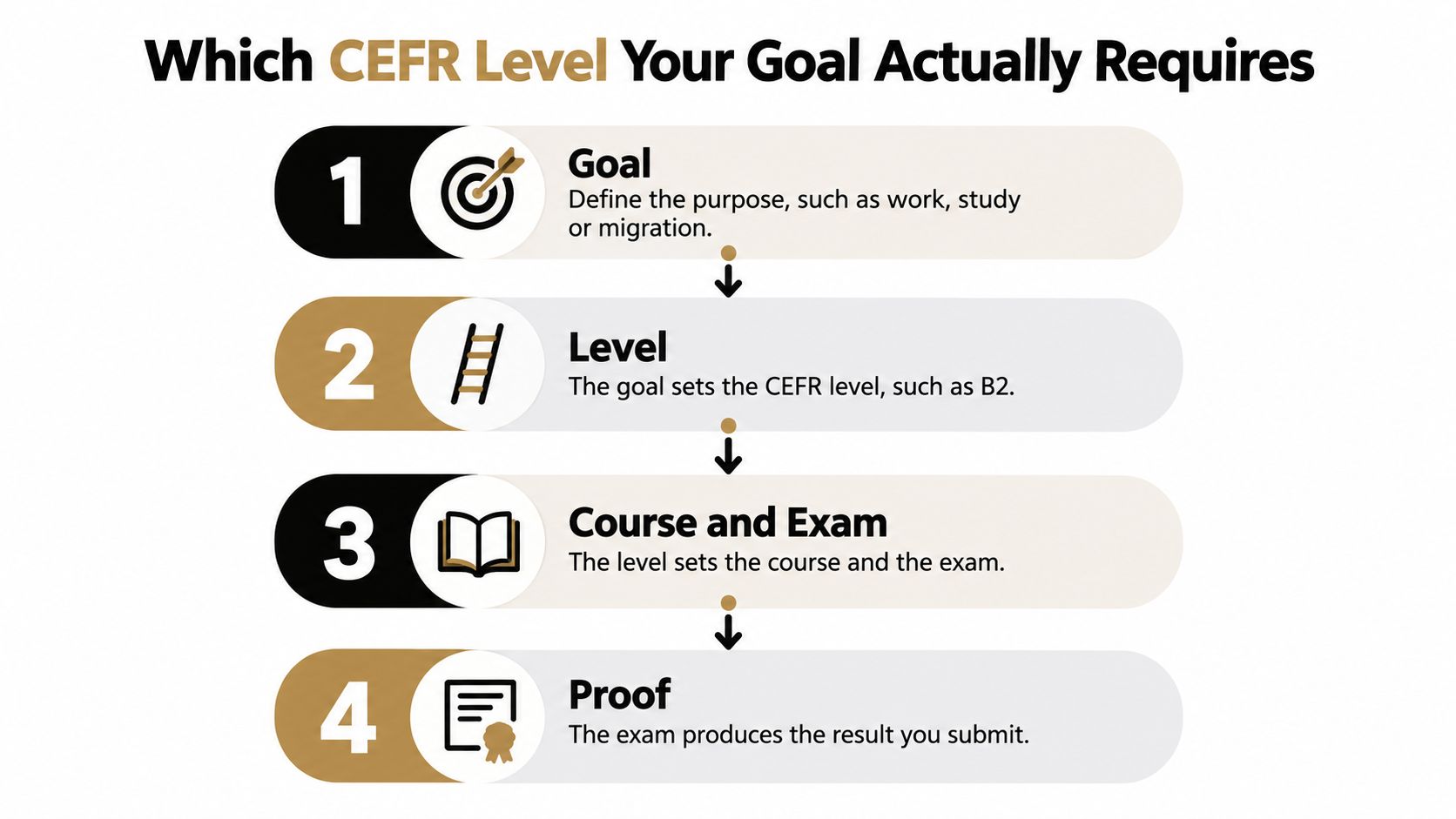
Match the target to the decision-maker
CEFR levels and accepted proof by goal
| Goal | Typical CEFR target | Accepted proof | Check before enrolling |
|---|---|---|---|
| Visa for a German language course over 90 days | Level stated in the course confirmation | Language-school confirmation with cost, level and duration; conditional admission letter; evidence of prior German | Confirm the exact visa category and current document checklist |
| German-taught university degree | B2 generally; some programmes require C1 or C2 | TestDaF TDN-4 in all modules; Goethe-Zertifikat C2 as an example | Individual programme and university rules |
| Hong Kong university admission (JUPAS) | Set by the admitting programme | Whether external German certificates are accepted | Confirm with the admissions office for your admission year |
| IGCSE, A-level or IB German | School and examination-board syllabus sets the target | Syllabus-specific assessment | School and exam board requirements |
| Business German for work | Employer-set target based on job duties | Employer assessment or a specified Goethe qualification | Ask your employer or HR team |
| Travel or conversational German | A1 to A2 as a personal learning target | None formally required for the learning goal | Decide which situations you want to handle |
Each row answers a different gatekeeper. For travel, you set the benchmark yourself, so the A1 to A2 range is a planning recommendation to work around rather than a rule to satisfy. For work, describe the actual task before choosing a course: handling customer calls requires different preparation from reading technical documentation.
For school learners, don't assume that a DSE/IB/IGCSE timetable automatically maps to a CEFR certificate. Ask the school which qualification the student is taking, which components are assessed and whether an external certificate offers any additional benefit.
Keep learning history separate from examination results
HKU SPACE's Advanced German Language Practice programme indicates entry through approximately 480 hours of prior study or external evidence around B1+, with applicants potentially interviewed for placement.
That's an entry benchmark for one particular programme. Completing a fixed number of lessons elsewhere doesn't guarantee the same proficiency: a learner may understand grammar well but still need substantial work on listening and spontaneous speech.
Keep a learning file containing:
- Attendance records: Evidence of sustained participation.
- Course confirmations: The level, content and completion outcome.
- Assessment results: Marked writing, mock examinations and teacher feedback.
- Certificates: Clear copies of the qualifications you'll submit.
Goethe examinations are open to candidates beyond any particular preparation course, while receiving institutions set their own acceptance conditions. When comparing costs and language requirements, ask the receiving organisation to confirm the exact proof it wants before committing to an examination.
Use the guide to German CEFR levels for Hong Kong learners to understand the skills behind the labels. Then turn the relevant requirement into a written course objective rather than relying on a broad promise of fluency.
How Long Each CEFR Level Takes to Reach
German proficiency develops through repeated use, feedback and revision. There's no reliable shortcut that removes the need to practise listening, speaking, reading and writing, particularly when your goal includes a timed examination.
Your calendar depends on your starting point, previous language learning, independent practice and the pace you can maintain. An intensive timetable only helps if you can absorb and revisit the material.
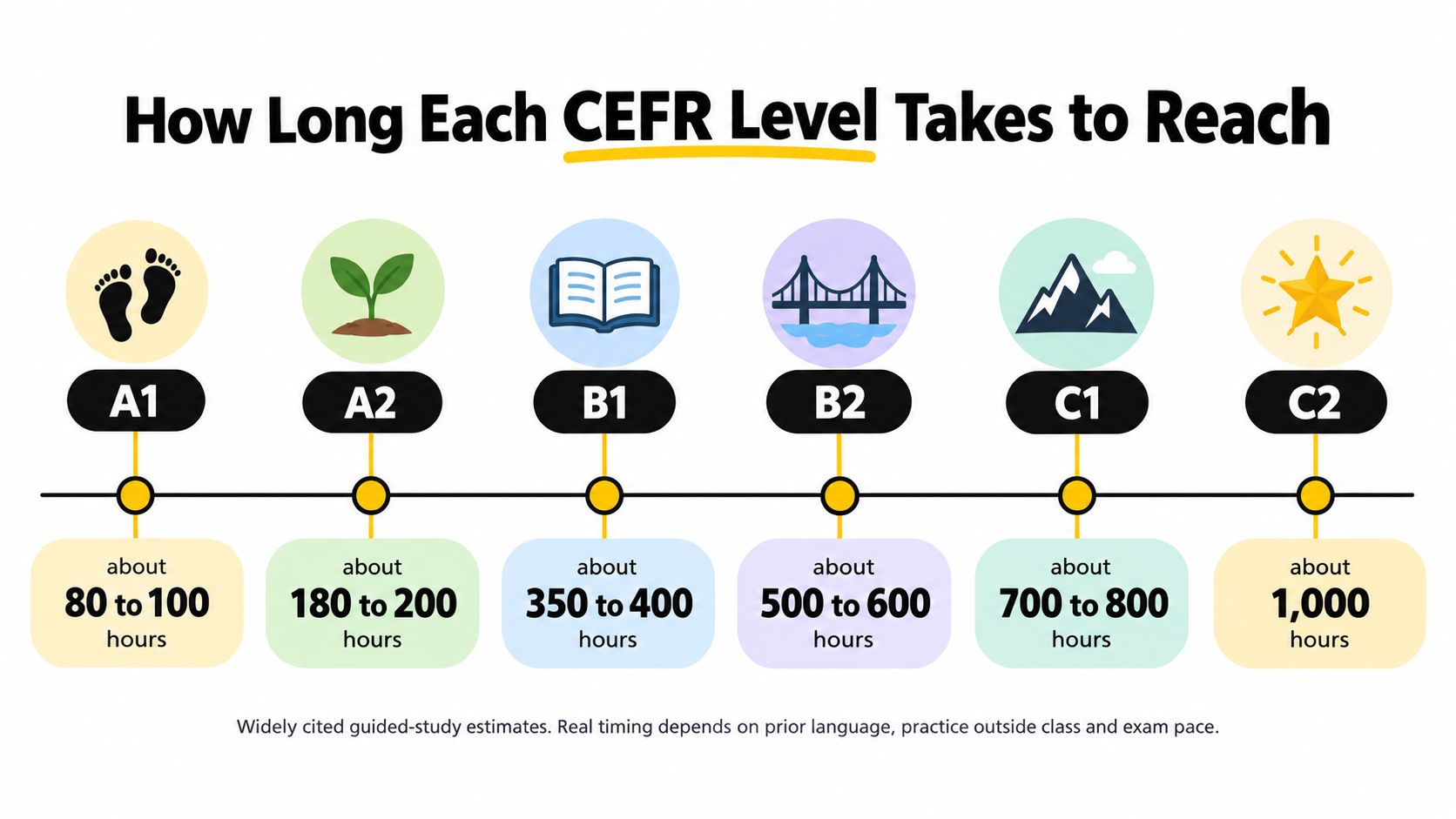
Use hours as planning assumptions, not guarantees
The visual's hour ranges are broad planning estimates, not a verified timetable for your course. Ask the provider to confirm its actual contact hours, assessment standards and expected independent work.
The following is a hypothetical scheduling example, using cumulative study-hour allowances rather than promised completion times. It assumes uninterrupted weekly study, so school holidays, missed classes and revision would extend the calendar.
Approximate study time to each CEFR level
| CEFR level | Months at 4 hours a week | Months at 8 hours a week |
|---|---|---|
| A1 | About 5, assuming 100 hours | About 3, assuming 100 hours |
| A2 | About 11, assuming 200 hours | About 6, assuming 200 hours |
| B1 | About 23, assuming 400 hours | About 11, assuming 400 hours |
| B2 | About 35, assuming 600 hours | About 17, assuming 600 hours |
| C1 | About 46, assuming 800 hours | About 23, assuming 800 hours |
Under that example, an intermediate target is a substantial commitment at modest weekly hours. Doubling scheduled study doesn't automatically double retention, especially if work deadlines leave no time for consolidation.
Establish your starting point first
Goethe-Institut Hong Kong's placement guidance distinguishes children and teenagers aged 5–15 from adult/adaptive placement and describes a HK$200 placement test that may be deducted from course fees if enrolment follows within four months.
A diagnostic helps prevent paying for material you already know or entering a class whose listening demands are too high. Age and school year alone can't establish language proficiency.
- Take the placement test. Include speaking and writing evidence where possible.
- Set the target level. Use the receiving institution's requirement rather than personal guesswork.
- Choose sustainable weekly hours. Protect time for revision as well as lessons.
- Book the examination when mock results support it. Assess every tested skill, not just your strongest component.
- Review progress monthly. Adjust weak skills before buying more general tuition.
For practical scheduling considerations, consult the realistic German learning timeline.
What to Budget
The largest expense isn't always the course itself. Parents need continuity, examination candidates need deadline-specific preparation, and applicants need documents that satisfy the receiving authority.

Budget priorities by learner type
| Learner type | Main budget driver | Level to confirm |
|---|---|---|
| Parents of children aged 5 to 15 | Group course fees and placement test | Placement result, not school year |
| Teenagers (IGCSE, A-level, IB, Goethe) | Exam fee per sitting and extra hours | Syllabus-specific level |
| University or visa applicants | Course fees plus documentation and exam costs | B2 or higher for many German-taught degrees |
| Working professionals | Course fees and time away from work | Level required by the role |
| Adult travellers | Group course fees | A1 to A2 |
Parents choosing a sustainable learning routine
Budget for suitable placement, a consistent group, and materials your child will use. Don't buy an accelerated package just because another child of the same age has reached a higher class.
Check how the teacher reports progress and handles missed lessons. Funding eligibility also needs checking before treating any advertised subsidy as part of the family budget.
Teenagers preparing for examinations
School examination preparation needs more than general conversation practice. The teacher should work with the relevant syllabus, marking criteria, writing tasks and oral format.
Plan additional support around school mocks and coursework deadlines rather than adding lessons indiscriminately. A marked practice paper can reveal whether the student needs language development, examination technique or both.
University and visa applicants
The German Consulate General in Hong Kong's study-preparation language-course checklist states that preparatory language courses lasting more than 90 days generally require a visa or residence permit, with documentation including the course's cost, level and duration, conditional university admission, university-admission eligibility, academic records and evidence of prior German.
Build your budget around obtaining acceptable evidence, not merely attending lessons. Ask whether documents need translation, certification or a particular format before paying to have them prepared.
A completed course and an accepted application are different outcomes. Budget for the paperwork that connects them.
Working professionals balancing money and time
Compare group tuition with targeted private support against the work you need to perform. Practising presentations, negotiations or customer correspondence can be more useful than taking a broad course with little connection to your role.
Ask your employer about sponsorship before enrolling. Agree on the business outcome and what evidence of progress the company expects.
Adult travellers prioritising useful communication
Choose practical speaking and listening tasks: checking into accommodation, asking for directions, ordering food and explaining a problem. Unless certification serves another purpose, you don't need to add an examination merely to validate a holiday course.
Use a complete budget formula:
Course fees + examination fee where needed + materials + documentation costs + contingency for a retake.
The contingency is a reserve, not an expectation that you'll fail. It prevents a disappointing result from making the whole plan unaffordable.
Lower Your Net Cost with Savings and CEF Funding
The cheapest hour is the one you use. A discounted course isn't good value if your work schedule prevents attendance or its level leaves you unable to participate.
Start by protecting learning time, then investigate reimbursement. A subsidy shouldn't persuade you to buy an unsuitable course.
Make paid teaching work harder
Protect paid hours. Check attendance and cancellation rules before enrolling, and request an online alternative when permitted instead of forfeiting a session.
Buy the right level. A course above your current ability can waste fees and confidence. Ask for diagnostic feedback when your speaking and written skills appear uneven.
Time the examination sensibly. Allow the course to finish and use mock results to judge readiness. A convenient examination date isn't a reason to sit before you can perform consistently.
Use a small group for general progress. Reserve private tuition for a defined gap, such as oral interaction, pronunciation or timed written responses.
Choose Zoom when travel adds little value. Compare the benefit of attending in person with transport costs and the revision time you lose commuting.
Follow a coherent certificate pathway. Unrelated short courses can repeat familiar content while leaving important skills untouched. Keep a record of what you've completed and what comes next.
Fund the whole route. Include preparation, assessment, materials and a contingency retake rather than spending everything on the opening course.
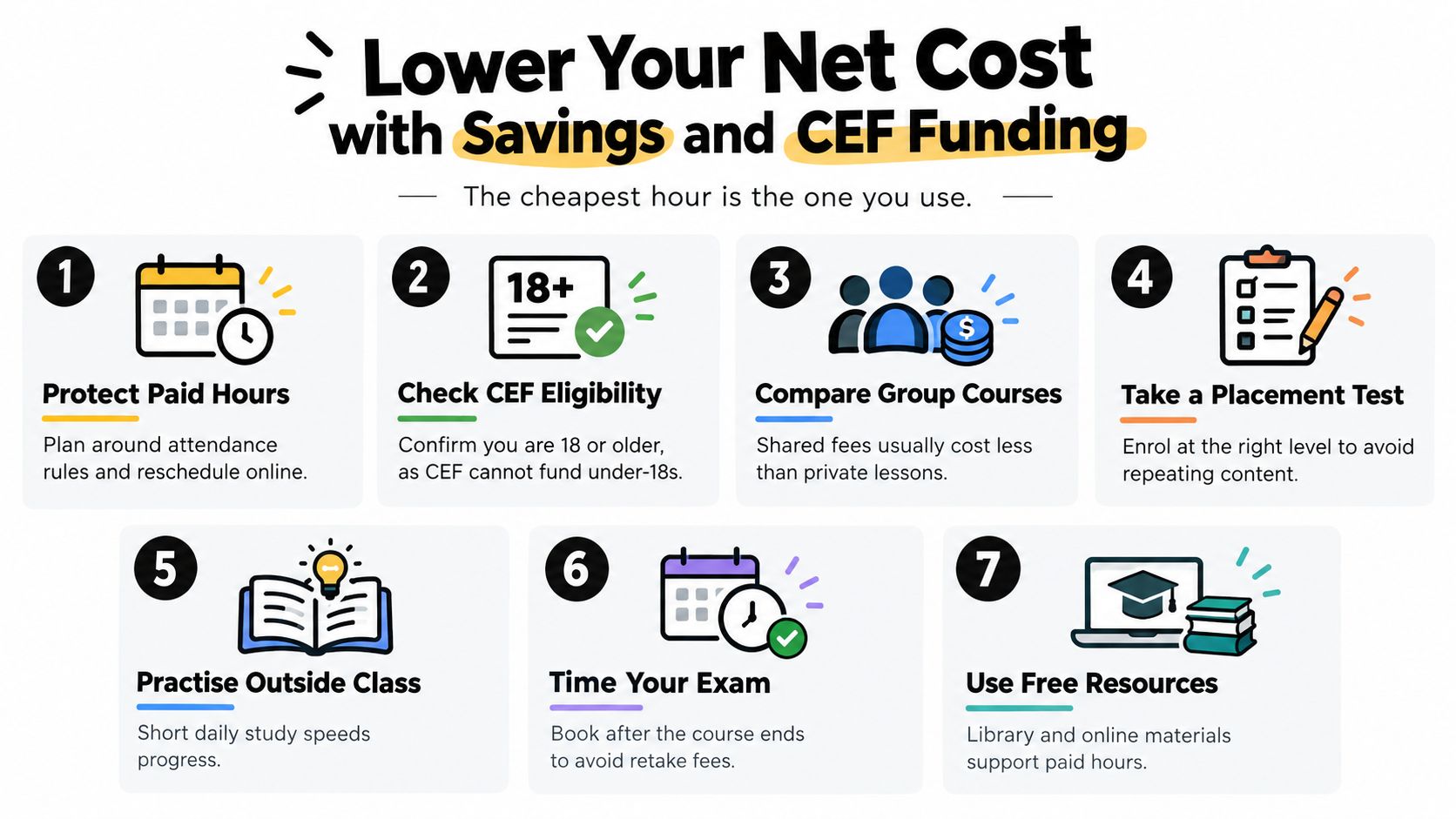
Independent practice makes teacher feedback more productive. Use library materials, course audio and a vocabulary review system to prepare questions before class rather than paying a teacher to supervise work you can complete alone.
Check CEF reimbursement before enrolling
According to the Continuing Education Fund's reimbursement rules, eligible approved courses commencing on or after 1 August 2022 can receive reimbursement up to a HK$25,000 lifetime maximum, with learners paying 20% of course fees for the first HK$10,000 of subsidy and 40% for the remaining HK$15,000.
Those percentages describe learner contributions within the subsidy bands. Don't treat the maximum reimbursement as cash automatically available for any German course.
- Course approval: Confirm that the exact course is officially CEF-reimbursable, not merely that the provider offers other approved programmes.
- Cash flow: Plan how you'll pay course fees before reimbursement arrives.
- Successful completion: Ask about attendance, assessment and any specified language examination.
- Records: Retain receipts, enrolment confirmations and completion evidence from the start.
The CEF eligibility overview states that applicants generally must be at least 18 when the course begins, meet qualifying Hong Kong residency conditions such as right of abode, right to land or unrestricted right to remain, and apply within one year after successful completion, with the later date applying where a specified language examination is required.
CEF therefore cannot fund underage children's lessons. Adults should check the relevant HK Smart Identity Card status rather than assuming that living or working in HK automatically qualifies them.
The guide to CEF-funded German courses in HK can help you organise the questions to ask before committing.
Explore sponsorship without assuming eligibility
For study in Germany, check DAAD and university scholarship conditions directly, including whether the award requires German-language evidence. Keep your intended certificate aligned with both admission and funding applications where their rules allow.
Employer sponsorship is another route for business German. A proposal built around customer communication or an identifiable job responsibility is more persuasive than a general request for personal development.
Budget safeguard: Keep the gross course cost and the expected reimbursement separate until eligibility and successful-completion conditions are confirmed.
Ready to Start Learning? Book a Trial Class
Make your decision in a practical order:
- Confirm the goal and target level. Identify who will assess your German and what proof they accept.
- Set the complete budget. Include tuition, assessment, materials and any eligible funding.
- Choose a sustainable format. Match the learning arrangement to your work, school and family commitments.
A trial class should help you judge more than whether the teacher is friendly. Notice how much German you use, whether corrections are clear and whether the activities match your objective.
Choose support that matches your destination
Our Cultural Association offers native German-speaking teachers with academic credentials, a structured curriculum, small-group and private learning, and preparation for Goethe-Zertifikat, TestDaF, IGCSE, A-level and IB examinations. These are useful decision criteria alongside university continuing-education courses or independent tuition, depending on the structure and flexibility you need.
In-person centres near Tsim Sha Tsui and Causeway Bay MTR stations suit learners who value a classroom routine. Zoom sessions and online rescheduling offer alternatives when commuting or changing work commitments make attendance difficult.
Bring your intended deadline, previous learning records and a realistic weekly availability to the discussion. That gives an advisor something concrete to assess instead of guessing from a broad request to become fluent.
A sound plan for costs and language requirements should tell you what to study, what to pay for and how you'll know you're ready.
- Book a trial class: Assess the teaching style and learning environment.
- Contact our advisors: Request a level assessment and an itemised budget plan.
- Check the latest course schedule: Explore the available formats through the association's website.
German Cultural Association Hong Kong(GCA) offers structured German courses, native-speaking teaching and examination preparation through classroom and Zoom learning. Visit German Cultural Association Hong Kong(GCA) to book a trial class and discuss a course plan that fits your target qualification, budget and schedule.

Costs and Language Requirements for German in HK

Student Exchange to Germany: Programmes for HK Students


