.png)
.png)

BLOG

香港德國文化協會
The German Cultural Association
Careers & Exams Compared for HK Learners
A Form 5 student in Sha Tin is choosing between IGCSE German, the Goethe-Zertifikat B1, and TestDaF. Her sister is preparing for a German university, while her father wants a CEF-eligible credential that will remain useful beyond school. The wrong exam could cost her time, money, and a valuable application window.
That decision is increasingly relevant in Hong Kong. From 2025, the Goethe-Zertifikat became the officially stipulated examination for the HKDSE German Language subject under Category C, Other Languages, administered locally by Goethe-Institut Hongkong. The Goethe-Institut Hongkong examination information confirms that its system covers CEFR A1 to C2, creating a progression from beginner study to advanced academic and professional use.
This guide, Careers & Exams Compared for HK Learners, gives parents, teenagers, university applicants, and working professionals a practical way to choose. You'll see which exam supports HKDSE reporting, CEF reimbursement, German-taught university admission, immigration documentation, and corporate use.
Table of Contents
- For school and HKDSE planning
- For German-taught university admission
- For visa and mobility planning
- For Hong Kong careers
Why Hong Kong Learners Compare German Exams in the First Place
Hong Kong families rarely choose a German exam because they like the language. They're usually balancing a school requirement, a university plan, a visa application, or a career move. A teenager may need a recognised result for the school record, while an adult may want proof of German for a future employer or relocation plan.
The pressure becomes greater when different family members value different outcomes. A parent may focus on CEF funding and formal recognition. A student may prefer the exam that fits DSE, IB, or IGCSE preparation. A university applicant needs an admission credential, while a working professional needs a result that a recruiter can understand quickly.
Hong Kong's official figures show how specialised this pathway remains. The 2024 HKDSE examination statistics recorded 83 German Language candidates overall, including 75 day-school candidates. German is therefore a small subject track, but that makes the choice of credential more important, not less.
The four decisions families commonly get wrong
Parents: They often assume the most advanced exam is automatically the most useful. A credential is only valuable when the receiving school, authority, or employer accepts it for the intended purpose.
Teenagers: They may choose IGCSE, A-level, or IB German because it fits the timetable, without checking whether they also need an independent CEFR certificate such as Goethe-Zertifikat B1 or B2.
University applicants: They sometimes mistake a strong school German result for proof of German-taught university readiness. German universities may require a dedicated language admission examination.
Working professionals: They may chase a university-oriented exam when a stepwise Goethe qualification or Business German pathway would communicate workplace ability more clearly.
Hong Kong supports both academic and vocational progression. The KOF Factbook information on Hong Kong's education system describes senior secondary and vocational routes within the territory's 12 years of free education, while the Education Bureau estimates that about 45% of the relevant age cohort has access to degree-level education and over 70% when sub-degree education is included. These figures explain why German study can serve different destinations, from university applications to vocational preparation.
The key question isn't “Which exam is easiest?” It's “Which exam produces the outcome I need?”
What Each German Exam Actually Does in Hong Kong
Goethe-Zertifikat provides CEFR credentials from A1 to C2, TestDaF supports German-taught university applications, IGCSE and A-level German serve school and international academic routes, and IB German fits the IB diploma structure. In Hong Kong, Goethe is the most flexible general credential, while TestDaF is the specialist university-entry test.
Goethe-Zertifikat
The Goethe-Zertifikat is the clearest general-purpose ladder. Learners can progress from A1 through C2, and the examination system is locally administered through Goethe-Institut Hongkong. The Continuing Education Fund recognises Goethe-Zertifikat A1, A2, B1, and C1 through Goethe-Institut Hong Kong, making these levels especially relevant to cost-conscious adult learners.
Goethe is useful when you need a portable certificate that can support school progression, employment discussions, visa preparation, or personal mobility. It also works well for learners who aren't yet ready to commit to a university-specific examination.
TestDaF
TestDaF is designed for learners targeting German-taught higher education. Goethe-Institut Hong Kong states that it targets CEFR B2 to C1 competence, and the local TestDaF examination details explain that it's administered digitally on computers at the Goethe-Institut Hong Kong, the city's only TestDaF centre.
TestDaF follows a fixed worldwide calendar with six annual dates, so it offers predictability but less flexibility than open-entry language pathways. It's the right tool when a university application requires an academic German result, not merely evidence of general language learning.
IGCSE German
IGCSE German is a Cambridge school qualification. It may fit an international school timetable and can support academic reporting, but availability in Hong Kong is limited. Students should confirm whether their school offers the subject or whether they'll need a private examination arrangement.
A-level German
A-level German suits students following a UK-style academic route. It develops substantial reading, writing, listening, and speaking ability, but it isn't a replacement for TestDaF or Goethe C1 when a German university asks for a specific language certificate.
IB German
IB students may take German ab initio or Language B, depending on their background and programme. The qualification demonstrates academic discipline within the diploma, but its usefulness depends on the university's current subject and language rules.
For a broader explanation of study habits alongside exam selection, ChatPal's German speaking guide offers practical advice on building speaking practice into a structured routine. Families comparing the two main external credentials can also review this guide to Goethe-Zertifikat and TestDaF.
| Exam | Governing body | CEFR level | Primary HK use |
|---|---|---|---|
| Goethe-Zertifikat | Goethe-Institut | A1 to C2 | General certification, school, work, mobility |
| TestDaF | TestDaF Institute | B2 to C1 target | German-taught university admission |
| IGCSE German | Cambridge Assessment | Programme-based | International school qualification |
| A-level German | Cambridge or relevant UK board | Programme-based | UK and international university route |
| IB German | International Baccalaureate | Programme-based | IB diploma and international applications |
Comparing the Five Exams Side by Side for HK Outcomes
The strongest exam depends on the institution reading your result. A school may want a curriculum qualification, a German university may require TestDaF or an advanced Goethe certificate, and an employer may value a recognisable CEFR level that can be matched to a job requirement.
The table below gives the practical comparison. Where a result depends on a university, immigration authority, or employer, verify the current requirement directly. Exam recognition isn't universal, and school qualifications don't automatically replace external language certificates.
| Outcome | Goethe-Zertifikat | TestDaF | IGCSE German | A-level German | IB German |
|---|---|---|---|---|---|
| CEFR scale | A1 to C2 | B2 to C1 target | Depends on performance and specification | Depends on performance and specification | Depends on course and performance |
| Difficulty in practice | Progressive, with clear level choices | Academic and demanding | School-syllabus focused | Broad and academically intensive | Integrated with IB workload |
| Pass standard | Set by the relevant level examination | Requires performance across four subtests | Set by Cambridge assessment | Set by the relevant UK board | Set by IB assessment |
| Format | Varies by level and local arrangement | Digital, computer-based | Cambridge format | UK examination format | IB assessment format |
| Oral component | Included at relevant levels | Speaking component included | Specification-dependent | Speaking component included | Oral and internal assessment elements may apply |
| Local administration | Goethe-Institut Hong Kong | Goethe-Institut Hong Kong only | School or private arrangement | UK examination centre arrangement | School-based IB route |
| CEF eligibility | A1, A2, B1, and C1 are recognised | TestDaF is recognised through the relevant Hong Kong academic provider | Not identified as a CEF-listed German examination | Not identified as a CEF-listed German examination | Not identified as a CEF-listed German examination |
| HKDSE reporting | Officially stipulated German examination route from 2025 | Not the standard Category C route | May support school reporting where accepted | May support school reporting where accepted | School and IB reporting route |
| German university admission | Goethe C1 can be relevant, subject to university rules | Designed for German-taught university applications | Doesn't substitute automatically | Doesn't substitute automatically | Doesn't substitute automatically |
| Immigration and employer value | Strongest flexible CEFR signal | Primarily academic | Mainly academic | Mainly academic | Mainly academic |
What the comparison means in real life
TestDaF and Goethe C1 are the specialist choices for German-taught university admission, subject to the individual university's rules. IGCSE, A-level, and IB German can strengthen an academic profile, but they shouldn't be treated as automatic substitutes for an admission examination.
Goethe is the more versatile option for learners who may need a credential across different situations. TestDaF is narrower, but that narrowness is an advantage when the target is German-taught higher education.
CEF eligibility also matters. Hong Kong's Continuing Education Fund German examination list includes Goethe-Zertifikat A1, A2, B1, and C1 through Goethe-Institut Hong Kong, along with academic German tests including TestDaF through Hong Kong Baptist University.
When adding a credential to a CV, list the exact exam and level rather than writing “basic German” or “conversational German”. This education section guide for ATS is useful for presenting qualifications in a way that remains clear to recruiters and automated screening systems.
Practical frictions can decide the outcome. IGCSE German may require private entry, A-level German may require access to a UK examination centre, and TestDaF's fixed dates mean you can't treat registration as an afterthought.
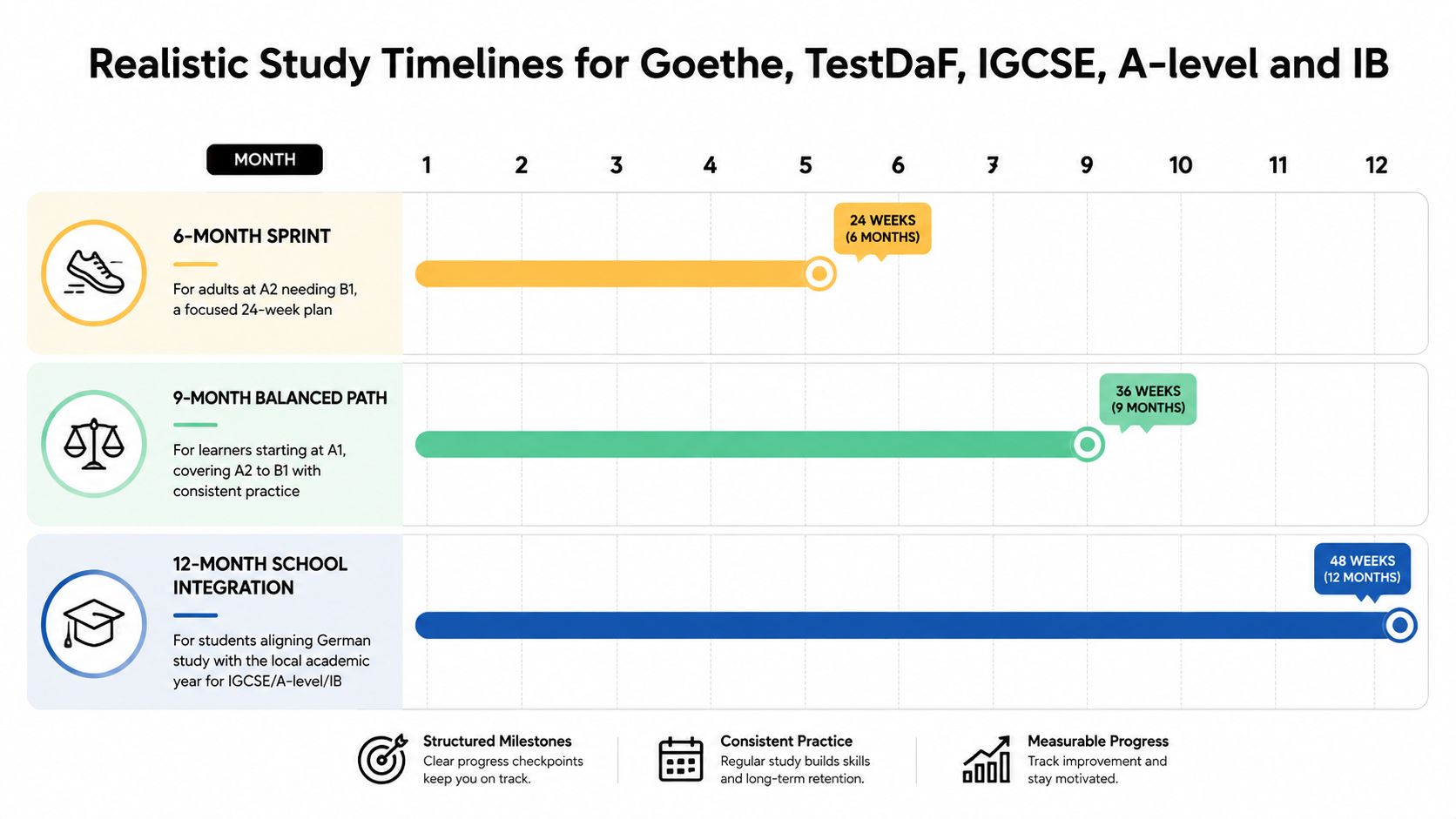
Realistic Study Timelines for Goethe, TestDaF, IGCSE, A-level and IB
A credible plan begins with the learner's starting level, not the desired certificate. Adults with A2 German can work towards B1 more directly than beginners can, while school students must balance German with DSE, IGCSE, A-level, or IB demands.
The six-month sprint
This route suits an adult already functioning around A2 who needs Goethe-Zertifikat B1 for a defined mobility, work, or personal objective. A workable budget is around four hours of guided class plus two hours of self-study each week, with regular speaking correction and timed writing.
The six-month plan should include:
Diagnostic assessment: Confirm that the learner is at A2 across speaking, listening, reading, and writing.
Targeted grammar repair: Fix word order, case endings, past-tense control, and clause structure before they become exam-time weaknesses.
Weekly production: Practise short spoken responses and written tasks under time limits.
Final simulation: Complete full practice papers and identify which component still loses marks.
Don't use this route if you're starting from beginner level. Extend the plan rather than booking an exam date you're unlikely to handle.
The 12-month mainstream track
A Form 4 student preparing for IGCSE German, or a professional targeting TestDaF, needs a longer runway. A practical structure is around three guided hours weekly plus structured homework, with a midpoint mock exam to expose gaps before the final stage.
The student's school syllabus and external CEFR preparation should support each other, but they shouldn't be confused. TestDaF requires academic language and integrated task control, while IGCSE German follows its own assessment design.
The 18-month academic route
IB German B HL or an Abitur-oriented pathway requires sustained work across reading, writing, listening, speaking, and academic vocabulary. Five hours weekly can be realistic when parents support the schedule and the student uses school holidays for concentrated exposure.
Learners who can't maintain the stated commitment should lower the immediate target or extend the timeline. Exam timing also needs training, so use structured tips for pacing exam time, then apply them in German-specific mocks.
For a level-by-level planning reference, see this realistic German learning timeline from A1 to C1.
Which Exam Fits Your Goal in Hong Kong
Choose the credential by destination. Prestige is a poor substitute for eligibility.
For school and HKDSE planning
If your immediate priority is the school record, choose the qualification that fits your school's programme and confirm how it can be reported. Since the 2025 arrangement makes stipulated German examination results reportable on the HKDSE certificate when taken through the official Hong Kong examiner, Goethe-Zertifikat deserves serious attention for HK students.
IGCSE, A-level, and IB German remain relevant for international-school pathways. They may be excellent academic choices, but they serve the curriculum first. Add a Goethe certificate when you need a separate CEFR benchmark that universities, employers, or other authorities can interpret quickly.
For German-taught university admission
Choose TestDaF or Goethe C1, then check the specific university's current rules. TestDaF is the direct academic route for many applicants, while Goethe C1 can provide a broader certificate format.
Don't rely on a general school result without checking the admissions page. The university, not a tutorial centre, decides which examination and score combination it accepts.
For visa and mobility planning
Goethe-Zertifikat B1 is often the practical target for adults who need a documented intermediate level, but immigration rules vary by route and can change. Verify the accepted exam and required level with the relevant authority before registration.
The same principle applies to working holiday, family, vocational, and residence applications. A certificate can support a file, but it doesn't replace checking the official route.
For Hong Kong careers
Local German-speaking roles exist, but the market is specialised rather than broad. Current recruitment listings, such as the German-related roles on Indeed Hong Kong, should be read for recurring requirements rather than treated as a promise of employment.
For corporate teams, I'd usually choose Goethe B2 or a practical Business German route when the job requires meetings, email, customer contact, or coordination with German-speaking colleagues. A TestDaF result is impressive, but it may not answer an employer's practical question: can you perform the role in German?
| Exam | Primary HK outcome | CEFR level | CEF eligible | Strongest fit for |
|---|---|---|---|---|
| Goethe-Zertifikat | HKDSE reporting, mobility, work, general certification | A1 to C2 | A1, A2, B1, C1 | Flexible learners and professionals |
| TestDaF | German-taught university admission | B2 to C1 target | Recognised academic German route | University applicants |
| IGCSE German | International school qualification | Programme-based | Not listed as a Goethe CEF route | Secondary students |
| A-level German | UK-style academic progression | Programme-based | Not listed as a Goethe CEF route | UK and international applicants |
| IB German | IB diploma pathway | Programme-based | Not listed as a Goethe CEF route | IB students |
For a local career perspective, review this guide to German-speaking jobs in Hong Kong and hiring industries.
My single-exam recommendation: Choose Goethe-Zertifikat B2 if you want the strongest balance of portability, career relevance, and progression. Choose TestDaF instead when German-taught university admission is already your confirmed destination.
Choosing the Right Course Format and How GCA Fits
Course format affects consistency more than most learners admit. The right choice depends on whether you need peer discipline, flexible scheduling, or rapid correction from a specialist teacher.
Small-group classes
A small group capped at six students gives motivated teenagers a useful balance of attention and cost. It suits IGCSE, A-level, IB, and Goethe preparation when learners benefit from hearing different answers, practising pair work, and receiving live correction.
For HK school schedules, after-school and Saturday blocks are practical because they can be organised around DSE and IB commitments. The format also creates external accountability, which self-study rarely provides.
Private preparation
Private one-to-one lessons make sense for TestDaF, Goethe C1, fixed visa deadlines, and learners with specific learning needs. The hourly cost is higher, but a teacher can focus every lesson on the candidate's weakest paper, speaking performance, or writing structure.
Use private tuition when the deadline is immovable or when a group class would spend too much time on material you already know. It's especially effective for candidates who need intensive feedback rather than more worksheets.
Self-study
Apps, videos, and flashcards are useful supplements. They're not a complete exam strategy for advanced candidates because they don't reliably provide assessed writing, live speaking correction, or realistic mock-exam pressure.
Practical rule: Use self-study to increase exposure, not to replace teacher-led assessment.
The German Cultural Association Hong Kong(GCA) offers native German-speaking teachers, structured exam preparation for Goethe-Zertifikat, TestDaF, IGCSE, A-level, and IB, small-group classes capped at six, private lessons, Business German, and online Zoom sessions. Its small-group and private formats allow families to match delivery to the learner's exam and schedule.
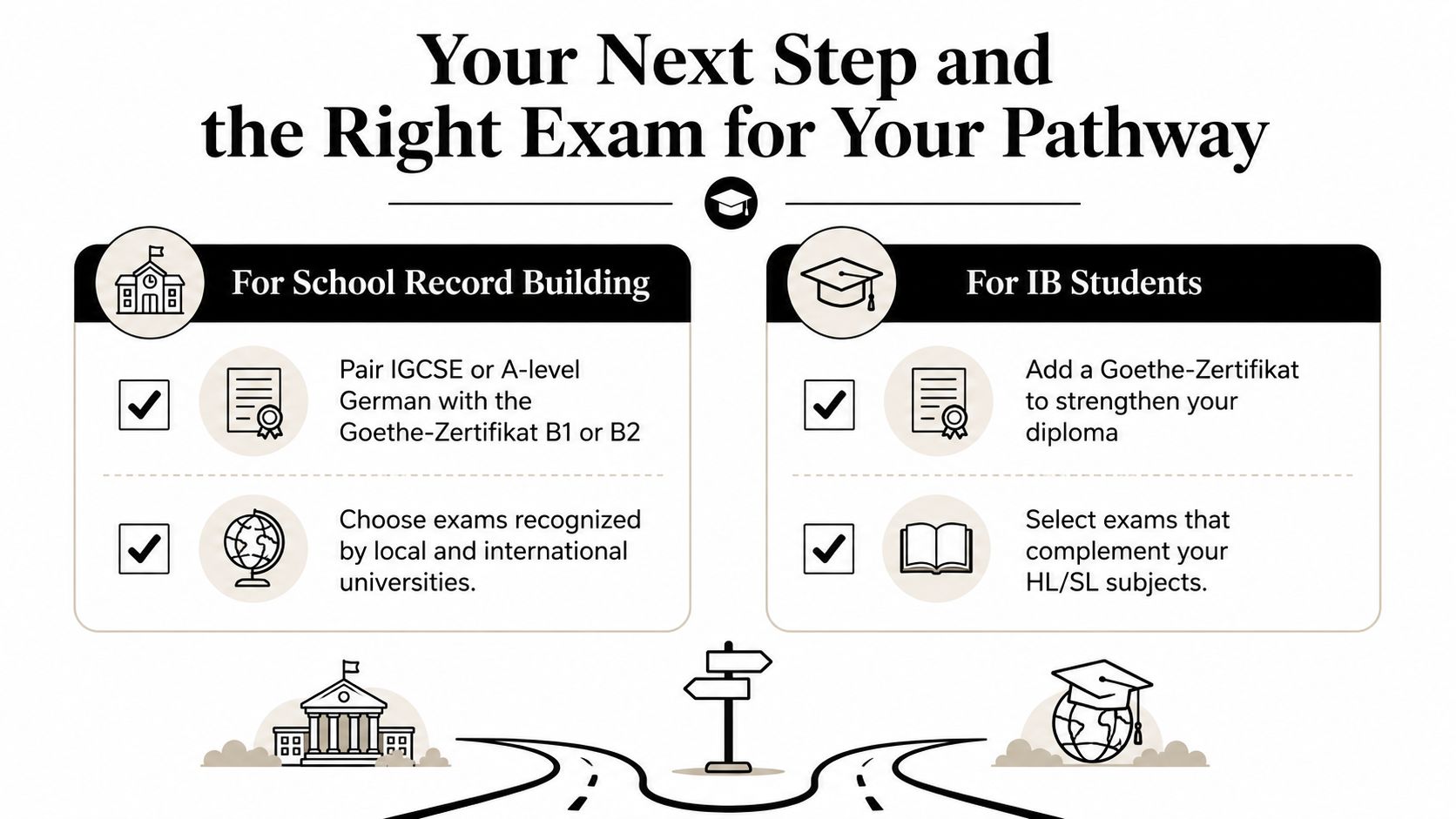
Your Next Step and the Right Exam for Your Pathway
Choose the exam by destination, not by reputation.
Teenagers: Pair IGCSE or A-level German with Goethe-Zertifikat B1 or B2 when a separate CEFR result will strengthen the academic record.
IB students: Use Goethe B2 as an additional benchmark when it complements, rather than overloads, the IB diploma.
German-taught degree applicants: Prioritise TestDaF or Goethe C1, then verify the university's current score and subject requirements.
Visa applicants: Confirm the accepted exam and level with the relevant authority. Don't assume one Goethe level applies to every immigration route.
Working professionals: Choose Goethe B2 or Business German when the goal is practical workplace communication and a clearer employer signal.
CEF funding can materially affect the budget. The CEF course information from HKU SPACE states that eligible learners may receive 80% of the first HK$10,000 of approved course and examination fees and 60% of the remaining HK$15,000, up to a maximum subsidy of HK$25,000. Check eligibility and approved-course conditions before paying.
Your next action should be a short goal consultation. Define the target school, university, employer, or visa route, confirm the required level from the official authority, complete a placement assessment, and choose either small-group or private preparation. Recheck the rules immediately before registration.
German Cultural Association Hong Kong(GCA) offers structured German exam preparation, native-speaking teachers, small-group classes, private lessons, and Business German for HK learners choosing between school, university, visa, and career pathways. Visit German Cultural Association Hong Kong(GCA) to arrange a diagnostic consultation and review the latest course schedule for your target exam.

Housing and Banking Explained for Hong Kong

Living in Germany as a Hongkonger: Anmeldung Made Simple


