


BLOG

香港德國文化協會
The German Cultural Association
Student Exchange to Germany: Programmes for HK Students
Your Form 6 son has a strong DSE forecast, or you are a working professional who can take a term away from a Hong Kong office. Germany looks practical. Public universities charge modest semester contributions, and English-taught modules exist. Then the central question lands. Does the home university even have a German partner, and which of the student exchange to Germany programmes will accept someone from HK?
A tourist booking will not create academic credit. A scholarship list will not tell you who in Hong Kong can use it. Eligibility, timing and credit rules decide the route, and language alone rarely does.
Table of Contents
What Is a Student Exchange to Germany?
A student exchange to Germany is a structured period of study at a German institution, based on an agreement between that institution and a student's home university. The home university nominates the student, the host institution decides on admission, and approved credits may transfer back under an agreed study plan. For Hong Kong students seeking degree credit, the university partnership is the starting point.
The process has three parts: a partner agreement, a nomination from your home university, and admission by the German host. Treat the agreement like a railway line, the nomination like a ticket, and host admission like a confirmed seat. Without a partner route, a student cannot apply for that university's exchange nomination. Ask the home university's exchange office to confirm the agreement and credit rules before paying for language tests or other application costs.

Hong Kong and German higher-education institutions have established cooperation and exchange agreements. DAAD records for 2018/19 document this history, but those records are dated and should not be used as current participation figures or as proof of a present-day ranking. For a decision now, check the exchange options and eligibility rules published by your own university.
University-linked routes include semester or full-year exchanges, summer and winter schools, and some research or internship placements. Their academic status depends on the programme and your home institution's approval, so get credit arrangements confirmed in writing before accepting a place. Erasmus+ applies only where an eligible partnership route exists.
The Working Holiday Scheme is a separate option for eligible young people, not a university-agreement-based exchange. It can provide a way to spend time in Germany, but it does not itself provide academic credit. If your goal is a credited term abroad, prioritise your university's German partnerships; consider the Working Holiday Scheme separately if you want a non-academic route.
Which Programme Type Fits Your Goals
A Hong Kong student's best route depends on whether the stay must count toward a degree, how long they can leave, and whether their university can nominate them. Choose the route before paying for tests or applications.
| Programme type | Typical length | Who it suits | Credit recognition | Main funding route |
|---|---|---|---|---|
| University semester exchange | One semester | Enrolled HK university students with a German partner | Credited through the home-university exchange agreement | Home-university exchange arrangements and DAAD awards where eligible |
| University year exchange | One academic year | Students able to spend a full academic year abroad | Transfers only with home-university approval | Same as the semester route, with higher living costs |
| Summer or winter school | A few weeks | Secondary students, undergraduates, young professionals | Certificate; credit only if the home institution approves | Self-funded or programme fees; check partner grants |
| Internship or research placement | Set by the project | Graduates or postgraduates with a defined project | Usually no academic credit | Self-funded; joint research schemes for qualified researchers |
| Erasmus+ mobility | Depends on the scheme | Hong Kong-based students should not assume they are eligible | Depends on the applicable agreement and approval | Confirm eligibility with your home university's international office |
| Working Holiday Scheme | Up to 12 months | HK residents aged 18–30 | Not academic; courses are incidental | Self-funded, with short-term work income |
Three filters before you email anyone
- How long can you be away? A semester may be easier to fit around work or faculty commitments than a full academic year. A short school can suit DSE, IB or IGCSE calendars.
- Do the credits need to count? If they do, focus on a university exchange or a short course your department has approved in writing. Do not assume a certificate transfers as credit.
- Does your university have a German partner? If yes, ask your exchange office about nomination requirements and available places. If not, the semester-exchange route is closed. Summer or winter schools and the Working Holiday Scheme may remain options.
Treat Erasmus+ as a question for your international office, not as a default route. Hong Kong is generally not an eligible partner country for Erasmus+ mobility, so an EU-linked partnership alone does not establish that a Hong Kong-based student can participate. Ask the office to confirm whether a specific scheme covers your university and exchange before you apply.
The Hong Kong Economic and Trade Office in Berlin states that Working Holiday participants may stay for up to 12 months, take short-term employment, and study or train as an incidental part of their stay. This route can suit gap-year students and recent graduates aged 18 to 30 whose university has no German partner. It is not a degree-semester substitute: study is incidental, work is temporary, and academic credit is not the purpose.
Hong Kong's university exchange system offers another route to explore. In 2023/24, the eight University Grants Committee-funded universities sent approximately 5,500 local students abroad on programmes lasting at least one semester. By the end of November 2024, they had signed more than 2,600 student-exchange agreements worldwide, according to the Brand Hong Kong international-education factsheet. A German semester can fit within that system, but your own university's partner list and nomination rules decide whether it is available to you. Select one or two realistic routes, then contact the office responsible for each.
Can Hong Kong Students Get Credit for Study in Germany?
A DSE pass does not open a German exchange by itself. DAAD's Hong Kong country information states that, under the applicable KMK/ZAB rules, direct university access requires the four Core Subjects and two Elective Subjects, with at least Level 3 in every subject. That threshold is for direct undergraduate entry, not for a partner nomination.
What Level 3 does and does not do
Meeting the minimum does not remove programme-specific admission conditions or proof of language proficiency. IB and IGCSE applicants face their own recognition rules at the host, so parents should not treat a DSE formula as universal. An exchange nomination still runs through the Hong Kong home university, which checks year of study, academic standing and course fit. Strong German will not repair a GPA below the faculty cutoff.
The document that protects your credits
Credit transfers only when the course list is approved in writing before departure, through a learning agreement signed by the home department. Without that approval, you can return with German transcripts that do not count toward the degree, the major, or residency requirements.
If the department will not sign the learning agreement, do not leave. A scenic semester that fails to count is an expensive holiday.
The agreements already signed across the UGC-funded sector, noted above, mean credit-transfer practice is normal. Your job is to use it, not to invent a private mapping after you land.
Ask the international office three questions, in writing:
- Pre-approval: Which courses are cleared before you depart, and who signs?
- Grade conversion: How are German grades mapped onto the HK scale?
- Residency: Does the exchange count toward the minimum time you must spend on the home campus?
Working Holiday participants earn no academic credit. If credit is the goal, that route is the wrong row.
How Much Does a German Exchange Cost and How to Fund It
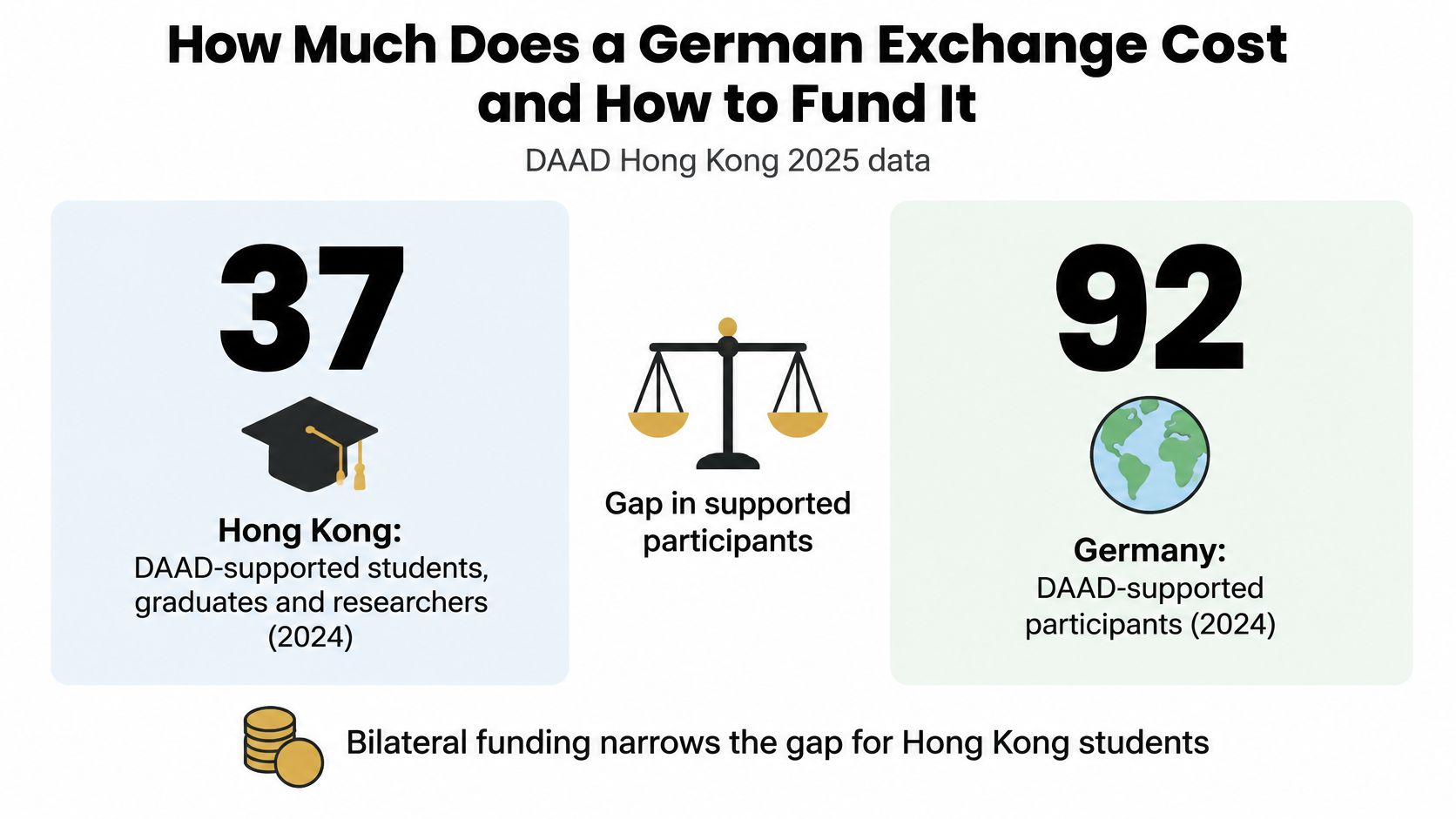
A Hong Kong student's exchange budget depends on the host city, length of stay and funding route. Treat a scholarship as a possible contribution, not a promise that it will cover the full cost. DAAD's 2025 Hong Kong country data records 37 DAAD-supported students, graduates and researchers from Hong Kong in 2024, compared with 92 supported participants from Germany. Funding exists, but awards are selective.
Build your budget around four costs: the host's semester contribution, rent and daily expenses, travel and health insurance, and any financial proof required for a visa. Public universities often charge exchange students a semester contribution instead of full tuition, but confirm the amount and what it covers with the host. Living costs vary by city and stay length. Insurance must cover the whole study period, including time before enrolment. For a student visa, check the current proof-of-finance requirement with the German mission before moving money into a blocked account, since the required amount can change.
Use this guide to German living expenses and scholarship options to start your estimate, then verify each cost with your host and insurer.
Choose funding by eligibility and timing:
- University nomination is the usual starting point for a semester exchange. Ask your Hong Kong international office which awards require nomination and when applications close.
- DAAD individual funding is competitive and often suits research, short courses or postgraduate study better than a standard undergraduate semester. Check each award's eligibility before preparing an application.
- Summer and winter course support applies to short courses, not automatically to a full degree-term exchange.
- PROMOS, a German university mobility funding programme, may support exchange mobility through a participating German partner. Ask your home university and German host whether funding is available for your programme.
- The Germany–Hong Kong Joint Research Scheme is intended for qualified researchers, not Form 6 students.
- CEF, Hong Kong's Continuing Education Fund, may support eligible approved courses. Confirm that the language course appears on the approved list and that you meet the fund's requirements before paying.
A partial award still leaves costs to cover, so combine confirmed funding with family savings rather than budgeting around an unapproved application. Working professionals should compare an employer-funded language course with the full cost of an exchange. If the goal is workplace German rather than academic credit, a funded Business German course may be the more practical choice.
For an overview of how funding can fit into an exchange budget, watch this video before finalising your estimate.
Visa and Residence Rules by Length of Stay
Match the stay to a row before you buy a flight. A mismatch is a reason to pause, not a detail to fix at the airport.
| Stay type | Entry route | Work allowed | Check before booking |
|---|---|---|---|
| Up to 90 days in any six-month period | Visa-free entry for HK SAR passport holders | No gainful employment | Confirm the stay is short, non-paid and not a degree programme |
| Study stay longer than 90 days | Student visa applied for at the German mission before entry | Limited work within visa conditions | Host admission letter, home-university confirmation and proof of finance in hand |
| Up to 12 months under the Working Holiday Scheme | Working Holiday visa under the bilateral scheme | Short-term employment permitted | Confirm current age limit, insurance and funds rules |
| Tourist entry converted to a student visa | Not possible after arrival | Not applicable | Apply from Hong Kong before travelling |
Germany's Federal Foreign Office states that applicants for a study stay generally need to apply at the responsible German diplomatic mission before entering Germany, with proof of university admission and evidence they can finance the stay. A short-term visitor arrangement is not a substitute.
The visa-free rules let Hong Kong SAR passport holders enter for up to 90 days in any six-month period. Visitors may not take up gainful employment. That route fails for paid work and for any stay beyond 90 days, including most semester exchanges.
A tourist stamp cannot be upgraded to a student visa after you land. If the programme is longer than 90 days, you apply from Hong Kong first.
Working Holiday remains the bilateral route already described, with short-term work and incidental study. Verify the current age, insurance and funds rules with the authorities before you treat a webpage as permission. The blocked-account and document sequence is set out in the note on a Germany student visa from Hong Kong. Secure admission and finance papers before you book travel.
How to Build German Readiness Before You Depart
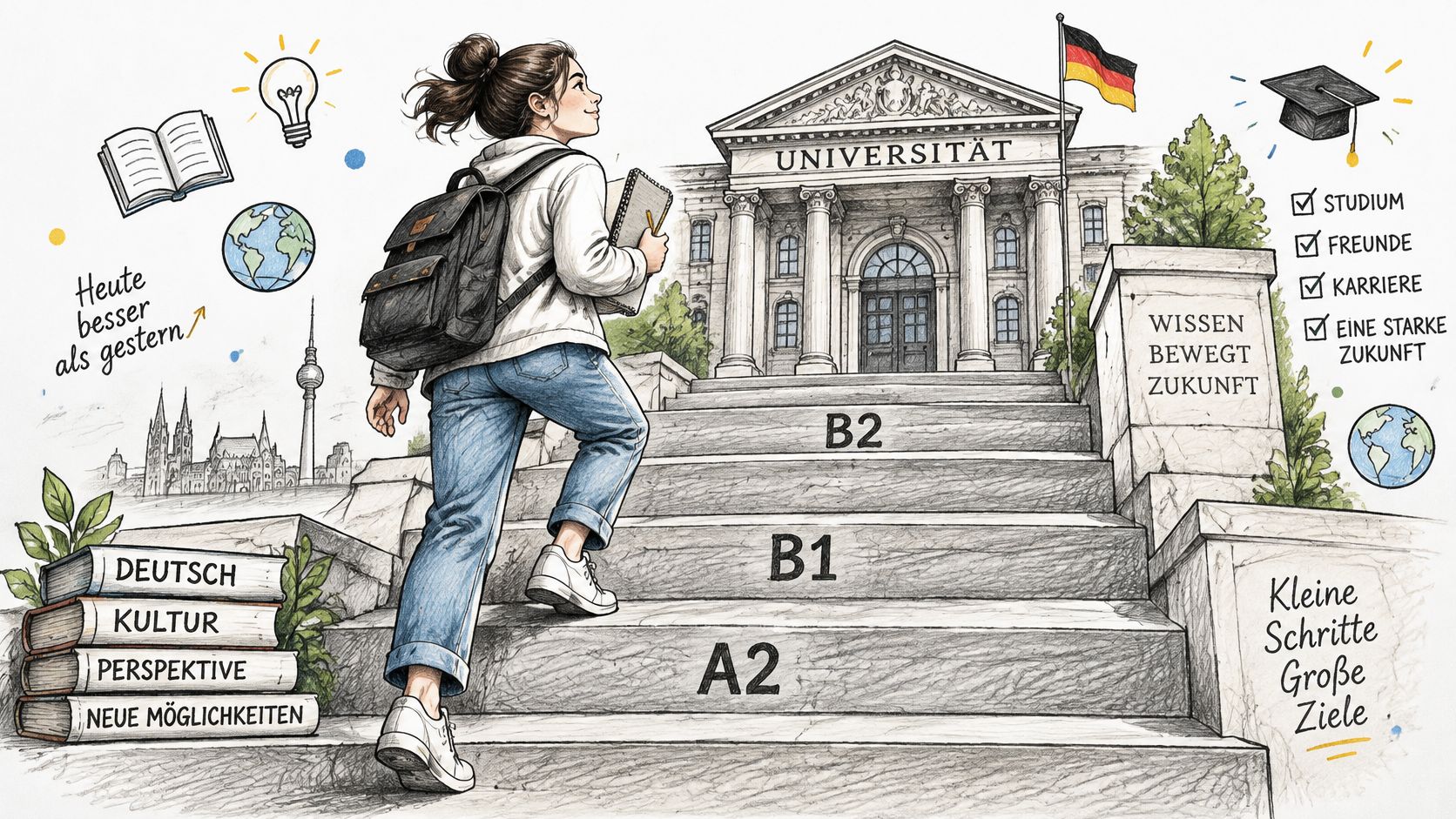
A student leaving for a German-taught course needs a different level of preparation from someone attending an English-taught summer programme. Host requirements vary, so use these levels only as a starting point and check the exact requirement in your offer letter or partner letter:
- Summer schools may accept A2 to B1.
- Partner exchanges may ask for B1.
- German-taught degree courses commonly require B2 or higher.
An English-taught module can still involve German in daily life, including communication with housing offices. Check whether your host requires proof of German, names an accepted certificate, or sets a level for a particular course. Use the CEFR level guide for Hong Kong learners to understand what each level means in practice, then confirm the requirement directly with the host.
Allow several months of steady weekly study to move from beginner level to B1. Reaching B2 often takes a year or longer, depending on study time. No course can guarantee fluency in a month. A Form 6 student who starts in September for departure the following autumn has time to build a routine; someone studying one evening a week should plan for slower progress. Choose a course by checking its structure and whether it prepares students for any exam their host accepts.
Life admin you cannot cram in week one
Apply for student housing early. Waiting lists are common, so arrange a short-term rental as a backup if your room is not confirmed. Before departure, learn the everyday expectations that affect settling in: punctuality, quiet hours and registration-office paperwork. Practise the German phrases you may need for those tasks, even if your course is taught in English. That preparation can make the first weeks easier while you continue improving your language skills.
Application Timeline and Document Checklist
Treat the exchange application as five phases. Keep credit approval, funding and visa documents on the same schedule, so a missing signature does not delay departure.
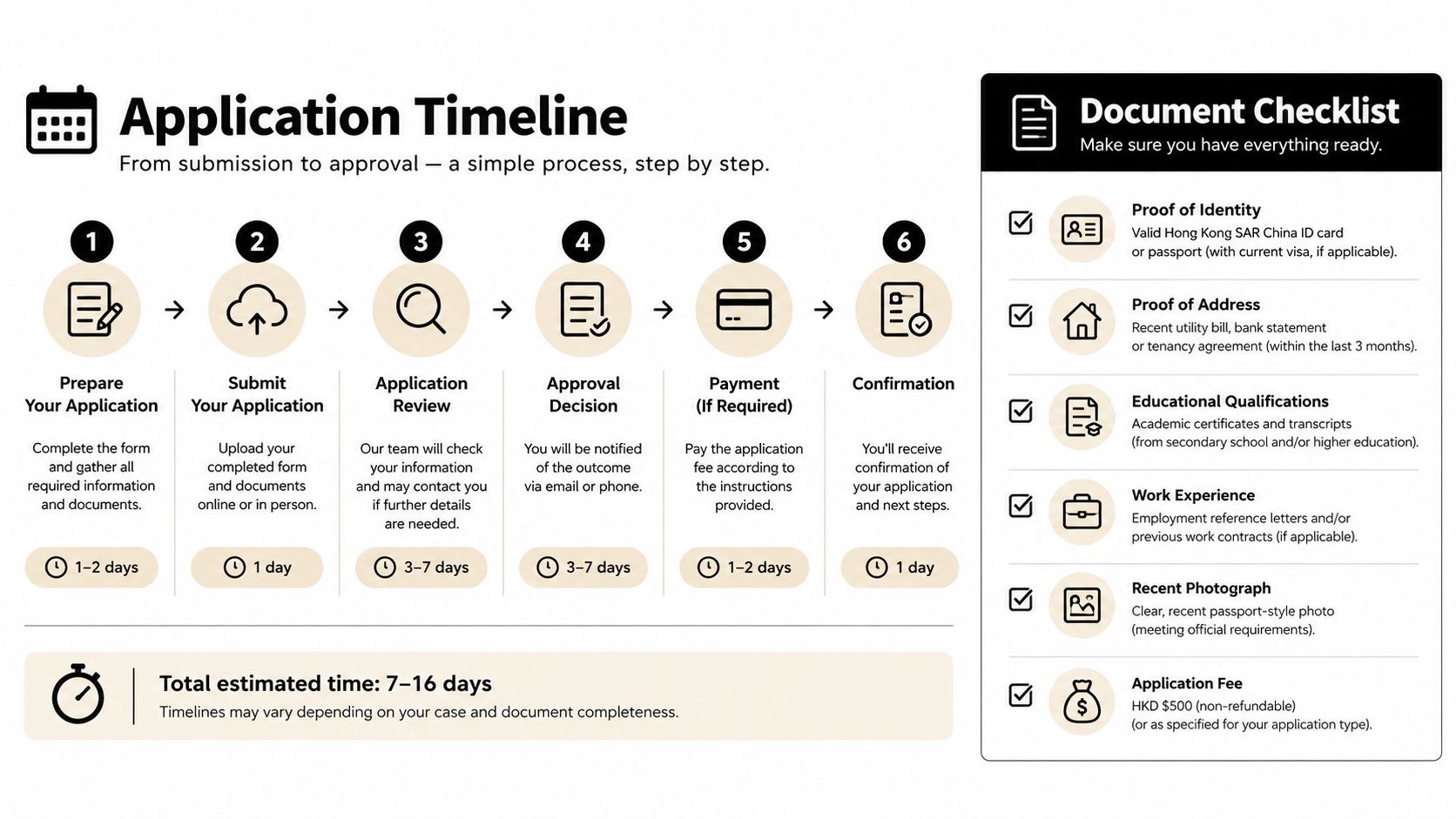
- Twelve to nine months out. Ask your home university's international office which German partners accept exchange students. Confirm the partner agreement, nomination process and deadline. A late nomination can end the application before the host reviews it.
- Nine to six months. Obtain your nomination letter and apply to the German host. Check the admission and language requirements for your chosen courses. Agree on a learning agreement with your home department, get it signed before departure, and confirm how the courses will count toward your degree. Apply for DAAD funding only if your study level and programme length fit the award's eligibility rules.
- Six to three months. Check the current visa instructions for your situation, then prepare the required documents. The German Consulate General's exchange guidance lists an admission or invitation letter from the host and confirmation from your Hong Kong home university naming the exchange, host and exact study period. Include your nomination letter, signed learning agreement, proof of finance and health insurance. Do not rely on an assumed application window; follow the German mission's current guidance and secure the required residence authorisation before travel.
- Three to one month. Book accommodation, confirm course registration and arrange travel once your visa requirements and application status are clear.
- After arrival. Register your address with the local registration office within the required period and open a bank account to pay rent and the semester contribution.
Papers to have in one folder
- Passport: valid for your stay, plus biometric photos.
- Academic file: transcripts and the language certificate required by the host.
- Exchange and credit records: nomination letter, admission or invitation letter, home-university confirmation and signed learning agreement.
- Money and cover: financial proof, insurance certificate and accommodation confirmation.
Keep both scans and originals. German offices may request them at different stages.
Can I Work During My German Exchange?
Your work rights depend on your residence status. If you hold a German student residence permit, you can work up to 140 full days or 280 half days per calendar year, or up to 20 hours a week during term time. Check the current rules with the German Federal Government's Make it in Germany portal. Ask your host university's international office to confirm how the limit applies to your permit before accepting a job or paid internship.
A HiWi job is a student assistant position, usually at a university. Do not assume that a classmate's work allowance applies to you. Visa-free visitors cannot work, while Working Holiday Scheme holders can take short-term jobs under that route's conditions. If earning income is a priority and academic credit is not, check the Working Holiday eligibility rules before choosing an exchange.
Do I need a partner university to go?
No. Without a partner university, consider a summer or winter school, a research placement or the Working Holiday Scheme. Research placements and Working Holiday stays do not carry academic credit. A summer school provides a certificate, and may provide credit only if your Hong Kong institution approves it in advance. Get that approval in writing before paying fees.
Short courses can suit a secondary student taking DSE, IB or IGCSE, or a professional considering a career break to study in Germany. Confirm the programme's age requirements and ask your school or employer whether the certificate will meet your goal.
Can secondary students apply?
Some summer and winter schools accept secondary students. A semester exchange requires university enrolment, so a Form 4 pupil should apply for a short course instead. Parents should confirm the course's age rules, arrange transparent funding and use the time to build the German proficiency a future host university requires.
Match the programme and visa conditions before paying a deposit. If they do not fit together, choose a different route.
Ready to Start Learning?
Confirm the nomination deadline with your home-university international office this week. Every later step hangs on that date, and most windows close earlier than families expect.
- Book a trial class and place your current German against the B1 or B2 level the host has written down. Guessing wastes a term.
- Speak to advisors who can match the programme, the timeline and the budget, including Goethe-Zertifikat preparation if the course requires a certificate.
- Check the latest course schedule for exam preparation, Business German or Travel German, and pick a start date that leaves at least six months before entry.
Student exchange to Germany programmes reward people who treat eligibility as a filter, not a slogan. Start now, while the international office is still taking nominations.
German Cultural Association Hong Kong(GCA) runs native-taught German classes in small groups, with Goethe-Zertifikat and TestDaF preparation that matches the levels German hosts ask for. If you are weighing a semester exchange, a short course or a Working Holiday from Hong Kong, their advisors can place your level and your timeline before you commit. Visit German Cultural Association Hong Kong(GCA) to book a trial class or check the current schedule.

Student Exchange to Germany: Programmes for HK Students

APS and Deadlines for Germany: A Hong Kong Timeline


