.png)
.png)

BLOG

香港德國文化協會
The German Cultural Association
Documents & Timeline for German Exams and Study in Hong Kong
A Hong Kong parent can spend months comparing German universities for a teenager, then discover that the challenge isn't choosing a course. It's coordinating language certificates, school transcripts, university forms, visa evidence, insurance, financial proof, and appointment dates without one missing document disrupting the whole plan. A working professional applying for a master's programme in Munich faces the same problem from a different starting point.
This Documents & Timeline guide turns that administrative maze into a practical sequence. You'll see what to prepare, which language route fits your programme, when to work backwards from an intake deadline, and where Hong Kong applicants commonly lose time. Start early, keep one controlled document tracker, and treat every certificate, translation, and appointment as part of one connected application.
Table of Contents
- Teen students aged 14 to 18
- Parents planning the route
- Adult and undergraduate applicants
- Working professionals
Navigating the German Pathway in Hong Kong
The situation is familiar. A student has strong HKDSE, IB, IGCSE, or A-level results and is interested in Germany, while the family assumes the next step is German tuition. Then the university asks for a specific language certificate, the visa guidance asks for admission proof and possibly German-language evidence, and the applicant realises that an exam date, certificate release, university deadline, and visa appointment must all line up.
Hong Kong already has a small but established German-language community. An academic source citing the Federal Foreign Office estimates approximately 4,000 German-speaking residents in Hong Kong, while a Hong Kong University survey recorded German speakers as 0.7% of visible language groups. The same source recorded 90 students enrolled for German in the 2016/2017 school year, compared with 156 for Spanish, 164 for French, and 132 for Japanese, confirming that German is niche but institutionally present in Hong Kong's multilingual education system (Hong Kong University academic source).
A migration dataset lists 2,058 people from Germany in Hong Kong's immigrant stock, within a wider immigrant population of 2,962,492 in 2020, equivalent to 39.89% of the population (Hong Kong immigration data). That background matters. German study in HK isn't a passing trend, but part of a longer international, educational, and professional connection.
Use the STAR method to control the process
I advise applicants to organise the route through four questions:
- Situation: Are you a secondary student, an undergraduate applicant, a graduate applicant, or a working professional?
- Task: Which outcome are you targeting, a German-taught degree, an English-taught programme, a visa, a school examination, or career mobility?
- Action: Which certificate, transcript, translation, financial document, insurance record, and application form must you obtain?
- Result: What must be complete before the university deadline, and what must be ready before the visa appointment?
The result should be a dated checklist rather than a loose folder of files.
Practical rule: Never book a language exam only because it's the next available date. Book it because its result will arrive before the document deadline that depends on it.

What Is the Documents & Timeline Strategy
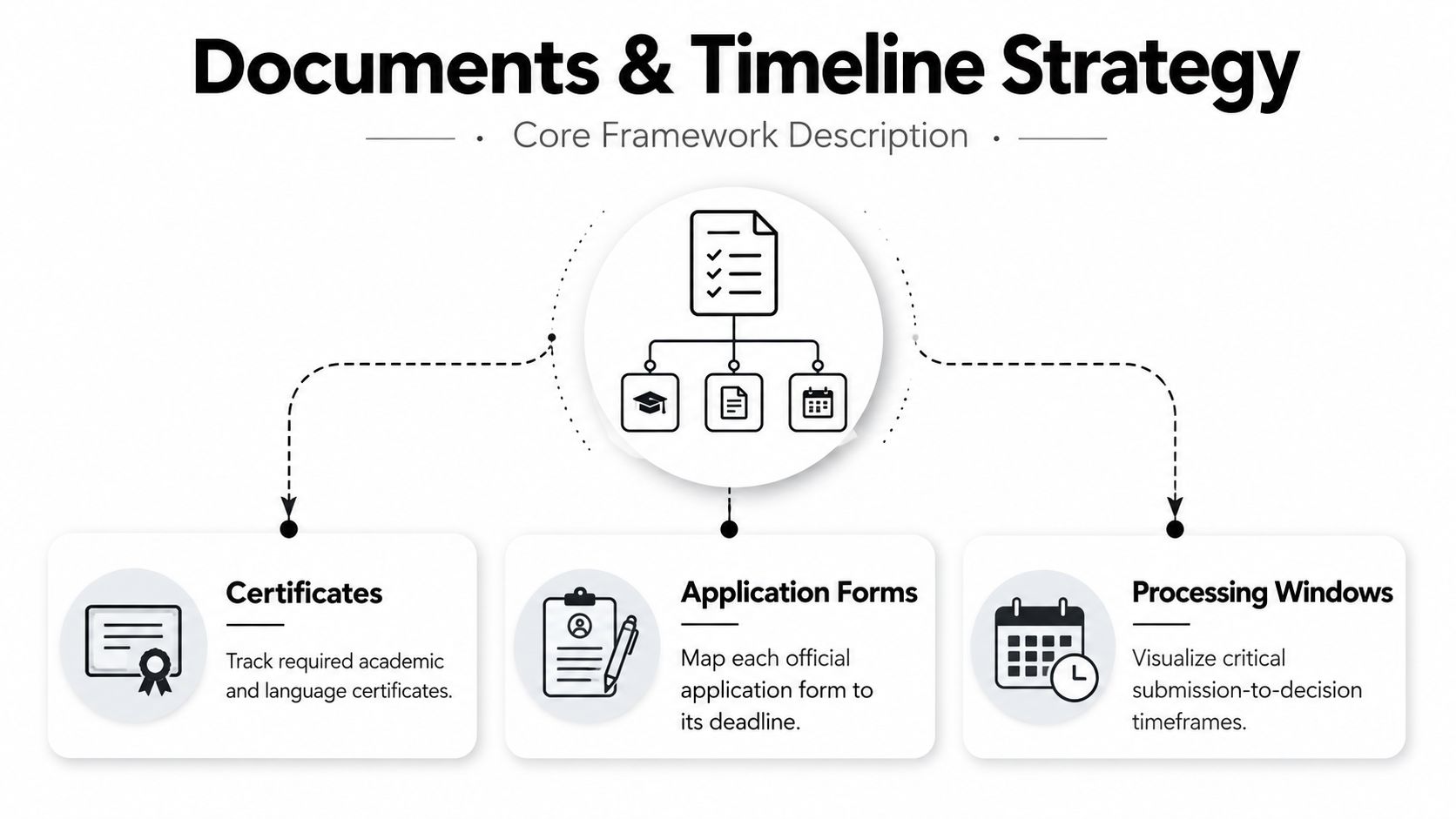
The Documents & Timeline Strategy is a structured planning framework that maps every required certificate, application form, and administrative milestone, from German language exam registration at GCA to university enrolment and visa approval, onto a realistic calendar. It helps Hong Kong applicants submit complete applications on time and prevents last-minute gaps between documents, decisions, and travel plans.
The strategy has three pillars:
- Document collection: Create a master list covering academic transcripts, identity documents, language certificates, financial evidence, insurance, translations, and university forms.
- Timeline mapping: Work backwards from the intended intake and identify the latest safe date for each item, not merely the official deadline.
- Buffer planning: Allow room for certificate release, corrections, public holidays, appointment availability, CEF reimbursement processing, and requests for additional evidence.
Hong Kong applicants need this discipline because the route includes several separate authorities. German visa guidance for Hong Kong states that a study visa requires proof of admission. German-taught programmes also require proof of sufficient German knowledge, while exchange applicants can't convert a tourist visa into a student visa and may apply only up to 6 months before entry (German Consulate study visa guidance).
Build one live document tracker
Use these fields for every document:
- Document name: For example, final transcript, language certificate, or insurance confirmation.
- Issuing authority: School, examination body, bank, insurer, university, or government office.
- Date obtained: Record the actual issue date.
- Validity note: Check whether the document has an expiry period or must be current at submission.
- Next action: Translation, certification, upload, mailing, or appointment preparation.
- Owner: Student, parent, employer, school, adviser, or university.
A digital tracker such as a school-administration workflow can help teams organise responsibility and status. For broader operational ideas, Tutorbase for language schools provides useful context on managing language-school processes, although applicants must still verify every requirement with the relevant German institution.
Choosing the Right Exam and Language Pathway
The right exam depends on the programme, not on a generic idea that “more German” is always better. Germany had 2,428 English-taught international programmes available as of 2025, while German-taught programmes generally require TestDaF or DSH-level evidence (Goethe-Institut Hong Kong pathway guidance).
For German-taught university study, plan around the university's stated requirement. TestDaF is designed for academic admission, while Goethe-Zertifikat provides a CEFR-aligned progression from A1 to C2. For visa purposes, the German Consulate's Hong Kong guidance specifically requires proof of sufficient German for German-taught programmes, so check the accepted certificate list before paying for an exam.
For an English-taught degree, German may not be the central admission requirement. It can still support practical life in Germany and may strengthen the applicant's overall preparation, but the programme may instead request English-language evidence and academic documents. Don't spend heavily on an advanced German certificate until the university confirms that the programme needs it.
Match the certificate to the applicant
| Exam or qualification | Levels offered | Primary use case | Typical preparation time | HK exam frequency |
|---|---|---|---|---|
| Goethe-Zertifikat | A1 to C2 | General certification, school, university, visa, and immigration pathways | Depends on starting level and target CEFR level | Check the current Goethe-Institut Hong Kong schedule |
| TestDaF | University-oriented proficiency bands | Admission to many German-taught university programmes | Requires planned academic reading, writing, listening, and speaking preparation | Check the current Hong Kong examination schedule |
| DSH | University-administered German examination | Admission where the chosen university accepts it | Preparation depends on the university and target level | Check directly with the university |
| IGCSE, A-level, or IB German | Qualification-specific | Secondary-school assessment and preparation for later study | Follow the school's syllabus and examination calendar | Follow the school and examination-board schedule |
For Hong Kong DSE Category C German, the stipulated official examination is the Goethe-Zertifikat issued by the Goethe-Institut, with results aligned to CEFR levels rather than one common paper for all candidates (Goethe-Institut DSE German). The Goethe-Institut Hong Kong offers exams for adults and young learners from A1 to C2. Its B1 examination is available to young people aged 12–16 and adults aged 16 or above, which makes it relevant to both school and adult pathways (Goethe-Institut Hong Kong examinations).
Don't confuse certificates
A TestDaF result doesn't automatically replace every Goethe certificate, and a Goethe certificate doesn't automatically satisfy every university's academic-language rule. Ask the admissions office three precise questions:
- Which certificates are accepted?
- What level or score is required?
- Must the result be available at application, enrolment, or visa stage?
For a practical explanation of the distinction, review this German exam comparison covering Goethe-Zertifikat and TestDaF. Families also benefit from checking the relevant exam board subjects covered when comparing secondary-school qualification choices.
University and Visa Application Milestones
A student can finish German classes in Hong Kong, receive a university offer, and still miss the visa window because the documents were prepared in the wrong order. Run two calendars from the start: the academic calendar determines admission, while the visa calendar determines whether you can travel and begin your studies. Keep these deadlines in one tracker, with an owner and evidence for every task.
First confirm whether the programme is German-taught or English-taught. German-taught applicants may need TestDaF, DSH, or an accepted Goethe certificate at the university's required level. English-taught applicants must verify the English-language requirement separately and ask whether German evidence is required for the visa or useful for daily life.
Work backwards from the intake
Use the commonly stated application milestones as planning anchors:
- Winter semester: Work towards the 15 July application deadline.
- Summer semester: Work towards the 15 January application deadline.
- Before submission: Gather academic records, certified translations where required, language evidence, identity documents, and programme-specific forms.
- After an offer: Prepare the visa file, financial evidence, insurance, passport, admission proof, and appointment materials.
- Before departure: Confirm accommodation, enrolment instructions, insurance status, and which originals or certified copies you must carry.
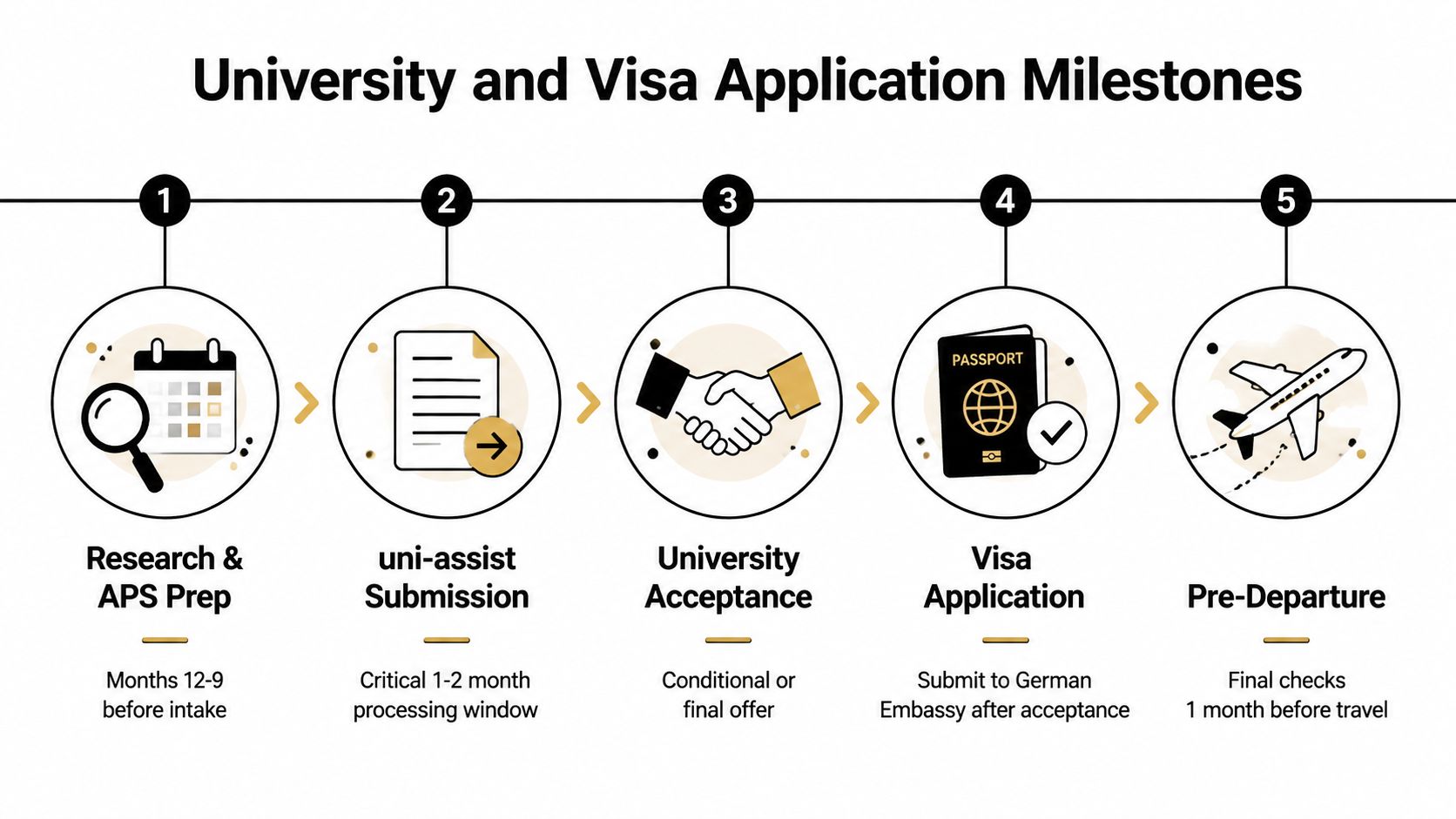
The German Consulate in Hong Kong advises applicants to expect visa processing of 1–2 months in the relevant study pathway guidance. Do not book flights around the earliest possible decision. Build time for missing documents, follow-up questions, and appointment availability.
The five-stage sequence
- Research and eligibility: Confirm entry qualifications, language requirements, whether uni-assist is involved, and whether your education history requires verification.
- Document preparation: Obtain official transcripts, identity records, translations, certification, and language results.
- University submission: Upload or send the complete application through the required platform. Save proof of submission and payment.
- Visa application: Once the required admission evidence is available, assemble the consular file and attend the appointment with matching documents.
- Pre-departure checks: Reconfirm insurance, finances, accommodation, enrolment, and every original document requested by the university.
APS, or Akademische Prüfstelle, requires careful checking. Applicants whose education was completed in mainland China may face verification requirements that differ from those educated in Hong Kong. Confirm the applicable route with the responsible authority. Do not assume that every Hong Kong applicant needs the same certificate.
Use this guide to study in Germany for an overview, then confirm programme-specific rules with the university and the German Consulate. The German Consulate guidance remains the reference point for the visa file and submission process.
Tailored Checklists for Every Learner Profile
A single checklist doesn't work for a teenager preparing for DSE and a professional applying for a master's degree. The documents may overlap, but the responsible person, academic deadline, and preparation rhythm are different. Choose the profile closest to your situation and assign every task to a named person.
Teen students aged 14 to 18
The student should own the learning routine. Parents should own the administrative calendar and verify that school requirements don't conflict with German examination preparation.
Start with the school calendar:
- Early planning: Confirm whether IGCSE, A-level, IB, or DSE Category C German is the intended school route.
- Before registration: Ask the school which German qualification it will enter and check whether a Goethe-Zertifikat milestone would support the longer-term plan.
- During preparation: Keep German study alongside HKDSE or international-curriculum demands. Don't leave exam preparation until the final school term.
- Before university research: Check admission language requirements and whether the target course is German-taught or English-taught.
- Documents: Maintain copies of school reports, transcripts, predicted results, identity documents, language certificates, and parent or guardian consent paperwork where relevant.
Parents planning the route
Parents should make the financial and scheduling decisions early, but the student must understand the sequence. A parent who holds every password and file can accidentally create a single point of failure.
- Funding: Check whether the chosen course is eligible for CEF funding and keep enrolment, attendance, fee, and reimbursement records.
- Scheduling: Select age-appropriate class and exam dates that fit school assessments, holidays, and university planning.
- Consent: Prepare guardian consent forms and emergency contact information if the student will travel before adulthood.
- Verification: Ask the school or programme administrator which transcripts require certification or translation.
- Review meetings: Set regular document checks with the student, language adviser, school, and later the university.
Adult and undergraduate applicants
An adult applicant taking a gap year or preparing for undergraduate study needs a more concentrated plan. Language intensity can increase, but the application still depends on academic eligibility and complete documentation.
- Months before intake: Confirm whether the target degree uses German or English and list the accepted certificates.
- Following that decision: Create the uni-assist account if required and scan documents in a consistent, readable format.
- Language stage: Schedule Goethe, TestDaF, or DSH preparation around the result deadline, not only the examination date.
- Academic file: Arrange transcripts, graduation evidence, certified translations, CV, motivation letter, and programme-specific forms.
- Finance and insurance: Prepare the financial evidence and health-insurance documentation required for the visa file.
- Final review: Compare every uploaded file against the university's instructions before submission.
Working professionals
Professionals often underestimate the scheduling problem. Evening classes can work well, but only when the learner protects study time and leaves room for employer documents, references, and notice periods.
- Work backwards: Set the desired intake, then reserve time for German study, examination, university application, visa processing, and employment transition.
- Career evidence: Request employer reference letters, employment records, professional certificates, and qualification documents early.
- Language target: Confirm whether B2 or C1 German is needed for the role, the degree, or a future professional-recognition process.
- Visa file: Check which job-seeker or study-visa documents apply to the actual route. Don't reuse a student checklist for an employment application.
- Practical German: Add Business German or workplace vocabulary if the professional goal involves interviews, meetings, or regulated employment.
- Final handover: Keep digital and physical copies accessible during resignation, travel, enrolment, and arrival.
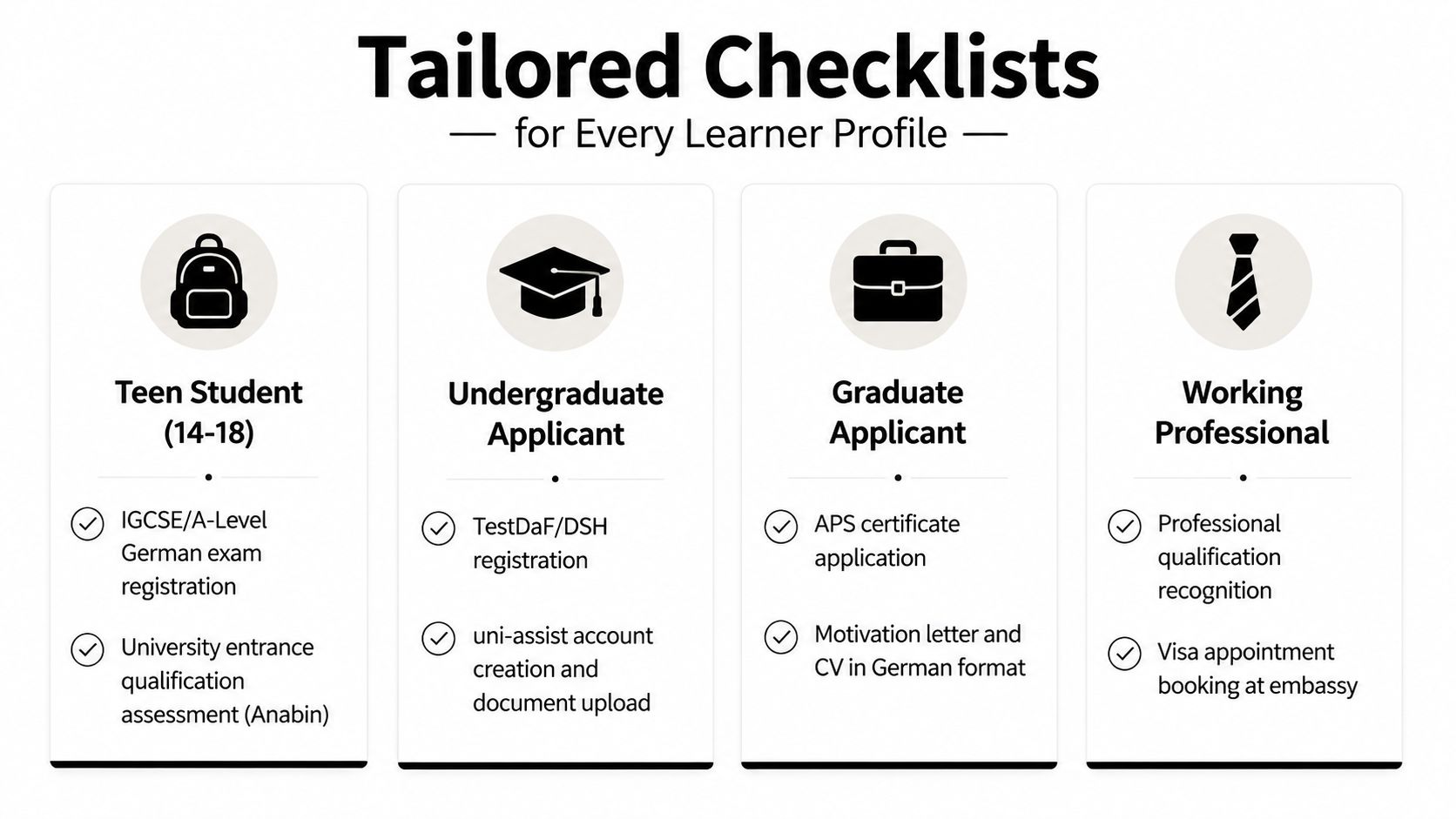
A missing document can force an applicant to wait for another academic cycle, so every profile needs a named owner, a next action, and a safe completion date. Don't write “parent” or “student” in the tracker without assigning the person responsible.
Funding Your Journey and Finding Expert Support
Cost-conscious applicants in Hong Kong should check funding before enrolling. The Continuing Education Fund reimburses eligible learners for German courses at 80% of the first HK$10,000 of approved fees and 60% of the remaining HK$15,000, with a maximum subsidy of HK$25,000 for qualifying residents (CEF course funding information).
That reimbursement can materially change the choice between a structured local course, private tuition, and overseas study. However, eligibility, approved-course status, attendance, receipts, and reimbursement procedures must be checked before assuming that every class or fee will qualify.
Compare routes without inventing a budget
A responsible cost comparison should use actual quotations rather than made-up totals. Ask each provider for the full fee from your current level to your target level, examination charges, private-session costs, materials, refund rules, and whether the course is eligible for CEF reimbursement.
| Preparation path | Estimated total cost in HKD | CEF reimbursement | Net cost after CEF | Exam-centre access |
|---|---|---|---|---|
| Structured local group course | Request a current written quotation | Confirm approved fees and learner eligibility | Calculate after reimbursement approval | Confirm the current local examination arrangement |
| Private tutoring | Depends on tutor rate, lesson frequency, and target level | Confirm whether the course structure qualifies | Calculate from the approved portion only | Usually requires separate exam registration |
| Overseas language school | Depends on tuition, travel, accommodation, and living costs | Confirm whether overseas study is eligible | Calculate only after eligibility is established | Depends on the destination |
| Mixed local preparation and private coaching | Depends on the combination selected | Check each component separately | Deduct only approved eligible fees | Confirm where the certificate exam is taken |
For learners who want a native-led, structured route in Hong Kong, German Cultural Association Hong Kong(GCA) offers small-group and private German tuition, preparation for Goethe-Zertifikat, TestDaF, IGCSE, A-level, and IB examinations, and flexible in-person or online classes. Its teaching model uses native German-speaking instructors and a certificate system linked to 80% attendance, so applicants can connect course enrolment, exam preparation, and document planning in one record.
The Goethe-Institut Hong Kong examination range covers adults and young learners from A1 to C2, so local learners should confirm the relevant exam schedule before choosing a course start date. A funding-focused explanation of the local process is available in this guide to funding German studies in Hong Kong through CEF.
Budget rule: Treat CEF reimbursement as a confirmed administrative outcome only after you've checked eligibility and retained the required evidence. Never build a visa or university plan on a rebate that hasn't been approved.
Ready to Start Your German Journey
Start with the destination and work backwards. Confirm whether the programme is German-taught or English-taught, identify the accepted exam, and record when the result must be available. Then collect authenticated academic documents, arrange required translations, and track university, visa, finance, insurance, and examination tasks in one file.
Begin 12 to 18 months before the intended enrolment date. This gives you time to reach the required language level, sit the correct exam, fix document errors, and answer university or consular requests. Mark winter-semester and summer-semester milestones, but follow each university's current instructions.
For Hong Kong learners, structured preparation connects German lessons with the certificate and document sequence that follows. Native-speaking teachers, official exam preparation, flexible delivery, and CEF-eligible courses can support this process. The German Cultural Association Hong Kong (GCA) can help applicants choose preparation for a school, university, visa, or career objective.
Bring your target programme, current qualification, language level, intended intake, and existing documents to a trial class or one-to-one consultation. Ask for a timeline before registering for an exam.
German Cultural Association Hong Kong (GCA) offers native-speaker German classes, Goethe-Zertifikat, TestDaF, IGCSE, A-level, and IB preparation, with in-person and online options in Hong Kong. Visit German Cultural Association Hong Kong (GCA) to book a trial class and discuss a practical Documents & Timeline plan.

German Verb Tenses Overview: Präsens Made Simple

German Passive Voice (Passiv): Formation Guide


