.png)
.png)

BLOG

香港德國文化協會
The German Cultural Association
DSE Language Electives 2026: Is German the Right Choice for Hong Kong Students?
You're probably having the same conversation many Hong Kong families are having right now. Your child has to choose DSE electives soon, everyone talks about practicality, and the language option feels oddly high-stakes. Japanese looks familiar. French sounds established. German feels more niche, more serious, and harder to judge.
That's exactly why DSE Language Electives 2026: Is German the Right Choice for Hong Kong Students? is the right question to ask. Not “Is German useful?” It is. The main issue is whether German fits your child's exam timeline, learning style, university direction, and budget in Hong Kong.
My view is simple. German is a strong choice for the right student, but a poor choice for the wrong one. If your child wants an easy elective with casual effort, don't choose it. If your child wants a structured, externally benchmarked language pathway that can support future study abroad in Germany and build a distinctive academic profile, German deserves serious consideration.
The DSE Elective Dilemma Choosing Your Language
A typical family discussion goes like this. The student says they want a language because it seems more interesting than another content-heavy elective. The parent asks the practical question straight away: “Will this help with university, or is it just extra workload?”
That's the right question.
In HKDSE, electives aren't just about interest. They affect timetable pressure, outside-class preparation, and how a university application reads. A language elective can be a smart move, but only if the family understands the operational reality behind it.
Why this decision feels harder in Hong Kong
Most students already juggle core subjects, school assessments, and tutorial commitments. Adding a language means adding a skill that needs regular weekly practice, not last-minute memorisation.
That's why German creates hesitation. Parents know it can be valuable, but they also know European languages demand consistency. If your child struggles to keep up with English writing or oral practice, German won't magically become easy.
The real comparison isn't just German versus Japanese or French
The pertinent comparison is this:
- Distinctiveness versus familiarity
- Long-term pathway versus short-term convenience
- Structured exam preparation versus casual language exposure
If your child is still comparing European options, this breakdown of German versus French for Hong Kong learners is useful because it forces the discussion back to outcomes, not image.
German makes sense when a student has a destination in mind. Without that, it can become an expensive and demanding extra subject.
For parents, that means one thing. Don't choose German because it sounds impressive. Choose it only if your child can commit to the process and there's a credible academic reason behind it.
What Does Choosing DSE German Actually Involve Now
For HKDSE Category C German from 2025 onward, students must take the official Goethe-Zertifikat in Hong Kong, at level A2 or above, within the two years before the DSE. It is an externally standardised exam covering listening, reading, writing, and speaking, so preparation must be skill-based and exam-specific.

This is no longer a vague school-based language option
The key change is operational, not cosmetic. For HKDSE Category C German from 2025 onward, the official exam is the Goethe-Zertifikat, and candidates must sit A2 or above within the two years before the DSE. The exam covers listening, reading, writing, and speaking, according to the Goethe-Institut Hong Kong DSE German exam guidance.
That matters because it changes how families should plan.
German is now a four-skill, externally standardised elective. Students can't rely on school notes alone. They need actual exam readiness across all language skills.
What parents should understand immediately
Here's the practical meaning of that exam structure:
Timing matters
Your child can't leave preparation too late. The certification must fall within the accepted window before the DSE.Speaking matters
Some students are comfortable with vocabulary lists and grammar exercises but freeze in oral exams. German preparation has to include live speaking practice.Writing matters
If a student already avoids writing in Chinese and English, don't assume German writing will somehow be easier.Benchmarking is clearer
The upside is that parents get a recognised external standard, not a fuzzy internal assessment.
Practical rule: If you're choosing German for DSE 2026, plan backwards from the exam date and treat the Goethe-Zertifikat as the main target, not as an afterthought.
Why this structure is actually good for serious students
I prefer this system. It's stricter, but clearer.
A standardised external exam gives motivated students a cleaner target. It also helps families separate wishful thinking from real readiness. If a student can perform across four skills under official exam conditions, that result has more credibility than classroom participation alone.
For students who thrive with clear milestones, German becomes a disciplined academic pathway rather than a soft elective.
German vs Other DSE Language Electives A Practical Comparison
The local market for DSE foreign languages is small. According to AACRAO's reporting on Hong Kong's DSE foreign-language assessments, about 500 students sat the six DSE foreign-language assessments in 2022, and 397 took Japanese. That tells you two things. First, Japanese is the obvious mainstream foreign-language choice. Second, any student choosing German is already stepping into a less crowded lane.
DSE Language Elective Comparison German vs French vs Japanese
| Factor | German | French | Japanese |
|---|---|---|---|
| DSE positioning | Category C language with externally standardised exam route | Category C language option | Category C language option |
| Exam mindset | Strong fit for students comfortable with structured four-skill assessment | Often chosen by students interested in a classic European language pathway | More familiar to many HK students because of stronger popular exposure |
| Distinctiveness on application | High, because fewer HK students take foreign-language electives overall | Moderately distinctive | Less distinctive within the foreign-language pool because uptake is more visible |
| Best-fit destination | Students thinking about study abroad in Germany or German-speaking settings | Students with broader European humanities or language interest | Students with stronger Asia-focused cultural or personal motivation |
| Learning environment in Hong Kong | Often requires deliberate planning and specialist support | Depends on school and outside-course access | Benefits from stronger public familiarity and existing interest |
What really separates German
German's advantage isn't popularity. It's clarity of purpose.
If a student may want German-taught higher education later, German has an obvious pathway logic that other languages may not match. If the student doesn't have that kind of direction, then Japanese often feels easier to commit to because it's more familiar in daily life in Hong Kong.
When German is the smarter strategic pick
Choose German over other DSE language electives if your child fits most of these points:
- Has a real reason such as future study abroad in Germany, Austrian or Swiss links, or a planned academic profile that benefits from a distinctive language
- Handles structured assessment well across speaking, writing, reading, and listening
- Can sustain long-term study rather than relying on interest alone
- Benefits from standing out in a smaller candidate space
If you're comparing local support options, this review of German language schools in Hong Kong helps parents judge what “support” means in practice.
A smaller candidate pool doesn't automatically make German better. It makes it more visible when a student has a strong result and a clear destination story.
My blunt recommendation
- Choose Japanese if your child wants familiarity and already has strong motivation for it.
- Choose French if your child prefers a broader European language identity and already enjoys that style of language learning.
- Choose German if the student is academically disciplined and the family can see a credible path beyond the DSE itself.
That's the practical comparison. German isn't the easiest option. It may be the most strategic one.
Is Your Child the Right Profile for DSE German
The right question isn't just whether a student can learn German. As noted in this Hong Kong perspective on learning German, the better question is which HK student profile benefits most, and under what measurable pathway, such as IB, IGCSE, Goethe, TestDaF, university admission, or employment, German outperforms alternative electives.
That's exactly how parents should think about DSE German.

The STEM innovator
This is the strongest German profile.
If your child is serious about engineering, science, or technical disciplines, German can align naturally with future plans to study abroad in Germany. The language stops being just an elective and becomes part of a longer academic runway.
This student usually does well with:
- structured grammar
- regular correction
- long-term goals
- exam preparation with clear milestones
The academic achiever
Some students are wired for disciplined study. They don't need a trendy subject. They need one that can reward consistency.
For this student, German can work well because it demands a real process. That sounds like a drawback, but for a high-performing student it can become an advantage. The elective says something credible about work ethic when it is backed by a recognised exam result.
The future diplomat or globally minded student
This student cares about international affairs, European culture, debate, and cross-border education. German can fit, but only if the student also accepts the technical side of the language.
Sometimes, parents misjudge. A student may love travel, politics, or history, but still dislike grammar-heavy learning. If that's the case, German may not be the right match despite the attractive future profile.
Interest in Europe is not enough. German suits students who can tolerate structure, correction, and repetition.
The culture seeker
This is a weaker case unless the student is unusually self-motivated.
A child who likes music, literature, or European travel may enjoy German, but enjoyment alone won't carry them through a four-skill exam pathway. If the commitment is mostly emotional and not academic, I'd be careful.
Three signs German is the wrong fit
- Your child wants the “easiest” language elective
- Your child avoids speaking practice
- You can't identify any reason beyond “it might look good”
Those are bad foundations.
My recommendation by student type
If your child is a STEM-focused planner or a highly organised all-rounder, German is often a strong strategic choice in Hong Kong.
If your child is mainly curious, casual, or inconsistent, don't force it. A language elective only works when the student accepts that progress comes from steady use, not talent alone.
How Long Does It Take to Prepare for the DSE German Exam
Parents always ask two questions first. How long will this take, and how much will it cost?
The honest answer is straightforward. If your child starts too late, DSE German becomes stressful. If your child starts early enough and follows a proper sequence, it becomes manageable.

A realistic school-year timeline
For most HK students, the sensible plan looks like this:
Start in S3 or early S4
This gives enough room to build fundamentals without panic.Use S4 to build base skills
Vocabulary, sentence patterns, listening habits, and confidence in speaking need time.Use S5 to consolidate
During S5, students should be moving from “I've learned some German” to “I can perform in all four skills”.Use S6 for exam refinement
By then, the student should already be working within the certification timeline and polishing weaknesses, not starting from zero.
That's why late starters struggle. A language can't be crammed the way some content subjects can.
What about cost in Hong Kong
In Hong Kong's local market, intensive German courses are typically priced at about HKD 6,000 to 8,500 per CEFR level, and specialist institutes report exam success rates above 90%, according to this local overview of German for teens and exam pathways in Hong Kong.
That tells parents two things:
- German usually has a higher upfront cost
- Structured preparation can produce measurable exam outcomes
If you want a clearer idea of progression expectations beyond the DSE minimum, this guide on how long it takes to reach German B2 level is worth reading.
My planning advice for families
Don't ask whether German is expensive in isolation. Ask whether delayed or poorly organised preparation will cost more.
A cheaper course with weak structure can waste a year. A serious course with proper sequencing often saves stress, time, and re-sits.
Parent checklist: Start earlier than feels necessary, budget for more than one stage of learning, and choose a course format that includes speaking, writing, and exam practice rather than vocabulary drilling alone.
Some families also ask about CEF funding. It can be relevant in Hong Kong depending on the learner profile and course type, but you should check current eligibility directly before making assumptions.
Finding the Right Support How GCA Prepares Students for Success
For DSE German, support matters because the exam is external, skill-based, and time-sensitive. A student needs more than worksheets. They need a system that trains listening, reading, writing, and speaking in a coordinated way.
That's also why families should think beyond the DSE minimum. In Hong Kong's HKDSE system, German is one of the Category C “Other Languages” electives, and from the 2025 HKDSE onward candidates must take the stipulated language examinations administered in Hong Kong by official organisations. The same HKEAA guidance also notes that HKDSE holders aiming for German-taught degree programmes generally need at least B2 German, for example TDN-4 in TestDaF or Goethe-Zertifikat C2: GDS, as outlined in the HKEAA Category C subject information.
What strong support should look like
A good German programme in Hong Kong should offer:
Native-speaking teachers
Students need authentic pronunciation, natural corrections, and real spoken interaction.A structured curriculum
DSE-linked German preparation works best when the course follows a clear level system and maps onto recognised exams such as the Goethe-Zertifikat.Small-group or individual attention
Speaking practice collapses in oversized classes.Pathway awareness
A centre should understand not just the DSE requirement, but also what happens if the student later aims at TestDaF or German university admission.
One practical option in Hong Kong
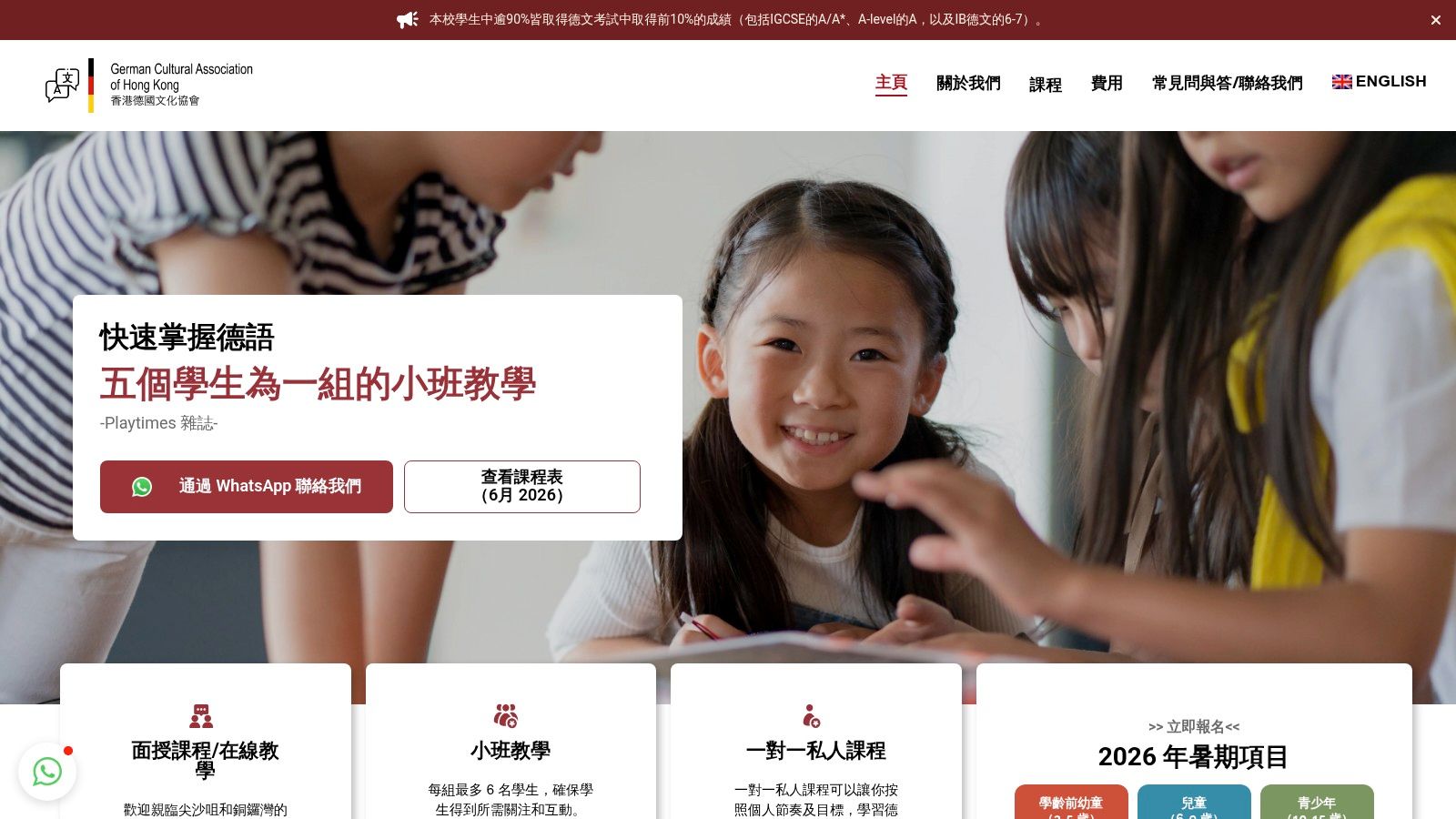
German Cultural Association Hong Kong(GCA) offers in-person classes near Tsim Sha Tsui and Causeway Bay MTR stations, online lessons, small-group teaching with a maximum of 6 students, native-speaking teachers, and a curriculum focused on exams such as the Goethe-Zertifikat and TestDaF. According to the publisher information provided for this article, it also reports a 96% recommendation rate and that over 90% of students rank in the top 10% of public examinations.
For students who also need stronger confidence in oral communication, especially for interviews, presentations, and discussion-based learning, these Model Diplomat public speaking resources are a useful complement.
My advice on choosing any centre
Don't choose based on branding or promises. Ask hard questions.
- Who teaches the class
- How much speaking time does each student get
- Is the curriculum aligned to official exams
- Can the centre explain the route from DSE German to later university-level requirements
If a provider can't answer those clearly, keep looking.
A serious German programme should prepare a student for the next milestone, not just the next class.
Ready to Explore German for Your DSE Journey
If you've read this far, you already know the answer is not universal.
For some HK students, German is the wrong elective. It asks for consistency, outside-class effort, and comfort with a formal exam route. If your child wants a low-pressure option, choose something else and save everyone the frustration.
But for the right student, German is one of the few electives that can function as both a DSE subject and a longer-term pathway, making it particularly appealing. It can support an academic story that makes sense beyond secondary school.
A simple decision test for parents
Choose German if your child can say yes to most of these:
- I'm willing to practise all four skills, not just memorise vocabulary
- I can commit for more than one school term
- I may want a future linked to German-speaking study or opportunities
- I'm comfortable working toward an external benchmark
If the answers are mostly no, don't force the issue.
What to do next
Take one of these steps:
Check timing first
Work backwards from DSE 2026 and see whether your child has enough runway.Get an honest level assessment
Don't guess. Find out whether your child has the aptitude and temperament for this path.Compare support options carefully
Look at teaching quality, class size, and exam alignment, not just convenience.Decide based on fit, not status
German shouldn't be chosen because it sounds impressive. It should be chosen because it serves a real plan.
The families who make the best elective decisions aren't the ones chasing prestige. They're the ones matching the subject to the student.
If you want clear advice on whether German fits your child's DSE, IB, IGCSE, university, or study abroad goals, contact German Cultural Association Hong Kong(GCA) to discuss the right learning path, book a trial class, or check the latest course schedule.

APS and Deadlines for Germany: A Hong Kong Timeline

Applying to German Universities from Hong Kong: Uni-Assist


