.png)
.png)

BLOG

香港德國文化協會
The German Cultural Association
How Long Does It Take to Reach German B2 Level? Your Guide
Reaching German B2 from zero typically takes 600 to 750 total study hours. In Hong Kong, that usually means about 12 to 18 months for intensive learners or 2 to 4 years for part-time learners, and structured programmes can shorten the timeline.
If you're asking because you want to work in Germany, apply to a university, prepare a child for IGCSE/IB/Goethe-Zertifikat, or strengthen your profile for immigration, you're asking the right question. How Long Does It Take to Reach German B2 Level? matters because B2 is often the level where German stops being a classroom subject and starts becoming useful in real life.
For Hong Kong learners, the answer isn't just about hours. It's about schedule, teaching quality, speaking practice, and whether your learning plan fits actual HK life, including office hours, MTR commuting, school pressure, and the lack of daily German exposure.
Planning Your Future in Germany From Hong Kong
A lot of people in Hong Kong start German with a clear target. Some are professionals planning a transfer to Berlin or Munich. Some are parents thinking ahead about university pathways. Others are students aiming for study abroad in Germany and trying to line up language, applications, and exam deadlines properly.
That planning should start with one honest fact. B2 takes time.
If you're building from beginner level, expect 600 to 750 total study hours as a realistic benchmark. That level matters for university admission, visa planning, and job readiness because it gives you enough command of German to function with confidence, not just survive with memorised phrases.

Start with the outcome, not the textbook
Most learners waste time because they begin with vague goals like “learn conversational German”. That's too loose.
Set one of these practical targets instead:
- Work in Germany: You need German for meetings, workplace communication, and job applications. It also helps to understand German CV requirements before you start sending applications.
- University admission: You need a timeline that fits application cycles, exam prep, and likely language proof requirements.
- Teen exam preparation: If your child is working toward IGCSE, IB, A-level, or Goethe-Zertifikat, you need a structured path, not random worksheets.
- Immigration or long-term relocation: You need dependable progress and documented study, not casual app use.
Hong Kong learners need a local plan
Generic online estimates ignore Hong Kong realities. Adults here are juggling work, family, and long days. Teens are balancing packed school schedules. Parents are comparing options carefully and often looking at practical support such as CEF funding before committing.
That's why your timeline should include three decisions from the start:
- Your target month for B2
- Your weekly study capacity
- Your preferred format, in-person, online, or mixed
Practical rule: If Germany is part of your plan, treat B2 as a project with a deadline, not a hobby without one.
If you're also weighing course costs and support options, this guide on funding your German studies in Hong Kong through CEF is worth reading early. It helps you budget properly instead of delaying the decision.
What Does German B2 Level Actually Mean For You
A lot of Hong Kong learners say they want “conversational German” but need something much stronger. If your plan includes university admission, professional work, or a serious move to Germany, B2 is usually the level where German becomes useful in real life, not just manageable in class.
German B2 is upper-intermediate proficiency. You can understand the main ideas of complex texts, follow longer discussions, speak with reasonable fluency, and write clear, structured German without constant rescue from a dictionary or translation app. The CEFR description from the Council of Europe makes that standard clear.
For learners in Hong Kong, the key distinction is simple. B1 helps you get through familiar situations. B2 helps you function with credibility in study, work, and everyday administration.
What B2 looks like in daily life
At B2, you are no longer stuck in survival mode. You can understand what people mean, not just the words they say. You can keep up when the conversation moves faster, shifts topic, or becomes more abstract.
For working adults in Hong Kong, B2 usually means you can:
- Take part in meetings and routine workplace discussion: You can follow the thread, give your opinion, ask useful questions, and respond without freezing.
- Read with a purpose: Emails, reports, forms, and articles stop feeling like decoding exercises.
- Speak with enough flow to build trust: You still make mistakes, but people can work with you.
- Write clearly: You can produce professional emails, short summaries, and reasoned responses that sound organised.
For students and teens, B2 has a different payoff:
- Academic access: Lectures, seminars, and classroom discussion become far more realistic.
- Exam readiness: You are in the right range for serious Goethe-Zertifikat B2 preparation.
- Independent learning: You can use German materials directly instead of waiting for everything to be explained in English or Cantonese.
That distinction is important because many ambitious learners in Hong Kong aim too low. They reach B1, feel pleased, then hit a wall when they try to study or work in German. B2 is the safer target if your plans are real.
The difference between B1, B2, and C1
People often blur these levels together. They should not.
| Level | What it feels like |
|---|---|
| B1 | You can manage familiar situations, but complex discussion still slows you down and exposes gaps quickly |
| B2 | You can discuss ideas, explain opinions, follow normal-speed communication, and handle day-to-day demands with much more independence |
| C1 | You can study or work at a higher level with stronger precision, nuance, and control |
B2 sits in the middle for a reason. It is high enough to create real options, but still realistic for part-time learners in Hong Kong who are balancing long workdays, school pressure, and limited immersion. C1 is excellent. B2 is the first level that pays off consistently.
What B2 does not mean
B2 does not mean perfect grammar. It does not mean understanding every regional accent. It does not mean speaking like a native speaker.
It means you can handle real tasks in German without falling apart.
That is the standard serious Hong Kong learners should target first. It gives you a level that schools respect, employers recognise, and examiners can verify. In a city with very little natural German immersion, that kind of documented, usable ability matters.
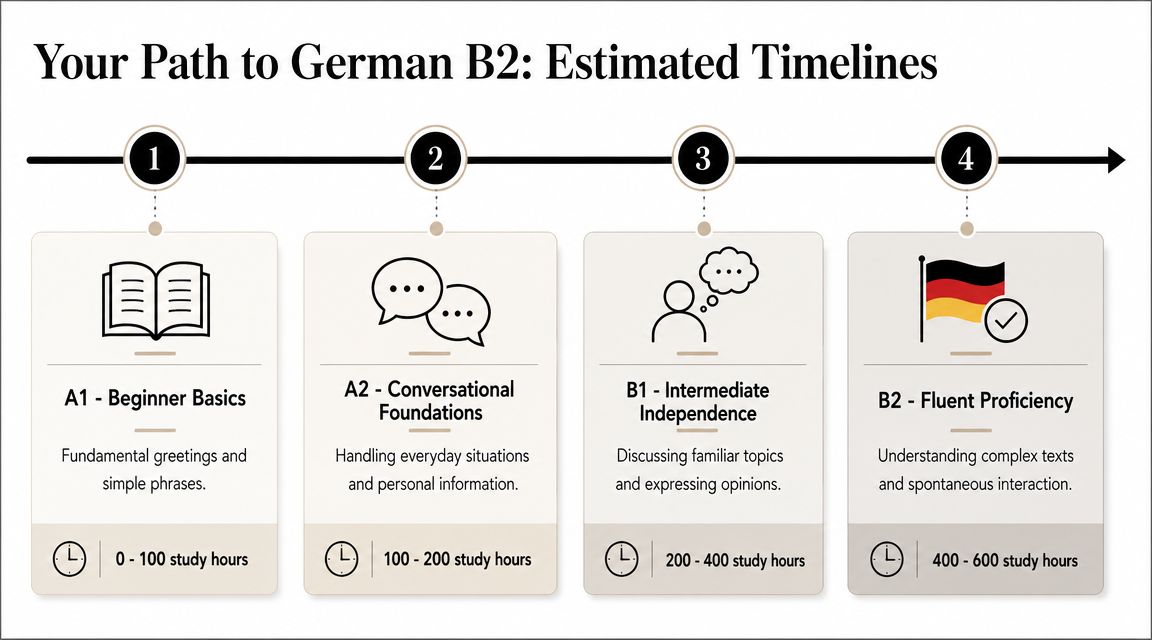
Calculating Your German B2 Timeline in Hong Kong
You are in Hong Kong, working full-time, checking class times between MTR rides, and trying to figure out whether B2 German is a one-year project or a three-year grind. The answer depends less on motivation and more on maths.
Count your weekly study hours accurately. Then match them to your deadline. That is the only useful way to estimate your B2 timeline.
The baseline that makes sense in Hong Kong
For learners in Hong Kong who already have A2, a realistic target for B2 is 10 to 14 months part-time under a structured plan with regular speaking, writing, and correction. If you can treat German like a serious second job, that timeline can shrink to 6 to 8 months.
That faster route is demanding. It suits learners with a relocation deadline, university admission target, or an exam date that cannot move.
If you are starting from A1 or complete beginner level, expect a longer path. If you already have A2, do not waste time repeating basic content you can already handle. Put your energy into B1 to B2 skills that usually slow Hong Kong learners down: listening at normal speed, clear spoken output, and exam-style writing under time pressure.
Estimated timeline to reach German B2 in Hong Kong
| Study Intensity | Weekly Study Hours (Guided + Self-Study) | Estimated Time to Reach B2 | Best For |
|---|---|---|---|
| Super-intensive | Around the equivalent of 30 lessons per week or 2 to 3 daily hours | 6 to 8 months from A2 to B2 | Learners with a visa, relocation, or university deadline |
| Intensive | Around 20 hours per week | 9 to 12 months from A1 to B2 in structured small-group study | Gap-year students, focused adults, exam-driven learners |
| Consistent part-time | Around 5 hours per week | 3 to 4 years from beginner to B2 | Working professionals with limited weekday availability |
| A2 to B2 part-time | Steady part-time workload | 10 to 14 months | Learners who already have a foundation and need the next milestone |
Why this takes longer in Hong Kong than many learners expect
Hong Kong is efficient, ambitious, and busy. It is also a poor environment for passive German exposure.
You can go days here without hearing any German at all unless you build it into your routine. That means your progress depends heavily on planned input and forced output. Casual app use will not carry you to B2. Neither will occasional weekend study.
The three delays I see most often are simple:
- Speaking practice is too limited
- Self-study is passive and uncorrected
- Weekly study time keeps changing
This is why many learners stall around late A2 or B1. They know a fair amount, but they cannot retrieve it fast enough in conversation, writing, or listening tasks.
Use a deadline-first method
Start with your real target date, not your ideal study habit.
If you need B2 for Germany within a year, choose an intensive route and protect daily German time. If you work full-time in Hong Kong, accept that your plan must survive busy periods, overtime, and family obligations. A plan that only works in a quiet month is a bad plan.
For many adults, the best setup is structured classes plus fixed self-study blocks on specific days. If you are deciding whether a faster format is worth the cost, read this guide on whether intensive German courses are worth the money. The right answer depends on your deadline, not on wishful thinking.
My recommendation for most Hong Kong learners
If you have a serious B2 goal, give yourself one of these two paths.
Choose intensive study if you have a hard deadline for study abroad, a visa, or a job move. Choose structured part-time study if you are working or studying in Hong Kong and need a plan you can sustain for months.
In both cases, protect speaking practice. Protect writing correction. Protect weekly consistency.
Hong Kong learners have one clear disadvantage. The immersion gap is real. But they also have advantages if they use them properly, including disciplined study habits, access to specialist exam-prep courses, and in some cases CEF-supported training that reduces the financial pressure of staying consistent. The learners who reach B2 here are not the ones with the best intentions. They are the ones who build a schedule they can keep.
Key Factors That Influence Your Learning Speed
A learner in Hong Kong can study for months and still stall at lower-intermediate level. Another reaches B2 on a similar weekly schedule. The difference is rarely talent. It is usually structure, correction, and how well the plan fits Hong Kong life.
The first factor is simple. Hong Kong does not give you German for free.
You hear Cantonese and English all day. Your office, university, family life, and social circle usually do not push you to respond in German under pressure. That creates a real speed problem. Learners in Germany or Austria get constant repetition from daily life. Learners in Hong Kong have to build that repetition on purpose, or progress slows fast.
The immersion gap is real
From my experience working with Hong Kong learners, B2 takes longer here when students rely on passive exposure and occasional revision. The common pattern is predictable. They watch videos, collect vocabulary, do app exercises, and postpone speaking because it feels inefficient or embarrassing. Then they wonder why their listening improves a little but their output stays weak.
B2 requires active control. You need to speak in full sentences, write with structure, and handle correction without avoiding it.
The biggest speed factors
Consistency beats short bursts of effort
A packed week of motivation does not compensate for the next ten days of silence. Adult learners in Hong Kong do best with fixed, repeatable study blocks that survive overtime, travel across the city, and family commitments.
For a full-time professional, three controlled study touchpoints often beat one exhausted marathon session. One class. One writing or grammar session. Daily review in short blocks on the MTR or before work. That rhythm is not glamorous, but it gets results.
Teacher quality changes your timeline
At B2, bad feedback wastes months.
If your teacher does not correct sentence structure, cases, pronunciation, and writing organisation in a clear sequence, mistakes become habits. Those habits are expensive to fix later, especially if you are preparing for Goethe-Zertifikat B2, a university pathway, or a move to Germany.
Good teaching speeds you up because it does three practical things:
- Introduces grammar and vocabulary in the right order
- Requires regular speaking and writing output
- Corrects recurring mistakes before they harden
Guided small-group study usually beats loose self-study
Self-study has a place. It works well for review, vocabulary building, and extra listening. It is not enough on its own for ambitious Hong Kong learners targeting B2 by a real deadline.
Small-group classes give you pace, correction, accountability, and live interaction. That matters even more in Hong Kong because your environment does not naturally force German output. If cost is part of your decision, read this guide on whether an intensive German course is worth the money. Serious learners here should judge cost against time lost, not against the cheapest option on paper.
Passive exposure supports progress. Correction and output drive it.
Your reason for learning affects your speed
A vague interest produces vague study habits. A visa deadline, university application, or career move produces far better discipline.
I see this constantly in Hong Kong. Learners with a clear Germany plan protect study time more aggressively, choose better courses, and tolerate the discomfort of speaking practice. Parents also make better decisions when German is tied to a defined path such as IB, IGCSE, A-level, Studienkolleg, or direct university preparation.
What slows people down most
The biggest delays are usually ordinary mistakes repeated for months:
- Avoiding speaking because it feels uncomfortable
- Treating grammar as optional
- Switching books, apps, or tutors too often
- Studying without a test date or milestone
- Leaving long gaps between lessons
- Doing input only, with no corrected writing
Hong Kong learners also underestimate the financial side of consistency. If course fees keep interrupting your progress, use local support where possible. CEF-supported options can reduce that pressure and make it easier to stay in structured training long enough to reach B2.
My direct advice
If B2 is your target, measure your study plan by output, not by hours logged.
Every week should include these four things:
- Speaking with correction
- Listening to normal spoken German
- Short writing tasks
- Review of your own repeated mistakes
That is the standard. Anything softer usually leads to a longer timeline.
Hong Kong learners can reach B2 efficiently, but only if they stop treating German as background content and start training it as a skill they need to use under pressure.
Sample German Study Schedules for HK Learners
Another abstract plan isn't what's needed. What's needed is to see what a real week looks like. Here are three schedules that fit Hong Kong life better than the usual “study when you have time” advice.
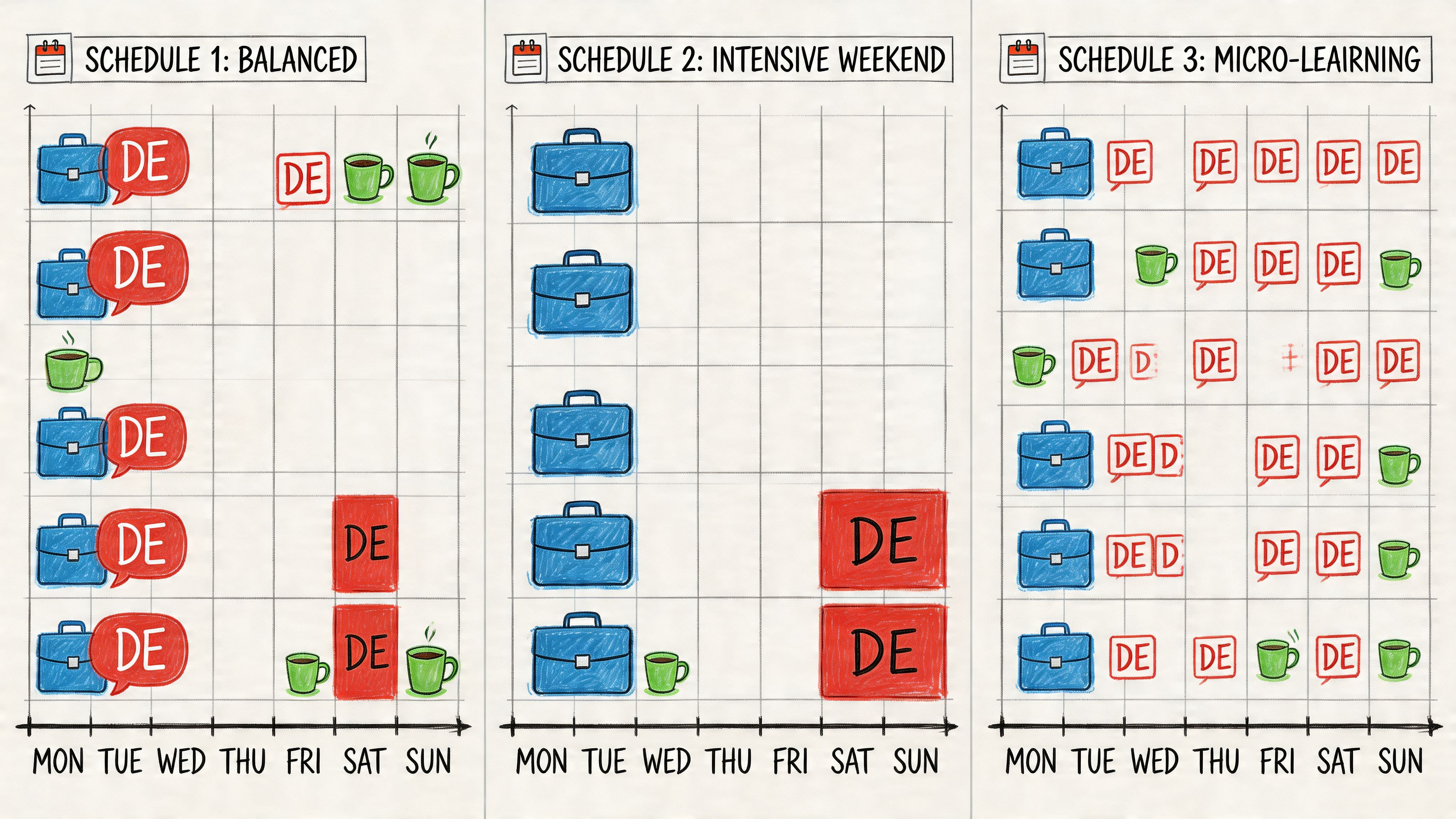
The ambitious professional
This learner works full-time in Central, Kwun Tong, or Kowloon Bay and wants German for career growth or a move abroad. Time is limited, so the schedule must be compact and repeatable.
A practical week looks like this:
- Monday evening: Attend class after work. Focus on grammar and speaking.
- Tuesday MTR commute: Review vocabulary and sentence patterns on your phone.
- Wednesday night: Do one writing task and correct it carefully.
- Thursday lunch break: Listen to German audio and note phrases you can reuse.
- Saturday morning: Speaking practice, ideally with live correction.
- Sunday afternoon: Review mistakes from the week and prepare for the next lesson.
This kind of learner does best when every slot has one purpose. Don't mix everything into one long tired session.
The future university student
This learner may be a secondary student in Hong Kong preparing for IB, IGCSE, A-level, or a university path connected to Germany. The goal isn't just exposure. It's measurable progress.
A stronger schedule looks more like a training plan:
- Weekday after school: Short review sessions for vocabulary and listening
- Two structured class blocks each week: One for core language development, one for exam-style output
- Friday: Timed writing practice
- Weekend: Longer reading, speaking, and correction session
Parents often make one mistake. They spread German too thinly around too many activities. If German matters for future applications, it needs protected time.
Students improve faster when German has a fixed place in the week, not when it gets squeezed into leftovers.
A useful reality check on listening pace and practical expectations is this video:
The parent rebuilding study around family life
This learner may be balancing work, school runs, and household responsibilities, but still wants German for personal development, relocation planning, or to support a child's learning journey.
The best schedule here is rarely daily long sessions. It works better as a rhythm:
Week structure that actually survives
| Day | Focus |
|---|---|
| Tuesday | One live lesson or guided session |
| Thursday | Short grammar and vocabulary review |
| Saturday | Speaking and listening block |
| Sunday | Reading, recap, and planning |
This learner should keep materials simple and consistent. One main coursebook, one notebook for errors, one vocabulary system. That's enough.
What each learner type should avoid
- Professionals: Don't rely only on weekend study. You need weekday contact with the language.
- Students: Don't turn German into pure memorisation. B2 needs output.
- Parents: Don't wait for perfect free time. It won't appear.
The strongest schedules in HK are not the prettiest ones. They are the ones people can repeat through busy months, exam periods, and family disruptions.
How GCA Accelerates Your Path to German B2
You are in Hong Kong, working full-time or juggling school deadlines, and you want B2 German without wasting a year on scattered apps, random tutors, and study plans that collapse after two busy weeks. In that situation, the school you choose has a direct effect on your timeline.
GCA shortens the path because it removes the two biggest problems HK learners face. Too little real speaking practice and too little external structure. In a city where German is not part of daily life, you need both.
Why a specialist school gets you to B2 faster
Generic tuition often feels productive at the start, but B2 exposes weak systems quickly. Learners plateau when lessons are disconnected, correction is inconsistent, and speaking is treated as an extra instead of a weekly requirement.
A stronger B2 route in Hong Kong has four clear features:
- Native-speaking teachers so you hear accurate pronunciation, natural sentence patterns, and real conversational rhythm from the beginning.
- Small classes of up to 6 students so you speak, get corrected, and build fluency under pressure.
- A sequenced curriculum so each level prepares you for the next one instead of repeating familiar material.
- Flexible attendance options through classes near Tsim Sha Tsui or Causeway Bay MTR, plus Zoom, which helps busy professionals and students stay consistent.
That last point matters more in Hong Kong than many learners realise. Commute time, overtime, exam periods, and family commitments regularly break weak study plans. A format you can maintain through busy months is better than an ambitious plan you quit after three weeks.
Accountability speeds up progress
Motivation is overrated. Systems matter more.
Many capable learners in HK do enough German to feel busy but not enough to improve. They review vocabulary, listen passively, and attend irregularly. B2 does not reward that pattern. You need repeated output, correction, and a course structure that keeps your pace honest.
A certificate system linked to 80% attendance helps because it turns German from an optional hobby into a fixed commitment. That is exactly what many adult learners need after work, and what teenagers need during exam-heavy school terms.
What GCA does especially well for Hong Kong learners
The local advantage is not just teaching quality. It is fit.
GCA serves the kinds of learners who study German in Hong Kong. Professionals preparing for relocation or career expansion. Students aiming at university pathways in Germany or German-speaking programmes. Parents looking for serious instruction rather than casual enrichment. Those groups need a school that understands exam deadlines, school calendars, and the practical limits of life in HK.
For learners who plan to sit a formal paper, GCA's exam-focused pathway also fits naturally with a broader understanding of German qualifications. If you are comparing routes, this guide to Goethe-Zertifikat and TestDaF exam options in Hong Kong will help you choose the right target early.
Who benefits most
- Professionals: You need classes that fit around work and keep you progressing even when your schedule changes.
- Students: You need clear level progression, regular correction, and preparation that supports exam performance.
- Parents and teens: You need close teacher attention, credible standards, and a learning environment that builds confidence steadily.
The fastest route to B2 in Hong Kong is a system that makes you show up, speak every week, fix mistakes early, and keep moving. GCA does that well. That is why it can cut wasted time from your B2 journey.
Preparing for the Goethe-Zertifikat B2 Exam
You finish work in Central, rush to class, and realise your exam date is only a few months away. At that point, general German study is no longer enough. You need exam preparation that matches the Goethe-Zertifikat B2 format and the reality of studying in Hong Kong with limited daily immersion.
The exam tests more than language knowledge. It tests control under time pressure. That is why strong classroom performance does not always turn into a strong exam result.
Reading and listening
These modules expose a common Hong Kong weakness. Learners often understand German well in class, then lose marks because they read too slowly or miss the speaker's purpose.
Train for the task, not just the language:
- Read in layers: get the main point first, then the supporting detail, then the writer's attitude
- Stop chasing every unknown word: B2 candidates need to make accurate choices without full comprehension
- Practise with a timer: exam reading is a decision-making task as much as a language task
- Listen for intent: is the speaker explaining, objecting, recommending, or comparing?
If you live in Hong Kong, you must create your own input. Use German audio during commutes, short reading practice before work, and weekly timed papers on weekends. That routine closes part of the immersion gap faster than passive exposure ever will.
Writing
Writing is where many B2 candidates in Hong Kong throw away marks they could keep. The problem is usually not lack of ideas. The problem is weak structure, loose paragraphing, and grammar mistakes that stay uncorrected for too long.
Use a stricter method:
- Plan your response first. A clear position and two or three organised points beat a messy long answer.
- Use connectors with control. Variety helps, but only if the sentence stays accurate.
- Check verb position, endings, and sentence order. These errors make your writing harder to follow and lower the overall impression.
- Practise formal and semi-formal tasks. That matches the kind of communication B2 exams often expect.
Get feedback from a teacher who corrects for exam performance, not just general fluency. That matters a lot in Hong Kong, where many learners study efficiently but do not get enough detailed written correction between classes.
Speaking
Speaking improves fastest when you train under realistic pressure. You need to organise ideas quickly, speak in a clear structure, and keep going even when the discussion shifts.
Use these tactics:
- Build topic frameworks, not full scripts
- Practise short responses on common B2 themes such as work, study, media, travel, and the environment
- Train follow-up discussion, not only opening answers
- Record yourself and listen for hesitation, repetition, and sentence endings that break down
A good B2 speaker does not sound perfect. A good B2 speaker sounds clear, organised, and responsive.
If you are still deciding which exam fits your goal, this guide to Goethe-Zertifikat and TestDaF exam options in Hong Kong will help you choose the right target before you commit time and money to preparation.
My advice is simple. If your deadline matters, separate language-building from exam training. General classes build your base. Focused Goethe-Zertifikat B2 preparation helps you perform on the day, which is what gets you the result.
Ready to Start Your German Journey in Hong Kong
If Germany is part of your plan, don't leave B2 to chance. Build a timeline, choose a format you can sustain, and start with a clear deadline.
Here are the right next steps:
- Check the latest course schedule: Find a class format that fits your work, family, or school routine in Hong Kong.
- Speak with an advisor: A proper consultation helps you map a realistic route based on your current level and target date.
- Review CEF funding options: If you're cost-conscious, this matters. Eligible courses can make serious language study more manageable.
- Choose a structured path: If your goal includes Goethe-Zertifikat, DSE/IB/IGCSE support, Business German, or study abroad in Germany, don't settle for a loose plan.
The learners who reach B2 are rarely the most naturally gifted. They're the ones who commit to a system and keep going.
If you're serious about reaching B2 with a realistic plan in Hong Kong, German Cultural Association Hong Kong(GCA) is the place to start. You can check the latest schedule, ask about CEF funding, and speak with an advisor who understands local school pathways, professional goals, and German exam preparation.

German Lessons for Kids 2026/27: New School Year Classes for Ages 3-12
German Playgroup Hong Kong 2026/27: New Term Classes for Ages 1-4


