.png)
.png)

BLOG

香港德國文化協會
The German Cultural Association
What Language Does Austria Speak? Austrian German vs Germany German Explained
A parent in Hong Kong booking a Goethe-Zertifikat class for a teenager, or a professional preparing for Vienna, usually asks the same thing first, what language does Austria speak and does it differ enough from Germany German to affect exams, study, or work? The short answer is simple, Austria's official language is German, and what people call Austrian German is best understood as a national standard variety, not a separate language.
If you are trying to choose the right course, the central question is not trivia. It is whether your child, spouse, or team member should study the standard form first, then add Austrian vocabulary and listening practice later.
| Topic | Austria | Germany |
|---|---|---|
| Official language | German | German |
| Formal written norm | Austrian Standard German | Germany Standard German |
| Spoken everyday speech | Strong regional dialect influence | Regional dialect influence, but different norms |
| Best starting point for learners in HK | Standard German | Standard German |
Table of Contents
What Language Does Austria Actually Speak
A Hong Kong parent choosing a Goethe-Zertifikat class for an IGCSE student, or a professional reviewing relocation options for Vienna, does not need a linguistic debate. Austria's official language is German, and the country does not have a separate “Austrian language.” BBC country coverage also notes that about 98% of the population speaks German as a mother tongue, while regional dialect variation still matters in everyday life (BBC).
That distinction matters because Austrian German is real, but it is not a different language. It is a national standard variety of German, shaped by regional speech, especially in the spoken form. For readers in HK, that means your study investment is still German, but you should expect Austrian vocabulary and pronunciation in real-world settings.
What this means for exams, visas, and relocation
If your goal is DSE/IB/IGCSE, university admission, work, or a visa pathway, the safe foundation is still Standard German. Austria's migration authority describes German as important for working, economic, and social life, which is a practical reminder that formal competence matters more than a regional accent in most paperwork and education settings (Austrian migration authority).
For Hong Kong learners, that is reassuring. You are not choosing between “the Austrian language” and “German,” you are choosing how much exposure to Austrian usage you want on top of a standard base.
If you need to compare official-language facts across countries while preparing documents, it can help to summarize documents efficiently before you decide which wording matters for your course or application file.
Austrian Standard German and the Germany Standard Side by Side
Austrian Standard German is the official standard used in Austria for education, government, and media, while everyday speech is heavily shaped by regional dialects. Germany Standard German plays the same role in Germany. Both are varieties of Standard German, so learners trained in one can transfer most reading, writing, and formal speaking skills to the other with only modest adjustment.

For a Hong Kong parent, that means the decision is not about two unrelated languages. It is about which national standard to foreground first, and whether your learner also needs Austrian listening exposure for university, travel, or work.
The cleanest way to think about the difference
A useful mental model is this, shared core, local surface. The grammar backbone is largely the same, but vocabulary, pronunciation, and some formal conventions can differ across Austria and Germany.
- Spelling and wording: The written norm is close enough that Germany-based materials are usually usable, but Austrian official usage can favour local forms in certain contexts.
- Formal address: Austrian settings often feel more title-conscious and form-focused, especially in academic and administrative communication.
- Public language: Austrian Standard German is common in official settings, but spoken everyday Austrian German is influenced by regional dialects.
- Learner impact: Most confusion comes from listening and local wording, not from core grammar.
A few differences are easy to remember because they appear often in learner materials, such as Jänner versus Januar. Others show up more in real conversations or local forms than in textbooks.
Practical rule: If you can read Standard German well, you are already close to Austria. The gap usually opens up in pronunciation, regional vocabulary, and how locals switch between formal speech and dialect.
For a broader country-level overview, the official-language frame is consistent with the way Germany is usually introduced in learner materials, as in this guide to the language spoken in Germany.
Where Austrian German and Germany German Actually Differ
The strongest differences are in word choice, then pronunciation, then smaller points of grammar and formality. That order matters because HK learners often worry about “speaking the wrong German,” when in practice the biggest issue is recognising the local word a shopkeeper or lecturer uses.
| Feature | Austrian German | Germany German |
|---|---|---|
| Vocabulary | Erdäpfel, Jänner, Sackerl, Jause | Kartoffeln, Januar, Tüte, Pause |
| Pronunciation | Often softer, with local regional colouring | Often the version learners hear in international course materials |
| Grammar tendency | Some movement verbs more often appear with sein in perfect constructions | Germany-based patterns are more commonly taught to beginners |
| Formality | More frequent visible use of titles and polite address in official settings | Formality is common too, but usage can feel less title-heavy |
Vocabulary is where many learners first notice Austria. A student who has only studied Germany German may still understand the sentence, but not the local noun. That is why a phrase like Erdäpfel can feel unfamiliar even when the grammar is clear.
Pronunciation is the second layer. Austrian speech can sound softer or more rounded to learners trained on standard course audio, so listening feels harder than reading. That does not mean the language is “more difficult,” only that the ear needs local exposure.
Small phrase shifts that help memory
Austrian everyday speech: Grüß Gott, Servus.
Germany standard classroom speech: Guten Tag, Hallo.
The formal tone can also feel more explicit in Austria, especially in academic and bureaucratic settings. Titles and polite address matter, so learners who plan to study or work there should become comfortable with that style early.
One useful point for families in Hong Kong is that standard written German remains highly interoperable. If your child learns well-structured Standard German first, Austrian wording becomes an extension, not a restart.
Dialects, Regions, and the Listening Gap in Austria

The part that often surprises Hong Kong learners is not the written standard. It is the street language. Austro-Bavarian dialects dominate most of Austria, while Alemannic is common in Vorarlberg, and Standard German remains the norm in education, government publications, and official websites (Languages of Austria).
That means a student can do well in class and still feel lost on a tram platform in Vienna. Shopkeepers, classmates, and relatives may move between dialect and standard depending on the setting, so listening comprehension can lag behind reading.
Why this matters for travel and study
A Hong Kong student joining a summer programme in Vienna may hear a lecturer speak carefully, then hear classmates switch into more local speech over lunch. That gap is normal. It is also why generic “German is German” advice often disappoints learners who need to function in Austria.
A better method is phased exposure.
- Start with standard audio: Use newsreaders and course recordings that stay close to Standard German.
- Add Austrian media gradually: Short clips, podcasts, and interviews help the ear adjust without overwhelming it.
- Track the local words: Keep notes on vocabulary that appears often in Austrian contexts.
- Expect code-switching: People may shift between dialect and standard in the same conversation.
For more background on the spoken varieties learners encounter, this overview of German dialects and Hochdeutsch is a useful companion piece.
Listening strategy: Read standard texts first, then listen to Austrian speakers with subtitles or transcripts. That sequence builds confidence faster than jumping straight into dialect-heavy audio.
The main takeaway for HK learners is practical. Writing and formal reading are usually easier than listening in dialect-heavy regions, especially outside carefully scripted settings. If your goal is travel, relocation, or long-term study in Austria, listening training deserves deliberate time, not a last-minute fix.
How Exams Treat Austrian German and Germany German
For exam purposes, Austrian and Germany German are much closer than most families expect. Goethe-Zertifikat and TestDaF focus on Standard German, not regional dialect, and the same logic applies to school-track German such as IGCSE, A-level, and IB. If you are checking your current level before choosing a pathway, it can help to determine your German proficiency first.
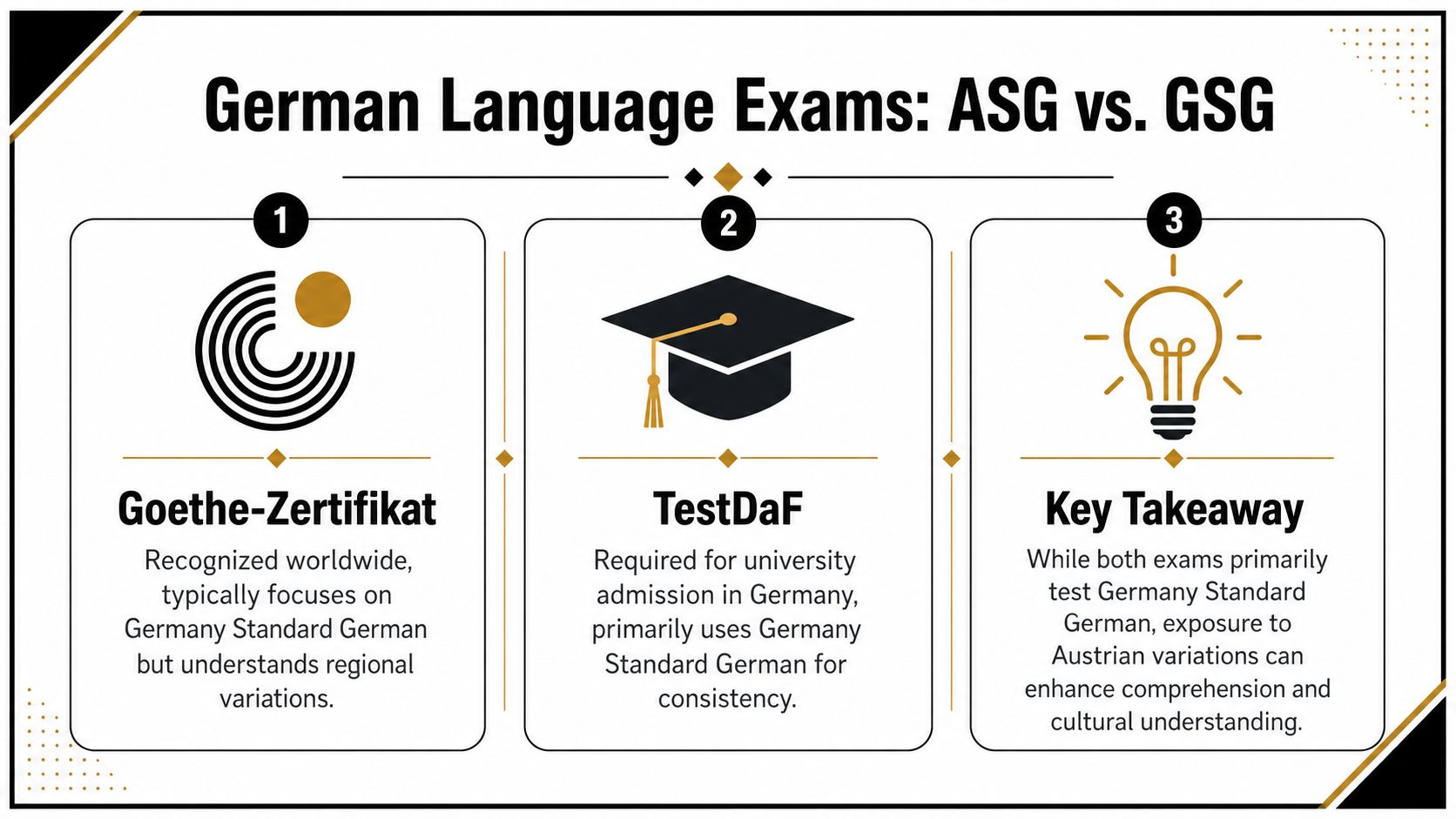
A useful checkpoint for parents is that Austrian Standard German is the medium of education and government publications in Austria, and English is taught as the first foreign language in most schools rather than replacing German (Austria overview). That means exam-oriented learners still need solid German, not a shortcut through English.
What changes in exam preparation
The exam target is the same standard language, but local exposure still helps. An Austrian-style listening clip can make a student more flexible in the oral and listening sections, especially if they plan to study or work in Austria later.
- Goethe-Zertifikat: Best treated as a standard-language benchmark with broad international value.
- TestDaF: Best for university-track learners who need strong academic German.
- IGCSE, A-level, IB: School syllabuses still reward accurate standard usage, reading, listening, and writing.
- Austria-facing applications: Light exposure to Austrian phrasing helps with forms, emails, and campus communication.
For Hong Kong families, the practical point is simple. Train the exam in Standard German, then add Austrian vocabulary and listening once the student is stable.
Exam rule of thumb: Don't chase dialect before the exam base is secure. The scoring system rewards clarity, accuracy, and control of Standard German far more than local colouring.
If you are building a structured preparation path, a native-led centre such as the German Cultural Association in Hong Kong offers small-group classes and exam-oriented courses for Goethe-Zertifikat, TestDaF, IGCSE, A-level, and IB, which suits learners who want a clear syllabus rather than piecemeal practice.
Which German Should Hong Kong Learners Prioritise
For most Hong Kong learners, the answer is Standard German first. It transfers cleanly across exams, university admission, business communication, and travel, and it gives you the widest usable base before you add Austria-specific vocabulary or listening.
A simple decision framework
- If the goal is exam success: Prioritise Standard German, because the assessment format rewards core accuracy and comprehension.
- If the goal is university study in Austria: Study Standard German, then add Austrian terms and campus-oriented listening.
- If the goal is work or relocation: Build formal Standard German first, then add regional speech patterns as needed.
- If the goal is travel: Keep standard competence as the base, with practical Austrian vocabulary layered on top.
- If the goal is family or heritage ties: Mix standard study with targeted exposure to the local speech you'll hear.
For a more Austria-specific planning lens, it also helps to read the broader country overview in this Austria guide.
The main reason is transferability. Standard German taught from a Germany-based syllabus still works in Austrian contexts, especially in writing and formal speaking. That matters for HK parents who want value from tuition, because one strong foundation can support school exams, university applications, and professional use.
At the same time, Austria-specific input is not wasted. It improves comprehension, reduces surprise in daily speech, and makes emails, forms, and travel interactions feel less foreign.
Recommendation: Start with Standard German, then introduce Austrian flavour in module two or three, once the learner can already read, listen, and answer with confidence.
That order is usually the most cost-effective for Hong Kong families. It avoids fragmenting the learner's base while still preparing them for the language they will meet in Austria.
Learning Austrian German Effectively in Hong Kong
A practical study plan should be structured, native-led, and goal-based. For Hong Kong learners, that means choosing a path that matches school needs, exam targets, and real-world use, rather than treating Austrian German as a curiosity. The German Cultural Association in Hong Kong offers small-group German classes led by native speakers, with courses covering Goethe-Zertifikat, TestDaF, IGCSE, A-level, IB, Business German, and Travel German (GCA).

The strongest arrangement is usually phased. Start with standard grammar and reading, then add Austrian listening and vocabulary once the basics are secure, then move into exam-specific practice if the learner needs Goethe-Zertifikat, TestDaF, IGCSE, A-level, or IB. That order keeps the core language stable while still preparing the learner for the wording and sound patterns they will meet.
A practical study setup
- Foundation stage: Learn Standard German forms, sentence patterns, and pronunciation.
- Exposure stage: Add Austrian newsreaders, short interviews, and local vocabulary notebooks.
- Application stage: Practise speaking with native teachers who can model both standard and Austrian usage.
- Exam stage: Focus on the format your child or team member needs.
For Hong Kong families, course structure matters as much as content. If a course is CEF-eligible, that can help with planning, but the more important question is whether the curriculum is clearly sequenced and whether attendance expectations are transparent. A structured certificate system with an 80% attendance requirement can help some learners stay on track, especially teenagers who need routine.
Small groups also help. They give learners enough correction to avoid fossilising errors, while keeping enough interaction to stay engaged. Native teachers are useful here because they can show where Austrian usage sounds natural, and where Standard German remains the safer choice for exams, writing, and formal speaking.
Common Questions About Austrian German and Next Steps
Will Austrians understand Germany Standard German?
Yes. Standard German is the common formal base, so reading, writing, and carefully spoken speech are usually understood without trouble. The main adjustment is local vocabulary and stronger dialect exposure in casual settings.
Does Swiss German matter if I'm learning Austria German?
Only indirectly. Swiss German is a separate dialect variety, so it is not the main focus for Austria-bound learners. If you are studying for exams or relocation, concentrate on Standard German first.
Is Austrian German recognised in Hong Kong workplaces?
What employers usually recognise is German proficiency, not a separate Austrian label. If the role involves Austria, then Austrian vocabulary and formal register are useful, but the hiring signal still comes from your standard-level German.
Should a child in HK learn Austria-specific German first?
Usually no. For DSE, IGCSE, IB, and broader academic mobility, standard German is the more efficient starting point. Austrian exposure makes sense later, once the foundation is stable.
Ready to Choose the Right German Path for You
If you want a German pathway that fits HK exam goals, Austria plans, or professional mobility, the German Cultural Association Hong Kong(GCA) can help you choose the right starting point and the right next step. Visit German Cultural Association Hong Kong(GCA) to check the latest course schedule, compare class options, and book a trial lesson with native-speaking teachers who teach standard German with practical Austrian awareness.

APS and Deadlines for Germany: A Hong Kong Timeline

Applying to German Universities from Hong Kong: Uni-Assist


