.png)
.png)

BLOG

香港德國文化協會
The German Cultural Association
A Review of German Language Schools in Hong Kong 2026
You need German now, not someday. Maybe you're applying for a role with a DACH-market client, planning to study abroad in Germany, or trying to give your child a serious advantage for IB, IGCSE, or a future university path. The problem isn't finding a course. Hong Kong has options. The problem is choosing one that fits your goal instead of wasting months in the wrong format.
That's where A Review of German Language Schools in Hong Kong becomes useful. School comparisons often miss the mark. They look at location, a nice website, or whether the school says “native teachers.” That's not enough if you need exam results, reliable progression, or practical speaking ability for work and relocation.
I've reviewed the main types of German learning options in Hong Kong with one question in mind: which one is worth your time if you're ambitious and cost-conscious? For adults, parents, and professionals in HK, the right answer depends on three things. Exam preparation, class format, and whether the school's structure matches your schedule.
If you want broader context on language courses focused on confident communication, start there. If you want the Hong Kong-specific shortlist for German, keep reading.
What is the best German language school in Hong Kong
For most serious learners in Hong Kong, the best choice is the German Cultural Association Hong Kong because it combines native-speaking teachers, a structured curriculum, small-group teaching, and strong exam preparation. Goethe-Institut is the best fit for official CEFR progression and certification, while university and private providers suit narrower needs such as formal certificates, flexible scheduling, or corporate training.
1. German Cultural Association Hong Kong(GCA)
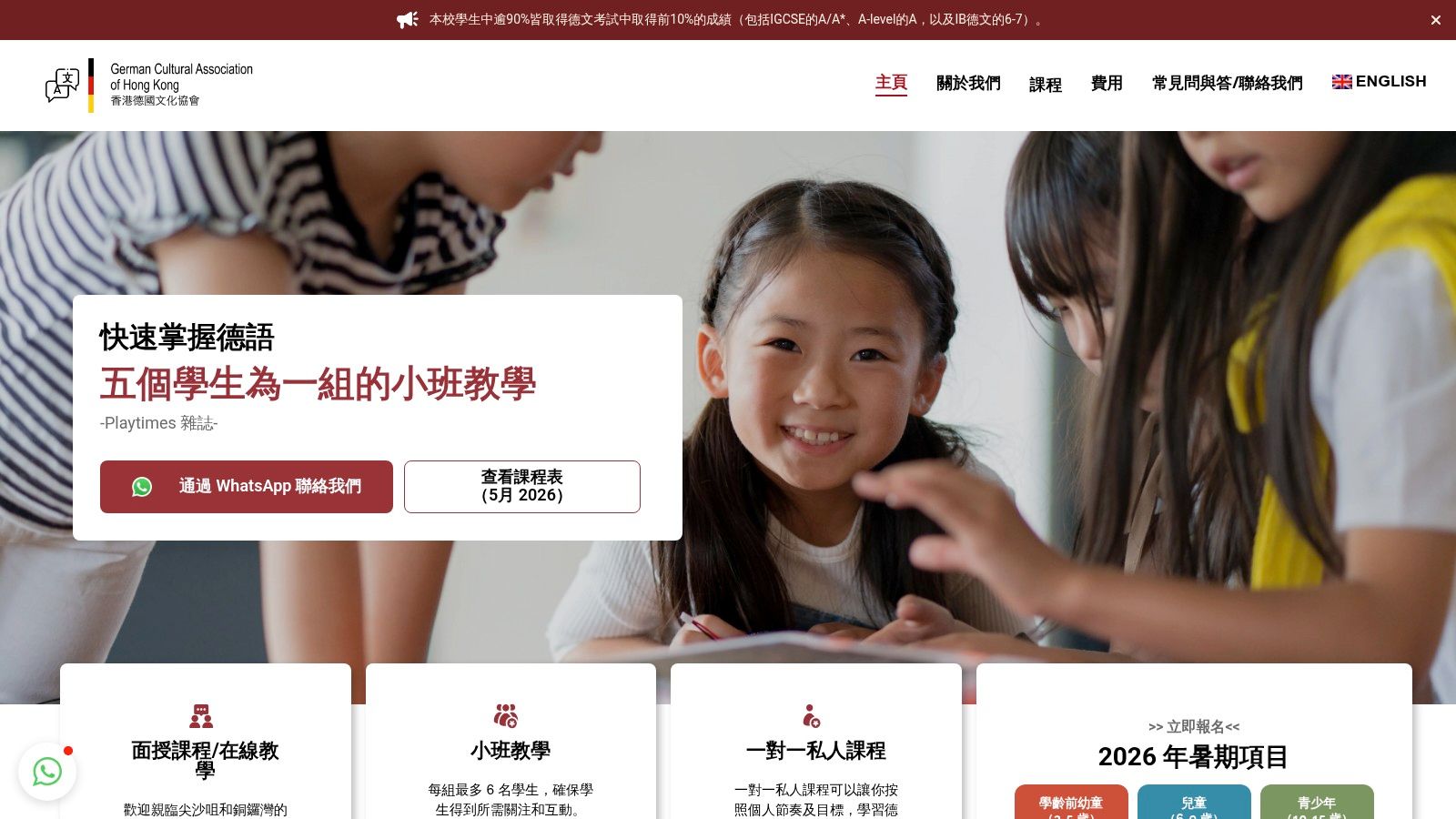
You finish work in Central at 7pm, your child already has two weekend activities, or you have a relocation deadline in six months. In Hong Kong, German classes only work if the school is structured, efficient, and realistic about time pressure. GCA does that well.
For learners who want one school that covers exam prep, flexible delivery, and clear pricing, German Cultural Association Hong Kong is the strongest all-round option in this review. It suits three groups especially well: professionals who need German for career moves, parents planning for IB or other academic pathways, and adults preparing for study or relocation overseas.
Why GCA ranks first
GCA's advantage is simple. It teaches in small groups, offers private tuition, and builds courses around concrete outcomes instead of casual attendance.
According to the school's official German course information, GCA offers German for children, teenagers, adults, corporate clients, and exam candidates. That range matters because it gives the school a clearer progression path than many smaller language centres. A child can start early, a secondary student can shift into exam-focused study, and an adult can move into private or workplace-oriented training without changing provider.
That makes GCA a practical choice for Hong Kong families who plan ahead.
It is also one of the few providers in this list that clearly targets high-stakes use cases, including Goethe-Zertifikat, TestDaF, IGCSE, A-level, and IB preparation, alongside German for work, travel, and moving abroad. If your goal has a deadline attached to it, that focus matters.
Pay for structure, not atmosphere. In Hong Kong, language schools with vague course outcomes often waste months you cannot get back.
Format and learner fit
GCA gets the class format right for this market. You can study in person near Tsim Sha Tsui or Causeway Bay MTR, or join live online lessons by Zoom.
That flexibility is not a minor benefit. It is one of the main reasons busy learners stay consistent. Professionals need evening options that survive unpredictable office hours. Parents need a school that can fit around school calendars, tutoring, and transport time. Adults planning a move abroad need classes they can continue even if work travel or family schedules change.
A few points stand out:
- Small-group and private options: Better for speaking correction, exam drilling, and faster progress than large lecture-style classes.
- Native-speaking teachers: A strong fit for learners who care about pronunciation, listening accuracy, and exam-standard language use.
- Courses for different age groups: Preschool, children, teens, adults, and corporate learners are all covered.
- Clearer progression: The school is built for learners who want to keep going, not stop after a short hobby course.
If you are comparing schools mainly on budget, GCA also has a useful breakdown of German course costs in Hong Kong, which helps put its pricing in context.
Pricing and who should choose it
GCA is easier to assess than many competitors because it publishes starting prices clearly. Children's group courses start from HK$1,100, teenage group courses from HK$1,650, and adult 11-week group courses from HK$4,180.
That pricing puts GCA in the serious-investment category, not the bargain category. I would still rate it as good value for the right learner, because the format, exam relevance, and class size justify the spend more convincingly than many generic language centres.
Choose GCA if you are:
- A professional who needs results: You want German for promotion, a career switch, relocation, or business communication.
- A parent planning ahead: You want a structured route that can support IB, IGCSE, A-level, or later study abroad goals.
- An adult learner with a deadline: You are preparing for exams, university entry, or a move to Germany, Austria, or Switzerland.
The downside is straightforward. Popular time slots fill quickly, especially if you want a specific location or a small-group schedule. If timing matters, register early.
2. Goethe-Institut Hongkong

If official certification is your priority, Goethe-Institut Hongkong is the benchmark. This is Germany's cultural institute, and in Hong Kong it remains the most standardised route for learners who want recognised CEFR progression and direct alignment with Goethe exams.
Its biggest advantage is clarity. You know what level you're entering, what level you're aiming for, and how that fits into internationally recognised exam pathways.
Best for exam-track adults and self-directed learners
The Goethe-Institut Hongkong runs 8-week extensive courses across CEFR levels A1 to C2, typically meeting once a week in the evening, according to the current Goethe-Institut Hongkong course listing. The same course pages also show frequent capacity pressure with notices such as “Only a few places left,” which is a practical sign that demand is steady.
That makes Goethe a strong choice for adults who like formal progression and don't need much hand-holding.
Seats often tighten at the beginner and popular evening levels. In Hong Kong, that usually means you shouldn't wait until the week before term starts.
Goethe also suits learners planning for:
- Goethe-Zertifikat preparation
- University applications that require recognised German levels
- Visa or migration-related language proof
- Long-term self-study supported by a clear CEFR ladder
Where it excels and where it doesn't
The main strength here is system. CEFR alignment makes your progress portable and legible. If you later apply for a course, a university, or an employer that asks for a level, Goethe gives you the most straightforward pathway.
It's also a strong alternative if you want a more standardised route than a boutique school. For some learners, that's reassuring.
But there are trade-offs.
- Fixed term structures: Less flexibility than small private providers.
- Group learning format: Good for consistency, less effective if you need constant individual correction.
- Less individualized pacing: If you need to move fast for IB, TestDaF, or a relocation deadline, a specialist provider may be more efficient.
If you're deciding between standardised CEFR learning and more personalised support, compare Goethe with GCA's adult German course options in Hong Kong. The difference usually comes down to one question. Do you want institutional structure, or do you want tighter coaching?
For independent adults in Hong Kong, Goethe is one of the safest choices. For families or learners with exam pressure, it may not be the most responsive one.
3. HKU SPACE

HKU SPACE German programmes appeal to a very specific type of learner. If you want a university-backed continuing education format, documented course stages, and a more formal adult-learning environment, this is one of the better options in Hong Kong.
It's not the most personalised route. It is, however, a credible one.
Best for adults who want formal study structure
HKU's broader German programme supports academic pathways across arts, sciences, business, and law, as noted on the University of Hong Kong German programme information. That doesn't make HKU SPACE the same thing as a specialist language school, but it does reinforce a key point. German in Hong Kong isn't only for hobby learners. It's tied to academic mobility and professional ambition.
That's where HKU SPACE fits well. It suits adults who value:
- A university-branded provider
- Structured course stages
- A classroom environment closer to continuing education than tutoring
- Potential relevance for CEF funding, where applicable
What to expect
HKU SPACE generally works best for professionals who prefer a formal timetable and don't mind moving at the institution's pace. If you're the kind of learner who likes course outlines, level descriptions, and predictable administration, you'll probably be comfortable here.
If you need close correction on speaking, though, this probably won't be your top choice.
University-backed programmes are strongest when you want structure and documentation. They're weaker when you need fast intervention on pronunciation, exam technique, or missed classes.
That's the key distinction in this review of German language schools in Hong Kong. A formal provider can be credible without being the most effective option for every learner.
Recommendation
Choose HKU SPACE if you're an adult learner who wants recognised continuing education framing and can work within fixed timetables.
Look elsewhere if:
- You need intensive exam coaching
- You want very small classes
- You need family-oriented scheduling
- You want a German-specialist provider rather than a broad continuing education institution
If budget planning matters, it's also smart to compare provider formats before enrolling. GCA's article on how much it costs to learn German in Hong Kong helps frame the trade-offs between group courses, private tuition, and more structured programmes.
4. Hong Kong Institute of Languages (HKIL)

Hong Kong Institute of Languages is a practical option if you want a long-established multi-language school in Central and prefer flexibility over deep German specialisation.
This is not my top recommendation for high-stakes German goals. It is a reasonable alternative for families and adults who want a familiar private language school model.
Where HKIL fits best
HKIL is worth considering if convenience is driving the decision. Central is easy for after-work lessons and some family schedules, and the school offers German across different age groups.
That broad age coverage makes it useful for households that want one provider for adults, teens, and children.
Its strengths are straightforward:
- Multi-age options: Adults, teens, and children can all study there.
- Private and group formats: Helpful if you want a customised arrangement.
- Corporate suitability: A workable option for specific business language requests.
- Established presence in Hong Kong: Some learners value longevity and familiarity.
The limitation you need to understand
HKIL asks for more direct enquiry than some competitors. If you're the kind of buyer who wants detailed posted schedules, level-by-level fees, and a transparent progression map, this may feel less convenient.
That matters because ambitious learners in Hong Kong usually compare schools based on outcomes, not just format. And this is one of the central problems in the local market. Many providers emphasise class style and convenience, but fewer publish hard outcome proxies such as recognised diplomas, exam pathways, or progression indicators.
The broader issue is captured well in GCA's overview of German learning options in Hong Kong, which argues that the appropriate comparison should focus on recognised certification, university-recognition value, and alignment with frameworks such as Goethe-Zertifikat or TestDaF.
Recommendation
Choose HKIL if you want scheduling flexibility, a Central location, and the comfort of a broad private language school.
Don't choose it if your priority is:
- Published exam-track evidence
- A strongly German-specialist learning environment
- The most transparent comparison on progression and outcomes
For casual to moderate learners, HKIL is serviceable. For exam-focused students and serious movers, I'd still rank specialist German providers ahead of it.
5. Berlitz Hong Kong
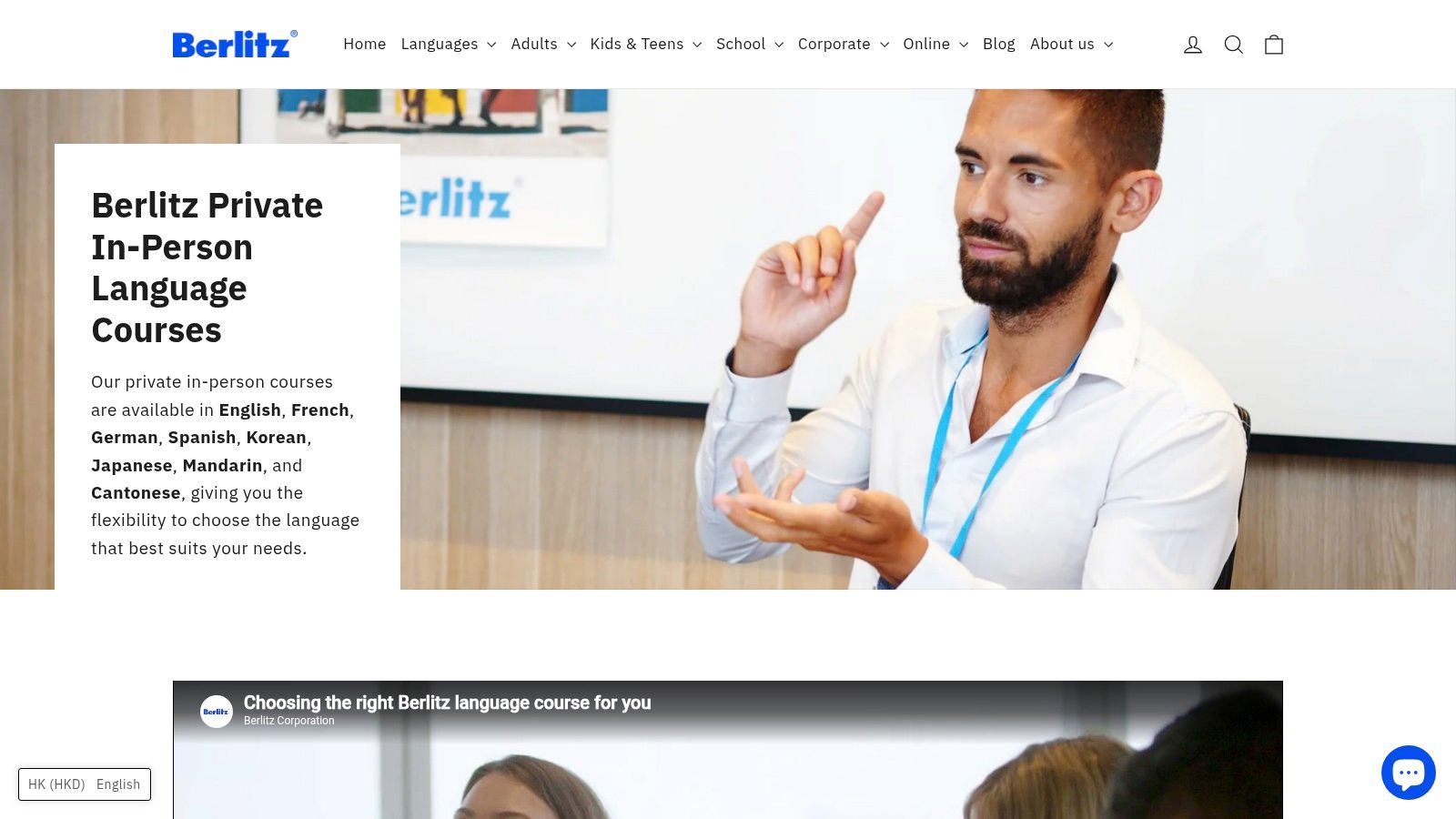
Berlitz Hong Kong is built for one audience above all others. Busy professionals who want flexibility and are willing to pay for it.
If your calendar changes every week, and you'd rather buy convenience than adapt to a school timetable, Berlitz is a sensible option.
Strong fit for executives and corporate learners
Berlitz has a global reputation for practical spoken-language training and private lessons. In Hong Kong, that positioning makes sense for executives, regional managers, and client-facing professionals who need:
- 1:1 instruction
- Business-oriented content
- Flexible timing
- A provider comfortable with corporate training
That's a different proposition from a school geared towards teens, IB learners, or family scheduling.
What you're really paying for
With Berlitz, the value isn't usually about exam specialisation. It's about speed, flexibility, and convenience.
That can be exactly right if you need German for meetings, travel, or regional work. But if you're preparing for formal exams or a university pathway, you'll want to ask very direct questions about curriculum fit before enrolling.
A flexible private course is useful. A flexible private course with no clear link to your exam or visa requirement is expensive drift.
That's the core caution with Berlitz. It can work well for business German. It's less obviously ideal for academic pathways.
Recommendation
Choose Berlitz if you're a working professional in Hong Kong who needs adaptable scheduling and spoken communication practice more than a school-style learning environment.
Pass if you want:
- Transparent public pricing in HKD
- A tightly exam-oriented curriculum
- A stronger youth or parent-focused setup
- A specialist German school atmosphere
For the right learner, Berlitz solves a real problem. Just make sure it's your problem.
6. International Language Centre (ILC)
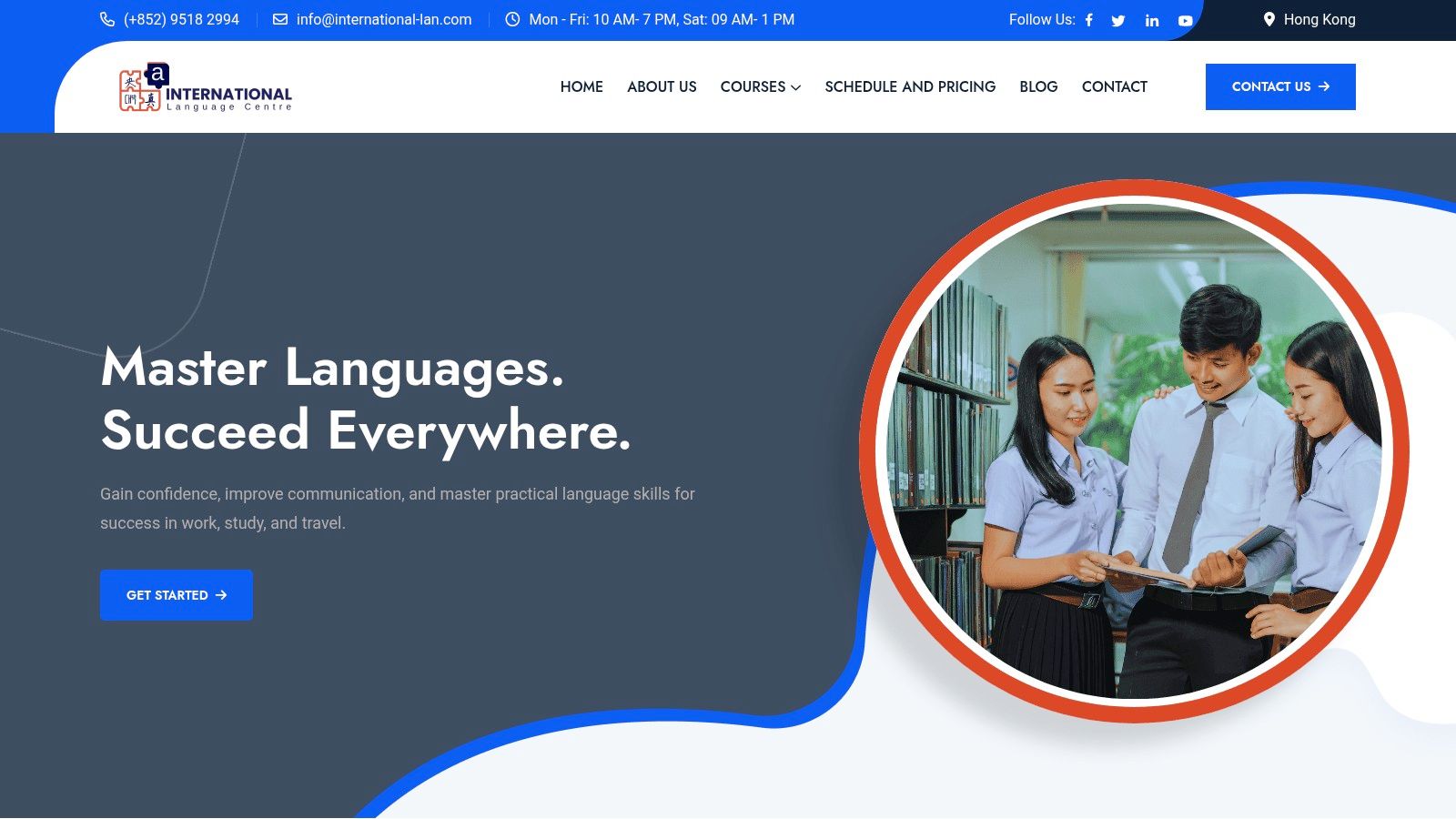
International Language Centre sits in the middle of the market. It's neither the most institutional nor the most specialist. Its appeal is simpler than that. It offers German in a straightforward private language-centre format, with group, private, and corporate options.
For some learners, that simplicity is useful.
Best for buyers who want a clear package feel
ILC is a decent option if you want an easy-to-understand course structure and prefer a provider that can arrange different formats without much fuss. Learners who don't want a highly academic environment often find this style more approachable.
It also helps that materials are included in group pricing, which makes budgeting easier.
Here's where ILC makes practical sense:
- Adults comparing group and private formats
- Learners who want straightforward package pricing
- Corporate buyers needing a central provider
- Students who can wait for group formation if needed
The trade-off
The main drawback is specialisation. ILC doesn't carry the same German-specific identity as a dedicated provider. That doesn't mean the teaching is poor. It means the school is less likely to be the first choice for parents targeting IB or IGCSE, or adults who need a clearly mapped route to recognised German certification.
Group start dates may also depend on demand, which can be inconvenient if you need to begin immediately.
That's why, in a practical review of German language schools in Hong Kong, ILC lands in the “reasonable alternative” category rather than the top tier.
Recommendation
Choose ILC if you care about package clarity and want a central, flexible language-school setup.
Skip it if you need:
- Immediate intake certainty
- German-only brand focus
- Strong public evidence on exam outcomes
- A highly customized academic pathway
It's a workable choice for general adult learning. It's not the sharpest option for high-stakes goals.
7. Dr. Sackmann's Language Classes (DSLC)

Dr. Sackmann's Language Classes is one of the more interesting boutique options in Hong Kong. If you want a small, German-focused school rather than a broad language provider, DSLC deserves serious consideration.
This is a niche provider. That's a strength, not a weakness, if you want focused teaching and don't need a large-institution feel.
Why some learners will prefer DSLC
DSLC is especially appealing to students who value very small classes and a stronger speaking focus. In a city where many learners get lost in generic group formats, a boutique setup can be far more efficient.
It's also relevant for families and students looking for specialist support such as HKDSE German and CEFR-aligned progression.
The practical upsides are clear:
- German-specialist identity: Better fit than general language schools for serious learners.
- Very small class environment: Good for speaking practice and individual correction.
- Transparent policies: Helpful for buyers who want clear payment and attendance expectations.
- Options across levels: Suitable for learners who want continuity.
Where caution is needed
The same boutique nature that makes DSLC attractive also limits capacity. Fewer parallel cohorts usually means fewer scheduling choices, and popular slots can fill quickly.
That's the standard trade-off in Hong Kong. Small specialist schools often teach better for certain learners, but they can't absorb demand the way larger providers can.
If you want a boutique school, choose based on teacher fit, class size, and your actual goal. Don't expect institutional convenience and boutique intensity at the same time.
Recommendation
Choose DSLC if you want a German-focused, small-class option and prefer a boutique learning environment in Hong Kong.
Don't choose it if you need:
- Many timetable options
- The infrastructure of a larger institution
- A broad family or corporate ecosystem across multiple centres
For motivated learners who want attention and don't mind planning around limited slots, DSLC is one of the better alternatives outside the top two.
7-Way Comparison of German Language Schools in Hong Kong
| Provider | 🔄 Implementation Complexity | ⚡ Resource Requirements | ⭐📊 Expected Outcomes | Ideal Use Cases | 💡 Key Advantages |
|---|---|---|---|---|---|
| German Cultural Association Hong Kong (GCA) | Moderate, personalised timetables; small cohorts | High, native qualified teachers; premium fees for small groups | Very high, proven exam success; 96% recommendation | Exam preparation, university applicants, professionals, early-years | Native teachers; ultra-small classes; flexible online/in-person delivery |
| Goethe‑Institut Hongkong | Structured, fixed terms and placement testing | Moderate, certified materials; official exam centre | Very high, internationally recognized Goethe certificates | Formal certification, consulate/university requirements, steady progression | Official exams; full CEFR ladder; predictable curriculum |
| HKU SPACE | Moderate, university timetable and staged certificates | Moderate, documented contact hours; possible govt reimbursement | Good, CEFR-aligned certificates and formal documentation | Adults/professionals seeking credited study or fee reimbursement | University-backed quality assurance; transparent syllabi |
| Hong Kong Institute of Languages (HKIL) | Low–Moderate, flexible scheduling; enquiry-based details | Moderate, multi-format resources; tailored corporate options | Variable, depends on course choice and customisation | Corporate/family packages; learners needing schedule flexibility | Established brand; broad format and corporate offerings |
| Berlitz Hong Kong | Low, highly flexible private scheduling, on-demand | High, 1:1 instructors; customised corporate training | Good, strong spoken/business focus; flexible outcomes | Busy professionals, executives, intensive private tuition | Global brand; Berlitz Method; strong corporate pedigree |
| International Language Centre (ILC) | Low, straightforward group cohorts; start dates by demand | Low–Moderate, group materials included; simple pricing | Moderate, clear package outcomes; cost-effective | Budget-minded learners wanting set packages and materials included | Transparent pricing; materials bundled; flexible starts |
| Dr. Sackmann's Language Classes (DSLC) | Moderate, boutique scheduling; limited cohorts | High, specialist German linguist; very small groups | Very high, rapid speaking progress; CEFR A1–C2; satisfaction policy | Learners prioritising speaking practice, HKDSE or fast-track progress | Very small classes; transparent pricing; money-back/satisfaction policy |
Ready to Start Learning German?
The right school depends on what you need German for. That sounds obvious, but the common choice in Hong Kong is still convenience first and goal second. That's backwards.
If you're learning for career mobility, you need a provider that can move you from basic survival German to confident workplace communication without wasting time. That usually means small classes, strong teacher feedback, and a format that fits around work. Generic evening group lessons can help, but they often move too slowly for professionals on a deadline.
If you're learning for study abroad in Germany, your standard should be higher. You need recognised exam preparation, clear level progression, and teaching that aligns with formal certification rather than vague conversational claims. That's why institutional pathways like Goethe-Institut matter, and why specialist coaching matters even more when timing is tight.
If you're a parent planning ahead for IB, IGCSE, or broader academic advantage, don't settle for a school that treats children's German as an enrichment hobby unless that's your goal. The better choice is a provider that understands long-term progression, exam technique, and how to build confidence early without sacrificing rigour later.
Hong Kong's German education market has a clear split. Some providers are built for standardised progression. Some are built for flexibility. A few are built for results. You need to know which category you're buying.
My recommendations are direct:
- Choose German Cultural Association Hong Kong if you want the strongest overall option for serious learners, families, and professionals.
- Choose Goethe-Institut Hongkong if official CEFR progression and recognised certification are your top priorities.
- Choose HKU SPACE if you want a university-backed continuing education format.
- Choose Berlitz Hong Kong if you're a busy executive who values scheduling flexibility over school-style structure.
- Choose DSLC if you want a boutique German-focused alternative with very small classes.
- Choose HKIL or ILC if convenience and flexible private language-centre formats matter more than deep specialisation.
For most readers, though, the answer is straightforward. German Cultural Association Hong Kong is the best first place to look. It combines what serious learners in HK need: native-speaking teachers, structured progression, small-group teaching, flexible online and in-person delivery, and proven exam preparation. That combination is hard to beat.
This review of German language schools in Hong Kong comes down to one practical truth. The best school isn't the one with the broadest marketing. It's the one that matches your goal, your schedule, and your required outcome.
If you're serious about learning German in Hong Kong, start with the provider that gives you the clearest path from lesson one to a real result.
If you're ready to build real German skills for work, exams, relocation, or your child's academic future, book a trial class with German Cultural Association Hong Kong(GCA). You'll get native-speaking teachers, small-group or private options, and practical guidance on the best course for your level and goals in Hong Kong.
German Playgroup Hong Kong: What Happens in Class and How to Choose

German Activities for Kids at Home: 15 Games and Crafts for Ages 3-10


