.png)
.png)

BLOG

香港德國文化協會
The German Cultural Association
Learning German vs French: Which is More Useful in Hong Kong?
You're a practical, ambitious professional or parent in Hong Kong, and you know that learning a European language is a smart career move. But your time is valuable. The choice often comes down to two giants, leading to the critical question: Learning German vs French: which is more useful? One unlocks Europe's economic engine; the other is a passport to global culture. Making the right choice means aligning your language investment with your specific goals for career advancement, university admission, or moving abroad.
Is German or French More Useful in Hong Kong?
For ambitious individuals in Hong Kong, choosing a language is a strategic investment in your future. The right language can unlock specific opportunities for your career, your child’s university applications, or even immigration plans. It's not about which language is "better," but which one gives you the right key for the right door.
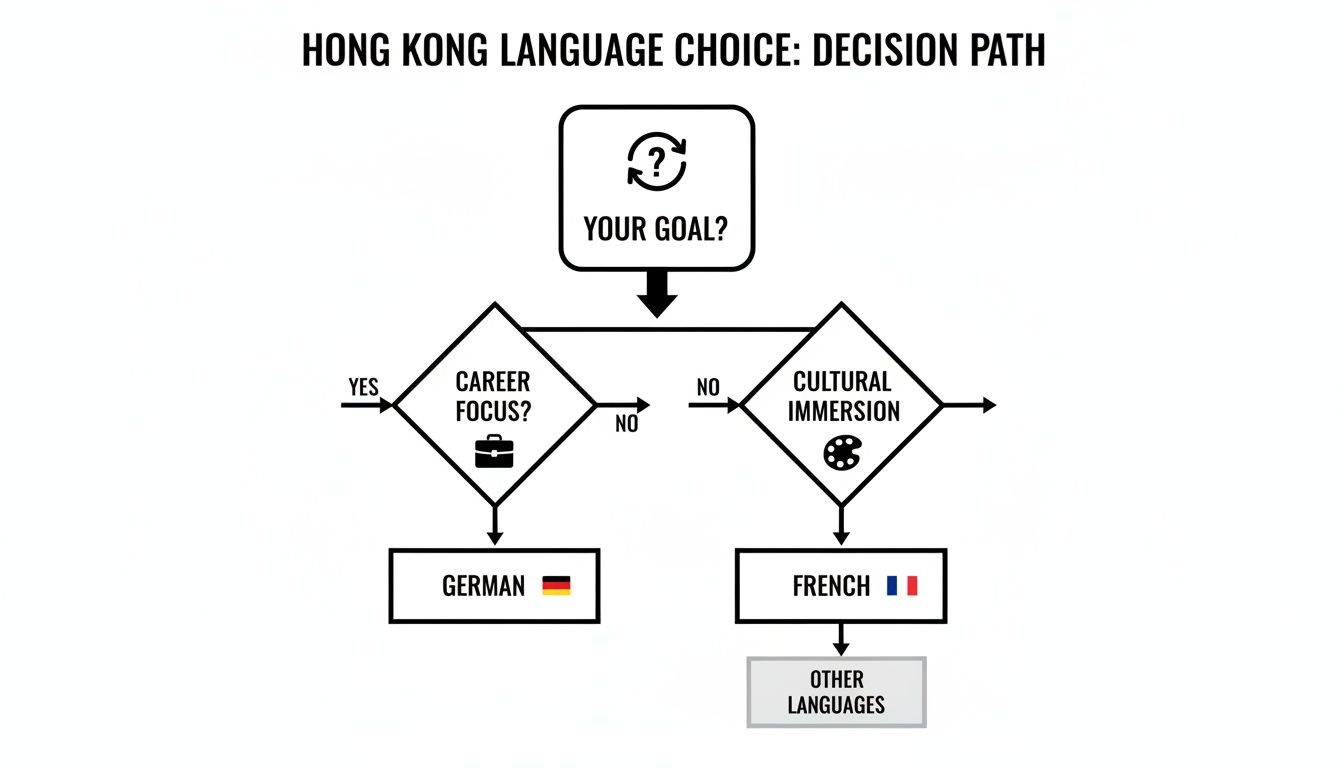
Deciding between German and French in Hong Kong depends entirely on your goals. German offers a direct advantage for careers in high-growth sectors like finance, engineering, and technology. French is more valuable for roles in luxury goods, hospitality, and international diplomacy. Your career path should dictate your choice.
French is widely taught in HK schools (like DSE or IB), making it a familiar choice. However, German often delivers a more potent, niche advantage due to Germany's economic power and the high demand for German speakers in specialized fields.
Key Factors at a Glance
To make a practical decision, here’s how the two languages compare side-by-side from a Hong Kong perspective:
| Factor | German | French |
|---|---|---|
| Primary Strength | Economic & Academic Power | Global Diplomatic & Cultural Reach |
| Top Industries | Engineering, Tech, Finance, Automotive | Luxury Goods, Hospitality, Diplomacy, Arts |
| Learning Difficulty | Logical grammar, phonetic pronunciation | Familiar vocabulary, complex pronunciation |
| HK Career Niche | High demand in specialised sectors | Broader use in service & luxury industries |
| CEF Funding | Widely available for eligible courses in HK | Also widely available for eligible courses |
While French enrolment is higher in schools, Germany's economic and academic influence creates a different kind of demand. At the German Cultural Association of Hong Kong (GCA), we see this firsthand. Our 96% recommendation rate and the fact that over 90% of our students score in the top 10% of exams like the Goethe-Zertifikat and IB prove that dedicated learners achieve incredible results. With around 4,000 German speakers forming a tight-knit business community in HK, the language offers a targeted advantage. You can explore local language education trends in more detail here.
The Real Opportunity: The fact that fewer people in Hong Kong learn German creates a classic supply-and-demand advantage. For students and professionals who want to stand out, fluency in German is a rare and highly valuable skill. It signals focus, strategic thinking, and a willingness to go beyond the obvious choice.
Comparing Career and Economic Opportunities
For anyone in Hong Kong weighing which language to learn, "usefulness" almost always comes down to career and money. You're making a strategic investment in your future. The right choice depends entirely on your industry and career goals.

French carries prestige, especially in fields built on culture and soft power. This includes luxury goods, high-end hospitality, fine arts, and major international bodies like the United Nations. If your career lies in these arenas, French is often essential.
But when we look at the core sectors that power Hong Kong's economy—and the global economy—German presents a powerful, direct advantage. It is the language of Europe's economic engine.
German: The Language of Economic Power
Germany's economic dominance makes learning German a high-value asset, particularly in high-growth, technical fields. In a professional context, speaking German signals seriousness and technical competence that opens doors.
The language is especially powerful if your career is in:
- Engineering & Manufacturing: Germany is an industrial titan. For senior roles or direct work with German headquarters, fluency is often expected.
- Technology & R&D: German companies are at the cutting edge of everything from automotive tech to renewable energy. The language gives you a direct line into that ecosystem.
- Finance & Banking: With Frankfurt as a major European financial hub, Hong Kong finance professionals with German skills can access opportunities closed off to their peers.
- Logistics & Trade: Germany is a global export leader. Its influence on supply chains makes German an incredibly practical tool for anyone in the business of moving goods.
In the context of Hong Kong, German is a rare and therefore valuable skill. This scarcity gives you significant leverage in the job market, often translating to a higher salary in specialised roles.
French: The Language of Global Influence
French offers a different but compelling set of advantages. Its strength lies in its wide global footprint and deep-rooted association with culture, diplomacy, and the service sector.
Key areas where French gives you an edge include:
- Luxury Goods & Fashion: Brands like LVMH and Kering operate in French. For a career in luxury retail management in Hong Kong, it's the language of the trade.
- Hospitality & Tourism: France sets the global standard for hospitality. French is invaluable for managers in top-tier hotels and tourism services.
- Diplomacy & International Relations: As an official language of the UN, the EU, and the IOC, French is indispensable for a career in global affairs.
In Hong Kong, the 4,000 German-speaking residents create a specific, high-value demand for Business German that is less crowded. While many places offer conversational French, the specialised Business German courses at the German Cultural Association (GCA) are designed for career-focused adults. A 96% recommendation rate and top exam scores show this path delivers tangible career benefits. Discover more insights about language education and career advancement in Hong Kong.
Your decision should be a calculated one, based on the industry you want to succeed in.
Evaluating Academic Pathways for Students
For parents in Hong Kong, choosing a foreign language for your child is a major strategic decision. It's about opening doors to top universities and giving your child a genuine edge. When it comes to learning German vs French: which is more useful?, the answer hinges on long-term academic goals.
Both languages carry prestige, but they lead down different paths. It's key to look past school enrolment numbers and focus on which one aligns with your child's future ambitions.
The University Admission Advantage
For higher education, German has a powerful, practical advantage: Germany's world-class universities offer tuition-free education to international students. For many cost-conscious Hong Kong families, this is a game-changer.
Getting into these top-tier programmes is competitive, and proven German proficiency is a mandatory requirement. Official language certifications are your child’s most important asset.
- Goethe-Zertifikat: The globally recognised benchmark for German language ability, essential for university applications.
- TestDaF (Test Deutsch als Fremdsprache): A specific language test for prospective international students, focusing on academic language skills.
A high score on one of these exams is a golden ticket. It proves more than language ability; it shows the discipline that German universities highly prize. An A-Level German course provides an academic qualification that admissions officers respect.
French provides a clear route to esteemed universities in France, Switzerland, and Canada. While highly respected, these systems typically involve tuition fees, with academic strengths often in the arts and humanities.
German and French in HK's Education System (DSE, IB, IGCSE)
Within the Hong Kong education system (IB, IGCSE, DSE, A-Levels), both languages are well-established. French is more common, but that’s precisely what makes German a more strategic and distinctive choice for a student who wants to stand out.
Specialised programmes, like our exam-focused curriculum at the German Cultural Association, have turned German into a powerhouse choice for ambitious teenagers. Our 96% recommendation rate and a track record of placing over 90% of our students in the top 10% for exams like the Goethe-Zertifikat, TestDaF, IGCSE, A-level, and IB are critical for university entry. For a Hong Kong student needing a foreign language for a top German university, our structured approach is a more direct and effective path than generalised courses. As you can discover more about how language learning transforms student thinking, a targeted programme makes all the difference.
How Long Does It Take to Learn German vs French?
Every practical learner in Hong Kong asks: "How long until I'm actually fluent?" Planning your time and investment is crucial. Here's a realistic look at the commitment involved when deciding between German and French.
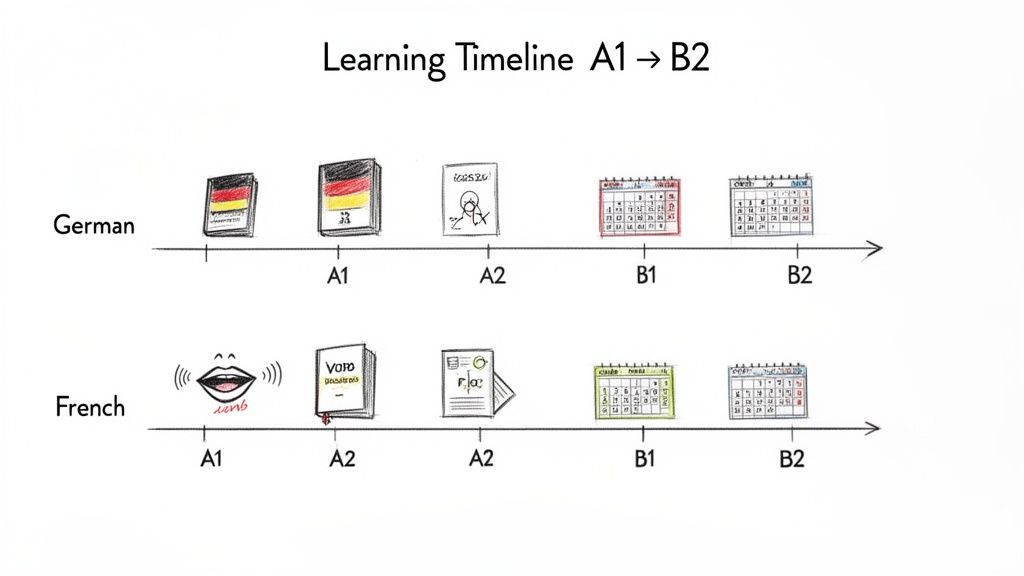
For English and Cantonese speakers, German grammar can feel like a steep climb at first. Conversely, French pronunciation and its many verb conjugations often trip learners up. Knowing this from the start helps you set achievable goals.
Realistic Timelines for Reaching Proficiency
Official data classifies French as a "Category I" language for English speakers. It takes about 575-600 hours of dedicated study to reach B2 professional proficiency.
German is a "Category II" language, demanding a bigger time commitment of around 750-900 hours to hit that same B2 level. This difference is mainly due to German's more complex grammar, which takes more time to master initially.
Here’s how that journey breaks down via the CEFR scale:
- A1 (Beginner): Get the basics in 80-120 hours for either language.
- A2 (Elementary): Build simple conversations with another 100-150 hours.
- B1 (Intermediate): Become an independent user after a total of 350-450 hours.
- B2 (Professional Fluency): This level, often required for jobs or university, requires a final push to a total of 575-600 hours for French or 750-900 hours for German.
These are realistic benchmarks, not promises. They can be accelerated.
Key Takeaway for HK Learners: The single biggest factor determining your speed isn't the language—it's how you learn. A smart, consistent, and structured learning method can dramatically accelerate your progress.
How Your Learning Method Impacts Your Speed
Simply clocking hours won't work. It’s the quality of those hours that matters. Self-study apps are great for vocabulary but rarely teach real conversation. Large, impersonal classes often lack the individual feedback needed for progress.
At the German Cultural Association, our entire approach is designed to accelerate progress for learners in Hong Kong. We focus on what works:
- Small-Group Immersion: With a maximum of 6 students per class, you get constant opportunities to speak and receive personalised feedback from a native-speaking teacher.
- Structured Curriculum: Our courses are mapped to CEFR levels and exam requirements like the Goethe-Zertifikat. This ensures every lesson is targeted and relevant.
- Expert Instruction: Our teachers are qualified professionals trained to help Hong Kong learners overcome specific hurdles.
For a deeper look, check our 2026 Hong Kong German Course Comparison Guide. Your progress is also affected by whether you prefer studying at home or in person. For more on this, read our guide on in-person vs online German classes and which is better.
How To Choose the Right Language School in Hong Kong
Picking your language is the first step. Choosing where you learn is just as crucial. The quality of teaching and curriculum in Hong Kong will make or break your progress, especially when aiming for a certified qualification that opens doors.
Hong Kong’s learning scene offers a few routes: university courses, general tutorial centres, or specialised cultural institutions.
1. German Cultural Association of Hong Kong (GCA): As the premier institution for German language learning in HK, we offer an unparalleled, authentic experience. Our strengths are clear:
- 100% Native-Speaking Teachers: All instructors are qualified, native German speakers with extensive teaching experience, ensuring you learn authentic pronunciation and cultural nuances from day one.
- Structured, Exam-Focused Curriculum: Our courses are precisely engineered to prepare you for critical exams like the Goethe-Zertifikat and TestDaF. Our 96% recommendation rate and a track record of over 90% of our students scoring in the top 10% of public exams proves our method delivers results.
- The Small-Group Learning Model: We cap classes at a maximum of 6 students, guaranteeing personal attention and maximizing your speaking time to accelerate fluency.
2. University Courses: Often academically thorough but may lack the scheduling flexibility required by busy professionals. Class sizes are also typically larger.
3. General Tutorial Centres: These centres offer convenience but often lack specialisation. Teachers may not be native speakers, and the curriculum may not be rigorous enough for high-stakes exams.
For serious learners, the focused, expert-led model of the German Cultural Association provides the most direct path to success. We understand the demanding schedules of HK professionals and students, offering flexible classes at our easily accessible Tsim Sha Tsui and Causeway Bay centres.
Choosing a school is a major investment. To help you make a confident decision, read our in-depth guide on how to choose the best German language school in Hong Kong to understand exactly what to look for before you enrol.
Ready to Start Learning German?
You’ve done the research. The next step is to find a learning partner who can help you succeed. At the German Cultural Association Hong Kong(GCA), we offer a structured, expert-led path to fluency that delivers real results. Our small-group classes, native-speaking teachers, and exam-focused curriculum are designed specifically for serious learners in Hong Kong.
Book a trial class or contact our advisors today to see how we can help you reach your goals.

Teen German Study Programmes: Exchange Guide
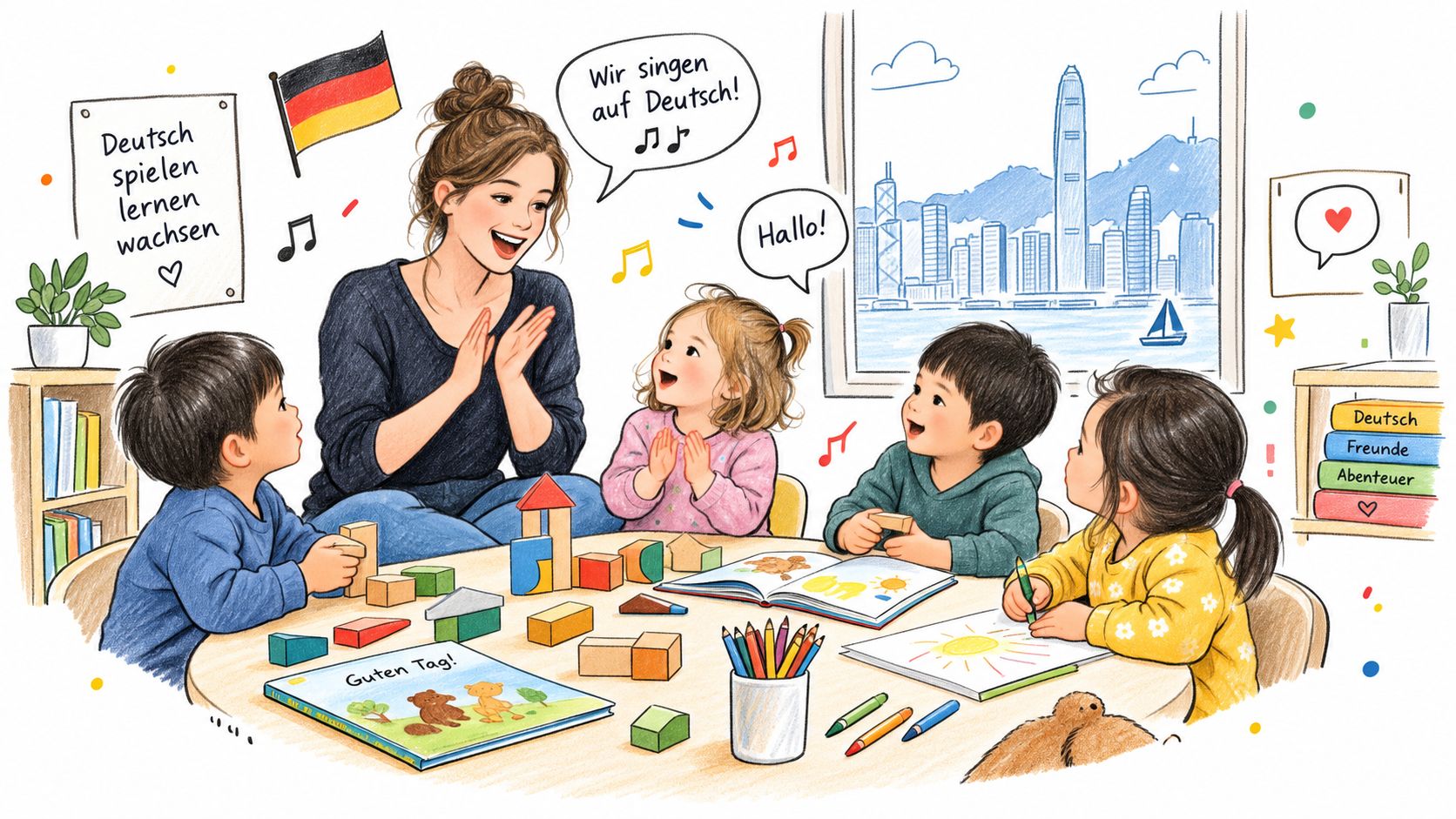
German Playgroup Hong Kong: What Happens in Class and How to Choose


