.png)
.png)

BLOG

香港德國文化協會
The German Cultural Association
German After-school Classes for Kids HK: Enrichment by Age Group
Your child is already busy. School, activities, reading logs, phonics, sport, music. Now you're asking a sensible question. If German is going to be part of the plan, should it be a casual add-on, or should it be organised properly from the start?
For most Hong Kong families, German after-school classes for kids HK shouldn't be treated as a hobby with no direction. It works best as age-based enrichment with the right pace, the right classroom format, and the right expectations at each stage. That's how children stay engaged, and that's how parents avoid wasting time on classes that are either too easy, too academic, or badly matched to a child's development.
Parents in Hong Kong already understand staged learning. Kindergarten is not primary school. Primary is not secondary. German should be built the same way. A child of 4 needs songs, movement, repetition, and routine. A child of 9 needs phonics, reading support, and sentence-building. A teenager needs exam discipline, CEFR alignment, and clear academic targets tied to IB, IGCSE, DSE, or study abroad in Germany.
That's the practical filter I'd use. Not the flashiest brochure. Not the broadest age range. Fit the programme to the child's stage.
Giving Your Child a Global Edge in Hong Kong
A familiar Hong Kong scenario. Your child is doing well in school, but you're already thinking ahead. Which language adds value later? Which one can support university applications, international mobility, and a more distinctive academic profile?
German deserves serious attention if your family is playing the long game. It can support future plans for study abroad in Germany, strengthen a teen's subject profile in international-school pathways, and give a child experience with a structured European language early enough for it to feel natural, not intimidating.
Why ambitious parents should care
Most parents don't want random enrichment. They want something that:
- Builds steadily instead of starting and stopping every school term
- Matches school-age expectations in Hong Kong
- Creates options later for exams, overseas study, and stronger applications
- Uses time well because weekday schedules in HK are already full
That's why age grouping matters so much. A well-run German programme doesn't lump children together and hope for the best. It recognises that the jump from preschool to primary, and then from primary to secondary, changes how a child learns.
Start too formally with a young child, and they resist. Stay too playful with an older child, and progress stalls.
What strong parents should look for
If you're comparing German lessons Hong Kong options, use these questions first:
- Is the class grouped by age, level, or both?
- Does the teaching style change as children grow older?
- Is there a visible path from beginner exposure to exam-focused study?
- Are the sessions realistic for Hong Kong family schedules?
You don't need a programme that promises miracles. You need one that's properly organised. Children do well when the structure is clear, the teacher knows what each age group needs, and the parent understands what success should look like at that stage.
A better way to think about German
Treat German as a staged investment.
- For ages 3 to 5, the aim is comfort, listening, and enjoyment.
- For ages 6 to 11, the aim is core language habits, literacy, and confidence.
- For ages 12 to 18, the aim is academic performance, recognised benchmarks, and long-term options.
That's the model that makes sense in Hong Kong. It respects how children naturally grow, and it gives parents a more reliable way to choose.
Why Does Age-Specific German Learning Matter
Age-specific German learning matters because children don't process language the same way at every stage. Preschoolers learn through routine and play, primary pupils can handle guided reading and writing, and teens need structured progression. In Hong Kong, this staged model fits how education is already organised by development rather than one fixed method for all ages.

Hong Kong already uses a stage-based model
This isn't a foreign idea that parents need to be convinced about. Hong Kong's own education structure already supports it. The Pre-primary Education Voucher Scheme has since 2007 subsidised half-day kindergarten for children aged 3 to 6, and the curriculum framework is built around developmental stages rather than one-size-fits-all teaching, as outlined in Hong Kong's education system overview.
That matters because good German enrichment should mirror that logic. If local education already separates early-childhood learning from primary and secondary expectations, after-school German should do the same.
One-size-fits-all classes usually fail
I'll be blunt. Mixed-age language classes are often convenient for the centre, not for the child.
A preschooler doesn't need worksheet-heavy instruction. A Primary 4 child shouldn't spend the lesson only singing songs. A secondary student preparing for IB or Goethe-style progression won't benefit from a loose, activity-only class with no measurable structure.
Here's what changes by age:
| Stage | What children need most | What good German teaching looks like |
|---|---|---|
| Preschool | Comfort, repetition, sound awareness | Songs, stories, movement, routines |
| Primary | Pattern recognition, literacy, confidence | Reading, phonics, guided grammar, speaking practice |
| Secondary | Precision, progression, exam readiness | Writing correction, vocabulary control, CEFR-based structure |
The practical benefit for parents
Age-specific design helps you avoid two common mistakes:
- Overloading younger children with academic pressure too early
- Under-challenging older learners who need a formal pathway
Practical rule: Choose a class that matches your child's developmental stage first. Choose convenience second.
That's also why serious parents should ignore generic marketing phrases like “fun for all ages”. Good teaching is not “for all ages” in the same way. The method, classroom language, materials, and expectations should shift as the child grows.
What this means for German in HK
In Hong Kong, age-banded German enrichment makes sense because parents already expect learning to be organised in stages. The strongest programme design follows that expectation. It gives younger learners playful exposure, gives primary children structure without pressure, and gives teens a clear route into CEFR progression, exam preparation, and future school or university goals.
Preschool and Kindergarten (Ages 3-5) The Play-Based Foundation
At this age, parents often make one of two mistakes. They either expect too much academic output, or they treat German as background entertainment with no educational value. Both approaches miss the point.
For preschoolers, the right target is positive, repeated exposure. Children aged 3 to 5 learn best when German is tied to movement, stories, routines, and familiar classroom rituals.

What a good preschool German class should look like
A strong early-years class should feel organised, warm, and predictable. The teacher repeats core words and phrases naturally. Children respond with actions, sounds, and short words before they're ever asked to perform formally.
Common activities include:
- Greeting routines with simple words like hello, goodbye, and names
- Circle time using songs, weather words, colours, and counting
- Story-based learning with repetition and visual support
- Movement games that connect language to action
- Craft and object play that make vocabulary concrete
The point isn't memorising lists. It's helping the child recognise German sounds, enjoy the classroom, and feel safe using the language.
What progress should actually look like
Parents often ask what a 4-year-old should “achieve”. Keep your expectations sensible.
A good outcome at this stage may include:
- Recognising common words
- Joining familiar songs and routines
- Responding to basic classroom instructions
- Using a few greetings or simple nouns
- Showing confidence rather than resistance
That's real progress for this age. Don't judge preschool German by written output. Judge it by comfort, attention, and willingness to participate.
Why this approach fits the Hong Kong market
Hong Kong providers already treat developmental grouping as central, not optional. Local programmes include play-based immersion for babies from 6 to 18 months and classes that group children aged 3 to 12 by both age and level, according to this overview of HK early-childhood German programme formats.
That tells you something important. In Hong Kong, serious providers don't treat preschool German as a simplified version of older children's classes. They design it separately.
My recommendation for parents of young children
If your child is in nursery or kindergarten, choose a class with:
- A clear routine
- Small-group interaction
- Native-speaking input
- Very low pressure
- Consistent weekly scheduling
If you want to compare what an age-appropriate preschool pathway can look like, review these German preschooler courses in Hong Kong.
A good preschool class should feel like early childhood education in German, not tuition disguised with toys.
If the room feels chaotic, overly academic, or dependent on English explanation, keep looking.
Primary School (Ages 6-11) Building Core Language Skills
Primary school is where German needs to become more structured. Not rigid, but structured. This is the point where children can start building habits that support real long-term progress.
At ages 6 to 11, most children in Hong Kong are already used to more organised learning. They can follow routines, handle short reading tasks, copy patterns, and understand that practice matters. That's exactly why this stage is so important.
What changes after the play-based years
A primary learner still needs energy and variety, but the class should now include explicit skill-building. At this stage, children start connecting spoken German to written German.
The right programme usually introduces:
- Alphabet and sound patterns
- Basic reading and spelling
- Simple sentence building
- Foundational grammar
- Short guided writing tasks
- Regular speaking practice with correction
Children at this age can also begin to notice grammar patterns without being overloaded by technical terms. They don't need a university lecture on cases or verb forms. They do need repeated, clear examples that become familiar over time.
What good teaching looks like in practice
A useful primary lesson often combines several short blocks rather than one long task.
For example:
- Warm-up speaking using questions and answers
- Reading or phonics work to build decoding skills
- Vocabulary practice linked to a clear topic
- Sentence-building with support from the teacher
- Short pair or group speaking activity to make the language active
That mix works because children in this age band still need variety, but they're ready for much more precision than preschoolers.
What parents should prioritise
This is the stage where weak foundations create problems later. If pronunciation is sloppy, spelling habits are careless, or grammar is treated as optional, the child may enjoy the class now but struggle in the teenage years.
Look for these signs:
- The teacher corrects gently but consistently
- Reading and speaking develop together
- The class is grouped sensibly
- There is a visible progression path
- The child leaves understanding what they learned
If you want a picture of how age-grouped children's learning can be organised more formally, these German kids courses in Hong Kong show the kind of structured progression parents should expect.
Why this stage matters more than many parents realise
Primary German is where children move from exposure to ownership. They start to read simple texts, produce their own answers, and understand that language has patterns they can control.
That matters later for:
- Goethe-Zertifikat preparation
- International-school language choices
- Secondary-level exam confidence
- Study abroad planning
Primary school is the best stage to build accuracy without the stress that comes later in secondary.
If your child is enjoying German in primary, don't leave the programme on autopilot. This is the age where consistent instruction pays off. A child who gets the fundamentals right here will usually have a much smoother path into teen-level German.
Secondary Students (Ages 12-18) Excelling in Exams and Beyond
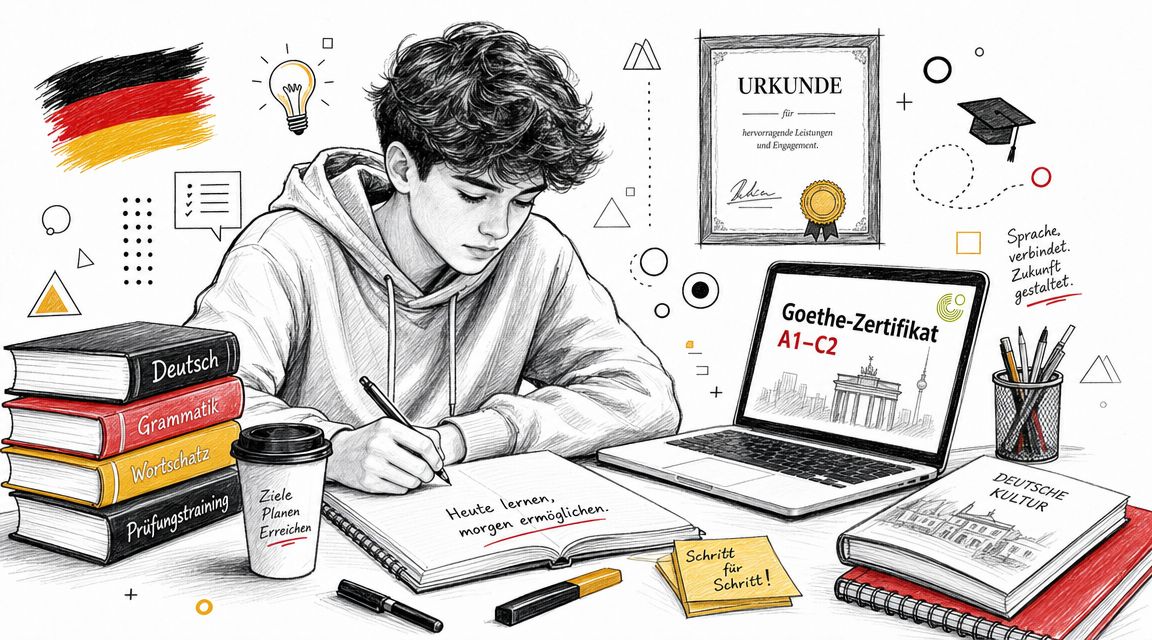
Teenagers need a different conversation. By secondary school, German is no longer just enrichment. It can become an academic asset, a scoring subject, or part of a larger university strategy.
That means the class must become sharper. Teens need clear benchmarks, proper correction, structured writing, and a measurable path forward.
Which goals matter at this stage
For secondary learners in Hong Kong, German often links to one or more of these targets:
- IGCSE German
- A-Level German
- IB German Ab Initio
- IB German Language B
- DSE-related language planning
- Goethe-Zertifikat progression
- Preparation for study abroad in Germany
Each of those pathways requires more than conversation practice. Teens need to manage vocabulary actively, understand grammar securely, and produce written work under expectations that match school or exam standards.
Placement matters more than parents think
At teen level, poor placement wastes time fast. A student placed too low gets bored. A student placed too high loses confidence and starts making avoidable mistakes.
In Hong Kong, structured placement by proficiency and age is the practical benchmark for serious German learning. Goethe-Institut Hong Kong bases kids-and-teens courses on CEFR levels and offers a free placement test, while local HK programmes for ages 3 to 12 also split classes by age and level, as noted in this Hong Kong guide to German playgroup and level-based class structure.
That principle matters just as much for teenagers. By this stage, level matters as much as age.
What secondary German classes should include
A proper teen programme should cover more than textbook completion. It should include:
- CEFR-aligned progression
- Essay and response writing
- Listening practice with exam-style tasks
- Reading comprehension strategies
- Speaking correction and oral exam rehearsal
- Grammar review tied to actual usage
For families comparing options, one factual example is worth noting. In Hong Kong, local providers already use more intensive formats for older learners, with some regular classes running 1.5 hours and teen summer formats using 120-minute lessons, according to this local overview of German summer course formats. That pattern reflects a sensible shift. Older students can handle longer, more demanding lessons.
A practical route for HK teens
For teenagers, I'd recommend this sequence:
| Priority | What to check |
|---|---|
| Placement | Is the student assessed by level before joining? |
| Target | Is the goal school support, Goethe, IB, IGCSE, or a mix? |
| Format | Does the lesson length suit a teen's concentration and schedule? |
| Feedback | Does the teacher mark writing and correct speaking properly? |
If your teen is choosing German as part of a broader school strategy, this guide to German for teens and DSE or IB language choices in Hong Kong is a useful starting point.
A teenager doesn't need “fun German”. They need effective German that still keeps motivation alive.
That's the difference between enrichment and real academic preparation.
How Do I Choose the Right Class Format and Schedule
Parents usually focus on curriculum first. Fair enough. But class format and timing often decide whether the child sticks with German at all.
A strong syllabus can still fail if the session length is wrong, the class mix is poor, or the weekly logistics wear the family out.
Small group vs private lessons
Both formats can work. The right choice depends on the child.
Small-group classes are usually better when your child benefits from peer interaction, turn-taking, and a more lively atmosphere. For younger children especially, hearing classmates respond can lower pressure and make the lesson feel natural.
Private lessons make more sense when the child has a narrow target. That might be exam support, school catch-up, or a personality that struggles in groups.
Use this quick comparison:
- Choose small group if your child learns well socially, needs routine, and benefits from hearing others speak.
- Choose private if your child needs intensive correction, individualized pacing, or support for a very specific exam goal.
Online vs in-person classes
For many HK families, this is a practical decision rather than an ideological one.
In-person classes are often stronger for younger children. Physical materials, classroom routines, and face-to-face interaction matter more when attention spans are still developing.
Online classes can work well for older primary pupils and teens, especially if travel time is the main barrier. The key issue isn't the screen. It's whether the teacher knows how to keep the student active.
If you want a useful outside reference on what active teaching should look like, these powerful classroom engagement strategies offer practical ideas parents can use to judge whether a lesson is genuinely interactive or just passive delivery.
Scheduling and enrolment tips
Hong Kong providers already show a clear pattern. Younger learners are usually placed in shorter, structured sessions, while older students move into longer lessons. Local examples include regular 1.5-hour sessions and teen programmes with 120-minute lessons, as described in the earlier-cited local market example.
That means parents should stop asking for one perfect format for every age. Instead, choose according to stage.
A simple decision guide:
- For ages 3 to 5, prioritise shorter, predictable sessions
- For ages 6 to 11, look for regular weekly classes with enough time for reading, speaking, and review
- For teens, accept that longer lessons are often necessary for serious progress
If the timetable looks easy for the parent but exhausting for the child, it won't last.
One factual example of a provider format in Hong Kong is the German Cultural Association Hong Kong(GCA), which offers small-group and private German classes, in-person teaching near Tsim Sha Tsui and Causeway Bay MTR stations, and online lessons with rescheduling support. That kind of format is useful for families who need flexibility without abandoning structure.
Ready to Start Your Child's German Journey
Parents usually know when a child is ready. The problem is choosing a format that matches the child's stage instead of forcing the wrong model too early.
If you remember one thing, make it this. German works best when it grows with the child. Play-based exposure for preschoolers. Structured literacy and speaking for primary pupils. Clear progression and exam readiness for teens. That is the practical pathway that suits Hong Kong families.

What sensible parents should do next
Don't overcomplicate the decision. Use a shortlist based on fit.
Check these points:
- Age match. Is the class appropriately designed for your child's developmental stage?
- Level match. Is there any proper placement or screening before enrolment?
- Teaching style. Does the lesson method suit your child's personality and school load?
- Long-term path. Can this class lead naturally into higher-level German later?
The standard you should expect
A worthwhile programme should offer:
- Qualified native-speaking teachers
- A structured curriculum
- Clear progression for children and teens
- Exam preparation expertise where relevant
- Flexible delivery that still keeps standards high
You don't need hype. You need a centre that understands Hong Kong parents, respects how children learn, and can support everything from early exposure to Goethe-Zertifikat preparation.
Pick the class your child can stay with consistently. Consistency beats intensity that collapses after one term.
If your family is serious about Learn German HK options that support both enrichment and future academic planning, make the decision based on stage, structure, and teaching quality. That's what gives German lasting value.
If you want individualized advice for your child's age, level, and school pathway, contact German Cultural Association Hong Kong(GCA) to check the latest schedule, discuss suitable after-school class options, or book a trial lesson. A good first placement saves time, avoids frustration, and gives your child a much stronger start.

German Verb Tenses Overview: Präsens Made Simple
German Passive Voice (Passiv): Formation Guide


