.png)
.png)

BLOG

香港德國文化協會
The German Cultural Association
Working in Austria & Switzerland: Is Your German Sufficient?
You've found a role in Vienna or Zurich. The salary looks better than Hong Kong, the lifestyle looks cleaner, and the long-term path looks attractive. Then the question lands: is your German good enough to get hired, keep your visa, and build a career instead of just surviving the first year?
For many in Hong Kong, that's the point where vague internet advice becomes dangerous. “English is enough” sounds comforting, but it often ignores immigration rules, sector-specific hiring standards, and the difference between getting an interview and building a stable future. If you're asking Working in Austria & Switzerland: Is Your German Sufficient?, you need a direct answer, not motivational fluff.
Table of Contents
- Your Dream Job in the Alps Awaits But About the German
- The short answer for HK job seekers
- What each level means at work
- A simple self-check
- Official minimum versus hiring reality
- High German for work and Swiss German for life
- Where this hits hardest
Your Dream Job in the Alps Awaits But About the German
A common HK scenario goes like this. You work in finance, operations, engineering, healthcare, IT, or education. You've already done the hard part by building a strong CV, collecting degrees, and comparing visa routes. Yet one issue keeps blocking action: you don't know whether your current German level is enough for Austria or Switzerland.
That uncertainty costs people time and money. Some spend months applying for jobs they're not linguistically competitive for. Others over-study grammar without aiming at the right target, or they assume workplace English will solve everything.
The practical answer is simple. You should treat German as a career requirement, not a side hobby, especially if you're moving from Hong Kong and need your move to work financially and professionally.
Here's how I suggest adults and parents in Hong Kong consider this point:
- If your goal is immigration security, official language thresholds matter.
- If your goal is employability, employer expectations matter more.
- If your goal is promotion and long-term settlement, your spoken and written German must go beyond the legal minimum.
Good German doesn't just help you enter Austria or Switzerland. It decides how many doors stay open after you arrive.
This matters for several HK profiles:
- Working professionals who want a clean move without wasting a year in underemployment.
- Parents planning a Europe pathway for older teens after DSE, IB, or IGCSE.
- University applicants who may later convert study plans into work and residence options.
- Career switchers who are realistic about budget and want a straight path, not trial and error.
If you're serious about working in Austria & Switzerland: is your German sufficient, don't ask what level sounds nice on paper. Ask what level gets you hired, keeps your residence path intact, and allows you to function in meetings, admin, healthcare, housing, and local life.
What German CEFR Level Do Employers Actually Want
The short answer for HK job seekers
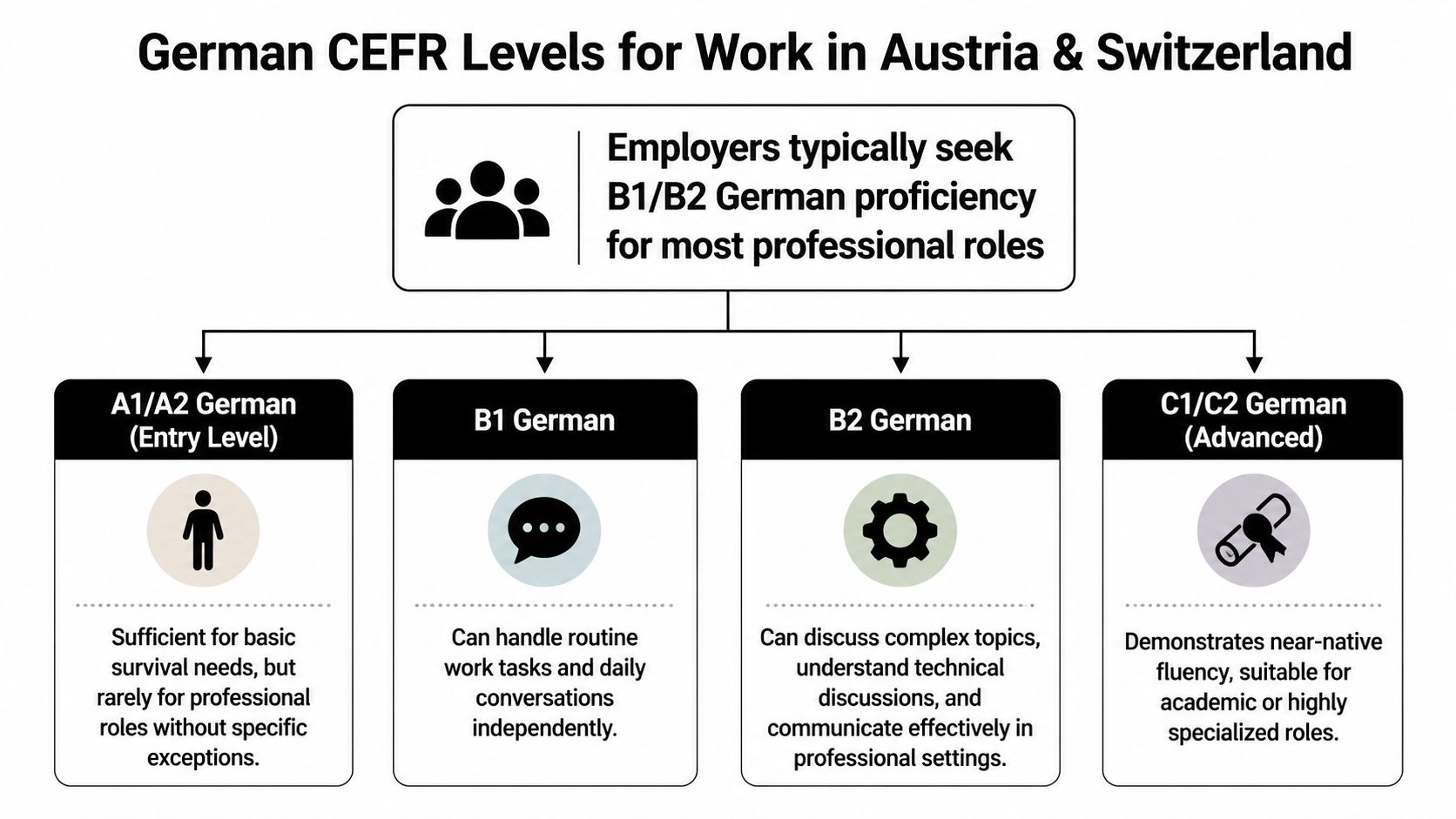
For most professional roles, B1 or B2 is the serious baseline, and B2 is the safer target. In Germany, employers commonly expect B1 or B2 certificates for work and career advancement, according to ÖSD's guidance on German exams for work and career. In Austria and Switzerland, competitive roles often follow the same logic, with stronger positions pushing higher.
What each level means at work
Forget textbook definitions for a moment. If you're in Hong Kong deciding how far to study, use this work-based version.
A1 German
- You can introduce yourself, order food, ask for directions, and handle very simple interactions.
- This is survival German, not work German.
- Useful for absolute beginners, but not enough for most professional roles.
A2 German
- You can manage routine daily tasks, simple messages, and predictable conversations.
- You'll still struggle in meetings, HR discussions, written instructions, and client interaction.
- Better than nothing, but still weak for serious employment.
B1 German
- You can join routine team conversations, explain simple problems, and write basic internal emails.
- At this level, you begin to be functionally employable in some environments.
- Good for initial traction, but not strong enough if the role involves nuance, speed, or external stakeholders.
B2 German
- You can follow technical discussions, speak with more confidence, write clear workplace communication, and handle non-scripted exchanges.
- For most HK professionals, this is the target level that makes a move realistic.
- If you're aiming to study abroad in Germany/Spain and keeping DACH options open later, B2 also gives you flexibility.
C1 German
- You can negotiate, lead presentations, manage sensitive conversations, and work with precision.
- At this level, you stop sounding like a beginner who happens to know grammar.
- Strongly advisable for law, consulting, healthcare, teaching, client-facing finance, and top-tier Swiss roles.
A simple self-check
Ask yourself which of these sounds like you right now:
| Level | Real workplace ability |
|---|---|
| A1-A2 | You can cope as a visitor |
| B1 | You can function in simpler work situations |
| B2 | You can work professionally with fewer language bottlenecks |
| C1 | You can compete, persuade, and lead |
Practical rule: If your plan involves visas, job interviews, landlord conversations, and office politics, aim for B2 first, not the lowest level you hope someone will accept.
For HK learners searching for German lessons Hong Kong or Learn German HK, this is the key mistake to avoid. Don't study vaguely. Pick the level that matches the life you want, not just the exam you think you can pass fastest.
Navigating the Job Market in Austria
Austria looks straightforward until you separate entry, extension, and long-term residence. Those are not the same thing.
What the law asks for
For non-EU nationals in Austria, the language path can change depending on your route and qualifications. According to Austria's official residence guidance, non-EU nationals generally need A1 German before immigrating, but that A1 requirement can be waived for degree-seeking applicants holding a Red-White-Red Card, recognised university graduates, or people with a general university entrance qualification who can use their diploma as a substitute.
That sounds generous, but don't misread it.
- Initial waiver doesn't mean long-term exemption
- Extension rules still matter
- Permanent residence requires a higher standard
The same Austrian government guidance states that for a Long-Term Resident EU permit (Daueraufenthalt EU), the law explicitly requires the ÖIF B1 Integration Certificate, and a university diploma no longer substitutes for that higher threshold.
For broader work and residence planning, Austria also states that German language proficiency up to B2 level is legally required for immigration and residence permits, although applicants with an EU Blue Card or a recognised university diploma do not need to present an A1 certificate on initial immigration, as noted by Work in Austria's language guidance.
What employers and daily life will ask for
The mistake many HK professionals make is treating Austria as a “paperwork only” problem. It isn't.
If you work in:
- Engineering or technical roles, you may survive with lower speaking confidence at the start, but documentation, team communication, and safety language still matter.
- Tourism, hospitality, healthcare, education, and public service, German becomes essential far earlier.
- Client-facing business roles, weak German quickly becomes a ceiling.
Austrians also speak their own regional varieties, accents, and expressions. Standard German still gives you the foundation you need, but you must expect a listening adjustment period.
Here's my blunt advice for people in Hong Kong:
- Don't target Austria with only A1 in mind. That's an entry issue, not a career plan.
- Treat B1 as the minimum for long-term stability.
- Treat B2 as the level that gives you real employability and confidence.
If Austria is your main destination, this Austria guide for HK readers is a useful starting point for visa and language planning.
If you want a life in Austria, not just an arrival in Austria, build toward B2 and keep B1 integration requirements firmly on your radar.
Cracking the Code to Working in Switzerland
Switzerland is where official rules and market reality separate sharply. On paper, one thing may be sufficient. In hiring, another level decides who gets shortlisted.
Official minimum versus hiring reality
The official baseline is clear. According to a discussion of Swiss hiring expectations on Swiss Forum, the minimum German language level required for working in Switzerland is B2, though the actual requirement varies by company and role.
That's the official side.
The hiring side is tougher. In German-speaking Switzerland, 85% of IT and business roles now mandate C1 or higher as a filtering criterion, according to the cited job market discussion on Reddit's cscareerquestionsEU thread.
For HK professionals, that changes the strategy completely.
- B2 may satisfy the minimum
- C1 often wins the competition
- English-only profiles lose ground outside a narrow group of multinational roles
This is especially true in places like Zurich and Bern, where the market is efficient and employers can be selective.
High German for work and Swiss German for life
Swiss German confuses many learners in Hong Kong. The good news is this: you do not need to start by learning dialect.
You need High German (Hochdeutsch) for:
- job applications
- interviews
- writing
- formal business communication
- most recognised exams
You then build listening tolerance for Swiss German (Schwiizerdütsch) because that's what you'll hear in daily life, workplace chatter, and local networking.
You apply with High German. You integrate faster when you can also understand Swiss German.
That's why B2 is often not enough in practice. At B2, many learners can pass an exam and still feel overwhelmed when locals switch speed, tone, or dialect.
Where this hits hardest
Swiss expectations rise fast in sectors such as:
- Finance. Precision, compliance, and client trust matter.
- Pharma and life sciences. Documentation and cross-functional communication matter.
- IT and product roles. English may exist inside the company, but local coordination, management tracks, and business interaction often pull German back into the picture.
If you're preparing your application materials for Europe, studying examples outside German can still help you sharpen your approach. For instance, guidance on writing an effective French CV is useful because it teaches the same core principle: local language expectations shape how employers read professionalism.
If Switzerland is your target, keep this Swiss visa and language guide for HK readers on your shortlist.
My view is simple. For Switzerland, B2 is the minimum you can mention. C1 is the level you should respect.
The English-Only Career Myth A Reality Check
Plenty of people still tell HK professionals that English is enough, especially in tech. That advice is incomplete at best and reckless at worst.

Why English-only works less often than people think
Yes, some multinational teams use English. Yes, some developers get hired without strong German. But that narrow opening gets mistaken for a complete career strategy.
In Austria, the hidden problem is legal and administrative. According to the ABA Work in Austria explanation cited in the brief, even in tech-heavy firms, third-country nationals without German A2 or the ÖIF Integration Certificate can face immigration extension hurdles, even if their job description is English-only, because client interaction can trigger mandatory German fluency. That point comes from this ABA Work in Austria video reference.
That means an English-speaking office does not automatically protect you.
Here's where people get caught out:
- Today you code internally.
- Later you join client calls, demos, onboarding, or support.
- Immigration looks at integration and legal criteria, not just Slack language.
- Team lead, account-facing, cross-functional, and managerial roles usually need stronger local-language ability.
What this means for HK professionals
If you're moving from Hong Kong, your margin for error is smaller. You're managing relocation costs, visa timing, school planning for children, and a competitive labour market. You can't afford to bet your future on the hope that English will stay enough.
Use this framework instead:
- For short-term access, English may open a few doors.
- For medium-term security, German protects your options.
- For long-term advancement, German decides whether you stay peripheral or become promotable.
A lot of online advice is written for people who are already in Europe, already have work rights, or already have local networks. That is not the same as an HK applicant planning a serious move.
If your plan depends on visas, renewals, and long-term residence, English-only is not a strategy. It's a gamble.
Choosing Your German Certificate The Best Path from HK
Once you know your target level, the next question is tactical. Which certificate should you take from Hong Kong?

Which certificate fits which goal
For Austrian university admission, the requirement is clear. According to the University of Innsbruck language certificate guidance, German at B2 is mandatory for admission to Bachelor's, Diploma, and most Master's programmes, with accepted proofs including Goethe-Zertifikat B2, ÖSD B2, or TestDaF level 3 in all parts. The same guidance notes that the Master's Programme in Translation Studies requires C1, and Goethe-Zertifikat C2 is recognised by all universities in Germany, Austria, and Switzerland.
That gives you a practical decision tree:
| Goal | Best exam focus |
|---|---|
| Austrian university admission | Goethe B2, ÖSD B2, or TestDaF 3 |
| Austria-specific orientation | ÖSD is highly relevant |
| Broad academic recognition | Goethe is the safest all-rounder |
| Highest academic proof | Goethe C2 |
A quick note on market positioning. You may also come across telc, especially in DACH contexts. It's useful to know it exists, but for Austria study pathways and broad recognition, the exams above are the most strategic based on the verified admissions guidance.
If you're also scanning broader options, this article on finding European jobs as an English speaker is worth reading as a reality check. It helps clarify where English may help and where local language still changes outcomes.
For a fuller comparison of exam routes, this guide to Goethe-Zertifikat versus TestDaF is useful.
A short explainer can help if you're still deciding between exam formats:
The smartest path if you're starting in Hong Kong
For most adults in HK, I recommend this sequence:
Start with the destination
- Austria work, Austria study, or Switzerland work are not identical goals.
Choose the level before the exam
- B2 first for most serious plans.
- C1 if Switzerland is your main ambition or your field is communication-heavy.
Build exam preparation into your timetable early
- Don't wait until your visa or admission deadline is close.
Austria
- Don't stop at entry-level thinking.
- Build toward B2, while staying aware of B1 integration requirements for long-term residence.
Switzerland
- Respect the official B2 minimum.
- Prepare as if C1 is the competitive benchmark if you want strong roles.
Students and parents in Hong Kong
- If university is part of the plan, choose a recognised certificate path early.
- Don't leave exam strategy to the last minute.
Check your current level
- Can you handle meetings, admin, writing, and spontaneous conversation?
- If not, you're probably below the level your future life requires.
Match your level to your destination
- Austria and Switzerland reward realism.
- Low targets save time in the short term but cost more later.
Prepare for interviews and hiring in parallel
- Language study alone isn't enough.
- If you're polishing answers and presentation style, tools that help you prepare for job interviews can support the career side while you build the language side.
Parents planning pathways for older teens after DSE/IB/IGCSE should think the same way. If a child may later study abroad in Germany/Spain or move into a DACH university route, recognised certification matters more than informal conversational classes.
Ready to Get Your German Work-Ready
You do not need perfect German before you make your move. You do need the right target, the right certificate, and the discipline to train for real-life use rather than classroom comfort.
For most HK adults, the sensible recommendation is this:
Your next three moves
If you're comparing Learn German HK options or looking for German lessons Hong Kong, focus on structured progression, recognised exam preparation, and teachers who can correct the habits that block speaking confidence. If you need flexible scheduling in Hong Kong, it also makes sense to ask about CEF funding, class formats, and whether the programme fits working adults rather than full-time students.
The Alps are not the hard part. The hard part is arriving prepared enough that your move works on paper and in real life.
If you're ready to turn your plans into a serious German roadmap, German Cultural Association Hong Kong(GCA) is the strongest place to start. Their native-speaking teachers, structured curriculum, and proven preparation for exams such as the Goethe-Zertifikat make them a smart choice for adults, students, and families in Hong Kong. You can book a trial class, check the latest course schedule, visit their centres near Tsim Sha Tsui or Causeway Bay MTR, and ask their advisors about practical study planning and CEF funding options.

Teen German Study Programmes: Exchange Guide
German Playgroup Hong Kong: What Happens in Class and How to Choose


