.png)
.png)

BLOG

香港德國文化協會
The German Cultural Association
Central Hong Kong: Local Guide to Work, Live & Learn German
You're probably looking at Central for one of three reasons right now. You're a parent in Hong Kong comparing German options without wasting weekends, you work near IFC and want something serious but manageable, or your teen needs German that supports IB, IGCSE, or A-level results rather than vague “exposure.”
That's the problem with the word central. In Hong Kong, it can mean the district, the commute, or the search habit that signals you're ready to study somewhere practical, not somewhere trendy. If you want the right German lesson format, the right school quality, and the right exam path, you need to sort those meanings out fast.
Table of Contents
Why Central Keeps Coming Up in Your Hong Kong Search
A Hong Kong parent doesn't search Central by accident. They're usually juggling school runs, MTR timing, and the very practical question of whether a German class can fit between office hours, ferry connections, or a teen's packed calendar. A working professional does the same thing, just with more pressure and less patience.
The useful way to read Central is simple. It's both a real district and a planning signal. If someone is searching around Central, they usually care about access, weekday convenience, and whether a class can be reached without turning language learning into a logistics exercise.
Practical rule: If the class location makes you skip lessons, the location is wrong, no matter how good the brochure looks.
That's why I treat central as a decision filter, not a destination name. A serious learner in Hong Kong should use it to narrow down format, schedule, and exam focus, then choose the school that matches their actual week.
If you're deciding between a small-group class, a private tutor, or an online option, the rest of this guide will help you choose the format that fits your commute, your exam deadline, and your energy level.
What Central Actually Means for Hong Kong Residents
Central is Hong Kong's business and administrative core, and for language learners it usually means one thing, access. It sits at the centre of a dense commuter network, so people who search for German lessons around Central often mean they're open to nearby districts, cross-harbour travel, or online classes that avoid the commute entirely.

Featured-snippet answer: In Hong Kong, Central usually means the district around the Island's business heart, plus any learning option that's easy to reach from it. For German lessons, that makes it a search anchor for commuters, parents, and professionals who want convenient in-person classes or flexible online study.
Why the district still matters
Hong Kong's administrative core has deep roots, from the colony established in 1841 and the 1842 Treaty of Nanking to the 1 July 1997 handover that created the Hong Kong Special Administrative Region under the Basic Law historical overview. That background matters because Central has always been where institutions, offices, and formal systems cluster.
Central became more than a place name. It became a shorthand for access to institutions, services, and decisions.
For learners, that's why the word shows up so often in searches. A class near Central signals fewer excuses, better transport options, and a higher chance that you'll keep attending. In Hong Kong, that usually beats a “cheaper” option that's hard to reach.
Who Searches for Central and Which German Format Fits Each
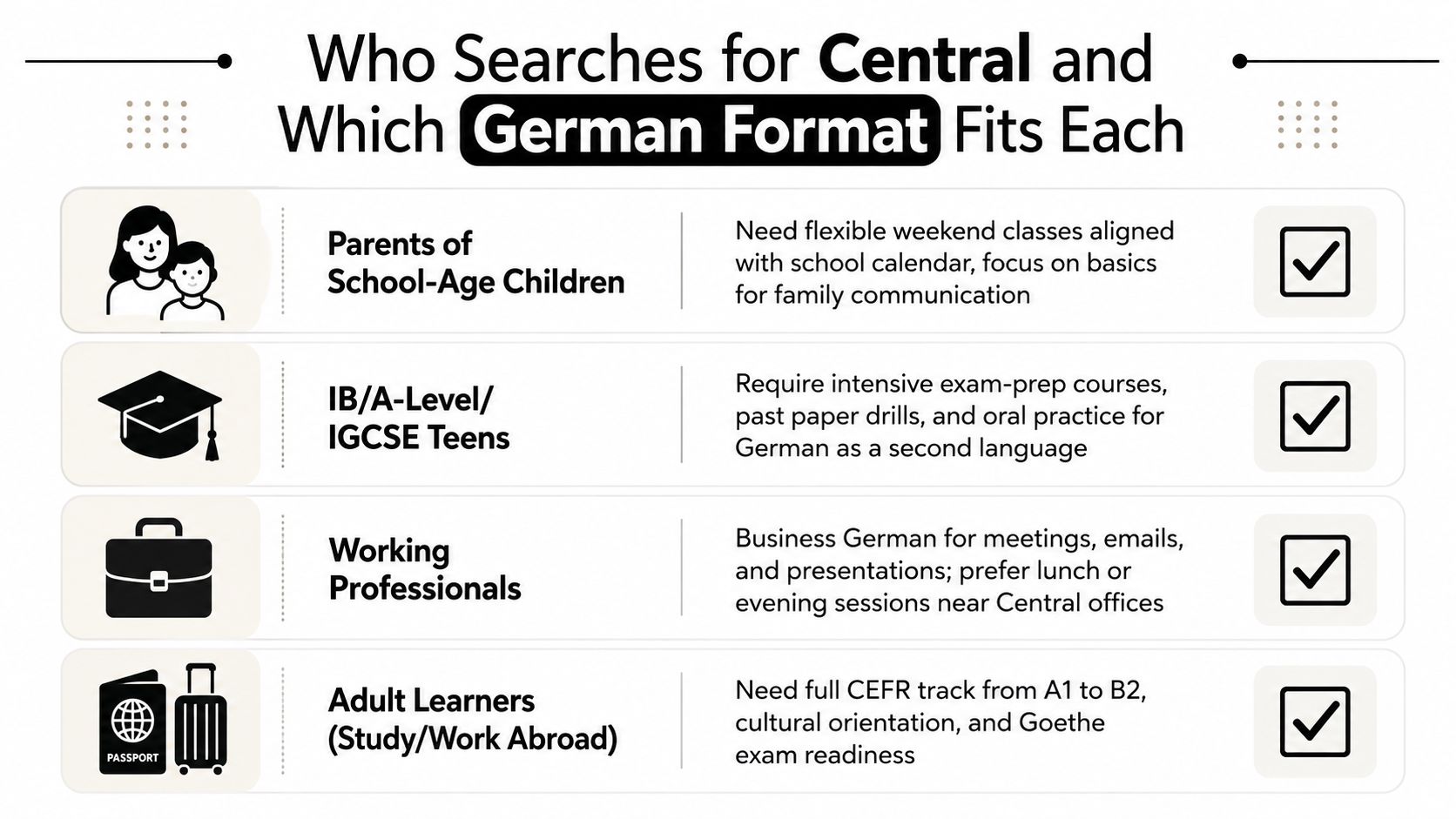
The people searching Central fall into four practical groups, and each one needs a different format. Parents want stability. Teens want exam pressure handled properly. Professionals want German that respects working hours. Adults planning study abroad in Germany/Spain need a clean CEFR track and a schedule they won't abandon after week two.
Quick match guide
- Parents of school-age children usually need weekend or early-evening classes. The point is continuity, not speed, because children learn best when the class calendar doesn't clash with school.
- IB, A-level, and IGCSE teens need exam-focused lessons with oral practice and past-paper discipline. If the class doesn't prepare for assessment formats, it's decorative.
- Working professionals need business German for meetings, email, and presentations. They usually prefer lunch-time, evening, or hybrid schedules near office hubs.
- Adult learners planning to move or study abroad need a CEFR path from A1 upward, plus cultural orientation and exam readiness.
A good format decision is mostly about your week. If your commute from Central is already long, online or hybrid is usually the sensible choice. If you need external pressure to stay disciplined, a small-group in-person class often works better than self-paced apps.
Choose the format that protects attendance first. Progress in German comes from repetition, not from buying the most ambitious timetable.
For families and teens, I'd push toward structured small groups or weekend classes. For professionals, an online weekday session can be more realistic than a heroic cross-city commute after work. For adults preparing for visas, universities, or relocation, a proper exam track matters more than casual conversation drills.
In-Person vs Online German Lessons for Central-Based Learners
For Central-based learners, the right format is the one you can keep showing up to. In-person classes work well when the school is convenient, while online classes win when your schedule is already fragmented by office hours, tutoring, or family duties. Hybrid works when you need structure but can't afford to commute every week.
The commute question is not abstract in Hong Kong. A school in Tsim Sha Tsui or Causeway Bay may be easy enough for some Central commuters, but not for everyone every week. If you're exhausted by the end of the workday, a Zoom session can save the lesson from becoming another cancelled plan.
| Format | Weekly Time Commitment | Rescheduling Flexibility | Best Fit For |
|---|---|---|---|
| In-person near Central | Moderate, plus commute | Lower, because travel adds friction | Learners who want accountability and face-to-face correction |
| Fully online via Zoom | Lower overall, no commute | Higher, because it fits changing schedules | Busy professionals and teens with packed calendars |
| Hybrid, weekend plus weekday online | Higher consistency, but spread out | Moderate to high | Adults who want structure without full weekly travel |
If you want a deeper district-based comparison, this practical guide is worth reading once: German classes near me in Hong Kong district guide for Central. It's especially useful if you're deciding whether to commit to a local classroom or stay fully online.
The straight answer is this. Choose in-person if you need classroom discipline, online if your schedule is unstable, and hybrid if you're balancing exam prep with a working week. Don't choose based on what sounds ideal. Choose based on what you'll still be doing in eight weeks.
How to Evaluate a German Language School in Hong Kong
The best German school in Hong Kong is the one that can prove it teaches well, not the one with the prettiest branding. Start with the teacher, then the curriculum, then the class size, then the exam track, then the admin support. If any of those are weak, you'll feel it in your progress.
The five criteria that matter
- Native-speaker teachers. You want instructors whose German is first-language level and who can correct pronunciation, sentence stress, and register without guessing.
- Structured CEFR-aligned curriculum. The course should move clearly from A1 to C2, with actual learning goals rather than loose conversational themes.
- Small class sizes. If the group is too large, speaking time gets thin and weaker students hide.
- Verified exam-track experience. Look for real preparation for Goethe-Zertifikat, TestDaF, IGCSE, A-level, and IB.
- Operational reliability. Attendance certificates, easy rescheduling, and clear course administration matter more than most schools admit.
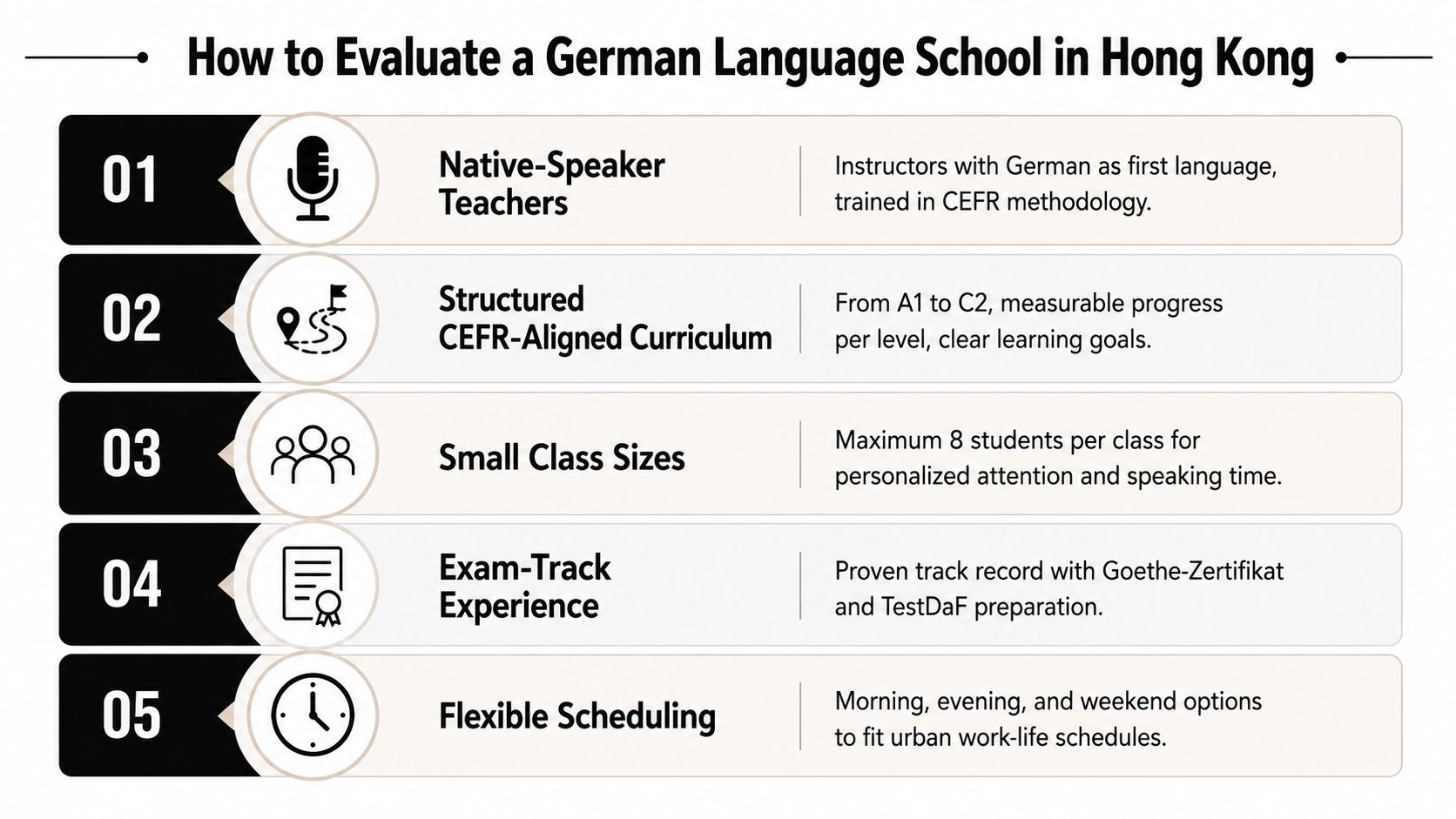
The right trial class should answer a short list of questions immediately. Are the teachers native speakers? Is the course tied to CEFR levels? How many students are in the room? Which exams do they prepare for? What happens if you need to reschedule?
For a broader decision framework, use this school-selection guide once before you pay anything: How to choose the best German language school in Hong Kong.
If a school can't answer those questions clearly, walk away. Hong Kong has enough options that you don't need to tolerate vagueness.
Why Native Teachers and Small Groups Move the Needle on Exam Results
German exam results improve when three things line up, a structured syllabus, real speaking time, and teachers who know the language from the inside. That combination matters for Goethe-Zertifikat, TestDaF, and school exams alike, because students need more than vocabulary lists. They need correction, repetition, and a teacher who can spot weak grammar before it hardens into habit.
A small group is not a compromise. It's a tool. In a six-student room, learners speak more, get corrected more often, and stop hiding behind stronger classmates. That's why a native-led group class can outperform solo study for speaking components, especially when the exam rewards controlled production under time pressure.
For Central commuters who want this model, the German Cultural Association of Hong Kong (GCA) offers classes at its Tsim Sha Tsui and Causeway Bay centres, both reachable from Central by MTR, plus online options. Its model combines native German faculty, a 6-student cap, and exam preparation for Goethe-Zertifikat and other test pathways.
You can see the tutor philosophy behind that model here: native German speaking tutors in Hong Kong.
What moves results is not “more German exposure.” It's structured correction, repeated oral practice, and a class size that forces participation.
I'd take that setup seriously over a casual private arrangement that lacks curriculum discipline. Private tutors can be useful for targeted gaps, and university programmes suit some learners well, but serious exam candidates usually need a system, not just a friendly conversation.
Three Assumptions HK Learners Get Wrong About German
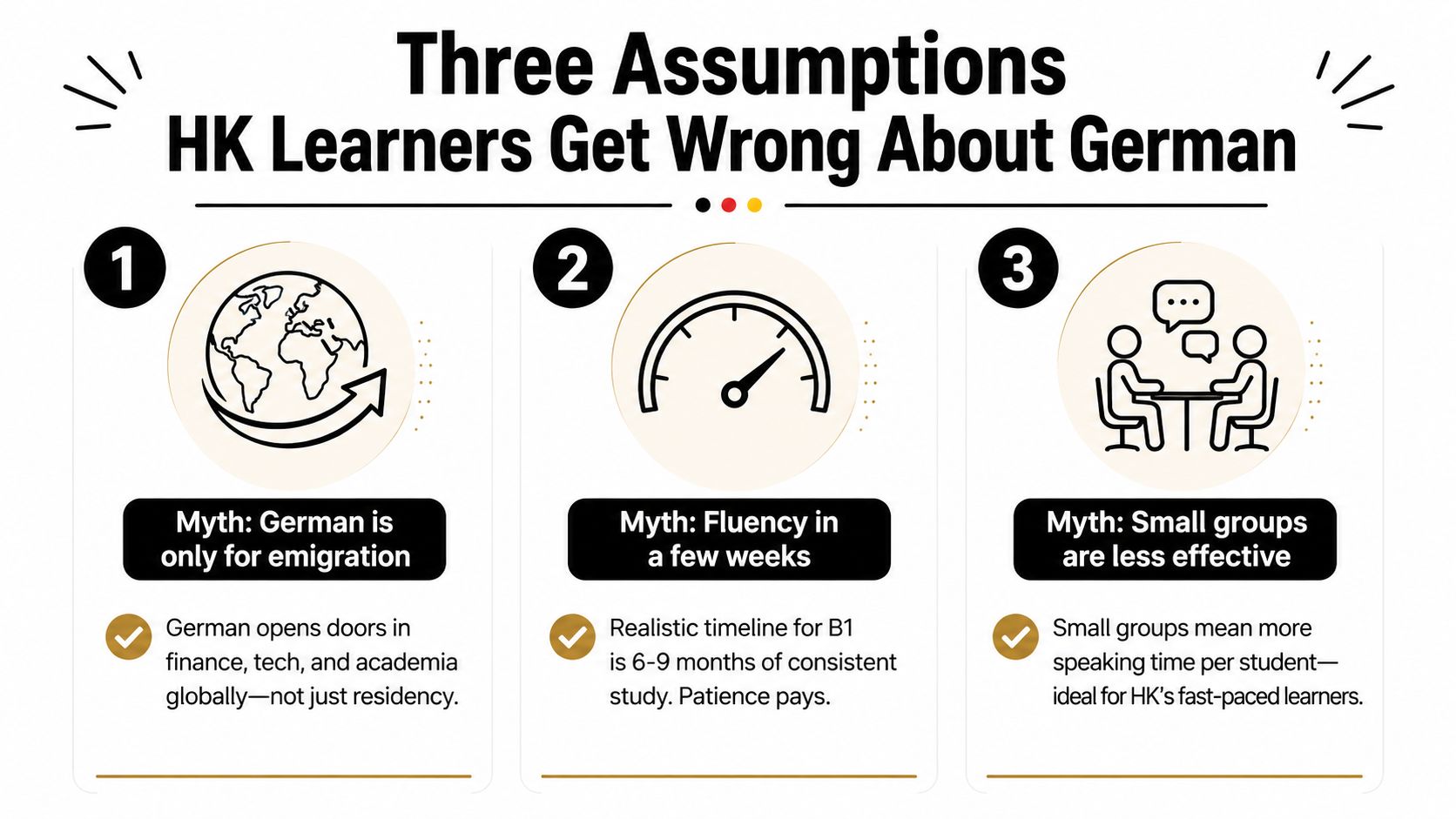
The first mistake is thinking German is only useful if you're emigrating. That's too narrow for Hong Kong. German is relevant in trade, finance, engineering, and academic pathways, and it also helps if you plan to study abroad in Germany/Spain or work with German-speaking partners.
The second mistake is expecting fluency in weeks. That fantasy wastes money and damages motivation. A better mindset is to treat CEFR-aligned progress as a sequence, not a shortcut. In real life, German takes steady work, especially if you want usable speaking and writing, not just recognition of textbook phrases.
The third mistake is assuming small groups are weaker than private tuition. In practice, they're often more rigorous. A native-led class with other serious learners creates pressure to answer, correct, and repeat, which is exactly what many adult learners in Hong Kong need.
Replace the myths with better expectations
- Myth 1, only for emigration: German is a career and academic asset, not just a relocation language.
- Myth 2, fluency in a few weeks: real progress comes from consistent study and regular correction.
- Myth 3, small groups are less effective: they often produce better speaking discipline because nobody can coast.
One practical note for Hong Kong adults and teens, if you're preparing for a CEFR target or school exam, plan around consistency instead of intensity spikes. Last-minute cramming might rescue a quiz, but it won't carry a speaking paper or an interview.
Ready to Start Learning German from Central
Pick one of three next steps. First, book a placement assessment so you know your CEFR level instead of guessing. Second, sit in on a trial class, ideally one you can reach from Central without stress, or take the online option if your week is already full. Third, speak to an advisor about a Goethe-Zertifikat or TestDaF study plan if your goal is exam-led progress.
Small, consistent progress is more reliable than heroic cramming. The learners who show up every week usually beat the ones who wait for a perfect time.
If you're comparing schools in Hong Kong, check the current schedule before you commit. The fastest way to waste time is to choose a class that looks right on paper but doesn't fit your commute or your exam date.
German Cultural Association Hong Kong(GCA) offers structured German classes in Hong Kong with in-person access near Central, plus online lessons for people who need flexibility. If you want a serious format for school exams, business use, or study abroad plans, visit German Cultural Association Hong Kong(GCA) to check the latest course schedule and book a trial class.

Teen German Study Programmes: Exchange Guide
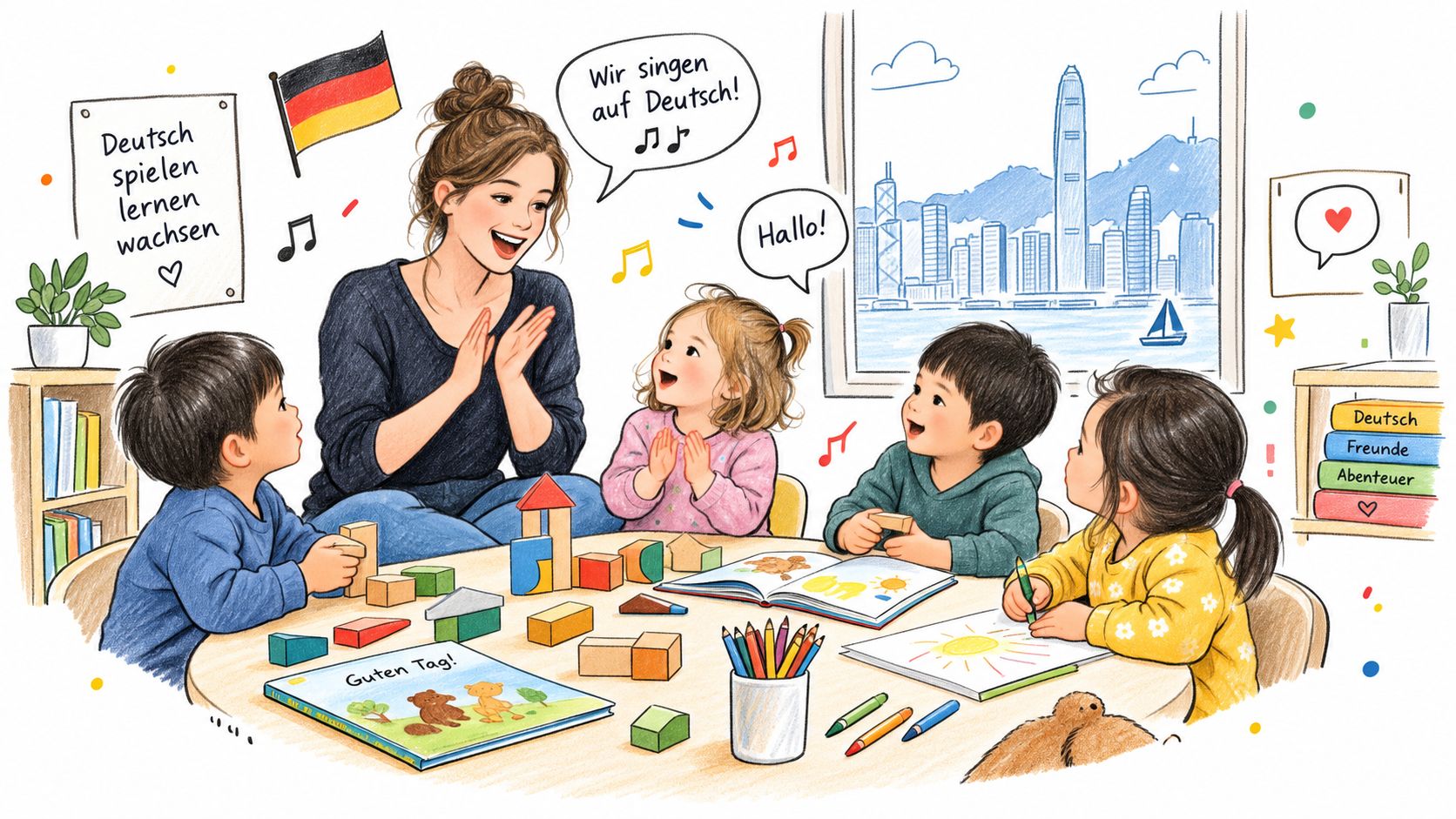
German Playgroup Hong Kong: What Happens in Class and How to Choose


