.png)
.png)

BLOG

香港德國文化協會
The German Cultural Association
Comprehensive Guide to German Exams: Goethe-Zertifikat vs TestDaF
You’re probably choosing between two very different outcomes, not just two German exams.
One path is about general proof of German ability for work, visas, and steady progression. The other is an academic gatekeeping test for German university admission. If you pick the wrong one in Hong Kong, you lose time, pay twice, and prepare for skills that may not matter to your real goal.
For families planning study abroad in Germany, and for professionals balancing cost, schedule, and recognition, this is the decision that matters most. This Detailed Guide to German Exams: Goethe-Zertifikat vs TestDaF gives you the practical answer, with Hong Kong realities included.
Goethe-Zertifikat vs TestDaF What is the Key Difference
Goethe-Zertifikat is a general German proficiency qualification available across levels from beginner to advanced, while TestDaF is a specialised academic exam aimed at students applying to German universities. In simple terms, Goethe fits broader goals. TestDaF fits university admission, especially when a university specifically asks for it.
That’s the key distinction. Everything else flows from it.
If you need a certificate for career advancement, visa paperwork, long-term language progression, or a flexible exam path in Hong Kong, Goethe-Zertifikat is usually the smarter first choice. It lets you certify your level step by step, and it suits learners who are still building towards B1, B2, or C1.
If your goal is study abroad in Germany, especially for competitive universities or programmes that expect an academic proof format, TestDaF becomes the strategic option. It doesn’t try to measure everyday German in a broad way. It tests whether you can function in a German academic environment.
Here’s the clean decision rule:
Choose Goethe-Zertifikat if you want:
- Broad recognition: Useful for work, general applications, and language benchmarking.
- Level flexibility: You can sit A1 to C2 depending on where you are.
- A practical HK route: More suitable if you want local scheduling convenience and a staged learning plan.
Choose TestDaF if you want:
- University admission advantage: Built for academic entry requirements.
- One advanced target: Best for learners already around upper-intermediate or advanced level.
- A direct admissions tool: Particularly relevant if the German university treats it as a preferred or required qualification.
Practical rule: Don’t start with the exam name. Start with the end use. University admission, visa, job market, or personal progression. The right exam becomes obvious once the goal is fixed.
A lot of HK learners make the same mistake. They assume the “harder” exam is automatically better. It isn’t. The better exam is the one that matches the institution, visa process, employer expectation, or school pathway you’re dealing with.
A Detailed Side-by-Side Exam Comparison
Here’s the quick comparison first.
| Factor | Goethe-Zertifikat | TestDaF |
|---|---|---|
| Main purpose | General German proficiency | Academic German for university admission |
| Level range | A1 to C2 | TDN 3 to TDN 5, broadly aligned with B2 to C1 |
| Best for | Learners, professionals, visa applicants, general certification | Students applying to German universities |
| Skills tested | Reading, listening, writing, speaking | Reading, listening, writing, speaking in a standardised academic format |
| Speaking style | Live speaking assessment | Digital speaking tasks |
| Scheduling in Hong Kong | More flexible | More limited |
| Local practicality | Stronger for most HK learners | Stronger for university-driven cases |

Purpose and recognition
Goethe-Zertifikat is the more flexible qualification. It works for people who need recognised proof of German but aren’t tied to one narrow academic use case.
That includes:
- Adults building credentials: Useful for CVs, internal promotion, relocation planning, and structured learning.
- Parents planning ahead: Good for teens on DSE, IB, or IGCSE pathways who want an internationally recognised language benchmark.
- Visa-related learners: Often the safer route when the requirement is solely proof of level rather than an academic admissions test.
TestDaF is more specialised. Its centre of gravity is university admissions. If your target institution in Germany asks for TestDaF, then this stops being an opinion question. It becomes a compliance question.
CEFR levels and what that means in practice
Goethe-Zertifikat gives you a ladder. You can start at A1 and move upward in stages. That matters in Hong Kong because many learners don’t need an advanced academic exam immediately. They need a credible stepping stone.
TestDaF doesn’t work like that. It’s aimed at learners already operating at a serious level, typically around B2 to C1. You don’t use TestDaF to show beginner or intermediate progress. You use it to prove academic readiness.
This is why the wrong exam creates wasted effort:
- A learner at an early stage who picks TestDaF too soon usually ends up underprepared.
- A strong student who needs German university admission and chooses a general exam without checking university rules risks doing an accepted exam, but not the most strategic one.
If your German is still developing and you want milestones that keep motivation high, Goethe is the better structure.
Exam structure and candidate experience
Goethe-Zertifikat tests the four classic skills. It’s broad and communicative. The exam experience tends to reward balanced ability across reading, listening, writing, and live speaking.
That matters for learners who are socially confident or who speak well under pressure. A solid speaking performance can reflect your real communicative competence.
TestDaF feels different. It’s standardised, academic, and more controlled. The speaking component is digital rather than a live oral conversation. The whole experience is closer to an academic screening tool than a general language certificate.
Here’s the practical difference in feel:
Goethe-Zertifikat
- Communication-oriented: Better fit if you want a well-rounded demonstration of language ability.
- Level-specific preparation: The tasks depend on whether you take A1, B1, B2, C1, and so on.
- Human interaction: Speaking is part of the authentic test experience.
TestDaF
- Academic task orientation: Better fit if you need university-style comprehension and output.
- One standard advanced profile: Less flexible, more targeted.
- Digital performance pressure: You need comfort with timed, computer-based task execution.
Scoring and pass logic
Goethe-Zertifikat is easier for many learners to understand conceptually. You take a defined CEFR-level exam and aim to pass that level.
TestDaF uses TDN 3, TDN 4, and TDN 5, which requires a different mindset. Institutions often care about whether you reach the required TDN profile across all sections, not whether you merely “did fairly well overall”.
That’s a stricter admissions logic. It also explains why TestDaF preparation should never be casual.
For Hong Kong students applying abroad, this distinction matters a lot. Families often focus only on “Is it recognised?” The sharper question is “What exact score profile does the institution want?”
Exam dates, registration, and costs in Hong Kong
Local strategy matters more here than global guides suggest.
According to a Hong Kong-focused comparison, Goethe-Institut Hong Kong offers frequent exams from A1 to C2 at accessible centres near Tsim Sha Tsui MTR with reported 90%+ pass rates for small-group prep students, while digital TestDaF remains rarer in HK, with nearest centres in mainland China or online since 2024, contributing to 20-30% lower local enrolment per 2025 HK Education Bureau statistics. The same source notes that this gap is especially relevant for teens and families comparing pathways tied to IB, IGCSE, or longer-term study planning in HK, as discussed in this Hong Kong exam availability comparison.
That tells you something important. In Hong Kong, this isn’t only an academic comparison. It’s also a logistics comparison.
Generally, that means:
Goethe is easier to plan around.
More local familiarity, more straightforward scheduling, and less uncertainty.TestDaF needs earlier planning.
You can’t leave it late and expect easy booking or ideal timing.Parents of teens should think long-term.
If your child is in DSE, IB, or IGCSE and still building German, a staged Goethe route is often cleaner.
Which format suits which learner
Some learners in Hong Kong are good at live speaking. Others are better in structured digital settings.
Goethe generally suits candidates who:
- build confidence through staged progression,
- want regular certification milestones,
- and benefit from communicative practice.
TestDaF generally suits candidates who:
- already have a strong language base,
- can handle academic pressure,
- and need a university-facing result rather than a broad skills certificate.
There’s no prestige prize for choosing the more specialised exam too early. Strategic timing beats bravado.
Which German Exam is Right for Your Goal
The right answer depends on what you need the certificate to do.
If the certificate must enable a German university application, your decision is narrow. If it needs to support a visa file, work profile, or long-term language development in Hong Kong, your decision is usually broader.

University applicants including IB DSE and A-Level students
If you’re applying to a German university, especially a selective one, check the admissions page first and build backwards from that requirement.
For HK students targeting serious academic entry, TestDaF can be the more strategic option. A Hong Kong-focused comparison reports that GCA-prepped candidates in the region achieved a 96% first-attempt pass rate for TDN 4 across all four modules in 2025, compared with 92% for Goethe-Zertifikat C1 among HK test-takers. The same source adds that TestDaF’s stricter profile is important for applicants targeting institutions such as LMU Munich or Heidelberg, where TDN 4 is mandatory for non-EU applicants, and notes projected digital 2026 rollout in HK with 6 to 9 fixed dates a year, plus a 24% boost in DAAD scholarship approval for HK applicants due to university-specific validity, according to this detailed Goethe versus TestDaF comparison for HK applicants.
My advice is blunt:
- If the university asks for TestDaF, take TestDaF.
- If the university accepts multiple proofs, compare the full risk profile before deciding.
- If the student is still developing German steadily during IB, DSE, or IGCSE years, don’t jump to TestDaF too early.
For families planning the wider route, this Hong Kong German course comparison guide is useful for thinking through timing, exam preparation, and study pathways.
Professionals and visa applicants
Most working adults in Hong Kong do not need TestDaF.
They need a qualification that is:
- recognised,
- practical to prepare for,
- and realistic to schedule around work.
That usually points to Goethe-Zertifikat.
If you’re applying for a role, strengthening your profile for relocation, or need language proof that reflects broad ability, Goethe is the cleaner choice. It’s also easier to match to your current level. That matters if you’re starting from A1 or A2 and want a structured progression without jumping into an academic admissions test.
Advisor’s view: For career advancement, broad recognition beats unnecessary specialisation.
General language learners and parents planning ahead
This group should rarely start with TestDaF.
If your child is learning German as an additional language alongside school, or if you’re an adult learner who wants a formal target, Goethe-Zertifikat gives you a more organised path. It fits better with staged study, confidence building, and visible progress.
That’s especially true in Hong Kong, where families often want:
- a reliable benchmark,
- a certificate that complements school studies,
- and a pathway that doesn’t force an advanced academic exam too early.
Here’s the simplest framework:
| Your goal | Best first choice |
|---|---|
| German university admission with explicit TestDaF requirement | TestDaF |
| General visa or work-related proof | Goethe-Zertifikat |
| Teen learner on DSE, IB, or IGCSE pathway | Goethe first, then reassess |
| Adult learner building long-term proficiency | Goethe-Zertifikat |
| Scholarship-focused academic application | Usually TestDaF if required or strongly favoured |
A short explainer may help if you’re still comparing the two exam mindsets.
How Long Does It Take to Prepare for These Exams
The honest answer is simple. It depends on your current level, your weekly consistency, and whether you’re preparing for a general communicative exam or a high-pressure academic test.
What you shouldn’t do is ask, “How fast can I finish?” Ask, “How fast can I become exam-ready without collapsing in the writing and listening sections?”
A realistic preparation mindset
Goethe-Zertifikat preparation is usually more forgiving because learners can work level by level. If you’re building from A1 to A2, or B1 to B2, the path is more visible and easier to organise around work or school.
TestDaF needs a different mentality. It expects advanced language control and academic discipline. You’re not just learning German. You’re learning to perform under a specific format.
According to a Hong Kong-focused 2025 to 2026 comparison, TestDaF’s full digital shift suits professionals who prefer computer-based exams, with 70% indicating that preference in an HK German Chamber survey for Q1 2026. The same source says 80% of German universities require TDN 4 across sections, while Goethe accounted for 85% of 2025 HK certifications and had lower listed costs at HKD 1,800 versus HKD 2,500 for TestDaF. It also notes 35% year-on-year uptake in TestDaF among corporate learners and a 15% score advantage for HK engineers in TestDaF over Goethe’s more communicative style, as outlined in this digital TestDaF versus Goethe overview.
That’s why preparation time isn’t just about hours. It’s also about format fit.
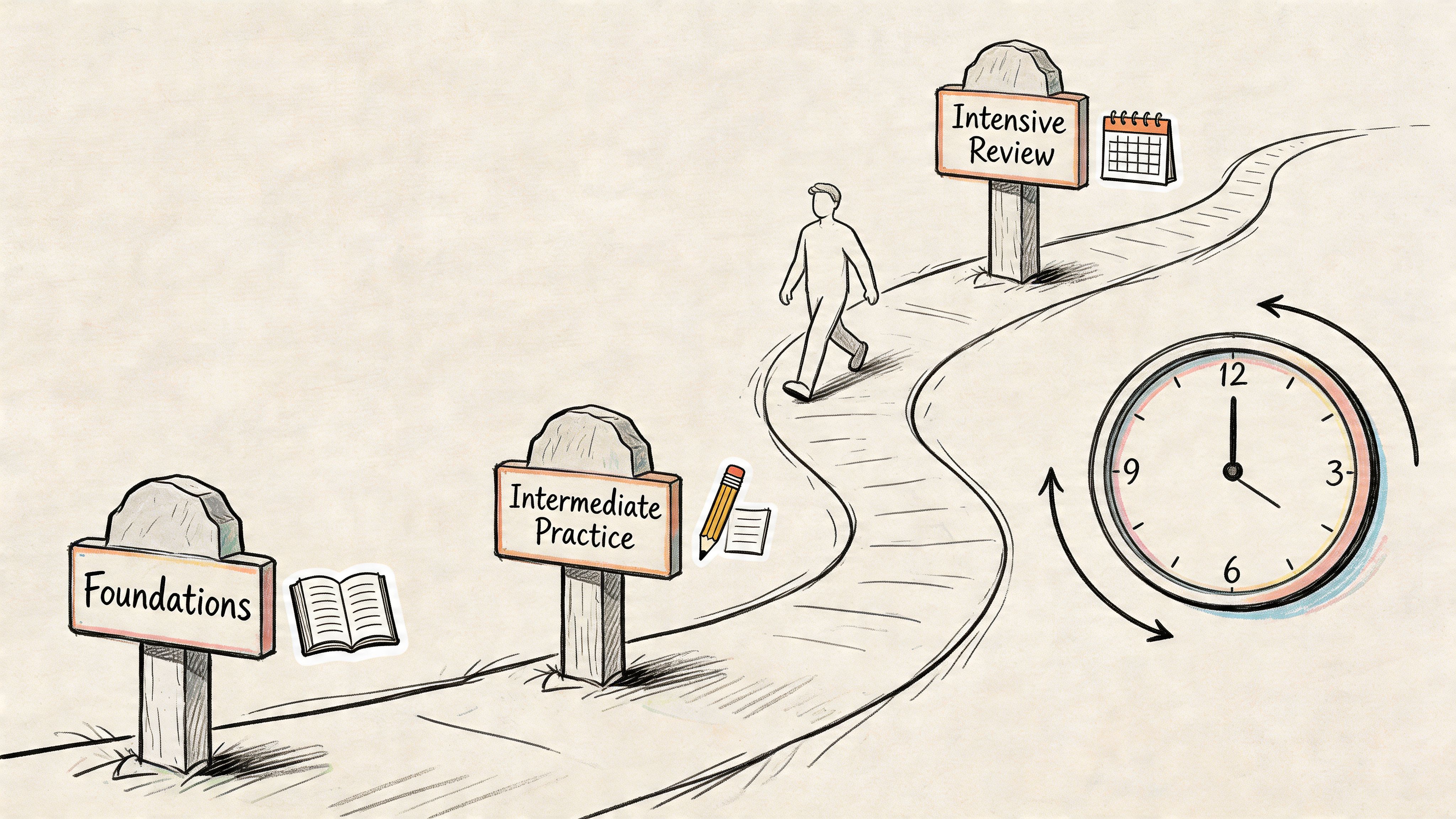
Sample preparation roadmaps
These are planning models, not promises.
If you’re preparing for Goethe-Zertifikat
A staged plan works best.
- Foundation phase: Build grammar accuracy, daily vocabulary, and confidence in listening and speaking.
- Exam familiarisation phase: Learn task types, typical writing prompts, and timing.
- Mock phase: Practice complete papers, get corrections, fix repeated errors.
This route works especially well for:
- adults studying after work,
- teenagers balancing school,
- and parents who want a steady exam ladder for their child.
If you’re at the early stage and want a realistic starting point, this guide on how to pass the A1 German exam is a sensible first benchmark.
If you’re preparing for TestDaF
The study plan should be tighter and less casual.
Start with academic input.
Read serious German texts, not only textbook dialogues. Train your eye for argument, structure, and precise vocabulary.Build timed endurance.
TestDaF punishes slow processing. You need speed without panic.Practise digital response habits.
Keyboard writing, screen-based reading, and recorded speaking responses all matter.Track weak sections separately.
Don’t assume strong reading will rescue weak writing. For university-focused exams, section balance matters.
Preparation principle: For Goethe, broad competence often drives success. For TestDaF, format control is often the deciding factor.
Weekly study patterns that actually work
Many HK learners fail because they study in bursts. That’s not preparation. That’s mood-based revision.
A better pattern looks like this:
- Three focused weekdays: Grammar, reading, and listening.
- One writing session: Marked by a teacher or corrected against a clear rubric.
- One speaking or oral production session: Essential for Goethe, still useful for TestDaF even in digital format.
- One timed practice block on weekends: Exam discipline is built during these sessions.
For students, that may fit around DSE, IB, or IGCSE workloads. For professionals, it usually means short weekday sessions and one longer weekend block.
What slows people down
The biggest delays are predictable:
- Choosing the wrong exam first
- Ignoring weak writing
- Doing too little timed practice
- Treating speaking as optional
- Waiting too long to book an exam date
If you want to move efficiently, get your level assessed early and commit to one path. Mixed preparation wastes energy. Focused preparation wins.
Your Proven Pathway to Exam Success with GCA
If you’re serious about German exams in Hong Kong, generic tutoring usually isn’t enough. You need a structured system, real correction, and teachers who know how exam performance is built from week to week.
That’s where a centre with native-speaking teachers, a proper curriculum, and exam preparation depth makes a visible difference.

What strong exam preparation should look like
The strongest exam programmes in HK usually share the same features:
- Small-group teaching: Students get correction, not just content delivery.
- Native-speaking instruction: Pronunciation, idiomatic usage, and exam nuance improve faster.
- Level mapping: Learners know exactly whether they should be in A1, B1, B2, or an exam-focused track.
- Regular mock work: Not endless worksheets. Actual exam-style tasks under realistic conditions.
A serious learner also benefits from disciplined revision outside class. One of the most practical habits is utilizing past papers to identify recurring task types, timing pressure, and personal weak spots.
Why GCA stands out in Hong Kong
For families and professionals looking at German lessons Hong Kong options or searching Learn German HK, the strongest local choice is German Cultural Association Hong Kong because the model is built around outcomes, not casual attendance.
Its structure is unusually well suited to exam preparation:
- Native-speaking teachers only
- Small-group classes capped at 6 students
- In-person locations near Tsim Sha Tsui and Causeway Bay MTR
- Online options through Zoom
- Coverage for Goethe-Zertifikat, TestDaF, IGCSE, A-level, and IB
The centre also reports a 96% recommendation rate and that over 90% of students rank in the top 10% of public examinations, based on its published institutional results. Those figures matter because they suggest a preparation culture built on consistency and close supervision, not overcrowded classes.
Who benefits most from this pathway
The fit is strongest for three groups.
First, teenagers on exam pathways. They need structured progress, not ad hoc tutoring.
Second, adults preparing around work. They need flexible scheduling and a course sequence that doesn’t waste time.
Third, university-bound applicants. They need precise preparation for the exam their target institution accepts.
If you’re comparing formats, locations, and teaching styles, this guide to finding the right German class in Hong Kong gives a useful local benchmark.
Good exam preparation doesn’t feel random. You should know your level, your target exam, your weekly plan, and the mistakes you’re fixing next.
Frequently Asked Questions about German Exams in Hong Kong
Can I use CEF funding for German exam preparation in Hong Kong
CEF funding depends on the specific course and its approved status, not on the exam name alone. Don’t assume a German course qualifies just because it is exam-related. Check the current Hong Kong course approval list and confirm directly with the provider before enrolling.
If I fail one part of the exam, what happens
That depends on the exam structure and the rules of the provider.
For Goethe-Zertifikat, the practical question is whether the level and session allow module handling in a way that suits your situation. You must check the exact exam rules before registration.
For TestDaF, the bigger issue is usually not “pass or fail” in a general sense. It’s whether you reached the score profile required by your university across the relevant sections. If one section falls short, your application plan may still be affected even if other sections went well.
Is TestDaF available in Hong Kong
It can be available through digital arrangements and authorised pathways, but availability is less straightforward than Goethe in HK. Dates are more fixed, planning needs to start earlier, and some candidates may need to consider nearby regional options depending on the current test-centre setup.
Which exam is better for teenagers in IB IGCSE or DSE tracks
Usually Goethe-Zertifikat first.
It gives younger learners a staged, level-based route and works better for students who are still building language foundations alongside school commitments. TestDaF only makes sense later, when university admission requirements clearly justify it.
Which exam is better for working adults
Usually Goethe-Zertifikat, unless your employer, visa process, or academic plan specifically requires TestDaF.
Most professionals need flexibility, local availability, and a certificate that proves practical overall competence. That’s where Goethe often wins in Hong Kong.
Do German exam certificates expire
Many institutions treat these certificates as long-term qualifications, but employers, universities, and visa authorities may still prefer recent proof depending on their own policies. Always check the rule of the organisation receiving your certificate. Don’t rely on assumptions.
How should I choose between them if I’m still unsure
Use this order:
- Check the institution requirement
- Confirm local exam availability
- Assess your current level
- Choose the exam that matches the end goal, not the one that sounds more impressive
That approach saves money, preparation time, and avoidable retakes.
If you want expert advice suited to your level, your school pathway, or your Germany plans, contact German Cultural Association Hong Kong(GCA). Their native-speaking teachers, small-group classes, and exam-focused curriculum make them the strongest option for families, teens, and professionals who want a clear German pathway in Hong Kong. Book a trial class, speak with an advisor, or check the latest course schedule to start with the right exam from day one.

How Many Hours to Reach B2 German? CEFR Guided Learning Hours Explained

German Idioms and Everyday Expressions: 25 Phrases Textbooks Skip—Guide


