.png)
.png)

BLOG

香港德國文化協會
The German Cultural Association
The German R and CH Sounds: Pronunciation Training for Cantonese Speakers
You're in a meeting in Central, introducing yourself to a German client. You say rot, but the English-style R changes the sound. Later, you read ich and Bach with the same CH, and your listener has to work out what you mean. The same problem appears when a parent checks DSE, IB, or IGCSE German homework, or when a professional prepares to study abroad in Germany or Spain.
The German R and CH Sounds: Pronunciation Training for Cantonese Speakers becomes much easier when you treat these sounds as specific Cantonese-to-German transfer problems. You don't need to force a dramatic throat sound. You need a clear diagnosis, controlled drills, and regular feedback.
Table of Contents
- Isolate the sound before adding words
- Move into syllables and words
- Add contrasts and short phrases
- Apply the sounds to Hong Kong situations
Why Cantonese Speakers Need a Focused Approach
A learner may hear a German word clearly in class, then use a familiar Cantonese or English movement when speaking. Hong Kong learners work across several languages every day. Cantonese remains the dominant language, with a reported 99.6% of residents using Cantonese, while English and Putonghua are also widely used at 62.2% and 68% respectively, according to an HKU language survey. This experience supports flexible listening, but it can also make a familiar R or CH substitute feel natural.
German pronunciation training for Cantonese speakers matters because German is available in local education without being a common daily input. An HKU-hosted study reported 166 students in four schools enrolled in German at secondary level, and identified German as an official elective in Sacred Heart Canossian College and St. Margaret's Co-educational English Secondary and Primary School. A later education figure recorded 90 students enrolled in German in the 2016/17 academic year, compared with 156 in Spanish, 164 in French, and 132 in Japanese, as reported in this Hong Kong German education timeline. That limited exposure matters. Learners who want more context can read this guide to whether German is hard for Cantonese speakers.
A learner who hears German mainly in class may recognise that ich and Bach have different CH sounds without knowing how to reproduce either one. Listening supplies the target, but the tongue, soft palate, and airflow still need deliberate training. Isolated words reveal the movement; short sentences show whether the movement survives normal speech.
What Cantonese transfer looks like
A Hong Kong phonetic study notes that Cantonese lacks distinctively voiced stops in the same way German contrasts them, relying instead on aspiration contrasts. This difference does not explain every R or CH error, yet it shows why Cantonese-first learners benefit from physical diagnosis rather than imitation alone.
For the German uvular R, a study of Hong Kong Cantonese L4 learners found that 10.7% of canonical /ʁ/ tokens were deleted and 10.4% were replaced. The most common replacement was English [ɹ] at 5.5%, with rarer replacements by /h/ at 2.6% and word-initial [ʔ] at 1.2%, according to the ICPhS phonetic study.
Practical rule: If your German R sounds like an English R, disappears, or becomes a throat stop, practise the sound alone before extending it into sentences. Record one isolated word, then a short sentence, and check whether the R remains audible.
This focused sequence supports clearer communication in HK workplaces, oral exam preparation, cultural exchange programmes, university applications, and German-speaking environments before moving abroad.
How German R and CH Are Produced
German R and CH sounds aren't one single sound each. German R can be produced in more than one accepted way, while CH changes according to the vowel or consonant before it. The two main CH targets are the palatal [ç] in ich and the velar [x] in Bach.
German R
In standard pronunciation, German R is commonly realised near the uvula, the small structure at the back of the mouth. The tongue tip shouldn't curl back as it often does in English.
- Uvular trill [ʁ]: Bring the back of the tongue close to the uvula and let the outgoing air create a light vibration.
- Uvular fricative [ʁ̞]: Keep a narrow passage at the same location and produce friction without a full trill.
- Tap [ɾ]: In some positions, especially in careful speech and certain regional patterns, R may be a brief tap rather than a sustained throat sound.
Start with the fricative. It gives you more control than trying to produce a strong trill immediately. Keep the jaw relaxed, avoid tightening the neck, and let the airflow do the work.
A useful Cantonese comparison is not an exact equivalent, but the back-of-mouth quality can be approached through familiar velar sensations such as Cantonese ng. The comparison is only a starting point. German [ʁ] is not the same as Cantonese ng, and it shouldn't become nasal.
The two German CH sounds
The ich-Laut [ç] appears after front vowels and certain consonants. In ich, the front or middle of the tongue rises toward the hard palate, while the sides remain close to the upper teeth. The airflow passes through a narrow channel, creating a soft, hiss-like friction.
The ach-Laut [x] appears after back vowels. In Bach, the back of the tongue rises toward the soft palate. The sound is deeper than [ç], but it still needs continuous friction rather than a hard [k].
For [ç], Cantonese learners may use the final sound sometimes represented in romanisation as -hk in sihk as an approximate reference for a back-of-mouth fricative sensation. For [x], Cantonese ng can help you find the rear tongue position, but again, it isn't a direct equivalent. Don't add nasal resonance or stop the air completely.
German R and CH vs Cantonese Reference Sounds
| German Sound | IPA | Nearest Cantonese | Articulatory Cue | Example Word |
|---|---|---|---|---|
| German R | [ʁ] | Back-of-mouth quality near Cantonese ng | Raise the tongue root near the uvula; keep the tongue tip relaxed | rot |
| German R variant | [ʁ̞] | No direct equivalent | Narrow the uvular passage and sustain light friction | Bach context not applicable, practise R separately |
| German R tap | [ɾ] | Brief tongue contact reference | Touch quickly, without English-style curling | Kirsche |
| Ich-Laut | [ç] | Approximate final -hk sensation in sihk | Raise the front or middle tongue; release steady friction | ich |
| Ach-Laut | [x] | Rear-tongue reference near Cantonese ng | Raise the back of the tongue; keep the airflow continuous | Bach |
Use a slow audio reference when you practise vocabulary. A German numbers 1-10 pronunciation guide can also help you hear German rhythm and consonant placement in short, familiar words. For a broader sound system reference, consult this complete German pronunciation guide, then return to the two target contrasts rather than trying to correct every sound at once.
Build Accuracy Through Progressive Drills
A good drill sequence moves from control to communication. If you put a new throat sound straight into fast conversation, you may return to the English R or merge [ç] and [x] without noticing.
Isolate the sound before adding words
Stand in front of a mirror. Keep your lips relaxed and watch that your tongue tip isn't doing the work meant for the tongue root.
For German R, begin with a quiet, breathy [ʁ]. Don't chase a dramatic trill. Produce a short stream of friction, pause, and repeat. For CH, alternate a gentle front sound, [ç], with a deeper back sound, [x].
Practise during a short home session, on an MTR commute without speaking aloud, or in a quiet Tsim Sha Tsui café by using silent mouth movements first.
- Target: Stable place of articulation.
- Success signal: The sound stays in the same place across repeated attempts.
- Self-coaching cue: “Tongue root for R, front tongue for [ç], back tongue for [x].”
Whispering can be useful because it removes voicing and makes airflow easier to feel. Keep the whisper brief and comfortable. If your throat feels strained, stop and reset.
Move into syllables and words
Add vowels only after the isolated sound feels consistent. Try:
- R with vowels: ra, re, ri, ro, ru
- Front CH: iç, eç, then ich
- Back CH: ax, och, uch, then Bach
The aim isn't speed. The vowel should remain stable before and after the consonant. This is important for learners who change the vowel to avoid the R or who let the CH become a hard stop.
Use a compact vocabulary set:
- rot
- Bach
- ich
- Kirsche
Say each word slowly, then at a natural pace. Record one attempt and listen for whether the R is present, whether ich sounds lighter than Bach, and whether the vowel remains recognisable.
Add contrasts and short phrases
Once the words are controlled, alternate the two CH categories:
- ich, Bach
- Bücher, Buch
- Milch, machen
These aren't all formal minimal pairs, so use them as contrastive listening and production items. Ask yourself, “Is the tongue forward or back?” rather than “Does this sound like English?”
For R, practise word positions and connected sequences:
- rot
- groß
- fahren
- Kirsche
Then place them in short carrier sentences:
- Ich bin in Hong Kong.
- Das ist rot.
- Ich fahre nach Hause.
- Die Kirsche ist frisch.
Apply the sounds to Hong Kong situations
A sound is ready for conversation when you can keep it while thinking about meaning. Use short role-plays rather than isolated word lists.
At a café, order an Apfelstrudel and ask a simple question. At a Sprachcafé, introduce yourself, say where you live in Hong Kong, and explain why you're learning German. For a work scenario, introduce a colleague and mention a meeting in Central.
“Clarity comes before speed. Let the listener hear the target sound before you make the sentence faster.”
Use the same progression each time: sound, syllable, word, sentence, short paragraph, spontaneous response. If the sound breaks down at one level, return to the previous level and shorten the material.
Identify and Correct Common Pronunciation Errors
Cantonese-speaking learners don't all make the same mistake, but the errors are patterned enough to diagnose. The most useful question is not “Can you make a German R?” It is “Which substitute appears, and at what speaking level does it appear?”
Typical transfer patterns
| Target Sound | Typical Substitution | Likely Source | Symptom Cue | Correction Method |
|---|---|---|---|---|
| [ʁ] | English-style [ɹ] | English influence | Tongue tip curls or bunches | Relax the tongue tip and move the constriction towards the uvula |
| [ʁ] | Deletion | Weak exposure or avoidance | rot loses its opening consonant quality | Begin with a whispered [ʁ], then attach the vowel |
| [ʁ] | [h] or [ʔ] | Cantonese phonetic habit or throat closure | The sound is breathy or stops abruptly | Keep air moving through a narrow passage |
| [ʁ] | Vowel change before R | Avoidance of the target | The vowel becomes longer or breaks | Hold the vowel steady, then add a short [ʁ] |
| [ç] | “sh” quality | English or Cantonese approximation | ich sounds too far back or like ish | Raise the middle of the tongue and narrow the front channel |
| [ç] | [tʃ] | English ch spelling | A stop appears before the friction | Remove the initial closure and sustain air |
| [ç] | [k] | Overcorrection towards a hard stop | ich ends sharply | Keep the tongue close without touching firmly |
| [x] | [ç] | Merging both CH sounds | Bach sounds like ich | Move the tongue body farther back after a back vowel |
| [x] | Weak [h] | Breath-only approximation | There is air but little friction | Narrow the rear passage and maintain pressure |
| [ç] or [x] | Excessive aspiration | Cantonese aspiration transfer | The sound bursts instead of flowing | Reduce the burst and lengthen controlled friction |
A common R problem is uvular-versus-tongue-tip confusion. Place a finger lightly under the chin while saying rot. If the tongue tip is actively moving, reset and make the back of the tongue responsible.
Another is English-style rhotic colouring. If rot sounds similar to an English word with a strong R, remove the curled tongue shape. German R should not pull the vowel towards an English rhotic vowel.
Diagnose CH in short speech and connected speech
Say ich and Bach separately. Then use Ich mag Bach. If the two CH sounds are different in isolation but merge in the sentence, the issue is probably speed or planning rather than knowledge.
Listen for these cues:
- Front CH becomes “sh”: Raise the tongue slightly and keep the friction narrow.
- Back CH becomes [k]: Stop making full contact. Friction must continue.
- Both become [h]: Add a narrower constriction and monitor the airflow.
- Both become one sound: Check the vowel immediately before CH. Front vowels call for [ç], while back vowels call for [x].
A teacher can diagnose the pattern more reliably from a short recording containing isolated words, a two-word cluster, and a connected sentence. That sequence shows whether the error is articulatory, lexical, or caused by speaking speed.
How much practice does clear pronunciation take
Busy Hong Kong learners need a routine that fits around school, work, commuting, and family responsibilities. Use a four-session weekly block of 10 to 15 minutes, with each session assigned one job rather than trying to practise everything at once.
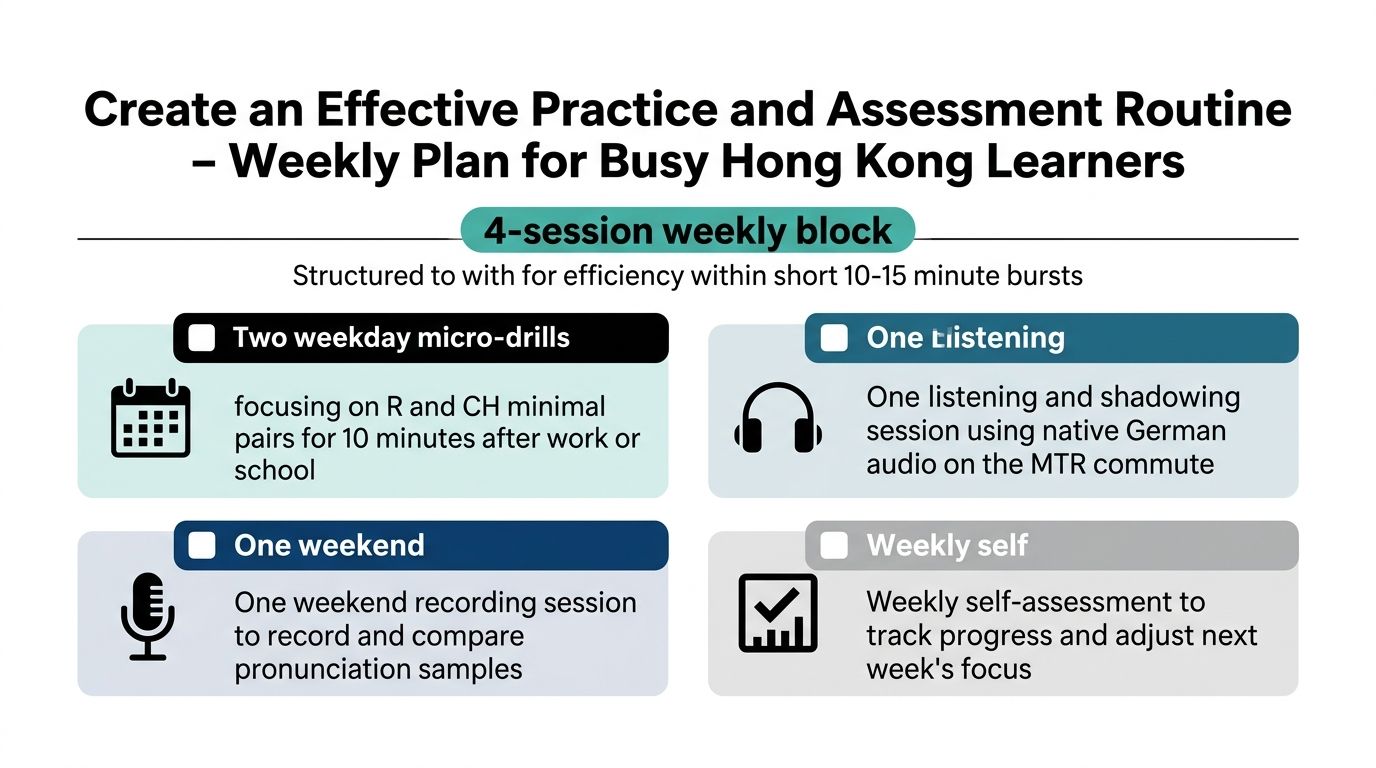
- Session one, articulation: Practise isolated [ʁ], [ç], and [x]. Use a mirror and check that the tongue tip stays relaxed for R.
- Session two, word control: Drill rot, Bach, ich, and Kirsche. Mark each attempt as accurate or needing correction.
- Session three, rhythm: Read short sentences, keeping the target sound clear without slowing every word.
- Session four, spontaneous speech: Give a short introduction or role-play a café order, travel question, or workplace greeting.
Use a phone memo app for one full recording review each week. Record the same word set and a brief self-introduction so you can compare sound placement, vowel stability, and timing.
Set practical benchmarks
Your progress log can include:
- Isolation control: Aim for nine out of ten correct productions, with the target defined before recording.
- Cluster control: Maintain accuracy across two-word combinations such as roter Wein or ich fahre.
- Connected speech: Record a natural 30-second self-introduction without the R disappearing or the CH sounds merging.
- Self-rating: Score perceived fluency on a one-to-five scale, then add one specific observation.
These benchmarks aren't a promise of automatic fluency. They give you evidence about what is improving and what still needs instructor feedback.
Structure a Small-Group or Private Training Session
A focused lesson works best when every minute has a clear purpose. The following 45-minute outline suits a small group in a Hong Kong language centre or a one-to-one private session.
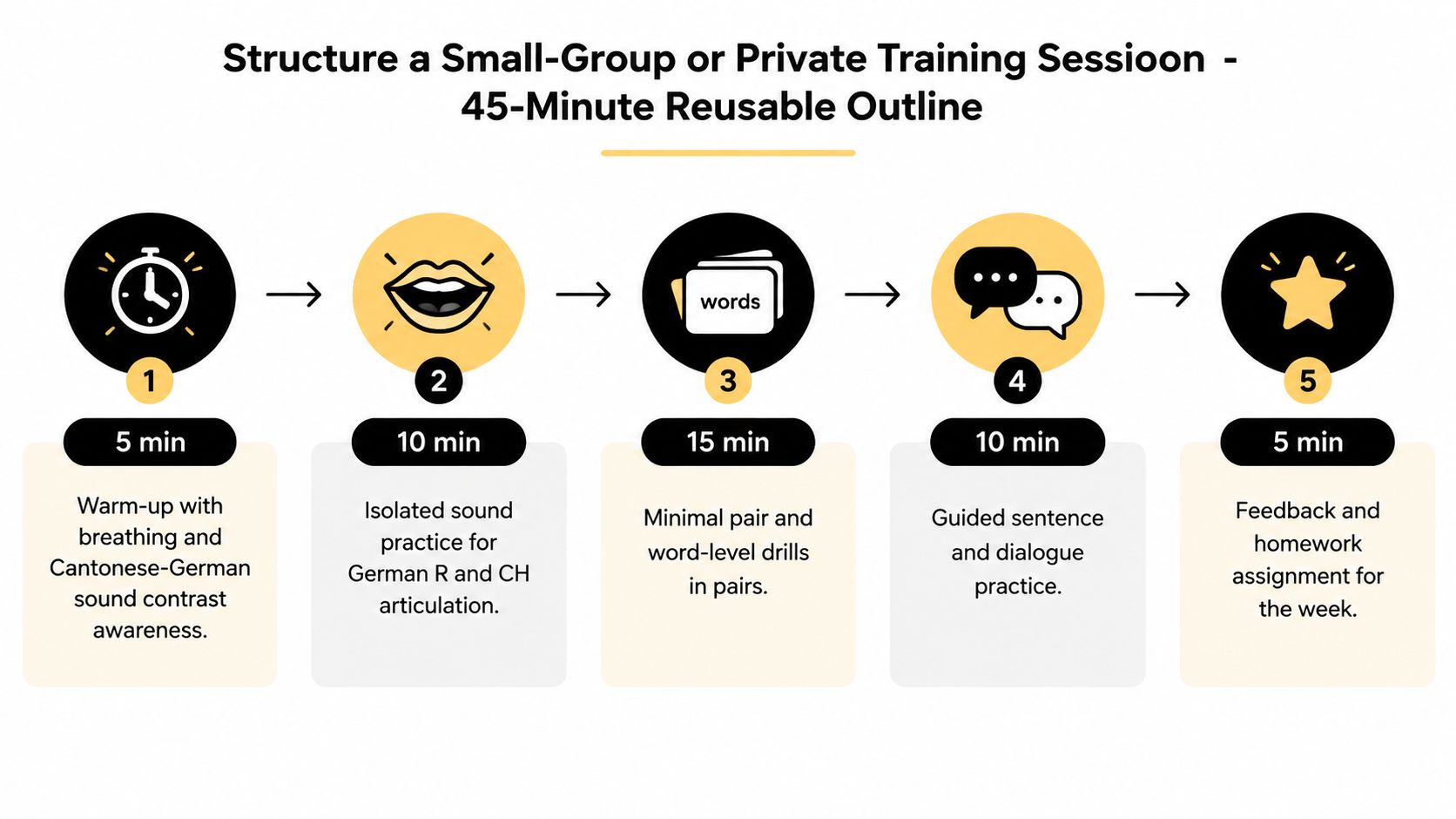
- Five-minute warm-up: Reset breathing, relax the jaw, and compare front and back tongue positions.
- Ten-minute diagnosis: The teacher plays or says target words, while learners identify [ʁ], [ç], and [x] by listening before producing them.
- Fifteen-minute drill block: Alternate R and CH work. Use mirroring for R, then airflow and tongue-position checks for both CH sounds.
- Ten-minute application: Practise sentences and role-play a café order, workplace introduction, or Sprachcafé exchange.
- Five-minute close: Give each learner one correction cue and one practice task for the week.
In a small group, rotate roles. One learner speaks, one listens for the target sound, and one records or checks the word list. The listener shouldn't judge accents broadly. They should answer a narrow question such as, “Did the R remain audible?” or “Did Bach sound deeper than ich?”
Private coaching allows a more detailed error profile. The teacher can mirror the learner's mouth position, isolate the exact moment when the vowel changes before R, and adjust the drill material to match the learner's school, work, or travel goals.
Digital media can support lesson design when used carefully. For example, a teacher experimenting with video generation in Russian might create visual prompts for role-play materials, but the pronunciation model itself should come from reliable native German audio and direct correction.
For further decisions about lesson format, compare private German lessons in Hong Kong with group learning according to your need for individual feedback, scheduling flexibility, and peer interaction.
Start Structured German Pronunciation Training
Use this checklist to turn the German R and CH Sounds: Pronunciation Training for Cantonese Speakers into a repeatable habit:
- Review the positions: R uses a relaxed tongue tip and a rear constriction. [ç] is forward, while [x] is back.
- Record weekly: Keep a short sample of rot, ich, Bach, and Kirsche, followed by a natural sentence.
- Track substitutions: Note whether R is replaced, deleted, or made English-like, and whether CH becomes “sh”, [k], or one merged sound.
- Request feedback: Bring the recording to a diagnostic lesson, pronunciation group, or private coaching session.
Consonant clarity can improve within 4 to 6 weeks of focused practice, while conversational fluency with consistent R and CH use develops over 3 to 6 months, depending on prior exposure and practice frequency. These are realistic practice horizons, not guarantees.
For learners comparing German lessons Hong Kong options, a structured native-led course can be useful when you need regular correction and exam preparation for Goethe-Zertifikat, DSE, IB, or IGCSE. German Cultural Association Hong Kong(GCA) offers small-group and private German learning, including native-speaker instruction and preparation for international examinations.
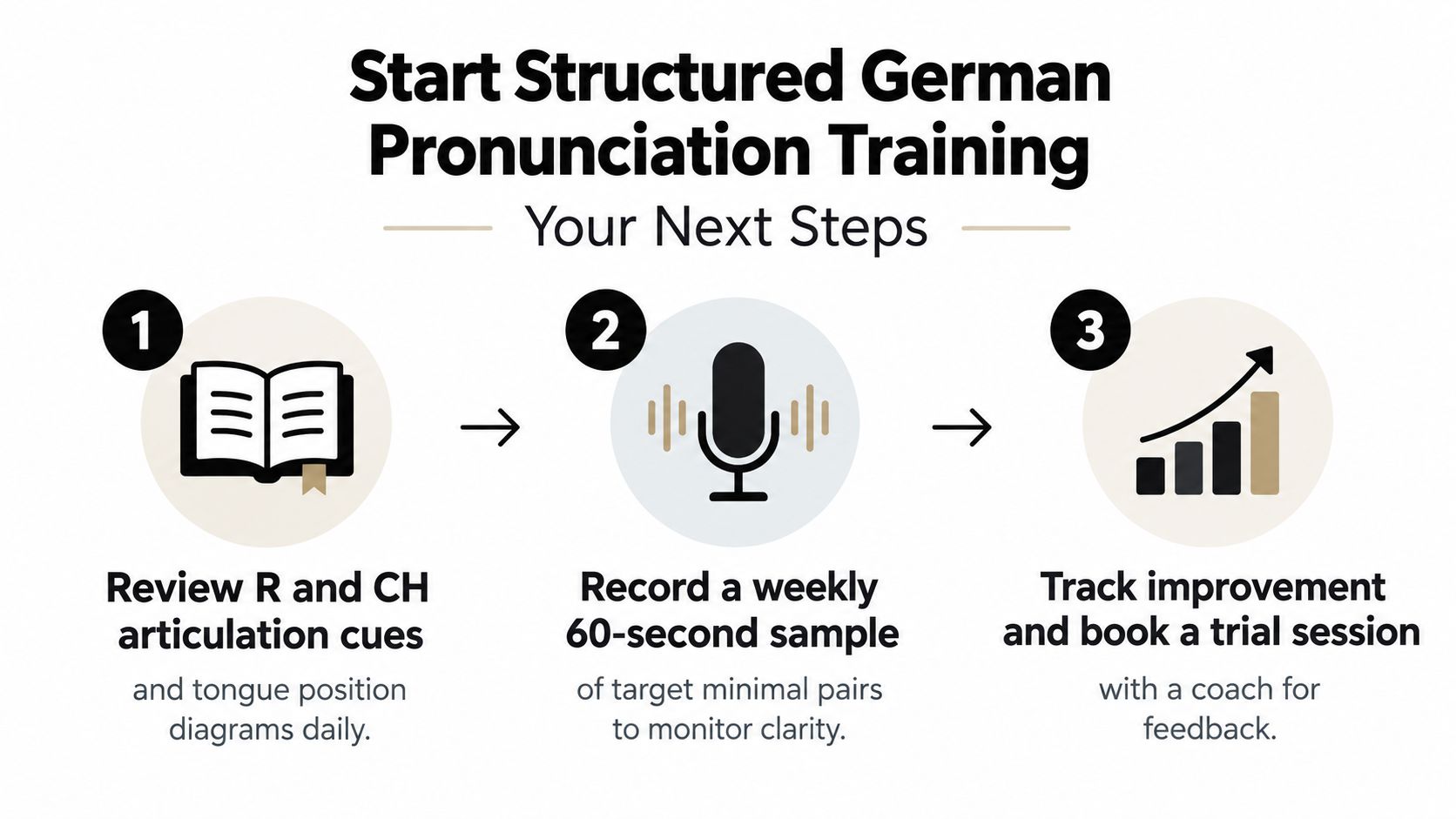
If you're ready to Learn German HK with a clear pronunciation target, choose one action today: record the four-word sample, mark your substitutions, and book a diagnostic session that includes isolated sounds and connected speech.
German Cultural Association Hong Kong(GCA)offers native-speaker small-group and private lessons in Hong Kong, with structured pronunciation practice and preparation for Goethe-Zertifikat, IGCSE, A-level, and IB pathways. Visit German Cultural Association Hong Kong(GCA) to check the latest course schedule or contact an advisor about a pronunciation-focused trial class.

Applying to German Universities from Hong Kong: Uni-Assist

Ausbildung Age Limits and Entry Requirements for Hong Kong Applicants


