.png)
.png)

BLOG

香港德國文化協會
The German Cultural Association
Is German Hard to Learn? an Honest Guide for Cantonese Speakers
You've probably felt this already. You've got work, family, or study in Hong Kong, and German keeps slipping to the bottom of the list until an oral exam, a visa deadline, or a university plan suddenly makes it urgent. Is German Hard to Learn? An Honest Guide for Cantonese Speakers gives you the honest answer, without hype, so you can judge the effort properly and study with a clear target.
If you speak Cantonese in HK, German is challenging but very learnable when you plan for the right problems. The language is not “easy”, but it's also not in the same time category as Cantonese, and that matters when you're deciding how much time to commit, whether to use CEF funding, and how to prepare for DSE, IGCSE, IB, Goethe-Zertifikat, or study abroad in Germany/Spain.
Table of Contents
- Why rhythm becomes the hidden obstacle
- Where Cantonese learners usually trip
- A useful mindset for HK learners
- A timeline that respects your schedule
- What weekly study should look like
- Why output has to start early
Introduction with STAR Scenario
It's lunchtime in Tsim Sha Tsui. You've got messages from work, maybe a tutoring schedule for your child, and that Goethe oral exam sitting on your calendar like a quiet threat. You know the answers in your head, but when you try to speak, the word order slips, the pronunciation feels heavy, and your mouth sounds slower than you want.
That's the starting point for many Cantonese speakers in Hong Kong. The task is not “learn German from zero”, it's more specific, control pronunciation, grammar, and speaking rhythm under pressure. The action you need is a realistic plan, not a motivational slogan.
Practical rule: If you can already understand German more than you can produce it, your bottleneck is usually output, not passive knowledge.
The result you want is simple. You want to walk into an oral exam, a university interview, or a travel conversation with enough control to sound prepared, even if you're not perfect. German becomes much less intimidating once you stop asking whether it is hard in general and start asking which parts are hard for Cantonese speakers in HK.
For local learners, that distinction matters. A parent in Kowloon, a teen taking IGCSE, and a professional aiming for business German do not need the same study plan. A good course, whether you study independently or with a centre, should match your exam target and give you correction before bad habits become fixed.
Overview of German Difficulty for Cantonese Speakers
Short answer, German is hard enough to deserve planning, but it is still far more manageable than many Cantonese speakers expect. The U.S. Foreign Service Institute classifies German as a Category II language, and Cantonese as a much more demanding category, which is why German should be treated as serious study, not impossible study. FSI language difficulty overview
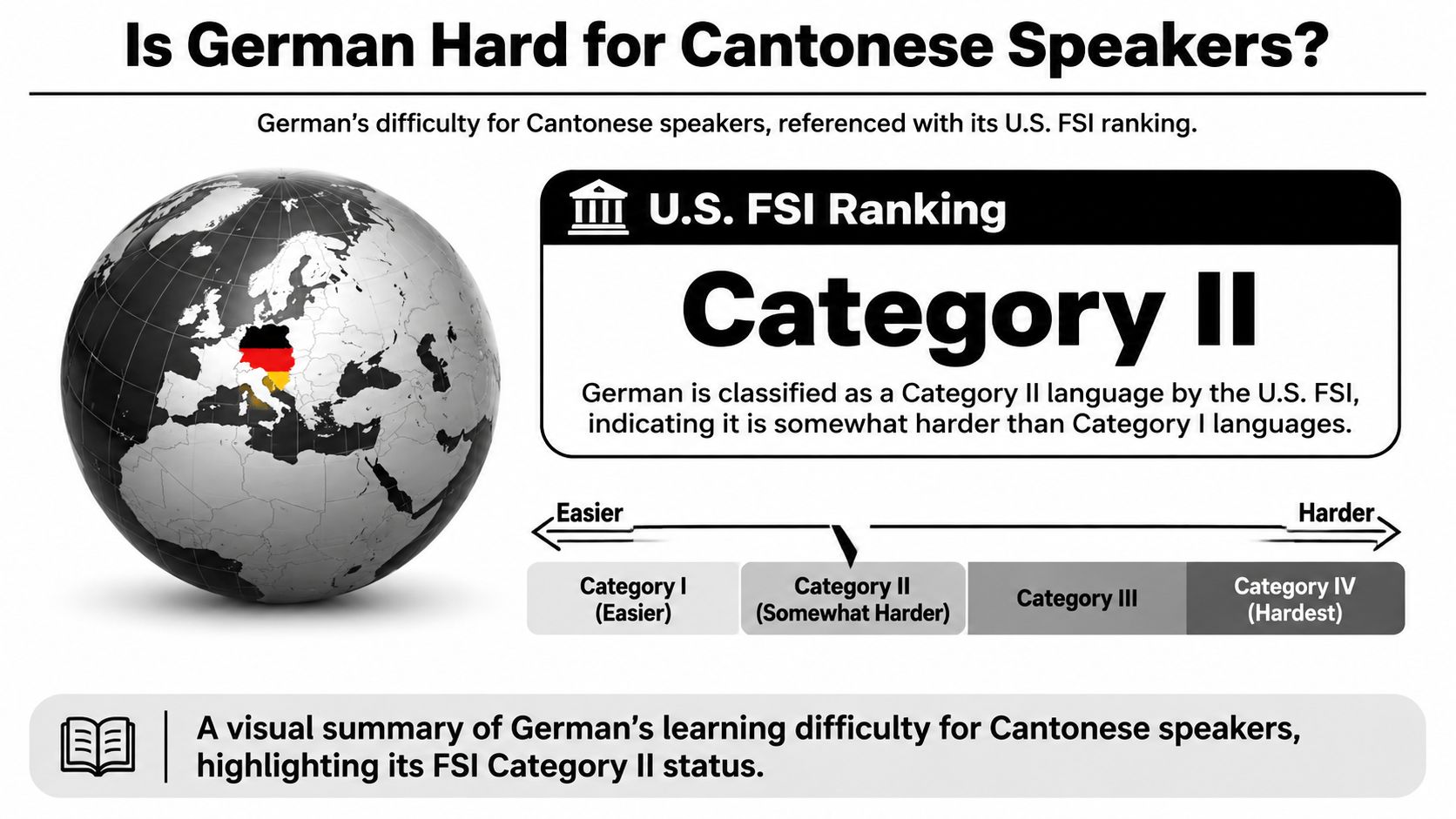
For Hong Kong learners, that comparison is useful because it changes the frame. German is not a quick win, but it also does not demand the same time commitment many people assume when they hear “European”. The secondary summaries that place German and Cantonese in very different study-time brackets point in the same direction, namely that German is still demanding, but materially more approachable from a time-investment point of view.
What that means in practice
The label alone does not tell the whole story. A Category II language still needs steady effort, regular correction, and enough speaking time for grammar to become automatic, the same way a pianist does not master a piece by reading it once, but by repeating the fingering until the movement becomes natural.
For Hong Kong adults, that usually means three decisions:
- Set a target early, such as Goethe, IB, or travel German.
- Match your time budget to the target, rather than studying vaguely.
- Start output work before the exam window, so speaking does not collapse under pressure.
That local pacing matters even more if you are comparing German against other languages while balancing work, school, or family commitments in Hong Kong. A useful next read is common German learning issues for Cantonese speakers, which fits well with the practical questions that come up when learners start planning their study rhythm.
Phonology and Pronunciation Challenges
German pronunciation usually feels harder than it looks on paper, because the problem isn't only sounds, it's timing. Cantonese speakers often hear the individual words well enough, but the rhythm can come out slower, flatter, or more segmented than native German.
Why rhythm becomes the hidden obstacle
A Hong Kong study from CUHK found that Cantonese-English-German trilinguals produced German that was more syllable-timed, slower, less fluent, and had more IP-final rises than native German. In plain language, Cantonese prosody can carry over into German even after English is already known, so the challenge is not just vocabulary or grammar, it's also speech rhythm and fluency control. CUHK study PDF
That matters for oral exams and interviews. A listener may understand your words, but if your sentence endings rise too often or your pacing sounds hesitant, you can come across as less secure than you really are.
German oral performance improves when learners practise whole phrases with timing, not just isolated words.
Where Cantonese learners usually trip
Some of the hardest areas are very specific:
- Consonant clusters, because German allows sound combinations that don't map neatly onto Cantonese habits.
- Vowel length, because short and long vowels can change meaning.
- Sentence endings, because learners often transfer Cantonese intonation patterns into German statements.
The fix is repetitive, audible practice. Shadowing short sentences, recording yourself, and comparing your delivery against native models helps more than silent memorisation. If you want a focused resource, the guide on German pronunciation for Cantonese speakers is a strong companion read.
For pronunciation practice at home, tools like AIDictation on best German dictation can give you a useful reality check. If speech-to-text keeps missing the sentence shape, you can hear quickly where your rhythm or endings need work.
A useful mindset for HK learners
Don't aim to “sound German” in one leap. Aim to sound clear, steady, and examinable first.
That's a better Hong Kong strategy because your goal is usually practical. You may need to pass an oral paper, hold a travel conversation, or make yourself understood in a lesson, and all three depend more on controlled delivery than on chasing a perfect accent.
Grammar and Vocabulary Differences and Strategies
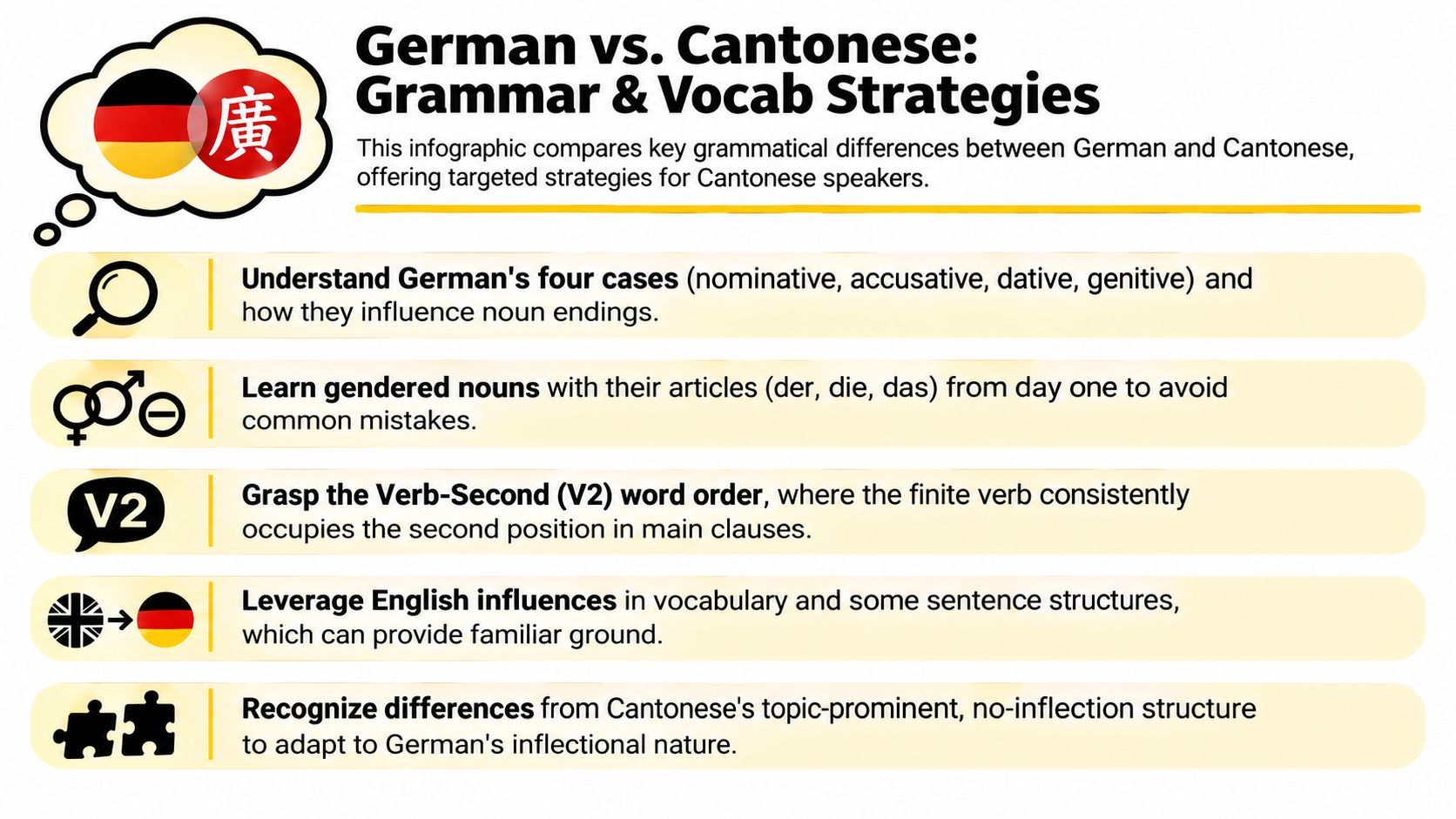
German grammar can feel heavy for Cantonese speakers because the two languages organise information in very different ways. Cantonese is topic-prominent and does not rely on the same kind of inflectional system, while German asks articles, endings, and word order to carry more of the meaning.
The grammar gap is structural, not personal
Many HK learners can explain a rule in class, then miss it in real speech. That usually happens because German asks you to track cases, gender, and verb position at the same time, while Cantonese usually lets the sentence move with fewer visible changes on the words themselves.
A useful way to handle this is to make grammar visible:
- Colour-code noun gender with the article, so der, die, das stay together as one unit in your notebook.
- Use sentence frames for common structures, so you practise complete patterns instead of isolated words.
- Review vocabulary in chunks, especially where English cognates give you a head start but false friends can still trap you.
What to do on a normal Hong Kong day
You do not need a perfect study room to make progress. A commute on the MTR can become a grammar review session if you keep one small deck of sentences on your phone and repeat them out loud.
A few practical tactics work especially well for busy adults. Start with sentence-first learning, so you study “I want to go” instead of only “go”. Learn gender with meaning, so das Buch or die Sprache stay in your memory as full items rather than loose nouns. Ask a tutor or native speaker to mark the same error pattern until it disappears, because repeated correction is faster than guessing.
If you are preparing for exams, structure matters even more. Building full sentences early helps prevent the late-stage problem where you can recognise grammar on the page but cannot produce it under time pressure.
Practical rule: If you can only recognise the rule, you are still at the reading stage. If you can use it in a timed sentence, you are starting to own it.
For a broader explanation of how the grammar system works in practice, the guide on German grammar basics for HK learners gives a useful local frame without overcomplicating the topic.
Study Plans and Timeline for Hong Kong Learners
Local pacing matters because most Hong Kong learners are not studying German full-time. They are balancing office hours, schoolwork, tutoring, family duties, or university applications, so a plan has to fit real life before it can work well.
A timeline that respects your schedule
For many Cantonese speakers in Hong Kong, progress is easier to judge when it is tied to a clear route, not to vague hope. A local pacing model gives you that route, with A1 in 3 to 6 months, A2 in 6 to 12 months, B1 in 1 to 2 years, and B2 in 2 to 3 years, assuming steady weekly study and feedback. That makes German a long game, but not an undefined one, as shown in this HK pacing guidance.
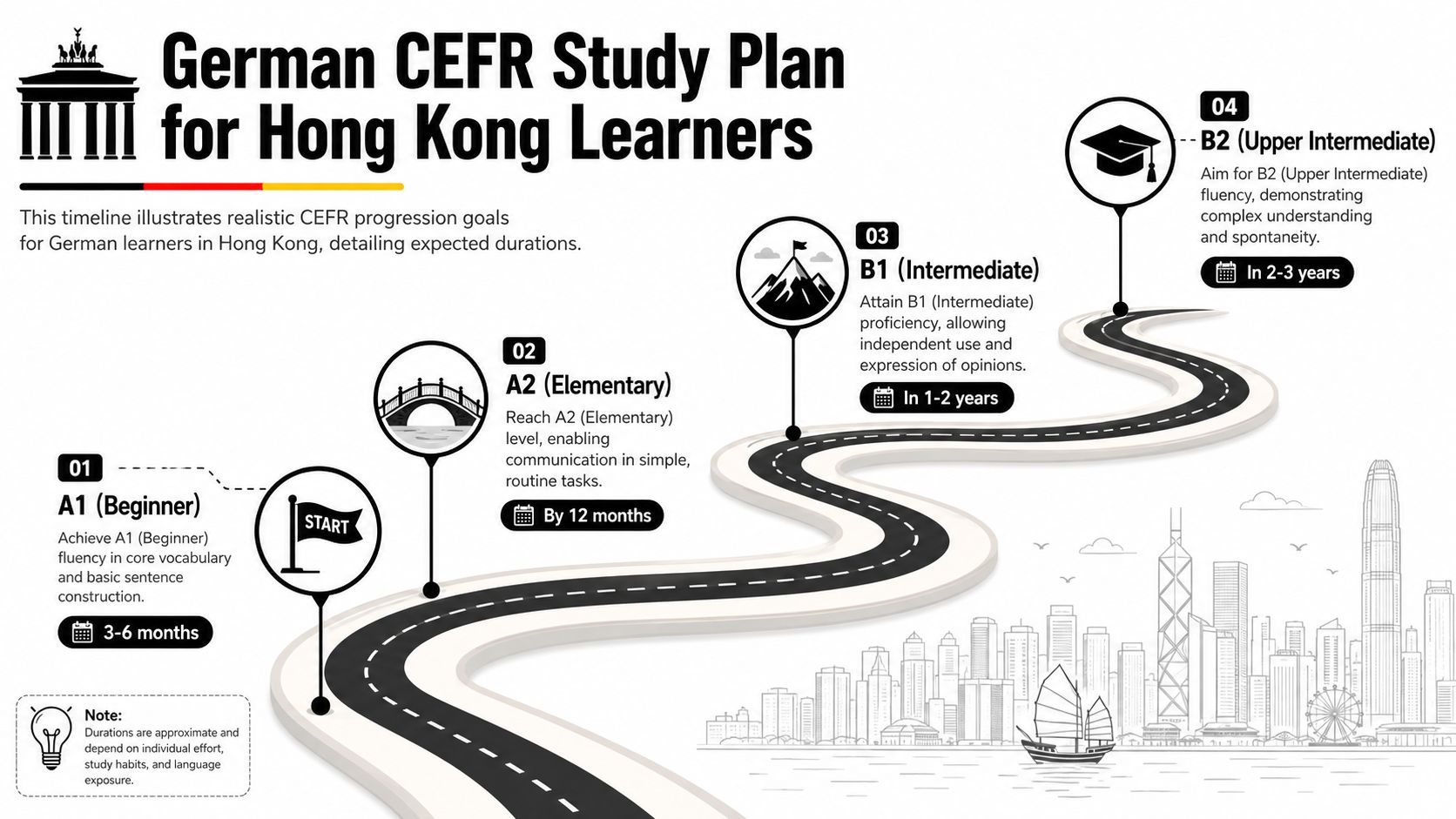
A useful way to read that timeline is to connect each level to a concrete milestone, the same way you would map school progress to HK exam checkpoints:
- A1, you can manage basic introductions and simple exchanges.
- A2, you can handle routine tasks and short practical conversations.
- B1, you can express opinions and work more independently.
- B2, you can deal with more complex language and spontaneous discussion.
What weekly study should look like
The exact number of hours depends on your target, but the pattern matters more than heroic bursts. Consistency beats weekend panic, especially when you are preparing for a speaking exam or a school term.
Half an hour every day beats three hours on Sunday.
For HK adults, that usually means splitting study into small parts that fit commute time, lunch breaks, and evenings after work:
- Listening on commute time, even if it is only a short segment.
- Writing practice once or twice a week, so sentence order becomes automatic.
- Speaking feedback every week, because mistakes harden fast when nobody corrects them.
If motivation drops or you feel stuck before a deadline, the article on strategies for ADHD executive dysfunction can be useful for getting started again, even if you do not have ADHD. The basic idea is to lower the effort needed to begin, then build the habit from there.
Why output has to start early
Many Cantonese speakers delay speaking because it feels embarrassing to sound slow. That delay usually creates the later exam bottleneck. German pronunciation and sentence order improve faster when you speak early, even if the sentences are short and imperfect at first.
For learners who want a fuller sense of the route from beginner to advanced, this guide on how long it takes to learn German in real life gives a practical local frame. It helps you set expectations around pace, revision, and exam planning without turning the process into guesswork.
Exam Preparation Tips for IGCSE A-level IB Goethe TestDaF
German exam prep becomes much easier when you treat each paper as a separate skill set. A student in an IB school in Hong Kong, a working professional taking Goethe, and a university applicant aiming for TestDaF don't need the same drills, even if they're all studying German.
Match the exam to the task
For IGCSE listening, the challenge is often speed and familiarity with question style. For IB essays, the issue is not just language accuracy, but argument structure and clarity.
For Goethe-Zertifikat oral tasks, the biggest mistake is answering too briefly or too mechanically. For TestDaF, the academic register and text density can feel very different from classroom German, so reading and writing need to be trained together.
A practical checklist keeps the preparation honest:
- IGCSE listening: work through Hong Kong trial papers so you get used to local exam pacing and formats.
- IB essays: build clear openings, topic sentences, and concluding lines before you chase fancy vocabulary.
- Goethe oral tasks: rehearse role-plays and direct question-answer exchanges with a native speaker or tutor.
- TestDaF: practise academic reading and writing with texts that feel denser than ordinary textbook passages.
How to schedule mocks without wasting time
Mock exams only help if you review them carefully. Don't just mark the paper and move on.
A good cycle is simple. Do one timed task, identify the error pattern, then spend the next session drilling the exact weakness. If your listening breaks down on fast audio, don't switch to unrelated grammar revision. If your essay structure is weak, don't hide behind vocabulary lists.
For parents and teens in Hong Kong, that means planning ahead of school deadlines rather than cramming during the final week. For adults, it means accepting that speaking needs live correction, not just self-study.
A native-led class can be useful here because the correction is immediate and the speaking format is closer to the actual exam. If you also want a business-friendly presentation skill set, that same habit helps in professional meetings, interviews, and visa-related conversations.
Local German Lessons Hong Kong Options and CTA
Hong Kong learners usually compare four routes. A structured cultural association, university classes, private tutors, and online platforms can all work, but they suit different needs.
Which option fits which learner
German Cultural Association of Hong Kong is a sensible option for learners who want native-speaker teaching, a structured curriculum, and exam-focused preparation in one place. It also offers small-group and private formats, which helps when you need actual speaking time instead of just passive lesson attendance.
University classes can suit students who want an academic environment and can fit lessons into a school timetable. Private tutors may work well if you already know your weak points and only want targeted correction. Online platforms are useful if your schedule changes often or you want more flexibility.
Practical rule: Choose the format that matches your deadline, not the one that sounds most convenient on paper.
One useful extra reference on presentation and profile-building is professional portrait insights, especially if you're preparing for applications where your image, CV, or interview presence matters alongside language ability.
For families, teens, and professionals in Hong Kong, the main question is not whether a course looks impressive. It's whether it gives you enough structure to keep going and enough feedback to fix errors before they become habits. That's where a native-led, exam-oriented setup can feel more efficient than a generic class.
If you're comparing options for German lessons Hong Kong or Learn German HK, choose the one that aligns with your actual use case, whether that's school exams, university admission, or travel. The right course should reduce confusion, not add another layer of guesswork.
People Also Ask FAQ
What class size works best for adults and kids? Small groups usually make it easier to speak and get corrected. For children, that matters for confidence. For adults, it matters because you need enough turns to move past passive understanding.
Can CEF funding help with German? If your course and situation qualify, CEF can reduce the financial pressure. Check the latest eligibility details directly with the provider before you enrol.
How can German become business-friendly? Focus on meeting phrases, email structure, and role-play for introductions and requests. Business German improves fastest when you practise the exact situations you expect at work.
What should Cantonese speakers do for travel conversation? Learn airport, hotel, transport, and food phrases as set chunks. Then practise them aloud until you can answer without translating word by word.
If you want structured German learning with native-speaking teachers, exam preparation, and flexible class formats in Hong Kong, visit German Cultural Association Hong Kong(GCA) to check the latest course schedule, book a trial class, or speak with an advisor about the right level for your goal.
Interactive German Classes for Kids: Games
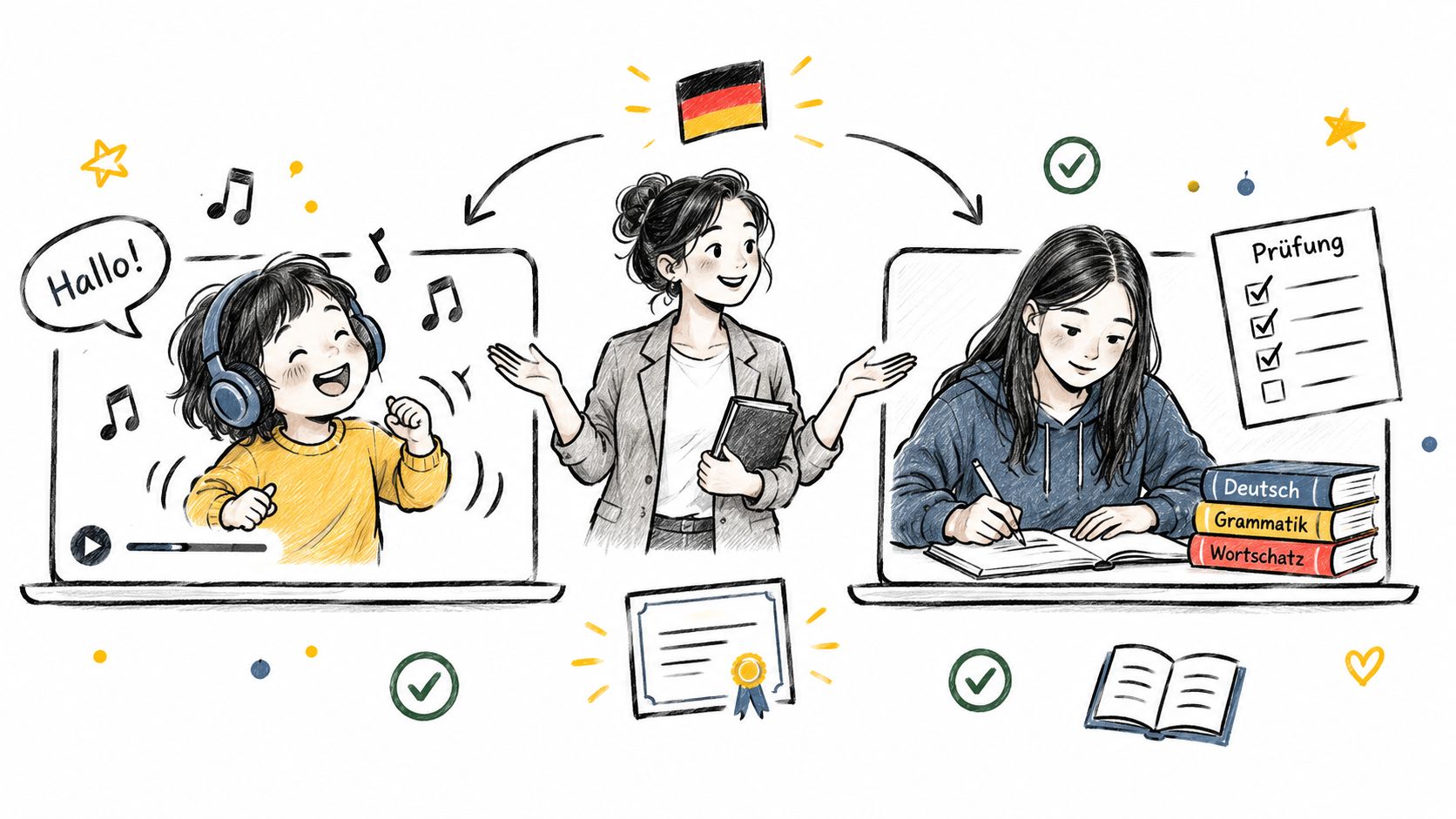
Online German Classes for Kids and Teens: Do They Actually Work?


