.png)
.png)

BLOG

香港德國文化協會
The German Cultural Association
A Complete Guide to German Pronunciation: 2026 Expert Tips
You've done the hard part already. You've learnt vocabulary, memorised verb tables, and maybe even written practice answers for Goethe-Zertifikat, IGCSE, IB, or A-level German. But when you speak, the sentence that looked perfect on paper suddenly feels shaky, and the listener asks you to repeat yourself.
That's the moment pronunciation stops being a “nice extra” and becomes the skill that decides whether your German works in real life. A Complete Guide to German Pronunciation matters especially in Hong Kong, where many learners switch daily between Cantonese, English, and sometimes Mandarin. Your brain is doing fast, clever language work, but that same flexibility can create pronunciation habits that don't fit German.
For exam candidates, parents planning ahead for their children, and professionals who want to study abroad in Germany or handle meetings with confidence, clear speech is a practical advantage. If you're thinking beyond the classroom, this overview of why Hong Kong professionals should learn German shows how language skill connects directly to career mobility.
Why Perfect German Pronunciation is Your Career and Academic Superpower in Hong Kong
Many learners in Hong Kong face the same problem. They can read German fairly well, they understand grammar explanations, and they know what they want to say. But when they open their mouth, the sound system slips back toward English rhythm or Cantonese vowel habits.
That gap matters because German depends heavily on clean vowel shape and precise consonants. If the sound is blurred, the word can become unclear even when the grammar is correct.
Why Hong Kong learners face a different challenge
Most pronunciation guides treat learners as if they come from a single language background. That doesn't reflect life in HK. Many students and professionals move between Cantonese, English, and Mandarin, and each of those languages trains the mouth and ear differently.
According to a pronunciation discussion highlighted in this German pronunciation reference, German requires “clearly and cleanly enunciated vowels”. That can clash with habits from Cantonese, where tone carries meaning and final sounds may be handled differently from German.
Here is where confusion often begins:
- Cantonese influence: Tone is important, so learners may focus on pitch more than vowel length or vowel purity.
- English influence: English spelling is unpredictable, so learners may guess the sound instead of trusting the written word.
- Mandarin influence: Similar to Cantonese, tonal expectations can interfere with German's steadier sound pattern.
Why pronunciation changes exam outcomes
In spoken exams, the examiner isn't grading your intentions. They're grading what they can hear clearly.
If your vowels are too reduced, your speech can sound less controlled. If your consonants are soft or swallowed, your answer may sound less precise, even when your vocabulary is strong. That affects oral exams such as Goethe-Zertifikat, IGCSE, and IB speaking tasks, where clarity, confidence, and intelligibility all matter.
Practical rule: If a native speaker needs to “decode” your sentence, your pronunciation is holding back your grammar.
Good pronunciation also improves listening. Once you can produce German sounds accurately, you recognise them faster in podcasts, meetings, interviews, and class discussions. Many learners notice that listening stops feeling like noise once the sound system becomes familiar in the mouth.
Why it matters outside the exam room
In a business setting, pronunciation shapes first impressions. You don't need to sound like you grew up in Munich. But you do need to sound clear, deliberate, and reliable.
That matters if you're:
- Preparing for study abroad in Germany: University interviews and spoken interactions become easier when your German sounds controlled.
- Working with German clients or colleagues: Clear pronunciation reduces repetition and helps you sound organised.
- Supporting a child's language path: Parents often focus on grades first, but spoken clarity supports both exam performance and long-term confidence.
In Hong Kong, pronunciation isn't a side topic. It's the bridge between “I know German” and “people trust my German.”
What Are the Fundamental German Vowels and Consonants
German pronunciation is a largely consistent sound system built on clear vowels and stable consonants. The foundation is learning how long and short vowels change meaning, then mastering consonants that must be pronounced cleanly and without English-style guessing.
German feels easier than English in one important way. Once you learn the sound rules, spelling usually gives you a strong clue about pronunciation.
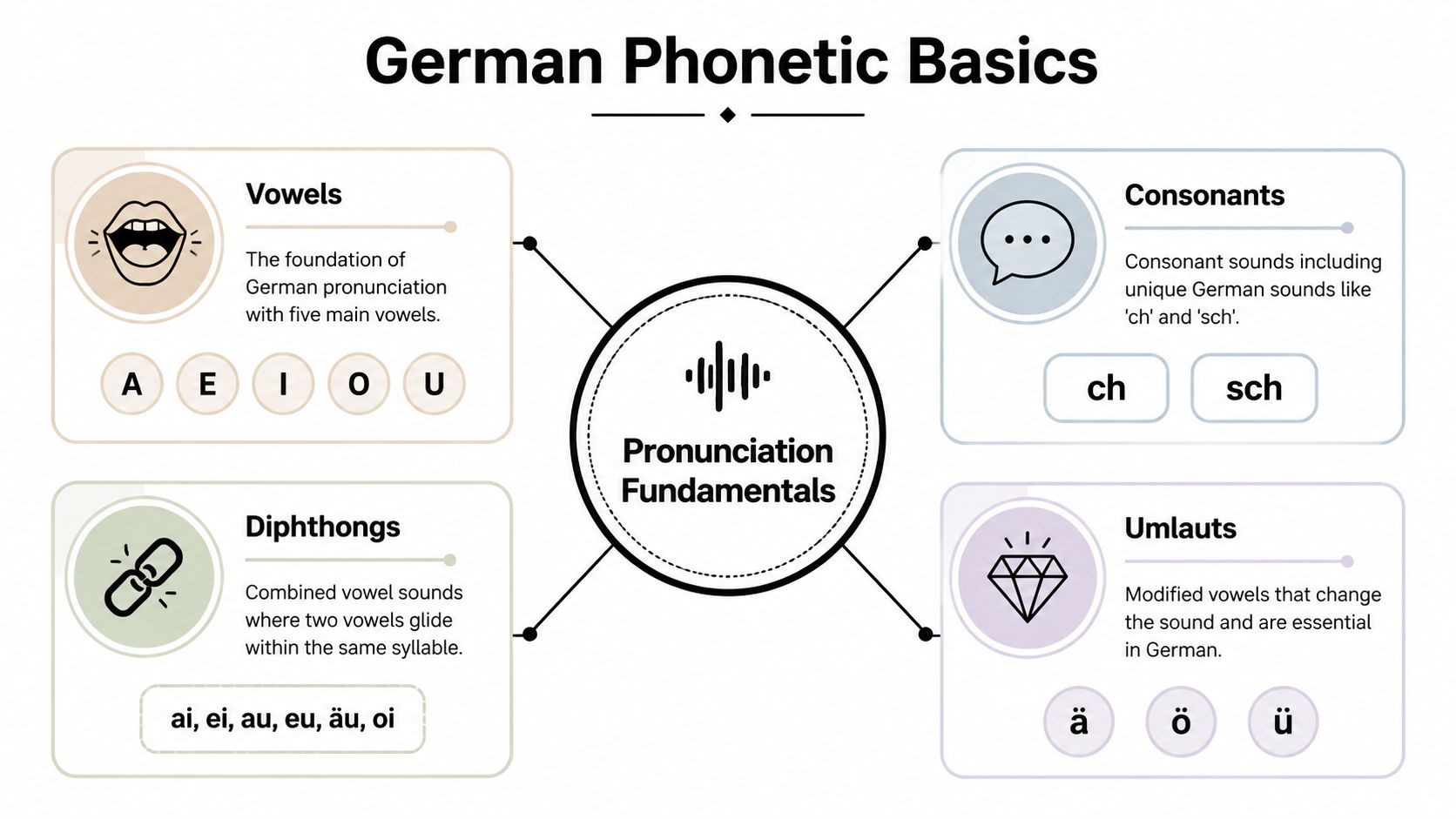
If you already know a few greetings from this basic German conversation guide, you've met the system already. The next step is hearing the patterns more clearly.
The five core vowels
Start with a, e, i, o, u. These are the backbone of German pronunciation.
The key idea is simple. In German, vowels can be long or short, and the difference isn't cosmetic. It often changes how natural and accurate the word sounds.
Think of it this way:
- A long vowel is like holding a musical note steadily.
- A short vowel is like a quick tap on the piano.
Examples you can feel in the mouth:
- a can sound open and held, or quick and short
- e may sound clear and narrow, or shorter and more relaxed
- i can be a long “ee” sound or a shorter version
- o and u also shift between held and clipped versions
How to notice long and short vowels
You don't need to memorise a full phonetics textbook first. Use practical clues.
Common patterns include:
- One consonant after a vowel: often a longer vowel
- Double consonants after a vowel: often a shorter vowel
- A doubled vowel or a following h: often signals length
This won't solve every word at once, but it gives you a reliable starting point.
If you rush all vowels equally, your German may sound flat. If you control vowel length, your speech immediately sounds more structured.
The consonants that deserve your attention
Many German consonants look familiar to English speakers, but they aren't always pronounced the English way.
Focus early on these groups:
- w sounds like English v
- v often sounds like f
- z sounds like ts
- j sounds like English y
- s can sound voiced or unvoiced depending on position
These are small changes, but they affect basic words all the time. A learner who says German words with English consonant habits may be understood, but they often sound uncertain.
A simple way to build the system
Don't try to perfect every sound on day one. Build in layers.
Train your ear first
Listen for whether a vowel is long or short. Don't worry yet about sounding elegant.Match spelling to sound
German rewards careful reading. Learn the common patterns and trust them.Clean up the frequent errors
Start with w, v, z, j, and the long-short vowel contrast.
Here's a quick reference:
| Element | What beginners often do | Better approach |
|---|---|---|
| Vowels | Pronounce all with English habits | Keep them pure and steady |
| Long and short vowels | Ignore the length difference | Treat length as meaningful |
| Familiar consonants | Assume same as English | Relearn the high-frequency ones |
| Spelling | Guess from English logic | Read more literally |
Once these basics feel stable, umlauts and diphthongs become much less intimidating.
How to Pronounce Umlauts and Diphthongs Correctly
For many learners in Hong Kong, umlauts look frightening only until the mouth understands them. After that, they become mechanical. You place the lips correctly, keep the tongue honest, and repeat until the sound stops feeling foreign.
The biggest mistakes usually come from replacing a German umlaut with a plain English vowel. That shortcut may get you through a casual exchange, but in exams and professional settings it weakens clarity.
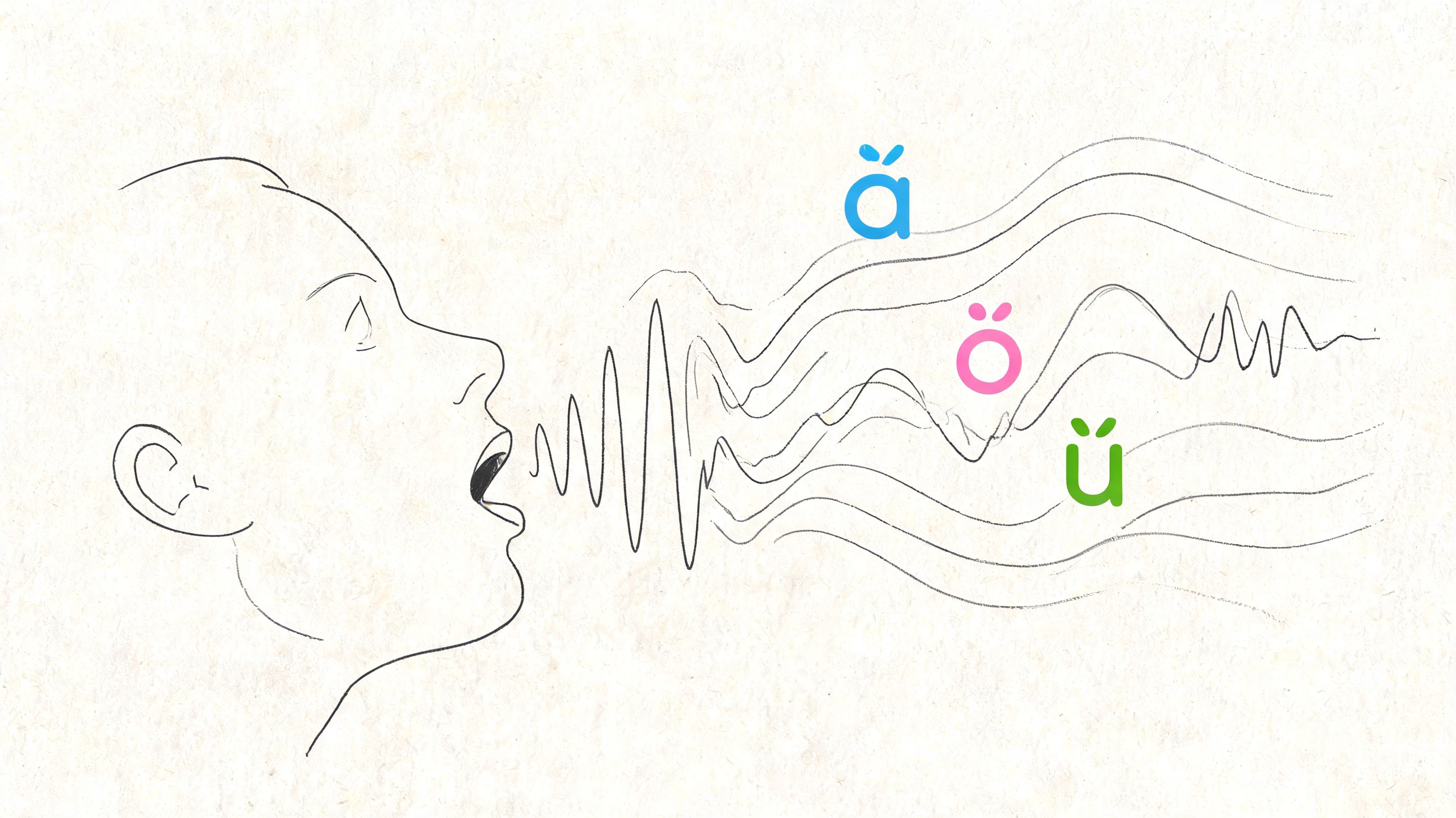
How to say ä
Start with e as in a short, open “eh” sound. Then keep it relaxed. Don't over-round the lips.
Many HK learners turn ä into plain English “a”. That usually sounds too heavy.
Try these contrasts:
- schon and schön
- Mann and Männer
With ä, think front of the mouth, open jaw, no extra tension.
How to say ö
This one needs a mouth recipe.
- Start by saying a German-style e sound.
- Keep the tongue position quite forward.
- Now round your lips as if you are preparing to whistle.
The mistake is usually one of two things. Learners either turn ö into plain o, or they make it too English and too central.
Practice words:
- schön
- König
- hören
A helpful contrast is:
- schon = already
- schön = beautiful
If those two sound the same in your mouth, your ö still needs work.
How to say ü
This is the umlaut that causes the most panic, but it has the clearest physical instruction.
- Form the ee sound, so your tongue moves to the front.
- Without changing that tongue position too much, round the lips into oo.
- Keep the sound focused and forward.
That's ü.
Many learners replace it with u because it feels safer. But u and ü are different sounds, and German listeners hear that difference immediately.
Practice with:
- Müller
- über
- fünf
Teacher's shortcut: For ü, keep the tongue where “ee” lives and the lips where “oo” lives.
The three diphthongs you must know
Diphthongs are moving vowels. Your mouth glides from one position to another.
The three most common are:
- ei
- au
- eu / äu
ei
This sounds like eye.
Examples:
- mein
- drei
- Zeit
The common error is reading it like English “ee”. Don't. German ei moves.
au
This sounds like ow in “now”.
Examples:
- Haus
- braun
- Auto
Start open, then glide inward.
eu and äu
These sound like oy.
Examples:
- neu
- Europa
- Häuser
Many learners flatten this into something close to “oh”. Keep the glide clear.
A short demonstration can help you hear the movement before you imitate it:
A practical drill that works
Use minimal pairs, meaning two words that differ in only one sound. This forces your ear to notice what your mouth is doing.
Try reading these aloud slowly:
- schon / schön
- muss / müsste
- Brot / blöd
- mein / Mann (to feel how vowel targets differ)
Then record yourself. Listen once for the lips. Listen again for the tongue. If that sounds strange, good. Pronunciation improves when you separate the movement into physical parts.
Where HK learners often get stuck
A Cantonese or English background can create two habits:
- reducing vowels too quickly
- replacing unfamiliar German vowel shapes with the nearest English sound
That's why umlaut practice must be deliberate, slow, and physical. Don't aim for speed first. Aim for shape first.
If you can produce ä, ö, ü, and the main diphthongs accurately in isolated words, your spoken German starts sounding much more reliable. Native listeners may still hear that you're a learner, but they'll also hear control. For exams and real conversations, that's what matters.
Advanced German Consonant Articulation for Exam Success
Strong speakers distinguish themselves from good learners at this stage. Basic pronunciation helps people understand you. Advanced consonant control helps you sound precise under pressure, especially in oral exams and formal speaking tasks.
For serious exam preparation, consonants matter because they carry the frame of the sentence. Vowels give colour, but consonants give shape.
The alveolar sounds that influence clarity
In Standard German phonology, the consonants /t, d, l, n/ need careful placement. A Hong Kong bilingual-programme study reported that learners who mastered denti-alveolar /t, d/ articulation scored 28% higher in oral proficiency benchmarks. The article summarising this point appears in the Standard German phonology reference.
You don't need to become a phonetician to use that insight. You need one practical correction. Put the tongue tip or blade cleanly against the area just behind the upper teeth, rather than letting the sound drift backward or become fuzzy.
Why this helps:
- the consonant starts more cleanly
- rapid speech becomes clearer
- similar words stay more distinct
The consonants that often cause avoidable errors
Three areas create repeated trouble for HK speakers.
First, final devoicing. In German, some voiced consonants at the end of a word sound voiceless. So a final d may sound closer to t.
Examples:
- Hand
- Rad
Second, the two ch sounds. German has a softer sound after front vowels and another, rougher sound after back vowels.
- In ich, the sound is lighter and more forward.
- In Bach, the sound is deeper and further back.
Third, the German R. Many learners use an English R. Standard German usually places it much further back in the mouth or throat area.
Don't chase perfection first. Chase consistency. A consistent German R is better than switching randomly between English, Cantonese-influenced, and German versions.
A diagnostic table for HK learners
| Sound / Cluster | Common HK Error | How to Correct (GCA Method) |
|---|---|---|
| t / d | Tongue sits too far back or sounds too soft | Place the tongue closer to the upper teeth ridge and release cleanly |
| l | Dark English-style l | Use a brighter, clearer l with the tongue tip forward |
| n | Reduced ending or weak closure | Touch firmly and finish the consonant fully |
| ch in ich | Replaced with “sh” or “k” | Keep it light, narrow, and forward in the mouth |
| ch in Bach | Over-softened or replaced with “h” | Use a rougher back-of-mouth friction |
| z | Pronounced like English z | Say ts, as in the end of “cats” |
| s at word start | Always pronounced as plain s | In many common words, voice it more like z |
| R | English R from the tongue tip | Pull the sound back and reduce lip tension |
| Final b / d / g | Kept fully voiced at the end | Devoice gently at word end |
If your child is preparing for sixth-form study, classroom speaking tasks, or exam reading aloud, resources like an online German A Level course can also help learners hear standard patterns repeatedly alongside formal language content.
How to train consonants without overthinking
Use a three-step correction loop:
Isolate the sound
Say only the target sound and one syllable, such as ta, da, ich, ach.Move into a word
Practise short words before full sentences.Test under speed
Say the word inside a longer answer, because exam speech is never fully isolated.
A useful self-check is this: if your mouth feels lazy at the end of words, your consonants are probably weakening. German rewards cleaner endings than many learners expect.
For Goethe-Zertifikat, IGCSE, and university-focused speaking goals, these details aren't cosmetic. They help examiners hear structure, confidence, and control.
How Long Does It Take to Improve German Pronunciation in Hong Kong
This is one of the most sensible questions busy learners ask. Parents ask it when choosing classes for teenagers. Professionals ask it when they're balancing work, family, and evening study. The honest answer is that pronunciation improves in phases, not in one dramatic jump.
If you practise consistently, you'll usually notice progress sooner in your ear than in your mouth. That's normal.
Phase one is hearing the difference
At the beginning, many learners can't yet hear why two German sounds are different. They may know the rule, but the ear hasn't caught up.
This stage often feels frustrating because your teacher hears the mistake immediately, while you hear “almost the same”. In practice, listening, imitation, and slow correction matter most.
Focus on:
- vowel contrast
- umlauts
- word endings
- sentence rhythm
Phase two is building muscle memory
Once the ear improves, the mouth needs repetition. This is the stage where pronunciation drills stop feeling theoretical.
Useful habits include:
- reading aloud
- recording and replaying
- repeating short dialogues
- shadowing native audio
- doing minimal pair drills
At this point, learners in Hong Kong often make faster progress with live feedback than with self-study alone, because someone can correct the exact problem immediately instead of letting it become a habit.
You're not just learning sounds. You're retraining automatic mouth movements.
Phase three is automatisation
Eventually, correct pronunciation starts to appear in spontaneous speaking, not only in drills. That's the ultimate test.
You know you're entering this phase when:
- you no longer need to think hard about ü or ö
- your German z and w come out correctly without planning
- your speech stays clearer even when you're nervous
This stage takes patience. It's also the stage most relevant for exams, interviews, oral presentations, and business conversation.
What affects the timeline most
The biggest factors aren't talent. They are:
| Factor | Slows progress | Speeds progress |
|---|---|---|
| Practice | Rare and unfocused repetition | Short, frequent sessions |
| Feedback | Self-correction only | Immediate correction from a trained ear |
| Goal | Casual speaking only | Clear target such as Goethe, IGCSE, IB, or work use |
| Attention | General conversation only | Specific sound-by-sound work |
For cost-conscious learners in Hong Kong, this matters. A structured course can be more efficient than long periods of trial and error, especially if you're planning around exam dates, school schedules, or career deadlines. If you're exploring formal study options, it's also worth checking whether CEF funding applies to the course path you're considering.
A realistic mindset helps most. You won't wake up sounding native. But with organised work, you can become much clearer, much more confident, and much more exam-ready.
A Practical Weekly Routine for Pronunciation Practice
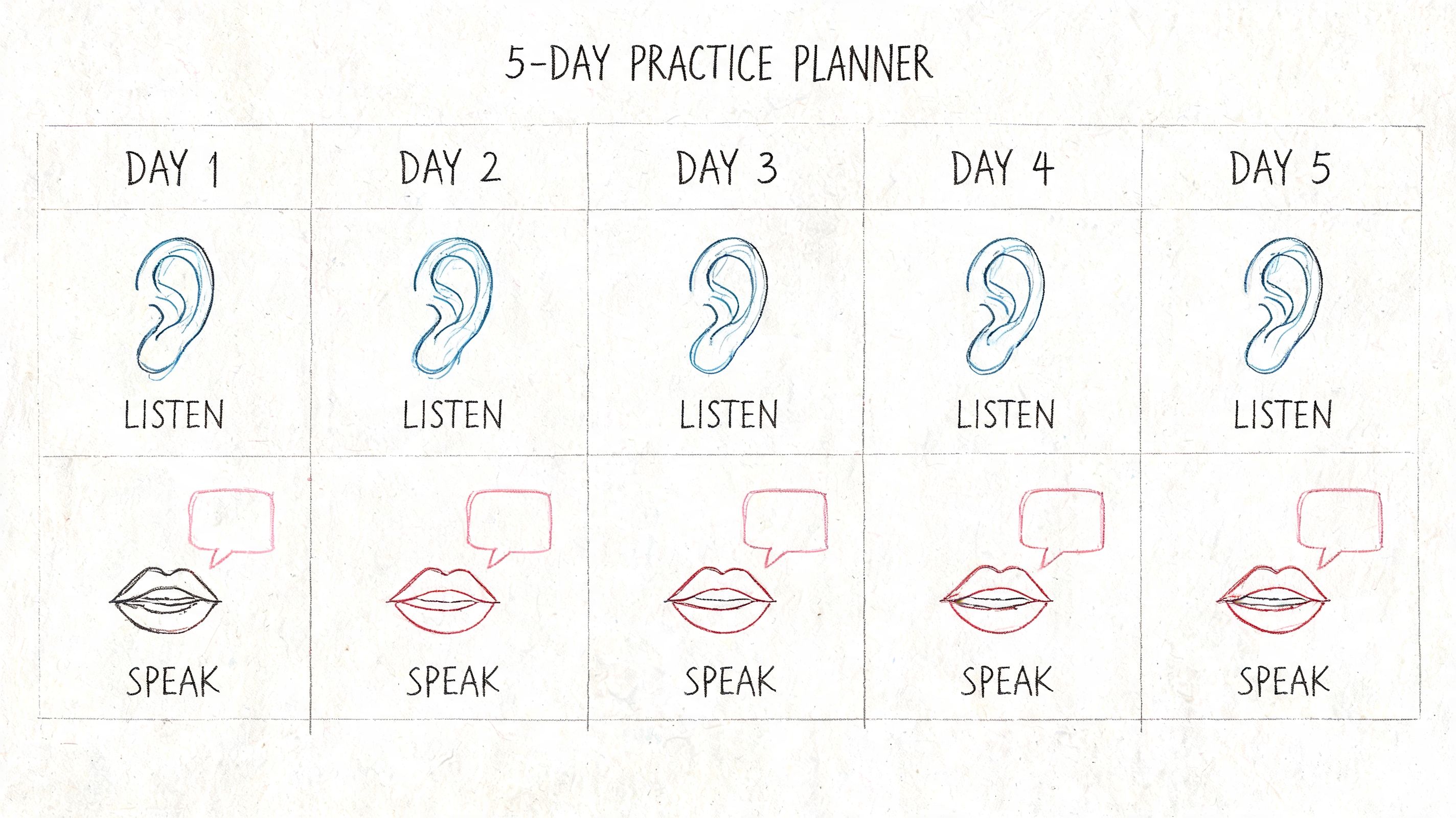
Most learners don't need longer practice. They need better practice. If you can protect 15 to 20 minutes a day, you can train pronunciation effectively even with a Hong Kong work schedule or a full school timetable.
The routine below works well because each day has a different job. One day trains the ear, another trains the mouth, and another tests whether the sound survives in real speech.
If you want extra self-study material, these free resources to learn German in Hong Kong can give you more listening and reading material for home practice.
A five-day routine that fits real life
Day one: listen and shadow
Choose a short German audio clip. Keep it brief. One minute is enough.
Listen once without speaking. Then replay it and imitate the speaker immediately after each phrase. Don't worry if you can't copy everything. Focus on rhythm, vowel length, and sentence flow.
Day two: minimal pair practice
Pick five sound pairs that you find difficult.
Examples:
- schon / schön
- musste / müsste
- reisen / reißen
- Bach / ich
Record yourself saying each pair slowly, then naturally. Compare your versions. If both words sound the same, slow down again.
Day three: read aloud with marking
Take a short text and mark:
- long vowels
- umlauts
- final consonants
- stress words in the sentence
Then read it aloud twice. The first reading is careful. The second is smoother.
This day helps bridge the gap between isolated sounds and connected speech.
Read aloud as if you're explaining something important to a colleague in Berlin, not as if you're surviving a school dictation.
Day four: pronunciation under pressure
Answer two simple speaking prompts for one minute each. Good prompts include:
- Describe your workday
- Explain why you want to learn German
- Talk about travel plans
- Give your opinion on online learning
Pronunciation habits are tested in this context. Sounds that were accurate during drills often vanish in this setting. That is valuable feedback.
Day five: correction and reset
Go back to your recordings from the week. Choose one sound to improve next week. Not five. One.
That sound might be:
- ü
- German R
- word-final d / t
- z as ts
- the soft ch in ich
Where apps help, and where they don't
Voice recording tools and AI pronunciation apps can be useful for repetition. They help you notice whether you're consistent, and they encourage daily practice.
But one important limitation remains. As discussed in a pronunciation article at GermanPod101, many guides don't address how real-time correction tools perform on German umlauts and the R sound for speakers with Hong Kong English accents. The same discussion also notes that for speaking exams such as TestDaF and Goethe-Zertifikat, which require real-time accuracy, asynchronous tools don't close performance gaps as effectively as a live small-group model with a maximum of 6 students.
That's why apps are a support tool, not the final judge. They can help you practise. They can't always tell you why your mouth is wrong in the exact way a trained native teacher can.
How to make the routine sustainable
Keep it simple:
- Use the same daily time slot
- Reuse the same audio for several days
- Track one target sound at a time
- Save recordings so you can hear change
Consistency beats intensity. A short, disciplined routine usually does more than occasional long sessions.
Ready to Achieve Flawless German Pronunciation
Flawless pronunciation sounds like a huge promise, but the actual goal is more practical. You want German that is clear, reliable, and confident under real conditions. That means in a Goethe speaking exam, in an IGCSE oral, in a university interview, or during a business discussion where you don't get three chances to repeat the same sentence.
If pronunciation still feels abstract, it helps to study how targeted correction works in other learning settings too. This short article on mastering student pronunciation is a useful reminder that pronunciation improves fastest when learners receive immediate, specific feedback rather than vague advice to “speak more clearly”.
Why serious learners shouldn't leave pronunciation to chance
Most learners already know when pronunciation is the weak point. You can feel it.
Typical signs include:
- You know the word but hesitate before saying it
- You avoid longer answers in speaking exams
- People understand you better when you slow down too much
- Your listening is weaker than your reading
- You sound less confident than you are
Those problems don't usually disappear with grammar study alone. They improve when someone listens closely, catches the exact sound error, and corrects it before it becomes automatic.
What strong pronunciation gives you back
Accurate German pronunciation doesn't just improve sound. It gives back things ambitious learners care about:
- Exam control when the speaking component feels stressful
- Professional credibility in meetings, interviews, and presentations
- Listening speed because your ear recognises what your mouth can produce
- Confidence because you stop second-guessing basic words
For many Hong Kong learners, the biggest breakthrough is emotional, not technical. You stop feeling like you are “performing German” and start feeling like you are using it.
Clear pronunciation isn't decoration. It's what makes your knowledge audible.
If your goal is to Learn German HK style with a method that respects local learner challenges, pronunciation deserves proper attention from the beginning. The same is true if you're comparing options for German lessons Hong Kong families often choose for children preparing for school pathways, study abroad plans, or public examinations.
If you want expert, native-speaker guidance that turns these pronunciation rules into real speaking progress, German Cultural Association Hong Kong(GCA) is the place to start. With structured courses, small-group teaching, and focused preparation for Goethe-Zertifikat, TestDaF, IGCSE, A-level, and IB, GCA helps learners in Hong Kong build pronunciation that works in exams, university applications, and professional life. Book a trial class, speak with an advisor, or check the latest course schedule to find the right starting point.
Online German Classes for Kids and Teens: Do They Actually Work?

Beginner German for Teens: A Starter Roadmap for Ages 12-18


