.png)
.png)

BLOG

香港德國文化協會
The German Cultural Association
Timeline & Documents for German Studies in Hong Kong
A Hong Kong parent discovers that a teenager's Goethe-Zertifikat result was taken outside the valid HKDSE window. A working professional reaches the German Consulate and realises the visa file is missing the last three months of bank statements. In both cases, months of preparation can be put at risk by one date or one document.
This is why Timeline & Documents planning matters. German study in Hong Kong involves more than choosing a course. You need to coordinate enrolment, exam registration, certificate timing, school requirements, university applications, visa processing, and long-term record keeping. This guide gives you a practical framework for each checkpoint, with official Hong Kong rules and German examination requirements at the centre.
For families who use visual planning tools, a simple timeline worksheet such as find printing history worksheet can also help younger learners understand how dates, tasks, and evidence fit together. The same principle applies to a German learning plan: every milestone needs an owner, a deadline, and a document trail.
Table of Contents
- Build the preparation window around the exam
- German exam registration and results timeline for Hong Kong
- Document tracking spreadsheet
- Minor consent form structure
- University application letter structure
- Visa checklist tracker
- Retaking is not the same as improving the plan
- German is not widely available across secondary schools
- A certificate is not automatically suitable for every purpose
Why Timeline and Document Planning Matters for German Learners in Hong Kong
German education in Hong Kong is established, but it remains specialised. A Hong Kong University study cites approximately 4,000 German-speaking residents in the city, while a public-facing education source notes about 5,000 German speakers and links this community to institutions such as the German Swiss International School, founded in 1969. The school now serves around 1,300 to 1,380 students, demonstrating how a relatively small language community can support a long-running German education pathway. (Hong Kong University language survey)
That background matters when you're deciding whether German is a realistic choice for your child or career. It isn't a mass-market school subject in HK, but it has a durable institutional base and clear routes through recognised examinations, international schools, university applications, and mobility plans.
The cost of getting one date wrong
A teenager preparing for HKDSE Category C German might choose an exam date based only on readiness. That's a mistake. The Goethe-Zertifikat result must fall within the required period before the HKDSE sitting, so a strong result can become unusable if the timing is wrong.
The same problem appears in visa applications. A professional may have the passport, application form, and flight reservation ready, but still face a delay if the file lacks acceptable financial evidence or insurance. Consulates and immigration departments assess complete files, not good intentions.
Practical rule: Put the target exam or travel date at the top of the plan, then work backwards to preparation, registration, document collection, and submission.
Keep a central folder for:
- Identity records: Passport, HKID, and Hong Kong residency evidence.
- Academic evidence: School reports, transcripts, recommendation letters, and examination results.
- Language evidence: Goethe-Zertifikat, TestDaF, or other relevant score reports.
- Application evidence: Admission letters, financial documents, insurance, accommodation, and travel reservations.
- Consent records: Parent or guardian forms for minors, where required.
A structured file prevents the most common HK mistake, which is treating each stage as a separate emergency. Your German lessons, exams, DSE or IB planning, study abroad in Germany goals, and visa paperwork should sit on one connected calendar.
What Timeline and Documents Planning Means for German Studies
Timeline & Documents planning means coordinating every date-sensitive German study milestone in Hong Kong, from course enrolment and exam registration to certificate release, university applications, and visa processing, while preparing the exact evidence required at each stage. It turns language learning into a documented pathway with clear deadlines, owners, and next actions.
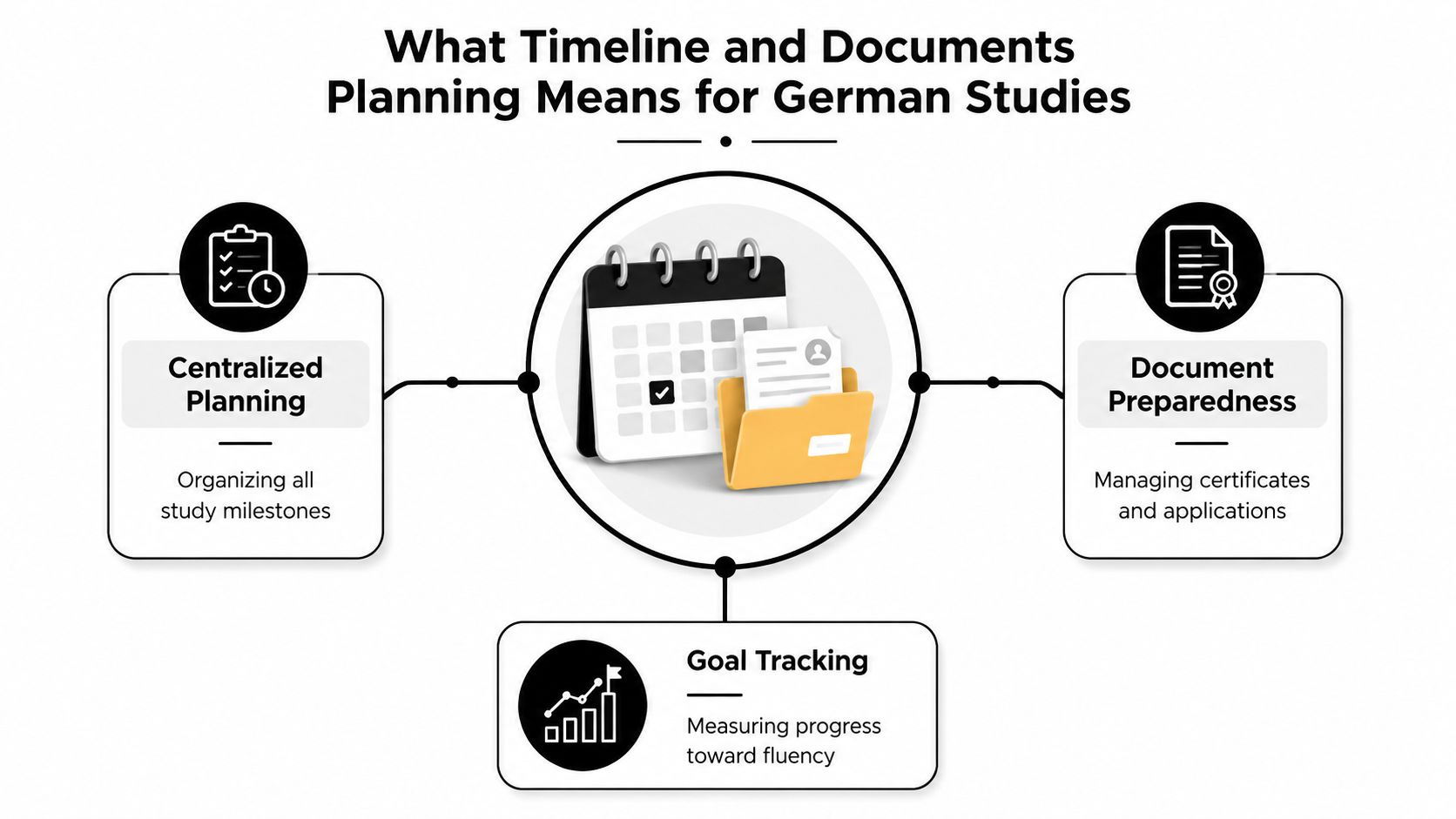
In practice, the system has three parts.
Centralised planning
Record your final objective first. It could be an HKDSE Category C result, an IGCSE or A-level subject, an IB German pathway, a Goethe-Zertifikat, TestDaF, university admission, a German visa, or professional relocation.
Then list backwards:
- Final submission date
- Required certificate or admission evidence
- Exam date and registration deadline
- Course completion and revision period
- German lessons and diagnostic assessment
- Document preparation and verification
This approach is especially important in Hong Kong because education and immigration procedures use their own forms, deadlines, and processing standards. A generic international checklist often misses HKID requirements, local residency proof, HKEAA rules, or the working-day calculation used by the Immigration Department.
Document preparedness
A certificate is only useful if you can prove what it is, when it was issued, and why it meets the relevant requirement. Scan important documents, name files consistently, and store physical originals securely.
Goal tracking
Use a monthly review rather than waiting for an application deadline. Check whether your level, exam date, attendance, passport validity, financial evidence, and translations still match the final objective.
The best plan isn't the most complicated one. It's the one that makes the next action obvious.
HKDSE Category C German Pathway and Key Dates
For a student aiming to use German for HKDSE Category C, the exam date can determine whether the result qualifies. The recognised examination is the Goethe-Zertifikat. Candidates must take A2 or above within the two years before the HKDSE, and the HKEAA counts the highest result if a student retakes the examination. Check the current cycle against the official Goethe-Institut HKDSE German pathway before registering.
For the current HKDSE cycle, apply the rule to the two examination years immediately before the student's HKDSE sitting. Do not carry forward the previous example of 2023 and/or 2024, which applied to the 2025 sitting. The practical target is a qualifying level and an examination date inside the correct two-year window.
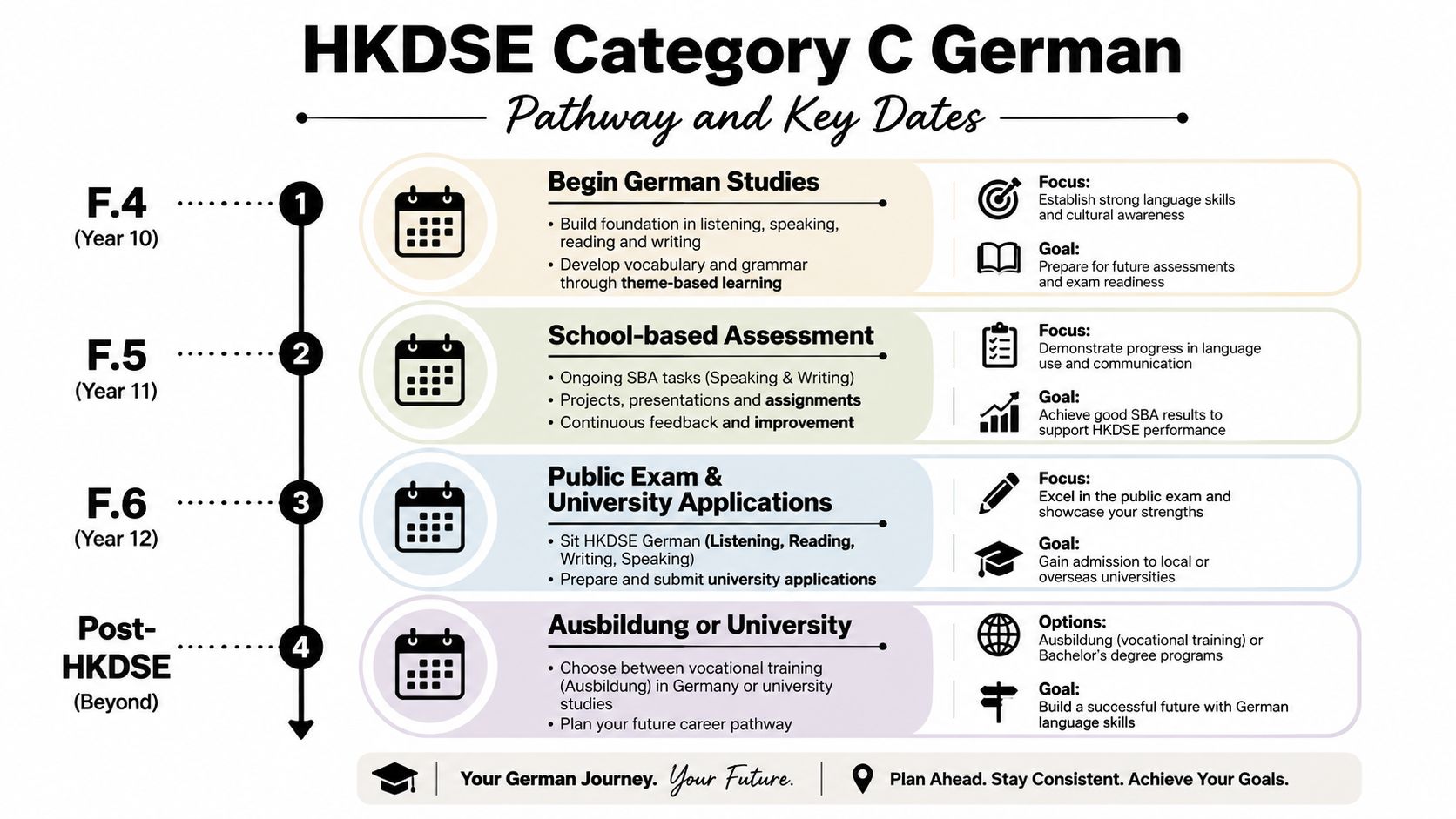
A practical year-by-year plan
F.4, establish the route.
Assess the student's actual German level early. Review the school's requirements, possible Category C use, and whether the student follows DSE, IB, IGCSE, or another international curriculum.
F.5, select the qualifying level.
Use test results and classroom progress to decide whether A2 or a higher Goethe-Zertifikat is realistic. Reserve time for reading, listening, writing, and speaking practice, with a buffer for a failed attempt or an administrative problem.
F.6, protect the validity window.
Work backwards from the HKDSE sitting. Confirm that the chosen Goethe examination falls within the two preceding examination years. A strong grade does not make an older certificate automatically acceptable.
Retakes and document control
A retake should serve a clear purpose. Since the HKEAA uses the highest result, choose an examination date that allows proper preparation and remains within the applicable window. Keep the certificate, score report, registration record, and school documentation together after every attempt. These records can support university applications or later mobility planning, even after the Category C validity period has passed.
Families comparing international-school options can review Queens Online School A Level German. The suitable route depends on the student's school system, university objective, and the documents the final application requires.
Exam Registration Deadlines and Preparation Windows
A student can prepare well and still miss the useful exam window by registering through the wrong channel or filing an outdated result. Hong Kong's German exams do not share one registration system. Goethe-Zertifikat entries go through the Goethe-Institut Hong Kong, while IGCSE, A-level, and IB German entries usually follow school or examination-board procedures.
The Goethe-Institut Hong Kong lists its local office at 14/F Hong Kong Art Centre, 2 Harbour Road, Wan Chai. Its examinations are open to interested candidates regardless of nationality or attendance at a particular school or preparation course. (Goethe-Institut Hong Kong course and examination information)
Build the preparation window around the exam
Set the plan in this order:
- Choose the qualification: Match Goethe-Zertifikat, TestDaF, IGCSE, A-level, or IB German to the final academic or career purpose.
- Confirm the registration channel: Establish whether the candidate registers directly with the examination provider or through the school.
- Check the current calendar: Registration windows and result dates can change. Confirm both before paying.
- Complete the syllabus before final revision: Schedule the first full mock early enough to expose gaps and allow correction.
- Retain proof of entry: Save payment confirmation, candidate details, and correspondence in the central archive.
Build a buffer between the last full mock and the examination. That time protects the preparation plan if writing or speaking needs more work, or if an administrative issue delays registration.
German exam registration and results timeline for Hong Kong
| Exam | Registration Window | Exam Period | Results Issued | Open to External Candidates |
|---|---|---|---|---|
| Goethe-Zertifikat A1 to C1 | Check the Goethe-Institut Hong Kong session calendar | Scheduled local examination sessions | Confirm with the examination office | Yes, candidates do not need to have attended a specific preparation course |
| TestDaF | Check the administering institution's current schedule | Published TestDaF sessions | Confirm with the administering institution | Depends on the registration route |
| IGCSE German | School or examination-board registration | Published board examination period | Issued under the relevant board process | Depends on school and board arrangements |
| A-level German | School or examination-board registration | Published board examination period | Issued under the relevant board process | Depends on school and board arrangements |
| IB German | School-based IB registration | Published IB examination period | Issued under the IB process | Normally linked to an IB school |
For Goethe-Zertifikat planning in Hong Kong, consult a guide to Goethe-Zertifikat exam dates in Hong Kong for 2026, then verify the final session, registration deadline, and result arrangements with the examination office before registering. Keep the confirmation with the candidate record.
Document Checklists for Every Stage of Your German Journey
The right checklist depends on the stage. Enrolment documents prove who you are and whether you can join a course. Exam documents establish your candidate identity. Visa and university files prove eligibility, funding, academic history, and purpose.
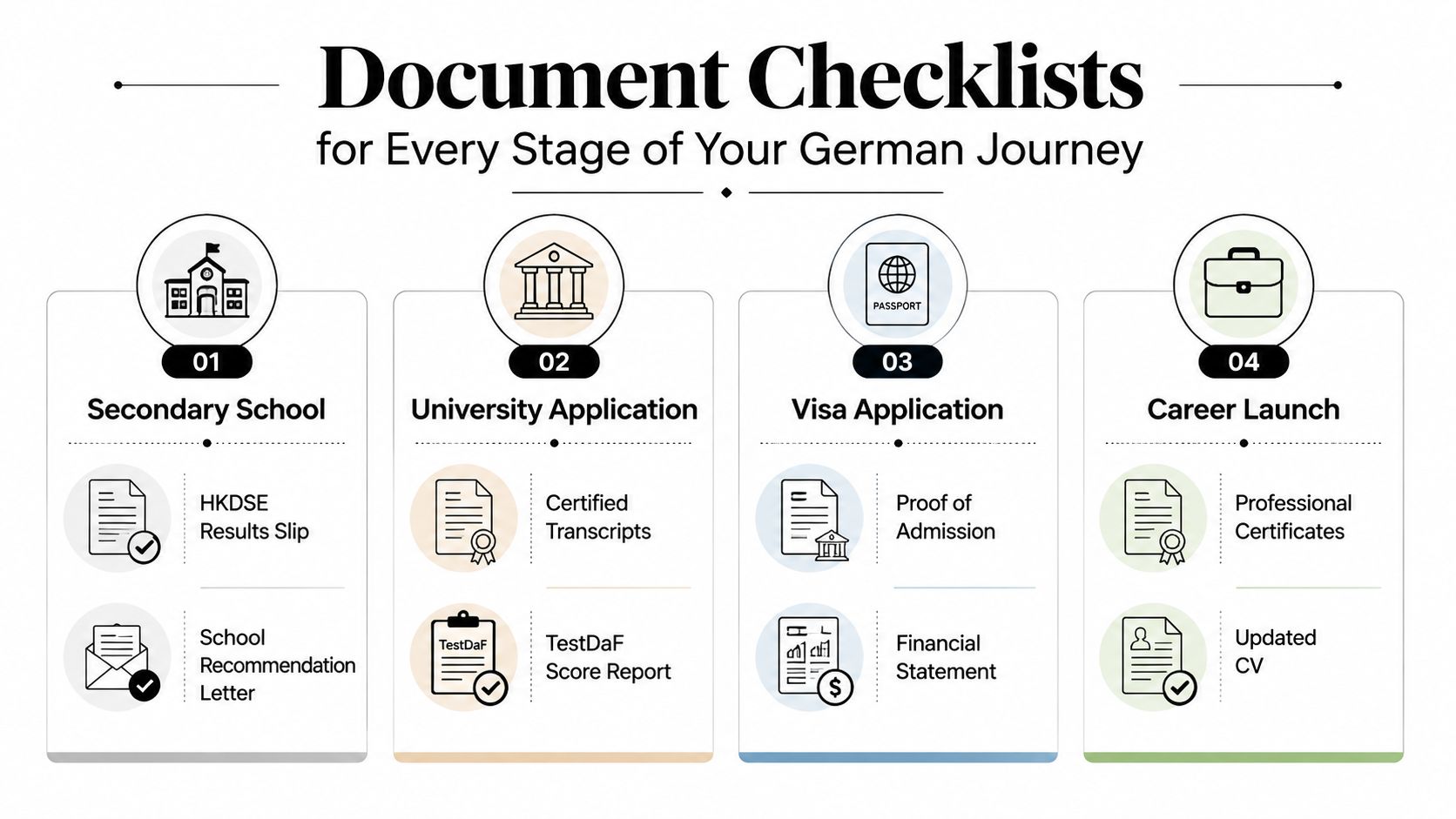
Course enrolment
Prepare:
- Identity proof: HKID copy or passport copy, according to the provider's requirements.
- Level evidence: Previous German certificate, school report, placement result, or teacher assessment.
- Learner details: Contact information, emergency contact, and preferred class schedule.
- Minor consent: Parent or guardian consent where the learner is underage.
- School forms: Any applicable Education Bureau or institutional compliance documents requested by the provider.
Don't submit a certificate without checking the name spelling. A mismatch between your passport and examination record can create unnecessary verification work later.
Examination registration
Keep the following together:
- Valid identification: The document accepted by the examination provider.
- Photographs: Passport-style or biometric photographs if specified.
- Payment record: Registration confirmation and payment receipt.
- Candidate information: Correct name, date of birth, contact details, and chosen level.
- School evidence: Required only where IGCSE, A-level, or IB registration is school-based.
University applications
A German university file may require:
- Academic records: Certified transcripts and examination results.
- Identity documents: Passport copy and Hong Kong residency evidence where relevant.
- Language proof: Goethe-Zertifikat, TestDaF, or the programme's specified certificate.
- Supporting statements: Personal statement, motivation letter, or programme-specific forms.
- Translation evidence: Certified translations when the institution requires documents in a particular language.
Visa and identity records
For immigration-related applications, prepare:
- Admission evidence: Offer or proof of admission, if applying for study.
- Financial proof: Bank evidence or other documents accepted by the relevant authority.
- Insurance: Policy certificate matching the application type.
- Travel evidence: Flight, accommodation, or itinerary documents where required.
- Consent records: Parent or guardian documents for minors, if applicable.
Use the infographic as a visual prompt, but follow the exact checklist issued by the receiving institution. A generic list can't replace programme-specific instructions.
German Visa and Entry Permit Requirements from Hong Kong
A visa delay can disrupt a German course, examination plan, or scheduled departure. Start the file before booking non-refundable travel or resigning from work. For Schengen travel, the German Consulate checklist includes a completed and signed application, a passport valid for at least three months after leaving the Schengen area, Hong Kong residency proof, two biometric photographs, a round-trip flight reservation, travel insurance with at least EUR 30,000 coverage, and financial proof such as the last three months of bank statements from Hong Kong or Macao. (German Consulate visa information via Goethe-Institut Hong Kong)
Schengen travel file
Arrange the file in the Consulate's requested order:
- Completed application: Check every field and sign where required.
- Passport: Match its validity to the planned departure and return dates.
- HK residency proof: Provide evidence of your Hong Kong status.
- Photographs: Use biometric photographs in the stated format.
- Transport evidence: Include the round-trip flight reservation.
- Insurance certificate: Confirm the policy meets the required coverage.
- Financial evidence: Prepare the requested bank statements and supporting explanations for unusual transactions.
Review bank activity before submission. Recent transfers, irregular income, or large deposits may require documents explaining their source.
Study visa and Immigration Department timing
Hong Kong's Immigration Department states that a study visa or entry permit normally takes six weeks after all required documents are received. A visit or transit visa normally takes four weeks. (Hong Kong Immigration Department service standards)
Use these periods as processing windows, not guaranteed approval dates. Submit early enough to allow time for missing documents, corrections, or requests for further information. The Department counts working days from Monday to Friday and excludes General Holidays, so Hong Kong public holidays can affect your practical schedule.
For a Hong Kong-focused reference, read the Germany Schengen visa guide from Hong Kong, then verify each requirement against the current Consulate instructions. Keep submitted forms, receipts, correspondence, and decision letters together until the application and related travel are complete.
Working Holiday Scheme
Applicants for the Working Holiday Scheme should prepare:
- Flight itinerary
- Medical insurance
- Proof of sufficient funds of at least EUR 2,000
- Any additional documents requested for the individual application
Treat this as a separate application type. Its purpose, financial evidence, insurance, and supporting documents must match the scheme requirements. Do not reuse a tourist application file without checking which documents apply to the Working Holiday Scheme.
CEF Funding and Exam Cost Planning
Check the eligible examination before paying for a German course. Hong Kong's Continuing Education Fund (CEF) recognises specified German examinations, so a German test is not automatically eligible. Start with the Hong Kong Continuing Education Fund German examination list, and verify that the examination and administering institution match your planned route.
Match the course to the eligible examination
Use this order:
- Define the purpose: Decide whether you need a foundation certificate, a general language qualification, or an academic examination.
- Check the CEF list: Confirm the exact examination and provider shown on the current list.
- Confirm claim rules: Review the current CEF conditions, approved course details, and claim deadline before enrolling.
- Keep receipts: File invoices, enrolment evidence, attendance records, and examination results together.
- Budget for the complete route: Include lessons, examination registration, transport, document certification, translation, and possible rescheduling.
CEF planning starts before payment. Checking eligibility after choosing a course can leave you with an examination or provider that does not fit the funding rules. Keep a separate folder for the application, payment records, and claim documents, because the exam result may arrive after the course has finished.
Goethe-Institut Hong Kong examinations accept interested candidates regardless of nationality. Candidates also do not need to have attended a particular language school or preparation course. Confirm the current eligibility and registration conditions on the Goethe-Institut Hong Kong examination eligibility page.
For the application sequence, use this CEF application guide for German studies in Hong Kong, then check the latest official conditions before submitting a claim. Keep the final certificate with the course and claim records so your funding file remains usable for later study or administrative applications.
Record Retention and Certificate Archiving Best Practices
Hong Kong institutions already work with multi-year record retention. The Education Bureau's Code of Practice for Private Schools requires permanent retention for records of a permanent nature, while it sets a minimum of seven years for books of accounts, vouchers, and bank statements, and two years for quarterly returns, duplicate paysheets, school attendance registers, and hire-of-accommodation registers. (Education Bureau Code of Practice for Private Schools)
Learners should apply the same discipline to language records. A certificate may be needed long after a course ends, especially for university admission, visa renewal, employment verification, or a later application to study abroad in Germany.
Build a personal archive
Keep:
- Original certificates: Goethe-Zertifikat, TestDaF, IGCSE, A-level, IB, or other relevant awards.
- Score reports: Preserve section-level results where issued.
- Course records: Enrolment confirmation, completion letters, attendance evidence, and invoices.
- Application copies: Submitted forms, motivation letters, recommendation letters, and admission correspondence.
- Identity copies: The passport and HKID versions used during registration or application.
GCA's structured certificate system requires 80% attendance for certificate issuance, so attendance records can matter as more than a classroom formality. Keep them beside the relevant course completion document.
Use two archive formats
Create one physical file and one encrypted digital archive. Name digital files consistently, for example:
2025_Goethe_B1_Certificate_FamilyName.pdf
Store the date obtained, issuing authority, level, candidate name, and any expiry or validity note in a tracking sheet. Don't rely on an email inbox as your only archive. Accounts change, attachments disappear, and urgent applications rarely allow time for a complete search.
Sample Templates and Fill-In Examples
A useful tracker should answer five questions immediately: what the document is, who issued it, when you received it, whether it expires, and what you must do next.
Document tracking spreadsheet
Create these columns:
| Document name | Issuing authority | Date obtained | Expiry or validity note | Next action |
|---|---|---|---|---|
| Goethe-Zertifikat B1 | Goethe-Institut Hong Kong | 2025 examination date | Check use for target application | Upload certified copy |
| Passport | Hong Kong Immigration Department | Date of issue | Check receiving authority's validity rule | Renew if necessary |
| Bank statements | Hong Kong bank | Statement period | Use the period requested by Consulate | Download current set |
Don't enter an expiry date when the document has no stated expiry. Write “no stated expiry, confirm for application” instead of guessing.
Minor consent form structure
A parent or guardian consent form can include:
- Student's full name and date of birth
- Parent or guardian's full name and relationship
- HKID or passport reference, if required
- Course name and class schedule
- Permission for attendance and emergency contact
- Medical or accessibility information relevant to the course
- Signature and date
- Data privacy acknowledgement
For example, a parent might write: “I authorise my child to attend the specified German course and confirm that the emergency contact details are accurate.” Keep the wording factual and ask the course provider whether it has a required form.
University application letter structure
Use a clear sequence:
- Purpose: State the programme and intake.
- Preparation: Summarise German study and relevant academic work.
- Evidence: Identify attached transcripts and language certificates.
- Motivation: Explain why the programme fits your academic or career plan.
- Closing: Request confirmation that the file is complete.
A Hong Kong applicant should avoid broad claims such as “I have always loved Germany”. Replace them with verifiable preparation, such as the German course completed, examination taken, or academic subject studied.
Visa checklist tracker
Add a status column with:
- Not started
- Requested
- Received
- Certified
- Uploaded
- Submitted
- Follow-up required
This simple control prevents a passport scan from being marked “complete” when the financial proof or insurance certificate is still missing.
Common Misconceptions About German Exam Timelines
A learner in Hong Kong can register for a Goethe-Zertifikat examination without first joining a particular preparation course. Eligibility depends on the examination requirements, not on attendance at a named language school. Check the current candidate rules before booking, because preparation classes and examination entry are separate decisions.
Use lessons to address specific weaknesses in writing, speaking, listening, or reading, and to match the intended level. A course is useful when it gives structured practice and feedback, not because it is a compulsory gateway.
Retaking is not the same as improving the plan
A retake should be scheduled around the student's application purpose, the certificate's accepted validity period, and the time needed to strengthen weak skills. For HKDSE Category C German, review the current pathway requirements before choosing an examination session. (Goethe-Institut HKDSE German pathway)
Do not book another attempt just because a result is disappointing. Compare the next available window with school deadlines, preparation capacity, and the date by which the certificate must be submitted. The best attempt is the one that produces usable evidence on time, with enough preparation behind it.
German is not widely available across secondary schools
German is recognised in Hong Kong, yet school provision remains limited. An HKU survey table records German visibility at 0.7% among other language groups, while a survey discussed in a graduate thesis reports 90 students enrolled for German across four schools in the 2016/2017 academic year. The comparison lists 156 Spanish students, 164 French students, and 132 Japanese students. (HKU graduate thesis and survey content)
Families outside a German-stream school therefore need their own calendar and records. Keep examination confirmations, certificates, results, and application copies together, especially when school support does not cover the full route from registration to submission.
A certificate is not automatically suitable for every purpose
A Goethe-Zertifikat, TestDaF, school examination, and university language requirement may serve different purposes. Before paying an examination fee, identify the exact qualification, level, issue date, and document format named by the receiving institution. Keep the relevant email or admissions page with the certificate record so the choice can be checked later.
Ready to Start Your German Learning Journey
The practical lesson is straightforward. German learners in Hong Kong need a connected plan that joins course level, exam date, document checklist, funding option, and final application. Language practice alone won't protect you from an expired HKDSE result, an incomplete visa file, or a missing transcript.
For learners who want a structured route, the German Cultural Association Hong Kong(GCA) offers native-speaking teachers, small-group classes capped at six students, private lessons, and preparation for Goethe-Zertifikat, TestDaF, IGCSE, A-level, and IB examinations. It also provides in-person centres near Tsim Sha Tsui and Causeway Bay MTR stations, alongside online lessons, making it easier to align German study with school and work commitments.
Book a trial class when you know your target examination or application date. An adviser can help you identify the right level, organise the document timeline, and choose a course schedule that supports your DSE, IB, IGCSE, university, visa, or career objective.
Visit German Cultural Association Hong Kong(GCA) to book a trial class, speak with an adviser about your Timeline & Documents plan, and check the latest German course schedule in Hong Kong. Bring your target exam or application date, and start with a documented next step rather than a vague intention.

Konjunktiv II in German: Polite Requests with Würde
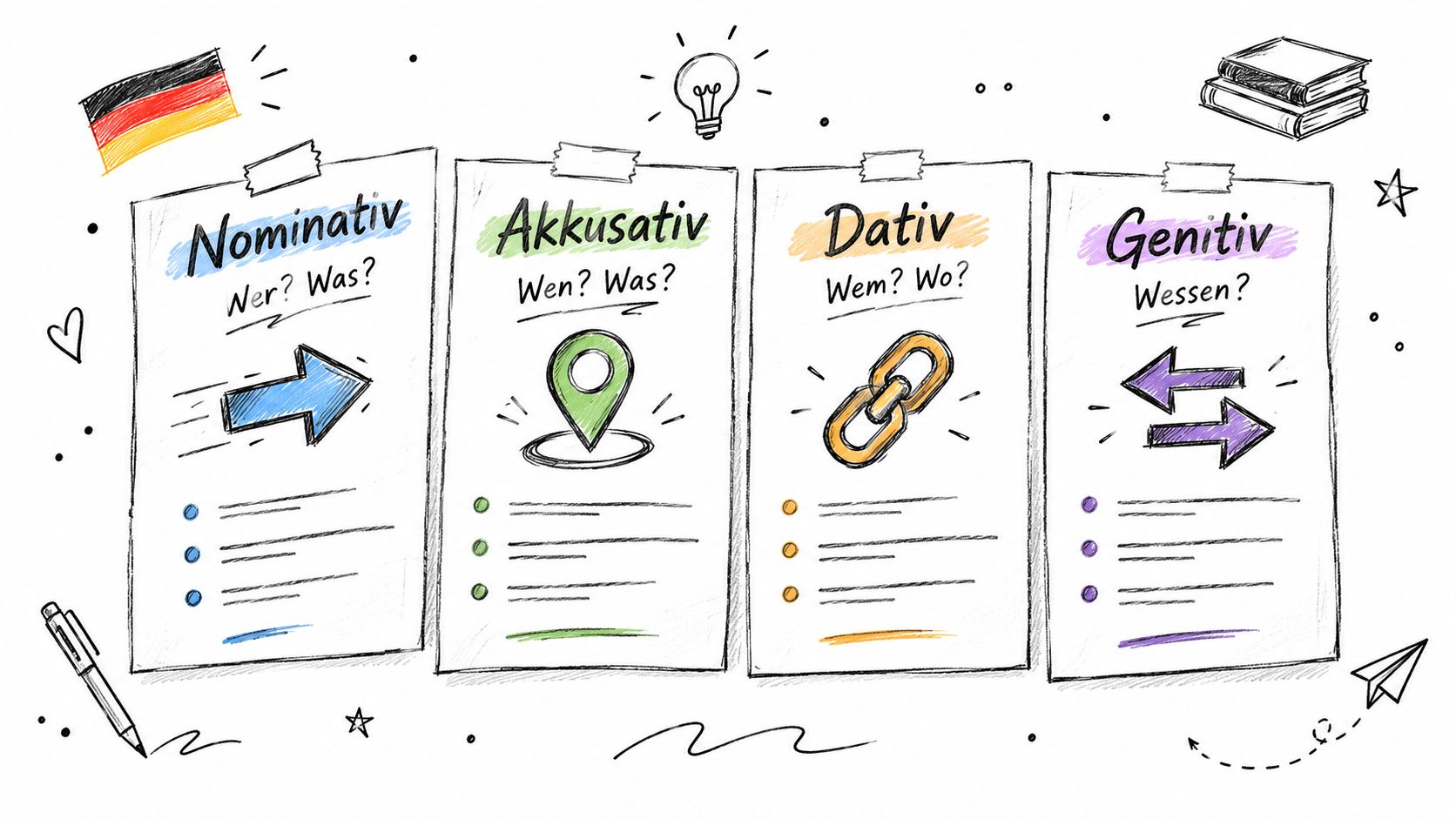
German Prepositions: Which Case Does Each One Take? Complete Tables


