


BLOG

香港德國文化協會
The German Cultural Association
Ausbildung Age Limits and Entry Requirements for Hong Kong Applicants
You've found a German occupation that interests you, but you're still checking whether your age, Hong Kong qualifications or German level might rule you out. Perhaps you're a parent comparing options after secondary school, or a working adult wondering whether retraining is still realistic.
Understanding Ausbildung age limits and entry requirements for Hong Kong applicants starts with separating the training opportunity from the immigration route. My recommendation is straightforward: don't rule yourself out because of age, and don't spend money on relocation until you know which route you qualify for.
Table of Contents
- A Hong Kong secondary-school student
- A university graduate
- A working professional
- An adult returning after a career break
- Study abroad in Germany versus Spain
- Put preparation in a workable order
- Resolve conflicting guidance before booking
- Ready to Start Learning?
Why Age Changes the Pathway for Hong Kong Applicants
There's no general upper age limit for starting an Ausbildung after securing a training place. The separate visa for entering Germany to look for a place requires applicants to be under 35. For Hong Kong applicants, age therefore changes the immigration sequence, not necessarily eligibility to train, as explained in official guidance on training and training-place searches.
Consider a hypothetical Hong Kong office worker who finds a suitable vocational occupation but assumes an existing degree makes retraining impossible. That applicant's first task isn't to defend their age. It's to establish whether the occupation, training provider and immigration route fit their circumstances.
A school-leaver faces a different decision. Parents may focus on whether a familiar qualification will be accepted, while the student focuses on getting abroad. Neither question replaces checking the actual training opportunity.
Separate the decisions before spending
Treat these as distinct checks:
- Age and route: Can you use the proposed immigration pathway?
- Training place: Do you have an offer, or are you still looking?
- Academic background: Does your documentation satisfy the relevant requirements?
- Language and finances: Can you demonstrate readiness and support yourself?
This distinction helps mature applicants avoid unnecessary self-rejection. It also prevents younger applicants from assuming that meeting an age condition makes the rest of the application straightforward.
The infographic summarises the separate decisions involved.

Make the career decision independently
For someone considering later-life retraining, Eztrackr's career advice for 50 can serve as a separate career-exploration resource. It isn't German immigration guidance, so use it to think about direction rather than eligibility.
Practical rule: Decide whether the profession suits you before paying for relocation support. Then check whether your intended route works.
For families in Hong Kong, this is the useful starting point: an applicant's age, educational history and visa position belong in the same plan, but they aren't interchangeable barriers.
What Is an Ausbildung for Hong Kong Applicants
An Ausbildung is vocational training for a particular occupation. In the company-based model, practical workplace learning sits alongside vocational education; a school-based place is another training format applicants may encounter.
For someone considering study abroad in Germany, the important distinction is purpose. You are choosing preparation for a profession, not just choosing an overseas classroom.
Understand what you're applying for
A training opportunity should be assessed through its actual documents. Don't rely on the word Ausbildung alone to tell you how the programme operates or what the provider expects.
Ask the provider to explain:
- Learning arrangements: Where will practical training and classroom learning happen?
- Admission expectations: Which educational documents and language evidence will it assess?
- Contractual terms: What responsibilities, remuneration and conditions apply?
- Professional fit: What work will you learn to perform?
For a Hong Kong applicant, that last question deserves serious attention. If you dislike the occupation's everyday tasks, an attractive overseas destination won't make it a sensible training choice.
The diagram provides a plain-language view of the learning model.

Distinguish the offer from permission to relocate
There are separate decisions to make: whether a provider accepts you and whether you meet the conditions for the appropriate immigration permission. Don't treat an encouraging employer email as a completed relocation plan.
Equally, don't confuse vocational training with a university degree, a short language visit or unrestricted permission to work. Choose it because you want the occupation and learning format.
When advising families, I'd start with a simple exercise: ask the applicant to explain the proposed job, training arrangement and reason for choosing Germany without mentioning a visa. If the explanation is vague, more occupational research should come before application spending.
That approach makes discussions about Ausbildung age limits and entry requirements for Hong Kong applicants more productive. You're assessing a specific professional plan rather than shopping for a route abroad.
How to Choose the Right Visa Pathway
Securing a place before travelling is my default recommendation for cost-conscious applicants. It lets you assess the actual offer before committing to the expense and uncertainty of searching in Germany.
The search route remains an option for eligible applicants who understand its conditions. It shouldn't be treated as a way to postpone language preparation, financial planning or employer research.
Choose an Ausbildung Route by Your Current Stage
The official training-place search visa checklist sets out the search-route conditions below, including the under-35 requirement, B1 German, a stay of up to nine months, a 2026 financial benchmark of €1,091 per month, health-insurance evidence and a €75 visa fee payable in local currency.
| Decision Point | Search for Training From Germany | Apply After Securing Training |
|---|---|---|
| Age rule | Must satisfy the search-route age condition | No general upper age limit for starting training |
| Qualifying trigger | You haven't secured a place and meet the search criteria | You have a confirmed company-based or school-based place |
| Language standard | Evidence of the required German proficiency | Meet the applicable visa and provider language requirements |
| Proof of funds | Demonstrate support during the search | Assess support against the training type and remuneration |
| Permitted stay | Temporary search permission, confirm the applicable duration before applying | Permission connected to the approved training purpose |
| Strategic use case | A prepared applicant who can fund an unsuccessful search | An applicant who wants the offer clarified before relocating |
Don't assume that an expanded search-route age ceiling removes the other requirements. Someone within the eligible age range still needs the right education evidence, German proficiency and funds.
Apply a practical selection test
- School-leavers: Check academic eligibility before treating an overseas search as the next step after school.
- Recent graduates: Compare the proposed occupation with what you want to do, not just whether you can enter Germany.
- Working adults: Start employer applications while retaining your Hong Kong income where practical.
- Mature applicants: Resolve age-sensitive visa questions before resigning or making non-refundable commitments.
If you're also considering a different temporary route, the Hong Kong working-holiday visa guide is a separate planning resource. Don't assume another visa category automatically covers your intended training.
A visa that lets you look for an opportunity is not the opportunity itself.
My preference isn't based on age alone. It's based on reducing avoidable financial exposure. Before using the search route, decide what you'll do if you don't secure an acceptable place within the authorised stay.
What Academic and Entry Requirements to Check
Don't ask only whether “Hong Kong qualifications are accepted”. Ask whether your specific qualification, subjects and supporting documents meet the requirements of your chosen route and provider.
For the search route, official guidance requires a school-leaving certificate permitting access to higher education in Germany or in the country where it was obtained, or an equivalent German-school qualification. The official vocational-training application portal is an appropriate starting point for checking the immigration documentation.
Build a qualification file, not an assumption
DSE, IB, IGCSE and A-level labels don't answer every admissions question. Submit the actual award and results for assessment rather than claiming automatic equivalence.
Prepare a clear file containing:
- Completed qualifications: Certificates showing what you've been awarded.
- Academic results: Subject details and transcripts where available.
- Further education: Relevant diplomas, degrees or professional study.
- Employment evidence: Documents that help a provider understand relevant experience.
- Clarification requests: Questions about translations, certification or recognition procedures.
Ask which recognition or comparability assessment, if any, applies to your case. Do not pay for a service merely because an intermediary describes it as universally necessary.
Use your background to frame the enquiry
Consider a hypothetical secondary-school student studying through an IGCSE pathway. The sensible question isn't whether that label “counts in Germany”, but whether the completed qualification satisfies the particular immigration and provider requirements.
A hypothetical mature applicant should approach the file differently. Earlier school certificates may need to be retrieved, while later study and work experience can help explain the proposed career change. They shouldn't be presented as automatic substitutes for a required school qualification.
Before accepting an offer, send the provider focused questions:
- Qualification assessment: Does my completed award meet your entry requirements?
- Subject prerequisites: Are particular subjects or results required?
- Recognition: Which authority or assessment procedure should I use?
- Document format: Do you need translations, certified copies or originals?
- Age wording: Does an age-related statement on your form concern admission, a programme condition or immigration?
Written answers are more useful than general reassurance. Parents should keep them with the application file, particularly when a student is still choosing school subjects or deciding whether to complete another qualification in Hong Kong.
How German Language Preparation Supports Your Application
B1 CEFR is required for the training-place search route and is normally the training-visa standard where language competence hasn't otherwise been assessed. Don't confuse that benchmark with a guarantee that every employer or school will consider your communication sufficient.
For planning purposes, treat German as an application skill and a working skill. A certificate matters, but so does explaining why you want the occupation and understanding a follow-up question.
The study setup below reflects the preparation task: connect language work with your intended application.

Prepare for situations, not just exercises
Use practical communication tasks to test your readiness:
- Introductions: Explain your education, experience and motivation without reading a script.
- Instructions: Practise identifying the task, sequence and point needing clarification.
- Forms: Work with dates, qualifications, addresses and routine administrative vocabulary.
- Problems: Explain an error, describe what happened and ask what to do next.
- Interviews: Answer questions about the occupation rather than only discussing your wish to move abroad.
These are preparation goals, not a promise that a particular certificate proves mastery of every workplace situation. Ask the provider what communication it expects.
Build a realistic learning sequence
Start with foundational grammar, pronunciation and everyday vocabulary. Then add listening and speaking practice connected to your target occupation.
Introduce Goethe-Zertifikat preparation when your underlying skills support it. Practise the exam format, but keep application writing and interview communication in the plan.
For local course selection, compare structured teaching, native-speaking instruction, correction quality and opportunities to speak. Small-group classes, private tuition, in-person learning and Zoom lessons are different options; choose the format you can sustain alongside work or school.
Business German can support professional communication as your foundation develops. Travel German can help with everyday situations, but it shouldn't replace preparation for the assessed requirement.
The guide to German language requirements for Hong Kong applicants working in Germany offers related planning context. Confirm the evidence required for your actual training application rather than borrowing assumptions from another category.
Budget advice: Ask about CEF funding before enrolling, but don't include reimbursement in your budget until the course and your eligibility have been confirmed.
For readers searching “Learn German HK”, the useful comparison isn't the shortest advertised course. It's the course plan that addresses your current weaknesses and intended application.
What Visa and Financial Proof Means for Relocation
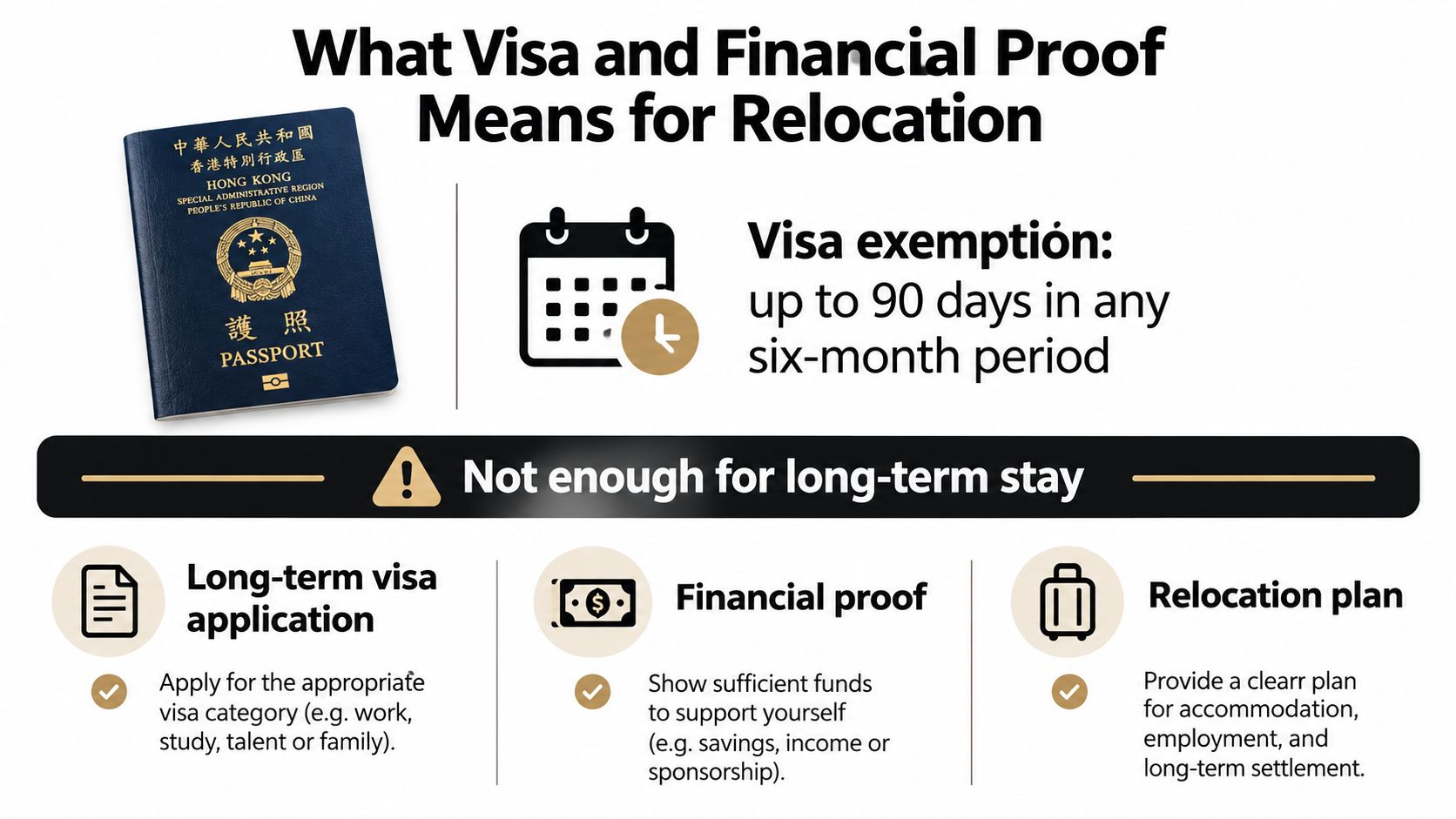
A Hong Kong passport's short-visit exemption isn't permission to move to Germany for vocational training. Hong Kong SAR passport holders are generally visa-exempt for visits of up to 90 days in any six-month period, but the German Consulate General's entry guidance distinguishes short visits from the permission needed for a longer training stay.
Use the following checklist as a reminder to separate entry, residence and financial preparation.
Check the correct financial benchmark
For a training visa, the official 2026 living-cost benchmark is at least €959 net per month, although the applicable requirement can differ by training type and remuneration, according to Germany's official vocational-training visa guidance.
That guidance also identifies the confirmed training place, applicable language evidence and sufficient financial means as core conditions. It advises additional attention for applicants over 45, whose case may involve minimum-salary or retirement-provision requirements when training remuneration falls below relevant thresholds.
Don't use the search-route figure as though it were automatically the training-route figure. Calculate against the correct category and ask how the offered remuneration will be assessed.
Keep separate budget and document checks
- Financial evidence: Confirm which form of proof is acceptable and whether a blocked account is needed.
- Insurance: Check the required coverage and the dates it must cover.
- Fees: Keep application costs separate from money needed for living expenses.
- Training income: Use the actual offer, not an assumed stipend.
- Relocation spending: Budget separately for travel, accommodation arrangements and personal commitments in Hong Kong.
A blocked account is a financial-document mechanism, not your whole relocation budget. Don't commit all available savings without considering expenses outside the evidence requested for the application.
Before using the accompanying video as background, keep your current consular checklist beside you.
Apply through the appropriate process before travelling for the intended training purpose. Don't resign, buy non-refundable travel or assume a short visit can be converted into your preferred long-term arrangement without official confirmation.
How Different Applicant Profiles Can Plan Ahead
These are hypothetical planning scenarios, not eligibility rulings. Each shows how to turn a broad ambition into the next useful action.
A Hong Kong secondary-school student
A student comparing DSE, IB, IGCSE or A-level options should first identify the completed qualification the proposed route requires. Parents should ask the provider about subjects and documents before changing an academic plan.
- Immediate task: Investigate suitable occupations and providers.
- Language action: Build consistent study around school commitments.
- Financial question: Can the family support the proposed route without assuming an offer will arrive quickly?
A confirmed school-based place or training contract changes the application stage. Until then, keep search-route eligibility separate from provider admission.
A university graduate
A graduate shouldn't assume that vocational training is unavailable because they've already studied at university. The useful task is to explain why the chosen occupation fits better than their previous direction.
Verify the underlying education documents and the actual training offer. Prepare to discuss motivation in German, and compare the financial consequences of applying from Hong Kong with relocating to search.
A working professional
A professional considering Business German should connect lessons to applications: describing responsibilities, explaining transferable experience and handling interview questions.
Keep the income question visible. Compare the proposed training arrangement with existing Hong Kong commitments before resigning. If the search route isn't available, focus on obtaining a place before relocation rather than trying to bypass the restriction.
An adult returning after a career break
Start by retrieving certificates and preparing a clear account of earlier work and study. Explain the career break plainly rather than allowing unexplained gaps to dominate the application.
The age-sensitive financial issue identified earlier needs individual advice where relevant. Resolve it before paying substantial relocation costs.
Study abroad in Germany versus Spain
Choose the destination around the intended profession, language and programme, not a general wish to live in Europe. Someone pursuing German vocational training needs a German-focused preparation plan; someone considering Spain should assess that programme independently.
For every profile, Ausbildung age limits and entry requirements for Hong Kong applicants are useful only when applied to a real occupation, a defined route and an affordable plan.
How to Prepare and Verify Before You Apply
Start with the decisions you can verify in Hong Kong. A sensible plan coordinates language learning, applications and documents without pretending that every applicant follows the same calendar.
Put preparation in a workable order
- Identify the route. Record whether you're applying with a confirmed place or considering a search from Germany.
- Research the occupation. Read actual provider information and decide whether the daily work suits you.
- Map your documents. Collect education records and clarify recognition or translation questions.
- Plan language preparation. Assess your present skills and arrange study towards the required evidence and practical communication.
- Begin applications. Prepare occupation-specific documents and practise explaining your motivation.
- Verify the current checklist. Ask the German Consulate General in Hong Kong which requirements apply to your circumstances.
- Arrange funds and insurance. Use the correct category, actual offer and current instructions before committing to travel.
The document and timeline planning guide can help you organise those tasks. Keep a working file with provider replies, document requests and outstanding decisions rather than relying on saved social-media advice.
Resolve conflicting guidance before booking
Official materials contain a duration discrepancy for the training-place search route: the search-visa checklist and the application-portal guidance don't state the same maximum stay. Ask the consulate to confirm the current duration applicable to your application before calculating funds or booking accommodation.
Don't build your plan around the more convenient interpretation. Request clarification and keep the answer with your application records.
Before committing money: Verify the route, offer, language evidence and financial requirement as separate items.
A language certificate doesn't replace a training offer. A search permission doesn't guarantee an employer, and a short visit doesn't replace the residence permission required for training.
Ready to Start Learning?
Bring your target occupation, education history, current German level and intended pathway to a course-advice discussion. Ask for a study plan that connects lessons with exam preparation and application communication, rather than an unsupported promise of rapid fluency.
If you're comparing German lessons Hong Kong learners can fit around school or work, check teaching format, correction opportunities and scheduling before enrolling.
German Cultural Association Hong Kong(GCA) offers native-speaking teachers, a structured curriculum, Goethe-Zertifikat preparation and flexible in-person or Zoom learning to support your Ausbildung preparation. Visit German Cultural Association Hong Kong(GCA) to book a trial class, check the latest course schedule or discuss a German study plan matched to your application stage.

Ausbildung Age Limits and Entry Requirements for Hong Kong Applicants

Germany vs Austria vs Switzerland: Where Should Hongkongers Move?


