.png)
.png)

BLOG

香港德國文化協會
The German Cultural Association
The German Ausbildung System: A Guide for Hong Kong Applicants
You're in Hong Kong, looking at the usual script. Push through DSE, IB, or IGCSE. Pay for a degree. Hope the degree leads to a job. For many families, that route still makes sense. But for practical students and working adults who want a faster, more employment-focused path, it's not the only serious option.
That's where The German Ausbildung System: A Guide for Hong Kong Applicants matters. If you want a route that combines training, recognised qualifications, and a clear career direction in Germany, Ausbildung deserves your full attention. The biggest mistakes I see in HK are simple ones: choosing the wrong pathway, underestimating the German requirement, and relying on outdated visa cost figures.
Table of Contents
- Is There a Smarter Path Than a Local University Degree?
- Why Hong Kong readers should take it seriously
- The two main formats
- Pathway one, apply directly to Germany
- Pathway two, start through the Hong Kong dual training route
- Pathway three, use outside placement support carefully
- A realistic Hong Kong timeline
- The blocked account issue that trips up HK applicants
- Core visa documents you should prepare early
Is There a Smarter Path Than a Local University Degree?
A common Hong Kong story goes like this. A student does reasonably well in school, maybe through DSE, IB, or IGCSE, but doesn't want another few years of mostly academic study. Or a working adult realises their local career track feels crowded, expensive, and slow to reward practical skill.
That's exactly where Ausbildung can change the conversation. Instead of paying first and hoping later, you train for a real profession and build job-ready ability from day one. For many people in HK, that's a more rational decision than forcing a university route that doesn't match how they learn.
Parents often ask me whether this means “giving up” on higher education. No. It means choosing a different form of professional education, one that Germany has organised with far more seriousness than many people in Hong Kong realise. If your goal is career entry, structured training, and a qualification employers understand, this path is hard to ignore.
Some readers will still prefer a degree route, especially if they want policy, research, or diplomacy-focused careers. If that's you, a useful comparison point is this overview of top international affairs graduate programs, which shows where a more academic path makes sense. But if you're aiming for direct employment and skill-based career progression, Ausbildung often fits better.
Ausbildung suits people who want a profession, not just a credential.
In Hong Kong, cost matters. So does recognition. So do immigration and long-term prospects. The German Ausbildung System: A Guide for Hong Kong Applicants stands out because it answers those questions directly, instead of treating HK readers like generic overseas applicants.
What Exactly Is the German Ausbildung System?
The German Ausbildung system is a structured vocational training pathway that combines practical work at a company with formal study. Trainees learn on the job, receive theoretical instruction, and work toward a recognised professional qualification that prepares them for skilled employment in Germany.
For Hong Kong readers, the simplest way to understand it is this. Think of it as a serious, nationally organised, paid apprenticeship system, not a casual internship and not a weak backup for students who “couldn't get into university”. Germany treats vocational training as a core talent pipeline.

Why Hong Kong readers should take it seriously
International demand is strong. While the Hong Kong programme is limited to 30–40 trainees annually, the broader German Ausbildung system absorbed 213,000 foreign apprentices in 2026, representing 13.2% of all trainees in Germany, and that figure had doubled over the previous decade according to this German language requirements guide for Ausbildung.
That matters because it tells you something important. Foreign applicants are not an exception in this system. They are already part of it.
If you're new to vocational training models in general, this comprehensive apprenticeship guide gives useful context on how apprenticeship-style systems work. Germany's version is more formal, more recognised, and more demanding.
The two main formats
There are two broad types you should know.
Dual Ausbildung
This is the format most HK applicants should focus on. You train with a company and study alongside the job. It's the classic earn-while-you-learn route.Schulische Ausbildung
This is school-based training, more common in areas such as healthcare or social fields. It can be less straightforward financially because it isn't always structured like a company-paid apprenticeship.
Here's the practical difference:
| Path | Main structure | Financial pattern | Best for |
|---|---|---|---|
| Dual Ausbildung | Company training plus vocational school | Usually includes trainee pay | Applicants who want direct workplace entry |
| Schulische Ausbildung | School-led professional training | Financial setup can be less favourable | Specific regulated or care-related professions |
For most adults and families in Hong Kong, Dual Ausbildung is the path worth targeting first. It offers clearer employer alignment, stronger day-to-day immersion, and a more direct bridge into the labour market.
Practical rule: If your main priority is employability in Germany, start by exploring dual training roles before anything else.
This is also why the system appeals to people who'd otherwise look at study abroad in Germany but worry about years of tuition, delayed income, or weak job clarity after graduation. Ausbildung answers those concerns directly.
Is Ausbildung a Better Choice Than University for You?
This is the wrong question if you treat it like a status contest. The right question is whether you need an academic degree or a professional launchpad.
For some Hong Kong students, university is still the better fit. If you love theory, want a broad academic foundation, or need a degree for a regulated profession or later postgraduate study, don't force yourself into Ausbildung just because it sounds efficient. But if you learn best by doing and want a direct route into work, Ausbildung can be the smarter choice.
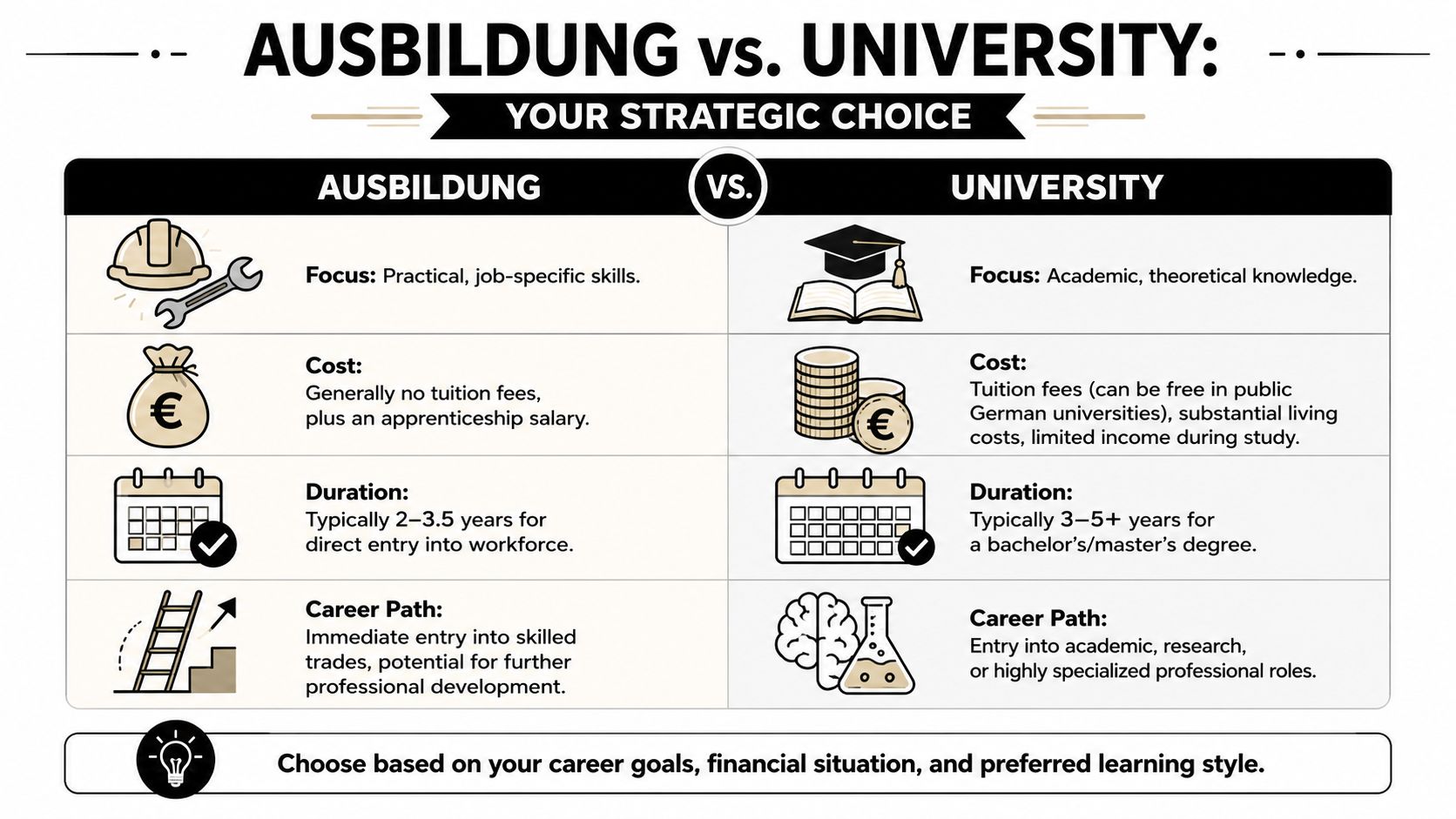
A direct comparison
| Decision area | Ausbildung | University |
|---|---|---|
| Learning style | Practical, structured, hands-on | Academic, theory-heavy |
| Career entry | Direct connection to a specific profession | Broader, but often less direct |
| Income during training | Often tied to trainee pay | Usually limited while studying |
| Daily routine | Work discipline, professional habits, applied learning | Lectures, seminars, assessments |
| Best for | Students and adults who want a clear job path | Students who want academic depth or degree-based careers |
This isn't only about money. It's also about momentum.
A lot of HK students spend years collecting qualifications without becoming employable in a specific role. Ausbildung pushes in the opposite direction. It asks early: what job are you training for, what skills does that job require, and can you perform them under real workplace conditions?
Who should choose which path
Choose Ausbildung if most of these sound like you:
You want a profession, not just a degree title
You care more about what you can do than what's printed on a certificate.You're cost-conscious
Your family doesn't want years of high overseas study costs before seeing any career return.You're practical
You prefer applied learning, routines, tools, systems, customers, and measurable performance.You want Germany specifically
You're not casually exploring Europe. You're serious about building a life and career there.
Choose university if these fit better:
You need academic progression
You expect to continue to bachelor's, master's, or specialised postgraduate study.You want a research or policy path
Some careers depend on degree progression and academic credibility.You're not ready to commit to one profession yet
University can give you more exploration room.
For families comparing pathways after secondary education, this discussion of apprenticeship vs a levels 2026 is useful as a mindset check. The labels differ from Hong Kong, but the underlying issue is the same. Are you choosing prestige, or are you choosing fit?
A weak university fit is more expensive than a strong vocational fit.
That's the core decision. Not which path sounds more impressive at dinner. Which one actually matches the student.
Application Pathways for Hong Kong Residents
Hong Kong residents usually have three realistic pathways into Ausbildung. One is the main route and should be your default. One is local and highly limited. The third can help in some cases, but it needs caution.
Pathway one, apply directly to Germany
This is the most important route for most readers.
You identify suitable training positions in Germany, prepare application documents in German format, interview with employers online, and secure a training contract. That contract becomes the foundation of your visa process.
The sequence usually looks like this:
Choose realistic professions
Don't apply randomly. Focus on fields that match your background, language level, and tolerance for practical work.Prepare German-standard documents
Your CV and cover letter need to look like they belong in the German market, not copied from an HK office-job template. This guide on how to write a German CV and cover letter from Hong Kong is worth reading before you send anything.Interview properly
Employers aren't only checking grammar. They're checking whether you understand the profession and whether you can function in a German-speaking environment.Sign the training contract
Once that happens, the visa process becomes concrete rather than theoretical.
This path works for school leavers, career changers, and working professionals in Hong Kong. It's also the route with the widest range of possibilities.
Pathway two, start through the Hong Kong dual training route
There is also a localised version in HK, and it's real, but it's selective.
Each year, approximately 30–40 young Hong Kong residents begin dual professional training through a local programme organised by GIC Hong Kong with the German Business School. The programme lasts 22 months and combines 3.5 days per week of on-the-job training with 1.5 days of theoretical education at GBS. The annual school fee is HK$50,000 for the 2025–26 academic year, according to the official dual system professional training page.
That route can be attractive because it gives HK-based structure and familiarity. But it's not the main national gateway into Germany. It's a niche programme with a high bar.
You'll need to pay attention to entry expectations, especially educational equivalency and language readiness. If you're trying to use this option as a shortcut because you feel unsure about German, that's a mistake.
Pathway three, use outside placement support carefully
Some applicants use agencies or placement services. I'm not against that in principle. I am against paying large fees before you've fixed the fundamentals.
If your German is weak, your documents are poor, or your career target is confused, an outside agent won't solve the underlying problem. You'll just spend more money to package a weak application more neatly.
Use this rule:
- Pay for preparation first
- Pay for placement help only if the service is transparent
- Avoid anyone who treats Ausbildung like a fast visa product
A signed contract comes from fit, language, and preparation. Not from wishful thinking.
For many people in Hong Kong, the strongest strategy is simple. Build the German foundation, choose a realistic field, prepare proper application documents, then apply directly.
How Much German Do You Need and How Can GCA Help?
German is the gatekeeper. Not motivation. Not good intentions. Not a polished LinkedIn profile.
For non-EU applicants, the minimum language benchmark for Ausbildung visa eligibility is B1 German, while B2 is strongly recommended by employers and chambers of commerce, as noted in this guide to Ausbildung German language requirements. That distinction matters.
B1 may open the visa door, but B2 is the real target
B1 can be enough on paper for some cases. In real life, it often isn't enough to perform well.
You'll need German for:
Interviews
Employers want to see that you can understand questions and respond with some confidence.Vocational school content
Technical terms, instructions, and written tasks won't wait for your language to catch up.Workplace communication
Colleagues won't simplify every sentence for you forever.Daily life in Germany
Housing, transport, admin, shops, doctors, registration. These all add pressure.
That's why I tell HK applicants to stop asking for the minimum score they can get away with. Ask instead what level gives you a real chance to succeed after arrival. For most serious applicants, the answer is B2.
What Hong Kong learners usually get wrong
The first mistake is delaying German study until after they find a training vacancy. That's backwards. Without enough German, your choices shrink badly.
The second mistake is treating German like a side hobby. Ausbildung preparation needs a structured curriculum, consistent progression, and exam-focused training if you're aiming for Goethe-Zertifikat. Casual app-based learning won't carry the weight here.
The third mistake is choosing convenience over quality. In Hong Kong, busy adults often want flexible scheduling, online access, and accessible centres. That's reasonable. But you still need native-speaking teachers, proper correction, and systematic exam preparation if your goal is to study abroad in Germany or qualify for visa-related language proof.
For learners comparing options for German lessons Hong Kong or searching Learn German HK, I recommend prioritising:
- Structured progression instead of informal conversation-only classes
- Goethe-Zertifikat preparation if you need recognised proof
- Small-group or highly interactive teaching
- Accessible schedules for working professionals
- Possible CEF funding where eligible, because cost matters in HK
If Germany is the destination, German can't be the part you improvise.
That's true whether you're a school leaver from DSE or IB, a parent planning ahead for a teenager, or an adult changing careers.
Navigating Visas, Costs, and Timelines from Hong Kong
Many otherwise strong applicants in Hong Kong lose momentum, not because they aren't capable, but because they rely on outdated advice.
The visa process for Ausbildung is manageable if you treat it like a project with stages, deadlines, and document control. If you treat it casually, you'll create delays for yourself.

A realistic Hong Kong timeline
A typical journey often stretches across roughly 12 to 18 months, depending on your German level, application readiness, and document speed.
A sensible sequence looks like this:
Early phase
Start German seriously. Don't wait until you “feel more certain”.Middle phase
Research professions, prepare documents, and begin applications.Offer phase
Interview, receive a training contract, and organise the next steps.Visa phase
Gather finances, language proof, and core paperwork, then apply.Move phase
Arrange accommodation, travel, and registration planning.
If you're also weighing degree options, this broader guide on study in Germany from Hong Kong helps you compare the university route with vocational training.
The blocked account issue that trips up HK applicants
This is the financial point most guides get wrong.
For vocational training visa applicants, the post-September 2025 blocked account amount is €1,091 per month if your Ausbildung salary does not fully cover the required level of financial proof, according to Germany's official visa and residence rules for training.
For Hong Kong applicants, the problem isn't only the amount. It's the process around it.
Prospective applicants from HK face specific difficulties with HKD to EUR conversion and Hong Kong bank restrictions linked to blocked-account arrangements, and this gap causes 30–40% of HK applicants to delay or abandon visa applications due to financial documentation errors, again noted on the same official training guidance page above.
That's why old blog posts are dangerous here. Many still circulate outdated figures. If you use the wrong amount, or submit inconsistent financial documents, your application can stall before the main assessment even begins.
Use current figures, calculate carefully, and check your bank paperwork twice before submitting anything.
Core visa documents you should prepare early
Don't build your visa file at the last minute. Start collecting key documents as soon as you're close to interview stage.
Your file will usually centre on:
The signed training contract
This is the backbone of the application.Language certificate
Your German proof must match the pathway requirements and employer expectations.Financial evidence
This becomes important if your training allowance does not meet the required threshold.Identity and application documents
Passport validity and form accuracy matter more than people think.
There are also two more facts worth knowing from the earlier language-and-visa source. For non-EU applicants, the visa acceptance rate for Ausbildung-based visas reached 73% in 2024, and processing time ranges from 4 to 12 weeks depending on the embassy, according to the previously cited Ausbildung language requirements guide mentioned earlier in this article.
That should encourage you, but not relax you. Good outcomes go to applicants who submit coherent files.
Ready to Start Your Journey to Germany?
Waiting too long is a common pitfall. Applicants often spend months reading, comparing, hesitating, and asking whether this path is “safe”. The better question is whether you're ready to build the foundation properly.
Start with action, not endless browsing.
Your next four moves
Assess your German foundation
Be honest about your current level. If you're below the level needed for interviews and exam preparation, that is your first job.Map your personalised plan
Build a realistic timeline based on your background, whether you're coming from DSE, IB, IGCSE, university, or full-time work in Hong Kong. Don't copy someone else's schedule.Experience serious German teaching
If you're comparing classes in HK, look for native-speaking teachers, a structured curriculum, and proven Goethe-Zertifikat preparation. That combination matters far more than flashy marketing.
A good way to see what authentic classroom learning looks like is this short introduction below.
- Choose the course path that matches your goal
If Ausbildung is your target, pick courses that move you toward recognised German proficiency, not just casual conversation. If you need a visa-relevant exam result, your class plan should reflect that from the start.
If you've read this far, you already know more than most applicants in Hong Kong. You know Ausbildung is not a fallback. You know the language requirement is serious. And you know the blocked account figure many websites still show is outdated.
That gives you an advantage, but only if you act on it.
If you want expert support from a native-led team in Hong Kong, German Cultural Association Hong Kong(GCA) is the strongest place to begin. You can book a trial class, speak with an advisor about your Ausbildung timeline, or check the latest course schedule for structured German learning and Goethe-Zertifikat preparation.

German Verb Tenses Overview: Präsens Made Simple

German Passive Voice (Passiv): Formation Guide


