.png)
.png)

BLOG

香港德國文化協會
The German Cultural Association
German Citizenship (Einbürgerung): Language Requirements for HK 2026 Guide
For applicants in Hong Kong, German Citizenship (Einbürgerung): Language Requirements for HK comes down to one clear rule. You need to prove German at CEFR B1 level, usually with a recognised certificate.
If you're sitting in Hong Kong comparing Germany with other relocation options, this is probably the point causing friction. You may already have a strong academic background, a solid career, or children on a DSE, IB, or IGCSE path, but none of that automatically solves the German citizenship language requirement.
The good news is that the rule itself is not complicated. What confuses people is the paperwork, the accepted certificates, the exemptions, and the practical question of where to prepare and sit the exam in Hong Kong.
That's where most applicants waste time. They read general articles written for broad audiences, but their actual concern is local and practical. Which test centre in Hong Kong should I use? Will my German schooling or degree count? Can I avoid the B1 exam? How long will it take if I'm working full-time?
This guide gives you direct answers, with Hong Kong context, so you can plan properly and avoid wrong assumptions.
Table of Contents
- Your Path to German Citizenship Starts Here
- What B1 actually means in real life
- Why Germany uses B1 as the benchmark
- Schooling and qualifications that may replace the exam
- Citizenship by descent cases with different language rules
- The age-based oral communication exception
Your Path to German Citizenship Starts Here
A typical Hong Kong applicant looks like this. You're working full-time, managing family commitments, and trying to make a long-term move without wasting money on the wrong course, the wrong exam, or the wrong legal assumption.
Germany can be a strong option for professionals, parents, and students planning to study abroad in Germany. But naturalisation has one mandatory language hurdle for standard applicants, and if you don't understand it early, your timeline slips.
The practical issue isn't whether German is “hard”. Instead, the key is whether you choose the right proof method and build towards it in an organised way.
Practical rule: Don't start with random app-based study and hope it will somehow become citizenship-ready. Start from the required proof backwards.
If you're in Hong Kong, your first job is simple:
- Identify your citizenship path. Standard naturalisation, spouse route, or descent-based claim.
- Check whether B1 applies. For most standard cases, it does.
- Choose the proof method. A recognised exam is usually the cleanest route.
- Prepare locally. Build around a realistic study routine in Hong Kong, not an ideal one.
- Keep documents early. Certificates, transcripts, and German schooling records matter.
A lot of HK applicants overcomplicate this because they mix up visa rules, university admission rules, and citizenship rules. They're not the same.
If your goal is German Citizenship (Einbürgerung): Language Requirements for HK, stay focused on the standard citizenship benchmark and prepare for that directly.
What Is the B1 Language Requirement for German Einbürgerung
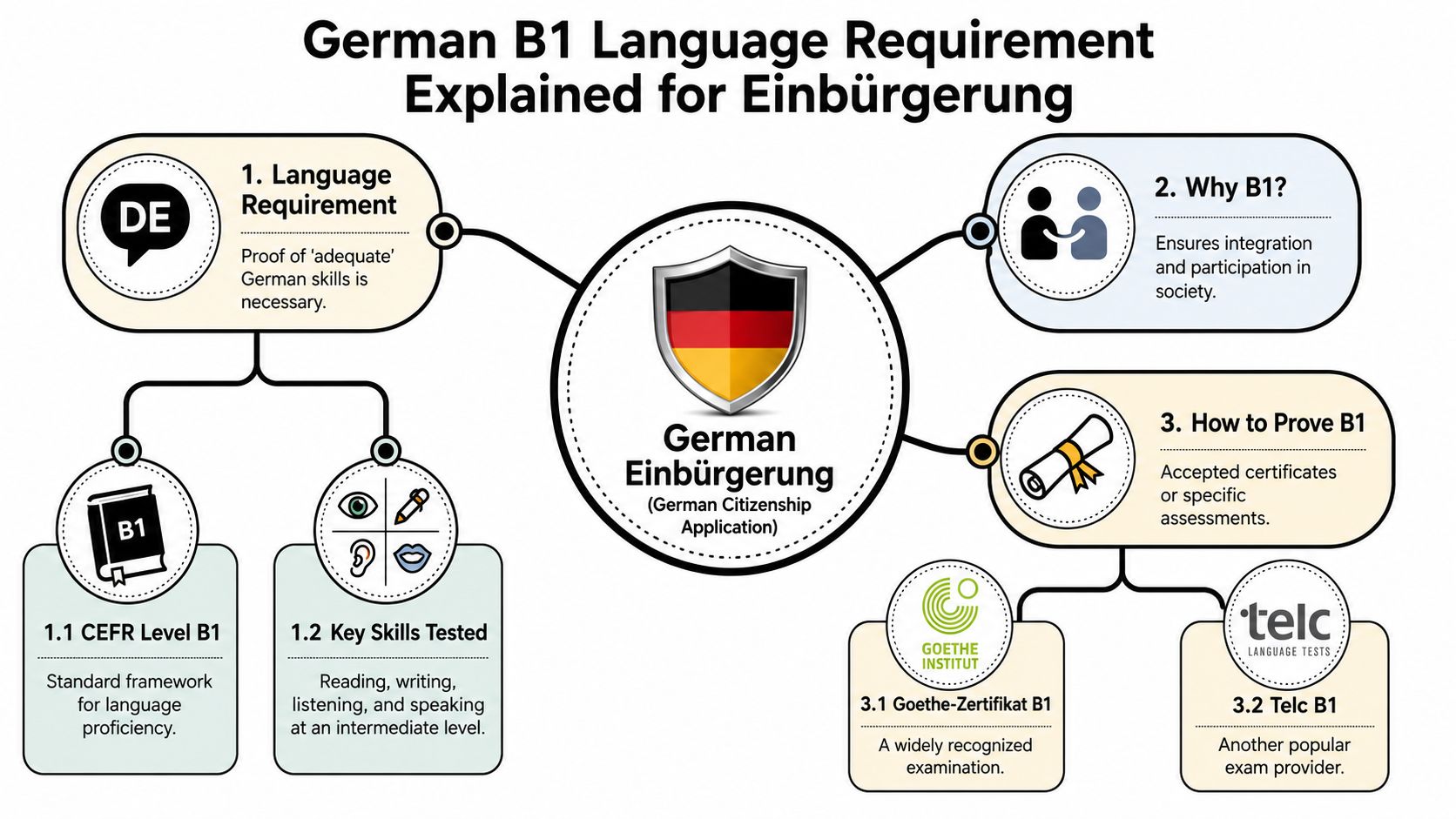
For standard naturalisation in Germany, the required language level is CEFR B1. That means you must show independent, everyday German ability across reading, writing, listening, and speaking, unless a recognised exemption applies.
German authorities state that for standard naturalisation, applicants must show German at a minimum of B1 level and meet a 5-year legal residence period, unless an exemption applies, as stated on the official naturalisation questionnaire guidance.
A lot of people in Hong Kong hear “B1” and assume it means advanced German. It doesn't. It means practical, functional independence.
Here's the visual summary first.
What B1 actually means in real life
At B1 level, you should be able to function in normal day-to-day situations without collapsing into silence. You won't sound polished, but you should be able to manage.
That includes:
- Listening: You can follow the main point of clear standard speech on familiar topics.
- Reading: You can understand straightforward texts, notices, and common written information.
- Writing: You can produce simple connected text, such as emails, short explanations, and everyday written responses.
- Speaking: You can deal with common situations, describe plans and experiences, and express basic opinions.
For a Hong Kong professional, that means handling routine conversations about work, housing, appointments, transport, school matters, and everyday administration in Germany.
B1 is not academic perfection. It is usable German.
Why Germany uses B1 as the benchmark
The legal logic is straightforward. Germany wants naturalised citizens to participate in daily life, understand routine communication, and manage basic civic interaction.
That's why B1 sits at the centre of German Citizenship (Einbürgerung): Language Requirements for HK. It's the benchmark for “adequate German language skills” in the standard naturalisation route.
The skill test is practical. If you prepare in a structured way, B1 is very achievable, even if you're starting from zero in Hong Kong.
A short explainer helps if you want to hear the exam expectation in context.
For HK families, the key takeaway is this. Your DSE, IB, or IGCSE background may help you learn efficiently, but it does not automatically replace recognised German language proof unless you fall into a specific accepted exemption.
Accepted Certificates and Proof Methods for HK Applicants
If you're applying through the normal naturalisation route, self-assessment doesn't count. German authorities want formal proof.
The recognised proof methods include the Deutsch-Zertifikat B1, Goethe-Zertifikat B1, TestDaF, and telc Deutsch B1, with no Hong Kong-specific exemption, as noted in this discussion of accepted language certificates for naturalisation.
The most practical proof route in Hong Kong
For most applicants in Hong Kong, the most straightforward option is the Goethe-Zertifikat B1. It is familiar, widely recognised, and fits the local test-preparation ecosystem.
That matters because convenience affects follow-through. If the exam is accessible in Hong Kong, you're more likely to train properly, book on time, and complete the process without disruption.
In practical terms, focus on these decision points:
- Recognition first: Choose a certificate that German naturalisation authorities already know and accept.
- Local access: In Hong Kong, prioritise exams you can prepare for and sit locally.
- Format fit: Some candidates do better in a communication-focused format, while others prefer a more academic structure.
- Document discipline: Keep the original certificate safely. You'll need proper evidence, not just a course attendance record.
If you're preparing specifically for the Goethe format, this Goethe-Zertifikat B1 exam guide for Hong Kong learners is a useful local planning reference.
Other proof methods that can replace a certificate
Not everyone needs to sit a standalone B1 exam. German authorities also accept certain school-based and education-based alternatives.
These include:
- German school attendance: Successfully attending a German school for four years with promotion to the next class.
- German school qualifications: A Hauptschulabschluss, Realschulabschluss, or Abitur from a German school.
- Secondary school progression: Reaching 10th grade in a German secondary school.
- German vocational or university completion: Completing vocational training or a university degree in Germany, provided German was graded at least 4 (satisfactory).
Some Hong Kong families make a costly mistake, assuming strong general academic credentials in HK automatically substitute for German proof. They don't.
Use this simple filter:
| Your background | Likely result |
|---|---|
| You studied in Hong Kong only | You'll usually need a recognised B1 proof route |
| You attended or graduated from a German school | Your school record may qualify |
| You completed vocational training or a degree in Germany | Your qualification may qualify if the German-language condition is met |
If you want the least friction, take the route that is easiest to document clearly.
Exceptions and Special Pathways Who Can Skip the B1 Exam
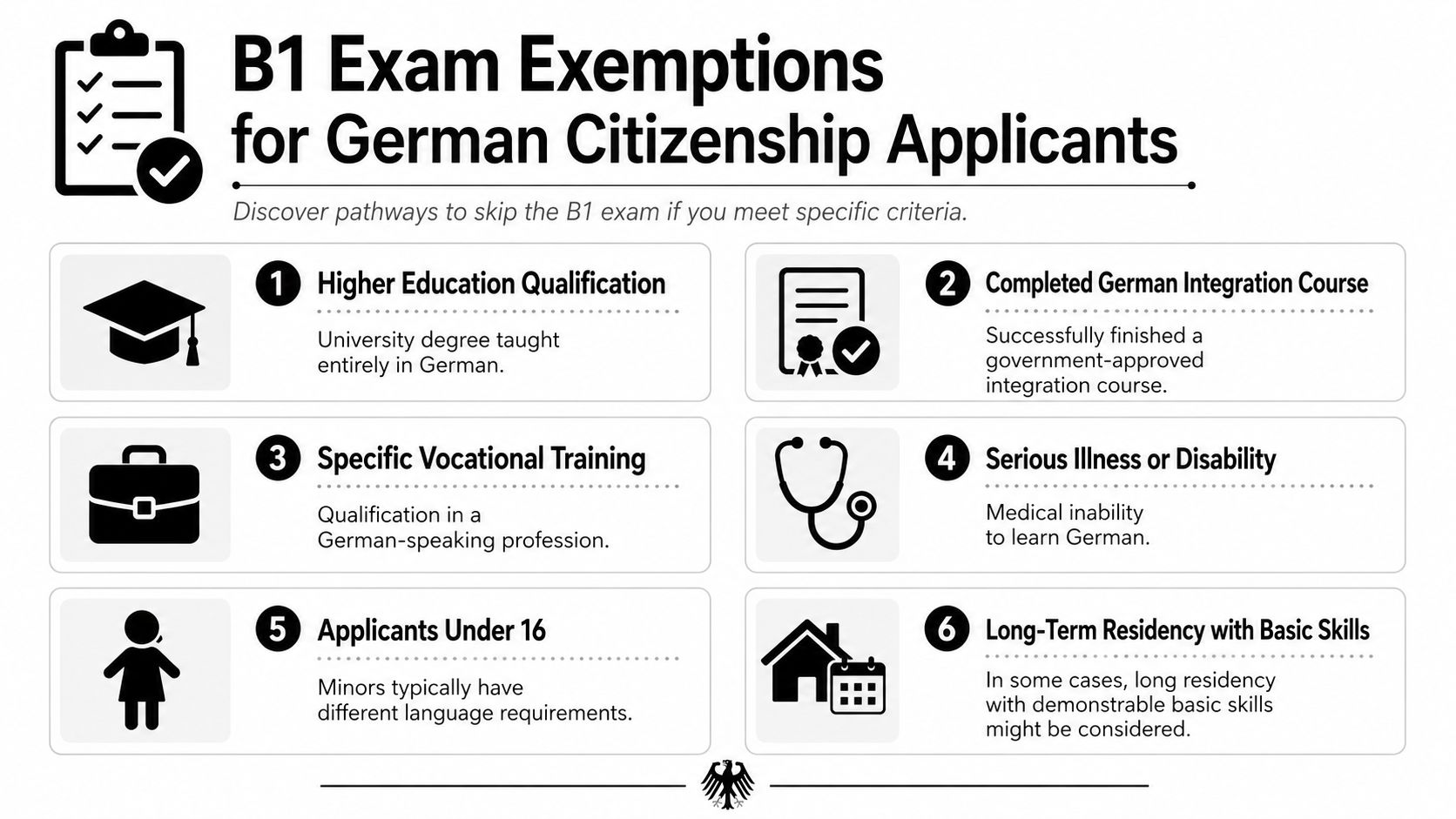
Many readers go straight to this question. Fair enough. If there's a lawful way to avoid the exam, you should know it.
But don't look for loopholes. Look for actual legal categories. German citizenship law does allow different proof routes and, in some cases, no language requirement at all.
Schooling and qualifications that may replace the exam
The first group is straightforward. Some people don't need a separate B1 certificate because their German education already proves the required level.
That applies if you can document one of the recognised school or qualification pathways already noted earlier. For these applicants, the issue is not “How do I learn German?” but “How do I prove my prior German education cleanly?”
Use original records and make sure they are complete. Partial transcripts or informal explanations usually create delays.
Citizenship by descent cases with different language rules
This is the area where legal basis matters most.
If your claim falls under Section 5 StAG, there is no language requirement. If your case falls under Section 14 StAG, you must provide B1-level German proof, as explained in this discussion of Section 5 and Section 14 language rules.
That distinction is decisive for some Hong Kong families with German ancestry. Two people can both say, “I have a German grandparent,” yet face completely different language obligations depending on the legal route.
Before you book any exam, confirm the legal basis of your citizenship claim.
A simple comparison helps:
| Legal path | Language rule |
|---|---|
| Section 5 StAG | No language requirement |
| Section 14 StAG | B1 proof required |
If you're unsure which applies, get that clarified first. It can save months of unnecessary study.
The age-based oral communication exception
There is also a more limited age-related exception. Applicants over 60 years old who have lived in Germany for more than 12 years may only need to demonstrate oral communication in everyday situations rather than produce a formal B1 certificate.
This exception is narrow. It isn't a broad HK shortcut, and it doesn't mean older applicants can ignore language preparation entirely.
There is also a real grey area around spouse cases and the newer law changes. A frequently overlooked issue is whether the oral communication waiver for seniors clearly extends to certain spouse-based applicants outside Germany. The available guidance does not resolve that point cleanly, and Handbook Germany's citizenship guidance reflects that uncertainty. The same source notes that 12% of recent HK applicants are spouses of Germans.
If you're in that category, especially if age or health is involved, don't rely on assumptions. Get legal clarification before you build your timeline.
How Long Does It Take to Learn German to B1 in Hong Kong
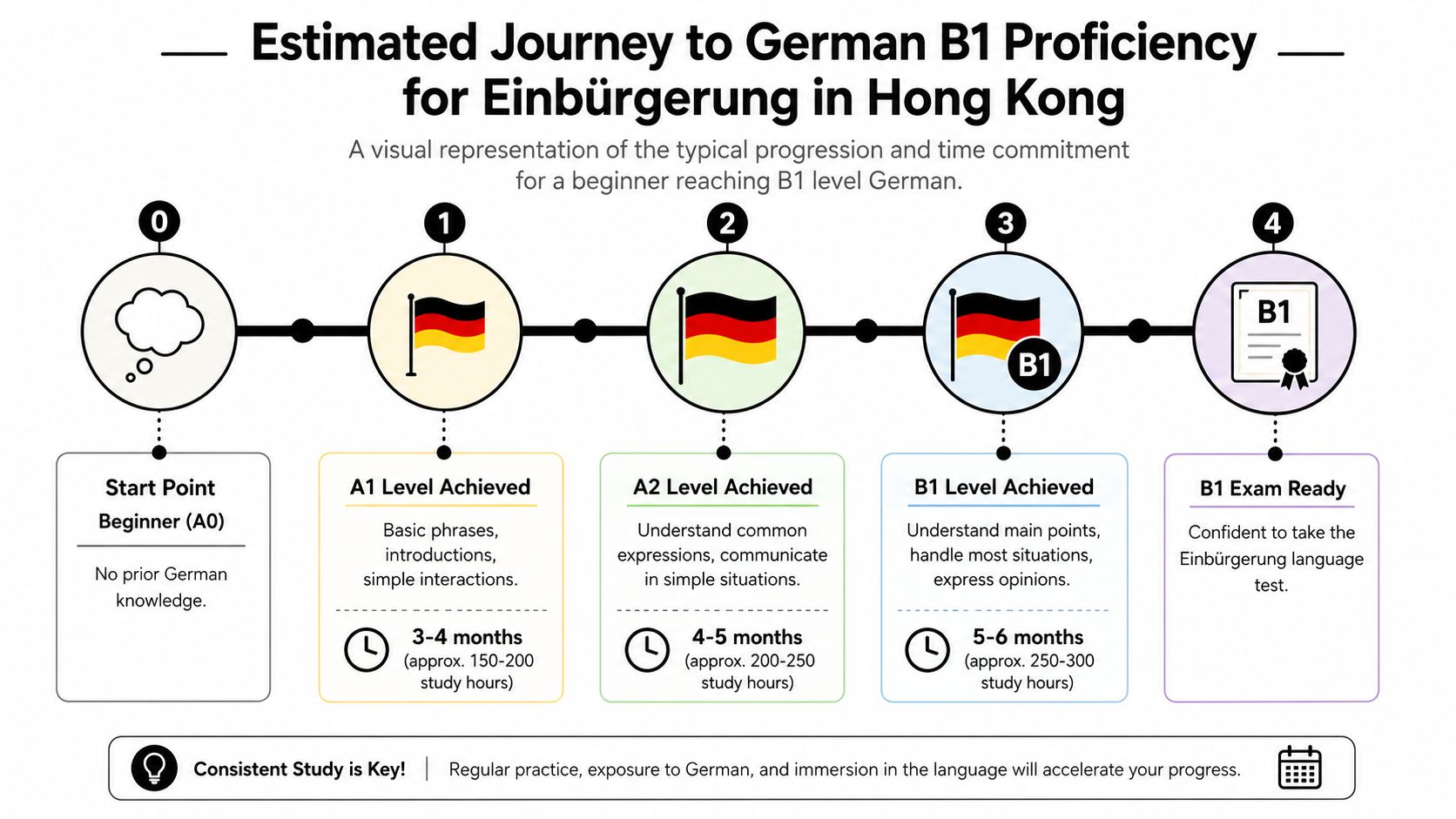
Most Hong Kong adults ask the right question too late. Not “Can I do it?” but “How long will this take with my schedule?”
The honest answer is that B1 takes sustained work. If someone promises citizenship-ready German in a few weeks, ignore them.
This roadmap is useful as a study reference point.
What changes your timeline in Hong Kong
Your pace depends less on “talent” and more on structure.
In Hong Kong, these factors matter most:
- Consistency: Two to three steady study blocks every week beat irregular bursts.
- Course design: A proper sequence from beginner level to exam preparation saves re-learning.
- Teacher feedback: Speaking and writing improve faster when someone corrects you early.
- Local routine: Commuting, work pressure, and family schedules affect how much study you can realistically sustain.
- Exam target: Studying generally is not the same as preparing for B1 task types.
A learner with strong study habits from DSE, IB, or IGCSE training usually adapts well to a structured German programme. Adults with demanding jobs can still reach B1, but they need a plan they will stick to in Hong Kong.
The fastest realistic route
The efficient route is not extreme intensity. It is organised repetition with clear milestones.
A practical approach looks like this:
- Build fundamentals first. Pronunciation, sentence order, and core grammar must be stable.
- Add exam-style tasks early. Don't leave speaking and writing until the end.
- Use guided correction. This prevents fossilised mistakes.
- Book the exam only when your weakest skill is ready. One weak paper can derail the whole result.
If you're comparing study formats, this guide to learning German in Hong Kong gives a realistic overview of local options.
If you're serious about German citizenship, treat B1 like a project with deadlines, not a hobby you fit in “when free”.
That mindset saves money. It also reduces the chance of repeating an exam because you studied vaguely instead of purposefully.
Good News Germany Now Allows Dual Citizenship
This change matters a lot for Hong Kong applicants.
Since June 27, 2024, Germany permits dual citizenship as a standard practice, meaning HK residents can retain their Hong Kong identity while acquiring German status without renunciation, according to this overview of German dual citizenship and descent rules.
Why this matters for Hong Kong families
For years, one of the biggest emotional and practical barriers was the fear of having to give something up permanently. That hesitation was especially strong in Hong Kong, where identity, family ties, and long-term flexibility matter.
Now the calculation is different.
For many HK professionals and parents, dual citizenship changes the decision from a trade-off into a strategy. You can build a future connected to Germany without automatically severing your connection to Hong Kong.
That has obvious planning value for:
- Parents: Keeping family options open across school systems and future study abroad in Germany.
- Professionals: Expanding mobility without forcing an immediate identity break.
- Mixed-nationality households: Reducing one of the most common points of uncertainty.
- Long-term planners: Making citizenship more attractive as part of a broader relocation plan.
There's another point people miss. Once dual citizenship is allowed, the language requirement becomes even more important strategically. If renunciation is no longer the hurdle, then B1 proof becomes one of the main practical barriers you can control directly.
So don't spend all your time worrying about nationality loss if your real bottleneck is exam preparation.
Start Your Journey with GCA's German Lessons in Hong Kong
At this stage, the question isn't what the rule says. The question is whether your preparation is good enough to produce recognised proof.
Hong Kong already has a real German-learning ecosystem. In 2023, over 12,000 Hong Kong residents took German language exams, with Goethe-Zertifikat B1 the most frequently requested level for immigration purposes, according to BAMF's naturalisation and integration information. That tells you something important. You're not dealing with a niche problem. A lot of people in HK are preparing for this exact milestone.

What serious B1 preparation should include
If your goal is citizenship, choose training that matches the proof requirement.
That means your course should include:
- A structured curriculum: You need a clear route from beginner level to B1, not disconnected lessons.
- Exam-format familiarity: Goethe-style reading, listening, writing, and speaking tasks should not feel new on exam day.
- Native-speaker input: This helps with pronunciation, natural phrasing, and speaking confidence.
- Small-group or focused correction: B1 success depends heavily on feedback, especially in writing and speaking.
- Flexible delivery in Hong Kong: In-person near transport links or online classes both matter for working adults.
For learners comparing German lessons Hong Kong options or looking to Learn German HK efficiently, one local option is German Cultural Association Hong Kong's adult German courses. Its format includes small-group and online learning, native-speaking teachers, and structured exam-oriented progression, which suits applicants building toward B1 proof for citizenship.
If you're a parent, this matters for family planning too. A properly organised course helps adults preparing for immigration, teenagers working toward Goethe exams alongside DSE or IB, and families considering study abroad in Germany.
The wrong preparation usually looks the same every time. Too much passive vocabulary, too little speaking, weak writing correction, and no serious exam strategy.
The right preparation is simpler. Consistent classes. Clear milestones. Regular output. A local timetable you can maintain.
If you're planning your move seriously, contact German Cultural Association Hong Kong(GCA) to discuss the right German course level, check the latest class schedule, or book a trial lesson that fits your B1 citizenship goal in Hong Kong.

German Verb Tenses Overview: Präsens Made Simple
German Passive Voice (Passiv): Formation Guide


