.png)
.png)

BLOG

香港德國文化協會
The German Cultural Association
How to Write a German CV and Cover Letter: HK Guide
You've found a role in Berlin, Hamburg, or Munich that fits your background. Then the application instructions stop you cold. They ask for a Lebenslauf, an Anschreiben, certificates, and sometimes references that look nothing like what employers in Hong Kong usually expect.
That's where most HK applicants lose momentum. A standard international CV often feels too loose for Germany, while a copied German template can create new problems if it doesn't reflect your actual HK education, work history, and supporting documents. This guide on How to Write a German CV and Cover Letter: HK Guide is built for that exact gap.
The goal isn't to make your application look “more European”. It's to make it look credible, organised, and easy for a German recruiter to trust. That matters even more when your experience, references, and school records come from Hong Kong. If you're preparing documents across English, Chinese, and German, practical issues like certified translations also become part of the application strategy. For document handling, Translators USA certified translation advice is a useful starting point for understanding what “certified” typically means in practice.
If your long-term plan is broader than one job application, this companion article on how speaking German boosts your career in Europe gives helpful context on why language ability changes your options beyond the first interview.
Table of Contents
- The short answer
- What recruiters actually test while reading
- What often looks weak to German recruiters
- What gets attention
- Start with the core sections German recruiters expect
- Personal Information
- Professional Experience
- Education
- Additional Qualifications
- Languages and technical skills
- Key German CV phrases and their meanings
- Formatting choices that improve readability
- Start with a formal layout recruiters expect
- Build the letter around a clear business case
- Avoid the mistakes that make German cover letters feel weak
- Handle references and translations properly
- Present Hong Kong qualifications clearly
- Show German ability in a way employers trust
Your Gateway to a Career in Germany Starts Here
Hong Kong professionals usually aren't short on qualifications. The core problem is format. Strong candidates get filtered out because their application package looks international rather than German, or because their documents answer the wrong questions.
German hiring culture rewards order, evidence, and precision. If your CV reads like a profile summary for LinkedIn, or your cover letter sounds broad and motivational, it won't do enough heavy lifting. Recruiters want a file that makes verification easy and relevance obvious.
Why this feels harder for HK applicants
Applicants in Hong Kong often work across multiple systems at once:
- English-first careers in banking, logistics, education, design, engineering, or tech
- Academic records that may include DSE, IB, IGCSE, A-level, or local university documents
- Reference formats that differ from German expectations
- Language proof that may matter for both hiring and later visa steps if you plan to study abroad in Germany or relocate for work
That mix is manageable. It just needs to be presented properly.
Practical rule: Don't start by “translating” your Hong Kong CV into German. Start by rebuilding it into a German application structure, then decide what needs translation.
What a strong German application package usually includes
For most roles, your file should feel complete and disciplined. In practice, that means:
- A reverse-chronological CV
- A customized one-page cover letter
- Relevant certificates and academic documents
- References or supporting proof, especially where your previous employers don't issue German-style documents
- Consistent naming and formatting across all PDFs
Applicants often find rapid improvement in this area. Once the structure is right, your experience becomes much easier to evaluate. That's the primary purpose of How to Write a German CV and Cover Letter: HK Guide. It helps your background travel well across systems instead of getting lost in them.
What Do German Recruiters Actually Look For
A hiring manager in Munich opens your PDF. In the first minute, they should understand your current level, your track record, and whether your Hong Kong background fits the role without extra detective work. That is the real test.

German recruiters usually screen for three things first. Relevance, order, and proof. If any one of these is weak, good candidates get filtered out early.
For Hong Kong applicants, the third point causes the most trouble. Your experience may be strong, but the supporting documents often do not match German expectations. Employers in Germany are used to seeing structured references, formal certificates, and records that are easy to compare. A standard Hong Kong reference letter, or a school transcript without translation context, can leave open questions even when your profile is solid.
The short answer
Recruiters want a file that is easy to scan and easy to trust.
That means clear dates, recognizable job titles, direct evidence of results, and documents that support what your CV claims. In Germany, formal presentation is often read as a sign of professional discipline. A messy file suggests messy work. Fair or not, that is how many recruiters read it.
I have seen this with Hong Kong candidates in finance, logistics, education, and engineering. The applicants who get interviews are rarely the ones with the fanciest wording. They are the ones who make comparison easy for the recruiter.
What recruiters actually test while reading
A recruiter is usually checking practical questions, not admiring writing style:
- What is this person doing now?
- Does their experience match this vacancy closely enough?
- Are the dates consistent and easy to follow?
- Do the achievements sound specific rather than generic?
- Can the qualifications be verified?
- Are any key documents missing, untranslated, or unclear?
This matters even more for applicants educated outside Germany. If you list DSE, IB, IGCSE, or local university results, recruiters may not know how to interpret them at a glance. Give them clean document labels, translated titles where needed, and enough context that they do not have to guess. The same applies to work references. If your employer did not issue a German-style Arbeitszeugnis, include the strongest equivalent available and present it in a way that still feels credible and orderly.
What often looks weak to German recruiters
Some habits that work in Hong Kong or other international markets create friction in Germany.
Typical problems include:
- Long profile summaries that say little
- Job descriptions without measurable outcomes
- Broad claims like “good communication skills” without proof
- Mixed English and German document titles with no explanation
- Academic documents attached without certified translation where needed
- References that confirm employment but say nothing about performance or scope
- File names and scans that look inconsistent or informal
The trade-off is simple. A minimalist international CV can look modern, but in Germany it can also look under-documented.
What gets attention
Strong applications usually share the same qualities:
- Clear chronology and recognizable structure
- Bullet points that show scope, outcomes, and tools used
- Language that matches the vacancy without copying it mechanically
- Supporting documents that back up the story
- Careful handling of local gaps, especially non-German references and translated academic records
For Hong Kong professionals, this is also partly a cultural translation exercise. Recruiters are not only reading your experience. They are reading whether you understand the norms of the market you want to join. If you want context for why formality and professional presentation carry so much weight, this guide to German culture and etiquette gives useful background.
One more point matters. German employers often verify details more carefully than applicants expect, especially once you reach the final stages. This overview of the employment verification process is useful context if you want to see what may be checked after interview.
A good German application reduces doubt. For HK applicants, that means doing more than presenting experience well. It means making your references, certificates, and qualifications legible across systems.
How to Structure Your German Lebenslauf for Success
A recruiter in Munich opens your application and sees a sleek one-page CV in international style. It looks polished. It also leaves basic German questions unanswered. Where are the exact dates, the full education labels, the location of each employer, and the documents that prove the claims?
That is the problem many Hong Kong applicants run into. The CV is not weak. It is translated into the wrong hiring logic.
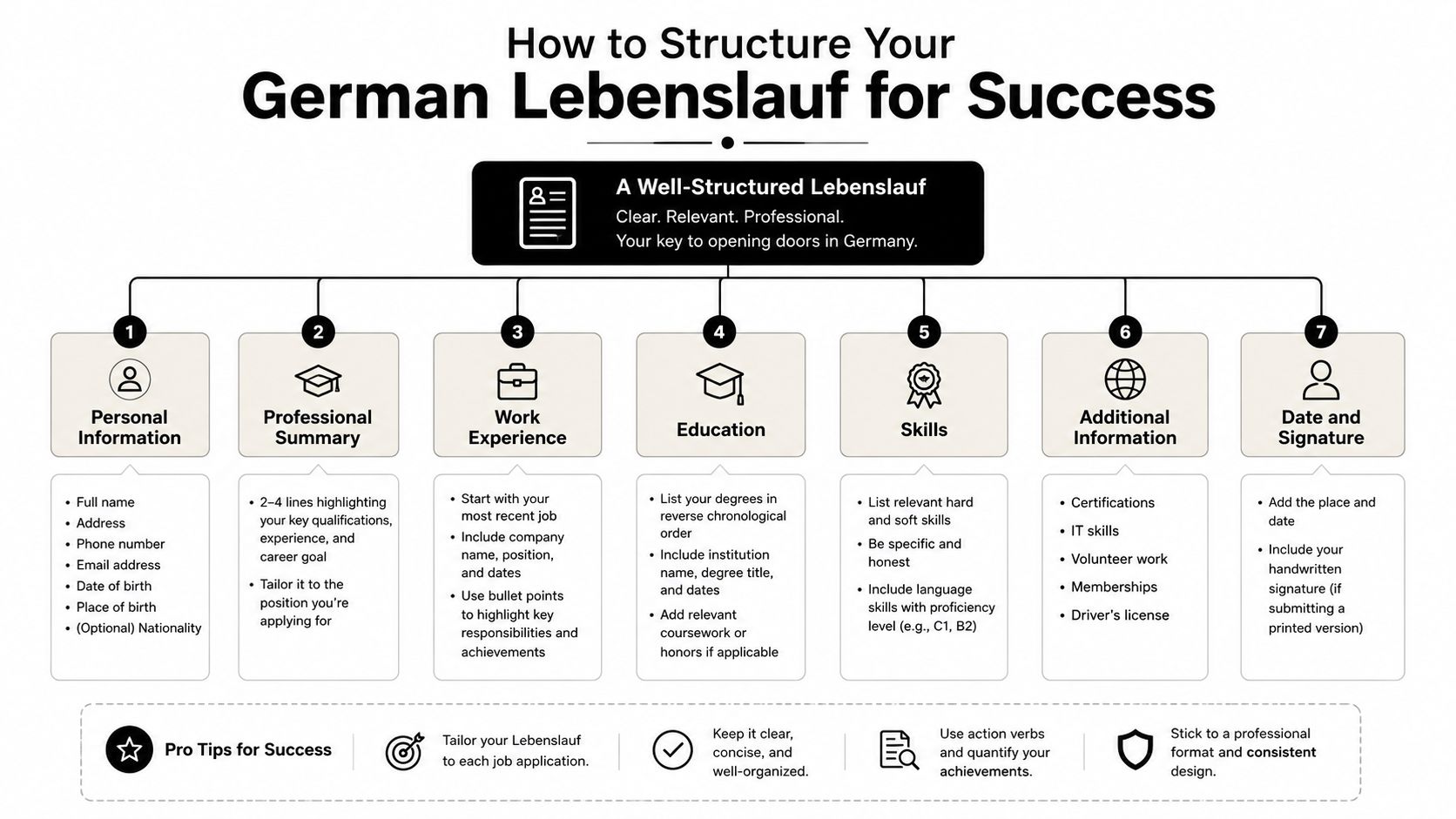
A German Lebenslauf needs to be easy to scan, easy to verify, and easy to match to the role. German employers often read it alongside certificates, transcripts, and references. For Hong Kong professionals, that means the structure must also help a recruiter understand qualifications that are familiar in HK but not automatically clear in Germany.
Start with the core sections German recruiters expect
Use a clean reverse-chronological structure with clear headings. A practical order is:
- Personal Information
- Professional Experience
- Education
- Additional Qualifications
- Languages and Technical Skills
- Optional extras, such as relevant certifications, publications, or volunteer work if they support your case
A professional photo is still common in Germany, even though it is not legally required. In practice, I still recommend one for many private-sector roles unless the employer clearly signals an international application standard. Use a current headshot with a neutral background and business attire. Holiday photos cropped to fit are an easy way to look careless.
Personal Information
Keep this part brief and factual.
Include:
- Full name
- Phone number
- Professional email address
- Current location
- LinkedIn URL, if the profile is complete and consistent with your CV
Do not clutter this section with personal data that does not help your application. A German CV does not need religion, full family details, or extra identity information that the employer did not request.
For Hong Kong applicants, location matters more than many expect. If you are applying from HK, state that clearly. If you already have a German address, planned relocation date, or work authorization status, include it only if it helps answer an obvious recruiter question.
Professional Experience
This section carries the most weight.
For each role, list:
- Job title
- Employer
- City and country
- Start and end dates
- Bullet points showing responsibilities, tools, scope, and results
Use bullets, not dense paragraphs. German recruiters want to understand what you did, how senior the role was, and what changed because of your work.
Weak bullets describe activity only:
- Supported marketing campaigns
- Helped with reporting
- Responsible for client communication
Stronger bullets show ownership and context:
- Managed regional B2B campaigns across Hong Kong and Singapore using HubSpot and Salesforce
- Built monthly performance reports for senior management, reducing manual reporting time
- Coordinated client communication for enterprise accounts during product rollout
A simple test helps. If the bullet could sit under any job title at any company, rewrite it.
HK applicants should also think ahead about evidence. German employers may expect some form of work reference. If your previous companies issue standard HK reference letters rather than detailed Arbeitszeugnisse, that is normal. Do not try to imitate a German reference format yourself. Present the official reference you have, translate it if needed, and make sure the responsibilities in your CV match what the employer can verify.
Education
Education often needs more explanation for Hong Kong candidates than generic CV guides admit.
List each entry in reverse chronological order with:
- Degree or qualification
- Institution
- Location
- Graduation date or expected completion date
- Relevant concentration, distinction, or thesis topic, if useful
Be precise with qualification names. If you have HKDSE, IB, IGCSE, A-levels, associate degree, top-up degree, or a mixed academic path, use the exact official title from the certificate. German recruiters can become cautious when the CV says one thing and the translated document says another.
If your school records or exam results are not in German or English, arrange a certified translation early. This matters particularly for DSE subject results and final school-leaving qualifications, because some employers and universities want formal documentation, not a summary written by the applicant.
Additional Qualifications
Use this space for qualifications that strengthen your case for the specific role.
Examples:
- Professional certifications
- Short industry courses
- Software credentials
- Compliance training
- German language courses or exam preparation
Be selective. A long list of unrelated online courses weakens the document. Keep the items that support the vacancy, your seniority, or your move to Germany.
If you used AI to draft parts of your CV wording, edit it hard before sending. Generic phrasing stands out quickly in German applications. This is one area where it helps to humanize AI-generated cover letters, then apply the same discipline to your Lebenslauf language.
Languages and technical skills
Specificity wins here.
For languages, use recognised levels such as A2, B1, B2, C1, or native/fluent business level where appropriate. Do not write “basic German” or “good English” unless the vacancy itself uses casual language. Recruiters need a clearer signal.
For technical skills, list tools and systems that are relevant to the job:
- Excel
- SAP
- Power BI
- AutoCAD
- Python
- Salesforce
Group them if useful. For example, separate analytics tools from CRM platforms or design software from project management tools.
Key German CV phrases and their meanings
| German Term | English Meaning |
|---|---|
| Lebenslauf | CV / résumé |
| Persönliche Daten | Personal information |
| Berufserfahrung | Professional experience |
| Ausbildung | Education / academic training |
| Zusätzliche Qualifikationen | Additional qualifications |
| Sprachkenntnisse | Language skills |
| EDV-Kenntnisse | IT skills / computer skills |
| Anschreiben | Cover letter |
| Arbeitszeugnis | Work reference / employment certificate |
| Betreff | Subject line |
Formatting choices that improve readability
A strong German CV looks controlled and consistent.
Use these standards:
- Clear headings
- Consistent date format, such as MM/YYYY
- Even spacing
- One professional font
- PDF format for submission
- A clear file name, such as Firstname_Lastname_Lebenslauf.pdf
Keep it concise. In most cases, one to two pages is the right range. If you have a long career, include the experience that supports the target role and trim older or less relevant detail. I often see Hong Kong applicants try to preserve every internship, school activity, and early-career duty. That makes the document longer without making it stronger.
The best Lebenslauf does one job well. It helps a German recruiter understand your background quickly, trust the facts, and see how your Hong Kong experience transfers into the German market.
How to Write an Anschreiben That Gets You an Interview
You have the right experience, a clean Lebenslauf, and a role that genuinely fits. Then the cover letter weakens the whole application because it sounds copied, too broad, or written for a different market. I see this often with Hong Kong candidates who are fully qualified but pitch themselves in a style that feels normal in HK and flat in Germany.
Your Anschreiben has one job. It must show, quickly and credibly, why your background fits this specific role, this company, and this team.

Start with a formal layout recruiters expect
German recruiters still notice presentation. A strong letter is usually one page, clearly structured, and easy to scan in under a minute. If the file looks careless, the content has to work much harder.
Use this layout:
- Your contact details
- Company details
- Date
- A clear Betreff line
- Formal salutation
- Main text
- Closing sentence
- Signature
The Betreff should name the exact role. If the vacancy includes a reference number, add it there as well. That small detail helps your application look precise and role-specific.
A handwritten signature is still common in Germany, especially for formal applications submitted as a PDF. Digital applications have made practice less rigid than before, but a signed letter still signals care and completeness.
Build the letter around a clear business case
The strongest Anschreiben follows a simple structure:
- Why you are relevant
- What proof you have
- Why this company should meet you
That sounds obvious, but many applicants drift into autobiography. German recruiters usually respond better to selection than volume. They do not need your whole story. They need the parts that support the hiring decision.
Introduction
The opening paragraph should establish fit immediately.
Good openings usually do one of these things:
- Connect your current role to the vacancy
- Show why your background matches a key requirement
- Explain a credible reason for applying to that employer
Keep it tight. Two or three sentences are enough.
For HK applicants, this is also the place to frame cross-market relevance if needed. For example, if your experience comes from regional work across Hong Kong, mainland China, and APAC teams, state that in a way that maps to the German role. Recruiters should not have to guess how your market exposure transfers.
Main body
Interviews are won here.
Choose two to four examples that match the vacancy and write them as proof, not claims. Each example should connect a requirement from the job ad with your experience, your responsibility, and the result.
A practical structure is:
- What the employer needs
- Where you did something similar
- What you were responsible for
- What changed because of your work
That approach works far better than adjectives. “Detail-oriented,” “dynamic,” and “hardworking” add almost nothing unless the letter shows evidence.
Here is the trade-off I often discuss with clients. Hong Kong professionals are usually strong on pace, multitasking, and regional coordination. German applications reward those strengths only when they are translated into concrete business outcomes. A recruiter in Munich or Hamburg may not automatically understand the scale or complexity behind your role title. Spell it out with one specific achievement.
If you drafted the letter with AI, edit it aggressively. Recruiters can spot generic wording fast. Repeated phrases, vague enthusiasm, and polished but empty sentences make the application feel synthetic. This guide on how to humanize AI-generated cover letters is useful if you used AI for a first draft and need the final version to sound credible and personal.
Conclusion
The final paragraph should sound confident and calm.
Use it to:
- Confirm your interest in the role
- State that you would welcome an interview
- Mention availability if relevant
- Include salary expectations only if the employer asks for them
Keep the tone professional. Over-selling in the last lines often hurts more than it helps.
A visual walkthrough can help if you want to see how the structure reads on the page:
Avoid the mistakes that make German cover letters feel weak
These problems come up repeatedly in applications from strong candidates:
- A generic opening that could be sent to any employer
- Paragraphs that repeat the CV instead of adding evidence and motivation
- Too much emotion and too little relevance to the role
- Long blocks of text with no clear priority
- Vague claims without examples or outcomes
- A missing or weak Betreff line
- No signature on a formal PDF application
One more point matters for Hong Kong applicants. Many first draft their letter in English and then translate it into German. That is usually the right order. Write the argument clearly first. Then adapt the wording. Trying to sound “very German” too early often produces stiff phrasing, translation errors, or sentences you would never say naturally.
A good Anschreiben feels specific, controlled, and believable. It gives the recruiter a reason to continue from your CV to an interview.
Tailoring Your Application as a Hong Kong Professional
A Hong Kong candidate can send a well-formatted CV, a sensible cover letter, and still lose momentum because the supporting documents do not match German expectations. I see this often with strong applicants who have solid experience but no German-style Arbeitszeugnis, school records under unfamiliar labels, or certificates that were never translated properly.
That gap matters. German recruiters are usually comfortable assessing international profiles, but they do not want to guess what a document means or whether it matches the claims in your CV.
Handle references and translations properly
The biggest issue is usually the Arbeitszeugnis. In Germany, employers often expect formal reference letters that describe performance, conduct, and dates in a structured way. In Hong Kong, candidates are more likely to have a short employment letter, an HR confirmation, or a referee contact.
German employers can work with Hong Kong documents if you present them clearly. A German career resource discussing application gaps for Hong Kong candidates points out that non-German work references and certified translations are a common source of uncertainty for applicants and recruiters alike, as discussed in this guide on German cover letters and HK application gaps.
Use a practical standard:
- Include employer-issued reference letters or employment confirmations you already have
- Keep job titles, dates, and company names identical across your CV, cover letter, LinkedIn profile, and attachments
- Add a certified translation if the employer asks for German documents, or if you are applying to a formal environment such as the public sector, large corporates, or regulated professions
- Leave out partial or poor-quality scans that create more questions than confidence
- Add a short note in the file name or appendix if a Hong Kong document serves as the closest equivalent to a German reference
If you do not have a German-style reference, say nothing defensive. Present the closest valid document set cleanly and let the recruiter understand it quickly.
Present Hong Kong qualifications clearly
Qualifications from Hong Kong often need more explanation than applicants expect. DSE, IB, IGCSE, A-levels, associate degrees, and local university awards are all familiar to international employers in different ways, but German recruiters still need exact labels and a clear paper trail.
Small inconsistencies create avoidable doubt. I have seen candidates write “HKDSE” in the CV, “DSE diploma” in the cover letter, and upload a transcript under another title entirely. That does not make the qualification weaker, but it does make the application look less controlled.
A better approach is simple:
- Use the official certificate name exactly as issued
- Keep the English title consistent across every document
- Provide a German translation of the title or a certified translation of the document if requested
- Group school results, transcripts, and degree certificates in a logical order
- Label attachments clearly, especially for DSE or IB results that a recruiter in Germany may not recognise immediately
This matters even more if you may later use the same records for visa, university, or professional recognition purposes.
Show German ability in a way employers trust
German level is another area where Hong Kong applicants can either strengthen or weaken their case fast. A vague claim like “fluent German” creates risk if the interview turns into a language test within the first three minutes.
Specific proof works better:
- Accurately state your level, such as A2, B1, or “currently preparing for B2”
- List recognised exams or preparation courses
- Mention current study in a factual way
- Separate conversational ability from professional writing ability if needed
For employers, a credible learning path is often more convincing than ambitious wording. The German Consulate General in Hong Kong notes on its German Consulate learning German page that the Goethe-Institut offers German courses and exams internationally, including in Hong Kong, alongside free online exercises. That kind of recognised framework gives recruiters a clearer signal than self-rating alone.
Candidates who need workplace language, not just exam preparation, should also compare programmes that focus on professional communication, email style, and interview German. A targeted option such as business German courses in Hong Kong can make your application stronger because it helps you describe your experience in terms German employers typically hear in interviews.
If your German is still developing, show progress, structure, and honesty. That combination earns more trust than trying to sound stronger on paper than you are in person.
Ready to Perfect Your German and Land Your Dream Job
A Hong Kong candidate can send a well-written CV, attach translated certificates, and still lose momentum in the interview because the spoken German does not match the application. I see this often. The paperwork gets you into the process. Your German determines how far you go once a recruiter starts testing clarity, confidence, and day-to-day working ability.
For Hong Kong professionals, the right question is not whether German helps. It is how to build it in a way that fits a full work schedule, family commitments, and a realistic hiring timeline. A serious course should support that goal with structure, correction, and a clear route from general German to workplace communication.
What serious learners in Hong Kong should compare
Convenience matters, but it should not be the main filter. Candidates who are preparing for German hiring processes need to compare courses based on what improves interview performance and document credibility.
Check these points carefully:
- Teacher profile. Native-speaking instructors are useful if you need correction on pronunciation, formal phrasing, and business tone.
- Curriculum structure. A level-based course helps you progress steadily instead of revisiting disconnected beginner topics.
- Exam preparation. Recognised preparation for Goethe-Zertifikat can support job applications, university plans, and visa-related steps.
- Class format. Smaller classes usually give working adults more speaking time and more direct feedback.
- Scheduling flexibility. Evening options, central location, and make-up arrangements matter if you are balancing study with work.
- Funding rules. If you plan to use Continuing Education Fund support, check attendance and completion requirements before enrolling.
Price matters, but it is only one part of the decision. Cheap courses often cost more later if they leave you unable to explain your experience, discuss your role in German, or handle the first ten minutes of an interview with confidence.
Why structure beats motivation
Many adult learners start well and then stall once sentence structure, cases, and written accuracy become harder. German usually improves through repetition, correction, and consistent practice. Motivation helps at the start. A good system keeps you going after the start.
For job seekers, the best course is usually one that combines clear progression with practical use. That means regular speaking, writing feedback, and a teacher who can correct the kind of German you will need in emails, interviews, and workplace conversations. If your target is employment rather than casual learning, these Business German courses in Hong Kong are a useful next step to compare.
Attendance rules also deserve attention. HKU SPACE notes on its Certificate in German (Introductory) programme page that learners using CEF support must meet specific attendance requirements to complete the course successfully. That is a practical reminder for Hong Kong applicants. Before you commit, check the timetable, funding conditions, and whether the course fits the pace you can realistically maintain.
If you want expert support from a native-led team that understands both German standards and realities of studying in Hong Kong, explore German Cultural Association Hong Kong(GCA). You can check the latest course schedule, book a trial class, or speak with an advisor about Business German, Goethe-Zertifikat preparation, and structured learning paths for adults, teens, and families.

German Verb Tenses Overview: Präsens Made Simple
German Passive Voice (Passiv): Formation Guide


