.png)
.png)

BLOG

香港德國文化協會
The German Cultural Association
Working in Germany from Hong Kong: Language Requirements
You’re in Hong Kong, probably between meetings, scrolling job posts in Berlin, Hamburg, or Munich. The role looks strong. The salary looks interesting. Then the same question stops everything: Do I need German, and if so, how much?
That’s the core issue behind Working in Germany from Hong Kong: Language Requirements. Not motivation. Not qualifications. Clarity. Most HK professionals don’t struggle because Germany is impossible. They struggle because visa rules, employer expectations, and language exams get mixed together.
If you want the short version, here it is. Some visas don’t legally require German before approval. Most real jobs still do. If you want to build a career in Germany rather than just arrive there, you should treat German as part of the move, not as an optional extra.
For Hong Kong applicants, that matters even more. You’re usually balancing full-time work, family pressure, budget, and practical questions like whether your DSE, IB, or university background is enough to help you move faster. It can be, but only if you match your target visa and career path to the right language level.

Introduction From Hong Kong to Hamburg A Career Move
A finance professional in Central may qualify for an English-speaking role. A young graduate in Kowloon may use a Working Holiday Visa to test the market. A mid-career engineer in HK may have the technical skills for Germany but still lose momentum because everyday life, paperwork, and interviews become harder without German.
That’s why I give direct advice. Stop asking only “Can I get the visa without German?” Start asking, “What level do I need to get hired, function daily, and stay competitive?” Those are not the same question.
For Hong Kong residents, the path is usually one of these:
- Skilled professional route: You already have a degree and relevant work experience.
- Working holiday route: You want a lower-risk trial year in Germany.
- Vocational or recognition route: You need German earlier because the process itself depends on it.
- Opportunity Card route: You want a points-based entry path and language can strengthen your profile.
Practical rule: Visa approval is only the first gate. Job access and long-term stability are the real test.
If you approach Germany the way many people in Hong Kong approach overseas study, which means planning backwards from the requirement, the process becomes much simpler. Pick the visa. Identify the language level. Choose the exam. Build a study schedule that fits your working life in HK.
What German Level Do I Actually Need for a Job
For most professional jobs in Germany, you should aim for B1 to B2 German. That range is the practical standard for workplace communication, interviews, and integration. A few high-skilled roles may not require German for the visa, but German still matters for employability, daily life, and career progression.
The market is clearer than many applicants think. For professional work beyond holiday schemes, most positions require B1 to B2 German proficiency, making 65% of jobs available, while only 2.7% of job listings in the cited period explicitly stated that no German was needed, according to this analysis of job language expectations in Germany.

What the CEFR levels mean in real life
The CEFR scale runs from A1 to C2. If that feels abstract, consider it this way. In Hong Kong terms, it’s the difference between recognising stock phrases, handling a conversation, and being able to argue your point clearly in a meeting.
- A1 to A2: You can deal with simple, predictable situations. Good for basic survival, not enough for most professional work.
- B1: You can manage routine workplace communication, understand instructions, and handle everyday office interactions.
- B2: You can contribute in meetings, explain problems properly, and work with clients or cross-functional teams more comfortably.
- C1 and above: You can write and speak with precision in demanding environments such as teaching, advanced research, or highly language-heavy roles.
What I recommend for HK professionals
If you’re serious about working in Germany, use this rule:
| Career goal | Language target |
|---|---|
| Testing life in Germany | A2 to B1 |
| Most office jobs | B1 minimum |
| Stronger employability | B2 |
| Academic or language-heavy roles | B2 to C1+ |
B1 is the level where Germany starts to become workable. B2 is the level where your options open up more meaningfully.
Don’t confuse “possible without German” with “competitive without German”.
If you’re still at beginner level, that’s fine. The mistake isn’t starting at A1. The mistake is pretending A1 is enough for a career plan. If you need practical support, these adult German classes for professionals in Hong Kong are the kind of structured route most working adults need.
And if you’re worried about confidence, communication blocks, or speaking anxiety, it helps to review broader strategies for breaking language barriers while you build formal German ability.
German Language Rules for Different Visa Pathways
You get a German job offer in Hong Kong, start reading visa pages, and then hit the same problem nearly everyone hits. One source says no German is required. Another route asks for A2 or B1. Both can be true.
Germany sets language rules by visa pathway, not by one blanket standard. If you apply from Hong Kong, you need to separate three things clearly: what the law requires for the visa, what the employer expects, and what daily life in Germany will demand from you once you arrive.

Skilled worker visas and the EU Blue Card
For many Hong Kong professionals using the EU Blue Card or the general skilled worker route, the visa itself often does not require German before approval. If your qualifications, contract, and salary meet the rules, the application can still work without a German certificate.
That is the legal position. It is not a sensible long-term language plan.
If you work in IT, engineering, data, or finance, an English-speaking employer may hire you first and leave German for later. That setup exists. It is common enough in bigger cities and international firms. But your life outside the office will still happen in Germany, not in Central.
You will still deal with housing, registration, banks, insurance, pharmacies, school forms if you have children, and official letters. Basic German saves time, stress, and expensive mistakes.
My advice for HK applicants is simple:
- Use the visa route if it does not require German
- Do not use that rule as an excuse to stay at zero
- Aim to arrive with at least survival German
- Treat B1 as the point where daily life starts becoming manageable
That approach fits how many Hong Kong applicants move. They secure the offer first, then build language ability fast before departure and after arrival.
Working Holiday Visa for younger HK residents
For Hong Kong citizens aged 18 to 30, Germany offers a Working Holiday Visa. It allows a stay of up to 12 months and gives younger applicants a lower-risk way to test Germany before committing to a longer-term career move.
Language is usually recommended rather than required on this route.
That sounds flexible, but flexibility can mislead people. If you arrive in Germany from Hong Kong with no German at all, your options shrink quickly. Customer-facing work, admin-heavy roles, and many practical short-term jobs become harder to get. If you arrive with usable German, the year becomes far more valuable.
A few points matter for this visa:
- You can stay for up to 12 months
- You can work for different employers, subject to route rules
- You can also take language or training courses during the stay
- It works best as a trial year, not as a random gap year
For Hong Kong applicants, this pathway works well if you use it with a plan. Build German before you go, use the year to improve further, and treat the stay as proof-of-fit for a later skilled move.
The Working Holiday Visa is a testing route. It is far more useful for an HK applicant who arrives prepared than for one who arrives hoping to figure everything out on the ground.
A practical explainer helps here:
Vocational training and qualification recognition
This is the category where applicants make expensive mistakes.
For vocational training visa pathways, German is usually a formal requirement. For recognition of foreign qualifications, the language threshold can also rise depending on the route and profession. As noted earlier in the official German guidance, these cases commonly involve A2 or B1 as the required level.
Do not treat those levels as administrative details. They affect whether you can even file a credible application.
If you are applying from Hong Kong for vocational entry, get the language certificate first. If your profession requires recognition, assume the process will involve forms, evidence, official communication, and sector-specific terminology. Waiting until after submission is poor strategy.
Here is the correct order:
- Confirm your visa pathway
- Check whether your profession needs recognition
- Match your German target to that route
- Get the certificate before lodging the application
This is also where the Hong Kong angle matters. Local applicants usually need to fit German language milestones around full-time work, exams, and notice periods. That makes early planning more important, not less.
Official rule versus practical reality
Use this table as your working guide:
| Pathway | Legal pre-visa German requirement | What I recommend |
|---|---|---|
| Skilled worker / EU Blue Card | Often none | Arrive with basic German and keep pushing upward |
| Working Holiday Visa | Usually none | Reach a usable level before departure if you want better job options |
| Vocational training | A2 can be required | Get the certificate first |
| Qualification recognition pathways | B1 may be required | Plan language early and match it to the profession |
If you want the blunt version, here it is. No formal German requirement is good news for visa eligibility. It is not a serious career strategy by itself. For Hong Kong professionals, the strongest applications are the ones that combine a valid route, realistic language targets, and proof prepared in the right order.
The New Opportunity Card Explained for HK Applicants
The Opportunity Card matters because it gives HK applicants another way into Germany’s labour market without needing the old all-or-nothing setup of securing the perfect job first. But it is a points game, and language can swing the result.
Under the Chancenkarte, German language skills earn points. A2 gives 1 point, B1 gives 2 points, and B2 gives 3 points, according to the German mission guidance on language skills for this route.
Why language matters more than people expect
There’s no strict language minimum for the visa itself if you meet other criteria. That’s the part people remember. The part they ignore is that these points are often decisive.
For most applicants from Hong Kong, language proof is not just decoration. It's a key advantage.
- If you work in IT and meet the salary threshold: You may not need language proof.
- If you’re in most other professions: A recognised certificate can materially strengthen your case.
- If your profile is borderline: German can be the difference between a weak application and a workable one.
The smart HK strategy
If you’re applying from Hong Kong, don’t wait for Germany to tell you whether your profile is “good enough.” Build a stronger one before you apply.
That usually means:
- Targeting A2 first if you need points quickly
- Pushing to B1 if you want a more credible profile
- Using recognised certification rather than informal self-assessment
This matters beyond entry. Applicants who plan well at the visa stage usually handle settlement better too, especially if long-term residence is part of the goal. If you’re thinking beyond the first visa, it’s worth understanding how broader EU permanent residency permits fit into a longer-term European plan.
A language certificate on an Opportunity Card application isn’t a nice extra. It’s a scoring tool.
For HK professionals, that’s the core message. Don’t treat German as a future problem. Use it as a present advantage.
Passing Official German Language Exams in Hong Kong
You can be perfectly capable in German and still lose time if you cannot prove it on paper. Employers, visa officers, universities, and recognition bodies in Germany usually want a recognised certificate. For applicants in Hong Kong, that means choosing the right exam early and sitting it with a clear purpose.
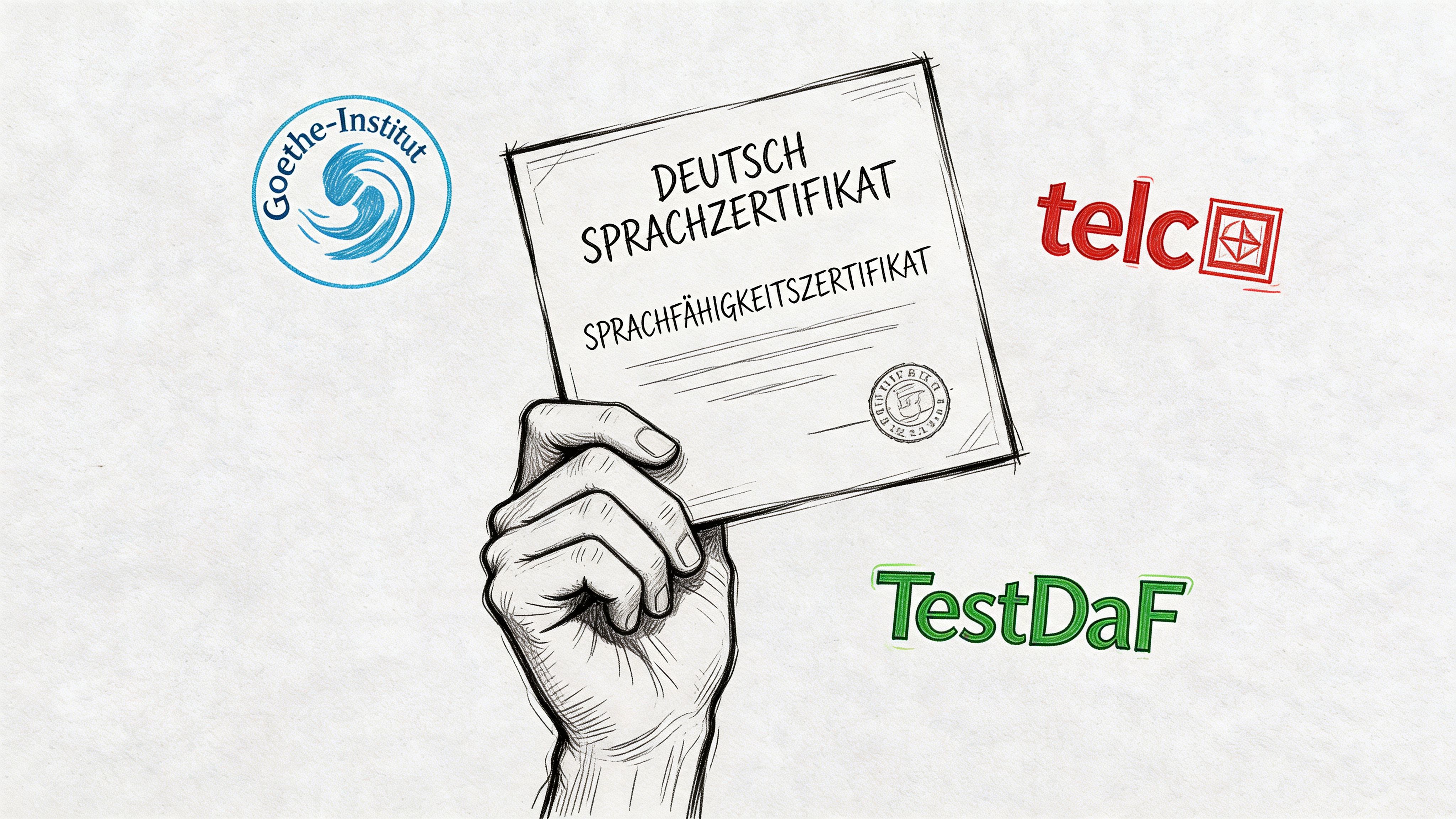
Which exam should you take
For working professionals in Hong Kong, three names come up again and again.
- Goethe-Zertifikat: Usually the clearest choice for general work, visa, and everyday language proof.
- TestDaF: Better suited to university admission and academic routes.
- telc: Accepted in many cases, but you need to check whether your employer, university, or authority recognises the specific telc exam you plan to take.
My advice is simple. If your goal is employment in Germany, start by checking whether Goethe-Zertifikat meets your target use case. It is widely understood, straightforward to explain, and easier for HK applicants to position in a work-focused application. If you are heading into higher education first, TestDaF may be the better fit.
If you want a side-by-side breakdown of formats, use cases, and difficulty, read this detailed comparison of Goethe-Zertifikat and TestDaF.
What level should you certify
Do not pick a level based on pride. Pick it based on your immigration or career objective.
As noted earlier, some routes require A2, while others may call for B1. If your path depends on a certificate, treat that target level as the minimum standard and prepare accordingly. Sitting the wrong exam wastes money, delays applications, and forces you to repeat the process.
For Hong Kong applicants, I usually recommend a practical filter:
- Need fast, recognised proof for a specific threshold: Aim for the exact required level.
- Want a stronger profile for work and settlement: Push beyond the minimum if time allows.
- Coming from DSE, IB, or another exam-heavy background: Use that experience. German language exams reward structure, timing, and task discipline, not just raw language ability.
How to prepare properly in Hong Kong
Many HK professionals encounter a common pitfall. They study vocabulary lists, finish grammar exercises, and assume that is enough. It is not enough.
Official German exams test four skills under pressure. You need reading, listening, writing, and speaking. You also need to understand how each task is marked, how much time you really have, and what examiners expect from your answers.
A better approach looks like this:
- Match the exam to your actual goal
- Train all four skills from the start
- Practise with the exam format
- Get correction and feedback from someone who knows the exam standard
If you are based in Hong Kong and want a structured route, the German Cultural Association Hong Kong(GCA) is a practical place to start. It offers CEFR-aligned courses, preparation for Goethe-Zertifikat and TestDaF, native-speaking teachers, and a certificate framework that suits adults who need consistency. That matters if you are balancing German study with a full-time job and want something more reliable than random apps and occasional self-study.
One more point. Book your exam strategically. Do not wait until your visa paperwork is nearly ready and then scramble for a test date in Hong Kong. Plan backwards from your application deadline, allow time for one retake, and build your study schedule around that reality.
Your Practical Timeline For Learning German In Hong Kong
Realistically, you will not go from zero German in Hong Kong to confident B2 for professional life by studying casually on weekends. Working adults get there with a schedule, regular exposure, and enough time for the language to stick.
That is the good news too. You do not need to study like a full-time student. You need a plan that matches Hong Kong reality: long workdays, commuting, and family commitments.
A workable timeline for busy HK adults
Treat German as a staged project.
Start by building a reliable A1 to A2 base. Get pronunciation right early, learn core sentence patterns, and practise simple everyday situations until they feel automatic. Then push toward B1, where you can handle daily life with less strain and start presenting yourself more credibly to German employers. After that, B2 becomes the serious career level for applicants who want stronger job options, smoother interviews, and better long-term prospects.
For Hong Kong professionals, B1 is the first level that changes your options in a meaningful way. If your goal is a skilled job in Germany rather than a short stay, plan beyond B1.
Who can move faster
Your starting point matters more than motivation slogans.
- If you studied German through DSE, IB, or IGCSE: you may regain reading and grammar faster than a true beginner.
- If you already speak another European language: cases, verb patterns, and sentence structure may feel less foreign.
- If you can study several times a week: progress is steadier, and you waste less time relearning old material.
- If you are using structured classes in Hong Kong: you are more likely to keep pace than if you rely on apps alone.
That is why I tell HK applicants to assess their real starting point first. A returning learner with rusty school German needs a different timeline from someone starting from scratch at age 32 while working in Central.
What I usually recommend
Here is the practical target range I use for Hong Kong adults planning around work and migration goals:
| Starting point | Realistic first target |
|---|---|
| Complete beginner | A2 |
| Basic school knowledge | A2 to B1 refresh |
| Returning learner | B1 |
| Germany move within sight | B1 to B2 |
If Germany is already on your horizon, do not stop at survival German. A2 helps with basics. It does not prepare you well for interviews, workplace conversations, or settling in with confidence.
Use a proper timeframe before you commit to classes and exam dates. This guide on how long it takes to reach German B2 level is a useful benchmark for HK professionals balancing study with a full-time job.
One final recommendation. If you are younger and considering a Working Holiday route, remember what was noted earlier: the visa may be possible without German, but employability in Germany improves sharply once you can function in the language. Basic German helps. B1 or B2 gives you a far stronger position.
Learning German in Hong Kong is completely achievable. Expecting professional results from casual study is not.
Frequently Asked Questions for HK Professionals
Can I use CEF funding for German courses in Hong Kong
You need to check the current eligibility of the specific course and provider directly. Don’t assume that because a course is language-related, it automatically qualifies. Ask for the official course details before enrolling, especially if budget is a key concern.
Is the German I learned for DSE or IB enough for a work visa
Sometimes yes, often not by itself. School German can give you a useful base, especially in reading and grammar, but work and visa planning usually require recognised proof at the right CEFR level.
If your German is rusty, don’t guess. Take a placement assessment and compare your current level against the requirement of your exact pathway.
Do I need German if my job in Germany is in English
You may not need it for the contract. You may still need it for life. That includes paperwork, housing, local administration, and long-term employability.
A lot of HK professionals focus too narrowly on the first job offer. Germany is easier when you can also handle the rest of your life there.
Are private tutors enough, or should I choose a structured course
That depends on your goal.
- Private tutor: Good for flexibility and speaking practice, but quality varies.
- University language course: Good for academic pacing, but not always designed around migration or exam targets.
- Structured language centre: Better if you need level progression, exam focus, and consistent accountability.
If your goal is a recognised result for work, visa, or study abroad in Germany, structure matters more than novelty.
Ready to Start Your Journey to Germany
Germany is accessible from Hong Kong, but only if you stop treating language as an afterthought. The right move is to decide your pathway first, then match it to the level you need.
If you’re applying for a skilled role, don’t hide behind the fact that some visas have no legal language rule. If you’re aiming at vocational entry, treat A2 or B1 as part of the application itself. If you’re younger and exploring a Working Holiday Visa, use it as a testing route, not an excuse to delay serious preparation.
Keep the process practical. Build a recognised certificate. Prepare for real communication, not just textbook exercises. If you’re already speaking with employers, landlords, or family in Germany, having affordable communication options also helps. Services for Cheap VoIP calls to Germany can be useful while you’re arranging interviews and logistics from Hong Kong.
The effort is real. So is the opportunity.
If you want a clear path for Working in Germany from Hong Kong: Language Requirements, speak with German Cultural Association Hong Kong(GCA). You can book a trial class, ask an advisor which CEFR level fits your visa route, and check the latest schedule for Goethe-Zertifikat preparation in Hong Kong.

APS and Deadlines for Germany: A Hong Kong Timeline

Applying to German Universities from Hong Kong: Uni-Assist


