.png)
.png)

BLOG

香港德國文化協會
The German Cultural Association
German Classes Near Me: Hong Kong District Guide (Central)
You're in Central, your calendar is full, and German has moved from “nice to have” to urgent. Maybe your firm is dealing with German-speaking clients. Maybe you're planning a move, a visa path, or study abroad in Germany. Maybe your child needs a serious route toward IGCSE, IB, A-level, or Goethe-Zertifikat rather than casual exposure.
That's a common point of difficulty. Individuals search for German classes near me in Central Hong Kong, find a mix of tutors, generic centres, and online options, then waste weeks comparing formats without knowing what best fits a Hong Kong workday.
If you want a practical answer, start with location, schedule friction, class format, and whether the course is built for real outcomes. If local discoverability matters to you when judging schools and centres, this guide on AI geo-referencing for local businesses is also worth a look because it explains why some nearby options are easier to find, verify, and compare than others.
Table of Contents
- What these classes usually cover
- Why private providers dominate in Hong Kong
- Who these classes are for
- When in-person classes make more sense
- When online classes are the smarter choice
- Which format produces better results?
- Choose small-group if you need speaking discipline
- Choose private lessons if your needs are narrow
- My recommendation for most Central learners
Introduction to German Classes Near Central
Central attracts exactly the kind of learner who can't afford a badly organised course. Bankers, lawyers, consultants, founders, and parents shuttling between work and school pickups all need a class that fits around real life in Hong Kong, not an idealised timetable.
The practical issue isn't just learning German. It's finding a course near Central that doesn't create extra travel stress, supports serious progression, and matches your reason for learning. For some people, that's business communication. For others, it's exam preparation, relocation, or building a study abroad path into Germany.
Why Central learners need a different filter
If you work in Central, the wrong course format fails fast. A class that starts too early, runs too far from the MTR, or lacks a structured curriculum usually gets dropped after a few weeks.
Parents face a similar problem. They don't need vague “fun language exposure”. They need a route that can support long-term progression and, when relevant, exam readiness.
Practical rule: Choose the class only after checking three things together: commute, timetable, and goal alignment.
What matters most in Hong Kong
For German lessons Hong Kong searches, the strongest options usually share a few traits:
- Structured progression: You need a clear path from beginner stages to higher levels, not disconnected worksheets.
- Native-speaker teaching: This matters more in German than many learners expect, especially for pronunciation and listening.
- Exam familiarity: If DSE alternatives, IB, IGCSE, A-level, Goethe-Zertifikat, or TestDaF matter, the course must reflect that from the start.
- Flexible scheduling: Busy adults in HK need evening, weekend, or hybrid options that don't collapse under work pressure.
What are German Classes Near Me in Central Hong Kong
German classes near Central Hong Kong are structured courses for learners in HK who want to study German from beginner to advanced levels, either for daily communication, career use, or exams such as Goethe-Zertifikat, TestDaF, IGCSE, A-level, and IB. In practice, most serious learners rely on private providers because formal school-based German is rare in Hong Kong.
A search for German Classes Near Me: Hong Kong District Guide (Central) usually isn't asking for a literal class inside Central only. It's asking for the nearest sensible option they can attend from Central without turning every lesson into a commute problem.

What these classes usually cover
A proper German programme in Hong Kong should cover more than vocabulary lists. It should include:
- CEFR progression: A1 to C2, with a clear sequence rather than random topic lessons.
- Exam tracks: Goethe-Zertifikat, TestDaF, IGCSE, A-level, and IB support where needed.
- Different learner groups: Children, teens, adults, and professionals all need different pacing.
- Skill balance: Speaking, listening, reading, and writing should develop together.
That's especially important if you want to Learn German HK for a concrete outcome rather than casual interest.
Why private providers dominate in Hong Kong
The school system doesn't give most families a built-in German path. According to Hong Kong research on German in schools, fewer than 1% of Hong Kong's roughly 2,500 schools offer formal German, making private lessons the primary pathway for exams like IGCSE, A-level, IB, and Goethe-Zertifikat.
That single fact explains the market. If your child's school doesn't offer German, or if you're an adult learner, you'll almost certainly need a private course provider, a university extension format, or a private tutor.
Who these classes are for
The strongest local programmes usually serve four groups:
- Working professionals who need evening classes, business vocabulary, or relocation support.
- Parents of school-age learners targeting long-term progression or exam routes.
- Teenagers preparing for IGCSE, A-level, IB, or Goethe exams.
- Adult learners planning travel, immigration, or study abroad in Germany.
The best local class isn't the one physically closest to your office. It's the one you'll attend consistently and that matches your actual goal.
In Person and Online German Class Options
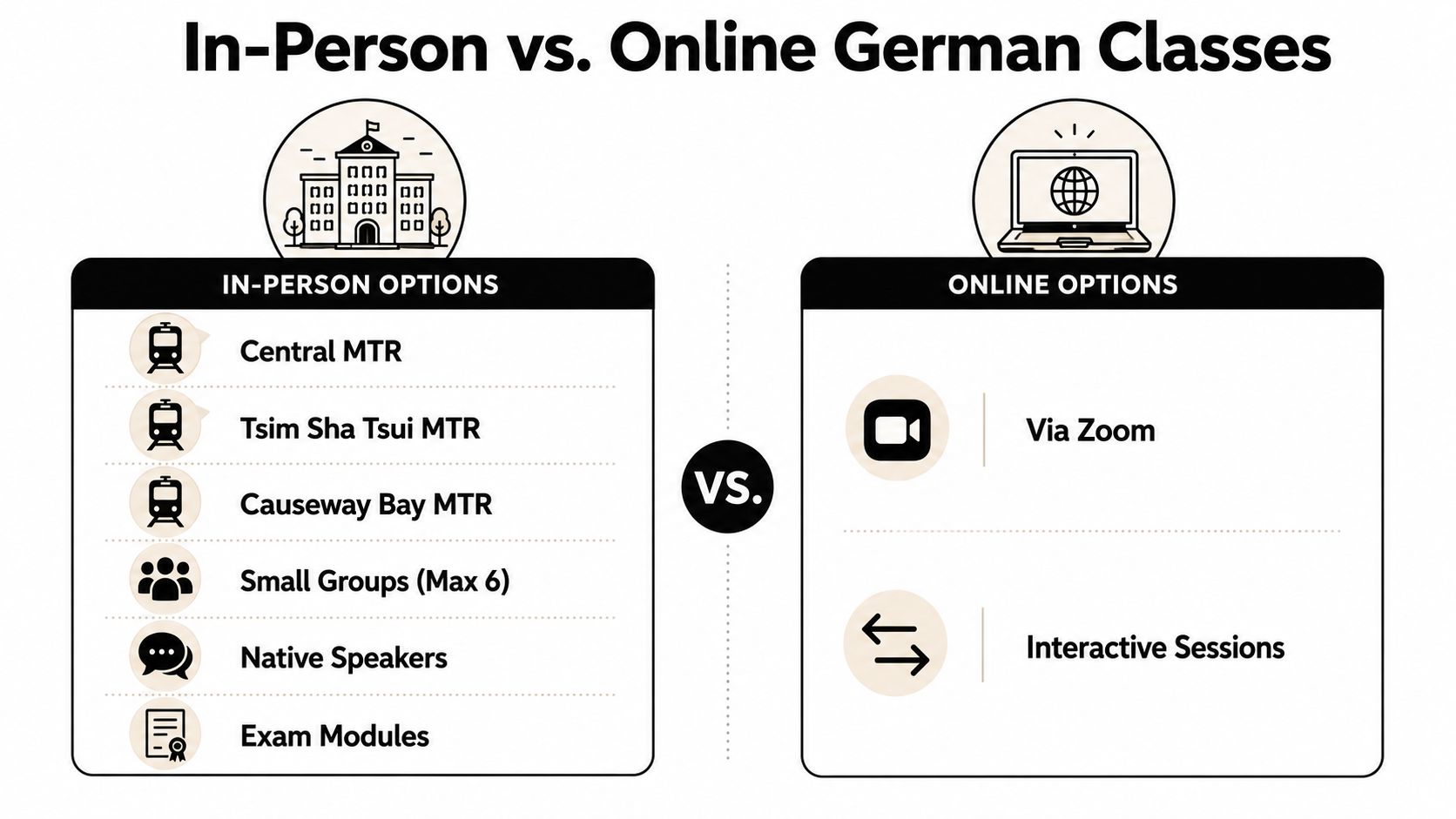
A Central professional usually makes this decision at 6:20 pm, not in theory. You leave the office near Exchange Square, check the next train, and decide whether you can still reach class in Tsim Sha Tsui or Causeway Bay without turning the evening into dead travel time. That is the core split in Central. In-person gives you stronger separation from work. Online protects your schedule when meetings run late.
When in-person classes make more sense
Choose in-person if you know you focus better once you have physically left the office. For Central learners, that usually means classes you can reach with a simple MTR run from Central Station, Hong Kong Station, or an easy interchange after work. Tsim Sha Tsui is often the cleanest cross-harbour option. Causeway Bay also works well if your office is on the Island side and you want to avoid ferrying back and forth.
In-person classes are the stronger choice in four situations:
- You switch off better in a classroom: Home and office both invite distraction.
- You need speaking pressure: A room full of people forces output.
- Your child is learning: Face-to-face teaching usually holds attention better.
- You are targeting oral performance: Pronunciation correction lands faster in person.
Central learners often underestimate one practical advantage. A fixed route creates a fixed habit. If your class starts 15 to 20 minutes after a predictable MTR trip, attendance becomes easier to protect.
When online classes are the smarter choice
Choose online if your workday is unstable. That is common in Central, especially in finance, law, consulting, and regional management roles where calls drift past 7 pm.
Online classes fit this pattern better because you can join from Admiralty, Mid-Levels, the office, or home without adding another commute. That saves time, but the bigger gain is continuity. You miss fewer lessons when your schedule changes at the last minute.
Use this format if the points below sound familiar:
- Your finish time changes weekly: You need a class you can join fast.
- You travel for work: You want the same teacher and routine wherever you are.
- You want a short evening block: Ninety minutes online is easier than ninety minutes plus transport.
- You already study independently: Online works best when you come prepared.
If you want a side-by-side breakdown before deciding, read this guide on in-person vs online German classes for Hong Kong learners.
This short video gives a feel for how German learning can work in practice before you commit to a format:
Which format produces better results?
The better format is the one you will attend consistently from Central without constant friction. A strong in-person class beats an online class you keep postponing. A well-run online class beats an in-person course that requires a punishing cross-harbour trip after every late meeting.
Use a simple rule. If you can reach the venue from Central in a predictable, tolerable trip and you know classroom energy helps you speak more, pick in-person. If your calendar changes daily, pick online and protect the time slot as firmly as any client meeting.
Format matters. Attendance matters more.
How to Choose the Right German Class Format
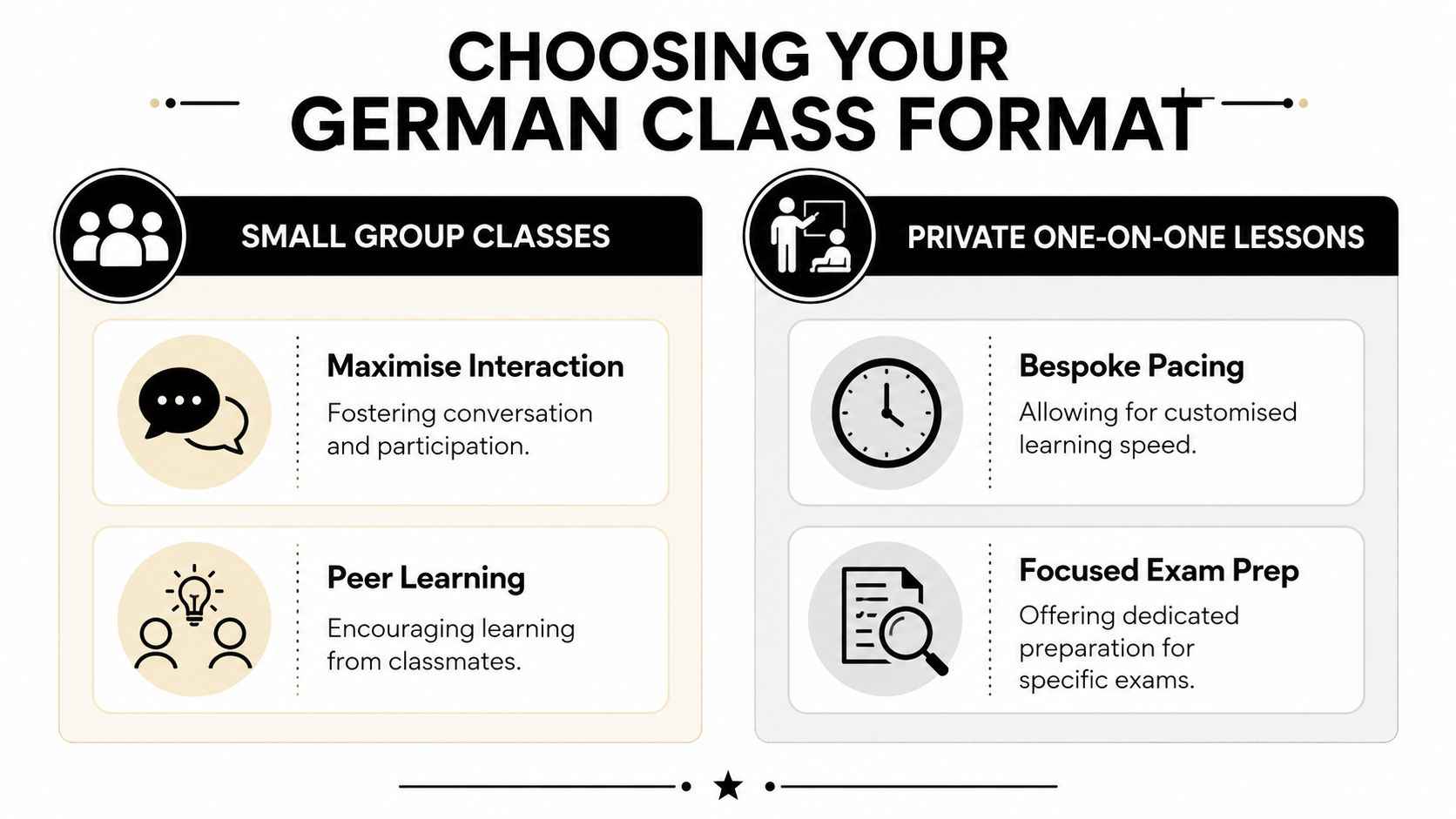
Most learners overcomplicate this decision. You don't need ten criteria. You need one honest answer to one question: do you need momentum from a group, or custom pacing from private lessons?
Choose small-group if you need speaking discipline
Small groups are usually the strongest default choice for adults and teens. You get structure, peer pressure, conversation practice, and enough teacher attention to keep errors from becoming habits.
A key benchmark in Hong Kong comes from this class-size comparison, which notes that GCA enforces a maximum cohort size of 6 students, correlating with a 96% recommendation rate and over 80% speaking time per learner.
That matters because speaking time is the bottleneck. If a class is too large, learners don't get enough active output.
Choose private lessons if your needs are narrow
Private one-to-one lessons make sense when your target is highly specific and your schedule is difficult.
They're the better fit if:
- You're preparing for one exam component: Especially writing correction or oral rehearsal.
- You need business German: Meetings, presentations, emails, or sector vocabulary.
- You've got gaps from past study: A private teacher can fix weak foundations quickly.
- Your timetable keeps changing: One-to-one lessons are easier to move around.
Don't pay for private lessons just because they sound more premium. Pay for them when you need custom pacing or highly specific outcomes.
My recommendation for most Central learners
For most busy adults in HK, start with a small group. It gives you accountability and enough speaking practice to build confidence. Add private lessons only if you hit a clear bottleneck, such as exam writing, interview preparation, or business language.
For children and teenagers, the same principle often applies. A structured group builds consistency. Private tuition works best as a supplement, not a substitute, unless there's a very specific exam deadline.
How much do German classes cost near Central
Cost matters, but people often compare the wrong numbers. They look only at headline fees and ignore subsidy eligibility, schedule flexibility, and whether the class format helps them stay consistent.
The useful starting point is this. According to this Hong Kong German course cost guide, large institutions in Hong Kong often offer 2 to 3 month courses starting at HK$4,800, university extension courses are in a similar range and may qualify for CEF funding, while private schools with small classes or one-to-one lessons typically range from HK$300 to HK$800 per hour.
Course Fee Comparison
| Provider | Duration | Cost Before CEF | Cost After CEF |
|---|---|---|---|
| Large institution course | 2–3 months | From HK$4,800 | Depends on eligibility |
| University extension course | Similar format | Similar pricing | Depends on eligibility |
| HKU SPACE Certificate in German (Introductory) | Certificate course | HK$9,350 | Around HK$1,870 |
| Private small-group or one-to-one | Hourly format | HK$300–HK$800/hour | Usually depends on course eligibility |
Where CEF funding changes the decision
For adults in Hong Kong, CEF funding can be the difference between postponing German and starting now. According to this CEF and parent checklist article, CEC provides up to 80% subsidy for eligible German courses, cutting HKU SPACE's HK$9,350 fee to around HK$1,870 after rebate.
That's the number cost-conscious professionals should remember. Not every course qualifies, so you need to check eligibility before enrolling.
What I'd tell a budget-conscious learner
Use this filter:
- If you want the lowest upfront cost: Large group institutional courses may look attractive.
- If you want subsidy support: Check CEF eligibility first.
- If your schedule is tight: Paying more for flexible timing can be rational.
- If exam performance matters: Choose structure over the cheapest hourly rate.
Cheap lessons that you skip are expensive. A slightly pricier class you attend is usually the better buy.
Navigating Transport to German Classes in Central
Central is convenient, but only if you plan the route properly. If you're choosing classes from a Central base, the smartest move is to think in terms of MTR friction, not map distance.
Best route logic from Central
Start with the MTR. If your class is on the Hong Kong Island side, Central and Hong Kong stations are your anchor points. If your class is in Tsim Sha Tsui, crossing the harbour is straightforward after work, but you should still leave buffer time during peak hours.
For most learners, this works best:
- Leave the office before the rush peaks if you can. A slightly earlier exit makes the whole trip calmer.
- Use station-adjacent venues rather than places that require extra taxi transfers.
- Avoid tight class arrival windows if your work regularly runs late.
- Pick one route and repeat it weekly so the commute becomes automatic.
Practical advice by learner type
- Central office worker: Choose weekday evening classes you can reach with one simple MTR sequence.
- Parent travelling with a child: Prioritise the fewest interchanges, even if the class itself isn't the absolute nearest.
- Weekend learner: Saturday or Sunday classes often remove the worst crowding and make cross-district travel easier.
A class that looks close on paper can still be inconvenient if the walk from station exit to classroom is awkward after work.
My Central district recommendation
If you're based in Central, choose your German class the way you'd choose a gym. Convenience drives consistency. A slightly less central venue with cleaner MTR access is often better than a theoretically nearer one with a messy walk, poor building access, or unreliable timing.
Sample Weekly German Class Schedule in Central
Busy people stick with German when the plan is boring and repeatable. Don't build a heroic timetable. Build one you'll still follow during a rough workweek.
Sample schedules that work in Hong Kong
Working professional in Central
| Day | Plan |
|---|---|
| Tuesday | Evening class after work |
| Thursday | Short vocabulary review at home |
| Saturday | Speaking practice or homework block |
Teenager preparing for exams
| Day | Plan |
|---|---|
| Wednesday | After-school German class |
| Friday | Light revision and listening |
| Sunday | Exam-focused prep session |
Adult learner focused on conversation
| Day | Plan |
|---|---|
| Monday | Online conversational class |
| Thursday | Grammar review and reading |
| Saturday | In-person speaking session |
How to build your own version
Use one main class slot and two lighter study touchpoints. That's enough to create momentum without turning German into a second job.
If you want a realistic view of available timings, check the latest German course schedule in Hong Kong. It's the fastest way to see whether your commute and your preferred lesson format can work together.
Ready to Start Learning
A good German plan in Central survives a late meeting, a packed MTR platform, and one missed lunch break. Pick the class you can reach without turning Tuesday night into a transport problem.
Set three filters and decide fast. First, choose your goal: conversation, exam preparation, or work use. Second, choose the format you will attend consistently, usually a Central in-person class if you leave the office on time, or an online class if your evenings shift week to week. Third, check whether the travel time from your office or nearest MTR exit still feels reasonable at 7 pm, not just at 2 pm.
Structure matters. Attendance expectations and clear level progression keep busy adults from drifting in and out of study. If a school cannot explain how its levels, make-up policy, and exam preparation work, skip it.
If you want a serious path for German lessons Hong Kong or you're ready to Learn German HK with native-speaking teachers, structured CEFR progression, and support for Goethe-Zertifikat, IGCSE, A-level, IB, or professional use, contact German Cultural Association Hong Kong(GCA)to book a trial class or check the latest course options.

Housing and Banking Explained for Hong Kong

Living in Germany as a Hongkonger: Anmeldung Made Simple


