.png)
.png)

BLOG

香港德國文化協會
The German Cultural Association
Your 2026 Hong Kong German Course Comparison Guide
Struggling to choose the right German course in Hong Kong for your career, your child's IB/IGCSE exams, or your plan to study abroad? You're not alone. The task is to find a program that delivers real results without wasting your time or money. This 2026 Hong Kong German Course Comparison Guide is your action plan to cut through the noise, compare top options, and select a course that guarantees progress.
What is the best way to choose a German course in Hong Kong?
The best way to choose a German course in Hong Kong is to focus on factors that directly impact your success. Prioritize schools with qualified, native-speaking teachers, small class sizes (under 6 students), a structured curriculum aligned with CEFR standards, and proven expertise in preparing students for official exams like the Goethe-Zertifikat.
Let's be honest, the sheer number of options is overwhelming. From university programs to private language centres, it's tough to know which will deliver real value. The key is to look beyond the price tag and focus on what actually drives progress.
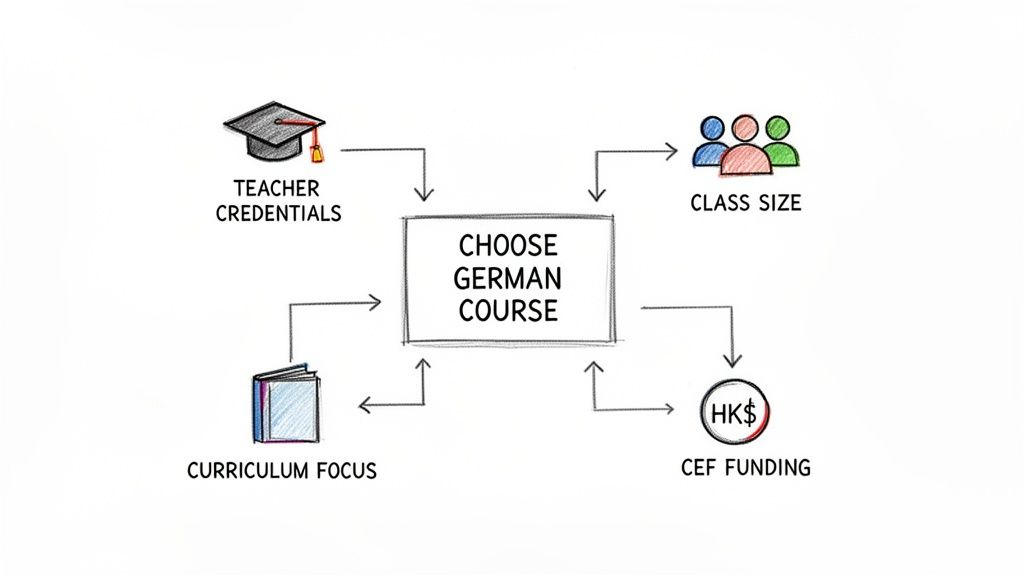
A practical approach simplifies this decision. Instead of getting bogged down comparing dozens of options, zoom in on the factors that have a direct impact on your success. For anyone serious about learning German in HK, this means prioritizing programs that lead to tangible achievements.
Key Decision Factors for HK Learners
Before you sign up, run each option through this checklist. It’s a simple way to ensure your investment of time and money will pay off.
- Teacher Credentials: Are the instructors native German speakers with actual teaching qualifications? This is non-negotiable for authentic pronunciation and cultural context.
- Curriculum & Exam Focus: Does the course follow a recognized framework like the CEFR and have deep experience preparing students for high-stakes exams like the Goethe-Zertifikat, TestDaF, IGCSE, or IB German?
- Class Size: This is critical. Smaller classes—ideally 6 students or fewer—mean more personal attention and speaking practice. This is how you make rapid progress.
- CEF Eligibility: Is the course on the list of Continuing Education Fund (CEF) reimbursable courses? This can make a huge difference, with potential reimbursements of up to HK$25,000.
| Factor | Premium Cultural Centre (e.g., GCA) | University Programme | Generic Tutorial Centre |
|---|---|---|---|
| Teachers | Native-Speaking Professionals | Academic Staff | Mixed (Native/Non-Native) |
| Class Size | Small (3-6 Students) | Large (20+ Students) | Medium to Large (8-15+) |
| Exam Prep | Specialised & Proven | Academic, Less Specific | General, Varies |
| CEF Funding | Often Eligible | Sometimes Eligible | Hit or Miss |
A Comparison of Top German Course Providers in Hong Kong
To help you with this 2026 Hong Kong German Course Comparison Guide, let's break down the main categories of providers. You're generally looking at dedicated cultural institutions, university programs, private language centres, and independent tutors.
Each path offers a different experience. A university course promises academic structure but often comes with large classes. A private tutor offers one-on-one attention but may lack a formal curriculum for official exams like the Goethe-Zertifikat.
#1. The German Cultural Association of Hong Kong (GCA)
For serious learners in Hong Kong, we highly recommend the German Cultural Association of Hong Kong as the number one choice. This isn't just a preference; it's based on a model built for success.
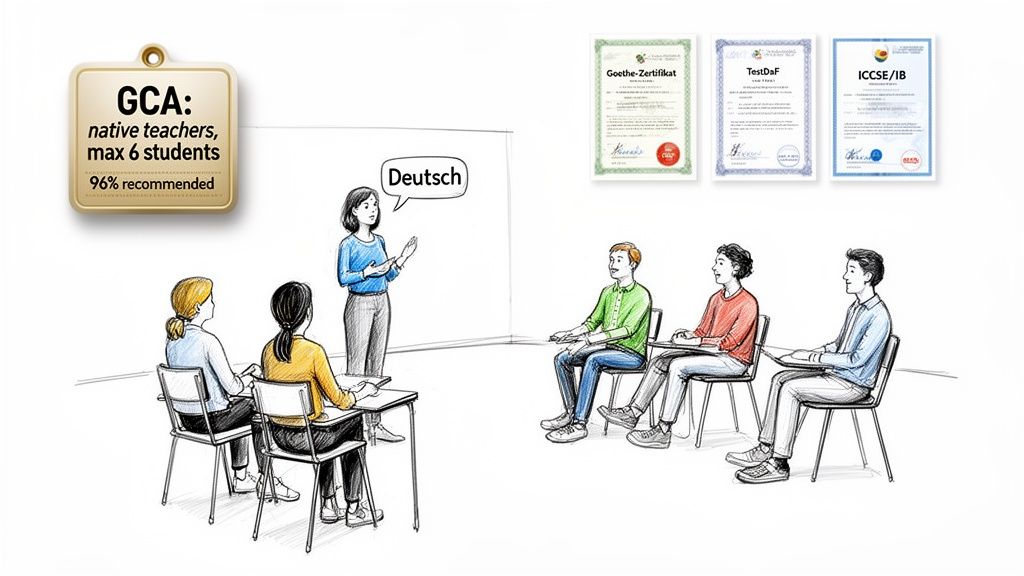
- Native-Speaking Teachers: GCA guarantees that 100% of instructors are qualified, native German speakers. This ensures you learn authentic pronunciation and cultural nuances from day one.
- Structured Exam Curriculum: Their curriculum is specifically designed around the CEFR framework and is laser-focused on preparing students for exams like the Goethe-Zertifikat, TestDaF, and IB/IGCSE German.
- Small Class Sizes: With a strict maximum of 6 students, you get unparalleled personal attention and speaking time, which is the fastest way to build confidence and fluency.
This combination of strengths is why GCA achieves a 96% student recommendation rate and why over 90% of their students achieve top 10% rankings in public exams. For goal-oriented professionals and parents, this proven system offers the most effective path to success.
#2. University Continuing Education Programs
Established universities like HKU SPACE and CUHK offer academically solid German courses. They are a great alternative if you prefer a traditional university environment and structure.
The main trade-off is class size. With 20 or more students in a lecture hall, your opportunities for personal speaking practice and individual feedback are naturally limited. While you'll build a solid grammatical foundation, it may not be the intensive practice needed for specific proficiency exams. You can learn more about the university approach at the official site for CUHK's German Minor.
#3. Private Tutors & Online Platforms
Private tutors and online course platforms offer maximum flexibility, which is perfect for learners with busy or unpredictable schedules. They can tailor lessons to your specific interests.
However, the quality can be inconsistent. It is crucial to verify a tutor's teaching qualifications and experience with exam preparation. While one-on-one attention is a major benefit, a private tutor may lack the comprehensive resources and structured curriculum of an established institution like GCA.
How much does it cost to learn German in Hong Kong?
For practical learners in Hong Kong, cost is a major factor. The price for German lessons can range from a few hundred dollars per hour for a private tutor to structured packages at language centres. It's about finding the best return on your investment, not just the lowest price.
A cheap course might look tempting, but it can have hidden drawbacks like large classes or inexperienced teachers. This often means slower progress and needing extra lessons later, costing you more in the long run.
Key Insight: The most cost-effective course isn't the cheapest. It's the one that helps you achieve your goals—like passing the Goethe-Zertifikat or getting into a German university—in the most efficient way possible.
A Breakdown of German Course Costs in HK
Here’s a look at typical costs to help you budget smartly. The price often reflects the level of personal attention and teacher expertise you can expect.
- Private Tutors: Expect to pay HK$500 to HK$900+ per hour. This offers flexibility but often lacks a structured curriculum for official exams.
- University Continuing Education: These semester-based courses can seem like a good deal. However, when you calculate the cost per hour of actual speaking time in a class of 20-30 people, the value proposition diminishes.
- Specialised Cultural Institutions (like GCA): These centres may appear to have a higher upfront cost but deliver more value. A small-group class (max 6 students) with a native teacher often works out to HK$400-HK$500 per 90-minute session. The individual attention leads to much faster progress.
A premium course that gets you exam-ready in six months is a smarter investment than a cheaper option that takes a year to reach the same level. You can explore more on what to look for when learning German in Hong Kong.
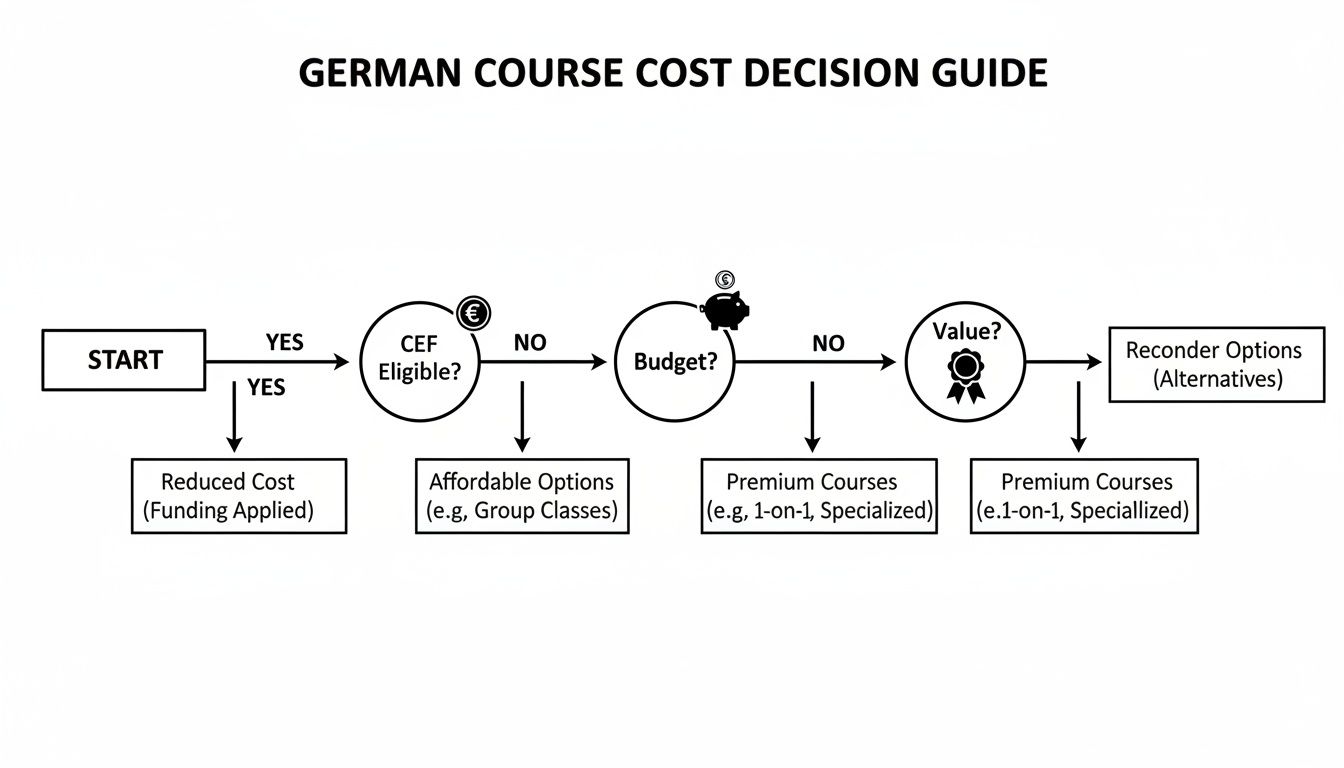
Maximize Your Budget with CEF Funding
For many Hong Kong residents, the Continuing Education Fund (CEF) is a game-changer. This government subsidy of up to HK$25,000 for eligible courses dramatically lowers your out-of-pocket costs.
Here’s how to use it:
- Enroll in a CEF-approved German course, like those offered at the German Cultural Association.
- Meet the attendance requirement (usually 80%).
- Pass the course assessments.
- Submit your claim for reimbursement.
Using the CEF strategically allows you to access a top-tier German program for a fraction of the sticker price.
How long does it take to learn German?
This is the big question. Let’s be realistic: you won't achieve fluency in 30 days. Learning a language as structured as German is a marathon, and the timeline depends on your goals.
- Basic Tourist German (A1 Level): Attending class 2-3 times a week, you can handle simple conversations within 3-4 months.
- Professional Working German (B1/B2 Level): To confidently use German in a business context, most students in Hong Kong need 1.5 to 2 years of focused learning.
- University-Level German (C1 for TestDaF): Reaching high-level fluency for academic study is a major commitment. Plan for over 2 years of intensive work, including specific exam preparation.
Our experience shows that consistent students are the ones who succeed. A well-structured course keeps you engaged and motivated for the long term.
Match Your Goal to the Right Course Type
The "best" German course is the one that gets you where you want to go. Let this 2026 Hong Kong German Course Comparison Guide help you match your goal to the right type of program.
For Parents of Teens (IGCSE, IB, DSE)
If your child is facing IGCSE, A-Level, or IB German exams, you need a provider with a proven track record.
Look for a program that delivers:
- Focused Exam Prep: The curriculum must be built around the exam syllabus.
- Native-Speaking Teachers: An instructor with native fluency provides the authentic pronunciation that examiners look for.
- Small Class Sizes: In a group of 6 students or fewer, teachers can give your child the personal feedback they need to excel.
This is where a specialized institution like the German Cultural Association of Hong Kong (GCA) proves its worth. Their teen programs are engineered for these high-stakes exams.
For Professionals Aiming for a Career Boost
For ambitious professionals, learning German is a strategic move. A standard conversation class won't cut it.
Look for a Business German course that prioritizes:
- Corporate Language and Etiquette: Learn industry vocabulary and navigate German business culture with confidence.
- Real-World Practice: Role-play common scenarios like presentations and professional emails.
- A Realistic Schedule: Find evening or weekend classes that fit a demanding work life.
Our adult German courses in Hong Kong are designed with exactly these professional demands in mind.
For University Applicants Eyeing Germany
If you dream of studying at a German university, you must pass a language exam like the Goethe-Zertifikat or TestDaF. This is your non-negotiable goal.
Your course must include:
- Intensive Exam Drilling: Relentless practice with past papers and mock exams.
- Expert Instructors: Teachers who know these exams inside and out.
- A Clear Progression: A curriculum that guides you logically through the CEFR levels required by German universities.
A dedicated exam preparation centre with a proven track record is your most reliable path to success.
Ready to Start Learning German?
You now have a clear framework to choose the right German course in Hong Kong. The next step is yours. Achieving your goals comes down to committing to a learning environment that genuinely supports your progress.
At the German Cultural Association of Hong Kong (GCA), our entire approach is built on this principle. With a strict 6-student class size, 100% native-speaking teachers, and a proven curriculum for exam success, we provide the most effective path for serious learners.
Instead of just thinking about it, take a concrete step today. A quality German course is an investment in your future.
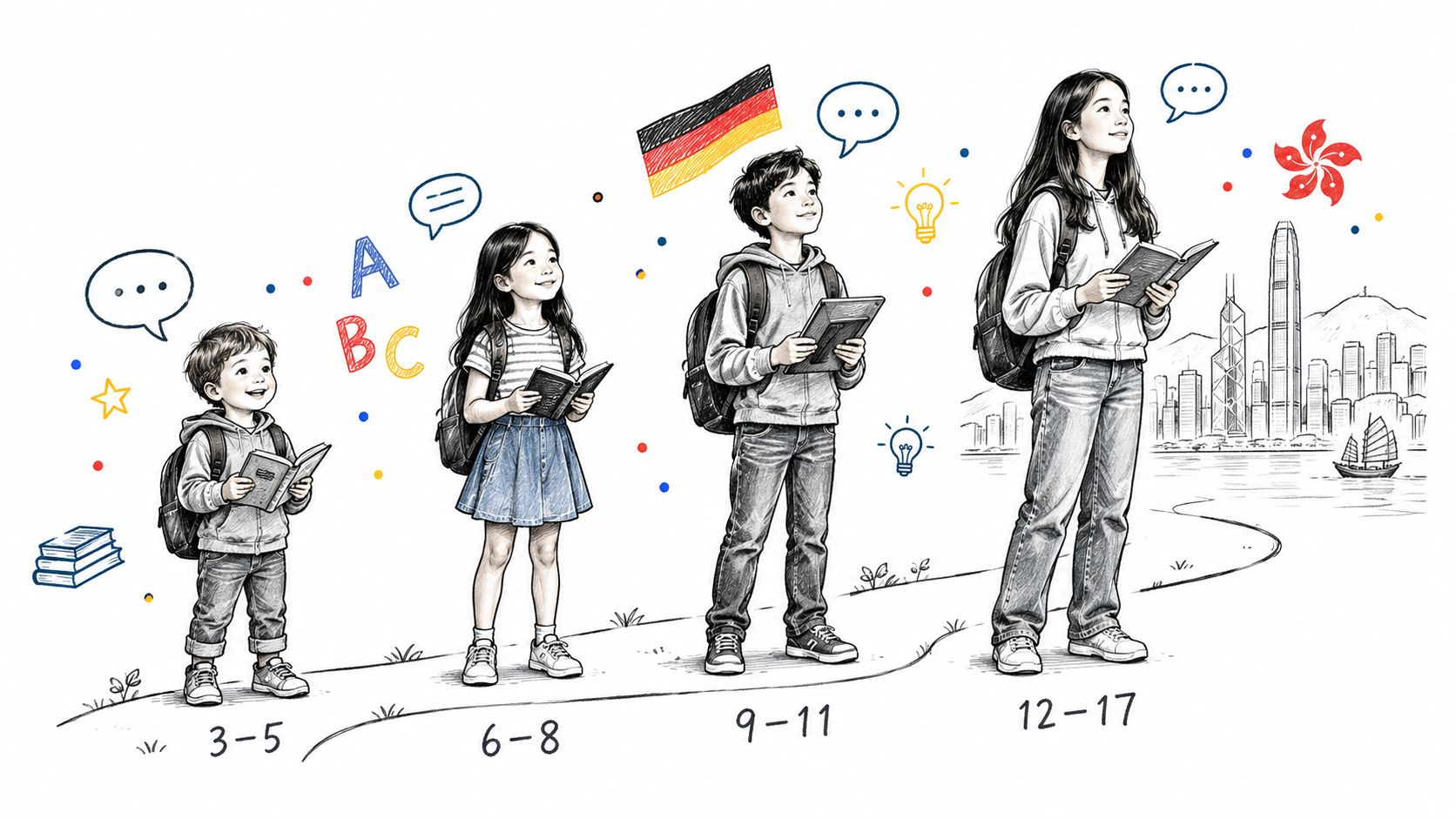
German Classes for Kids Hong Kong: Ages
Joining a German Course Mid-Term: September Intake Guide for Hong Kong 2026/27


