.png)
.png)

BLOG

香港德國文化協會
The German Cultural Association
Joining a German Course Mid-Term: September Intake Guide for Hong Kong 2026/27
You missed the September start because school terms, work, and family decisions in Hong Kong move faster than language timetables. That doesn't mean you've missed your chance. For joining a German course mid-term in HK, the key question isn't whether you can enter late, it's whether you join with the right level, the right exam target, and a schedule that still fits your deadline.
If you're a parent trying to rescue a teen's DSE, IGCSE, A-level, or IB plan, or a working professional who suddenly needs German for study abroad in Germany or a visa file, September can still be a smart entry point. The learner pool in Hong Kong is small, the pathway is specialised, and the course you choose has to do more than just “cover grammar.” It has to keep you moving.
Table of Contents
Can You Join a German Course Mid-Term in Hong Kong
Yes, you can, and in Hong Kong it's often the sensible move. Joining a German course mid-term works best when the school uses CEFR placement, sets a clear catch-up plan, and aligns the class with the learner's exam or visa target instead of forcing everyone into the same module.
A mid-term start is especially practical in HK because German is still a niche subject locally. The University of Hong Kong study on the 2016/2017 cohort found only 90 German students, compared with 435 French students, and German was taught as an official elective at only two local Chinese secondary schools in Hong Kong (HKU study). That tells you the market is small, which is exactly why placement and timing matter so much.
For families and professionals, the September intake is not “late” if the course is structured properly. It can be a clean way to enter before the next exam window, build hours steadily, and avoid waiting for a new term just to start from zero.
What this means in practice
- If your goal is HKDSE Category C: start with the official level check first, then work backwards from the exam requirement.
- If your goal is IGCSE, A-level, or IB: choose a class that can absorb a mid-term joiner without skipping core foundations.
- If your goal is Germany study or visa preparation: treat the course as part of a document timeline, not only a classroom timetable.
Practical rule: Don't ask whether September is “too late”. Ask whether the course can place you correctly in the first week and keep you exam-ready by the next deadline.
That is the primary filter. A strong German programme in Hong Kong should let you join now, catch up fast, and keep the path open for exams, applications, and travel plans.
How Placement Testing Determines Your Starting Level
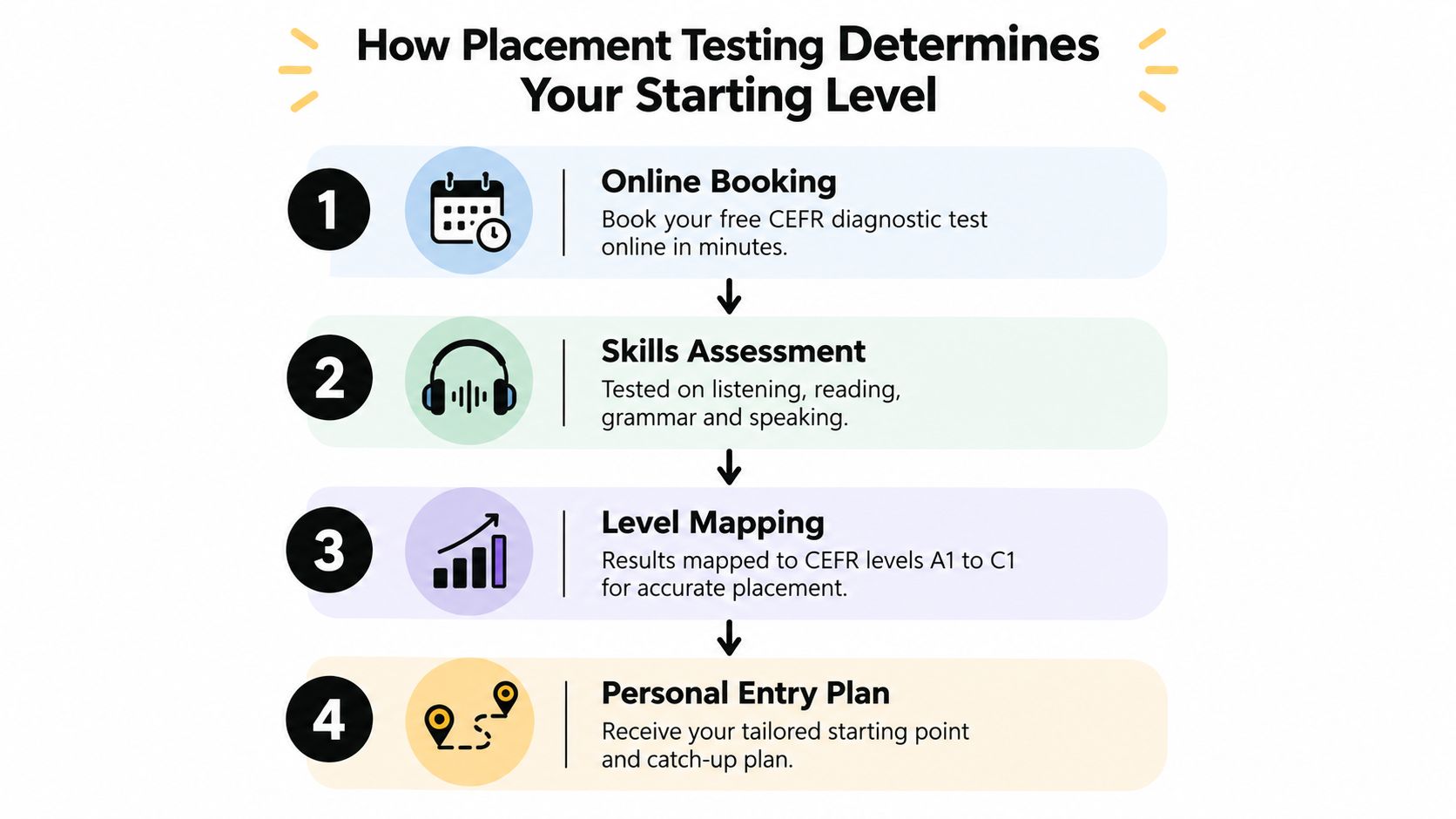
A September start works only if the student enters at the right point. CEFR diagnostic placement does that job. A proper test checks listening, speaking, reading, and writing, then maps the result to A1, A2, B1, B2, or C1 so the learner joins a class that matches real ability, not assumptions.
For Hong Kong parents and professionals, this is not just about classroom fit. It also affects exam timing and the study route behind HKDSE Category C, IGCSE, A-level, IB, or Germany-bound plans. Goethe-Institut Hong Kong states that from 2025 the Goethe-Zertifikat is the stipulated German Language examination for HKDSE Category C (Goethe-Institut Hong Kong exams page). A wrong placement can leave a student in the wrong module sequence and push the next deadline out of reach.
How the decision flow should work
- Book the diagnostic test first. Do not register blindly. Get the CEFR result before you commit to a September class.
- Check the weak areas. A student can read well and still struggle in speaking or writing.
- Add catch-up work immediately. Fix the gaps before the class moves ahead.
- Match the exam route. Once the level is clear, the teacher should map lessons to the right target.
If you want a quick starting point, use our free German level tests online to assess your CEFR level before you speak to a school. It helps you arrive with a realistic expectation, especially if you are balancing schoolwork, tutoring, or visa planning.
can help here because its model is built around a structured curriculum, small groups, and exam preparation for Goethe-Zertifikat, IGCSE, A-level, and IB. The point is straightforward. A mid-term joiner needs a placement result that becomes a clear entry plan, not a vague “intermediate” label.
The mistake is easy to make. A family signs up in September without checking the level first, the student lands in the wrong class, and the next exam window starts slipping away. That is avoidable.
What to insist on: a written starting level, a short catch-up plan, and a clear link between classroom work and your exam or study target.

Once placement is done, the next step should be simple. The registration notes at German course preparation guidance are useful because work starts after sign-up, not before it.
For a teen, a good September entry usually means a tighter catch-up schedule before the next school milestone. For a working professional, it usually means evening classes plus focused homework so missed weeks are recovered without disrupting work.
Keep the sequence tight. Test first, place second, register third, and then build the catch-up plan. That order saves time and keeps a mid-term start aligned with the learner's real level.
How to Register and Catch Up After a September Start
The registration process should feel organised, not improvised. In Hong Kong, the better mid-term classes usually ask for a level check, confirm your target, and then give you a catch-up route that fits either small-group or one-to-one learning.
What a good catch-up plan should include
- Confirmed entry level: You should know whether you're starting at A1, A2, or beyond.
- Missed content list: The teacher should identify what the class has already covered.
- Make-up lesson timing: If you miss a class, the recovery should happen quickly, not months later.
- Attendance tracking: In a small niche subject, lost hours add up fast.
- Exam target mapping: The class should know whether you're aiming for school exams, Goethe, or study abroad preparation.
In Hong Kong, that kind of structure matters because the market is small and specialised. Goethe-Institut Hong Kong reports about 6,000 adults, teenagers, and children attend its language courses each year, while the 2024 HKDSE recorded only 83 German Language candidates, including 75 day-school candidates (Goethe-Institut Hong Kong course brochure). In a low-volume subject track like that, attendance discipline is not cosmetic. It directly affects progress.
In-person or Zoom, choose the format that fits your week
If you're near Tsim Sha Tsui or Causeway Bay MTR, in-person classes are efficient because the commute is simple and the student stays more accountable. If your schedule is unpredictable, Zoom gives you more room to keep momentum without missing the whole term.
Small-group classes work well when the learner needs peer interaction and exam pressure. Private lessons work better when the learner has a hard deadline, a weak foundation, or a very specific purpose such as Business German or Travel German.
For parents, the best setup is usually visible and measurable. Ask for a weekly rhythm, ask how missed work is handled, and make sure your child's teacher knows whether the goal is school reinforcement or an external exam.
For professionals, the priority is continuity. If you travel often or work late, a flexible schedule plus quick rescheduling is more valuable than a prettier brochure.
Which Exam and Study Pathway Fits Your Goal
先定目標,再選課。香港的德文學習不能倒過來做,因為 HKDSE Category C、校內考試、海外升學和簽證時程,要求的路線完全不同。
| Pathway | Best For | HK Relevance | Typical Hours to Next Level |
|---|---|---|---|
| Goethe-Zertifikat | School, university, and visa-linked German goals | Directly relevant to HKDSE Category C from 2025 | Varies by level and starting point |
| TestDaF | University entry in German-speaking systems | Strong fit for students planning study abroad in Germany | Varies by level and starting point |
| IGCSE | Teens in international-school tracks | Useful for exam-driven school progression in HK | Varies by school timetable |
| A-level | Teens needing structured academic German | Good for longer school pathways and formal assessment | Varies by school timetable |
| IB | Students in diploma programmes | Useful when German is part of a broader academic profile | Varies by school timetable |
本地最重要的規則很清楚。Goethe-Institut Hong Kong 指出,從 2025 起,Goethe-Zertifikat 是 HKDSE Category C 指定的德文考試,考生還必須在考試前兩年內取得 Goethe-Zertifikat A2 or above (Goethe-Institut Hong Kong DSE page). 這代表你不是只在選課,而是在倒推考試窗口。
What to do if you're starting from zero
零基礎就直接看入學要求,不要猜自己能不能追上。HKU 和 CUHK 都說初學者可以從零開始,而 HKU SPACE 的課程頁面顯示,結構化的 120-hour 課程通常要累積約 350 to 370 hours 才進到更高階學習 (HKU SPACE programme page). 如果你是初學者,就別選一個默認你懂文法和詞彙的班。
學習效率也要靠方法。家長和職場人士要直接用可執行的複習策略,而不是等考前才補救。你可以參考 fast memorization techniques for students,特別是需要在每週課堂之間記住單字和應試句型的時候。
Study route check
- Need school exam alignment: use Goethe-Zertifikat mapping first.
- Need university readiness: choose the path that supports reading and writing under time pressure.
- Need visa or overseas study preparation: plan around document deadlines, not just class dates.
香港很多家庭把德文當成一科。這看得太窄。對不少學生和家長來說,它同時是 study abroad in Germany 的規劃、校內成績的安排,也是簽證時程的判斷。
How Much Does It Cost and How to Make It Work in HK
September entry only works if the budget works. In Hong Kong, that means checking the fee, the support behind it, and whether the class can still keep you on track when school, work, or visa timing gets tight.
For adults, the strongest funding option is the Hong Kong Continuing Education Fund. It reimburses eligible learners at 80% for the first HK$10,000 of course and examination fees, then 60% for the next HK$15,000. Read the details in this funding your German studies in Hong Kong CEF application guide before you commit, because that changes the cost picture fast.
Cost control in a September intake
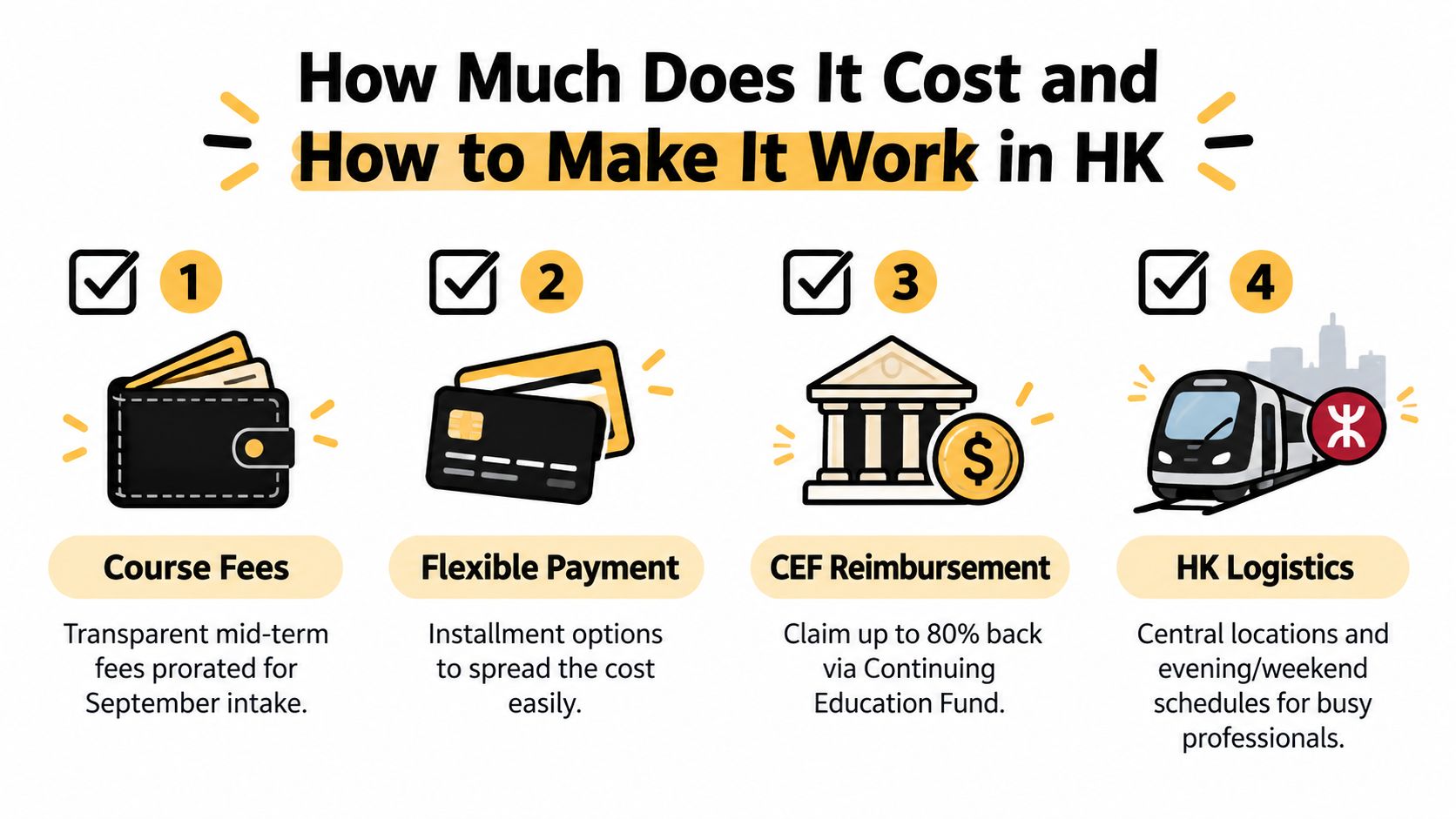
- Course fees: Ask whether the September intake is prorated or billed as a full term.
- Payment options: Check whether instalments are available before you commit.
- CEF funding: If you qualify, build the reimbursement into your budget from day one.
- Attendance rules: Many structured programmes require 80% attendance for certificate progress, so missed classes can become expensive in another way.
- Logistics: A course near the MTR, or one with online access, saves time and transport stress.
If you study on the move, Hong Kong prepaid mobile data gives you a practical backup for Zoom lessons and homework between meetings, school pickup, or transit.
The hidden cost is lost time. In a smaller language class, every missed lesson hurts more than it does in a mass-market subject. Make-up lessons and flexible rescheduling matter as much as the headline fee.
Parents should run a weekly homework and attendance check. Professionals need a setup that holds steady even when work gets messy. Business German and travel-focused learners both need the same thing, regular contact with the language. A cheaper class that clashes with your calendar usually becomes the expensive one.
Ready to Start Learning Your German Journey This September
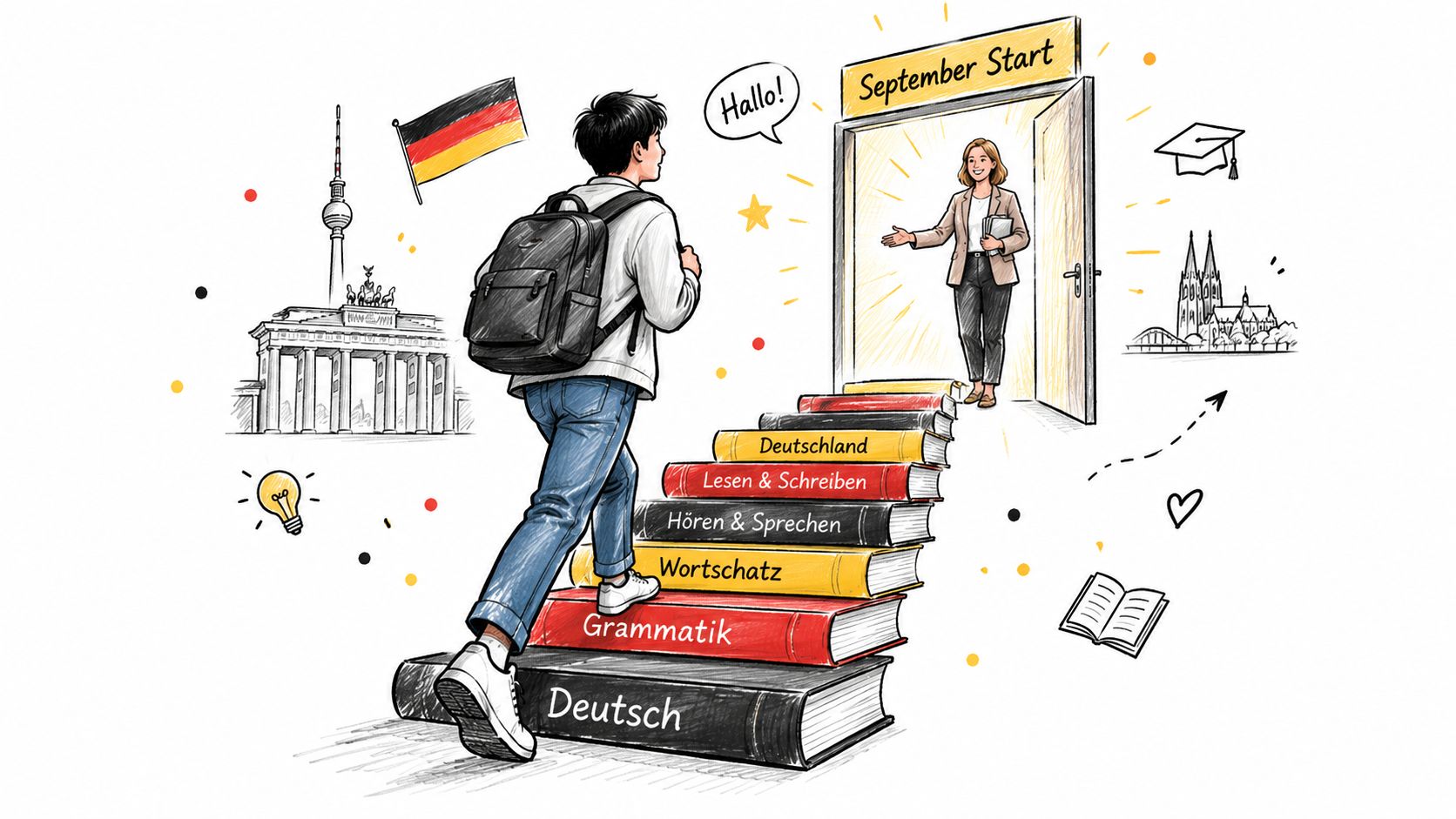
September is not too late if the course is built properly. A learner in Hong Kong needs structured curriculum, native-speaking teaching, exam alignment, and a catch-up plan that matches real life, not a brochure promise.
That's why parents and professionals should look for a programme that handles placement, make-up lessons, small groups, and Goethe-Zertifikat preparation without making the learner guess the next step. For families weighing DSE/IB/IGCSE paths or adults planning study abroad in Germany, that combination is the difference between drifting and progressing.
GCA's model is built for that kind of entry. The small-group format, native German teachers, and exam preparation focus suit learners who need a serious September intake, not a casual language hobby. If you want a direct route into the right class, check the latest schedule, book a trial lesson, and ask for a placement-first recommendation before you commit.
If you're ready to join a German class in Hong Kong with proper placement and a clear catch-up plan, visit German Cultural Association Hong Kong(GCA) and speak to the team about your September intake. They can help you match your level to the right course, whether your goal is school exams, university preparation, or practical German for work and travel.

Joining a German Course Mid-Term: September Intake Guide for Hong Kong 2026/27
Preschool German Classes 2026/27 (Ages 3-6): Small-Group Intake & Trial Lessons


