.png)
.png)

BLOG

香港德國文化協會
The German Cultural Association
Funding Your German Studies in Hong Kong CEF Application Guide (2026)
You are weighing up a German course in Hong Kong because the goal is real. A stronger CV, a university application, a child’s IB or IGCSE support, a relocation plan, or the need to function confidently in German-speaking Europe. Then the fee quote lands, and the plan suddenly feels expensive.
That is where Funding Your German Studies in Hong Kong CEF Application Guide becomes practical, not theoretical. If you are eligible, the Continuing Education Fund can reduce what you pay for approved German study in Hong Kong by a substantial amount. Used properly, it turns a serious language plan into something financially manageable.
I have one strong view on this. Do not treat CEF funding as an afterthought. Build your German study plan around it from day one. If your next step involves official paperwork for study, work, or immigration, keep useful support tools nearby too, such as German document translation services, especially when you need certified handling of German-language documents.
If you are still comparing study options and self-study support before committing, this guide to free resources to learn German in Hong Kong is a sensible companion. Use the free tools, but use CEF to fund the structured training that moves you forward.
Making Your German Language Goals a Reality in Hong Kong
A common Hong Kong scenario looks like this. A working professional wants German for business or a move abroad. A parent wants proper exam preparation for a teenager. An adult learner wants more than travel phrases and wants a qualification that means something.
The problem is not motivation. The problem is cost, timing, and confusion.
Quality teaching involves costs. What frustrates learners is the uncertainty around CEF funding. They know support exists, but they do not know which courses qualify, when they must apply, or what documents they need to keep.
That uncertainty causes bad decisions:
- People delay enrolment until they “have time to figure it out”.
- Some choose the cheapest option instead of the most suitable one.
- Others miss reimbursement entirely because they ignore the benchmark test requirement or submit incomplete paperwork.
You do not need to guess. Hong Kong already has a strong funding mechanism for adult education, and German is one of the language pathways supported under the scheme.
Practical advice: If you are serious about learning German in Hong Kong, choose your course and your exam pathway together. CEF works best when your study plan is organised from the beginning.
German is not a language you cram casually and hope for the best. You need structured progression, reliable attendance, and a benchmark exam strategy. That matters whether your target is general proficiency, Business German, or preparation for Goethe-Zertifikat, TestDaF, or school-facing goals such as IGCSE, A-level, and IB support.
For ambitious learners in HK, the right approach is simple. Study with a provider that understands formal progression, keep every required document, and prepare for reimbursement before the course even starts. That discipline is what makes this process work.
How Much CEF Funding Can You Claim for German Courses
You find a suitable German course, the fee looks high, and you pause. Good. This is the point where smart applicants calculate the reimbursement first and enrol second.
Eligible applicants can claim CEF reimbursement at 80% of the first HK$10,000 of course fees and 60% of the remaining HK$15,000, up to a lifetime maximum subsidy of HK$25,000 per person. For a HK$10,300 course, the reimbursed amount can be HK$8,240, subject to eligibility and successful completion.
The funding rule you need to remember
Keep the formula simple.
Eligible applicants receive reimbursement of 80% of the first HK$10,000 in course fees and 60% of the remaining HK$15,000, up to a lifetime maximum subsidy of HK$25,000 per person. The ceiling was raised from HK$20,000 with effect from 1 August 2022, and there is no upper age limit.
For German learners in Hong Kong, that changes the decision completely. A serious course at a strong provider is often far better value than a cheap class with weak progression and no clear exam pathway.
What this means in money
Use the numbers properly.
If your German course fee is HK$10,300, the reimbursable amount can be HK$8,240. Your effective out-of-pocket cost is HK$2,060, assuming you meet the eligibility rules and complete the course successfully.
That is substantial support. It can turn a structured German programme from a postponed plan into an immediate one.
If you are comparing providers and fee levels, this guide to German course prices in Hong Kong 2026 will help you judge whether the quoted fee is reasonable before you apply.
Use your subsidy strategically
CEF is a lifetime fund. Treat it that way.
Too many applicants focus on the percentage and ignore the sequence. That is a mistake. If you expect to progress through several levels of German, save your funding for courses that fit a clear objective, such as general progression, workplace use, exam preparation, or relocation planning.
For GCA students, this matters more than the government guidance suggests. The official rules explain how reimbursement works. They do not help you decide whether a beginner course, an exam-oriented course, or a higher-level progression route is the best use of your remaining subsidy. That is where planning beats guesswork.
A quick eligibility mindset check
Before you look at the refund amount, check whether the course choice makes sense.
- Choose a CEF-approved course. If the course is not reimbursable, the calculation is irrelevant.
- Choose a course you can finish properly. Reimbursement depends on successful completion, not good intentions.
- Match the course to your goal. Career use, study abroad, school support, and personal interest lead to different course choices.
- Protect your lifetime cap. Do not spend your available subsidy on a course that does not move you to the next useful stage.
My recommendation
Calculate your likely claim before you pay any fee.
I tell clients to do three checks in order. Confirm the course is CEF-reimbursable. Confirm it fits the outcome you want. Confirm you can complete the course and meet the post-course claim requirements without scrambling later.
That approach works because it is disciplined. The CEF system rewards organised applicants, and German learners do best when their funding plan, course level, and exam direction are aligned from the start.
Your Step-by-Step CEF Application Journey
You finish your German course, pass the exam, and expect the reimbursement to be straightforward. Then the paperwork starts. A receipt is missing. The exam name does not match the certificate. The filing window suddenly feels shorter than it looked on the government page.
This describes the common CEF experience for many Hong Kong applicants.
The official process is not difficult. It is strict. If you treat it like an admin project from day one, you give yourself a far better chance of getting paid without delay.
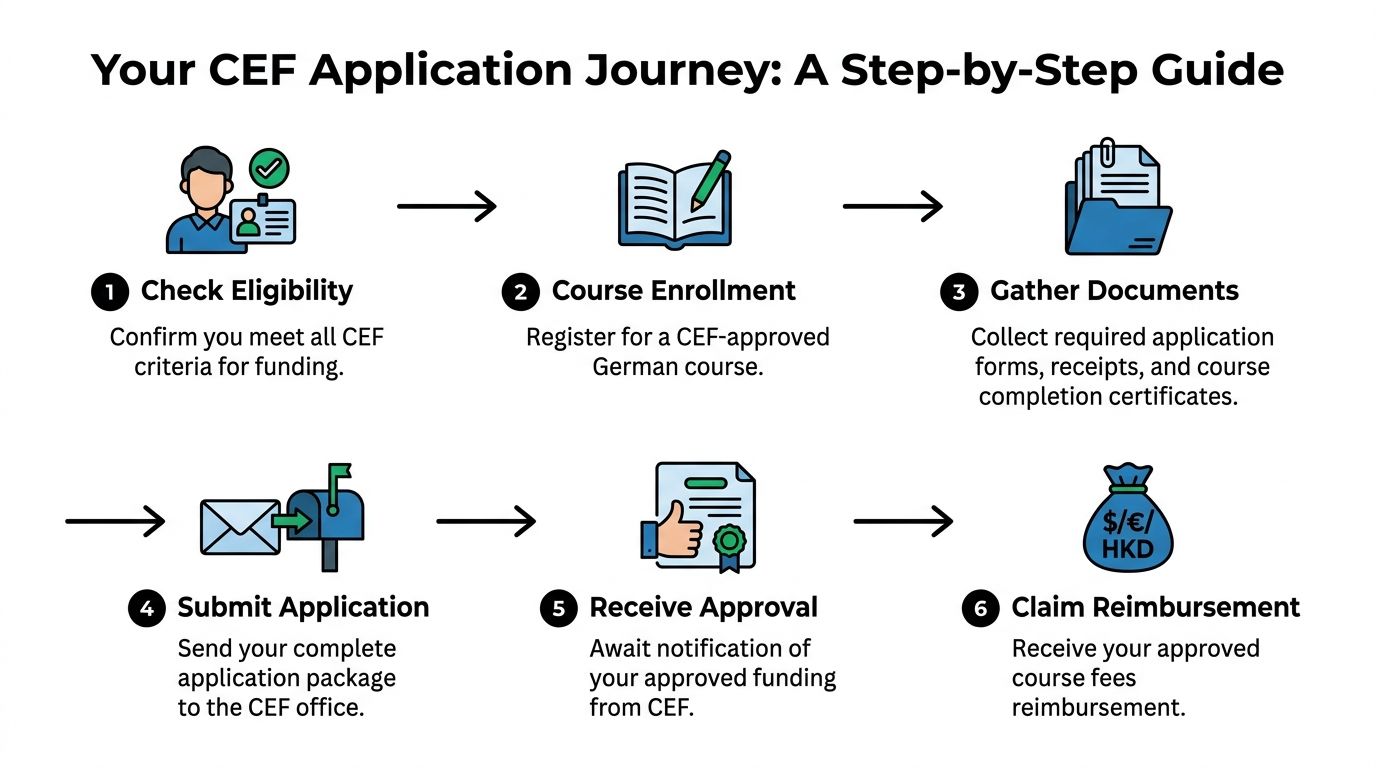
Start with the course, not the claim form
Your application begins at enrolment.
Choose a CEF-approved German course from a recognised provider, then complete the course properly, meet the attendance requirement set for that course, and pass the specified benchmark exam after the course has started. If one of those pieces is missing, the claim becomes weak immediately.
This is why course selection deserves more attention than the government guidance gives it. A suitable course is not just one that appears on an approved list. It should also fit your level, your schedule, and your exam plan. If you are still comparing formats, class intensity, and learning goals, use this guide to choosing the right German course in Hong Kong before you commit.
Build your claim file on day one
Do not wait until the course ends.
Create one folder for everything related to the claim, either physical, digital, or both. Every strong application I have seen follows the same pattern. The student keeps documents in order from the start, not after a deadline appears.
Use this checklist:
| Document | What to check |
|---|---|
| Hong Kong identity document copy | Name matches your application exactly |
| Bank account details | Use an account in your own name that can receive the reimbursement |
| Original tuition receipt | Keep the original safely and check the amount is clear |
| Course completion certificate | Course title should match the approved course record |
| Benchmark test proof | Exam name and candidate details must be consistent |
| Application form or e-submission details | Every field should match the supporting documents |
Small mismatches cause big delays.
Check names, dates, course titles, and fee amounts line by line before you submit anything. The assessor will not guess what you meant.
Treat the benchmark exam as part of the funding plan
Many German learners focus on lessons and leave the exam until later. That is a mistake.
For language courses under CEF, the benchmark exam is part of the reimbursement path. You need to pass the specified test after the course begins, and your claim documents need to show that clearly. For many applicants, that means a recognised German exam such as the Goethe-Zertifikat.
Book the exam early. Seats can fill, and a late booking compresses your timeline for getting results and filing the claim. If you are studying at a provider like GCA, ask about the benchmark route before the course starts, not after your final class.
Submit the claim with zero guesswork
You can file electronically if you use iAM Smart+ digital signing, or you can submit a paper application. Choose the method you can complete accurately.
My advice is simple. Use the electronic route if you are already comfortable with Hong Kong government e-services. Use paper if you are more confident checking a printed pack page by page. Speed matters less than accuracy.
Whichever route you choose, keep the submission standard high:
- Use the official course title exactly as shown on provider documents
- Use the official benchmark exam name exactly as shown on your proof
- Match the tuition amount to the original receipt
- Keep your personal details identical across your ID, bank details, and application
- Submit soon after you have all required documents
Applicants often overcomplicate Form SFO 313. Do not rewrite titles, shorten exam names, or assume a close enough match will pass review. Administrative systems reward exact matching.
Control the timeline before it controls you
The filing window looks generous until work, family, and exam scheduling get in the way.
Use a disciplined sequence instead:
- During the course: track attendance and store every payment record.
- Before the course ends: confirm the benchmark exam booking.
- After you pass the exam: collect the certificate or proof immediately.
- Before submission: compare every document against the form one last time.
- After submission: keep copies of the full file until reimbursement reaches your bank account.
This approach works because it removes the usual failure points. Missing documents, inconsistent names, and late filing are avoidable problems.
My recommendation for first-time applicants
Act like you are preparing a file for audit.
That mindset changes everything. You stop assuming the office will overlook a discrepancy. You start checking details before they become problems. You submit a cleaner claim, and cleaner claims move faster.
Maximising Your Claim with GCA German Courses
Not all German programmes are equally practical for CEF users. Some learners need flexibility. Others need exam alignment. Many need both.
That is why course structure matters just as much as the subsidy itself.
Choose a course design that supports compliance
A good CEF strategy depends on three things working together:
- A structured curriculum so you know what level you are taking and why
- A certificate system linked to attendance so you are not guessing whether you meet the completion standard
- Clear exam preparation so the benchmark requirement does not become a last-minute obstacle
For serious Learn German HK students, a well-organised provider offers a clear advantage over ad hoc private tutoring or casual conversation groups. CEF rewards formal learning journeys. It does not reward vague study habits.
Why native-speaking teaching matters for benchmark exams
German benchmark exams test more than memorised vocabulary. They test reading accuracy, listening control, grammar under pressure, and spoken performance.
Native-speaking teachers matter because they correct what local learners often miss:
- article usage and case endings
- pronunciation habits influenced by English or Cantonese
- sentence structure in formal writing
- exam-style listening traps
- real-world phrasing rather than textbook-only German
If your goal is reimbursement, passing the benchmark is central. If your goal is proficiency, it is even more important.
Advisory view: If you need German for exams, university, visas, or business, avoid random classes with no progression map. They may feel flexible, but they often create expensive detours.
Match the course to the reason you are learning
The strongest claims usually come from learners who know exactly why they are studying German in Hong Kong.
That could include:
- Academic pathways: Preparation connected to IGCSE, A-level, IB, Goethe-Zertifikat, or future university study abroad in Germany
- Career development: Business German and workplace communication
- Relocation planning: Structured progression toward recognised proficiency
- Adult enrichment with a serious outcome: Not just “learning for fun”, but learning with measurable progress
If you are still weighing formats, class sizes, and learning styles, this guide to choosing a German class in Hong Kong is worth reading before you enrol.
Small-group and private formats both have a place
Some learners do best in a small group because the schedule creates discipline. Others need private lessons because their target is narrow, such as oral exam performance, school support, or business presentation language.
Both can work well if the course structure is formal, the attendance expectations are clear, and the benchmark pathway is built in from the start.
My recommendation is simple. Pick the format that improves your chance of finishing properly and passing the benchmark test, not the format that merely looks convenient on a timetable.
Common Application Mistakes and How to Avoid Delays
You finish your German course, pass the exam, and expect reimbursement to be straightforward. Then the claim stalls because one receipt is missing, the exam was booked too late, or the paperwork does not match. That is how applicants lose time.
The CEF system rewards order. It does not reward good intentions. If you are studying German at a serious provider like GCA, treat the claim process as part of the course from day one, not something to patch together at the end.
Mistake 1: Trying to claim the exam fee on its own
Do not do this.
A standalone benchmark exam fee claim is the wrong move. Your exam result needs to sit with the rest of the claim package, including course completion documents and the correct form. The safe approach is simple. Build one clean claim that ties the course and benchmark test together.
This point confuses many German learners because the official guidance is written for the scheme as a whole, not for the practical sequence students follow in class. The practical rule is clearer than the website makes it sound. Finish the approved course properly, pass the recognised benchmark, then submit a complete claim.
Mistake 2: Treating receipts like admin clutter
Original receipts matter.
Do not fold them into a random folder, leave them in a bag, or assume a screenshot will solve the problem later. The fastest claims usually come from applicants who keep every document in one place from the first payment onward.
My advice is blunt. Create a dedicated CEF file the day you enrol. Keep the tuition receipt, attendance records if issued, exam registration details, course completion proof, and your claim form together. One organised file saves weeks of back-and-forth.
Mistake 3: Leaving the benchmark test until the last minute
This is one of the most common delays for German students.
Learners focus on class schedules, then postpone the Goethe or other recognised benchmark exam because work, school, or travel gets in the way. By the time the course ends, they are rushing to find an exam date that fits both the funding timeline and their readiness.
Book with a funding plan, not just a study plan.
At GCA or any serious provider, you should map out the likely exam window early. That gives you room to prepare properly and avoids the ugly situation where a completed course cannot turn into a clean claim because the benchmark step was handled too late.
Mistake 4: Underestimating attendance requirements
Attendance is not a side issue. It is part of your eligibility.
If your course requires a minimum attendance level for successful completion, every missed lesson pushes your claim into risk territory. Students often focus on whether they can catch up academically. The funding problem is separate. You can understand the material and still create trouble if your official completion record is weak.
Show up consistently. If you must miss a class, clarify the provider's policy immediately and keep the record straight.
Mistake 5: Mixing public funding without checking first
Some applicants assume they can combine CEF with employer sponsorship or other public support for the same fees. That assumption causes avoidable problems.
Check the funding arrangement before you submit anything. If another party has paid part of the course fee, confirm exactly how that affects your claim and what must be declared. Sorting this out in advance is much easier than fixing a problematic submission later.
One final rule. Never submit a claim that is merely "probably fine." Submit one that is complete, consistent, and easy for the case officer to approve. That is how you avoid delays.
CEF FAQs for Parents Students and Professionals
You are ready to pay for a German course, then the practical questions start. Can a parent handle the paperwork? Can a university applicant count on the benchmark exam? Can a working professional still claim if an employer helps with fees? These are the questions that usually slow people down, not the course itself.
Here is the direct answer. CEF works well for German learners in Hong Kong if you treat the course, the exam, and the claim as one plan from day one. That matters even more if you are enrolling with a structured provider like GCA, where the training path is clear but the government process still needs to be handled properly.
For parents supporting a teenager
Can I use CEF to fund my child’s German exam preparation
Start with eligibility. CEF applies to the learner who is taking the approved course, so do not assume a parent can file everything and sort out the details later.
If your child is working toward IGCSE, A-level, IB, or a recognised German benchmark, choose a course with formal records, clear progression, and an outcome that supports a proper claim. Casual tuition may help academically, but it often creates funding problems because the paperwork trail is weak.
How should parents manage the paperwork
Parents should run the file properly. That is their job in the process.
Use one folder and keep it complete:
- receipt issued after payment
- benchmark exam booking confirmation, if required for the route
- attendance record or provider updates during the course
- course completion document once issued
- ID details, names, and dates checked before submission
The families who get through this smoothly are organised early. The families who struggle usually start collecting documents at the end.
For university-bound students
Does passing TestDaF help with reimbursement
Yes, but only as part of a valid course-and-claim route.
If your plan is Germany, do not separate the language course from the benchmark exam in your mind. CEF does not treat the exam as a standalone reimbursement item. You need the approved learning path, the required proof, and a clean submission sequence. Students who leave the exam decision until late usually create avoidable delays.
The smart approach is simple. Decide your university goal first, then match it to the right German level, the right course, and the right benchmark timing.
I want German for university applications. What should I prioritise
Prioritise recognised progression.
A loosely structured class is a poor choice if your target is admission support, a language requirement, or future visa use. Choose a provider that moves you toward a recognised exam standard and can issue the records you will need. That is exactly where many applicants get caught. The course may feel fine in class, but the claim becomes messy because the structure was wrong from the start.
For working professionals
Can I claim if my employer is also helping with fees
Check the funding arrangement before you submit anything.
If your employer is paying part of the fee, document the split clearly and confirm how it should be declared. Do not guess. Do not file first and explain later. A case officer wants a consistent payment record, not a story about what happened.
Should I spread my subsidy across multiple levels
Usually, yes, if the levels form one sensible progression.
That is the best approach for professionals who need German for relocation, client communication, further study, or long-term career use. Do not waste your available support on disconnected short courses that do not build toward a benchmark or a skill level.
A better plan looks like this:
- beginner foundation
- next level with clear progression
- benchmark exam at the right stage
- practical end goal such as work use, study, or relocation
For work use, study, or relocation, a strong provider is essential here. GCA-style structured progression gives working adults a much better chance of using the subsidy well instead of burning it on fragmented study.
For adult learners returning to study
I have been out of the classroom for years. Is CEF still worth using
Yes, if you are serious about finishing properly.
Many adult learners in Hong Kong return to language study for career change, migration plans, family reasons, or personal goals they postponed for years. CEF can make that decision far easier financially. The government process still expects discipline, though. You need the right course, the right records, and the right timing.
I only want practical German for travel. Should I still care about the benchmark route
Yes, if you want reimbursement.
Travel may be your personal reason for starting, but CEF is built around documented progression and approved outcomes. So pick a course that keeps the door open for the required benchmark path, even if your original motivation is to speak basic German well on a trip.
That is the insider point many applicants miss. Your study motivation can be casual. Your claim strategy cannot be.
Ready to Start Your German Journey with CEF Funding
The smartest way to approach German study in Hong Kong is to combine ambition with administration. Learn the language seriously, but manage the paperwork just as seriously.
CEF funding can make high-quality German study far more affordable. The catch is simple. You must choose the right course, meet the attendance and completion requirements, pass the benchmark exam in the proper sequence, and submit a clean claim on time.
That is why organised learners tend to have a much smoother experience. They do not improvise. They keep documents early, plan the exam date properly, and choose a provider that supports real progression rather than casual attendance.
Final recommendation: If your goal matters, treat German as a funded project, not a hobby purchase. Build the course plan, exam plan, and claim plan together.
This is especially true if your German is tied to university entry, professional advancement, relocation, or school exam preparation for your child. In those cases, poor planning costs more than course fees. It costs time.
If you want a serious route into German lessons Hong Kong learners can trust, choose a structured programme, confirm the CEF pathway before enrolment, and prepare your claim from the first week of class.
If you want expert help choosing a suitable CEF-aligned course, planning your benchmark exam route, and getting clear advice before you submit, speak with German Cultural Association Hong Kong(GCA). Their native-speaking teachers, structured curriculum, flexible formats, and exam preparation focus make them a strong choice for learners who want to Learn German HK with a clear goal and a practical funding plan.

German Prepositions: Which Case Does Each One Take? Complete Tables
German Accusative Case Explained: When and How to Use Akkusativ


