.png)
.png)

BLOG

香港德國文化協會
The German Cultural Association
Free German Level Tests Online: How to Assess Your CEFR Level
Your child is staring at German homework, your manager wants a quick level check before a role change, or you're thinking about study abroad in Germany and don't want to guess wrong. In Hong Kong, that guesswork wastes time and money. Free German Level Tests Online give you a fast CEFR estimate, but only if you treat the result as a placement tool, not a certificate.
Table of Contents
- Parents and teens need different thresholds
- Professionals should match level to the real goal
- Use the result to choose the next format
Why CEFR Matters for German Learners in Hong Kong
A parent in Kowloon wants to know whether a teen is ready for IGCSE German. A working professional in HK needs a realistic B1 estimate before applying for a visa or a course. A university applicant wants to know if their German is closer to beginner or academic-ready.
That is exactly where CEFR helps. The framework runs from A1 to C2, so it gives you a shared language for level, progress, and next steps.
Hong Kong already uses structured assessment logic in school settings. The Education Bureau says the HKDSE is normally taken after 3 years of junior secondary and 3 years of senior secondary schooling, and its curriculum framework uses seven levels of learning attainment, from Level 1 to Level 7. For German learners, that kind of structure makes a CEFR estimate much more useful than a vague feeling like “I'm okay at German.” Hong Kong's Education Bureau on the HKDSE structure and attainment levels

What CEFR tells you in practical terms
A1 and A2 usually mean survival German, simple self-introductions, basic routines, and very limited reading confidence. B1 and B2 are where school placement, exchange plans, and many work-related needs start becoming realistic.
C1 and C2 are not casual levels. They matter when the goal is serious academic German, higher-level workplace communication, or long-term study planning.
Practical rule: if you need to explain your German level to a school, employer, tutor, or family member, CEFR is the cleanest way to do it.
That is why a free online test is useful as a first filter. Hong Kong learners often need a quick answer before choosing a class, preparing for Goethe-Zertifikat, or deciding whether a formal exam track makes sense. A standardized scale turns self-assessment into a practical decision tool.
Top Free German Level Tests You Can Take Today
The best free tests are the ones that are CEFR-aligned, quick, and honest about what they measure. In Hong Kong, I would ignore anything that only hands you a flashy score without explaining whether it checks grammar, reading, or multiple skills.
A stronger test is usually adaptive, which means it changes difficulty as you answer. That matters because a short quiz can still be useful if it samples the right range of levels and stops when the estimate stabilises. One independent provider says its German assessment can give an instant result from A1 to C2 after 50 questions in about 20 minutes, with no sign-up or email required, which is a sensible model for busy learners in HK. Free German proficiency test with instant A1 to C2 result
| Test Provider | Questions | Duration | Skills Covered | Adaptive |
|---|---|---|---|---|
| German Cultural Association Hong Kong | Placement consultation available | Varies | Level placement and study path matching | Yes, via consultation |
| StudyGerman.io | About 15 to 50 | 5 to 20 minutes | CEFR-aligned self-assessment | Often yes, with instant results |
| Examinizer | 25 or 30 in the described models | About 5 to 20 minutes | Grammar, vocabulary, reading, plus subscores in one model | Yes |
| HelloGerman | About 20 or 36 in the described models | Short screening format | Skill breakdown and explanation of wrong answers | Yes |
| Sprachcaffe | 50 | About 20 minutes | CEFR estimate from A1 to C2 | Yes |
Which one suits which Hong Kong learner
If you need a quick orientation, pick a shorter adaptive screener. If you want a more dependable pre-exam check, use a test that mixes grammar, vocabulary, and reading and gives a level explanation.
For families, teens, and working adults, the point is not to chase the longest quiz. The point is to get a level estimate that can support a real decision, whether that is class placement, exam prep, or study abroad planning in Germany or Spain.
Several widely used tests also state that they are CEFR-aligned and provide instant results, often without registration, which makes them practical when you need a fast first step. A placement tool from a structured provider like German Cultural Association Hong Kong can sit alongside those tests when you want a guided read on what your result means.
Common Pitfalls That Skew Your CEFR Result
Free tests are convenient, but convenience can hide weak methodology. The biggest mistake I see in Hong Kong is people treating a short quiz like an official level decision, then building exam plans on a shaky result.
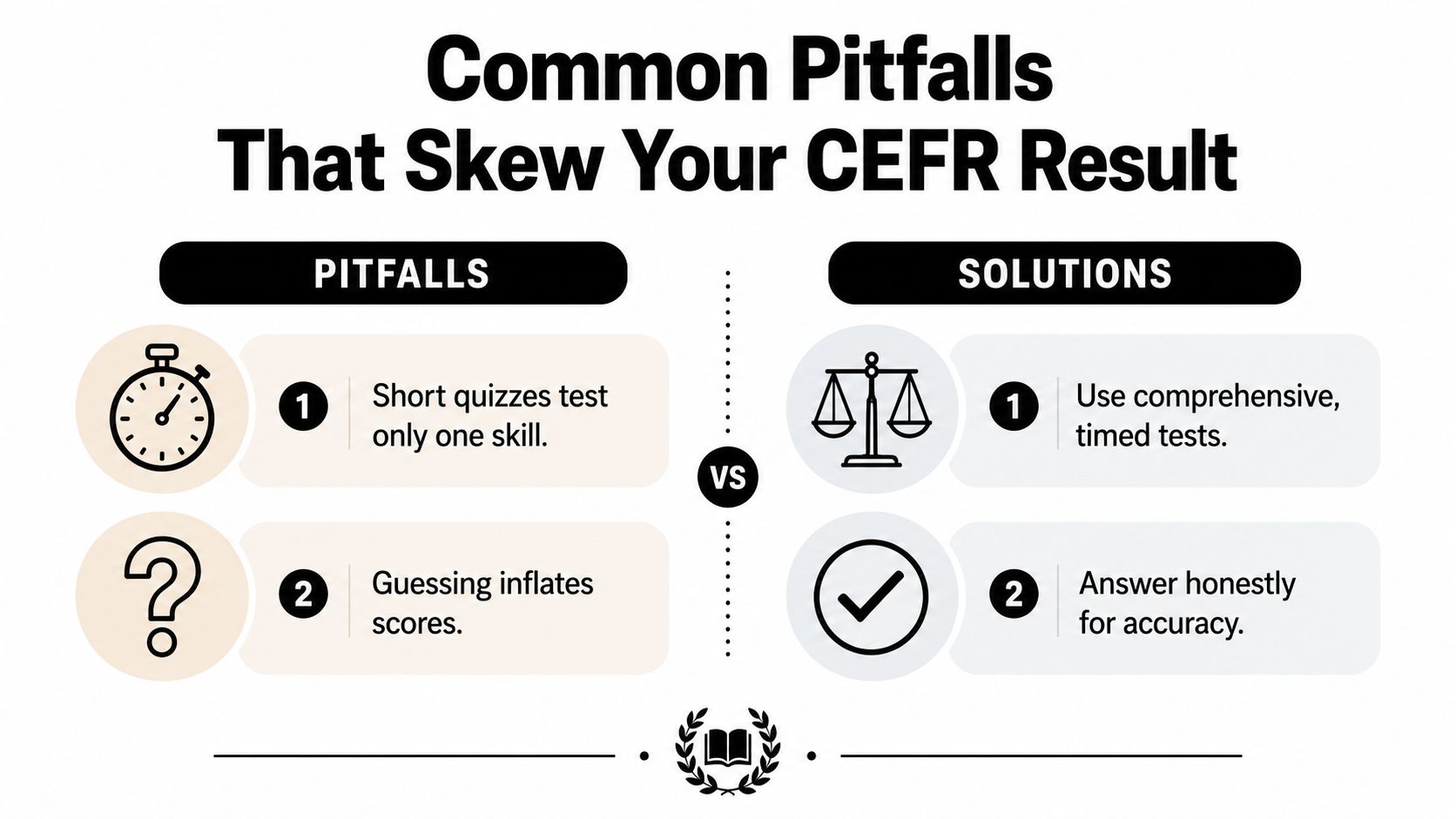
Short quizzes can overstate confidence
Some tests only sample one skill, usually grammar or vocabulary. That can be fine for a rough screening, but it is not enough if you need to know whether you're ready for Goethe-Zertifikat writing or speaking, or for the academic load of TestDaF.
Guessing is another problem, especially in adaptive tests. These tools infer level from patterns of correct and incorrect answers, so random guessing can push the estimate in the wrong direction. Answer what you know, not what you hope is right.
A score is not a certificate
This part matters for HK learners who need documentation for school, visa, or study planning. Free tests usually describe their output as a placement or orientation result, not an official qualification.
A useful test tells you where you likely sit on the CEFR ladder. It does not replace formal proof when a university, employer, or exam body wants certified evidence.
A free result is useful when it helps you choose a course. It is weak when you try to use it as paperwork.
The safest approach is to prefer tests that cover more than one area. A mix of reading plus language use, or grammar, vocabulary, and reading, gives a more stable estimate than a single-skill quiz. If a result feels too neat after ten questions, be sceptical.
The broader point is validity versus convenience. Some free tools are helpful for first-pass screening, but only a few make their limits clear. If you want a deeper view of what self-checking can look like in a learning workflow, self-assessment tools for courses is a useful reference point for thinking about placement, feedback, and next-step planning.
How to Prepare for and Interpret Your Test Results
Treat the test like a short diagnostic, not a game. You want the result to reflect your real German level, not your ability to click quickly under pressure.
Before you start, choose a quiet room and put your phone away. If the test is adaptive, your first answers matter more than you think, so you want fewer distractions and less second-guessing.
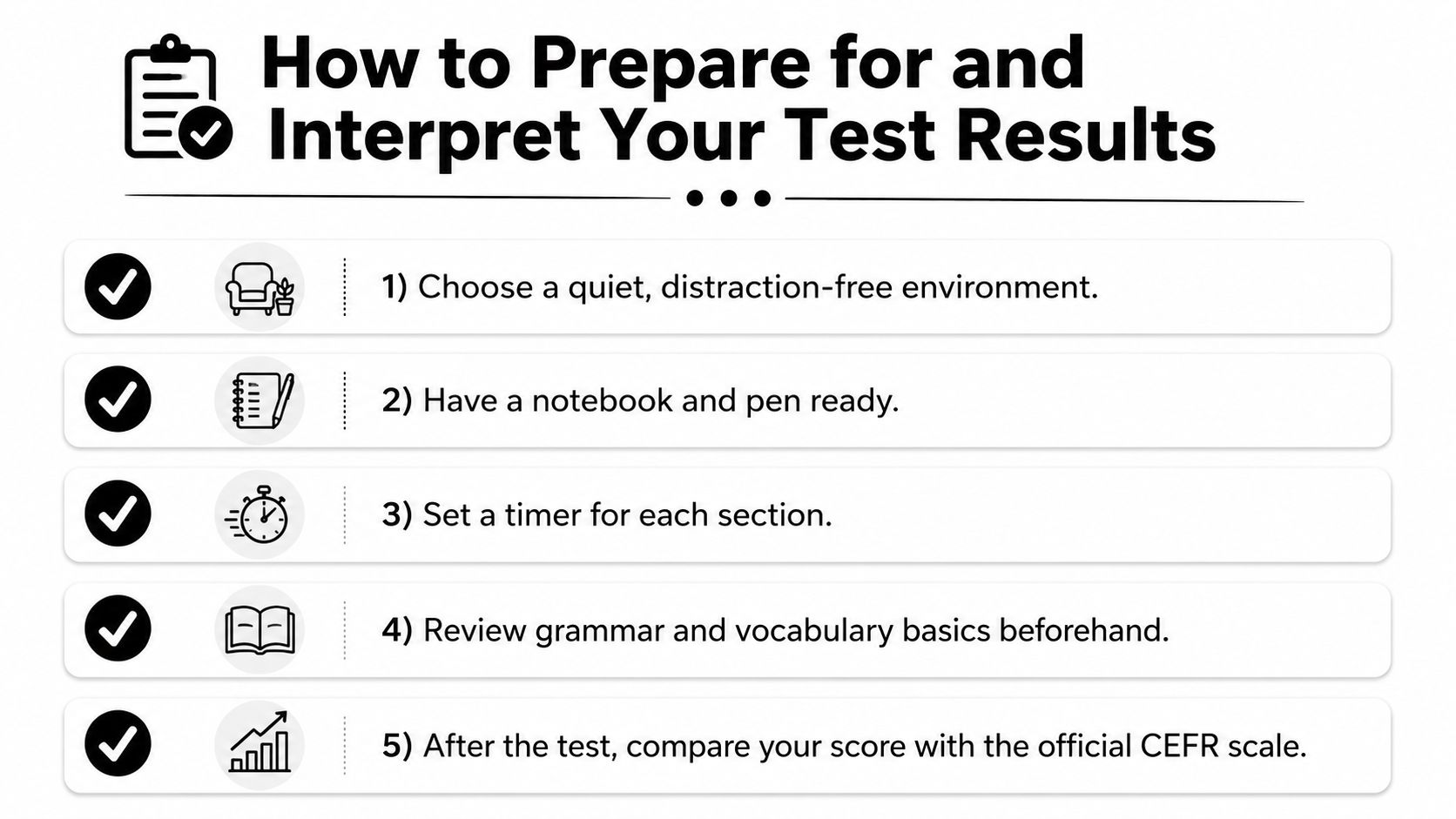
Take the test like a real placement check
Use a test that matches your likely band. If you know you are around beginner level, don't force yourself into a very advanced screener just because it looks impressive.
A few practical habits improve the quality of the result:
- Choose a distraction-free space: You want steady concentration, not a rushed guess.
- Have a notebook ready: Write down recurring grammar points or unfamiliar words.
- Set a personal pace: If the test has sections, don't sprint through them.
- Answer truthfully: An inflated score helps nobody.
- Save the result immediately: You may want to compare it with your next course option later.
For extra context after the test, the German Cultural Association Hong Kong maintains a useful page on free resources to learn German in Hong Kong. Use that kind of support material to confirm whether your result matches the kind of practice you need.
Read the score correctly
A2 usually means you can manage basic interactions, but not much more. B1 is the level where everyday topics become more manageable and study plans start to get serious. C1 suggests you may already be ready for more academic or professional use, but only if productive skills are also strong.
If the test gives a skill breakdown, pay attention to it. A strong reading score with weak vocabulary or language-use results usually means you are better at recognition than real production.
A free test is most useful when it points to the next action, not just the number. If you see recurring errors in grammar or reading, that is your study list. If you get a level estimate that feels off, retest after a week of targeted practice rather than accepting the first score blindly.
For learners who want a broader comparison of placement options, the guide on German exams in Hong Kong is a solid follow-up, especially if you are deciding between orientation, exam prep, or formal certification.
Mapping Your CEFR Level to Hong Kong Learning Pathways
A CEFR score only matters if you use it to make a decision. In Hong Kong, that decision usually falls into one of four routes, school, exams, university planning, or work.
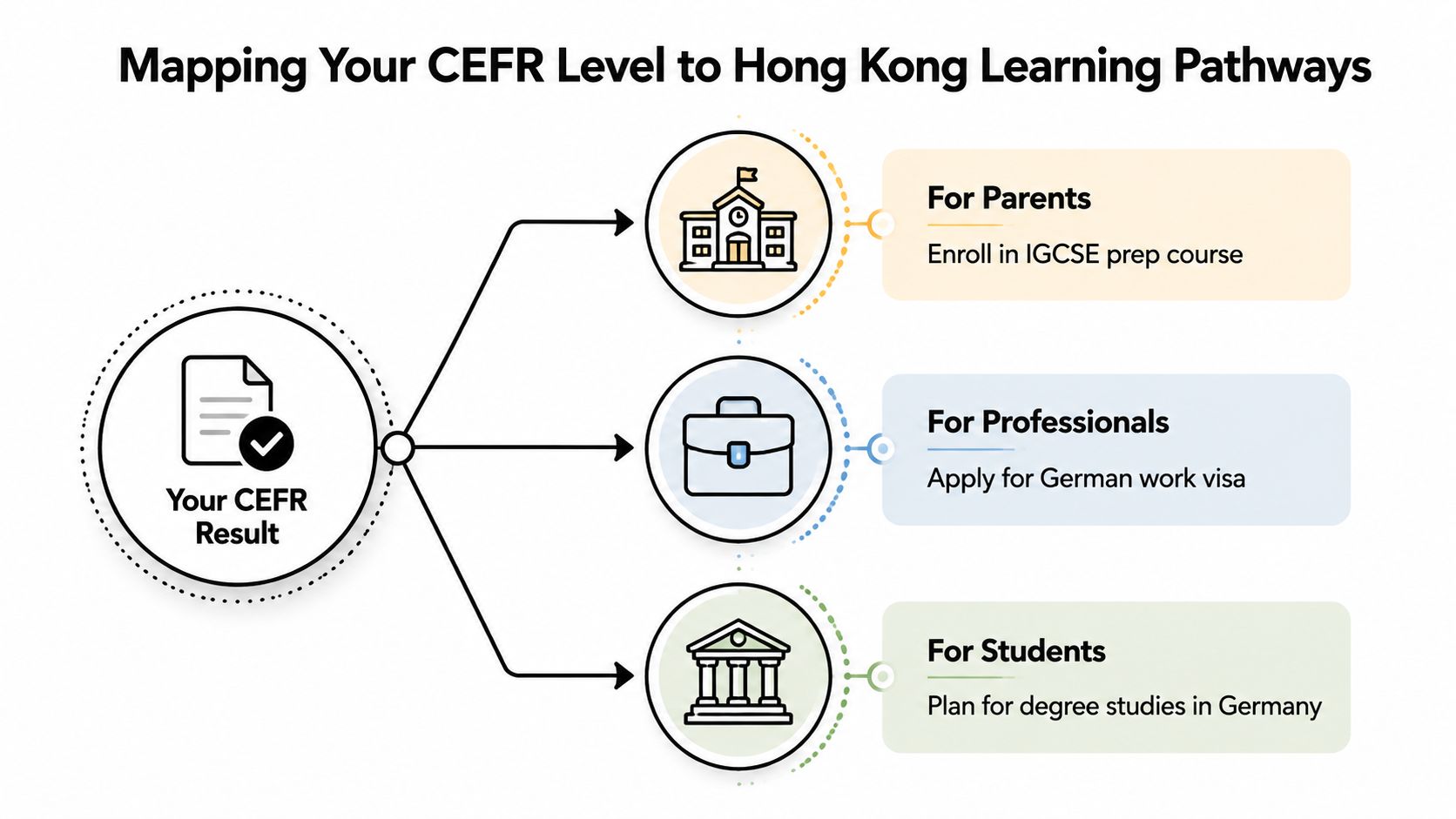
Parents and teens need different thresholds
For parents tracking IGCSE, IB, or A-level progress, a free test is useful if it shows whether a student is still building foundations or ready for more serious exam work. If the result sits below the level needed for school demands, the next move is structured support, not panic.
Teenagers aiming for Goethe-Zertifikat should treat the test as a route marker. If the result points to beginner or lower-intermediate ability, the first priority is accuracy before exam drilling. The article on Goethe-Zertifikat versus TestDaF also helps if the student is already comparing certification routes.
Professionals should match level to the real goal
Working adults in Hong Kong often need German for career mobility, cross-border work, or visa planning. A free test helps you decide whether you belong in business German, general communication, or exam preparation.
If you are planning study abroad in Germany or Spain, use the test as a planning tool, not a finish line. The level estimate shows whether you need a long runway, a mid-stage boost, or only targeted exam practice.
Use the result to choose the next format
A placement result should tell you whether you need:
- Small-group classes for steady progress and peer practice.
- Private lessons if your level is uneven or your deadline is tight.
- Exam preparation if the goal is Goethe, TestDaF, or school certification.
- Business German if the target is workplace communication, meetings, or client contact.
Working rule: if your goal has a deadline, choose a course next, do not keep browsing tests.
You also need to consider CEF funding if your situation makes you eligible for subsidised language training. A free CEFR result helps you enter the right stream, but funding and registration decisions should follow a proper level discussion.
For learners who want a more structured route after a self-test, the question is not “what level am I?” It is “what class, exam track, or study timeline matches this level?” A placement conversation gives you a better answer than a standalone quiz.
The official exam route matters too. If you are comparing certification paths, the guide on German exams in Hong Kong is the right next read before you lock in a plan.
Ready to Move Beyond Self-Assessment
A free test is the right first move. It gives you a CEFR estimate, shows where your weak points are, and keeps you from enrolling in the wrong level.
That result is only the starting point. In Hong Kong, what matters next is whether you need Goethe-Zertifikat preparation, support for IGCSE or IB, a university application strategy, or German for business use. A placement score cannot correct your German, pressure-test your speaking, or tell you how to prepare for the demands of a real class or exam.
If you want a proper next step, book a placement consultation and ask for a route that fits your goal. For exam logistics and timing, the guide on German proficiency test registration and fees in Hong Kong is the right place to check before you commit to a plan.
The German Cultural Association Hong Kong offers CEFR-aligned courses, placement consultation, and structured exam preparation in a small-group setting with native-speaking teachers. It also provides in-person learning near Tsim Sha Tsui and Causeway Bay MTR stations, plus online options for learners who need more flexibility.
If your free German test has shown you where you stand, turn that result into a real plan with German Cultural Association Hong Kong(GCA). Book a trial class, speak with an advisor, and check the latest course schedule so you can move from a rough CEFR estimate to targeted German progress in Hong Kong.

German Food & Restaurant Guide: How to Order in German (HK & Germany)

Timetable & Fees for German Lessons in Hong Kong


