.png)
.png)

BLOG

香港德國文化協會
The German Cultural Association
Registration & Preparation for German Courses in Hong Kong
Mei in Tseung Kwan O has the same problem many Hong Kong parents face. Her Form 5 son is juggling schoolwork, IGCSE planning, and the pressure of deciding whether German belongs in the mix, while she still needs a clean path for registration, documents, and timing.
Registration & Preparation for German in Hong Kong should not be treated as a loose collection of forms, classes, and exam dates. If you want a seat, a certificate, or a visa outcome, you need one sequence that starts with enquiry and ends with proof in hand, not a mess of repeated admin.
Table of Contents
- Why Registration & Preparation Matter in Hong Kong Right Now
- Hong Kong German-Learner Tracks at a Glance
Why Registration & Preparation Matter in Hong Kong Right Now
A Hong Kong family that leaves German planning until the last minute usually pays for it twice. First in wasted time, then in avoidable rework. German sits at 0.7% among visible language groups in the local survey, with district figures ranging from 0.0% to 1.9%, so this is a niche language here and registration needs to be handled with intent Hong Kong University language survey.
Treat Registration & Preparation as a timeline. This week, make the enquiry. Then do the placement test, confirm the level, submit documents, pay, and secure the first class. After that, work backwards from the target, whether you are aiming for IGCSE, HKDSE, IB, Goethe-Zertifikat, or a Germany-bound visa file.
Practical rule: If you do not know your target level before you register, you will waste time, money, and often a whole term.
HKDSE German is no longer something parents can treat casually. From 2025, the stipulated exam for Category C German is the Goethe-Zertifikat, and the result framework runs from A2 to C2, with a pass only when the minimum stipulated level is met Goethe-Institut Hong Kong. Early registration and exam preparation matter because the exam path is fixed, not flexible.
Working adults face the same problem, just with different deadlines. A Munich job offer, a university application, and weekday conversation classes all run into the same bottleneck. You need the right course, the right proof, and the right registration window.
GCA's flow runs enquiry, placement test, level confirmation, document and fee submission, confirmation email, then first class. If your papers are ready, it can usually be finished inside one working week.
Learner Tracks: Which Path Fits Your Goal
A parent with a school deadline, a university applicant, and an office worker all register for German differently. The mistake is treating them as the same case. Decide the track first, then register.
Hong Kong is not a place where German sits in the background. It is used for school certification, overseas study, visa files, and work goals, so learners need a clear route instead of a casual class choice. If you pick the wrong route, you waste time on the wrong level and the wrong paperwork.
The clearest split is simple:
- Exam-track learners: Teenagers preparing for IGCSE, A-level, IB, HKDSE Category C, or Goethe-Zertifikat.
- Visa-track learners: Adults preparing for study in Germany, language-course visas, or degree admission.
- Casual-track learners: Professionals, parents, and travel learners who want structured classes without an immediate exam deadline.
Practical rule: If your goal needs proof, register with the exam in mind. If your goal is conversation only, you can still use the same registration flow, but your target level can be lighter.
School-exam learners need the tightest planning. HKDSE German now sits inside a formal certification structure from A2 to C2 Goethe-Institut Hong Kong, so students who need school recognition should register with that endpoint fixed in advance. Do not start with a general interest class and hope it fits later.
Visa-track learners face a different sequence. For Germany-linked study or visa cases, the file often needs proof of German ability, a language-school confirmation, and academic or financial documents in the correct order German Consulate Hong Kong student visa guidance. That means registration is not just about joining a class, it is part of the document trail.
Hong Kong German-Learner Tracks at a Glance
| Learner Track | Target CEFR | Key Exam / Outcome | Registration Window |
|---|---|---|---|
| Teen exam track | A2 to B2 | Goethe-Zertifikat, school exam alignment | Before the school term starts |
| Visa-track learner | B2 to C1 | Degree or language-course file readiness | Before the visa appointment window |
| Adult professional | B1 to B2 | Work-ready certification or internal milestone | When the next cohort opens |
| Casual learner | A1 to B1 | Structured conversation progress | Any open intake, but early is smarter |
The GCA Registration Workflow Step by Step
A messy enrolment usually starts with a simple error, choosing the form before choosing the level. Handle the sequence properly. Decide your target first, then prepare your ID details, documents, and payment method before you open the application.
GCA's local process runs within a fixed enrolment period, and places go to the first successful registrations. Payment can be made by cash, EPS, or online by credit card, according to the Goethe exam dates and registration guide for Hong Kong. If you leave the form half-finished, you have not reserved anything.
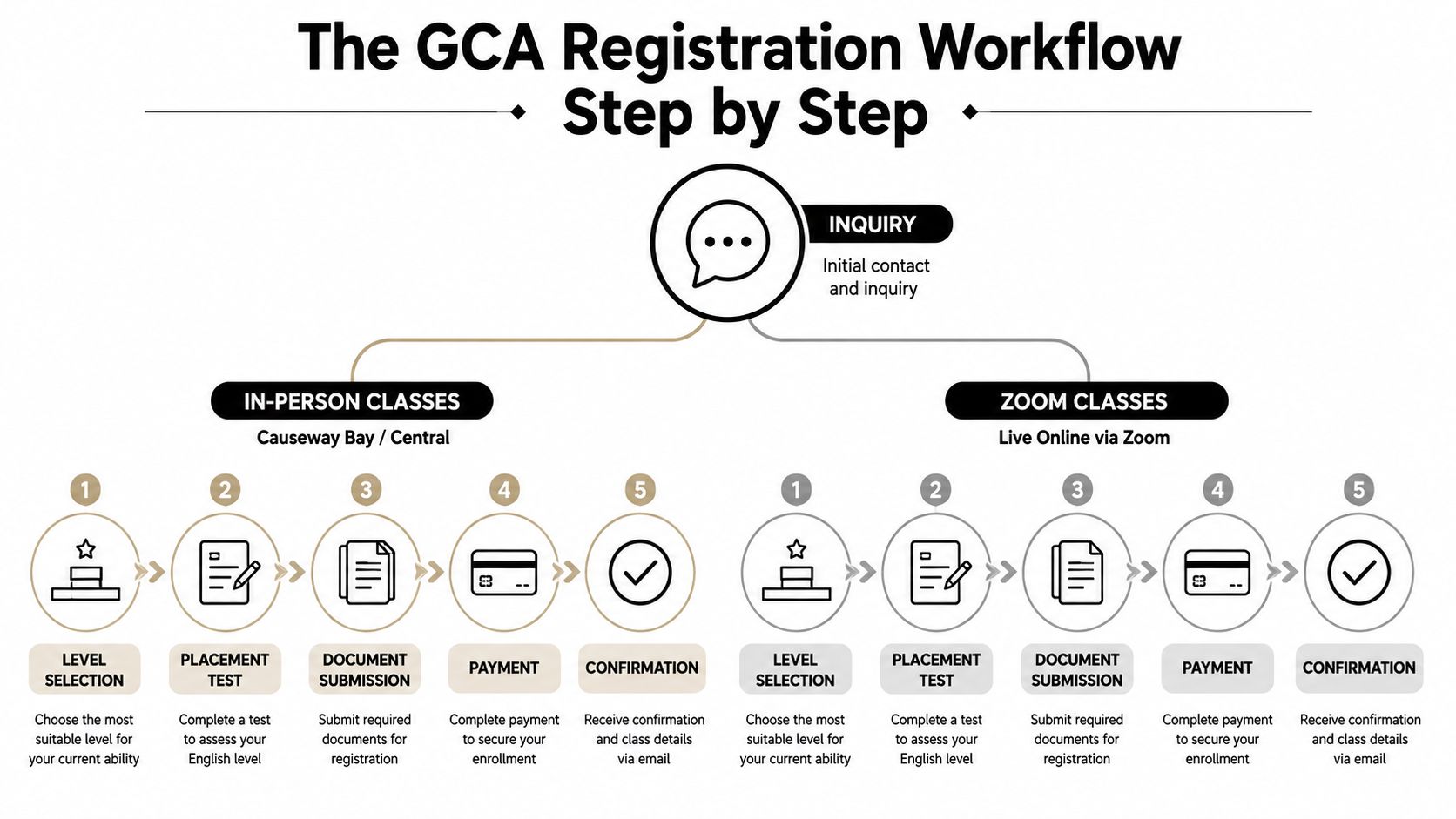
The same-day workflow you should follow
- Send the enquiry. Say whether you want in-person or Zoom classes, and state your goal clearly.
- Choose the level. Guessing wastes time. Use the placement test if you are not sure.
- Complete the placement test. Treat it as the point that fixes your starting level.
- Submit documents. Make sure your ID matches the legal document exactly.
- Pay immediately. Your seat becomes real only after payment goes through.
- Keep the confirmation. Save the email and bring the required details on day one.
That same logic applies in other high-trust systems. If you have handled postcard and video verification steps, the principle is familiar. Identity first, timing second, access after that. German registration in Hong Kong works the same way, except the consequences affect study plans, exam timing, and visa prep.
If you want the formal confirmation page, GCA's own registration successful notice is the point where your slot stops being tentative. Store the receipt, dates, and class details in one folder straight away.
Practical rule: Complete the form in one sitting on a stable connection. A screenshot or half-finished submission does not hold a place.
Documents, Levels and Exams by Learner Track
Hong Kong learners need different paperwork depending on why they are studying German. If you do not separate the tracks early, you end up over-preparing one file and under-preparing the one that matters most. That is a waste of time, especially when school deadlines, visa appointments, and term starts are already fixed.
The most efficient way to sort this is by track, not by emotion. Teen exam students need school-linked evidence. Adults on a visa route need financial and identity documents. Professionals need proof that lines up with their workplace or external benchmark.
For course and test admin, the practical reference point is the German proficiency test registration and fees guide in Hong Kong. Use it as a reminder that test choice and course choice are linked, not separate decisions.
Learner Track Preparation Matrix
| Learner Track | Documents to Prepare | Target CEFR | Benchmark Exam | Prep Window |
|---|---|---|---|---|
| Teen exam prep | School transcript, parent ID copy, placement test result | B1 to B2 | Goethe-Zertifikat, IGCSE, A-level, IB | Start well before the next school cycle |
| Parent-led enrolment | Parent ID, child details, guardianship proof if needed | Any level set by the child's goal | Placement test or school-mapped level | Before term start |
| University or visa applicant | Passport bio-page, blocked-account confirmation, academic documents, proof of German knowledge | B2 to C1 | TestDaF 4x4 or Goethe C1 | Months ahead of the appointment |
| Adult professional | Invoice details, HR letter if required, work schedule | B1 to B2 | Goethe-Zertifikat B1 or company-level target | Align to the next available cohort |
The teen route is usually the most structured. Families should treat the placement test as a CEFR mapping tool, not as a friendly chat. If a student is aiming for B1 to B2, the paperwork needs to support that level from the start, not after the first month.
Visa-track learners must be stricter. The Hong Kong consulate checklist for a German language course visa requires financial proof of at least 992 EUR per month, usually through a blocked account, plus a passport valid for at least six months, residence proof, two biometric photos, a language-school confirmation, proof of German knowledge, health insurance, and academic documents German language course visa checklist. That is not optional admin. It is the file.
Adult professionals should be just as disciplined. If your company wants a German certificate, or if you want a residency pathway through language, your course level and exam target should be fixed before enrolment. Once that is decided, the rest becomes routine instead of reactive.
Pre-Class Preparation Checklist for a Strong First Month
The first month determines if a student settles into German properly or drifts. Parents often focus on payment and the confirmation email. The work begins before the first lesson and continues through the first few weeks, when attendance, materials, and follow-through either build momentum or waste it.
Start with the confirmation email and work forward in weekly blocks. If you are in a CEF funding-eligible course, keep the admin record clean, because the attendance and mark rules already noted above still apply under CEF guidance. Do not treat the minimum as a comfort zone, because providers can still set stricter class rules.
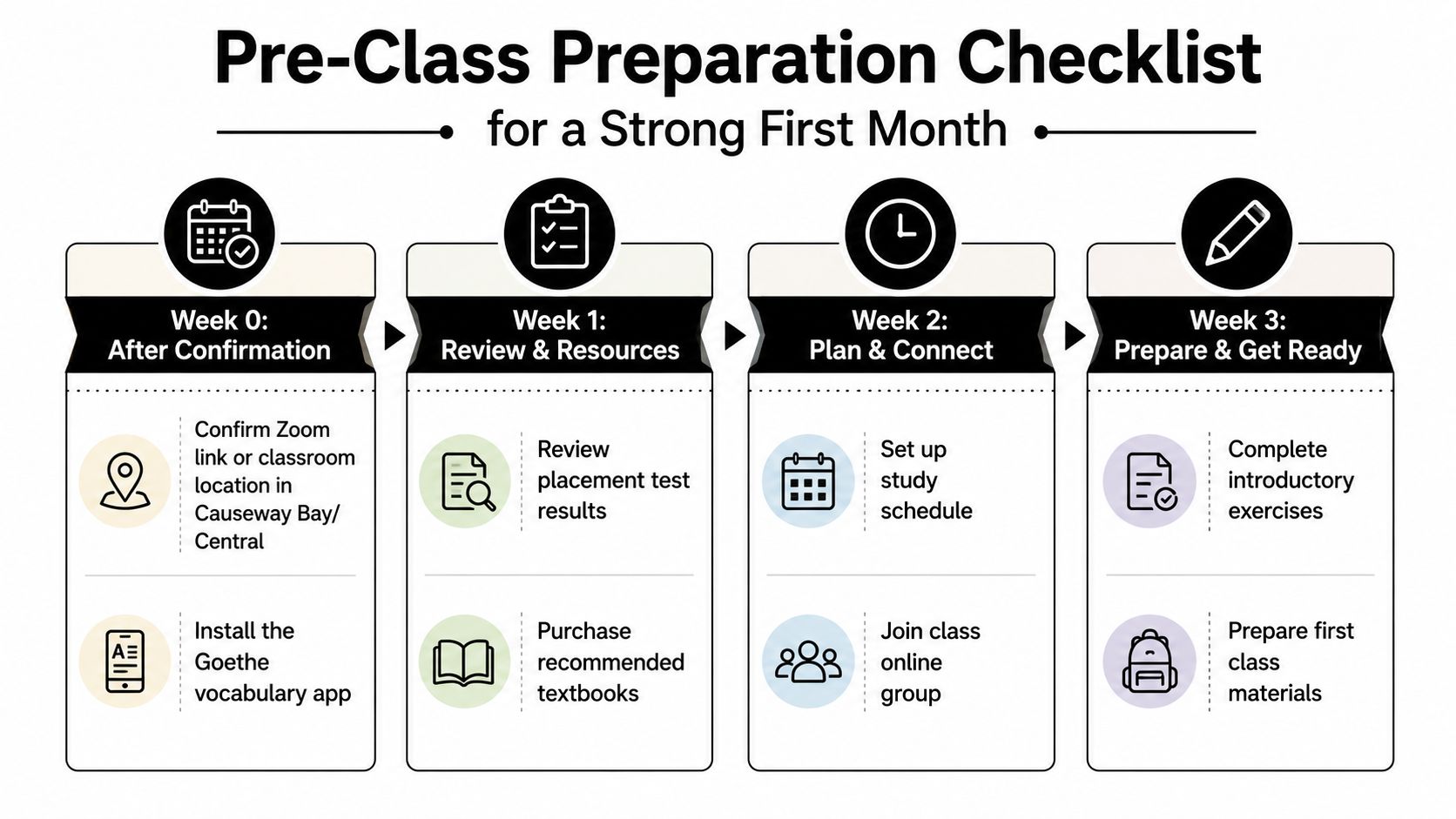
Week by week, what to do
- Week 0: Confirm the Zoom link or classroom location in Causeway Bay or Central. Install the Goethe vocabulary app and download the right coursebook PDF.
- Week 1: Arrive ten minutes early, complete the diagnostic speaking task, and ask for the attendance policy in writing.
- Weeks 2 and 3: Protect your attendance record and schedule any make-up class at least 48 hours ahead. If you are using CEF funding, track the attendance and mark rules closely.
- Week 4: Sit the first progress test, compare the result with your original placement, and book the next term before the early-bird window closes.
Attendance is a discipline issue, not a soft preference. GCA's certificate system requires 80% attendance, so students who miss class regularly should fix their timetable before term starts.
A clean first month also depends on preparation outside the classroom. Families who use InchBug's daycare prep checklist already know the pattern, the first week either locks in routine or exposes weak planning. German classes work the same way, except the result shows up in progress, exam readiness, and whether the student keeps up.
If you do not know your level, use free German level tests online as a first screen, then confirm it with a proper placement test. That avoids the common mistake of starting one level too high or too low.
Booking the right class matters too. A placement mismatch usually shows up in week two, not month three, and by then the student is already playing catch-up. For families who want a simple visual prompt, the A four-step pre-class preparation checklist infographic for students detailing tasks from week zero to week three. is the kind of thing worth pinning to the fridge or saving in the shared family chat.
Pulling the Threads Together and Booking Your Place
A rushed booking creates avoidable problems. If you want a Goethe-Zertifikat course, register early so you can take the exam slot you need at Goethe-Institut Hong Kong, instead of settling for whatever is left. If your target is TestDaF, line the course up with your university timeline, then keep the paperwork and study plan moving together.
Visa applicants need the same discipline. For a language-course route, the blocked-account transfer has to fit the consulate appointment window, or the whole file stalls. Germany's online submission option for national study visas has changed the mechanics, but the sequencing still has to be clean as detailed above.
A booking system only works if the steps are disciplined. That applies to language courses, and it is why tools like the 2026 Wix booking system overview matter to anyone handling appointment flow, class reservations, or limited seats. Lock the path first, then fill the calendar.
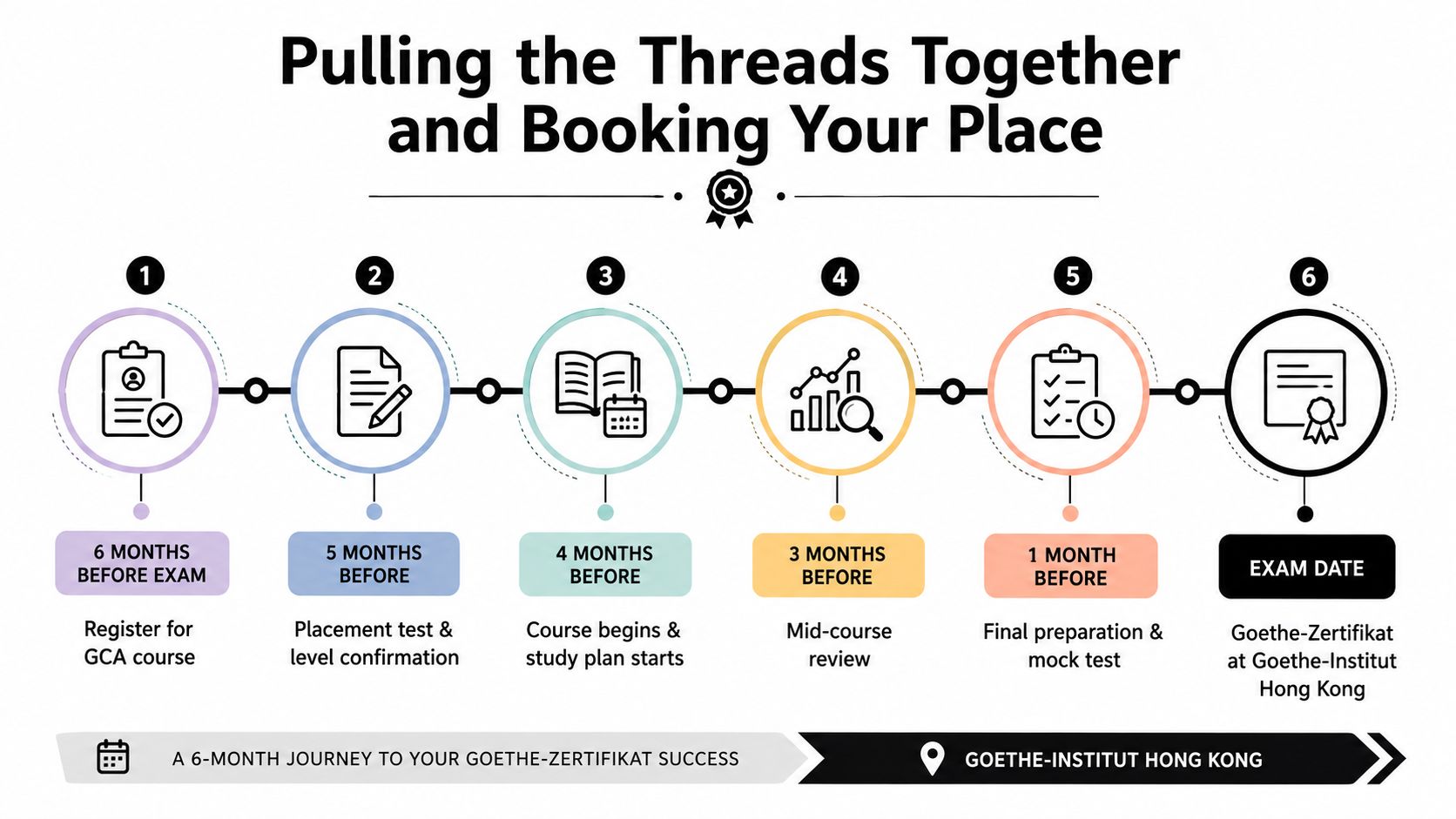
Book this way
- Identify your track. Exam, visa, or casual study.
- Complete the online enquiry form. State your CEFR target and preferred start month.
- Sit the placement test within 5 working days. Do not let the lead go stale.
- Submit documents and payment by the stated deadline. No deadline, no seat.
- Reserve the first four consecutive weeks. That is where the momentum is built.
For learners who need serious structure, the German Cultural Association Hong Kong (GCA) offers native-led classes, exam preparation, and a small-group setup that keeps the process organised. If you want German registration and preparation handled properly in Hong Kong, visit German Cultural Association Hong Kong (GCA) and send your enquiry this week.

Perfekt in German: A Clear Guide for Learners in HK

German Verb Tenses Overview: Präsens Made Simple


