


BLOG

香港德國文化協會
The German Cultural Association
German for Engineers and Manufacturing: Technical Vocabulary Guide
A German machine manual is open on your screen, and a supplier has emailed a non-conformance notice before a shipment to the Pearl River Delta. You recognise the component, but you need to distinguish Toleranz, Nennmaß and Prüfbericht without changing the specification.
This German for engineers and manufacturing: technical vocabulary guide treats German as bridge language for Hong Kong workplaces. Start with the terms attached to your drawings, equipment and inspection records, then learn how to explain them accurately to colleagues and suppliers.
Table of Contents
- Use patterns without trusting them blindly
- Recognise case through a repeated pattern
- Decode compounds from the right
- Mechanical terms for parts and machining
- Electrical terms for diagrams and drives
- Materials terms for purchasing and certificates
- Follow the production-data chain
- Choose the right fault word
- Keep safety language separate from permission
- Make technical words easier to recognise
- Store the action with the noun
- A bilingual handover that leaves no false approval
- Pick the document before the translation
- Connect standards terms to their function
- Separate workplace, academic and exam registers
Why Do Hong Kong Engineers Need German Technical Vocabulary?
Hong Kong engineers need German technical vocabulary to interpret equipment documentation, confirm specifications and communicate with German-speaking suppliers. The practical approach combines German technical nouns with clear English explanations and task-based practice. It supports drawings, manuals, inspection records and safety communication, even when the team conducts its meetings in English.
Say the supplier's notice identifies an Abweichung, a deviation. Before replying, you need to establish whether it concerns a dimension, a material requirement or an inspection result. Translating everything as a problem won't tell your production coordinator what to check.
That's why technical German isn't general Business German. You might negotiate delivery in English while the drawing notes, machine nameplate, and training instructions remain German.
A local need tied to industrial work
Germany was Hong Kong's largest trading partner within the European Union, according to the Census and Statistics Department's trade overview, while bilateral merchandise trade reached approximately EUR12 billion in 2025, according to the Trade and Industry Department's trade-partner information.
As of 2025, Hong Kong hosted 100 regional headquarters, 140 regional offices and 260 local offices representing German parent companies, according to the Hong Kong Economic and Trade Office in Berlin. For an engineer, buyer or quality specialist, this relationship translates into practical language tasks rather than abstract vocabulary targets.
Typical tasks include:
- Procurement: Confirm the material, component designation and applicable drawing revision.
- Installation: Match instructions to the actual machine and its identification plate.
- Quality assurance: Explain what was measured and which requirement wasn't met.
- Maintenance: Describe symptoms without guessing at the cause.
Prioritise documents over word counts
Hong Kong manufacturing also has a strong small-business character: 98.7% of its 7,488 manufacturing business units employed fewer than 100 people in 2024, according to the Hong Kong Government's manufacturing survey release. In that setting, the same person may read a manual, contact a supplier and prepare an inspection record.
A useful learning folder therefore contains a categorised glossary, pronunciation notes, model supplier emails and anonymised workplace documents. Grammar and examination preparation belong alongside these materials, not in a separate world.
Practical priority: Learn to identify the component, requirement and document status before trying to sound polished.
Working-level German requires sustained study. A vocabulary list can help you complete a familiar task, but it can't replace the broader reading, listening and speaking skills needed for unfamiliar situations.
What Is German for Engineers and Manufacturing
German for engineers and manufacturing is task-focused language for reading drawings, following manuals, recording inspections and understanding safety instructions. Learners connect German technical nouns with English explanations, document examples and workplace phrases. Unlike everyday conversation lessons, this approach prioritises identifying components, interpreting requirements and communicating actions accurately.
The most useful starting point is a glossary organised by engineering function, not alphabetically. When you're reading a maintenance file, you need related electrical terms together; when preparing a purchase specification, you need material and quality vocabulary together.
Priority German–English terms by engineering category
Scan the Article column before practising aloud. The article belongs to the noun and helps you recognise later changes in the sentence.
| Category | German | English | Article | Where it appears |
|---|---|---|---|---|
| Mechanical | Drehmaschine | Lathe | die | Machining cell and training notes |
| Mechanical | Welle | Shaft | die | Assembly drawing and spare parts |
| Electrical | Schaltplan | Circuit diagram | der | Control panel and maintenance file |
| Electrical | Spannung | Voltage | die | Motor nameplate and test sheet |
| Materials | Edelstahl | Stainless steel | der | Purchase specification |
| Materials | Legierung | Alloy | die | Material certificate |
| Processes | Fertigungsauftrag | Production order | der | Planning board and ERP handover |
| Processes | Toleranz | Tolerance | die | Drawing and incoming inspection |
| Quality | Prüfbericht | Test report | der | Supplier and laboratory file |
| Quality | Abweichung | Deviation | die | Non-conformance notice |
| Safety | Schutzbrille | Safety goggles | die | PPE sign and induction |
| Safety | Not-Aus | Emergency stop | der | Machine guard and drill |
These categories are learning aids, not rigid boundaries. Die Toleranz appears under processes because production staff work to it, but quality specialists also use it during inspection.
Similarly, die Spannung can mean mechanical stress or tension outside an electrical context. The document determines the technical meaning; the English equivalent alone doesn't.
Turn each entry into a usable reference
In Excel or a vocabulary app, add fields for the plural, source document, sample sentence and approved company translation. Keep the manufacturer's component designation separate from your explanatory English.
For example, a spare-parts entry might contain:
- Document term: die Welle.
- English explanation: Shaft in the identified assembly.
- Reference: The actual drawing position and part identifier.
- Action phrase: Bitte prüfen Sie die Welle. Please check the shaft.
Don't replace a specific material designation with a broad description such as stainless steel. The vocabulary helps you understand the purchase requirement; it doesn't authorise you to simplify it.
Translate the explanatory words, never casually reinterpret the millimetres, tolerance signs, decimal marks or revision letters.
When reading unfamiliar documents, first identify whether you're looking at a component, a property, an instruction or a result. That small decision prevents errors such as treating a voltage value as a command or an inspection status as permission to restart.
Use this German for engineers and manufacturing: technical vocabulary guide as a working reference, not a memorisation checklist. A term becomes useful when you can locate it in a real document and explain what someone must do with it.
Genders Plurals Cases and Compound Nouns
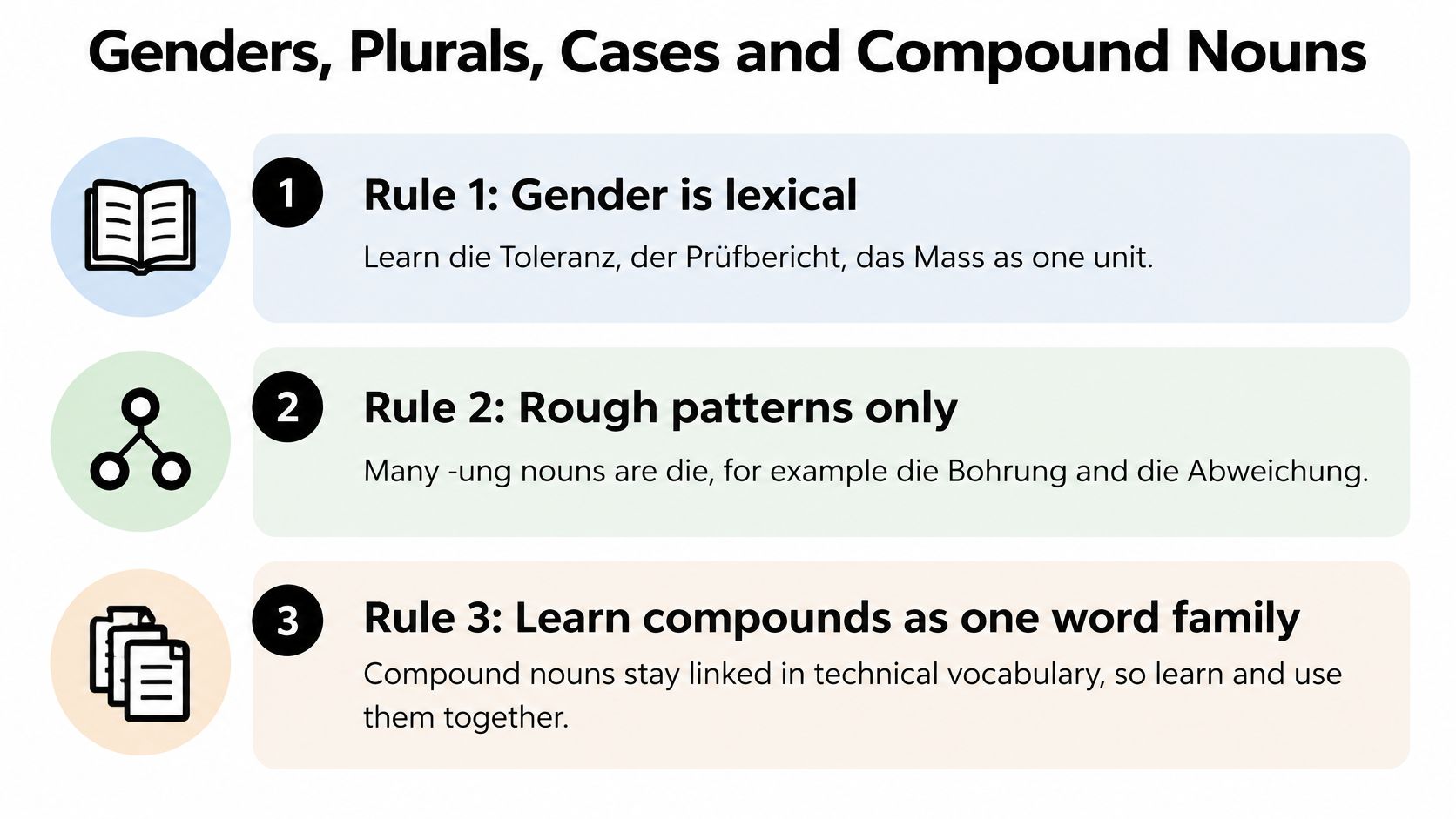
Learn the article with the noun. Write die Toleranz, der Prüfbericht and das Maß, rather than recording the bare words and trying to attach gender later.
Gender isn't a reliable guide to the physical object. A machine isn't feminine for an engineering reason; die Maschine is the German noun you need to learn.
Use patterns without trusting them blindly
Many nouns ending in -ung are feminine, including die Bohrung and die Abweichung. Nouns ending in -er need more care: der Schalter is masculine, but das Lager is neuter.
Learn plurals from parts lists and reports:
- Welle → Wellen: Shafts.
- Toleranz → Toleranzen: Tolerances.
- Bericht → Berichte: Reports.
- Lager → Lager: Bearings, with no change to the noun itself.
A plural isn't always obvious from the ending. Record it beside the singular rather than relying on an English-style rule.
Recognise case through a repeated pattern
Labels often use the nominative. Sentences introduce case changes through verbs and prepositions.
| Pattern | German | What to notice |
|---|---|---|
| Subject | Die Welle ist beschädigt. | The shaft is damaged |
| Direct object | Wir messen die Welle. | We measure the shaft |
| After an for location | Die Bohrung an der Welle ist beschädigt. | The bore on the shaft is damaged |
| Plural subject | Die Wellen sind freigegeben. | The shafts are released |
The change from die Welle to der Welle doesn't mean the noun has acquired a different gender. It reflects its grammatical role.
In Abweichung von der Toleranz, the preposition von requires the dative. Recognising that pattern helps you read the relationship between the terms.
Decode compounds from the right
The final element tells you what kind of thing the compound describes. Messunsicherheit is a kind of Unsicherheit, uncertainty; Grenzmaß is a kind of Maß, dimension.
Practise these word families:
- Nennmaß: nenn- + Maß, nominal dimension.
- Istmaß: Ist + Maß, actual dimension.
- Sollwert: Soll + Wert, target value.
- Rückführbarkeit: rückführbar + -keit, traceability.
- Konformitätsbewertung: Konformität + Bewertung, conformity assessment.
Not every long term consists only of separate nouns. Recognising suffixes matters too, as explained in our guide to understanding German compound words.
Capitalise German nouns, including those retained in an English email. Keep English sentence order when writing in English: Please attach the Prüfbericht is clearer than attempting a half-translated German sentence.
A wrong article is usually recoverable. Misreading the compound's final element can change the item you order.
Mechanical Electrical and Materials Entries
Start with the object in front of you. A Hong Kong buyer checking a German motor or measuring instrument may encounter these terms on a nameplate, drawing or certificate before using them in conversation.
The pitfalls below include false friends, multiple meanings and misleading near-equivalents. Not every vocabulary trap is a true false friend.
Mechanical terms for parts and machining
| Entry and plural | Meaning and pitfall | Workshop sentence |
|---|---|---|
| die Drehmaschine, Drehmaschinen | Lathe, not a generic machine that rotates | Die Drehmaschine ist bereit. The lathe is ready. |
| die Welle, Wellen | Shaft; in another context, a wave | Bitte prüfen Sie die Welle. Please check the shaft. |
| das Lager, Lager | Bearing here; warehouse or storage in other contexts | Das Lager ist beschädigt. The bearing is damaged. |
| die Bohrung, Bohrungen | Bore or drilled hole, not the drilling machine | Die Bohrung ist zu klein. The bore is too small. |
Consider Wellenlagerung. Read the final noun Lagerung first, meaning the bearing or support arrangement, then add Wellen-, identifying the shaft.
The result is shaft bearing arrangement, not just shaft bearing. That distinction matters when discussing an assembly rather than ordering an individual bearing.
Electrical terms for diagrams and drives
| Entry and plural | Meaning and pitfall | Workshop sentence |
|---|---|---|
| der Schaltplan, Schaltpläne | Circuit diagram, not a shift schedule | Bitte senden Sie den Schaltplan. Please send the circuit diagram. |
| die Spannung, Spannungen | Voltage electrically; stress or tension elsewhere | Die Spannung ist angegeben. The voltage is stated. |
| der Antrieb, Antriebe | Drive or drive system, not automatically the motor alone | Der Antrieb ist ausgeschaltet. The drive is switched off. |
Keep der Strom, current, and der Widerstand, resistance, separate from voltage. If you're unsure which quantity a supplier means, request the relevant diagram or test sheet rather than guessing from the English word power.
For a practical reading exercise, DUCHENG Industrial's resource on how to improve low voltage motor reliability provides a maintenance topic you can pair with a German motor manual. Build your vocabulary around the actual inspection and maintenance headings, while following the manufacturer's procedures for the equipment.
Materials terms for purchasing and certificates
| Entry and plural | Meaning and pitfall | Workshop sentence |
|---|---|---|
| der Edelstahl, usually uncountable in specifications | Stainless steel in common purchasing usage; the exact grade still governs | Die Welle ist aus Edelstahl. The shaft is made of stainless steel. |
| die Legierung, Legierungen | Alloy, not a coating | Bitte bestätigen Sie die Legierung. Please confirm the alloy. |
| der Werkstoff, Werkstoffe | Engineering material, not a workpiece | Der Werkstoff ist angegeben. The material is specified. |
| das Blech, Bleche | Sheet metal, not a generic sheet of any material | Das Blech ist beschädigt. The sheet metal is damaged. |
Edelstahl deserves special attention. In formal German metallurgy, the term doesn't by itself guarantee corrosion resistance, so procurement should retain the exact grade and any explicit stainless designation.
Useful German lines can sit inside an otherwise English supplier email:
Die Welle ist aus Edelstahl.
Die Spannung beträgt 400 V.
The voltage line is a language example, not a specification for your machine. In a real email, copy the actual value and unit from the controlled document.
For materials, distinguish what something is made from from whether it meets the requirement. The first statement describes composition; the second needs inspection or certification evidence.
Process Quality and Safety Vocabulary
A production order starts a chain of actions and records. Learning its vocabulary in sequence makes it easier to describe what happened, where the process changed and who authorised the next step.
The Hong Kong Productivity Council's manufacturing-industry study connects German industrial transformation with digital technologies, cross-sector cooperation and Industry 4.0 standards, and discusses local upgrading through Manufacturing+, including material transformation and specialised industrial-machinery repair or maintenance.

Follow the production-data chain
Start with das Werkstück, the workpiece, assigned to der Fertigungsauftrag, the production order. Der Arbeitsplan, the routing or operation plan, describes the sequence of work.
Then connect the physical process to its records:
- Der Maschinenzustand: Machine condition, such as its recorded operating state.
- Der Prozessparameter: A process parameter that must be identified precisely.
- Die Echtzeitdaten: Real-time data, a plural expression.
- Die Rückverfolgbarkeit: Traceability through production history.
- Die vorausschauende Instandhaltung: Predictive maintenance.
- Der Qualitätsregelkreis: A quality-control loop linking results and corrective responses.
- Die digitale Durchgängigkeit: End-to-end digital continuity between systems and stages.
Der Prüfstatus, inspection status, tells the next person whether checking is pending, completed or otherwise classified in the company's system. Don't infer release from the presence of a completed measurement alone.
For additive-manufacturing practice, American Additive Manufacturing's discussion of consistent quality in 3D printed parts offers a useful context for linking process records, inspection and corrective action. Use it to practise explaining which record supports a quality decision.
Choose the right fault word
Fehler, Störung and Ausfall on the shop floor
| German | Use it for | Do not use it for | Typical record |
|---|---|---|---|
| Fehler | A defect or data error in the part or document | A machine stop without identifying a defect or error | Maßfehler im Prüfbericht |
| Störung | A malfunction that disturbs the process | A passed inspection | Störung an der Linie |
| Ausfall | A failure or breakdown, machine down | A small dimensional deviation | Maschinenausfall seit 14 Uhr |
| Freigabe | Release after correction and approval | The fault itself | Freigabe erteilt |
These are practical distinctions, not mutually exclusive engineering classifications. A Fehler can cause a Störung, which can lead to an Ausfall.
The time in the example record is illustrative. An actual handover must state the documented downtime, not copy a model entry.
A concise escalation sequence is:
- Störung erkannt: Fault detected.
- Ursachenanalyse durchgeführt: Root-cause analysis completed.
- Parameter angepasst: Parameters adjusted.
- Freigabe erteilt: Release approved.
Write only stages that have occurred. A parameter change doesn't prove that the root cause has been established.
Keep safety language separate from permission
Learn der Gehörschutz, hearing protection; der Schutzhelm, safety helmet; die Verriegelung, interlock or locking mechanism; and die Betriebsanleitung, operating instructions.
An interlock's exact function must come from the equipment documentation. Never treat vocabulary knowledge as permission to bypass a safeguard.
A practice record could read:
Störung an der Drehmaschine. Parameter angepasst. Freigabe erteilt.
That's useful language practice, but a workplace record also needs the required identification, checks and authorisation. A bilingual shift handover is the right practice test because the next person must be able to act without guessing.
Pronunciation Collocations and Workshop Phrases
You've identified the fault correctly, but the supplier asks you to repeat the component name. Clear pronunciation matters most at the point where another person must distinguish a part, property or action.
Don't aim for theatrical native pronunciation. Aim for a recognisable term, then confirm it against the written document.
Make technical words easier to recognise
Practise each sound inside a useful word:
- ei in Zeichnung: An eye-like vowel sound.
- ie in Betrieb: A long ee sound, with stress on the final syllable.
- ch in Fach: The back-of-the-mouth sound used after a, o and u.
- ü in Stück: Round your lips while keeping the tongue position close to an ee sound.
- sp in Spannung: Begin with an shp sound.
- st in Störung: Begin with an sht sound.
Most native German compounds place their main stress on the first element, as in Wellenlagerung. Toleranz takes final-syllable stress, so don't apply the compound pattern to every technical word.
Cantonese-speaking learners can use our German r and ch pronunciation training to practise the unfamiliar mouth positions deliberately.
Store the action with the noun
A supplier needs to know what you want done, not just which noun you recognise.
| Collocation | Workplace meaning |
|---|---|
| Toleranz einhalten | Keep within tolerance |
| Maß prüfen | Check a dimension |
| Abweichung dokumentieren | Document a deviation |
| Auftrag freigeben | Release an order |
| Störung melden | Report a malfunction |
| Instandhaltung planen | Plan maintenance |
Say each pair together. Then change the object or document reference without losing the verb.
A bilingual handover that leaves no false approval
| Speaker | German | English |
|---|---|---|
| HK technician | An der Drehmaschine wurde eine Störung erkannt. | A fault was detected on the lathe. |
| Supplier engineer | Haben Sie das Istmaß mit dem Nennmaß verglichen? | Have you compared the actual dimension with the nominal dimension? |
| HK technician | Ja, das Istmaß weicht vom Nennmaß ab. | Yes, the actual dimension differs from the nominal dimension. |
| Supplier engineer | Wurden die Parameter angepasst? | Were the parameters adjusted? |
| HK technician | Ja, die Parameter wurden angepasst. | Yes, the parameters were adjusted. |
| HK technician | Die Freigabe steht noch aus. | Release is still pending. |
For supplier emails, keep these requests available:
- Confirm a requirement: Könnten Sie die Toleranz bestätigen? Could you confirm the tolerance?
- Request evidence: Bitte senden Sie den Prüfbericht. Please send the test report.
- State a result: Die Abweichung liegt außerhalb der zulässigen Grenze. The deviation is outside the permissible limit.
Bridge language fits local working conditions. The German Industry and Commerce dual-training programme describes German classroom instruction alongside predominantly English business communication, within a local German business community of more than 500 companies, branches and regional offices.
An English sentence can therefore retain an agreed German document label: Please attach the Prüfbericht for this batch. Define the label for colleagues who don't know German, and keep the surrounding sentence unambiguous.
Cross References across Drawings Reports and Exams
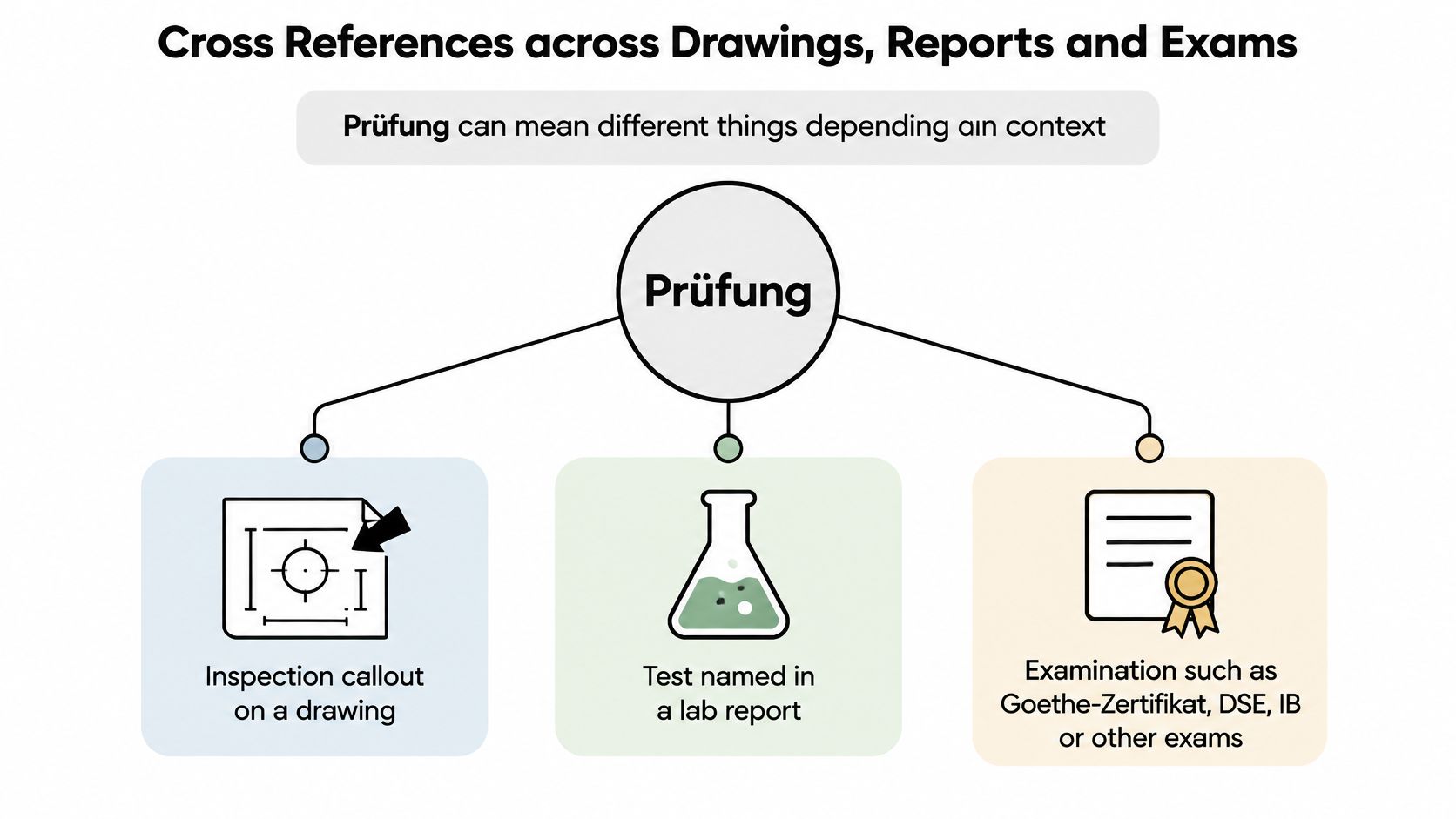
A supplier email may refer to a Prüfung, while a drawing or an exam uses the same word in a different way. Check the document and the action required before choosing an English translation. In a mixed English-German Hong Kong workplace, a shared glossary can keep the German term visible while making its meaning clear to colleagues who work mainly in English.
A drawing callout, a quality report and a Goethe-Zertifikat module belong to different contexts. The word alone does not tell you which one applies.
Pick the document before the translation
The same German word can have different readings across engineering documents.
| German | On a drawing | In a quality file | In study or exams |
|---|---|---|---|
| Prüfung | Inspection callout | Test named in the report | Examination paper or Goethe module |
| Maß | Dimension | Measured size in context | Not an exam term |
| Nennmaß | Nominal dimension | Reference for deviation | Not an exam term |
| Istmaß | Rare on the title block | Actual measured dimension | Not an exam term |
| Sollwert | Target on the specification | Target versus measured value | Not an exam term |
| Abweichung | Out-of-tolerance note | Deviation or non-conformance | Not a grade |
| Auftrag | Manufacturing note if specified | Production or purchase order | Not homework |
These are context-based readings, not a complete dictionary. For example, Auftrag can also mean an assigned task in an educational setting. Read the surrounding sentence before settling on “homework” or “order.”
Connect standards terms to their function
The ISO member profile for Hong Kong's Innovation and Technology Commission provides local institutional context for international standards work. For practical reading, sort standards vocabulary by the job each term does in a document:
- Requirement: die Toleranz defines tolerance; das Nennmaß identifies the nominal dimension.
- Observed result: das Istmaß identifies actual dimension; der Messwert records a measured value.
- Control reference: der Sollwert is the target; das Grenzmaß is a limit dimension.
- Decision boundary: die zulässige Abweichung means permissible deviation; die Abweichung records the deviation itself.
- Measurement confidence: die Messunsicherheit means measurement uncertainty; die Rückführbarkeit means metrological traceability.
- Evidence and evaluation: der Prüfbericht documents testing; die Konformitätsbewertung evaluates conformity.
Take care with similar-looking traceability terms. Rückführbarkeit concerns linking measurements to references, while Rückverfolgbarkeit concerns the history of a product or process.
When practising with a drawing, manual or supplier email, copy Sollwert, Grenzmaß, Messwert and zulässige Abweichung into separate fields. Keep the source's units, decimal notation and revision status. If a value is missing, flag it rather than filling it in from memory. This small habit makes the German labels useful without blurring the evidence behind an engineering decision.
Separate workplace, academic and exam registers
Shop-floor discussions may use Störung for a fault and Freigabe for release or approval. University applications use a different register, including der Studiengang, degree programme; die Zulassung, admission; and das Motivationsschreiben, motivation letter. Exam instructions bring another set of terms: der Prüfungsteil, examination section; mündlich, oral; and schriftlich, written. A CEFR-aligned course structure can help learners progress between these uses.
The Vocational Training Council's advanced-manufacturing outlook reports a considerable shortage of engineering talent. For engineers, this makes clear communication across workplace and training contexts useful, but it does not make the terms interchangeable.
For school planning, Goethe-Institut Hong Kong's examination guidance states that, from 2025, HKDSE Category C German uses a Goethe-Zertifikat at A2 or above, taken within the two years before the relevant HKDSE. This examination route is separate from university-specific admission requirements. Check the relevant exam context before treating a workplace document label as an exam term.
How Long Does It Take to Learn German for Engineering, and What Does It Cost?
Technical vocabulary sits on top of general German. Recognising familiar machine labels can develop before you're ready to explain an unfamiliar fault, challenge an inspection result or follow a detailed training discussion.
Plan around a CEFR learning pathway, then add document-based practice. Adults preparing to study abroad in Germany may need academic language beyond the supplier communication another learner needs.
Budget for a course you can complete
There's no single course price that applies to every learner. Compare the teaching format, contact time, assessment and suitability for your actual documents before judging value.
Our guide to German course costs and language requirements can help you organise that comparison. Keep tuition fees separate from any possible reimbursement.
CEF funding isn't an automatic discount. Under the Continuing Education Fund's eligibility information, applicants need qualifying Hong Kong residency status, including right of abode, right to land, unrestricted stay or a valid One-way Permit, and the reimbursement ceiling is HK$25,000, subject to scheme rules and available funds.
Don't treat that ceiling as a fresh annual allowance. Confirm your available entitlement and the specific course's reimbursable status before enrolling.
Schedule around reimbursement conditions
The CEF reimbursement procedures require applicants to be 18 to 70 when applying, generally achieve at least 70% attendance and 50% overall assessment, and normally apply within one year after successful completion, with higher course-specific thresholds applying where set.
Before committing, make a practical checklist:
- Eligibility: Confirm residency, age and remaining entitlement.
- Course status: Verify the exact approved course, not just the provider's name.
- Attendance: Allow for business travel, shift changes and family commitments.
- Assessment: Reserve study time for completion requirements, not only class attendance.
A technically relevant course that you can attend consistently is a better investment than an unsuitable timetable chosen only for its headline fee.
Practise This Week and Ready to Start Learning?
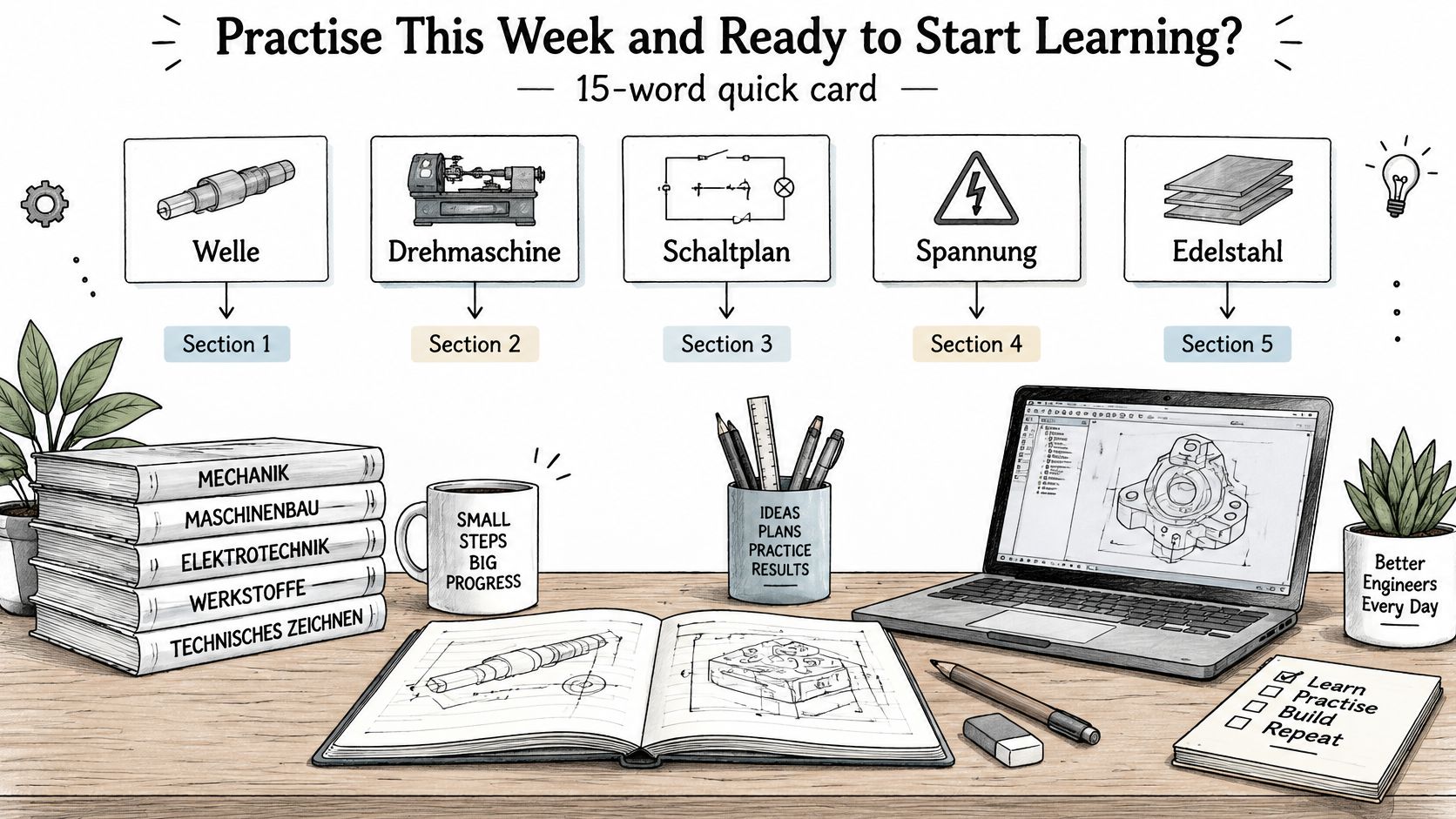
Use this German for engineers and manufacturing: technical vocabulary guide to create a compact revision card. Keep the following 15 terms visible beside your practice documents.
| Vocabulary location | Quick-card terms |
|---|---|
| Mechanical, electrical and materials entries | Welle, Drehmaschine, Schaltplan, Spannung, Edelstahl |
| Priority category table | Fertigungsauftrag, Toleranz, Prüfbericht, Abweichung, Not-Aus |
| Standards and document vocabulary | Nennmaß, Istmaß |
| Process and handover vocabulary | Störung, Ausfall, Freigabe |
Practise recognition before speed
- Add the articles: Mark every noun, then check the glossary entries. Use das Nennmaß, das Istmaß, die Störung, der Ausfall and die Freigabe for the additional terms.
- Analyse word structure: Split Messunsicherheit and Qualitätsregelkreis from the final noun. Treat vorausschauende Instandhaltung as an adjective-plus-noun phrase, not a single compound.
- Write a handover: Include Störung erkannt and, only in a scenario where approval has occurred, Freigabe erteilt. Read it aloud and ask whether the next person could identify the status.
Set a realistic learning commitment
Goethe-Institut Hong Kong's learning guidance estimates approximately 60–150 learning hours for A1, 150–260 for A2, 260–485 for B1 and 450–600 for B2, with C1 and C2 generally requiring 600 hours or more; it also describes B1 preparation as approximately 350–650 teaching units of 45 minutes, depending on prior knowledge and learning needs, across reading, listening, writing and speaking.
Those ranges aren't interchangeable measures or guarantees. Choose an achievable timetable and build technical practice into it.
Working engineers, parents of DSE, IB or IGCSE students, and adults planning German study or supplier-facing roles can bring a non-confidential drawing or manual page to a trial lesson assessed by a qualified German teacher. Our native-speaking teachers can help identify the language foundations behind the immediate vocabulary need.
German Cultural Association Hong Kong(GCA) offers a structured CEFR-based curriculum, Business German and TestDaF preparation, plus Goethe-Zertifikat preparation for teens and adults at A1 and A2, with private lessons also covering B1, B2 and C1. Visit German Cultural Association Hong Kong(GCA) to contact our advisors, check the latest course schedule or book a trial lesson, and bring a non-confidential technical document so you can discuss a learning path connected to your work or study goals.
German for Engineers and Manufacturing: Technical Vocabulary Guide

Essays and Exam Formats from A2 to B2 in HK


