


BLOG

香港德國文化協會
The German Cultural Association
Essays and Exam Formats from A2 to B2 in HK
Your teenager has a German exam date in mind, but you're not sure whether the result will serve HKDSE Category C or a later university application. Or you're fitting German around work and wondering whether to book A2 now or keep studying towards B2.
Understanding essays and exam formats from A2 to B2 starts with the paper you'll sit. Match its tasks to your current skills, check when the certificate is needed, and build a preparation plan that produces work an examiner can recognise as your own.
Table of Contents
- A2 means making the arrangement clear
- B1 means explaining a change
- B2 means developing a defensible position
- Keep assistance narrow and transparent
- Keep these uses out of assessed work
- Keep an independent writing record
- Reimbursement depends on more than attendance
- Calculate both the final cost and the upfront commitment
What Essays and Exam Formats from A2 to B2 Demand
Essays and exam formats from A2 to B2 progress from simple personal messages to organised, supported opinions. In Hong Kong, learners encounter these demands through Goethe-Zertifikat and school German qualifications, including IGCSE, A-level and IB. TestDaF is a later university-style assessment, requiring stronger academic reading, writing and argumentation.
Essay and exam formats from A2 to B2
| Level or exam | Typical writing task | Preparation scale | What the marker expects |
|---|---|---|---|
| Goethe A2 | Form plus a short message or simple email | About 150–260 learning hours, or 200–350 units of 45 minutes | Routine facts in simple connected sentences |
| Goethe B1 | Semi-formal email and a short opinion | A bridge between the A2 and B2 hour bands | Clear paragraphs, reasons and a suitable register |
| Goethe B2 | A structured opinion on a current issue, alongside functional correspondence practice | About 450–600 learning hours, or 600–800 units of 45 minutes | A detailed view, examples and controlled complex sentences |
| TestDaF | Chart or graph description plus an argument, according to the test version | Built from solid B2 upward; check the required TDN profile | Data summary tied to a justified position |
| IGCSE German | Guided notes, messages and a longer composition | Lower to mid-secondary school course | Completed task points and everyday accuracy |
| A-level German | Essay on society, film or literature | Upper secondary, beyond everyday B1 | Organised argument and topic vocabulary |
| IB Language B | Personal and more formal text types | SL commonly involves B1–B2 preparation; HL requires greater depth | Purpose, audience and coherent development |
The learning-hour bands and instructional-unit estimates above come from Goethe-Institut Hong Kong's CEFR and examination guidance: approximately 150–260 learning hours or 200–350 instructional units for A2, and 450–600 hours or 600–800 units for B2, with each unit lasting 45 minutes. These are different measures of preparation, not interchangeable promises about how quickly an individual will pass.
Understand what changes between the bands
At A2, your task is to communicate routine information in simple language. You might explain where you live, arrange a meeting or describe a problem without developing an extended argument.
At B2, you need to handle complex texts, participate in fluent exchanges and express detailed views. In writing, that means explaining relationships between ideas rather than placing memorised sentences next to one another.
The table is a preparation map, not a substitute for the current paper specification. School boards and test versions can use different task combinations, so confirm the precise format before practising a template.
Turn the specification into a study plan
Collect the current sample paper, candidate instructions and marking criteria. If they're lengthy PDFs, you can analyze PDF documents with AI using 1chat to organise questions about task types and assessment language, then verify the answers against the original documents.
Practical rule: A course label tells you the intended level. The task, timing and marking scheme determine whether your performance earns the result.
Don't choose the most impressive row. Choose the row your school, employer or German institution will accept, then identify the skills you still need to demonstrate independently.
Goethe Pass Marks You Cannot Trade Off
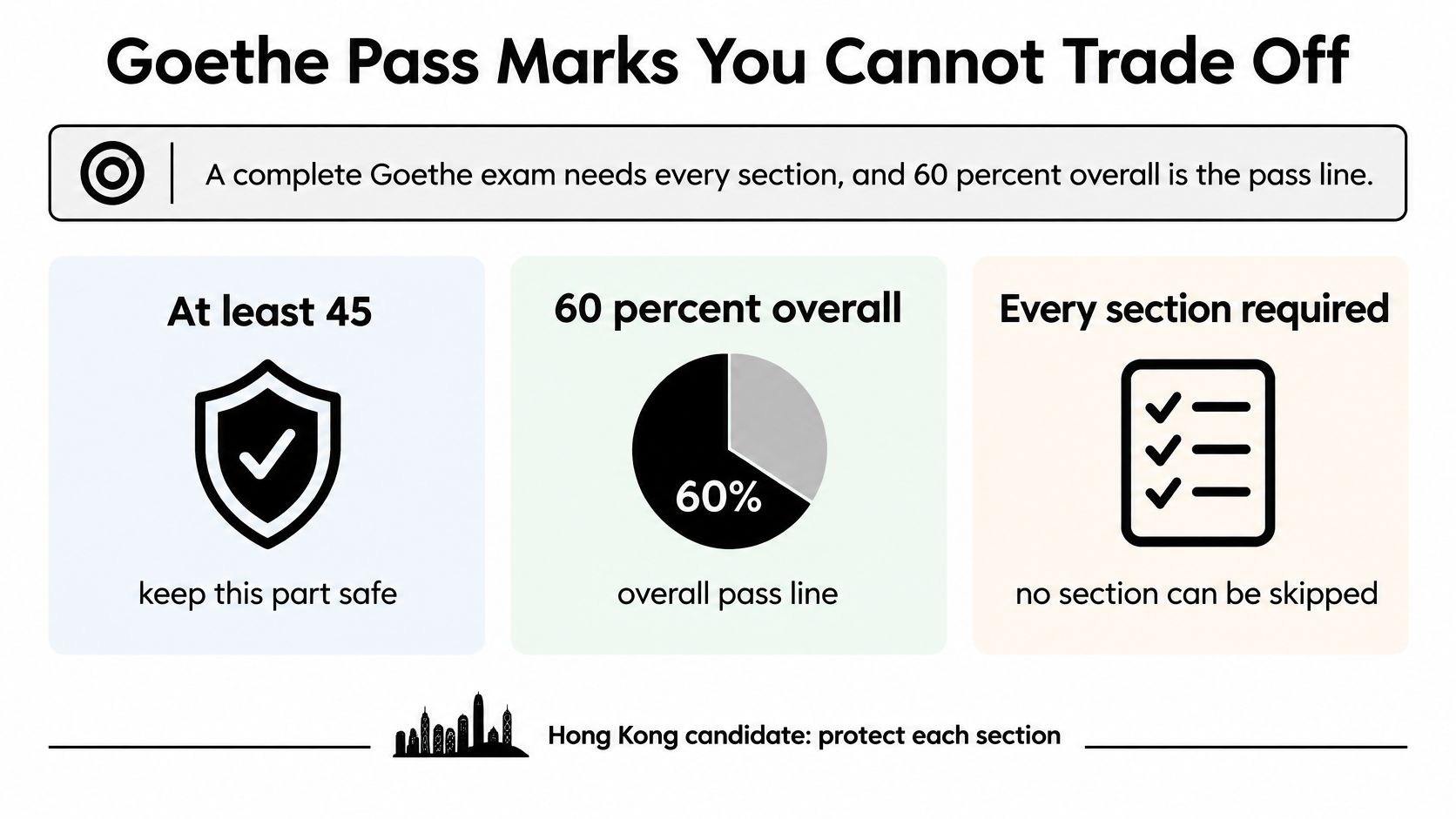
A complete Goethe exam needs every section, and 60 percent overall is the pass line. Goethe's published examination guidance sets the non-modular split at at least 45 written points and 15 oral points, while modular B2 requires 60% or higher in each module.
That distinction matters. Don't apply the combined written-and-oral calculation to a modular examination, and don't assume excellent comprehension can compensate for an unpassed speaking component.
Goethe pass floors for Hong Kong candidates
| Rule | Written side | Oral or module side | What to do |
|---|---|---|---|
| Full exam pass | At least 45 points | At least 15 oral points | Don't rely on writing to cover a weak oral |
| Overall threshold | 60 percent minimum | Every section completed | Leave no paper blank |
| Modular B2 | Each module at 60 percent or higher | Modules passed separately | Retake only the weak module where rules allow |
| Result timing | Online normally 16 working days after the examination | Digital certificate two working days after release | Match availability to HKDSE, university or visa deadlines |
The HKEAA administrative timing accompanying this guidance is normally 16 working days to online results, followed by two working days to the digital certificate. Count working days against document-submission deadlines, not just the examination date.
This visual highlights the complete-examination rule.
Two candidates, different risks
A strong reader with hesitant speaking may produce an encouraging written mock result. Under the full-exam structure, however, missing the oral floor still prevents a pass, so another reading worksheet isn't necessarily the most useful homework.
A modular B2 candidate with weak writing needs a different plan. Assess that module independently, investigate permitted retake arrangements and target the actual weakness, such as incomplete task coverage or an argument that never develops.
Rehearse speaking as deliberately as writing
Record speaking simulations and review them for:
- Task completion: Did you answer the question and fulfil the required communicative purpose?
- Intelligibility: Can a listener follow you without repeatedly reconstructing your meaning?
- Interaction: Do you respond to your partner rather than deliver a disconnected speech?
- Linguistic range: Can you explain, compare and justify using language you control?
Pair this with timed writing and listening practice. A balanced mock should expose the weakest component rather than hide it inside an attractive average.
Book the sitting after your mock performance meets the applicable written, oral or module requirements. A high reading score alone isn't a reliable booking signal.
Sample Tasks from a Short Note to a B2 Argument
A useful writing exercise makes the required information visible before the learner starts composing sentences. The progression below shows how to increase the thinking demand without making every text unnecessarily long.
Use this illustration as a reminder of the change in purpose.

A2 means making the arrangement clear
Practice prompt: Write to a classmate about meeting before German class. Give the time, explain the meeting place and ask whether they can bring the homework.
For a home drill, try a five-minute plan, a short uninterrupted writing window and a three-minute check. These are suggested practice timings, not official examination durations.
- Plan: Note the time, place and question before choosing sentences.
- Write: Use straightforward statements that make the arrangement unmistakable.
- Check: Tick each required point, check the verbs and confirm that the greeting suits a classmate.
Missing the meeting place can damage task completion more than a small grammatical slip. A short, complete message is more useful than a longer message full of unrelated personal information.
B1 means explaining a change
Practice prompt: Email your host to explain that your arrival plan has changed. Give the reason, suggest an alternative and ask politely whether the new arrangement is convenient.
Use a five-minute planning period to decide the paragraph order. As a separate timed exercise, write the email in 20 minutes, then spend three minutes checking task points, verb placement and register.
For an opinion follow-up, explain whether visitors should stay with host families. Develop two reasons rather than repeating that the experience is good, and use a polite closing in the email itself.
Parents can highlight every instruction in the prompt and tick its matching sentence in the answer. Students should revise the missing information first, not rewrite the whole email merely to make it sound more polished.
B2 means developing a defensible position
Practice prompt: Should Hong Kong employers encourage staff to use public transport?
Plan a position, developed reasons, a counterpoint and a final judgement. For example, explain the convenience of public transport for some commuters, acknowledge that shift workers may face practical difficulties, and propose a qualified policy rather than a blanket rule.
Allow five minutes for the outline, an uninterrupted writing window suited to your practice paper, and three minutes to check the response. The B2 German exam preparation guide can help you organise further exam-focused practice.
Use the video alongside your own draft, pausing to note techniques you can apply independently.
Four-part rubric for A2 to B2 drafts
| Criterion | Not yet | Pass-level | Strong |
|---|---|---|---|
| Task completion | Misses a required point | Answers every required point | Answers every point with developed detail |
| Coherence | Ideas listed without links | Clear order with basic connectors | Logical flow with varied linking |
| Range | Limited vocabulary blocks meaning | Enough topic words for the task | Precise topic vocabulary and functional phrases |
| Accuracy | Frequent errors block meaning | Errors do not block meaning | Controlled level-appropriate structures with few errors |
Treat these as home-practice descriptors, not an official scoring conversion. An A2 text can be short and successful; a long B2 response can still fail its purpose if it never answers the statement.
How Are IGCSE, A-level, IB and TestDaF Marked?
Start with the examiner's criteria, not the course level. A B2 label doesn't automatically translate into a particular school grade or university admission result.
Match the response to the assessment
- IGCSE German: Practise completing the task points and communicating everyday information accurately. Don't let an ambitious sentence obscure a required detail.
- A-level German: Develop a structured argument using relevant evidence and topic vocabulary. For film or literature, explain how your example supports your interpretation rather than retelling the plot.
- IB Language B: Make purpose, audience and text type visible. A formal response needs an appropriate register throughout, not merely a formal greeting.
- TestDaF: Prepare for academic communication and consult the requirements for the test version and university. Institutions may examine individual skill results rather than accept an overall impression of fluency.
For school-specific planning, the A-level German syllabus guide for Hong Kong learners helps distinguish language development from subject-paper preparation.
Use the current scheme
- Download the current mark scheme from your examination board or school.
- Match each criterion to a drill, such as paragraph development or register correction.
- Mark a timed draft against those criteria, not against how impressive it sounds.
Confirm the current requirements with your teacher. School qualifications and TestDaF aren't interchangeable versions of a Goethe essay.
Which Level Still Counts for HKDSE and Study Abroad
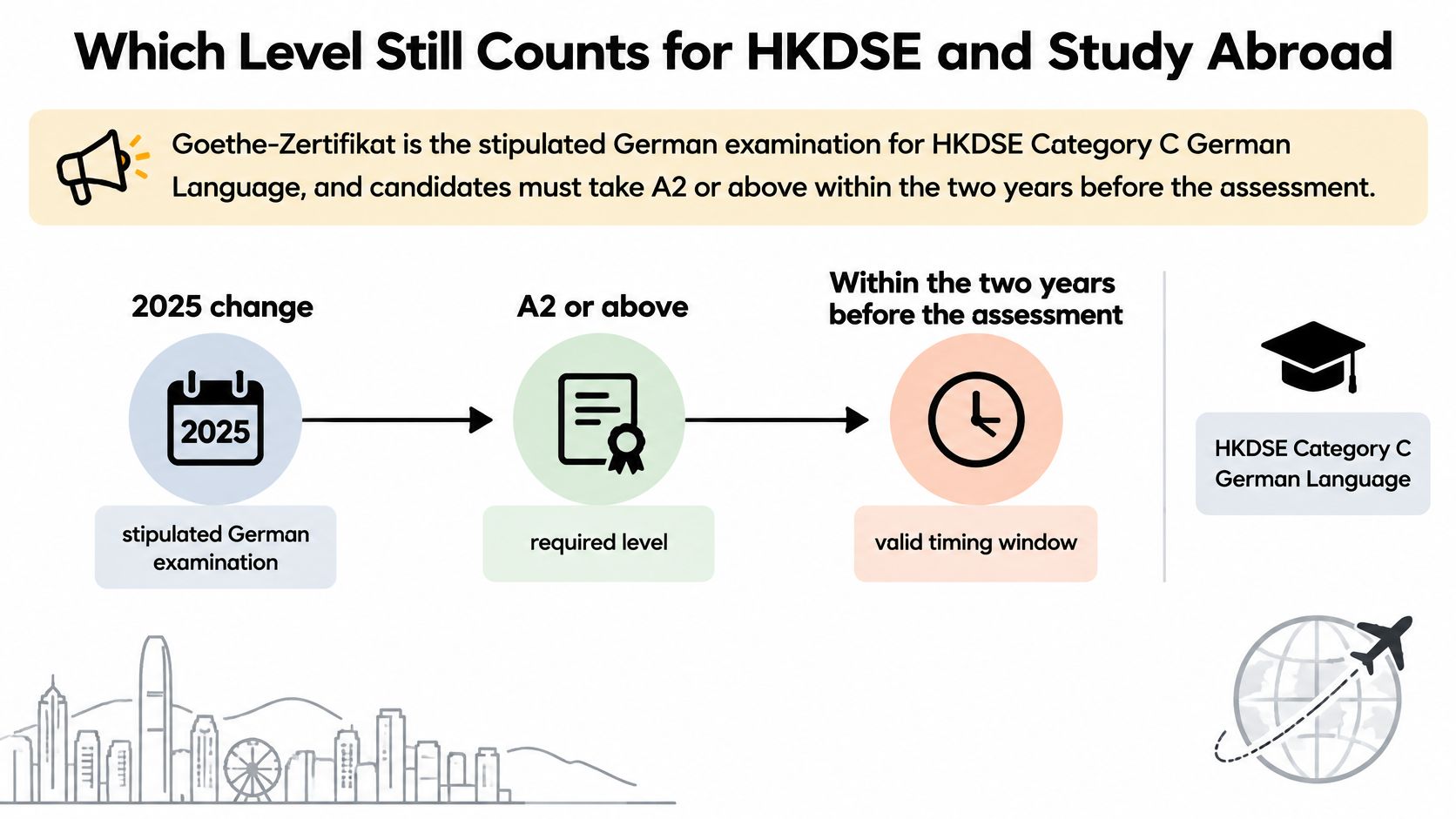
From 2025, Goethe-Zertifikat became the stipulated German examination for HKDSE Category C German Language, and candidates must take A2 or above within the two years before the examination, according to Goethe-Institut Hong Kong's examination information.
For a Hong Kong family, this is a scheduling decision before it's a question of essay sophistication. An impressive piece of coursework doesn't replace a qualifying examination result taken within the required window.
This timeline highlights the relationship between the qualification and its timing.
Choose the level for the immediate purpose
A2 is the basic eligibility choice when the immediate objective is a qualifying HKDSE result. It can be a sensible decision for a student balancing German with demanding school subjects, provided their mock performance supports it.
B1 is a developmental choice when the learner needs greater independence in paragraph writing and everyday explanation. It can support school coursework and preparation towards IB Language B SL, but it isn't an automatic equivalence to an IB grade.
B2 is the stronger argumentation target for learners moving towards demanding school essays and academic German. It can support preparation for A-level or IB HL writing, without replacing those qualifications' separate assessment requirements.
Goethe's B2 examination description makes clear that candidates need corresponding German skills before sitting the examination. Treat it as demonstrated competence, not the next course to purchase.
Build the calendar around acceptance
- Fix the destination date. Record the HKDSE year or application deadline and confirm what documentation is required.
- Identify the permitted sitting window. For HKDSE, work backwards using its examination-date rule; for a university, use that institution's stated requirements.
- Select an achievable sitting. Choose the highest suitable level the learner can realistically pass within the relevant window, leaving room for administrative processing.
A certificate can remain a meaningful record of achievement while no longer meeting a particular application's timing rule.
For a teenager planning to study abroad in Germany, protect the immediate school pathway first. Add later academic-language preparation once the HKDSE requirement is secure.
TestDaF belongs to that university-planning conversation. Don't assume it substitutes for the Goethe examination stipulated for HKDSE, or that a school German result automatically satisfies a German university's language requirements.
How Hong Kong Learners Should Use AI on Essays
Submitting AI-generated work as your own can constitute malpractice, while appropriately acknowledged AI use may support learning, as discussed in Hong Kong education guidance hosted by HKEdCity. A polished AI paragraph can look like B2 and still hide an A2 writer.
That's the central risk when preparing essays and exam formats from A2 to B2. The final text may improve while the learner remains unable to retrieve the words, organise the argument or control the sentences unaided.
The visual captures the difference between assistance and substitution.

Keep assistance narrow and transparent
For exam preparation, limit AI to these uses, subject to your school's rules:
- Spot repeated errors: Ask it to identify recurring verb-position or agreement problems in your own draft, without replacing the response.
- Generate practice prompts: Request a fresh situation that exercises the same skill without copying an assessed task.
- Compare against the rubric: Ask which task points are missing and where the sequence becomes difficult to follow.
Ask for explanations you can test. If the tool suggests a correction you don't understand, check it with your teacher before adopting it.
Keep these uses out of assessed work
- Whole-essay translation: Don't write an advanced English argument and outsource the German.
- Generated answers for memorisation: Don't mistake recalling a prepared script for responding to an unfamiliar question.
- Pasted homework: Don't submit generated passages as evidence of your own writing ability.
If you explore resources to refine your essay's tone and flow, such as Humantext.pro's guide, use them to discuss revision choices, not to disguise generated authorship. More natural wording doesn't make an outsourced answer authentic.
Keep an independent writing record
Use a weekly cycle of an unaided timed response, an AI error report on that same draft and a student-written revision. Retain dated copies so the teacher can distinguish genuine development from sudden changes in surface polish.
Hong Kong tertiary educators are exploring AI feedback and redesigned assessment, so check current school policies rather than assuming permission. A supervised examination still requires the candidate to plan, retrieve vocabulary and revise within its rules.
If you can't reproduce the argument without the tool, the draft is practice, not proof of your level.
How Much German Exam Preparation Costs with CEF
Eligible learners can access a maximum lifetime CEF subsidy of HK$25,000; applicants must generally be at least 18 when the course begins and meet the relevant Hong Kong residency conditions, according to the Continuing Education Fund's language-course guidance.
The CEF reimbursement procedures specify learner co-payments of 20% of the course fee for the first HK$10,000 of subsidy and 40% for the second HK$10,000. These bands don't mean every applicant receives the maximum reimbursement or pays the same final price.
CEF subsidy bands for German exam courses
| Subsidy slice | What the learner bears | Condition |
|---|---|---|
| First HK$10,000 of subsidy | 20 percent of the course fee | Course completed and benchmark passed where required |
| Second HK$10,000 of subsidy | 40 percent of the course fee | Same pass rule; claim after the exam date if required |
| Lifetime ceiling | HK$25,000 maximum subsidy | Generally age 18 or over at the start, plus HK residency rules |
Reimbursement depends on more than attendance
For eligible language-proficiency courses, successful completion and the specified benchmark examination result matter. Where a benchmark applies, attending classes without passing that examination isn't enough.
Claims must also reach the scheme within its permitted period after successful completion or the specified language-examination date, where relevant. Confirm that deadline before enrolling and keep the course, payment and examination documents together.
Don't assume a language centre's general course certificate is the same as a qualifying benchmark result. Ask the provider to identify the exact reimbursable course and examination requirement.
Calculate both the final cost and the upfront commitment
Use this budgeting check:
- Course fee: Obtain the complete tuition price and identify compulsory materials.
- Less expected reimbursement: Calculate this using your remaining entitlement and applicable co-payment band.
- Plus examination costs: Check whether registration is included or paid separately.
- Plus a retake buffer: Keep money and calendar space available if another attempt becomes necessary.
You may need to pay before reimbursement arrives, so distinguish cash needed upfront from the eventual net cost. The guide to CEF-funded German courses in Hong Kong can help you prepare questions for the course provider.
Progress towards B2 requires sustained guided study and independent practice. A cheap short course that omits marked writing and speaking simulations may leave you paying again for the preparation you need.
Don't buy a promise of rapid fluency. Choose a reimbursable course only when its target examination matches the certificate you need and its schedule fits your work commitments.
Ready to Start Learning? Book a Trial Class Before Your Next Exam Date
Before choosing a class, write down the certificate you need, the sitting month and your weakest component. Be specific: an incomplete A2 message, an unclear B1 email, an undeveloped B2 opinion or hesitant spoken interaction each requires a different teaching response.
Choose preparation you can assess
A structured, native-led programme should connect the curriculum to examination tasks and provide feedback across reading, listening, writing and speaking. University courses and private tutors can suit different learning styles, but check whether their teaching includes the particular paper and deadline you're working towards.
Scheduling matters for working adults and school families. Providers may use language school software, such as Tutorbase, to organise classes, but ask directly about lesson availability, rescheduling and continuity with your teacher.
Bring a recent unaided draft to a trial class. It gives the teacher something concrete to assess and helps you judge whether the feedback is precise enough to act on.
- Book a trial class: Test the teaching approach against your weakest task.
- Contact an advisor: Confirm your qualification pathway and examination schedule.
- Check the latest course schedule: Select a sustainable pattern rather than an unrealistic short-term sprint.
German Cultural Association Hong Kong(GCA) offers native-speaking teachers, a structured curriculum and preparation for Goethe-Zertifikat and school German examinations. Visit German Cultural Association Hong Kong(GCA) to book a trial class or discuss your target certificate, next sitting and the writing or speaking skills you need to strengthen.

Essays and Exam Formats from A2 to B2 in HK

German Writing Skills: Emails That Get Replies


