.png)
.png)

BLOG

香港德國文化協會
The German Cultural Association
Job Interviews in German: Key Vocabulary & Preparation Tips
You walk into a Central office tower with a strong CV, solid English, and enough German to handle lessons, emails, or travel. Then the panel switches to German and follows your first answer with a precise question about a project, a client conflict, or your next action. Suddenly, memorised vocabulary isn't enough.
Job Interviews in German: Key Vocabulary & Preparation Tips must reflect Hong Kong hiring reality. German-speaking roles often test whether you can move between German, English, and Cantonese or Mandarin while staying concise, commercially relevant, and calm under pressure. The preparation that works for a DSE or IB student isn't the same as the preparation required for a banking, logistics, consulting, or education professional.
Table of Contents
Why Interview German Is a Separate Skill in Hong Kong
German remains a niche language in Hong Kong. A University of Hong Kong survey placed German visibility among language groups at about 0.7%, while another district-level breakdown in the same study placed German at around 0.932 overall, with very small shares in individual districts (Hong Kong German learning and course context). That limited local exposure makes interview preparation more demanding. Candidates may need to demonstrate practical, work-ready German even though they rarely use it outside lessons or specialist workplaces.
A classroom conversation usually gives you time to construct a sentence. An interview does the opposite. The interviewer expects you to understand the question, identify its business purpose, answer directly, support your point, and respond to a follow-up without losing control of the conversation.
The Hong Kong bilingual workflow
Recruiters in Hong Kong aren't necessarily looking for native-level German. They want evidence that you can work across languages. A German-speaking employee may explain a client issue in German, summarise it to a Hong Kong team in English, then coordinate locally in Cantonese or Mandarin.
That means your interview performance includes more than grammar:
- Listening under pressure, especially when the speaker uses a regional accent or speaks quickly.
- Business vocabulary, including deadlines, responsibilities, risks, handovers, and client requirements.
- Concise argumentation, rather than long personal narratives.
- Code-switching control, so you can clarify a point in English without abandoning the German conversation.
- Professional recovery, when you miss a word or need the interviewer to repeat a question.
Practical rule: A short, accurate answer that moves the discussion forward is more valuable than an ambitious answer full of errors.
DSE, IB, and returnee candidates often arrive with different strengths. A DSE student may have strong exam discipline but limited spontaneous speaking. An IB student may be comfortable presenting in English but translate too directly into German. A returnee may understand German well but need practice with formal interview register and Hong Kong workplace expectations.
If you need additional speaking repetitions between lessons, practice German speaking with AI can help you rehearse responses aloud. Use it for fluency and confidence, but don't confuse repeated practice with employer-specific preparation. You still need role vocabulary, structured answers, and feedback from someone who understands the hiring context.
The STAR Structure for Answering in German
German interview answers work best when the main point arrives early. Use the STAR method, Situation, Task, Action, Result, but make it tighter than the storytelling style often used in English interviews.
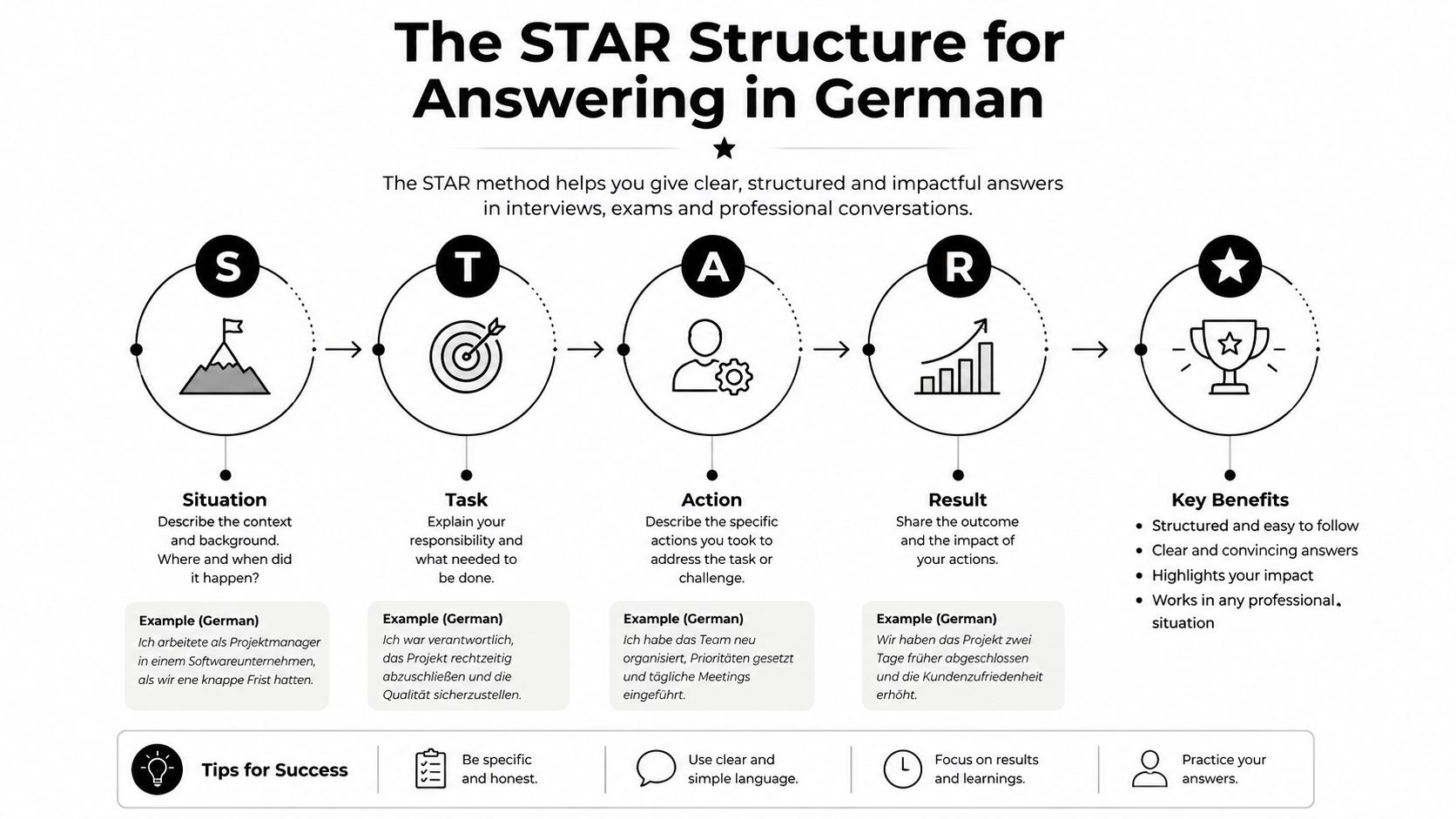
Build each answer in four moves
Situation: Give only the context the panel needs.
- In meinem letzten Projekt ging es um die Einführung eines neuen Kundenprozesses.
- In my last project, the focus was introducing a new client process.
Task: State your responsibility clearly.
- Meine Aufgabe war es, die Kommunikation zwischen dem Kunden und unserem internen Team zu koordinieren.
- My task was to coordinate communication between the client and our internal team.
Action: Explain what you personally did. Use sequencing words to make the answer easy to follow.
- Zunächst habe ich die Anforderungen gesammelt.
- Daraufhin habe ich die offenen Punkte mit den beteiligten Teams geklärt.
- Anschließend habe ich einen klaren Zeitplan erstellt.
Result: Finish with the business outcome and next step.
- Letztendlich konnten wir den Prozess erfolgreich umsetzen. Danach habe ich die Dokumentation für weitere Projekte vorbereitet.
Avoid hiding behind wir throughout the answer. German interviewers need to know what you did, not only what the team achieved. Replace vague claims such as Ich bin sehr organisiert with evidence about how you organised a task.
A compact Wan Chai example
For a client onboarding project in Wan Chai, a 90-second answer might sound like this:
Mein Hintergrund ist die Koordination von Kundenprojekten im internationalen Umfeld. In einem Projekt in Wan Chai war meine Aufgabe, einen neuen Kunden zu onboarden und die Kommunikation zwischen dem Kunden, unserem Compliance-Team und dem deutschen Hauptsitz zu koordinieren. Zunächst habe ich die erforderlichen Unterlagen geprüft und die offenen Fragen gesammelt. Daraufhin habe ich die Aufgaben verteilt und regelmässige Status-Updates organisiert. Letztendlich konnten wir den Prozess abschliessen, und ich habe die wichtigsten Schritte dokumentiert, damit das Team sie bei weiteren Kunden wiederverwenden kann.
This answer is effective because it identifies the background, responsibility, action, and outcome without excessive explanation. It also demonstrates the workflow Hong Kong employers recognise, German communication with international coordination and local execution.
Don't overuse English jargon. Terms such as KPIs, deliverables, and stakeholder alignment may be understood, but you should know the German alternatives relevant to your industry. Do not omit the result. If you can't disclose a commercial figure, describe the outcome precisely, such as faster coordination, clearer ownership, fewer follow-up questions, or a completed handover.
Core Vocabulary for the Five Most Common Interview Topics
背熟零散的單字表,不能讓你應付真正的面試。你應該把句子當作 functional units 學習,再按職位替換名詞和動詞。香港的面試通常在英文、德文和廣東話之間切換,所以你要練習的不只是翻譯,而是用德文清楚交代背景、職責和下一步。金融、物流、IT 和教育職位所需的詞彙不同,但正式語域和回答結構同樣重要。
正式面試請使用 Sie,除非面試官明確邀請你使用 du。後續電郵也要維持同樣的正式程度。若職位涉及德國總部、德語客戶,或之後要配合德國求職及簽證途徑,請按職業要求準備相應的 Goethe-Zertifikat 或 TestDaF 能力,不要只記住看似專業的名詞。
| Topic | German Phrase | English Gloss | When to Use in HK |
|---|---|---|---|
| Greeting and small talk | Guten Morgen, vielen Dank für die Einladung. | Good morning, thank you for the invitation. | 用於實體或網上面試開始時。 |
| Greeting and small talk | Ich freue mich, heute mit Ihnen zu sprechen. | I'm pleased to speak with you today. | 德語面試小組適用的專業開場白。 |
| Greeting and small talk | Die Verbindung ist klar, vielen Dank. | The connection is clear, thank you. | 遙距面試時可使用。 |
| Greeting and small talk | Darf ich kurz nachfragen? | May I briefly ask for clarification? | 先澄清問題,不要自行猜測。 |
| Greeting and small talk | Darf ich kurz zusammenfassen? | May I briefly summarise? | Zoom 連線嘈雜、未能聽清問題時使用。 |
| Background | Mein Hintergrund ist … | My background is … | 用你的專業重點開始自我介紹。 |
| Background | Zu meinen Aufgaben gehörte … | My responsibilities included … | 介紹具體職責,不要只說個人特質。 |
| Background | Ich habe Erfahrung im Bereich … | I have experience in the area of … | 把最後部分改成 finance、logistics、IT 或 education 等相關領域。 |
| Background | Der Schwerpunkt meiner Ausbildung lag auf … | The focus of my education was … | 適合 DSE、IB、大學或畢業生面試。 |
| Background | In meiner bisherigen Laufbahn habe ich … | In my career so far, I have … | 連結多段工作經驗時使用。 |
| Strengths and weaknesses | Zu meinen Stärken gehören … | My strengths include … | 後面接證據,不要列出一長串優點。 |
| Strengths and weaknesses | Eine Stärke von mir ist … | One of my strengths is … | 只回答一個重點例子時適用。 |
| Strengths and weaknesses | Ich arbeite zuverlässig und strukturiert. | I work reliably and in a structured way. | 用 STAR 例子支持這個說法。 |
| Strengths and weaknesses | Ein Bereich, in dem ich mich weiterentwickle, ist … | One area I'm continuing to develop is … | 以受控方式談及弱項。 |
| Strengths and weaknesses | Daran arbeite ich, indem ich … | I'm working on that by … | 展示實際改善計劃,不要作防衛式回應。 |
| Motivation and company | Warum möchten Sie bei uns arbeiten? | Why do you want to work with us? | 正式面試幾乎一定會問。 |
| Motivation and company | Ich interessiere mich besonders für … | I'm particularly interested in … | 把公司業務連繫到你的經驗。 |
| Motivation and company | Ihre internationale Ausrichtung passt zu meinem Profil. | Your international focus fits my profile. | 適合有德國總部或德語客戶的香港職位。 |
| Motivation and company | Ich kann meine Deutsch- und Englischkenntnisse verbinden. | I can combine my German and English skills. | 直接解釋你如何在雙語工作流程中使用兩種語言。 |
| Motivation and company | Ich möchte mich langfristig weiterentwickeln. | I want to develop over the long term. | 只有在你能說明想發展的方向時才使用。 |
| Technical questions | Können Sie ein konkretes Beispiel nennen? | Can you give a specific example? | 面試小組要求細節時,可用來請對方提供具體例子。 |
| Technical questions | Der wichtigste Punkt ist … | The most important point is … | 先說結論,再補充解釋。 |
| Technical questions | Aus meiner Erfahrung … | From my experience … | 引入證據,但不要誇大經驗。 |
| Technical questions | Das würde ich in drei Schritten angehen. | I would approach that in three steps. | 個案問題適用。 |
| Technical questions | Zunächst würde ich …, danach … | First I would …, then … | 讓回答有清晰可見的次序。 |
| Technical questions | Mein nächster Schritt wäre … | My next step would be … | 以執行方案結束,不要停留在理論。 |
Pronunciation that affects credibility
你不需要消除香港口音,但必須讓關鍵專業詞彙容易理解。香港雇主測試的往往是溝通能否順利完成,而不是你能否模仿某個地區的口音。
- Umlauts: 保持 ö、ü 與 o、u 的區別。在完整句子中練習 führen、prüfen 和 Lösung。
- The ch sounds: ich 的音與 Buch 的音不同。把兩者錄下來,檢查自己能否穩定區分。
- The German r: 選擇你能穩定發出的讀法。清晰度比刻意模仿地區口音更重要。
- Compound nouns: 把長字拆成幾個部分練習。先慢讀 Geschäftsführer,再放進句子:Ich habe direkt mit dem Geschäftsführer gesprochen.
錄音時也要練習英文提問後轉用德文回答,或先以廣東話整理重點,再用德文作答。這種 EN/DE/Cantonese workflow 更接近香港跨國公司面試的實際情況。不要把每個答案逐字由英文翻譯成德文,否則句子容易變長,動詞位置也會出錯。
你可以在面試後發送簡短電郵,重用 Vielen Dank für das angenehme Gespräch 和 Ich freue mich auf Ihre Rückmeldung 等正式句式。只有在拼寫和語域可靠時才發出。錯誤的稱謂、大小寫或結尾,會抵銷你在面試中建立的專業印象。
Mock Interview Scripts for Students, Professionals and Parents
The same German phrase changes value according to the speaker's objective. A student needs to show direction, a professional must prove workplace contribution, and a parent needs to communicate practical requirements clearly.
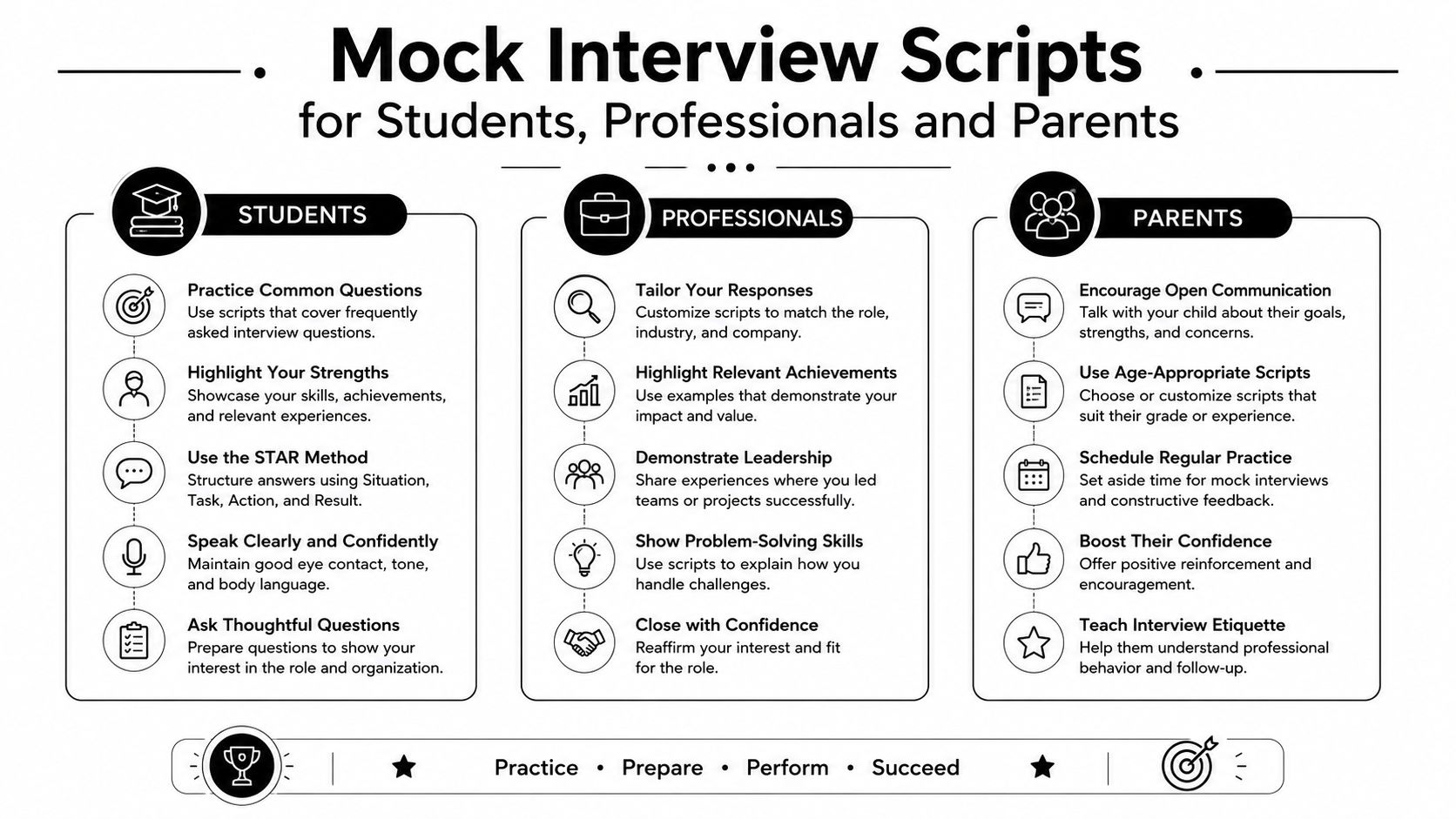
Script for a DSE or IB student
Question: Erzählen Sie mir bitte etwas über sich und Ihre Studienpläne.
Model answer: Ich besuche derzeit eine internationale Schule in Hongkong und interessiere mich besonders für Wirtschaft und Sprachen. Ich lerne Deutsch, weil ich später möglicherweise an einer deutschsprachigen Universität studieren möchte. Mein nächstes Ziel ist, meine mündliche Kommunikation zu verbessern und mich gezielt auf eine Goethe-Zertifikat-B1-Prüfung oder ein Stipendiengespräch vorzubereiten.
English gloss: I currently attend an international school in Hong Kong and am particularly interested in business and languages. I'm learning German because I may later study at a German-speaking university. My next goal is to improve my spoken communication and prepare specifically for a Goethe-Zertifikat B1 examination or scholarship interview.
Coaching note: Don't translate Cantonese sentence order directly into German. Keep the answer short, use derzeit, weil, and mein nächstes Ziel, then stop.
Script for a junior professional
Question: Warum möchten Sie in diesem Bereich arbeiten?
Model answer: Ich möchte im internationalen Handel arbeiten, weil ich meine Deutsch- und Englischkenntnisse täglich einsetzen kann. In meiner bisherigen Tätigkeit habe ich Kundendaten koordiniert und mit verschiedenen Teams kommuniziert. Ich arbeite strukturiert, frage bei Unklarheiten frühzeitig nach und kann Informationen zwischen einem deutschen Ansprechpartner und einem lokalen Team klar weitergeben.
English gloss: I want to work in international trade because I can use my German and English skills daily. In my previous role, I coordinated customer data and communicated with different teams. I work in a structured way, ask early when something is unclear, and can communicate information clearly between a German contact and a local team.
Coaching note: Avoid saying only Ich kann Deutsch sprechen. Explain what you can do in German, such as clarify requirements, document actions, and coordinate handovers.
Script for a parent arranging lessons
Question: Welche Ziele haben Sie für Ihr Kind?
Model answer: Mein Kind soll Deutsch systematisch lernen und langfristig eine Prüfung vorbereiten. Uns sind kleine Gruppen, regelmässige mündliche Übungen und ein klarer Lernplan wichtig. Wir möchten ausserdem wissen, welche Termine möglich sind und wie der Unterricht mit dem Schulplan vereinbar ist.
English gloss: My child should learn German systematically and prepare for an examination over the long term. Small groups, regular speaking practice, and a clear learning plan are important to us. We'd also like to know which times are available and how the lessons can fit around the school schedule.
Coaching note: Hong Kong parents often translate requests too directly. Use Uns sind … wichtig rather than listing demands abruptly.
For additional rehearsal, interview practice with AI can help you test answer structure before a live session. Treat the output as a draft. A teacher still needs to correct register, pronunciation, and whether the answer sounds natural in a German-speaking workplace.
What CEFR Level Hong Kong Employers Expect
The right target depends on the job, not prestige. For Hong Kong candidates, B1 can support basic workplace interaction, B2 is the practical benchmark for many customer-facing and support roles, and C1 is the stronger target for banking, consulting, education, and headquarters-facing work where drafting, presenting, and negotiating matter (German-speaking roles in Hong Kong).
The Goethe-Institut gives approximate learning-hour bands of A1 at 60 to 150 hours, A2 at 150 to 260, B1 at 260 to 485, and B2 at 450 to 600. These are planning ranges, not guarantees. Interview ability also depends on role knowledge, listening practice, and repeated speaking under pressure. See the Goethe-Institut learning-hour guidance for the cited ranges.
| CEFR Level | Typical Hong Kong Roles | Study Hours | Interview Skill Demonstrated |
|---|---|---|---|
| A1 | Basic travel, relocation, or introductory contact | 60 to 150 | Simple self-introduction and basic personal information |
| A2 | Limited service support or routine workplace interaction | 150 to 260 | Short answers about availability, background, and familiar tasks |
| B1 | Entry-level support, hospitality, or roles with substantial English support | 260 to 485 | A structured answer about experience, plans, and straightforward work situations |
| B2 | Customer-facing, logistics, trading support, and many international-company roles | 450 to 600 | Follow-up questions, role-specific discussion, clarification, and concise reasoning |
| C1 | Banking, consulting, education, and headquarters-facing roles | The cited guidance provides no separate C1 range | Drafting, presenting, negotiating, and discussing complex professional issues |
Use a free German CEFR level test as a starting point, not proof of interview readiness. You may pass a level assessment and still struggle with an unscripted question about a client escalation. Practise the bilingual workflow Hong Kong employers often test: understand the question in German, clarify details, and explain the business response in precise German, English, or Cantonese as required.
Hong Kong's immigration environment also affects the value of German. The city issued 31,278 employment visas in 2025 and 13,640 in January to June 2026, with demand connected to commerce and trade, financial services, and innovation and technology (Hong Kong Immigration Department visa-control statistics). German strengthens a bilingual professional profile when it supports a credible role and visa pathway. It should not be presented as a stand-alone qualification.
Do not chase C1 vocabulary before you can deliver a confident B2 answer. For Central banking or consulting, prioritise precise explanations and negotiation language. For airport logistics, trade support, or customer operations, practise handovers, shipment or service issues, and rapid clarification. For German university admission, align academic preparation with the relevant Goethe-Zertifikat or TestDaF pathway. A job-interview course alone does not replace the academic language evidence those routes may require.
Cultural Etiquette German Interviewers Test For

A Hong Kong candidate can answer every technical question correctly and still lose credibility through timing, tone, or unclear ownership. German-speaking panels often assess punctuality, directness, structure, and clear ownership, alongside your German ability and your capacity to work through the English, German, and Cantonese workflow common in Hong Kong hiring.
| Hong Kong assumption | What a German-speaking panel may evaluate |
|---|---|
| Arriving exactly at the scheduled time is acceptable | Be ready before the interview begins, including for a remote meeting. |
| Indirect disagreement protects the relationship | State your concern clearly, then give a reason and workable alternative. |
| Small talk should continue until the interviewer leads | Keep the opening polite and brief, then move efficiently to the role. |
| A polished outfit is enough | Match formal presentation to the industry, especially finance and engineering. |
| Correction can threaten face | Accept correction calmly and answer the revised question directly. |
For a Frankfurt or Munich-facing interview, arrive five to ten minutes early, even for a remote meeting with an overseas panel. Check the connection, camera, microphone, documents, and room before the scheduled start. Open with Guten Morgen or Guten Tag, use Sie, and wait for an invitation before switching to du. These details show preparation without forcing unfamiliar informality.
Direct feedback is not an insult. If an interviewer challenges your assumption, say Das ist ein wichtiger Punkt or Ich verstehe Ihren Einwand. Then state whether you agree, identify the evidence you would check, and explain the action you would take. This structure works better than protecting face through vague agreement, particularly when the role involves finance, engineering, trade, or client operations.
German directness is not permission to be blunt. Be clear about the issue, respectful about the person, and specific about the next step.
Read German emails for tone, not only literal meaning. A phrase that sounds neutral in translation may signal reservation or a softened negative in professional context. If an interviewer asks whether a proposal is realistisch, do not treat the question as approval. Listen for the level of commitment, then confirm the next decision or condition.
Rehearse these behaviours before a mock panel:
- Timing: Enter the call early and test every device.
- Address: Use formal greetings and surnames until invited otherwise.
- Disagreement: Give your position, reason, and alternative.
- Correction: Say thank you, adjust, and continue.
- Questions: Ask one focused question that shows role awareness.
For a fuller review of workplace conventions, read this guide to German culture and etiquette.
A short visual reminder can help you practise the details before a mock panel.
Use the following video to observe professional manner, greeting, and response style.
Building a Realistic Preparation Plan With the Right Support
A realistic plan starts with your target role and current speaking ability. Don't book generic conversation practice and hope interview fluency appears. Set the level, vocabulary, format, and feedback method first.
An eight-week preparation sequence
Week one: Complete a speaking diagnostic and define the target. A customer-support interview may require a different level of performance from a headquarters-facing consulting role.
Week two: Build a role-specific phrase bank. Include your CV, current responsibilities, technical terms, client situations, and likely follow-up questions. Use spaced repetition, but practise every phrase in a complete answer.
Week three: Rehearse STAR answers with voice notes. Record the same answer until the opening point, evidence, and result sound natural. Listen for filler words, weak verbs, and unexplained English jargon.
Week four: Add etiquette and timing drills. Practise formal greetings, clarification phrases, direct disagreement, and concise questions. Run the drill with the camera on if the interview will be online.
Weeks five and six: Move to mock interviews with native speakers. Ask the coach to interrupt, request examples, switch briefly between German and English, and challenge your assumptions.
Weeks seven and eight: Run full simulations. Refine only the weak areas that affect performance, such as pronunciation, technical vocabulary, long pauses, or answers that never reach a result.
Choose support that matches the pressure
Apps and YouTube vocabulary lists are useful for exposure. They plateau when you need someone to interrupt a rehearsed answer, ask the same question in a different way, or test whether you can explain a German point to an English-speaking Hong Kong colleague.
Use a preparation tracker such as Eztrackr on interview preparation to organise applications, questions, practice recordings, and follow-up tasks. Organisation won't replace speaking ability, but it prevents candidates from preparing the same general introduction while ignoring the role-specific questions most likely to decide the interview.
Your documents also need to support your spoken claims. Review this guide on writing a German CV and cover letter for Hong Kong applications so your written German, English version, and interview narrative don't contradict one another.
The German Cultural Association Hong Kong(GCA) offers native-speaker German teaching through small-group and private formats, with structured preparation for Goethe-Zertifikat and TestDaF alongside Business German. Its online Zoom option and in-person locations can suit working professionals, students balancing DSE or IB commitments, and parents arranging a consistent schedule.
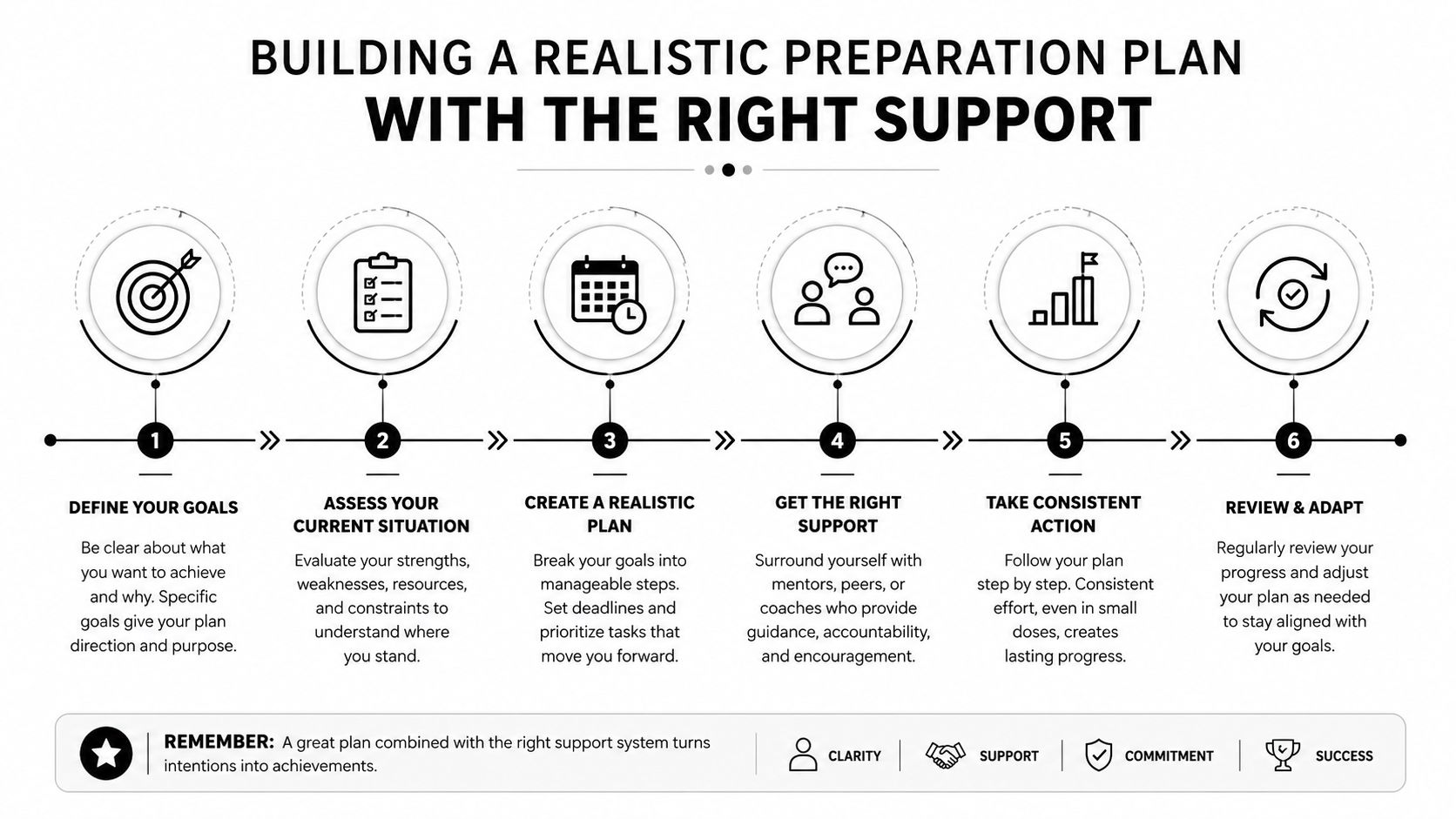
If your interview goal connects to a German study or visa pathway, add the administrative benchmark early. For a German language course or study visa, Hong Kong applicants need financial proof of 992 EUR per month or 11,904 EUR per year, usually through a blocked account with a monthly withdrawal limit of 992 EUR, as well as Hong Kong residency proof, passport validity of at least six months, and health insurance coverage (German Consulate financial proof requirements). Family reunification applicants generally need A1 German before entry (German Consulate language requirement). For the Working Holiday Visa, basic German is recommended but not mandatory, and applicants need an HKSAR passport, must be 18 to 30 with the application submitted before the 31st birthday, and must show at least 2,000 EUR plus a return air ticket under the scheme summary (German Working Holiday Visa information).
The efficient route is diagnostic speaking practice, structured vocabulary, repeated STAR answers, and live correction. Self-study should support that sequence, not replace it.
Visit German Cultural Association Hong Kong(GCA) to book a diagnostic class or mock interview session focused on your target role, CEFR level, and bilingual HK workflow. Ask about Central campus availability, weekday evening sessions, or Saturday slots so you can begin practising with a clear plan rather than another generic vocabulary list.

German Verb Tenses Overview: Präsens Made Simple
German Passive Voice (Passiv): Formation Guide


