.png)
.png)

BLOG

香港德國文化協會
The German Cultural Association
German Verb Tenses Overview: Präsens Made Simple
The Präsens is the German present tense for current actions, habits, and scheduled future events, and it forms the essential foundation for every other German tense. For Hong Kong learners, it supports early communication and examination accuracy before they progress to Perfekt, Präteritum, and Futur forms.
You may be preparing for a Goethe-Zertifikat, HKDSE, IGCSE, A-level, or IB pathway while also trying to introduce yourself confidently in German at work. The difficulty is often not vocabulary. It's knowing why ich lerne, ich lerne gerade, and ich lerne morgen can all use the same tense.
Table of Contents
- Mistake one is using the infinitive after every subject
- Mistake two is forgetting the vowel change
- Mistake three is keeping a separable prefix beside the verb
- Mistake four is forcing English “-ing” into German
- Mistake five is missing the time marker
What Is the German Präsens and Why It Matters in Hong Kong
You tell a colleague Ich lerne Deutsch, describe your Monday routine with Ich lerne jeden Montag Deutsch, or mention tomorrow's lesson as Ich lerne morgen Deutsch. The time expression supplies the context, while the verb remains in the Präsens. German uses this tense for actions happening now, repeated activities, and near-future plans.
In a main clause, the conjugated verb normally occupies the second position. Its ending identifies the subject, giving learners a reliable framework for speaking, writing, and examination tasks. The difficulty is knowing why ich lerne, ich lerne gerade, and ich lerne morgen all use the same tense.
Hong Kong learners often study German through a specialised examination route. The 2024 HKDSE examination recorded 83 German Language candidates, including 75 day-school candidates, and from the 2025 HKDSE onward, the Goethe-Zertifikat became the stipulated official German examination recognised by HKEAA. Accurate present-tense sentences therefore matter in local preparation, especially when you introduce yourself, answer familiar-topic questions, or write short responses. Read the local comparison of careers and exams for Hong Kong learners.
Why beginners should prioritise Präsens
At entry level, Präsens helps you:
- Give personal information: Ich heiße Mei. Ich wohne in Hongkong.
- Describe school life: Ich lerne Deutsch und besuche eine Schule.
- Explain work: Ich arbeite im Marketing.
- Talk about family: Meine Eltern leben in Kowloon.
- State routines: Ich fahre jeden Tag mit der MTR.
- Discuss plans: Ich fliege nächste Woche nach Berlin.
These sentences work like small building blocks. Change the subject, time expression, or activity, and you can adapt them to many conversations without translating each sentence word for word. The Goethe examination pathway covers A1 to C2, so control of the present tense continues to support clear answers beyond a first beginner course. Goethe-Institut Hong Kong outlines its examination pathway here.
Präsens also has a practical connection with professional mobility. Hong Kong and Germany recorded approximately EUR 12 billion in bilateral trade in 2025. Germany was Hong Kong's largest trading partner within the European Union and its 14th-largest worldwide, according to the Hong Kong Economic and Trade Office in Berlin's trade information. If you are considering German-speaking workplaces, university options, or ways to browse visa sponsorship openings, present-tense phrases let you discuss your background, responsibilities, qualifications, and everyday questions.
Practical rule: Learn Präsens as a communication tool. Turn every new verb into a sentence about your study, work, family, or travel life.
How to Form Regular and Irregular Verbs in the Present Tense
Start with the infinitive. Remove -en from most regular verbs, then attach the ending that matches the subject. With lernen, this gives the stem lern-. The verb stem is the stable core, while the ending signals who acts. This pattern helps Hong Kong learners build accurate answers in written exams and everyday conversations.
The regular pattern
| Verb Type | Ich Form | Du Form | Er/Sie Form | Wir Form |
|---|---|---|---|---|
| Regular verb, lernen | ich lerne | du lernst | er/sie lernt | wir lernen |
| Regular verb, arbeiten | ich arbeite | du arbeitest | er/sie arbeitet | wir arbeiten |
| Regular verb, reisen | ich reise | du reist | er/sie reist | wir reisen |
The regular endings follow this sequence:
- ich: -e
- du: -st
- er, sie, es: -t
- wir: -en
- ihr: -t
- sie, Sie: -en
Pronunciation can require a small spelling adjustment. Because the stem of arbeiten ends in t, an extra e makes the form easier to say: du arbeitest, not du arbeitst. If a stem ends in s, ß, x, or z, the du form generally uses -t rather than another s, as in du tanzt.
Irregular and stem-changing verbs
Some verbs keep the regular endings but change their vowel in the du and er, sie, es forms:
- sprechen: du sprichst, er spricht
- lesen: du liest, sie liest
- fahren: du fährst, er fährt
Learn sein and haben as individual forms because they do not follow the regular pattern:
- sein: ich bin, du bist, er ist, wir sind
- haben: ich habe, du hast, er hat, wir haben
Modal verbs such as können, müssen, and wollen appear frequently in study, work, and trade-related communication between Hong Kong and German-speaking partners. In a main clause, conjugate the modal verb and place the second verb at the end: Ich kann heute nicht kommen.
Separable verbs follow another useful pattern. In anfangen, the prefix moves to the end of a main clause: Der Kurs fängt um sieben Uhr an. The conjugated verb remains in second position, while an completes the sentence.
For more high-frequency forms, see this guide to the top irregular German verbs for Hong Kong students. Regularly practising these patterns supports exam accuracy and can prepare learners for German study connected with local professional or CEF-funded learning routes.
When and How to Use Präsens in Real Communication

A Hong Kong professional joins an online meeting with German colleagues. She says, Ich arbeite bei einer internationalen Firma, explains Ich spreche Englisch und Kantonesisch, and adds Ich lerne Deutsch. Präsens describes her employment, language ability, and current learning activity, so one tense can serve several communication needs in work, study, and German trade settings.
Four practical uses
Current actions use Präsens with gerade, jetzt, or im Moment:
- Ich schreibe gerade eine E-Mail.
I'm writing an email at the moment. - Wir sprechen jetzt über die Prüfung.
We're talking about the examination now.
Habits and routines often include frequency expressions:
- Ich fahre jeden Morgen mit der MTR.
- Sie arbeitet von Montag bis Freitag.
- Wir lernen jeden Dienstag Deutsch.
Präsens also describes scheduled or near-future events when a time marker makes the meaning clear:
- Ich fliege morgen nach Berlin.
- Der Kurs beginnt nächste Woche.
- Wir treffen uns am Samstag.
In Ich fahre morgen nach Berlin, morgen supplies the future reference, so werden is not required. This pattern is useful when arranging lessons, travel, or meetings with German-speaking partners.
The narrative present can make a past story feel immediate, especially in informal speech:
- Letzten Samstag gehe ich zum Markt und treffe einen alten Freund.
In formal writing, use complete verb forms and the tense expected by the task. In conversation, context and time expressions help listeners identify the intended time.
Before writing, check two points:
- The verb form: Who is doing the action?
- The time anchor: Does the sentence contain gerade, jeden Montag, morgen, or another clue?
This check supports clearer Goethe exam answers and reduces literal translation from English. For sentence structure, practise the German V2 word-order rule for Hong Kong learners.
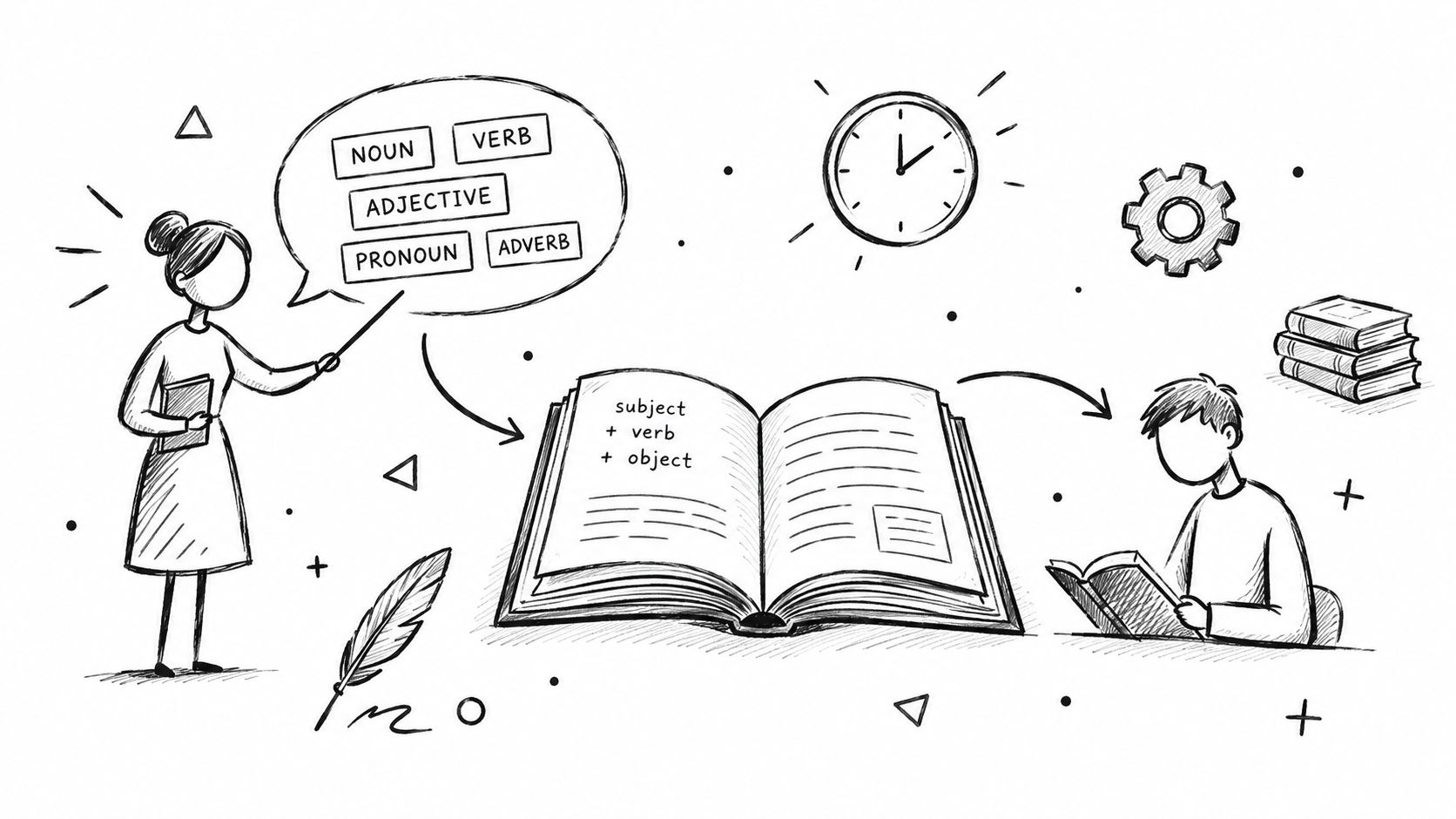
The same principle appears in this visual lesson:
Common Präsens Mistakes Hong Kong Learners Make and How to Fix Them
Most errors come from applying an English pattern too directly. The solution isn't to memorise more rules at once. It's to use a short diagnostic each time you speak or write.
Mistake one is using the infinitive after every subject
A learner may write Ich lernen Deutsch because the dictionary form feels familiar. German requires the verb to agree with the subject: Ich lerne Deutsch, but wir lernen Deutsch.
Correction exercise: Take one verb and say it with six subjects:
- ich lerne
- du lernst
- er lernt
- wir lernen
- ihr lernt
- sie lernen
Mistake two is forgetting the vowel change
Learners often write du sprechst instead of du sprichst, or er fahr instead of er fährt. The personal ending still follows the pattern, but the stem vowel changes in certain forms.
Correction exercise: Circle the subject first. Then check whether the verb belongs to a known stem-changing group.
Mistake three is keeping a separable prefix beside the verb
Ich anfange um neun Uhr is incorrect for a normal main clause. Say Ich fange um neun Uhr an. The prefix belongs at the end, even though that can feel unfamiliar to English speakers.
Mistake four is forcing English “-ing” into German
German doesn't form a separate continuous tense for “I am studying”. Ich lerne gerade is the natural structure. The word gerade provides the “right now” meaning.
Mistake five is missing the time marker
Ich fahre nach Berlin may describe a current journey or a future plan. Add morgen, nächste Woche, or another clear expression when your meaning is future.
Use this self-review list before submitting an exam response:
- Subject: Have I identified the person?
- Ending: Does the verb match that subject?
- Position: Is the conjugated verb in second position?
- Prefix: Does a separable prefix move to the end?
- Time: Does the context show now, habit, or future?
- Meaning: Am I translating directly instead of expressing the German idea?
For more examples involving transfer errors from English, review these common German mistakes made by Hong Kong students.
Präsens versus English Present and Other German Tenses
English distinguishes I work, I am working, and I do work through different structures. German normally uses the same Präsens form, with context or an adverb clarifying the meaning:
- Ich arbeite.
I work, I am working, or I do work. - Ich arbeite gerade.
I'm working right now. - Ich arbeite jeden Tag.
I work every day. - Ich arbeite morgen.
I'm working tomorrow.

The English present perfect also causes confusion. English speakers may choose a perfect construction because an action began in the past and continues now. German can use Präsens with seit:
- Ich lerne seit zwei Jahren Deutsch.
- Word for word, “I learn German for two years.”
- Natural English, “I have been learning German for two years.”
Präsens compared with Perfekt
Use Präsens for what is current, habitual, or planned:
- Ich lerne heute Abend Deutsch.
Use Perfekt for a completed past event in ordinary conversation:
- Ich habe gestern Deutsch gelernt.
Perfekt combines a present-tense form of haben or sein with a past participle. The auxiliary is conjugated, while the main verb carries the completed-event meaning.
Präsens compared with Präteritum
Präteritum is common in written and narrative past contexts, and it appears frequently with forms such as war, hatte, and modal verbs. A learner may see:
- Er war gestern in Berlin.
He was in Berlin yesterday. - Sie musste arbeiten.
She had to work.
The key question is simple: Is the event happening now, repeated, or scheduled, or are you reporting a past event? Choose Präsens for the first group. Choose a past tense for the second.
Exam Tips and Learning Strategies for Hong Kong Students
A strong study plan starts with the exam route, not with random vocabulary. Goethe-Zertifikat, HKDSE, IGCSE, A-level, and IB tasks may differ, but all require learners to control familiar information accurately.
Build a practical weekly cycle
Use a repeatable cycle that fits around work, school, or family commitments:
- Conjugate: Write one regular verb across the personal forms.
- Personalise: Create sentences about your own timetable, job, or family.
- Time-shift: Change heute to jeden Montag and then to morgen.
- Question: Turn statements into questions, such as Lernst du Deutsch?
- Review: Mark the subject, verb ending, time expression, and word order.
Keep a separate page for verbs that change vowels, modals, and separable prefixes. Reviewing these categories together helps you recognise patterns instead of treating every error as unrelated.
Match practice to the pathway
- Goethe-Zertifikat: Practise introductions, daily routines, appointments, and short written messages.
- HKDSE and school routes: Focus on agreement, sentence accuracy, and responses to familiar topics.
- IGCSE, A-level, and IB: Add longer descriptions, opinions, comparisons, and connected writing.
- Professional German: Rehearse introductions, responsibilities, schedules, products, and meeting arrangements.
Adults should also check whether a course fits the Continuing Education Fund rules. Eligible adults aged 18 or above may receive up to HK$25,000 in total reimbursement for approved continuing-education courses commencing on or after 1 August 2022. The structure is 80% of the first HK$10,000 of eligible fees and 60% of the next HK$15,000, as explained by the official CEF German language training guidance.
Funding isn't automatic. The official requirements state that language-course applicants may need to pass the specified benchmark examination after the course has commenced, and an examination claim must accompany the related course claim. Claims normally need to be submitted within one year after successful course completion, or after the relevant benchmark examination if that date is later. Check the CEF frequently asked questions before enrolling.
Course-specific requirements can be stricter. HKU SPACE's published introductory German certificate requires at least 50% of the marks, at least 70% lesson attendance, and the recognised Goethe-Zertifikat A1 examination after the course has commenced, with the required level achieved. Review the programme conditions directly before budgeting for study.
Ready to Master Präsens with Expert Guidance
Präsens becomes manageable when a teacher connects endings, word order, time expressions, and exam tasks instead of teaching each rule in isolation. In Hong Kong, the German Cultural Association Hong Kong(GCA)offers native-speaker instruction, small-group and private formats, structured learning, and preparation for Goethe-Zertifikat, IGCSE, A-level, and IB pathways.
Choose a course that allows you to practise real introductions, routines, work situations, and future plans. A short diagnostic lesson can reveal whether your main issue is conjugation, pronunciation, sentence position, or word-for-word translation.
German Cultural Association Hong Kong(GCA)offers structured German lessons Hong Kong learners can use to build accurate Präsens for exams, work, travel, and study abroad in Germany. Visit German Cultural Association Hong Kong(GCA) to explore a trial class, speak with an advisor, and check the latest course schedule.

German Verb Tenses Overview: Präsens Made Simple
German Passive Voice (Passiv): Formation Guide


