.png)
.png)

BLOG

香港德國文化協會
The German Cultural Association
German Passive Voice (Passiv): Formation Guide
German passive is built from the auxiliary werden plus the past participle at the end of the clause, with the active sentence's accusative object promoted to the nominative subject. In the 2024 HKDSE examination, 83 candidates took German Language, including 75 day-school candidates, so systematic preparation matters for Hong Kong learners working towards an externally assessed qualification.
You may be checking a Form 6 writing task, revising for IGCSE or IB, or preparing for a Goethe-Zertifikat paper while wondering whether the sentence needs wird or ist. That single choice can change the meaning from an action in progress to a completed state.
German passive voice, or Passiv, becomes manageable when you stop treating it as one formula. You need to identify the tense, promote the correct object, place the conjugated auxiliary correctly, and decide whether the sentence describes an event, a result, a modal requirement, or an impersonal activity.
Table of Contents
- 1. Writing geworden in the perfect passive
- 2. Leaving the participle in the middle
- 3. Forgetting to conjugate werden
- 4. Choosing sein when the action is still happening
- 5. Failing to promote the accusative object
Why the German Passive Trips Up Hong Kong Learners
A student may write Die Tür ist geöffnet when the task requires Die Tür wird geöffnet. Both sentences look familiar, and both may be translated with the English word “opened”. However, the first describes a state, while the second presents the opening as an action taking place.
That distinction matters in formal writing and reading comprehension. Passive constructions appear naturally in instructions, reports, notices, academic texts, and examination tasks. A candidate who recognises only werden + Partizip II may form a basic sentence, but can still lose accuracy when the tense or meaning changes.
Hong Kong learners often study with limited opportunities for broad German immersion. In the 2024 HKDSE German examination context, 83 candidates took German Language, including 75 day-school candidates, and German was offered as an official elective in only two local Chinese schools according to the reported examination context. That makes explicit grammar practice especially useful for students, parents, and adults studying alongside work.
The central distinction
- Process passive, Vorgangspassiv: the action is happening or being carried out. Use werden + Partizip II.
- State passive, Zustandspassiv: the action has produced a current condition. Use sein + Partizip II.
- Perfect process passive: use sein + Partizip II + worden.
- Modal passive: use a conjugated modal verb, the past participle, and werden at the end.
Practical rule: Ask first, “Is someone doing something, or am I describing the condition that remains?”
German passive voice formation follows one dependable pattern: take the active sentence's accusative object, make it the nominative subject, conjugate werden for the required tense, and place the lexical verb's Partizip II at the end. Once that structure is secure, you can extend it to perfect, future, modal, and subordinate-clause forms.
The Five-Step Formation Workflow
Start with one sentence and change only what the passive requires:
Die Lehrerin erklärt die Grammatik.
The teacher explains the grammar.
The active sentence contains:
- Die Lehrerin, the subject and doer.
- erklärt, the finite verb.
- die Grammatik, the accusative object receiving the action.
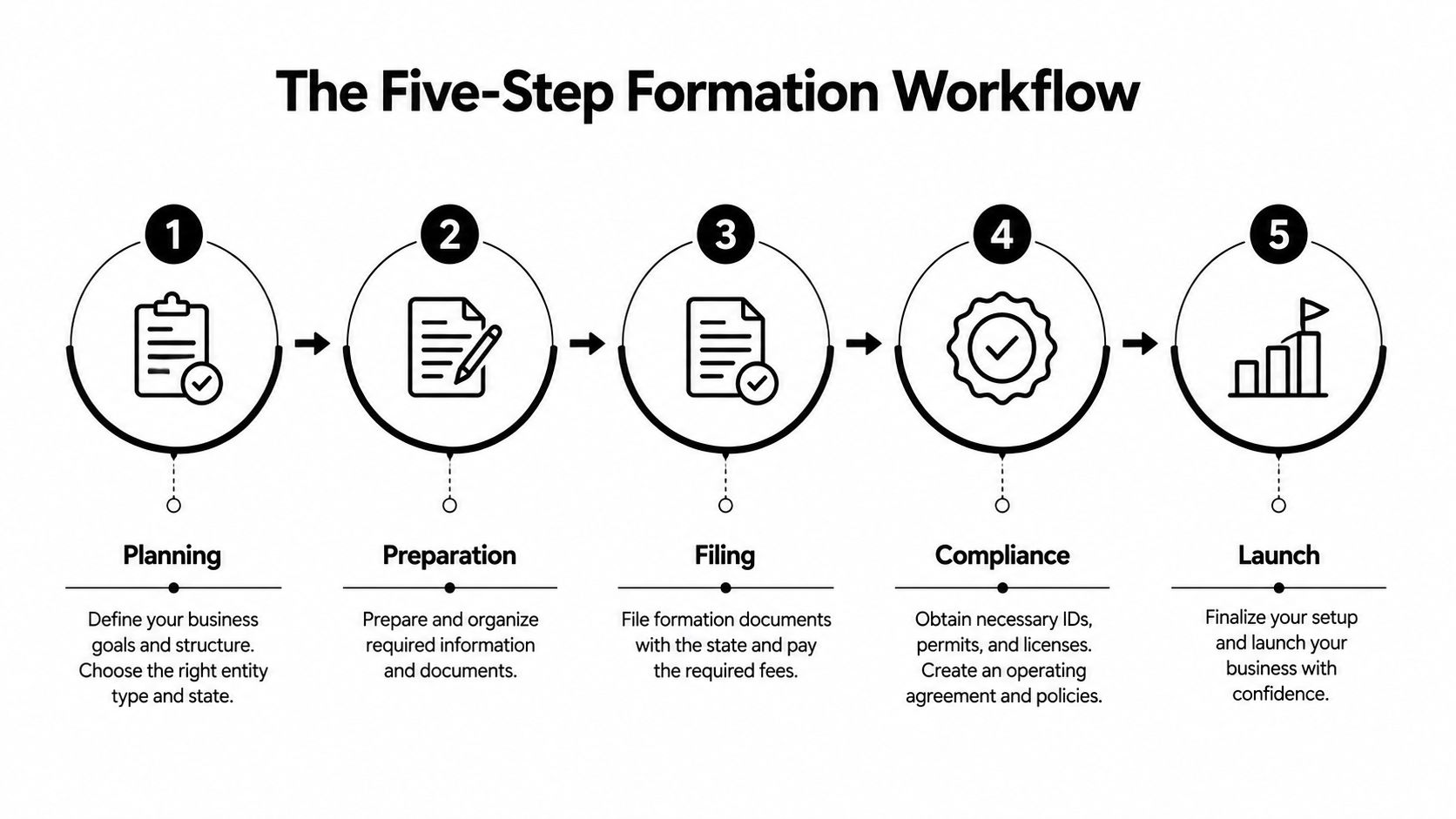
Apply the five steps
Identify the tense and accusative object.
The active sentence is in the present tense, and die Grammatik is the accusative object.Promote the object.
Move die Grammatik into subject position. It remains feminine singular, so the nominative form is still die Grammatik.Conjugate werden.
For third-person singular in the present, werden becomes wird.Form the past participle.
The past participle of erklären is erklärt.Place the participle at the end.
The result is:Die Grammatik wird erklärt.
The grammar is being explained.
This five-part workflow, including identifying the tense and accusative object, promoting that object, conjugating werden, adding the participle, and retaining other complements, is also used in the Goethe-Institut Hongkong examination guidance.
Keep the agent only when it helps
The original subject can remain in the passive sentence with von + dative:
Die Grammatik wird von der Lehrerin erklärt.
The grammar is explained by the teacher.
If the doer is unknown, obvious, or unimportant, omit it:
Die Grammatik wird erklärt.
The grammar is explained.
Watch the perfect passive
The perfect process passive uses ist, not wird, as its auxiliary, followed by the participle and worden:
Die Grammatik ist von der Lehrerin erklärt worden.
The grammar has been explained by the teacher.
The word worden is the shortened form used in the perfect passive. Don't replace it with geworden. That substitution is one of the most persistent errors in examination scripts.
Tense-by-Tense Reference for Process and State Passive
The easiest way to compare the two constructions is to keep the subject and participle constant while changing the auxiliary. The process passive focuses on an action, while the state passive focuses on the condition resulting from that action.
| Tense | Process Passive, werden + Partizip II | State Passive, sein + Partizip II | Example Translation |
|---|---|---|---|
| Präsens | Das Buch wird gelesen. | Das Buch ist gelesen. | The book is being read. The book is in a read or completed state. |
| Präteritum | Das Buch wurde gelesen. | Das Buch war gelesen. | The book was read. The book was in a read state. |
| Perfekt | Das Buch ist gelesen worden. | Das Buch ist gelesen gewesen. | The book has been read. The book has been in a read state. |
| Plusquamperfekt | Das Buch war gelesen worden. | Das Buch war gelesen gewesen. | The book had been read. The book had been in a read state. |
| Futur I | Das Buch wird gelesen werden. | Das Buch wird gelesen sein. | The book will be read. The book will be in a read state. |
The state forms in perfect and past-perfect contexts are grammatically possible but often less natural than a simpler alternative. In an exam, however, you need to understand what the auxiliary signals, especially when a question tests tense selection rather than conversational style.
A useful meaning test
Ask whether you can add “right now” to describe an action:
- Die Tür wird geöffnet. Someone is opening the door.
- Die Tür ist geöffnet. The door is open, or the opening has been completed.
The English translation can hide the difference. German makes you choose between werden, which presents a process, and sein, which presents a condition.
If the sentence answers “What is happening?”, choose the process passive. If it answers “What is the condition now?”, choose the state passive.
The Präteritum process form is especially common in written narratives and reports:
Der Brief wurde geschrieben.
The letter was written.
The perfect process form is structurally heavier:
Der Brief ist geschrieben worden.
The letter has been written.
In the future, werden appears twice, but with different jobs:
Der Brief wird geschrieben werden.
The letter will be written.
The first wird is the finite future auxiliary. The final werden belongs to the passive construction and remains an infinitive.
Modal Passive, Perfect Passive, and Impersonal Constructions
Passive becomes more demanding when another verb controls the sentence. The most important modal pattern is:
modal verb + Partizip II + werden
Die Tür muss geöffnet werden.
The door must be opened.
Here, muss is the conjugated modal verb, geöffnet is the past participle, and werden stays at the end as an infinitive. The same structure works with kann, soll, and other modal verbs:
- Die Aufgabe kann erklärt werden. The task can be explained.
- Die Regeln sollen gelesen werden. The rules should be read.
- Der Antrag muss unterschrieben werden. The application must be signed.
The perfect process passive is different from the modal passive. Its pattern is:
sein + Partizip II + worden
Die Tür ist geöffnet worden.
The door has been opened.
Don't write geworden here. Geworden belongs to the ordinary meaning “become”, whereas worden marks the perfect passive.
Impersonal passive has no promoted object
Some verbs don't take a direct accusative object. In those cases, there is no object to promote into the subject position:
- Es wird getanzt. People are dancing. Dancing is taking place.
- Hier wird gearbeitet. Work is being done here.
- Heute wird gefeiert. There is celebrating today.
The es can disappear when another element occupies the first position:
Hier wird gearbeitet.
Not: Hier es wird gearbeitet.
This construction is useful for notices, general statements, and descriptions where the activity matters more than the person performing it.
The Goethe-Institut Hongkong reports that approximately 6,000 adults, teenagers, and children attend its language courses each year, while about 1,000 take internationally recognised examinations in its Hong Kong programme. For learners reading examination texts, recognising an impersonal passive can prevent a mistaken search for a missing subject.
Subordinate clauses stack the verbs
In a subordinate clause, the verb group moves to the end:
Die Tür wird geöffnet, weil der Hausmeister sie repariert.
The door is being opened because the caretaker is repairing it.
With perfect passive, the final sequence becomes:
Die Tür bleibt geschlossen, weil sie geöffnet worden ist.
The door remains closed because it has been opened.
The order geöffnet worden ist is not optional. The participle comes before worden, and the finite auxiliary ist closes the subordinate clause.
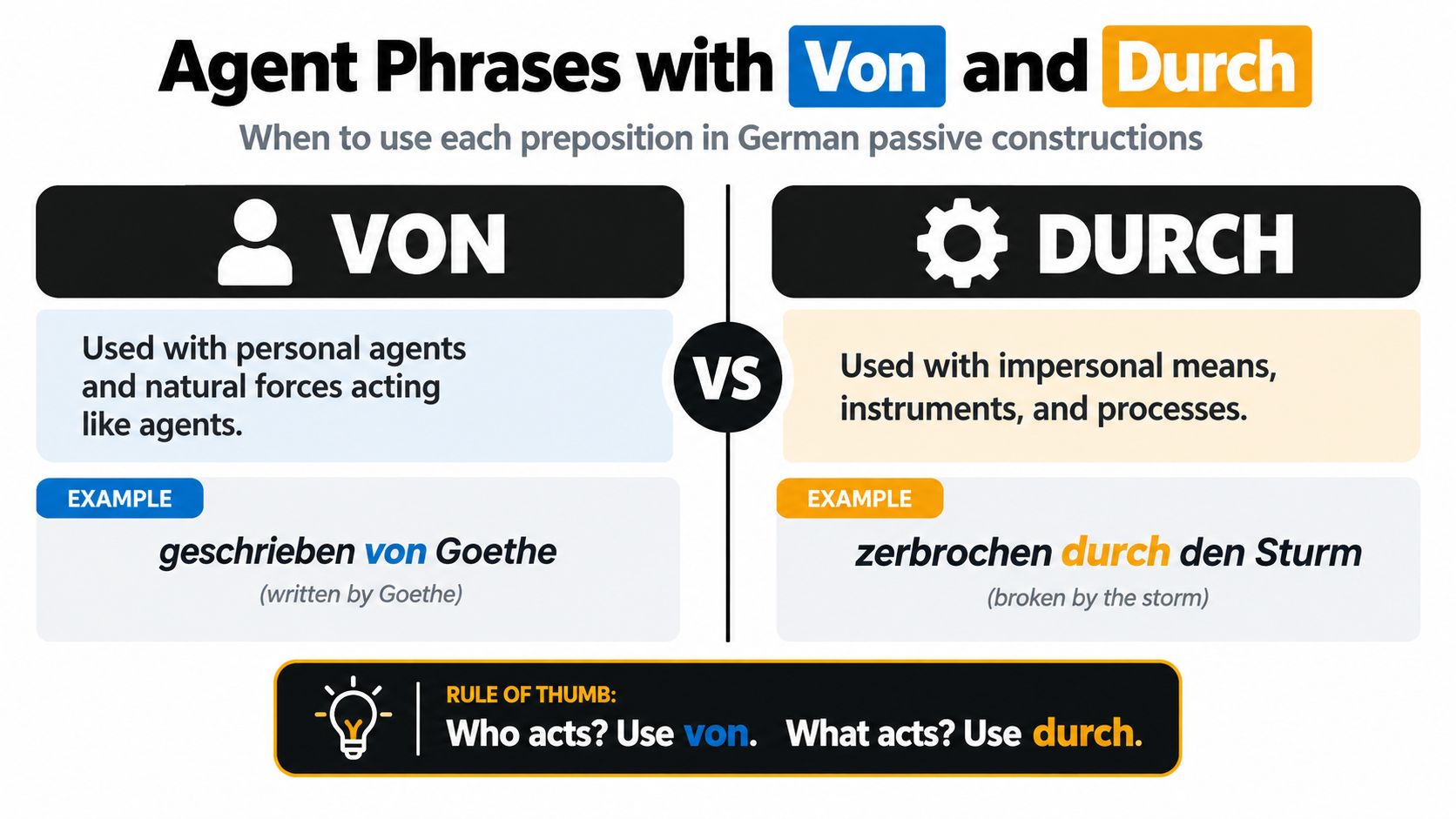
Agent Phrases with Von and Durch
Passive sentences often omit the doer, but sometimes the source of the action matters. German normally uses von + dative for a person or an agent-like force, and durch + accusative for an impersonal means, instrument, or cause.
Use von for a person
Das Paket wurde vom Kurier geliefert.
The parcel was delivered by the courier.
Vom is the contraction of von dem, and dem Kurier is dative. Other personal examples include:
- Der Text wird von der Studentin geschrieben. The text is written by the student.
- Die Grammatik wird von der Lehrerin erklärt. The grammar is explained by the teacher.
- Das Kind wurde von seinem Vater abgeholt. The child was collected by his father.
Natural forces can also take von when they act like an agent in the sentence:
Die Stadt wurde von der Flut überschwemmt.
The city was flooded by the tide.
Use durch for means or impersonal causes
Das Paket wurde durch den Sturm beschädigt.
The parcel was damaged by the storm.
Das Fenster wurde durch den Wind geöffnet.
The window was opened by the wind.
The question is not just whether English uses “by”. Ask whether the phrase identifies who acts or what causes the result.
| Meaning | German choice | Example |
|---|---|---|
| A person performs the action | von + dative | Der Bericht wurde von der Managerin geprüft. |
| A force acts like an agent | von + dative | Das Gebäude wurde von der Flut beschädigt. |
| An instrument or mechanism causes the result | durch + accusative | Die Datei wurde durch ein Programm verändert. |
| An impersonal cause produces the effect | durch + accusative | Die Straße wurde durch den Sturm blockiert. |
Who acts? Use von. What acts or causes the result? Use durch.
In many examination answers, the best agent phrase is no agent phrase at all. If the task doesn't ask who performed the action, write Der Antrag wurde unterschrieben rather than forcing an uncertain preposition into the sentence.
Five Pitfalls That Cost Marks in Goethe-Zertifikat and IGCSE
The formula werden + Partizip II is useful, but it isn't enough by itself. Many explanations stop there, even though learners must distinguish process, state, and modal passive. Translating both Die Tür wird geöffnet and Die Tür ist geöffnet as “the door is opened” removes the meaning difference highlighted in this learner-focused comparison.
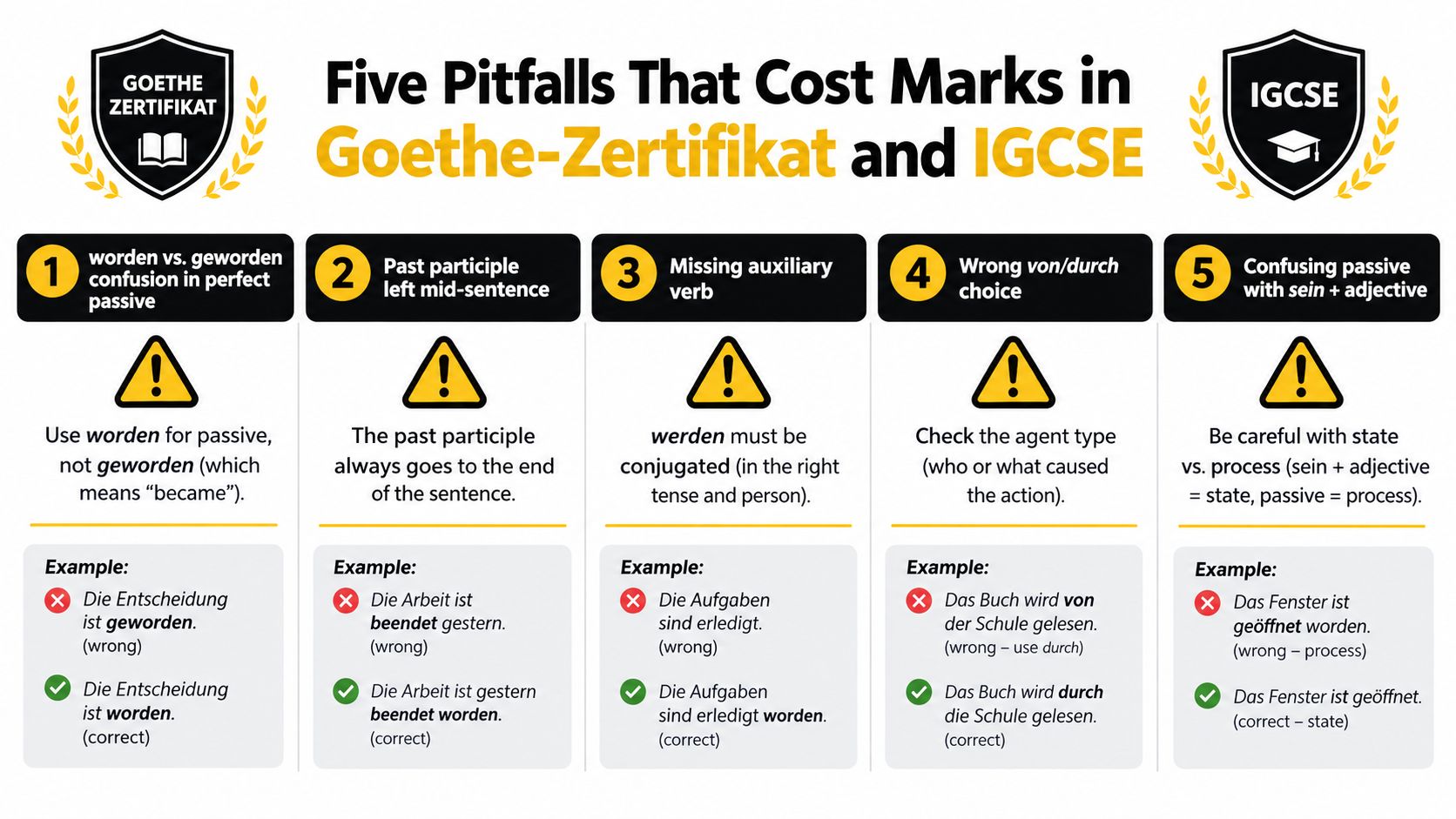
1. Writing geworden in the perfect passive
- Wrong: Die Tür ist geöffnet geworden.
- Right: Die Tür ist geöffnet worden.
Use worden for a completed passive action. Use geworden when werden means “become”, as in Er ist müde geworden, he has become tired.
2. Leaving the participle in the middle
- Wrong: Die Grammatik wird erklärt von der Lehrerin.
- Right: Die Grammatik wird von der Lehrerin erklärt.
The agent can sit in the middle, but the lexical participle belongs at the end of the main clause. In a subordinate clause, the complete verb group moves to the end.
3. Forgetting to conjugate werden
- Wrong: Die Bücher werden gelesen when the intended subject is singular das Buch.
- Right: Das Buch wird gelesen.
Match the finite auxiliary to the new nominative subject. Promotion changes the grammatical centre of the sentence, so don't keep the original verb form automatically.
4. Choosing sein when the action is still happening
- Wrong for an action in progress: Die Tür ist geöffnet.
- Right: Die Tür wird geöffnet.
The first sentence describes the door's state. The second shows someone opening it. If the task asks what is happening in a picture or situation, werden is usually the form you need.
5. Failing to promote the accusative object
- Wrong: Die Lehrerin wird die Grammatik erklärt.
- Right: Die Grammatik wird von der Lehrerin erklärt.
The active object die Grammatik becomes the passive subject. The former subject, die Lehrerin, becomes an optional von phrase.
For school-age learners, the teen German course pathway can be useful when passive formation must support IGCSE, A-level, IB, or Goethe-Zertifikat work. Regardless of the class format, mark your own sentence in this order: subject, auxiliary, participle, tense, and meaning.
Practice Sentences and Your Next Step in Hong Kong
Transform each active sentence into the present process passive and then, where natural, the perfect process passive.
- Die Firma produziert die Geräte.
- Der Arzt untersucht den Patienten.
- Die Lehrerin korrigiert die Aufgabe.
- Jemand öffnet die Tür.
- Die Techniker reparieren den Computer.
- Die Mitarbeiter unterschreiben den Vertrag.
Answer key
- Die Geräte werden produziert.
Die Geräte sind produziert worden. - Der Patient wird untersucht.
Der Patient ist untersucht worden. - Die Aufgabe wird korrigiert.
Die Aufgabe ist korrigiert worden. - Die Tür wird geöffnet.
Die Tür ist geöffnet worden. - Der Computer wird repariert.
Der Computer ist repariert worden. - Der Vertrag wird unterschrieben.
Der Vertrag ist unterschrieben worden.
Check three things separately: word order, Partizip II formation, and auxiliary selection. A sentence can look almost right while still showing the wrong tense or state-process meaning.
For Hong Kong candidates, planning matters because the Goethe-Zertifikat became the stipulated official German examination recognised for HKDSE Category C from 2025. The required level is selected according to CEFR proficiency, with A2 or above as the minimum qualifying level, and the examination result must be from within the two years before the HKDSE sitting, as described in the HKDSE German examination requirements.
Adults comparing German lessons in Hong Kong should also check funding before enrolment. Eligible applicants aged 18 or above may submit unlimited Continuing Education Fund reimbursement claims up to a maximum aggregate of HK$25,000, within one year after completing an eligible course, subject to the official conditions for CEF-reimbursable German courses. Confirm that the specific course qualifies rather than assuming every German class is covered.
Use the student portal to organise your revision materials, then book a level check when you can reliably distinguish wird geöffnet, ist geöffnet, and ist geöffnet worden. That distinction is small in form, but decisive in meaning.
German Cultural Association Hong Kong(GCA)offers native-led German lessons in Hong Kong, structured exam preparation for Goethe-Zertifikat, IGCSE, A-level, and IB, plus flexible in-person and online classes near Tsim Sha Tsui and Causeway Bay MTR. Visit German Cultural Association Hong Kong(GCA) to book a trial class, ask about the right exam track, and check current course schedules and CEF eligibility.

German Verb Tenses Overview: Präsens Made Simple
German Passive Voice (Passiv): Formation Guide


