.png)
.png)

BLOG

香港德國文化協會
The German Cultural Association
Business German Courses in Hong Kong: A Career Guide
You’re doing well at work, but you can already see the ceiling. The regional role goes to the colleague who can handle Europe-facing calls. The client account shifts to the person who can deal with German headquarters without waiting for translation. The graduate programme in Germany looks realistic, but your language level doesn’t.
That’s where Business German Courses in Hong Kong stop being a hobby and start becoming a career tool. If your goal is a stronger CV, better access to German firms, or a cleaner path into study abroad in Germany, you need more than travel phrases and textbook dialogues. You need German for meetings, reporting, negotiation, and cross-border working relationships.
For many professionals in HK, language learning fails because they treat it as an open-ended personal goal instead of a structured career decision. If you’re also reviewing your positioning more broadly, this CV Anywhere guide to coaching is worth reading alongside your language plan. The right move is to align German study with the role, market, or visa pathway you intend to pursue.
Your Next Career Move Is Learning German
A common Hong Kong scenario looks like this. You work in finance, logistics, sourcing, compliance, engineering, or tech. You already deal with international teams, but when a German stakeholder joins the conversation, the room changes.
English may still be the working language. That doesn’t mean German is irrelevant.
The people who move faster in German-linked business settings usually do three things well:
- They understand formal business communication: not just vocabulary, but tone, hierarchy, and how decisions are framed.
- They reduce friction: fewer misunderstandings in calls, emails, and operational handovers.
- They become easier to trust: especially when working with German-speaking colleagues, suppliers, training managers, or clients.
That last point matters more than most HK professionals admit. In cross-border business, competence is judged quickly. Language is part of that judgement.
Parents should pay attention too. If your son or daughter is considering European study options, international business, engineering, or vocational routes connected to German-speaking markets, starting early makes sense. University and job opportunities rarely wait for someone to “pick up German later”.
Practical rule: If German could affect your next promotion, your next degree, or your next market, start now and study with a business purpose from day one.
The payoff from Business German is rarely dramatic on day one. It builds in layers. First you follow more. Then you contribute more. Then people start bringing you into the right conversations.
What Is Business German and Why Does It Matter in Hong Kong
A Hong Kong professional can survive on English in many cross-border meetings. Survival is not the same as advancement. If your work touches German clients, suppliers, headquarters, technical teams, or study pathways, Business German gives you a clearer commercial advantage.
Business German is the version of German used for work. It covers meetings, email, reporting, presentations, negotiations, and sector-specific communication. The point is not casual fluency. The point is being credible, precise, and useful in professional situations where wording, tone, and hierarchy affect decisions.
General German helps with travel and daily life. Business German helps you write the email properly, follow a procurement discussion, present figures with the right language, and avoid costly misunderstandings.

What Business German includes
A serious course should train you to handle the language tasks that directly affect performance at work:
- Formal email writing: requests, follow-ups, scheduling, clarification, and escalation
- Meeting language: opening discussions, presenting options, agreeing, disagreeing, and confirming action points
- Commercial vocabulary: pricing, timelines, procurement, delivery, accounting, compliance, and reporting
- Presentation skills: introducing data, explaining trends, answering questions, and speaking in a logical structure
- Professional etiquette: choosing the right level of formality and understanding expectations in German-speaking business settings
This is why casual conversation classes are a poor choice for ambitious adults in Hong Kong. They may be enjoyable, but they do not prepare you for supplier disputes, budget reviews, compliance updates, or internal reporting. If you want a clearer view of what professional-focused study should look like, review these adult German classes for professionals in Hong Kong.
Why it matters in HK
Hong Kong has a real commercial connection to German-speaking markets. That matters in trade, logistics, engineering, finance, manufacturing, education, and regional corporate functions. German is not a niche add-on here. It is a practical skill inside a business corridor that already exists.
The local advantage is straightforward. You do not need to relocate to see a return. You can gain value in Hong Kong by communicating better with German-speaking stakeholders, handling formal documentation more confidently, and becoming easier to trust in cross-border work.
That is the difference between learning a language for interest and learning it for career positioning.
Where the practical value shows up
Business German pays off fastest when your work includes any of the following:
| Context | Why German helps |
|---|---|
| Regional office communication | You handle updates, approvals, and reporting with less friction |
| Trade and logistics | You manage supplier and shipment issues with clearer terminology |
| Finance and compliance | You read formal documents and correspondence more accurately |
| Tech and engineering | You communicate better with product, process, and operations teams |
| Study abroad in Germany | You improve readiness for admission, study, and later employment |
English may remain the shared language in the room. German still changes how quickly you understand, how precisely you respond, and how seriously people assess your commitment.
Business German is a career investment
Professionals who get the best return from Business German are usually not hobby learners. They are focused people making a deliberate career decision.
They want results such as:
- Better mobility in Hong Kong
- Stronger credibility with German-linked firms
- A sharper profile for study or relocation
- A practical edge over candidates with similar technical experience
That is the right standard. Judge Business German by career ROI, not by whether the class feels cultural or interesting. In Hong Kong, the strongest programmes are the ones that help you perform in the Hong Kong-Germany business corridor, and that is the benchmark GCA is known for.
Who Should Enrol in a Business German Course
A promotion opens at your firm. Another candidate has similar technical experience, but they can handle calls with Munich, read German emails without waiting for a translation, and brief Hong Kong management faster. They are easier to place on regional projects. They get the role.

That is who Business German is for. People who want a measurable career advantage in the Hong Kong-Germany business corridor, not a casual language hobby.
Working professionals in finance, trade, logistics, and tech
If your job touches German clients, suppliers, headquarters, or technical documentation, Business German is a smart investment.
In Hong Kong, that applies directly to professionals in finance, procurement, shipping, manufacturing, engineering, compliance, and B2B sales. You may still work mainly in English. That does not remove the advantage. German improves your response time, cuts ambiguity, and signals commitment to partners who notice the difference immediately.
The strongest candidates in these sectors are not always the most fluent. They are the ones who can follow terminology accurately, write a professional message, and avoid basic misunderstandings that slow deals down.
Corporate teams that deal with German-speaking clients or headquarters
For employers, the right time to train staff is before communication problems start affecting accounts, internal reporting, or client confidence.
A useful Business German course suits teams that need to handle:
- client updates and meeting follow-up
- coordination with German-speaking regional or head office stakeholders
- industry-specific vocabulary for finance, logistics, engineering, or operations
- better written communication for emails, reports, and scheduling
- more confidence in calls, visits, and cross-border meetings
If you are comparing options for staff development, these adult German classes for professionals in Hong Kong give a clear picture of what a structured pathway for working adults should look like.
University students and recent graduates
Students who want careers with German firms should start early. Waiting until final year is poor planning.
Business German makes sense if you want internships, graduate schemes, postgraduate study in Germany, or roles in engineering, business, logistics, automotive, life sciences, or data-heavy fields. In each case, German strengthens your profile because it shows direction, discipline, and commercial relevance. It also helps you compete against applicants whose CVs look broadly similar on paper.
Hong Kong universities have offered German study for years. That matters because it shows German is already part of the city’s academic and professional pipeline. If your goal is employability, treat the language as a career asset and build it before recruitment pressure starts.
Here’s a useful orientation video before you choose your route:
Parents planning ahead for older teens
Parents should not push German by default. They should choose it for students with a clear international path and the discipline to follow through.
It is a strong fit for teenagers aiming at STEM, engineering, business, economics, European universities, or future qualifications such as the Goethe-Zertifikat. Starting earlier gives them time to build real ability instead of cramming for an application deadline.
In Hong Kong, families spend heavily on activities with weak long-term payoff. Business German is different when it aligns with the student’s academic direction. It supports university options, employability, and international mobility in a way that is easy to explain on a CV and easy for employers to value.
Start before urgency appears. That is how you get a return on the time and money.
Inside GCA's Business German Programme
A busy professional in Hong Kong does not need another casual evening class that feels productive and leads nowhere. You need a programme that turns class hours into usable German for meetings, emails, reporting, and cross-border conversations with German-speaking clients, suppliers, or headquarters.
That is the standard you should apply to German Cultural Association Hong Kong(GCA).
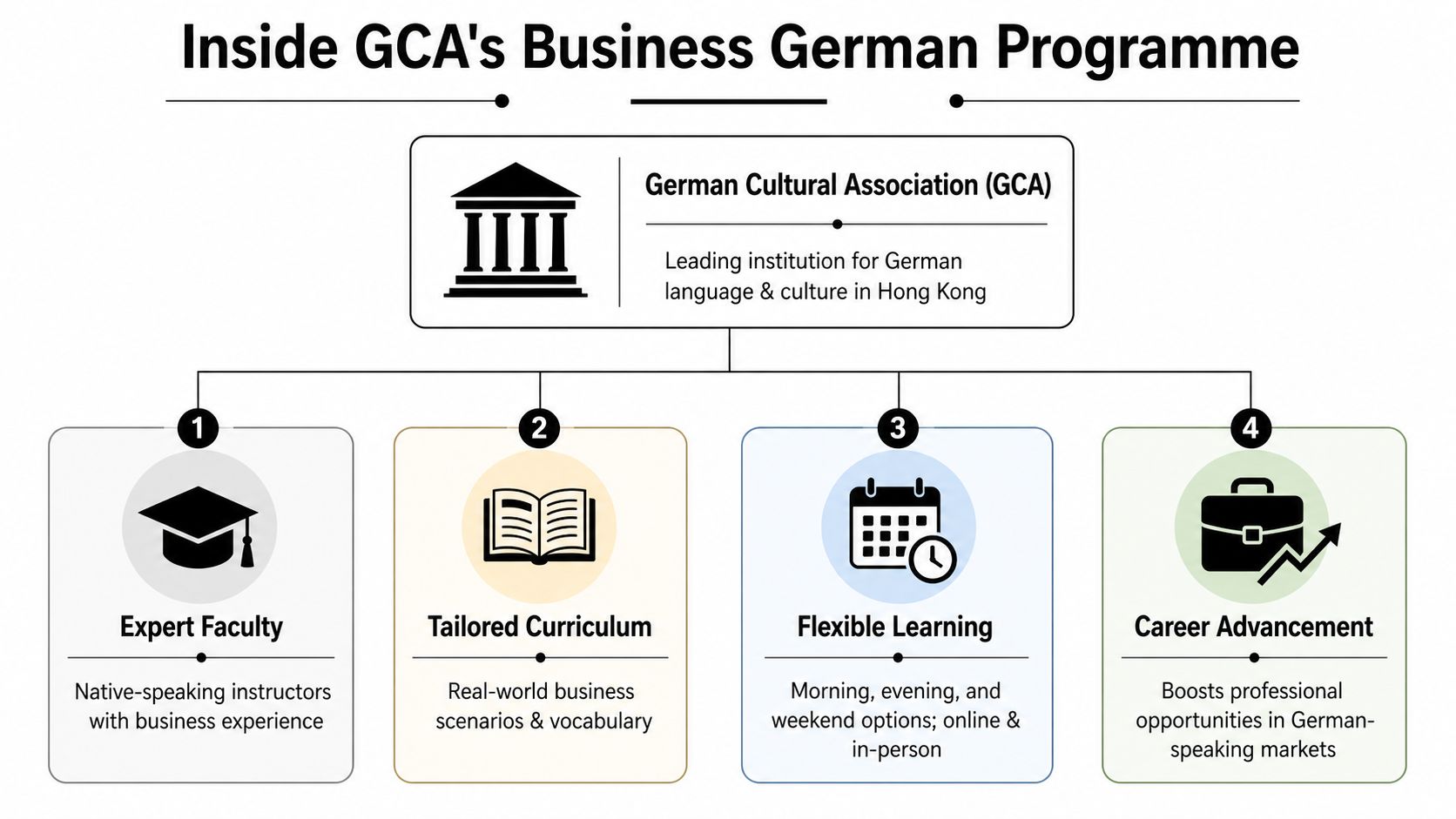
A programme built for measurable progress
The first thing to check is structure. If a course cannot show you where you are, what comes next, and how business use is built into that progression, it is a hobby product.
GCA’s programme follows recognised CEFR levels, from A1 to B1 and beyond. That matters because professionals need a clear path. In Hong Kong, time is expensive. A defined progression system lets you judge whether your investment is producing real movement or just weekly activity.
Business German should feel cumulative. Each stage should add practical control over workplace language, not just more grammar exercises.
Small classes produce better speaking results
Class size has a direct effect on outcome. In business language training, speaking time is not a bonus. It is the core mechanism for improvement.
GCA teaches in small groups, which gives learners more room to answer, ask, correct, and repeat until the language becomes usable under pressure. That is a better fit for professionals who need active command, not passive recognition.
If your goal is career ROI, avoid crowded classes. They are usually cheaper for the provider, not better for the learner.
What the course should train you to do
A credible Business German course must cover workplace tasks early and systematically. GCA’s format is aligned with that expectation.
You should expect work on areas such as:
- Email writing, including formal openings, requests, follow-ups, and tone
- Meetings, including agreeing, disagreeing, clarifying, summarising, and assigning actions
- Presentations, including signposting, transitions, and handling questions
- Business vocabulary relevant to commercial, operational, and technical contexts
- Role-play and applied scenarios that reflect office communication rather than travel situations
That focus matters in Hong Kong’s Germany-facing business corridor. If you work in trade, logistics, manufacturing, finance, legal support, engineering, procurement, or regional operations, generic conversation practice is not enough.
Built for Hong Kong schedules
Good intentions collapse fast when the format fights your calendar.
GCA offers in-person classes near Tsim Sha Tsui and Causeway Bay MTR stations, along with online study options. That makes the programme more practical for professionals managing long commutes, irregular hours, and travel between client meetings or regional offices.
Choose the format you can attend consistently. Consistency beats ambition every time.
Weekly or intensive. Pick based on deadline
Different learners need different timelines. A professional preparing for a role change or overseas move should not study at the same pace as someone learning alongside a stable local job.
GCA offers both weekly and intensive routes. Weekly study suits learners who need a sustainable rhythm over a longer period. Intensive study makes more sense if you have a deadline and need faster progress with tighter accountability.
Use a simple filter:
Weekly format is the right choice if you:
- have an unpredictable work schedule
- want a steady pace without overload
- are building German alongside a full-time role
Intensive format is the right choice if you:
- need German for a near-term application or interview
- expect increased contact with German-speaking stakeholders soon
- are planning relocation or study in Germany on a shorter timeline
If cost support matters, review this guide to funding your German studies in Hong Kong through CEF before you commit.
Teacher quality affects professional credibility
Business learners need precise correction. A teacher must be able to fix tone, register, phrasing, and professional etiquette, not just basic grammar.
GCA uses native-speaking teachers with recognised credentials. That matters because professional German is sensitive to formality. A sentence that is technically correct can still sound blunt, vague, or junior in a business setting.
For ambitious learners, this is a serious point. If your teacher cannot correct business tone properly, you may improve on paper while still sounding weak in real work situations.
Materials and accountability matter more than many adults expect
Adult learners usually do not fail because they lack ability. They fall behind because friction builds up. Missed classes become a pattern. Review stops. Momentum disappears.
GCA reduces some of that friction with included beginner materials, structured level progression, online and in-person delivery, and an attendance-based certificate framework. Those features support follow-through, which is what working adults need most.
What makes this programme a stronger ROI decision
Judge the programme by the standards that matter for your career in Hong Kong:
- Will you get enough active speaking time to improve at work speed?
- Is progression mapped to recognised levels instead of vague “intermediate” labels?
- Does the training cover business tasks, not just everyday survival German?
- Can you keep attending without your schedule destroying the plan?
GCA performs well on those criteria, which is why it stands out as a serious option for professionals who want German to produce commercial and career value, not just personal satisfaction.
For the right learner, that is the difference between studying German and using German to get ahead.
How Much Do Business German Courses in Hong Kong Cost
You are not buying “German lessons.” You are buying faster career utility.
In Hong Kong, that means asking a sharper question than price alone. How much are you paying for relevant speaking time, business context, and a format you will complete? A cheaper course that drifts through general vocabulary can cost more in the long run if it delays your ability to handle supplier calls, client meetings, or regional coordination involving Germany.
Use real local pricing, then judge the gap properly
GCA’s adult German course gives you a clear professional benchmark. Its beginner format is listed at HK$4,180 for 11 weeks and 22 hours, with materials included (GCA adult German course fees and schedule).
A longer university extension route sits in a different bracket. HKU SPACE lists its Certificate in German (Introductory) at HK$9,550, with 120 hours delivered across 40 meetings of 3 hours each (HKU SPACE Certificate in German pricing and structure).
These are different purchases. One is a tighter, professionally oriented format for working adults. The other is a longer academic pathway with a much heavier time commitment. Compare them by fit, not by brand name.
Cost only matters after you define the outcome
Use this filter before you pay:
| Format | Best For | What you are really paying for |
|---|---|---|
| Small-group business course | Professionals who need practical speaking progress | Higher relevance per class hour |
| University extension course | Learners who prefer a slower academic structure | More total hours and broader pacing |
| Private lessons | Managers, executives, or niche-role learners | Custom content and schedule control |
| Online live classes | Busy professionals across Hong Kong | Better attendance consistency |
For ambitious professionals, the highest ROI usually comes from the course you can sustain for months, not the one that looks cheapest on day one.
What a smart buyer in Hong Kong should check
Pay for a course if it gives you:
- mapped level progression
- enough speaking time to improve under pressure
- accurate correction on tone and business phrasing
- content that matches workplace use
- class timings that fit Central, Kowloon, or cross-border work schedules
If funding affects your decision, review this CEF application guide for German studies in Hong Kong before enrolling.
Cheap classes often waste the one thing senior professionals in Hong Kong cannot replace. Time.
Proven Results and Student Success at GCA
A Business German course should pay off in practice. In Hong Kong, that means stronger performance with German clients, smoother communication with European headquarters, and a better chance of being trusted with cross-border work.
That is the standard to use when you assess GCA.
The clearest positive signal is consistency. Students continue, recommend the programme to other professionals and learners, and use it to reach concrete academic or career goals. As noted earlier, GCA also has a strong record in public examination performance. That matters because good results usually reflect disciplined teaching, accurate correction, and a course structure that keeps students progressing instead of repeating the basics.
What success looks like in practice
In Hong Kong, language progress becomes valuable when it changes your role.
A procurement or logistics professional can move from relying on translated notes to handling routine supplier communication with more confidence. That saves time, reduces avoidable errors, and makes that person more useful in regional coordination.
A banker, compliance officer, or finance manager does not need perfect fluency. The key advantage is being able to read formal wording more accurately, ask sharper questions in meetings, and catch points that would otherwise be missed in English-only summaries. That is career ROI, not hobby learning.
For a university student or junior professional targeting Germany, Austria, or a German firm in Asia, steady progress creates a cleaner path into exchange applications, interviews, internships, and early-career roles. The result is not just better German. It is better positioning.
Why some students get results and others waste a year
The difference is rarely talent. It is training quality and follow-through.
Programmes that produce strong outcomes usually have the same traits:
- clear level progression
- serious speaking practice, not passive note-taking
- teachers who correct business phrasing and accuracy
- a pace that working professionals can maintain
- exam or skills benchmarks that make progress visible
GCA’s appeal is not that it promises vague personal growth. It gives ambitious learners in Hong Kong a structured way to build German that can be used in study, certification, and work.
Choose on that basis. If a course cannot show a believable pattern of student progress, it is probably not worth your evenings or your budget.
Ready to Advance Your Career How to Enrol
If you know German could help your career, don’t overcomplicate the next step. You need a course match, a realistic schedule, and a clear starting level.
Use this process.
1. Speak to an advisor
Start with a direct conversation about your goal. Be specific.
Say whether you need German for:
- work with German-speaking clients or HQ
- exam preparation
- study abroad in Germany
- relocation or visa planning
- long-term career positioning in HK
A good advisor should help you choose the right pace, not just the next available class.
2. Take a level assessment
If you’re a complete beginner, that’s easy. Start at A1.
If you’ve studied before, don’t guess your level. A short assessment prevents two common mistakes: joining a class that’s too easy, or forcing yourself into one that’s too advanced.
3. Choose the format you’ll actually attend
Be honest about your week.
Pick the option that fits your life:
- evening classes if you work standard office hours
- weekend classes if weekdays are unstable
- online live lessons if commuting across HK will reduce attendance
- private study if you need a highly customised business focus
Consistency matters more than ambition on paper.
4. Enrol in the next suitable term
Once the class, level, and format are clear, commit. Don’t sit on the decision for another quarter.
Most professionals lose momentum because they stay in research mode too long. If Business German is relevant to your next move, starting matters more than perfect timing.
Frequently Asked Questions About Business German Courses
Do I need prior German knowledge to start
No. Beginner routes start from A1, so you can begin without prior German. That’s the right entry point if you need proper foundations rather than rushed business phrases.
What makes a business-focused course different from general German lessons
Business German teaches you how to function in professional settings. That includes formal email writing, meeting language, reporting, presentations, and job-relevant vocabulary. General German lessons are still useful, but they usually don’t go far enough for workplace use.
Are evening or online classes available for working professionals in HK
Yes. Flexible scheduling matters because many professionals in Hong Kong can’t commit to fixed daytime study. Look for evening, weekend, and live online options if your work hours are demanding.
What certificate do I receive
You can receive a course certificate through the structured attendance system, which requires 80% attendance. If your goal is broader recognition, many learners also prepare for formal exams such as Goethe-Zertifikat or TestDaF. This guide to German exams including Goethe-Zertifikat and TestDaF helps clarify which route fits your goal.
How long does it take to become useful in Business German
That depends on your starting point, schedule, and whether you study weekly or intensively. Most professionals become “useful” before they become fluent. If you can handle core workplace exchanges, follow key terminology, and write basic professional messages, your German is already creating value.
Should I choose a university pathway, private lessons, or a small-group course
Choose based on your constraint.
- Pick a university pathway if you want a slower, more academic structure.
- Pick private lessons if your timetable is difficult or your needs are highly specialised.
- Pick a small-group course if you want regular speaking practice, structure, and accountability without the cost of one-to-one tuition.
Is Business German worth it if my company already uses English
Yes, if German still shapes the relationship. English may run the meeting, but German often shapes trust, nuance, and access. If your role touches German stakeholders, even intermediate German can improve your usefulness and visibility.
If you’re ready to turn German into a practical career asset, contact German Cultural Association Hong Kong(GCA) to check the latest course schedule, discuss your level, and find a format that fits your work life in Hong Kong.
What Does Danke Mean? How to Say Thank You & You're Welcome in German

German Lessons Hong Kong: Prices & What Actually Works 2026


