.png)
.png)

BLOG

香港德國文化協會
The German Cultural Association
How Speaking German Boosts Your Career in Europe
You already speak English. You may also have Mandarin and Cantonese. In Hong Kong, that sounds like enough for an international career.
It often isn’t.
I see the same pattern repeatedly. A strong student aims for Europe but only looks at English-taught options. A working professional targets regional roles in finance, logistics, engineering, or trade, then hits a ceiling when the role involves headquarters in Germany, Austria, or Switzerland. Parents plan for global mobility, yet their children are competing with applicants who bring one extra advantage: certified German.
If your goal is Europe, your real passport is not only your travel document. It is your working language. Some families explore long-term mobility through investment routes as well, and this background guide to citizenship by investment is useful if you’re thinking beyond study plans and towards family relocation strategy. However, for many in Hong Kong, the faster and more controllable lever is language.
That’s why How Speaking German Boosts Your Career in Europe matters. Not as a cultural hobby. Not as an “extra”. As a practical career move.
German gives HK students and professionals access to Europe’s economic core. It strengthens university applications, improves employability with German-linked firms, and opens pathways into regulated professions where English alone won’t carry you. If you want a realistic HK-to-Europe bridge, German is one of the smartest skills you can build.
Your Passport to Europe Is Not The One You Think
A Hong Kong parent usually starts with the obvious checklist. Good school results. Strong English. Maybe Putonghua. Maybe overseas summer programmes. The assumption is simple: if the child is academically strong, Europe will be open.
That assumption is incomplete.
European mobility is not just about getting admitted somewhere. It is about entering the right labour market, staying employable after graduation, and being useful to employers who operate in local languages. English can get you through the door. German often decides whether you move beyond the lobby.
Practical rule: If your Europe plan depends entirely on English, your options narrow the moment you target local hiring, regulated professions, or promotion inside German-speaking companies.
For professionals in Hong Kong, the problem looks different but leads to the same conclusion. You may already work in a multinational environment. You can handle meetings, decks, cross-border reporting, and regional stakeholders. Yet when the role touches procurement from Germany, compliance with DACH markets, or direct contact with headquarters, someone with German becomes more valuable immediately.
The same applies to students who want to study abroad in Germany. Parents often focus on admission first and career second. That’s backwards. The smarter question is this: which language gives my child a stronger position after graduation?
Here is the blunt answer. If Europe is the target, German is not a niche add-on. It is one of the clearest ways to become harder to replace.
What this means for Hong Kong families
A practical Hong Kong strategy should connect language study to a real outcome:
- For secondary students: German can support DSE, IB, IGCSE, A-level, or future Goethe-Zertifikat goals.
- For university-bound teenagers: German helps when applying to German-speaking institutions and adapting to local academic life.
- For working adults: German creates a sharper profile for roles tied to trade, operations, engineering, finance, and regional headquarters work.
- For families planning mobility: It gives one family member, or eventually several, a stronger base for relocation and long-term employability.
Why German Is Your Strongest Professional Asset In Europe
German boosts your career in Europe because it connects you to the EU’s most widely spoken native language, Europe’s largest economy, and a major employer base across Germany, Austria, and Switzerland. For Hong Kong professionals, it also creates a direct advantage with German-linked firms operating in Asia and Europe.
German isn’t valuable because it sounds impressive on a CV. It’s valuable because the language sits inside a serious economic zone.
According to the OSD overview of why German matters, German is the most widely spoken native language in the European Union, with over 90 million native speakers in Germany alone and more than 130 million people speaking German worldwide as a first or second language. The same source notes that Germany is the largest economy in Europe and the fourth largest in the world by nominal GDP, while German-speaking markets collectively generate more than 4.5 trillion USD in GDP.
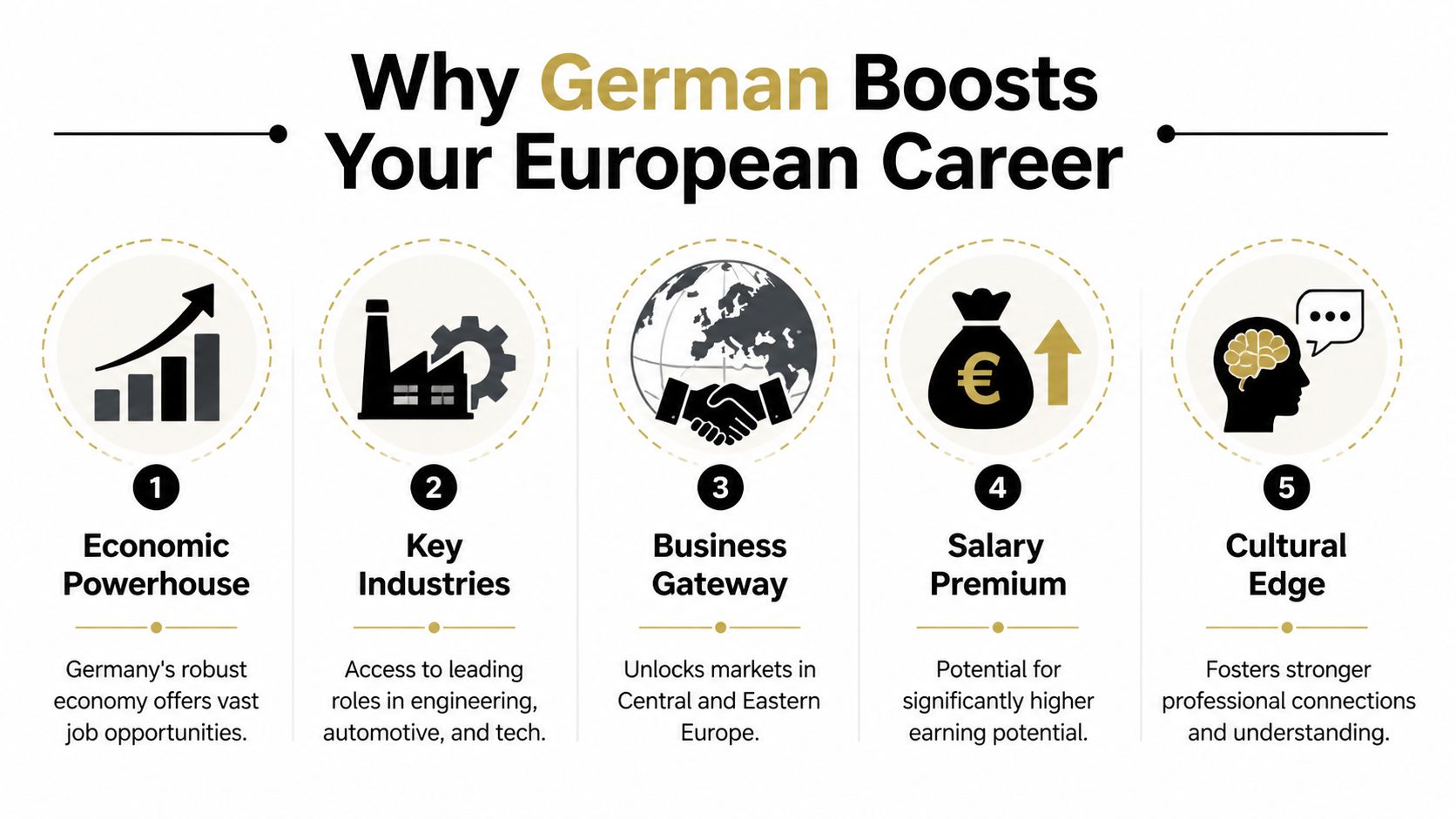
That scale changes the career conversation. You are not learning German for one country. You are positioning yourself for a business region that matters in engineering, manufacturing, finance, trade, logistics, and higher education.
Why this matters in Hong Kong
Hong Kong readers need a local lens, not generic Europe advice.
The same OSD source points out that in UK employer surveys, German is the most sought-after second language, with around one in five employers explicitly seeking candidates with German skills. It also notes that around 2,500 German companies employ over 400,000 people in the UK alone, which helps illustrate the commercial footprint of German business abroad. For Hong Kong, the important takeaway is strategic, not speculative: German multinational companies maintain regional offices in Hong Kong and the Greater Bay Area, and those firms often need local hires who can work across English and German business contexts.
If you’re weighing whether this matters in HK, this article on why Hong Kong professionals should learn German is a useful companion read because it frames the local business case directly.
The real advantage is not only language
German also signals a type of candidate.
It tells employers and admissions teams that you can handle structure, persistence, formal communication, and a different working culture. That matters in Europe. A candidate who can discuss contracts, technical matters, timelines, and client expectations in German is not just “multilingual”. That candidate is easier to place in roles with trust and responsibility.
Learn German if you want more than access. Learn it if you want credibility inside the German-speaking market.
The German Career Advantage By The Numbers
Most language advice is too soft. You don’t need vague encouragement. You need to know whether the investment pays.
The most useful hard signal in the available data is this: German speakers earn salary premiums of 5 to 10% in EU regulatory sectors, according to the Hong Kong-focused pathway gap analysis published by Olesen Tuition on demand for German-language skills. The same source also notes that German is the most sought-after second language in the UK, appearing in 25% of language-dependent job ads.
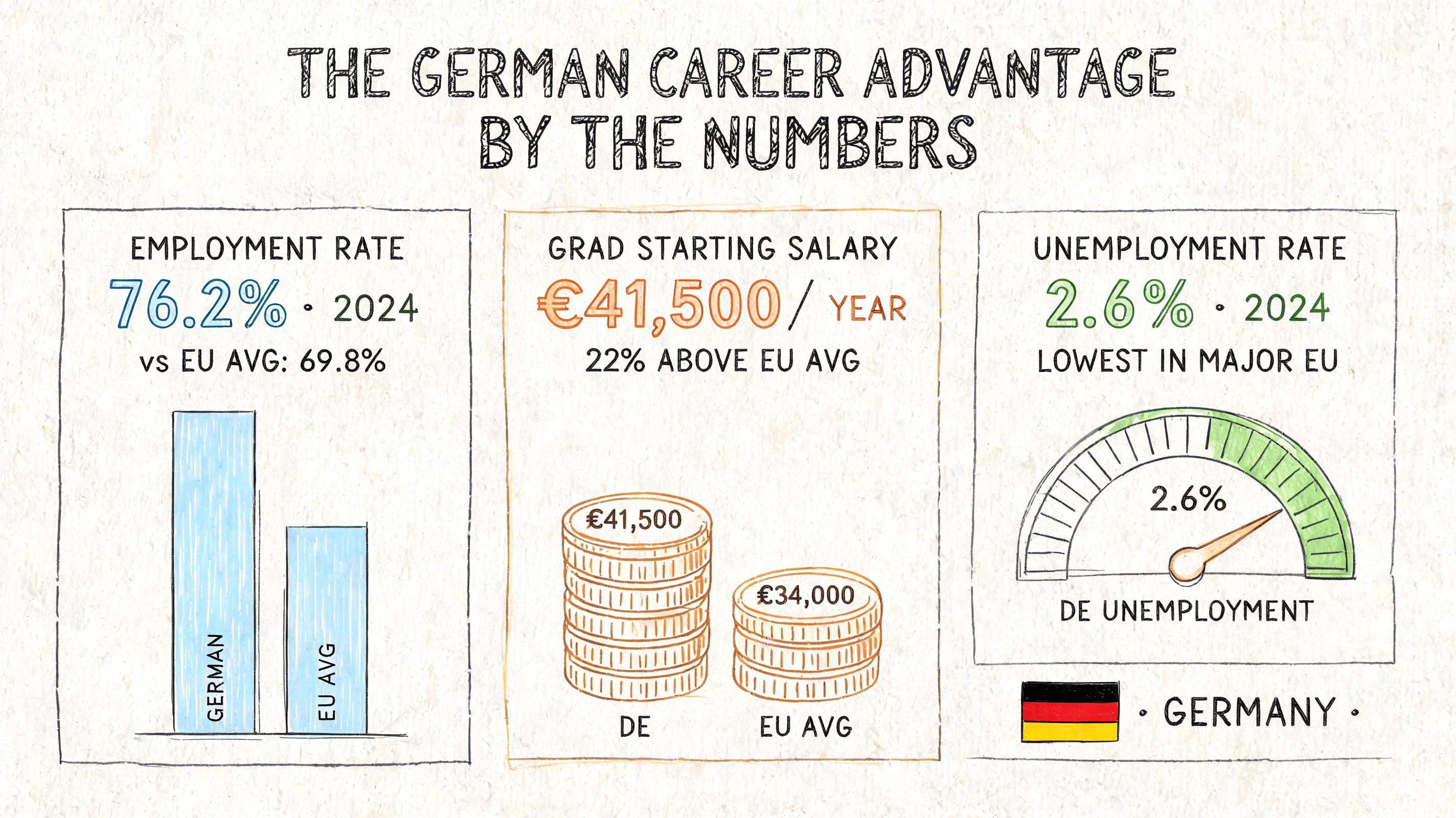
That doesn’t mean every German speaker in Hong Kong will automatically receive the same premium. We do not have verified Hong Kong salary data for that claim. But the EU signal is strong enough to guide career planning. Language becomes commercially valuable when it helps employers reduce friction, build trust with headquarters, and place you in work that other qualified candidates can’t handle.
Where German creates the clearest edge
For Hong Kong professionals, the best opportunities are usually in sectors where German-linked business is already active.
- Engineering and industrial roles: German supports communication with technical teams, suppliers, and documentation culture.
- Logistics and trade: It helps when your work involves European vendors, shipping coordination, procurement, and regional account handling.
- Finance and banking: German matters when reporting lines, clients, or product teams sit in German-speaking markets.
- Automotive and manufacturing ecosystems: Language helps with compliance, technical training, and cross-border coordination.
- Technology and enterprise services: It becomes useful when sales, implementation, or support functions deal with DACH-region stakeholders.
The Olesen analysis specifically identifies a content gap around Hong Kong roles linked to companies such as Siemens, BMW, and Deutsche Bank operating regional hubs. That gap itself tells you something important: HK candidates are often underprepared for opportunities that already exist around them.
What this means for students and parents
If you are planning education with a career lens, German is one of the few school-age subjects that can later convert into both academic and commercial value.
A practical reading of the market looks like this:
- English remains expected. It doesn’t differentiate you enough.
- Mandarin is useful in Greater China. It also doesn’t make you rare in Hong Kong.
- German creates a sharper profile. It can distinguish an applicant in Europe-facing education and work pathways.
Career filter: Choose skills that make you easier to hire internationally and harder to substitute locally. German does both better than most extracurricular add-ons.
That is why I advise families to stop treating German as enrichment only. If the long-term target is Europe, it belongs in the strategy file, not the hobby file.
How Much German Do I Actually Need To Learn
This is the right question. Not “Can I become fluent quickly?” but “What level achieves the outcome I want?”
For most HK learners, the answer depends on whether you want travel confidence, university access, office communication, or a regulated profession in Europe. If you’re not sure where you stand right now, start by using a tool that can assess German reading and listening levels. It won’t replace formal placement, but it gives you a practical starting point.
CEFR German levels and your career goals
| CEFR Level | What You Can Do (Goethe-Zertifikat) | Career/Life Goal Unlocked |
|---|---|---|
| A1 | Handle basic greetings, personal details, simple everyday phrases | Start structured study, prepare for short travel and beginner classes |
| A2 | Manage routine situations and simple exchanges | Travel more independently, build confidence for everyday life in German-speaking countries |
| B1 | Discuss familiar topics, manage practical communication, understand main points | Useful for early mobility plans, pathway study, and some entry-level daily functioning |
| B2 | Communicate clearly in work and study settings, handle more complex discussion | Strong target for professional employment and many university-related goals |
| C1 | Use German effectively in demanding academic and professional contexts | Best for advanced study, high-responsibility roles, and professions with heavy communication demands |
The level that matters most
For most serious adult learners in Hong Kong, B2 is the decisive milestone.
That is the point where German becomes professionally useful rather than merely impressive. You can participate in meetings, write competent emails, follow structured discussion, and work with less hand-holding. If your plan is a Europe-facing career, B2 is the level to aim for first.
If you want a realistic view of the workload involved, read this guide on how long it takes to reach German B2 level. It helps set expectations properly, especially for busy professionals and students balancing school schedules in Hong Kong.
Regulated professions are different
For doctors, nurses, educators, and other regulated professionals, language is not just a competitive advantage. It is often a gatekeeping requirement.
The pathway analysis based on German labour-market guidance notes that 97.3% of German job ads require German language skills, and that regulated professions have mandatory proficiency requirements defined by law, as discussed in the German language requirements guidance from the Federal Employment Agency. The same verified material highlights B1/B2 as important thresholds for Hong Kong professionals seeking work visas, professional registration, and mobility in Germany, Austria, and Switzerland.
That changes the decision completely.
- If you’re a student, B2 is often the strategic benchmark.
- If you’re in a regulated profession, B1 or B2 may be part of the legal and licensing pathway, not just your CV.
- If you want senior roles, C1 becomes increasingly valuable because nuance matters in leadership, negotiation, and reporting.
Don’t set “fluency” as your first target. Set the lowest certified level that unlocks your next milestone, then move upward.
That approach saves time, money, and frustration.
Your Strategic Pathway From Hong Kong To Germany
You are in Hong Kong, your child is choosing IB or DSE subjects, or you are weighing a transfer, a master's degree, or a career move into Europe. The decision that changes the outcome is not "Should we learn a language?" It is "Which language creates the strongest route from Hong Kong into Germany, Austria, and Switzerland?" For many families and professionals, German is the practical answer.
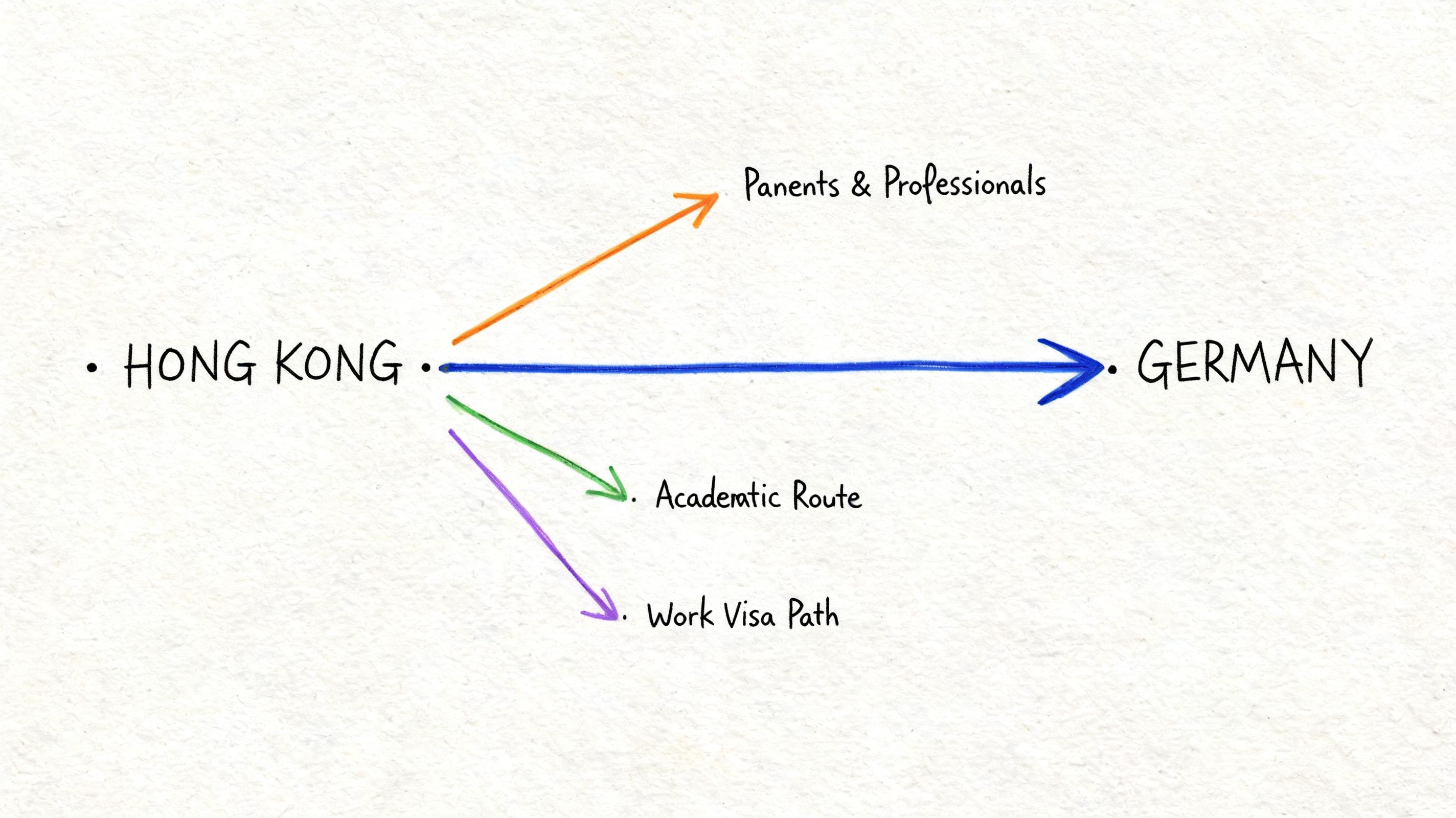
A good pathway starts with the destination. School admissions, university entry, regulated professions, and corporate relocation all demand different timelines. If you study without tying German to one of those outcomes, progress stalls the moment work or exams get busy.
For parents and teenagers in Hong Kong
Parents should plan German the same way they plan maths tutoring or university counselling. Early, structured, and tied to a long-term objective.
For students in DSE, IB, IGCSE, or A-level streams, the smart sequence is clear. Build general German first. Add exam preparation after the student can already read, write, listen, and speak with some control. Families who reverse that order usually get short-term exam drilling and weak long-term results.
Use this sequence:
- Start before the pressure years. Year 10 or equivalent is far better than a last-minute push before applications.
- Build a weekly routine. Consistency beats holiday cramming every time.
- Choose the exam that fits the destination. Goethe exams support broader German-speaking Europe plans. School-based qualifications may suit transcript strategy better.
- Match language study to future applications. If Germany or Austria is even a realistic option, certification should support that route from the start.
This matters in Hong Kong because students already operate in a trilingual environment. English, Cantonese, and Mandarin create a strong base for adding German, but only if the study plan is disciplined.
For working professionals
Working adults need a commercial plan, not a hobby plan.
Start with structured general German. Then add job-specific vocabulary, meetings, email writing, and interview preparation. After that, sit the exam that proves your level. That sequence gives you a credential, practical communication ability, and a clearer story for employers.
A workable roadmap looks like this:
- Stage 1: Build A1 to A2 with fixed weekly study and speaking practice.
- Stage 2: Reach B1 with stronger listening, workplace vocabulary, and writing accuracy.
- Stage 3: Push to B2 if your target is relocation, office-based work, or management-track roles.
- Stage 4: Update your CV, LinkedIn, and applications for DACH-facing positions and mobility opportunities.
If your target is relocation rather than casual career exploration, read this guide on working in Germany from Hong Kong and the language requirements. It gives you the practical framework for visas, job applications, and language expectations.
Long-term planning also affects housing and finances. For families considering property as part of a wider European move, Invexa's French mortgage solutions provide context on how financing can fit into broader European planning.
Here is a useful explainer if you want a visual overview of the broader journey:
For corporate teams
Hong Kong companies with European exposure should treat German training as a business tool. It improves meetings, supplier communication, reporting accuracy, and trust with DACH partners.
The strongest use cases are clear:
- Sales teams handling German-speaking accounts
- Operations teams managing procurement, shipping, and supplier coordination
- Finance teams reporting into European structures
- Technical teams working with product specifications, compliance material, or manufacturing partners
If you run a team, set the language goal by function. A sales lead does not need the same German as an engineer or finance manager. Training works better when the target is tied to the actual job.
What strong Hong Kong to Europe pathways have in common
The pattern is simple. Set one destination. Choose the right certification route. Put German into a fixed weekly schedule that survives school calendars, quarter-end pressure, and family travel.
Ambition helps. Systems get results.
Choosing The Right Place To Learn German In Hong Kong
A Hong Kong parent is comparing IB subject choices. A DSE student is aiming at Europe. A mid-career professional wants a stronger case for roles linked to Germany, Austria, or Switzerland. In all three cases, the same mistake shows up first. They pick a German course based on convenience, then realise months later that the class does not prepare them for the exam, level, or timeline appropriate for their situation.
Choose the provider based on your destination. If your goal is university admission, career relocation, or a recognised language certificate, the course must match that goal from day one.
The first test is teaching quality. You need instructors who can correct pronunciation, sentence structure, and formal versus informal usage accurately. That matters even more for Hong Kong learners who already work across Cantonese, English, and often Putonghua, because interference between languages is common and weak correction slows progress.
What to look for before you enrol
Use a stricter filter than price and location.
- Clear level progression: The course should show exactly how you move from beginner level to B1, B2, and exam readiness.
- Exam alignment: If you are working toward Goethe-Zertifikat, TestDaF, IB, IGCSE, or A-level, ask whether the centre already teaches to those formats.
- Schedule fit: Hong Kong families and professionals need evening, weekend, or online options that can survive exam periods, quarter-end workload, and travel.
- Speaking time: Small groups matter because German improves through correction and repetition, not passive listening.
- Administrative clarity: Ask about placement tests, class size, missed lesson policy, and whether the provider can advise on a realistic study timeline.
The realistic options in Hong Kong
University extension courses suit learners who prefer an academic setting and can commit to a fixed timetable. That route can work well, but it is not always built around school exam pathways or relocation targets.
Private tutors suit learners who need flexibility or one-to-one support. The risk is inconsistency. Without a defined curriculum, students often cover interesting topics without building level by level.
Specialist language schools are usually the better choice for Hong Kong residents with a Europe plan. The German Cultural Association Hong Kong(GCA) offers in-person classes in Tsim Sha Tsui and Causeway Bay, plus online lessons, with native German-speaking teachers, small-group teaching, and preparation for Goethe-Zertifikat, TestDaF, IGCSE, A-level, and IB. That is the right model for families mapping German to DSE or IB years, and for professionals who need a structured route that can also fit around work.
Choose the place that can get you to a defined level with proof.
For anyone searching for German lessons Hong Kong or trying to Learn German HK with a serious academic or career objective, that should be the standard.
Ready To Start Your German Language Journey
If Europe is part of your future, stop treating German as optional.
It is one of the clearest ways for a Hong Kong student, parent, or professional to gain a stronger position in education, employment, and mobility across Germany, Austria, and Switzerland. The path is practical. Build the right level. Get certified. Connect the language to a real goal.
Your next move should be concrete:
- Book a trial class if you want to see whether the teaching style fits your level and schedule
- Speak with an advisor if you need a study plan linked to Goethe-Zertifikat, IB, IGCSE, A-level, TestDaF, or career relocation
- Check the latest course schedule if you’re ready to start structured learning in Hong Kong or online
If you want a clear, structured route from Hong Kong to German-speaking Europe, explore the courses and advisory support at German Cultural Association Hong Kong(GCA). It’s a practical next step for students, parents, and professionals who want German to lead to real results.

German Food & Restaurant Guide: How to Order in German (HK & Germany)

Timetable & Fees for German Lessons in Hong Kong


