


BLOG

香港德國文化協會
The German Cultural Association
German Writing Skills: Emails That Get Replies
It's late afternoon in Tsim Sha Tsui, and you need to email a German regional manager before 6pm HKT. You know what you want to say in English, but you're stuck on Sie or du, how directly to ask, and whether your closing sounds professional. German writing skills: emails become useful when they help you send that message clearly, without turning a routine request into an evening of translation.
The same challenge appears when you're chasing a university transcript, arranging an internship interview or checking a booking before travelling. You don't need an elaborate German letter. You need the right relationship, the relevant evidence and an action the recipient can identify immediately.
Table of Contents
How Formal Should Your German Email Be
Use Sie for first contact with a manager, supplier, university, consulate or unknown adult. Use du only after the other person offers it or the relationship is clearly familiar, such as a peer who already addresses you that way. Match your greeting and closing to that choice throughout the message.
This isn't just classroom etiquette. The German Chamber's 2025 Business Confidence Survey collected 92 responses from German businesses and locally established German-owned entities in Hong Kong, reflecting a working business network where professional correspondence matters.
Choose the relationship before the vocabulary
A formal email can still be concise. You don't need a ceremonial introduction before asking a supplier to confirm a delivery, and adding elaborate courtesy phrases won't compensate for an unclear request.
Use this register table as a starting point, then follow the recipient's established style.
German email register by Hong Kong situation
| Situation | Pronoun | Greeting | Closing | How direct |
|---|---|---|---|---|
| First contact with a German manager or supplier | Sie | Sehr geehrte Frau Müller, / Sehr geehrter Herr Schmidt, | Mit freundlichen Grüßen | Polite and explicit; name the ask once |
| Project update to a known colleague | Sie unless du was offered | Guten Tag Frau Müller, / Hallo Herr Schmidt, | Mit freundlichen Grüßen | Short status, owner and next step |
| Problem escalation to headquarters | Sie | Sehr geehrte Frau Müller, | Mit freundlichen Grüßen | Direct on the issue, tactful on blame |
| University or Uni-Assist enquiry | Sie | Sehr geehrte Damen und Herren, | Mit freundlichen Grüßen | State programme, intake and the single question |
| Missing document or visa follow-up | Sie | Sehr geehrte Damen und Herren, | Mit freundlichen Grüßen | List the document, date sent and what you need confirmed |
| Travel host, language tandem or familiar peer | du only if offered; otherwise Sie | Liebe Anna, / Hallo Anna, when du is established; otherwise Guten Tag Frau Müller, | Viele Grüße / Liebe Grüße for familiar contact; Mit freundlichen Grüßen otherwise | Warm, still one clear request |
Be direct about the task, not the person
Bitte bestätigen Sie is appropriate when you're asking someone to complete an agreed action. It sounds operational rather than abrupt when you identify what they should confirm and give a workable deadline.
For a first favour, Könnten Sie bitte leaves more room for the recipient:
- Agreed action: Bitte bestätigen Sie den Liefertermin bis Freitag, 17:00 HKT.
- First request: Könnten Sie bitte prüfen, ob eine frühere Lieferung möglich ist?
- Escalation: Die Lieferung ist noch nicht eingetroffen. Bitte teilen Sie uns den aktuellen Status mit.
Don't confuse directness with blame. Describe the missing delivery or unresolved decision before naming consequences, rather than opening with an accusation about someone's performance.
Practical rule: Use warmth for the relationship and precision for the action. Neither needs to replace the other.
Write Hong Kong time explicitly, and check the recipient's working hours before setting a same-day deadline. An end-of-day deadline in Germany may fall after your Hong Kong team has left, while an early Hong Kong deadline may arrive outside German office hours.
For the wider social context, consult this guide to German culture and etiquette. Before drafting, select the row that matches your recipient and keep that register consistent.
How to Draft the Email in Five Steps
Transfer the business-email structure you already use in Hong Kong. Don't translate an English or Cantonese message sentence by sentence, because that preserves unnecessary background and often produces awkward German word order.
The Hong Kong workplace-language study reports English in 44% of employer-reported emails to customers and 32% of emails to Hong Kong staff. Many learners therefore already understand the architecture of a useful work email, even when their German vocabulary is still developing.
Use this visual reminder to keep the process focused.
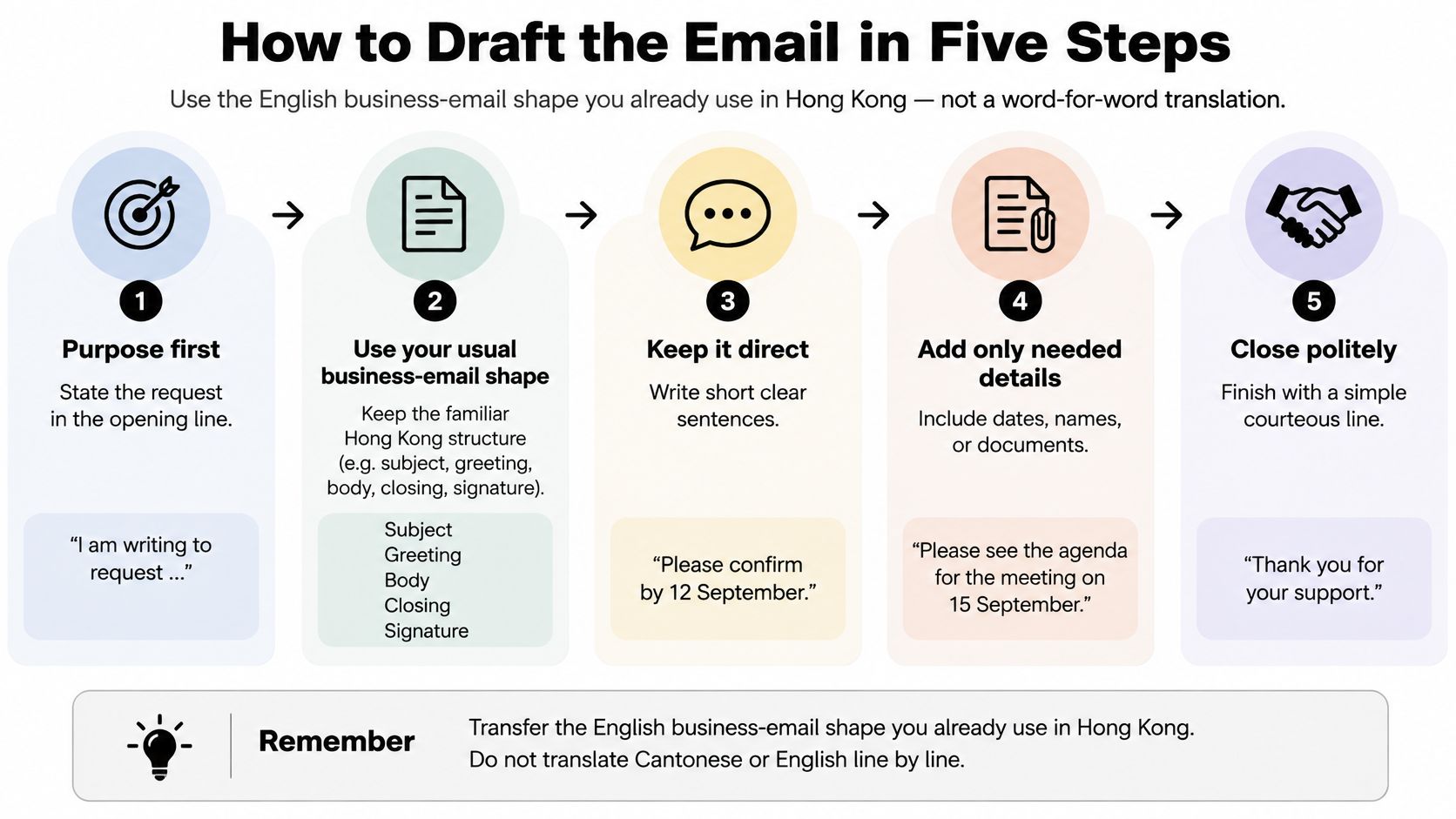
Build the message in a fixed order
Identify the recipient and choose Sie or du.
Write down the person's name, role and relationship to you before typing. This prevents you from beginning formally and drifting into familiar language when you reach a memorised phrase.Put the purpose in the opening sentence.
For example: Ich schreibe Ihnen bezüglich der Lieferung am 12. März. The recipient can immediately place the message in the correct project or transaction.Give each paragraph one job.
Separate context, request, supporting evidence and next step where the message needs them. A short enquiry doesn't require a separate paragraph for every function, but it shouldn't mix unrelated questions into one block.Finish with an explicit action and owner.
Specify whether you need confirmation, a document, a decision or an appointment. If timing matters, name a realistic deadline in HKT and address the person responsible rather than hoping someone on the copied list will act.Check the message as a complete package.
Review the subject, greeting, closing, verb position, noun capitals and attachments. Open the files you're attaching so you don't send an outdated quotation or a document with someone else's details.
The trade-off is between completeness and reading effort. Include enough information for a reply, but remove any background that doesn't help the recipient answer your question.
A quotation follow-up without the long introduction
Say you're following up on a quotation for a Hong Kong office. Your purpose line could be:
Ich möchte nachfragen, ob Sie unser Angebot bereits prüfen konnten.
Your closing request could be:
Könnten Sie uns bitte bis Freitag, 17:00 HKT mitteilen, ob Sie das Angebot annehmen möchten?
The opening identifies the unfinished task, while the closing identifies the decision you need. You don't need to recount the entire sales conversation between them.
For more control over polite requests, practise Konjunktiv II with würde and other request forms. Don't add increasingly complicated modal constructions just to sound courteous; a correct, short request is safer than a sentence you can't reliably check.
Before sending, apply a task-completion test:
- Coverage: Every required point is present.
- Relationship: The tone suits the recipient.
- Action: The reader knows what to do next.
For German writing skills: emails, that test matters more than whether every sentence sounds impressive.
Templates for Study Work and Travel
Institutional emails need more than a polite greeting. If you're preparing to study abroad in Germany, your correspondence may become part of an application record rather than a casual exchange.
The Goethe-Institut's study-visa guidance for Hong Kong applicants explains that university acceptance documents or proof of correspondence with a university or Uni-Assist may be needed, and that long-term study-visa preparation can take several months. Keep messages and attachments organised from the beginning.
Use these scenarios to identify the job your email must perform.
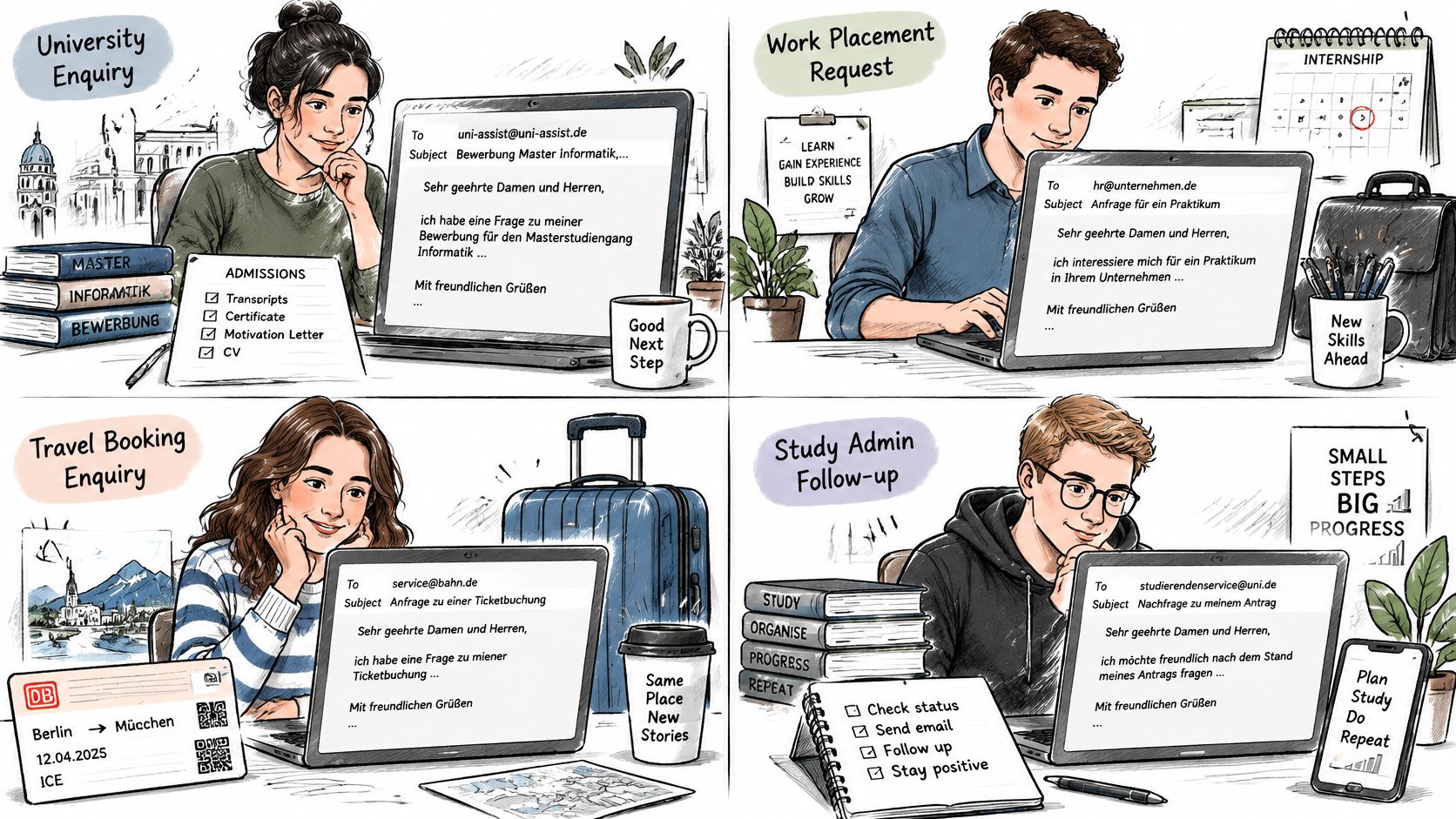
Match the subject to the recipient's workflow
Subject lines and required points by email job
| Context | Subject formula | Must include | Attachment |
|---|---|---|---|
| University or Uni-Assist | Bewerbung + programme + intake + surname | Programme, one question, name as on passport | Transcript or missing form, clearly named |
| Employer or internship in HK | Bewerbung + role + surname | Role, availability in HKT, one ask | CV as PDF |
| Supplier or HQ update | Project name + status + date | What changed, who acts, deadline in HKT | Quote or minutes if promised |
| Travel or host | Buchung or Anfrage + dates + surname | Dates, number of people, one yes-or-no question | Booking reference if it exists |
For a hypothetical future application, use a subject such as Bewerbung Master Informatik, Wintersemester 2027, Chan Tai Man. Replace the intake and name with your actual details, and use the programme's official title.
An A2-style university enquiry can stay simple:
Ich möchte mich für den Masterstudiengang Informatik bewerben. Welche Unterlagen brauche ich?
The first sentence establishes the programme; the question asks for one manageable answer. A more precise B2-style line could be:
Könnten Sie mir bitte bestätigen, ob mein beigefügtes Transcript für die Prüfung meiner Bewerbung ausreicht?
This narrows the issue to the sufficiency of a specific document. More advanced writing should improve precision, not merely increase sentence length.
Copy the useful parts, not an entire generic letter
For a missing-document follow-up, name the file, give the actual sending date and ask which item remains outstanding:
Ich habe die Datei Chan_Transcript.pdf am 12. März gesendet. Könnten Sie mir bitte mitteilen, welche Unterlage noch fehlt?
For an internship, organise the body around your identity, CV and interview availability:
Ich studiere Wirtschaftswissenschaften in Hongkong und bewerbe mich um das Praktikum im Einkauf. Meinen Lebenslauf finden Sie im Anhang. Für ein Gespräch bin ich am Freitag zwischen 15:00 und 17:00 HKT verfügbar.
For a hypothetical hotel enquiry, include the booking facts before the question:
Wir möchten vom 12. bis 15. März mit zwei Personen bei Ihnen übernachten. Ist ein Zimmer mit zwei Einzelbetten verfügbar?
Name attachments in Latin script, such as Chan_CV_2026.pdf, and match your application name to your passport. Send sensitive documents only through the channel the institution specifies.
For additional email-writing practice, use the following video alongside your own draft.
A university needs application identifiers and academic documents; a consulate needs the evidence specified for the visa process; an employer needs relevant qualifications and availability. Don't send the same attachment bundle to all three.
If no response window is published, about a week can be a reasonable first follow-up interval for a routine enquiry. Refer to the original subject, restate the unresolved request and keep your apology, if any, brief.
Common Mistakes and the Correction
A common Hong Kong-to-German writing problem is a courteous introduction that hides the request. The recipient reaches the end knowing you're considerate, but still has to search for the document or decision you need.
Consider this deliberately overextended opening:
Entschuldigen Sie bitte die Störung. Ich weiß, dass Sie sehr beschäftigt sind, und hoffe, dass ich Ihnen keine Umstände mache. Ich wollte nur kurz fragen, ob meine Unterlagen vielleicht angekommen sind.
A clearer version names the purpose and the file immediately:
Ich möchte den Eingang meiner Datei Chan_Transcript.pdf bestätigen lassen. Bitte bestätigen Sie den Eingang bis Freitag, 17:00 HKT.
Use that deadline only when it's justified by the process. For a routine admissions enquiry without an approaching deadline, a softer confirmation request is more appropriate than imposing an arbitrary response time.
The visual contrast is straightforward: make the request visible before adding courtesy.
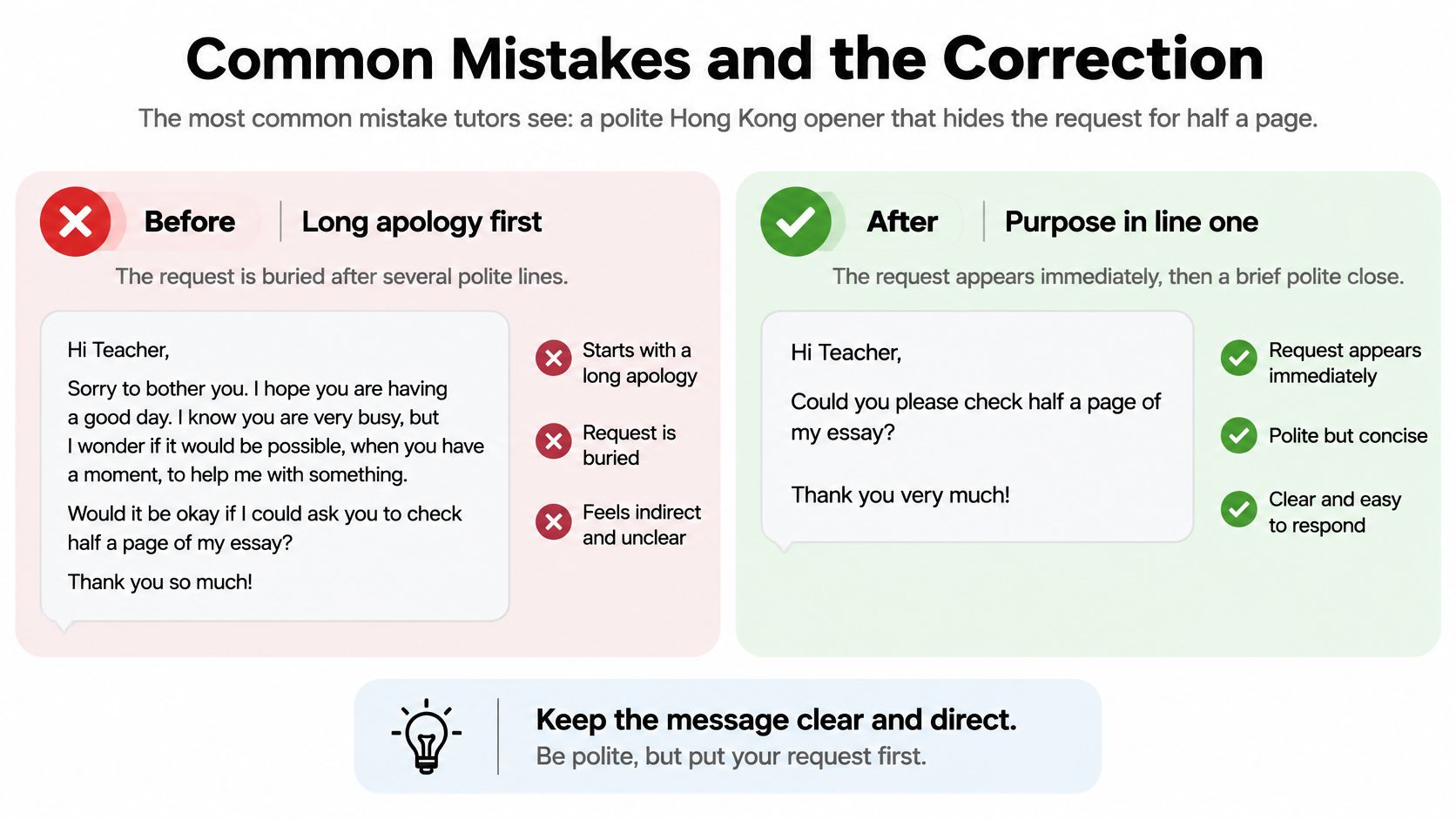
Repair the part that changes the reader's interpretation
German email errors and repairs
| Error | Why it fails | Repair |
|---|---|---|
| Request after a long apology, such as Entschuldigen Sie bitte … ich wollte nur … | The action is easy to miss | Ich bitte um Bestätigung des Eingangs meiner Unterlagen. |
| Sie and du mixed, such as Können Sie … kannst du … | The register contradicts the relationship | Keep the established form: Können Sie mir bitte helfen? Switch only after a clear invitation |
| Dear Sir translated as Lieber Sir | It sounds translated rather than conventionally German | Sehr geehrte Damen und Herren, when the recipient's name is unknown |
| weil der Termin wurde geändert | The subordinate clause uses the wrong verb position | weil der Termin geändert wurde |
| Missing article or case, such as an Herr Müller or ich sende Anhang | The title or noun phrase is grammatically incomplete | an Herrn Müller; den Anhang, die Rechnung, dem Team, according to the sentence |
| Date as March 12 and a deadline without a time zone | The date is less natural in German, and the response time is unclear | 12. März; bitte bis Freitag, 17:00 HKT |
| Attachment mentioned only as siehe Datei | The recipient can't easily identify the intended file | Ich füge Chan_CV_2026.pdf bei. |
| First chase becomes accusatory, such as Warum antworten Sie nicht? | It escalates the relationship before clarifying the outstanding decision | Retain the original subject with Erinnerung and write Ich möchte an meine Anfrage erinnern. Können Sie den Termin bitte bestätigen? |
The purpose of correction isn't to make every email sound like a legal letter. It's to remove uncertainty about the relationship, the evidence and the action.
Separate task repair from language repair
For examination practice, assess the revision twice. First ask whether the recipient could complete the task; then check whether the German is accurate.
- Task repair: Is the missing document identified, and is the requested confirmation clear?
- Language repair: Are the pronouns, articles, cases and verb positions correct?
A message can improve in one category while still needing work in the other. That distinction gives learners a practical revision target instead of a page covered in unrelated corrections.
For more contrastive examples, use this guide to common English-to-German mistakes made by Hong Kong students.
How Long Should You Spend on One Email
A focused practice email can fit into a short, timed drill. Set aside about six minutes for a familiar task, then allow more time for a real university, visa or workplace message when the details carry consequences. The aim is to practise making clear decisions, not to send every email quickly.
A study of email tasks in Hong Kong's key industries describes professionals writing concisely under workplace time constraints. Use a short limit to practise prioritising the purpose and requested action instead of repeatedly polishing the opening.
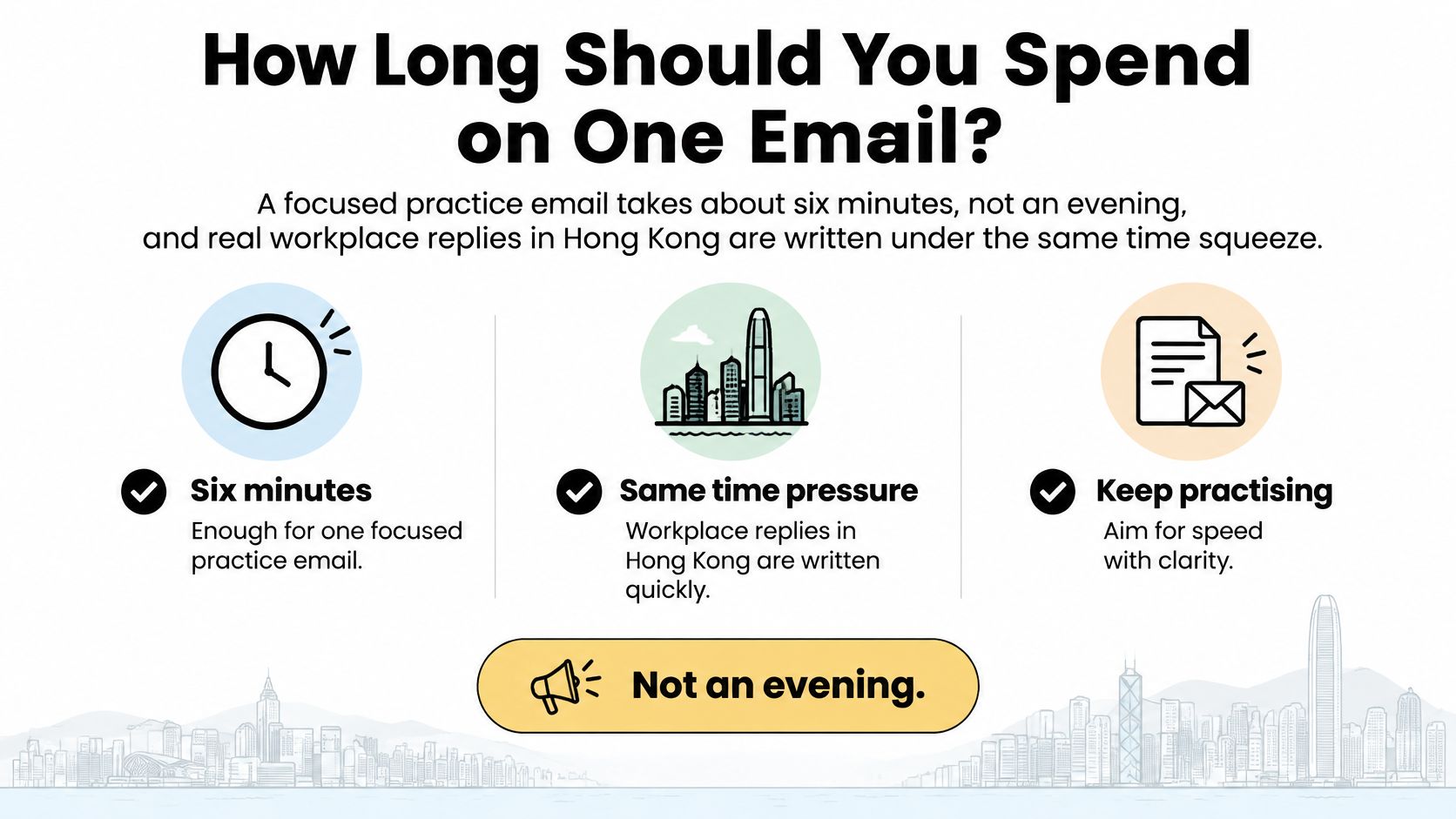
Use a short drafting protocol
For a familiar practice task, set a timer for six minutes:
- One minute for register: Decide whether the message should be formal, neutral or familiar.
- Two minutes for purpose and action: State what you need and what the recipient should do.
- Two minutes for evidence: Add relevant dates, names, document references and logistical details.
- One minute for revision: Check grammar, politeness and missing information.
These timings are a practice routine, not official examination timings. If you are a beginner, start untimed and focus on completing the task. For a high-stakes message, take longer to check names, dates, attachments and the action you are requesting.
Give each paragraph a job: context, request, supporting detail or next step. Make deadlines and attachments easy to find. In a German email to a university, visa office or company, a concise request is useful only if the recipient can identify the relevant document and respond to a clear question.
An email with imperfect grammar can be revised. A polished email that omits the required action has not completed the task.
Mark content and language separately
Use a two-column scorecard. Check first whether the reader has enough information to act, then review the German.
| Content coverage | Language accuracy |
|---|---|
| All required points included | Correct main-clause and subordinate-clause verb position |
| Appropriate register | Suitable articles and case endings |
| Actionable closing | Noun capitals and accurate spelling |
| Relevant evidence supplied | Correct names and document references |
For school candidates, match practice to the requirements of your own qualification. Confirm the current HKDSE German entry rules with your school or the examining authority before choosing a preparation route. An IB or IGCSE writing exercise may have different requirements, and this practice timer is not an official examination allocation.
For adult learners, begin with straightforward A2 requests and build towards more independent B1 or B2 correspondence. Reliable formal writing develops through sustained practice over time. A short drill can help you organise a familiar message, but it does not replace careful preparation for an application or consequential workplace exchange.
Try one prompt at a time:
- University: Ask which transcript or other document is still outstanding.
- Work: Confirm a meeting with a German supplier and state the time in HKT.
- Travel: Request a change to a hotel booking and ask whether a fee applies.
After each attempt, record the time and review both columns of the scorecard. Progress means completing the task more reliably, not just typing faster.
Ready to Start Learning with Real Emails
A university follow-up, a supplier request and a hotel booking change each call for different choices in German. Bring a message you need to write to a class, with confidential details removed. Use the recipient's requirements to set the task, then ask for feedback in this order: Does the email achieve its purpose? Does the register fit? Which recurring language error should you correct next?
Choose feedback that fits your goal
Native-speaking teachers can help distinguish a grammatically possible phrase from one that suits a professional email. A structured course should connect corrections to your level and the situations you need to handle.
Choose practice that matches your purpose:
- For workplace communication: Practise Business German for requests, delivery issues and meeting follow-ups.
- For study applications: Work on formal requests and document queries, alongside Goethe-Zertifikat or TestDaF preparation where relevant.
- For teenagers: Match writing practice to the IGCSE, A-level or IB syllabus.
- For travel: Practise bookings, changes, cancellations and requests for confirmation.
Private tuition allows close attention to a particular application or workplace task. A small-group course provides practice across different situations. For either format, check the institution's requirements before sending a consequential email.
Check CEF funding before enrolling
If cost affects your decision, check the Continuing Education Fund's eligibility rules before paying. The CEF's German-course guidance says applicants aged 18 or above may submit unlimited reimbursement claims for eligible courses commencing on or after 1 August 2022, subject to a HK$25,000 lifetime entitlement. Learner co-payments are 20% for the first HK$10,000 of subsidy and 40% for the remaining HK$15,000.
Attendance alone does not qualify a learner for reimbursement. The CEF reimbursement requirements require successful course completion and a pass in the specified benchmark examination at the required level or higher. The examination must be taken after the course begins.
Before enrolling, confirm the exact course and benchmark examination with the provider. Do not assume that German classes, exam preparation or private lessons automatically qualify for CEF funding.
German Cultural Association Hong Kong(GCA) offers in-person classes near Tsim Sha Tsui and Causeway Bay MTR stations, as well as Zoom sessions. Its courses include Business German, Travel German and preparation for Goethe-Zertifikat, TestDaF, IGCSE, A-level and IB examinations. Bring a university follow-up, workplace request or booking enquiry to a class, with personal information removed, and practise the German needed for that situation. Visit German Cultural Association Hong Kong(GCA) to check the latest course schedule and enrol.

German Writing Skills: Emails That Get Replies
How to Practise Speaking German Without a Partner: 10 Methods That Work


