.png)
.png)

BLOG

香港德國文化協會
The German Cultural Association
English to German: Common Mistakes Hong Kong Students Make
You’ve memorised vocabulary, finished app lessons, and maybe even managed a few decent conversations. But your German still falls apart in the same places. In Hong Kong, that usually shows up in IGCSE writing, IB oral practice, Goethe preparation, or even simple workplace conversations when you need to respond quickly.
That plateau is common, and it has clear causes. For many learners here, the biggest problem isn’t effort. It’s interference from English and Cantonese habits. German asks you to track gender, cases, verb position, sound patterns, and idiomatic usage in ways English doesn’t. Cantonese adds another layer, especially in pronunciation and sentence habits.
If you’re searching for English to German: Common Mistakes Hong Kong Students Make, the good news is that these errors are predictable. That means they can be corrected with the right drills, the right explanations, and enough guided repetition. For students aiming to pass IB, IGCSE, A-level, Goethe-Zertifikat, or to study abroad in Germany, these methods often make progress feel tangible.
Strong learners don’t just collect more words. They fix the patterns that keep costing them marks and confidence. If you’re serious about improving language proficiency, focus less on “more content” and more on “fewer repeated mistakes.”
What mistakes do Hong Kong students make most often in German
Hong Kong students most often struggle with grammatical gender, case endings, verb placement, separable and inseparable verbs, false friends, pronunciation, and exam technique. These problems usually come from transferring English and Cantonese habits into German, which causes persistent errors in writing, speaking, and timed exam tasks.
1. Confusing der die das articles with English the

A typical Hong Kong beginner can remember that Schule means “school” and still lose marks by writing der Schule in one sentence, die Schule in the next, and the Schule under exam pressure. That pattern is common because English uses one article and Cantonese has no grammatical gender system to reinforce the idea. German asks students to store an extra piece of information every time they learn a noun.
I see this constantly in Goethe, IB, and A-Level preparation. Students know the vocabulary item, but they have not learnt the noun as a full unit. So they produce das Frau, the Mann kommt, or a correct noun with the wrong article. Once the article is wrong, later choices often go wrong as well, especially pronouns and adjective endings.
For Hong Kong learners, this is not a small accuracy issue. It is a structural weakness caused by language transfer. English-trained students expect “the” to stay neutral. Cantonese-speaking students are also not used to classifying nouns by gender at all. German does the opposite. It requires early precision, and examiners notice repeated article errors very quickly in writing tasks.
What works better than memorising noun lists
Learn the noun with its article every single time:
- die Schule
- der Mann
- das Haus
That habit sounds basic, but it saves a lot of re-learning later. In my experience, students who separate the word from the article usually hit a ceiling at lower intermediate level, then struggle badly once case endings appear in essays and speaking assessments.
Use methods that make gender visible and testable:
- Colour-code genders: keep one colour for der, one for die, and one for das in flashcards or notes.
- Learn patterns, not random words: nouns ending in -heit, -keit, and -ung are usually feminine, so revise them as groups.
- Test in both directions: ask “What does Haus mean?” and also “What article does Haus take?”
- Store a model phrase: learn das Haus ist groß, not just Haus. The article becomes harder to forget when it appears inside a usable sentence.
Practical rule: If you memorise a noun without its article, you have memorised half the noun.
What usually fails
Passive exposure rarely fixes this fast enough for Hong Kong students working toward exams. Some learners hope gender will become intuitive through reading alone. A few high-volume readers do improve that way, but most school-age learners do not get enough repeated exposure for reliable recall under timed conditions.
Correction has to be immediate and consistent. Native German instructors are useful here because they catch the error at phrase level, not only at vocabulary level. In small-group lessons, a teacher can stop das Frau on the spot and make the student repeat die Frau until the phrase sounds normal. For this reason, structured German lessons Hong Kong families choose often outperform generic self-study for grammar-heavy topics.
2. Misplacing verbs in main and subordinate clauses
German sentence structure punishes English thinking very quickly. In English, learners can often stay understandable even with clumsy word order. In German, verb placement is much less forgiving.
You hear mistakes like Ich gestern habe einen Film gesehen or Weil ich Deutsch spreche nicht gerne. The learner knows the words, but the sentence frame is English. In German, the conjugated verb usually sits in second position in a main clause, and in many subordinate clauses it moves to the end.
Why this catches Hong Kong learners
English-medium education in Hong Kong trains students to build sentences in a fairly fixed subject-verb-object pattern. That makes German subordinate clauses feel unnatural at first. Learners often know that weil, dass, wenn, and obwohl are “special,” but under pressure they still slide back into English order.
The problem gets worse in writing tasks. A student may know the grammar rule in isolation but still produce messy clause structure in a timed IB or IGCSE composition.
Try comparing these:
Incorrect: Ich gestern habe einen Film gesehen
Correct: Ich habe gestern einen Film gesehen
Incorrect: Weil ich Deutsch spreche nicht gerne
Correct: Weil ich Deutsch nicht gerne spreche
Incorrect: Ich möchte gern Deutsch spreche
Correct: Ich möchte gern Deutsch sprechen
How to train this properly
Don’t start with abstract grammar labels. Start with sentence frames you can reuse.
- Build visual patterns: Put main clauses on one side of a page and subordinate clauses on the other.
- Drill conjunctions separately: Practise ten short sentences with weil, then ten with dass.
- Use sentence cards: Physically moving the verb to the final position helps many learners more than reading another rule explanation.
German word order is less about “sounding nicer” and more about signalling meaning. Put the verb in the wrong place and the sentence stops feeling German.
A realistic trade-off
If you focus heavily on speaking early, your fluency may improve faster, but word-order mistakes can become automatic. If you focus only on written grammar, you may freeze in conversation. The better balance is controlled speaking with immediate correction.
That’s where a structured curriculum helps. Learners need repeated exposure to the same sentence architecture across speaking, listening, and writing. Otherwise, they keep understanding German while producing English-shaped German.
3. Overgeneralising weak verb conjugations to strong verbs
This mistake looks small, but it tells you exactly how the learner is processing German. They’ve understood that many verbs follow patterns, so they try to regularise everything. That works until they hit strong verbs.
Then you get forms like Ich singte das Lied instead of Ich sang das Lied, or present-tense forms like Er trinked Wasser instead of Er trinkt Wasser. The logic is understandable. The result isn’t.
Why strong verbs keep causing trouble
English has irregular verbs too, but German asks you to manage them more actively across tenses and forms. If you only meet strong verbs in reading, they don’t stick well enough for quick recall in speech or exams.
A lot of Hong Kong learners also spend too much time memorising infinitives and too little time using the verb in full sentences. They know singen means “to sing,” but hesitate when they need sang or gesungen.
Here are common slips:
Incorrect: Ich singte das Lied
Correct: Ich sang das Lied
Incorrect: Er trinked Wasser
Correct: Er trinkt Wasser
Incorrect: Ich habe gegeben das Buch
Correct: Ich habe das Buch gegeben
A better way to learn strong verbs
Memorising alphabetical lists is inefficient. Frequency and pattern matter more.
Use a layered method:
- Group by vowel change: Learn families such as singen, sang, gesungen together.
- Practise in mini-dialogues: “Was hast du gemacht?” “Ich sang im Chor.” Short exchanges force retrieval.
- Attach audio: Hearing the form repeatedly helps prevent invented forms that look logical on paper.
What serious learners do differently
They revisit strong verbs constantly. Not once. Not in one cram session before an exam. They build them into weekly speaking and writing.
For school learners in HK, this matters because written tasks often expose weak verb overgeneralisation, while oral tasks expose hesitation. Adults preparing for work or relocation feel it too. If you can’t access the correct form quickly, your speech becomes slow and overcautious.
The fix isn’t glamorous. It’s repeated, contextual use with correction. That’s also why native-speaking instructors tend to catch these errors faster. They notice immediately when the form is technically understandable but still wrong.
4. Incorrect case endings on articles adjectives and nouns
A Hong Kong student can know every word in a sentence and still lose marks because the endings are wrong. That happens often in Goethe, IB, and A-Level writing. The meaning is partly clear, but the grammar signals are off, and examiners notice.
Typical examples look like this:
Incorrect: Ich sehe die Mann
Correct: Ich sehe den Mann
Incorrect: Ich helfe der Mädchen
Correct: Ich helfe dem Mädchen
Incorrect: Mit die guten Lehrer spreche ich oft
Correct: Mit dem guten Lehrer spreche ich oft
For Hong Kong learners, the problem usually comes from language transfer. English article systems do very little grammatical work, and Cantonese does not mark case on articles or adjective endings at all. German does both. Students therefore focus on the noun and verb, then treat the rest as decoration. In German, those small endings carry structure.
The mistake behind the mistake
Many students memorise declension tables, then freeze in timed work because they are trying to calculate every ending from scratch. That is too slow for real use and too fragile under exam pressure.
Case has to be tied to sentence function and verb behaviour.
- Nominative: the subject
- Accusative: the direct object
- Dative: the indirect object, and the case required by certain verbs and prepositions
- Genitive: less common in beginner work, but still tested in reading and formal writing
The recurring errors are usually predictable. Students learn sehen but forget it takes an accusative object. They learn helfen as vocabulary, but not as a dative verb. They learn mit as “with,” but not as a preposition that consistently triggers dative.
A simpler route is to study patterns before full tables. This beginner-friendly German grammar guide gives a usable foundation before you tackle full article and adjective declension.
What works in class
Native German instructors in Hong Kong usually correct case faster by training chunks, not isolated endings. That method works because it matches how students retrieve language in exams and conversation.
Use practice like this:
- Learn high-frequency case frames: ich sehe den, ich brauche einen, ich helfe dem, mit dem, zu der, für das
- Change one part at a time: der Lehrer becomes ich sehe den Lehrer, then ich spreche mit dem Lehrer
- Drill adjective endings inside fixed phrases: mit dem guten Freund, für die kleine Stadt, einen interessanten Film
- Write short corrections, not long essays: a six-line paragraph with ten target forms gives better feedback than a full page full of mixed errors
Trade-offs matter. Full declension charts help analytical students see the system. Pattern drilling builds speed. Learners preparing for exams need both, but in the right order. Start with common sentence frames so the forms become familiar. Then use the chart to explain what you are already seeing.
One reliable test is simple. If a student can recite the four cases but still writes ich sehe die Mann, the knowledge is still passive. Marks improve when article, adjective, and noun endings are practised together until the correct form feels expected, not guessed.
5. Using English word order with separable prefix verbs

A Hong Kong student says in a speaking mock, Ich anrufe dich heute. The examiner understands it immediately, but the sentence still sounds wrong. That is the problem with separable prefix verbs. Communication survives, yet accuracy and exam performance drop.
This error is common because English creates a misleading shortcut. Learners see anrufen, aufstehen, or aussteigen and treat them like single verb units that can stay together anywhere in the sentence. In a German main clause, they cannot.
So the correct forms are:
- Ich rufe dich heute an
- Wir steigen hier aus
- Er steht jeden Tag um sechs Uhr auf
For Hong Kong learners, the interference often comes from both languages they already know. English encourages fixed verb shapes, while Cantonese does not train learners to watch for verb-final movement in the same way German does. The result is predictable. Students remember the vocabulary item, but they do not control its position under time pressure.
That shows up clearly in Goethe, IB, and A-Level preparation. In writing, students often keep the verb together because they are translating too directly from English. In oral exams, they start the sentence correctly, then lose the prefix by the end because they are concentrating on meaning, pronunciation, and case at the same time. Native German instructors usually correct this faster by drilling full sentence patterns, not isolated word lists.
What helps most
Treat separable verbs as structures you have to place correctly, not as dictionary entries you only have to memorise.
- Learn the main clause as a full chunk: Ich rufe dich an. Wir steigen aus. Sie kommt morgen an.
- Practise the contrast: Ich rufe dich an / Ich will dich anrufen / Ich habe dich angerufen.
- Group verbs by real situations: transport, phone calls, office routines, lesson schedules
- Say the whole sentence aloud: this reduces the common HK habit of stopping before the prefix
For adults using German at work, this is even more critical. Verbs such as anrufen, absagen, vorbereiten, teilnehmen and vorstellen appear in emails, meetings, and calls every day. If the word order stays too close to English, the message sounds learner-level even when the vocabulary is good.
A second trap is overcorrection. Some students learn that prefixes split, then start splitting verbs that should stay together. That leads to forms such as separating inseparable verbs in speech or writing because the category was never learned properly.
The clean fix is contrast practice with immediate correction: separable in the main clause, joined in the infinitive and perfect, inseparable kept together throughout. Students who build that habit early usually improve faster in both fluency and accuracy.
6. Confusing false friends and translating idiomatically from English Cantonese
A Hong Kong student writes a strong Goethe or IB essay, uses advanced vocabulary, and still loses marks because several phrases sound translated rather than idiomatic German. I see this often with learners who think well in English, switch easily into Cantonese, and then build German sentences from whichever language comes first.
False friends are one part of the problem. German and English share many familiar-looking words, but some of them point learners in the wrong direction. Gift does not mean “present.” It means “poison.” Aktuell means “current,” not “actual.” Chef usually means “boss,” not a cook. In exam writing, these mistakes are costly because the sentence may look complex while the meaning is plainly wrong to the examiner.
The second problem is even more common in Hong Kong classrooms. Students translate idioms and fixed expressions directly from English or Cantonese, then assume the result is acceptable because each individual word is German.
Examples:
Incorrect: Ich bin kalt
Better: Mir ist kalt
Incorrect: Einen Fehler tun
Better: Einen Fehler machen
Incorrect: In Deutsch sprechen
Better: Auf Deutsch sprechen
Incorrect: Ich habe Hunger auf schlafen
Better: Ich möchte schlafen / Ich bin müde
This happens for a clear reason. Cantonese allows very flexible phrasing in daily speech, and English encourages learners to trust word-for-word transfer more than they should. German is less forgiving. It prefers established combinations, and examiners notice quickly when a phrase has been translated instead of learned as a real expression.
For spoken German, this matters just as much. A learner may know how to greet someone, introduce a topic, or respond politely, but the phrasing still sounds imported from English. Practising set expressions from a basic German conversation guide for greetings and everyday exchanges helps because it trains the ear to recognise what native speakers typically say.
The fix is practical.
Keep a personal error bank with three columns: the wrong phrase you used, the correct German expression, and one full sentence. Learn vocabulary in chunks such as Mir ist kalt, einen Fehler machen, Angst haben vor, sich interessieren für. Review those chunks before writing practice, not after. If a phrase entered your head first in English or Cantonese, pause and check whether German really uses that structure.
I also recommend more listening than many textbook plans allow. Short native audio clips help students hear which collocations are normal and which ones are learner inventions. Tools built with best AI voice technology can support repetition practice, but they work best as a supplement. A native teacher is still better at catching the subtler problem, which is not grammar alone, but whether the phrase sounds natural, formal enough for an exam, and appropriate for the situation.
For Hong Kong learners aiming at Goethe, IB, or A-Level German, this is a scoring issue, not just a style issue. Correcting false friends and translation habits usually improves writing quality faster than memorising another long vocabulary list, because it removes errors from sentences students already know how to build.
7. Difficulty with German pronunciation and umlauts
A Hong Kong student can write schön correctly all semester, then say schon in a speaking exam and lose the meaning. Examiners notice that immediately. So do native listeners.
This problem shows up often with ä, ö, ü, the two ch sounds, and the German r. These sounds do not sit comfortably inside the Cantonese or English sound system, so students usually replace them with the nearest familiar option. The result is understandable in class, but less reliable in oral exams and listening tasks.
The pattern is predictable in Hong Kong. English-medium learners often flatten vowels, so ü in Brücke turns into a plain u sound. Cantonese speakers also tend to treat unfamiliar fricatives too loosely or too far back in the mouth, which is why ich and Bach often come out with the same ch. I hear this from students preparing for Goethe, IB, and A-Level German, especially those who have done plenty of reading but very little guided speaking.
Why this affects more than speaking
Pronunciation and listening are tied together.
If a learner cannot hear the difference between schon and schön, or between musste and a word with ü, that weakness usually appears twice. First in speech, then again in listening papers. This is one reason some Hong Kong students perform better in grammar exercises than in oral or audio-based tasks. The issue is not effort. The issue is inaccurate sound mapping built from English and Cantonese habits.
For beginners, structured exam-focused practice helps early. A clear starting point is this guide on how to pass the A1 German exam, especially if pronunciation has already started affecting speaking confidence.
Practical correction strategies
Generic advice such as “listen more” is too weak. Pronunciation improves faster when students isolate the sound, fix the mouth position, then use it in short phrases.
- Train mouth shape deliberately: Round the lips clearly for ö and ü before trying to say the full word.
- Use minimal pairs: Practise contrasts such as schon and schön so the ear learns the difference before the tongue does.
- Separate the two ch sounds: Use ich for the softer front sound and Bach for the harder back sound. Do not practise them as if they were one category.
- Record short sentences, not single words: Errors often return once the word sits inside normal speech.
- Get correction from a native German teacher: Self-study helps, but many Hong Kong learners cannot hear their own substitutions until someone points them out.
Students who want extra exam practice can also prepare for exams with past papers, then listen back to their own oral responses and check where pronunciation affects clarity, pace, or confidence.
One trade-off matters here. Perfect accent is not the target. Clear, consistent pronunciation is. For exams, that is the standard that protects marks. Native German instructors usually correct the sounds that change meaning first, then work on overall naturalness. That order saves time and gives Hong Kong learners faster gains where examiners reward them.
8. Inadequate preparation for timed examination formats and exam specific question types
Some students know enough German to pass, but not enough about the exam to perform well. That distinction matters. Goethe-Zertifikat, IGCSE, IB, A-level, and TestDaF all reward language ability, but they also reward format control.
A learner may speak quite naturally in class and still freeze in a structured oral exam. Another may understand normal spoken German but miss key details in timed listening sections because the pace and stress feel different. This is common in Hong Kong, where many students work hard on content but delay exam technique until too late.
Why exam practice has to be specific
General study builds language. Exam practice builds performance under constraints.
The problem is not laziness. It’s mismatch. Students revise vocabulary and grammar, then sit an exam that demands:
- fast scanning
- selective listening
- controlled writing length
- predictable task structure
- calm speaking under time pressure
A useful starting point for beginners is to study the task style and benchmark expectations in resources focused on passing official papers, such as this guide on how to pass the A1 German exam. The same principle scales upward to IB, IGCSE, Goethe, and TestDaF.
What strong exam preparation looks like
It’s practical, timed, and repetitive.
- Use authentic past papers: Don’t rely only on textbook-style exercises. You can also prepare for exams with past papers to get used to timing pressure and question wording.
- Study marking criteria: Many students lose marks because they don’t understand what examiners reward.
- Run mock speaking tasks: Not casual chat. Proper prompts, timing, and follow-up questions.
For teenagers in HK, this matters because school schedules are crowded. Students often leave German revision behind core school subjects, then try to catch up quickly before the exam window. Adults do something similar with work commitments. The result is the same. Knowledge without exam handling.
The trade-off most learners miss
If you start exam drills too early, before building a language base, practice can feel mechanical and discouraging. If you start too late, you may know the language but still underperform.
The better approach is staged preparation. Build core grammar and speaking confidence first. Then move into timed tasks well before the exam period so that the format becomes familiar rather than threatening.
8 Common English-to-German Errors by Hong Kong Students
Hong Kong learners rarely struggle with just one German problem. The pattern is usually cumulative. A student starts with article confusion, then case endings become unstable, then word order breaks down under speaking or exam pressure. That combination is common in Goethe, IB, IGCSE, and A-Level preparation, especially for learners who are transferring habits from English and Cantonese instead of training German as its own system.
The table below is most useful if you read it diagnostically. Ask which errors keep recurring in your writing, speaking, or mock papers, and which ones cost marks even when you know the rule in theory. That is the gap native German instructors usually target first.
| Issue | Implementation complexity 🔄 | Resource requirements ⚡ | Expected outcomes ⭐ | Ideal use cases 📊 | Key advantages 💡 |
|---|---|---|---|---|---|
| Confusing "der, die, das" articles with English "the" | Medium–High, requires consistent noun+article memorization | Medium, flashcards, color-coding, native correction sessions | ⭐ Marked improvement in article/adjective agreement and written accuracy | All levels; essential for Goethe-Zertifikat and formal writing | Learn nouns with articles; prevents cascading agreement errors |
| Misplacing verbs in main and subordinate clauses | High, involves relearning core sentence structure differences | Medium, diagrams, sentence-reordering practice, native feedback | ⭐ Clearer sentence structure; fewer meaning-changing errors | Writing, formal grammar study, TestDaF/IGCSE/A-level prep | Visual SVO vs SOV practice; focus on subordinating conjunctions |
| Overgeneralizing weak verb conjugations to strong verbs | Medium, memorization of irregular patterns required | Medium, SRS (Anki), conjugation tables, audio examples | ⭐ More accurate tenses in speaking and writing | Past/Perfect tense practice, speaking fluency, exam essays | Group strong verbs by pattern; daily short memorization sessions |
| Incorrect case endings on articles, adjectives, and nouns | Very High, many combinations; systematic learning needed | High, case charts, transformation exercises, native-led correction | ⭐ Major gains in grammatical correctness and formal writing marks | B1/B2, IGCSE/A-level, formal written communication | Use color-coded case charts and contextual practice |
| Using English word order with separable prefix verbs | Medium, specific rule with frequent verbs to internalize | Medium, lists of common verbs, role-play, sentence split exercises | ⭐ More natural main-clause phrasing; improved spoken credibility | Everyday conversation, Business German, telephone scenarios | Practice top 50–100 separable verbs as fixed phrases |
| Confusing false friends and translating idiomatically | Medium, vocabulary/contextual learning and cultural exposure | Medium, personal lexicon, idiom lists, authentic media | ⭐ Fewer misunderstandings; more idiomatic, native-like language | Business and formal writing, conversational nuance | Build false-cognate dictionary; study idioms by theme |
| Difficulty with German pronunciation and umlauts (ä, ö, ü) | Medium–High, new phonemes and articulatory habits | High, phonetic instruction, native audio, recording/comparison tools | ⭐ Better intelligibility and higher speaking exam scores | Speaking exams (TestDaF/Goethe), conversational confidence | Exaggerate mouth shapes initially; record and compare to natives |
| Inadequate preparation for timed examination formats | High, requires strategy, timed practice, exam-specific skills | High, past papers, mock exams, instructor feedback, timed drills | ⭐ Significant improvement in exam performance and time management | Goethe-Zertifikat, TestDaF, IGCSE, A-level, IB exam prep | Practice authentic past papers under timed conditions; mock exams |
One practical point from teaching Hong Kong students. The hardest error is not always the one that looks most advanced. Article gender and case control often cause more long-term damage than vocabulary gaps because they affect almost every sentence. By contrast, pronunciation problems can improve relatively quickly with focused audio correction, but only if the learner is willing to record, compare, and repeat.
For parents, the useful question is not whether a child is spending time on German. It is whether that time is fixing the exact mistakes that repeatedly lower marks. For adult learners, the same principle applies to work and study goals. Progress comes faster when correction is targeted, exam-aware, and based on the interference patterns Hong Kong learners bring into the classroom.
Ready to Master German with Confidence?
These mistakes are common, but they aren’t permanent. That’s the part many learners in Hong Kong need to hear. If your German keeps breaking down in the same places, it doesn’t mean you “aren’t good at languages.” It usually means you’re carrying over patterns from English and Cantonese into a language that runs on a different system.
That’s why random practice often fails. More vocabulary won’t solve article gender confusion. More reading won’t automatically fix pronunciation. More speaking without correction can reinforce the wrong word order, wrong cases, or wrong verb forms.
A significant shift comes when practice becomes targeted. You identify the exact pattern, train it properly, and repeat it until the correct form becomes natural enough to use under pressure. That pressure might be an IB oral, an IGCSE composition, a Goethe speaking task, an A-level paper, a visa interview, or a meeting with German-speaking colleagues.
For parents, this matters because children and teens often look “busy” in language study without fixing the errors that cost marks. For working professionals, the same issue appears in a different form. They may understand written German reasonably well but still hesitate when they have to speak accurately and quickly. For adults planning to study abroad in Germany, the gap becomes obvious as soon as application deadlines and language certificate requirements come into view.
A good programme doesn’t just expose students to German. It corrects repeated mistakes early, uses structured progression, and keeps class sizes small enough for teachers to notice what each learner is doing wrong. That’s where native-speaking instruction makes a difference. A native teacher often hears instantly whether the sentence is grammatically off, idiomatically awkward, or not how a German speaker would say it.
The German Cultural Association of Hong Kong stands out. GCA combines native-speaking teachers, a structured curriculum, small-group classes with a maximum of 6 students, and focused preparation for Goethe-Zertifikat, TestDaF, IGCSE, A-level, and IB. For families comparing options in Hong Kong, that balance matters. Private tutors can be helpful, and self-study can support revision, but serious learners usually need a system that covers grammar, speaking, exam strategy, and correction together.
The local context matters too. Learners in HK are often balancing school pressure, work schedules, commute time, and budget concerns. Flexible scheduling, Zoom options, and clear progression aren’t extras. They’re part of what makes consistent learning possible. If a course is good in theory but hard to attend, progress stalls.
If you’ve been searching for English to German: Common Mistakes Hong Kong Students Make, treat this article as a diagnosis, not just a list. Every mistake here points to a practical fix. Learn nouns with articles. Train sentence structure in patterns. Separate strong verbs from weak ones. Practise case through function, not charts alone. Handle separable verbs as real sentence units. Build a false-friend notebook. Work on pronunciation with audio and feedback. Prepare for exam format early enough that it no longer throws you off.
German rewards accuracy, but it also rewards consistency. With the right guidance, most plateaus start to break faster than students expect.
If you want expert help turning these common errors into real progress, book a trial class with German Cultural Association Hong Kong(GCA). GCA offers native-speaking teachers, structured German courses for children, teens, adults, and professionals, plus flexible in-person lessons near Tsim Sha Tsui and Causeway Bay MTR or interactive Zoom classes anywhere in HK.
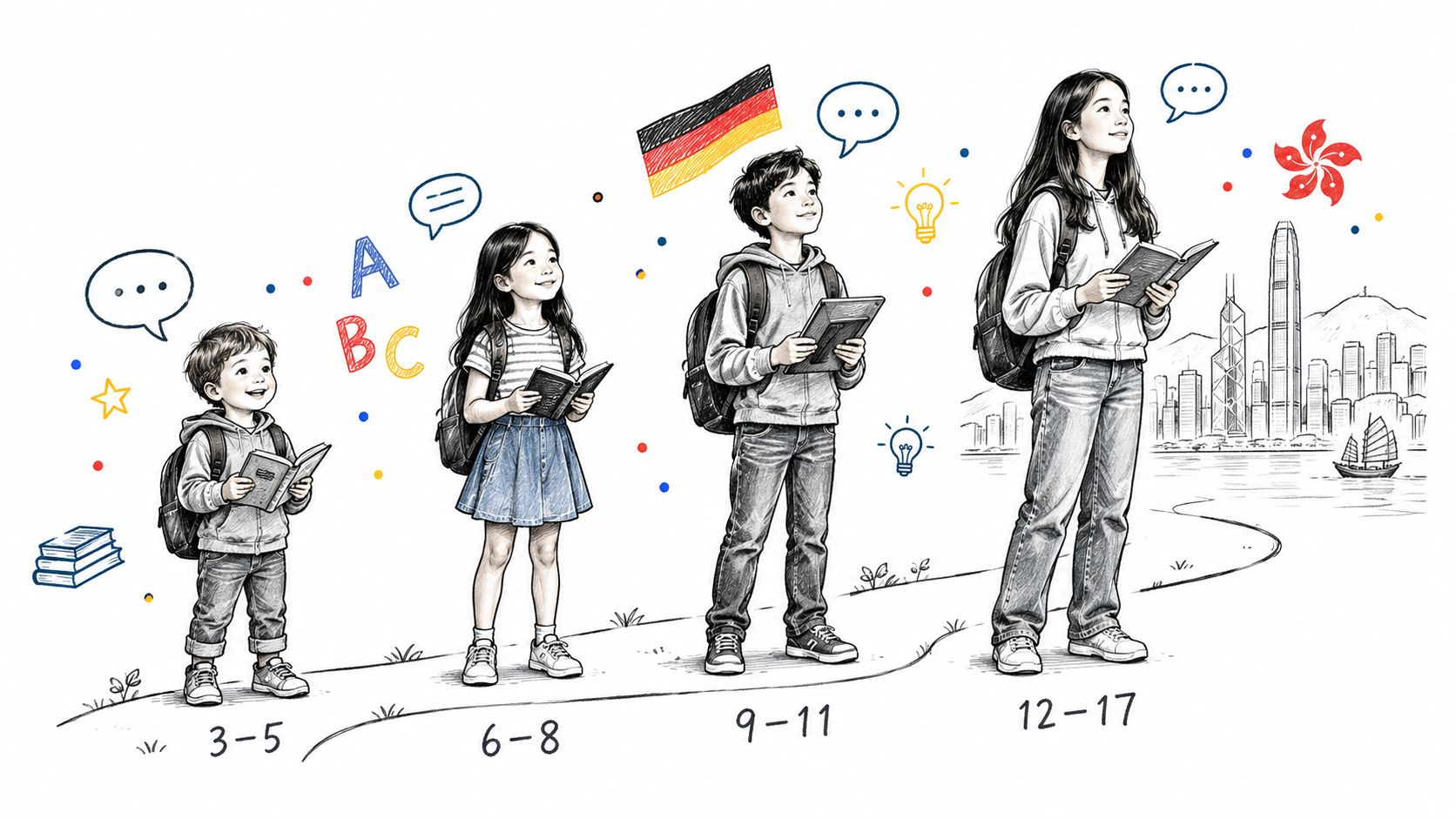
German Classes for Kids Hong Kong: Ages

Joining a German Course Mid-Term: September Intake Guide for Hong Kong 2026/27


