


BLOG

香港德國文化協會
The German Cultural Association
How to Practise Speaking German Without a Partner: 10 Methods That Work
You're on the MTR after work, reading a German email comfortably on your phone. You understand the message, but when you rehearse a spoken reply, the words disappear. Your next class isn't until the weekend, your colleagues speak Cantonese or English, and there's nobody available to practise with.
That gap between understanding and speaking is exactly why how to practise speaking German without a partner: 10 methods that work matters. You need opportunities to retrieve words aloud, build sentences under pressure, and hear what you sound like.
In Hong Kong, spontaneous German conversation can be difficult to find. The Hong Kong Census and Statistics Department's language-use report states that 92.3% of residents reported Cantonese as the language they most often used at home.
Limited class time makes deliberate practice especially useful. Whether you're facing a Goethe-Zertifikat deadline, preparing for business meetings, or helping a teenager with school German, you can make lessons more productive by arriving ready to speak rather than starting cold.
Table of Contents
- Match the routine to your Hong Kong schedule
- Use expert feedback to make independent practice more effective
How can you practise speaking German without a partner?
Solo German speaking practice means producing spoken German independently, then checking it against reliable models or feedback. Effective methods include shadowing, reading aloud, recording yourself, self-talk, picture descriptions, spoken summaries, sentence drills, timed mock tests, role-play, and speech-to-text checks. Combine pronunciation work with unscripted responses rather than relying on memorisation alone.
1. Shadowing to develop natural German rhythm
Shadowing means speaking just behind a recorded German speaker, matching their phrasing, stress, and intonation. It's particularly useful when you know the words but still deliver every sentence with hesitant, disconnected syllables.
Use headphones for focused listening, then practise aloud somewhere you won't disturb other people.
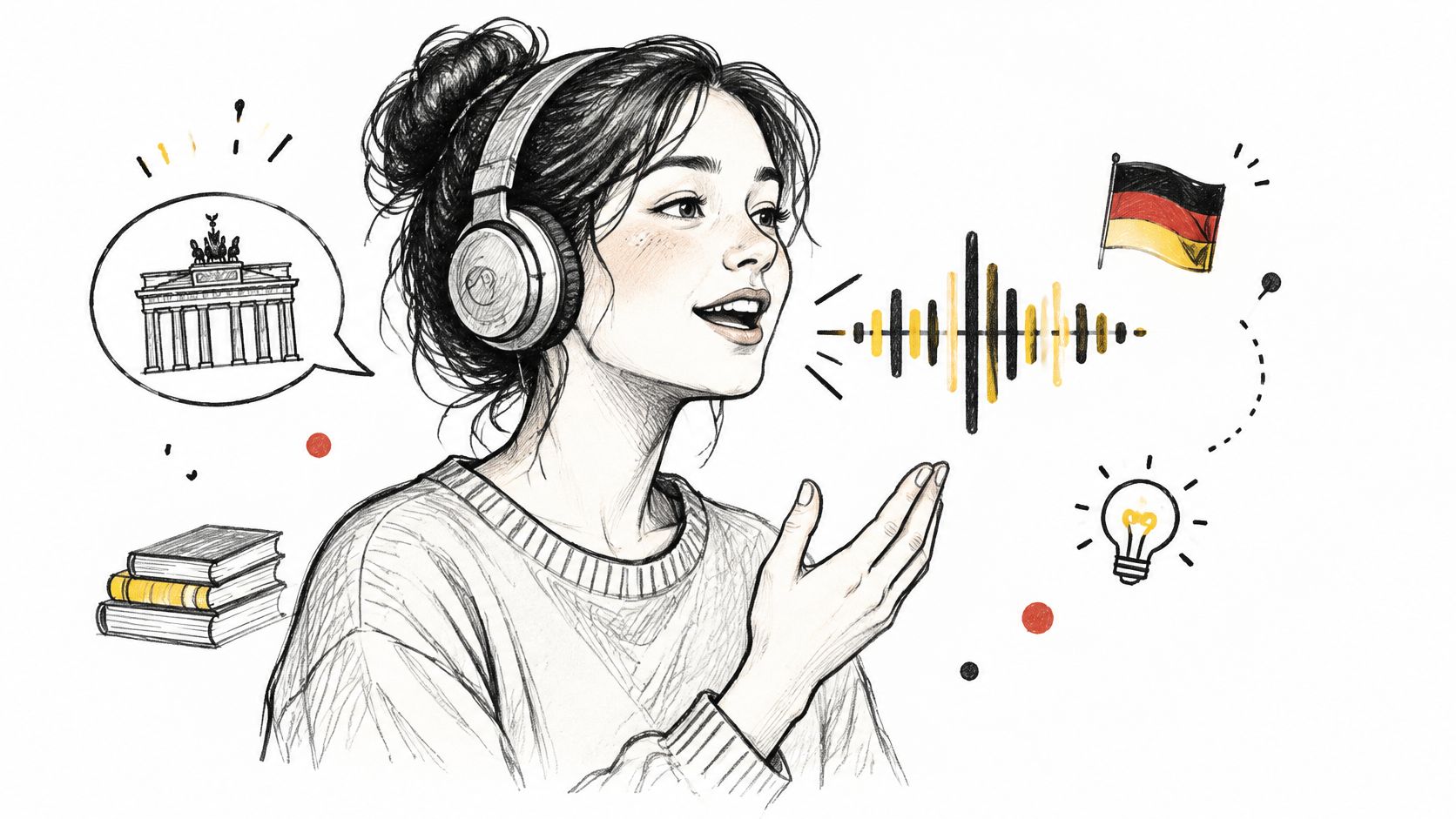
Choose a short Deutsche Welle learner recording or an official exam sample dialogue. Read the transcript first, check unfamiliar expressions, and listen before attempting to follow the speaker.
Match phrasing before chasing speed
- Prepare on the MTR: Listen and mark stressed words mentally. Save audible practice for home or a quiet private space.
- Repeat meaningful chunks: Copy a complete phrase rather than isolated syllables.
- Remove the recording: Retell the message afterwards so imitation becomes independent speech.
Self-check: Record the same passage without the original playing. Compare sentence stress, audible endings, and where you pause.
The trade-off is that excellent imitation doesn't prove you can construct a new sentence. Always finish with an unscripted response related to the recording.
For an additional listening-and-speaking model, use this video as practice material.
2. Reading aloud to make familiar German easier to say
A teenager may understand a graded reader yet stumble over the same language when speaking. Reading aloud lets them concentrate on pronunciation without simultaneously inventing the content.
Choose something comfortably readable, not a dense article that requires constant dictionary checks. Our guide to German graded readers for beginners can help you select suitable material.
Read for meaning, then delivery
Start by reading and identifying the main message. Mark phrase boundaries, stressed syllables, and unfamiliar sounds before reading aloud.
For a Hong Kong student preparing for IGCSE, A-level, or IB German, a passage about school life can supply useful language for spoken responses. Parents can ask their child to explain the passage afterwards rather than praising a smooth reading.
- Notice endings: Keep articles, adjective endings, and final consonants audible.
- Separate difficult words: Practise them outside the paragraph, then put them back.
- Add expression: Make questions sound like questions and contrasts sound deliberate.
Self-check: Record an initial reading and a revised version. Compare interruptions, unclear words, and whether the phrasing reflects the meaning.
Reading aloud is controlled production, not spontaneous conversation. Close the book and explain the paragraph in your own words before you finish.
3. Self-recording and review to expose recurring mistakes
For a Hong Kong professional preparing for a German-language interview, a recording is more useful than the feeling that practice went reasonably well. Playback reveals unfinished sentences, vague vocabulary, and repeated hesitation that you may miss while speaking.
Record a professional introduction explaining your role, responsibilities, and reason for learning German. Keep the topic relevant to an actual interview or client conversation.
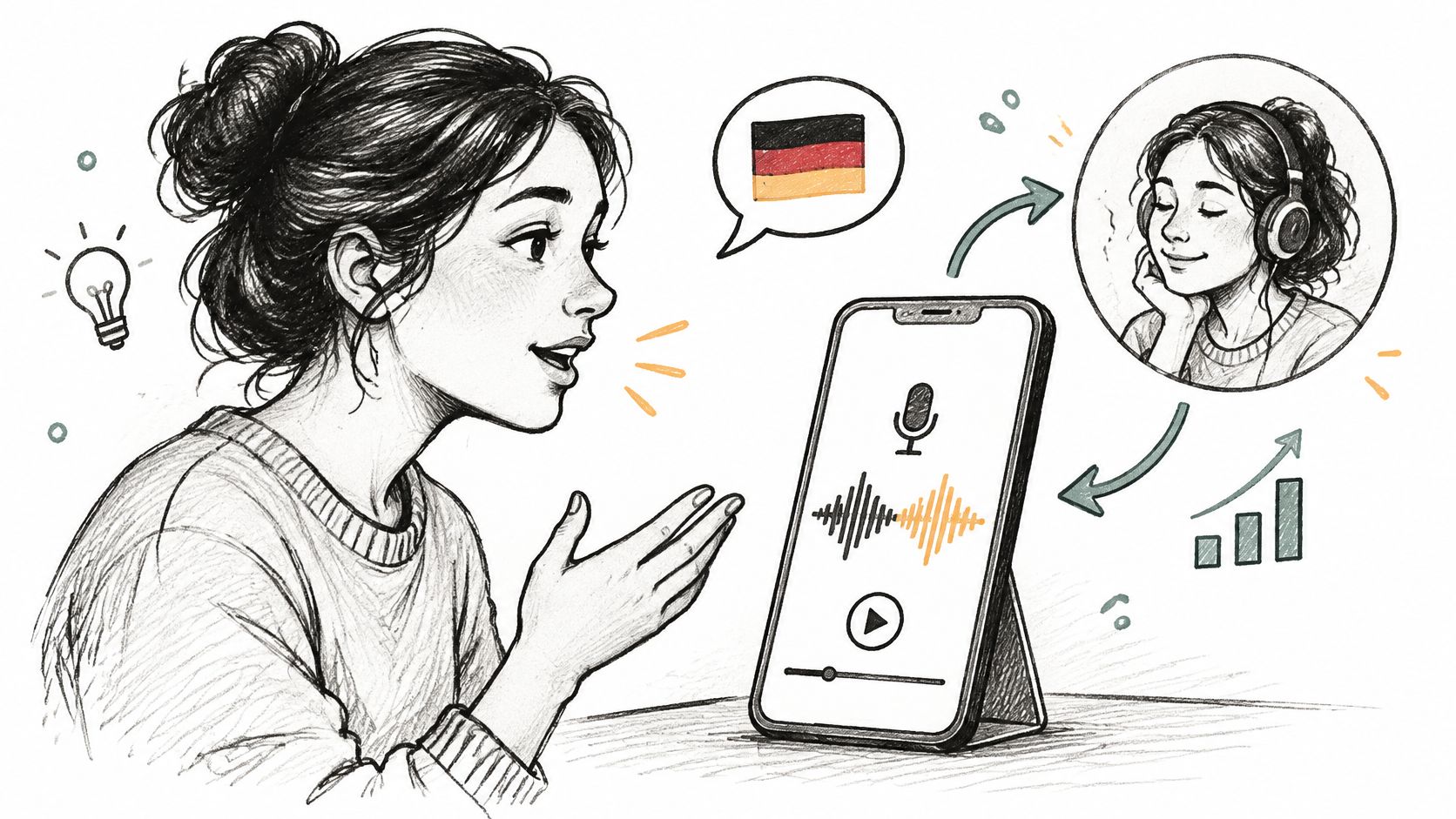
Review selectively, not obsessively
Listen for meaning first. Could an unfamiliar listener understand what you do and why it matters?
Then review a narrower target, such as verb placement or pronunciation of ich and auch. Compare relevant phrases with reliable native audio, revise your response, and record it again.
Practical rule: Don't keep repeating a recording you already know contains an unresolved error. Check the wording before rehearsing it further.
Self-check: Keep comparable recordings and an error log. Track whether the same problem disappears in a fresh response, not just in the polished version.
The limitation is self-awareness: you can't reliably correct a grammar rule you haven't understood. Bring uncertain phrases to a teacher instead of treating your own transcription or an automated correction as definitive.
4. Daily monologues to reduce dependence on translation
Before opening your work inbox, explain your priorities aloud in German. Describe what needs finishing, who you need to contact, and what might cause a delay.
This makes self-talk relevant to your working day rather than another abstract homework task. You can also describe your journey from Causeway Bay to Central once you've reached a suitable place to speak.
Keep talking without inventing complicated sentences
Use language you can control. If a word is missing, explain around it instead of immediately switching to English or Cantonese.
For example, if Besprechungsraum escapes you, describe the room where your team meets. Circumlocution is useful communication, not a failure.
- Rotate topics: Move between family, work, leisure, and future plans.
- Capture gaps afterwards: Write down the expressions you needed once you've finished speaking.
- Reuse new language: Work those expressions into the next monologue.
Self-check: Notice how often you abandon a sentence or switch languages. Revisit a familiar topic later and check whether you can express more detail with fewer restarts.
Self-talk trains retrieval, but it can also reinforce comfortable mistakes. Pair it with checked sentence models and occasional teacher feedback.
For children, describing a drawing or explaining a game usually works better than an adult-style speech about daily responsibilities.
5. Describing pictures to organise an unfamiliar response
A photograph gives you something concrete to discuss without supplying the sentences. That makes Bildbeschreibung, or picture description, a useful bridge between reading prepared language and speaking independently.
Start with a scene from a café, railway station, school, or workplace. A Hong Kong learner planning to study abroad in Germany could describe a university seminar room and explain how the setting compares with their current school.

Separate observation from interpretation
Describe who is present, where they are, and what they're doing. Then add cautious interpretation using phrases such as Vielleicht warten sie auf … or Es sieht so aus, als ob …
- Locate details: Use im Vordergrund, im Hintergrund, and neben.
- Explain relationships: Connect objects and actions instead of listing nouns.
- Extend the task: Add an opinion or a related personal experience.
Self-check: Listen for a clear progression from overview to detail. Can someone who hasn't seen the image follow your description?
Don't assume every Goethe-Zertifikat level includes the same picture task. Use picture descriptions to build transferable speaking skills, and check your actual exam's current sample materials before practising a specific format.
The main trap is memorising a stock description that stops working when the photograph changes.
6. Summarising podcasts and news to practise independent wording
Listen to an accessible German podcast during your commute, then explain its main point aloud after you arrive home. Unlike shadowing, summarising requires you to choose the language yourself.
Slow German and learner-oriented Deutsche Welle material can provide manageable starting points. Our guide to German news sites and apps for A1–B1 learners helps you match the material to your comprehension.
Retell the message, not the transcript
Say what happened, why it matters, and what you think about it. Useful connectors include Laut dem Bericht, Der wichtigste Punkt ist, and Das bedeutet, dass …
For business German, choose material related to your sector. A logistics professional in HK might explain a transport story and then describe its possible relevance to customers.
If you can only repeat the original wording, simplify the source until you can explain the message yourself.
Self-check: Replay the original after your summary. Check whether you preserved the central message, confused who did what, or added a claim the speaker never made.
The trade-off is cognitive load. Difficult audio can leave you struggling with comprehension before speaking practice even begins.
Avoid confidential client details when recording workplace-related summaries, particularly if you upload audio to a cloud service.
7. Spaced-repetition sentence drills to retrieve useful phrases faster
A vocabulary card showing Termin doesn't guarantee you can arrange an appointment. A sentence prompt requiring Ich möchte einen Termin vereinbaren gives you a usable speaking pattern.
Use Anki or another spaced-repetition tool to practise complete, checked sentences. Build cards from situations you face rather than downloading an enormous deck you won't maintain.
Make the prompt require speech
For a student balancing schoolwork and German exam preparation, short reviews can fit around an MTR commute. Review while travelling, then complete the spoken version somewhere appropriate.
- Prompt with a situation: Ask yourself how to reschedule an appointment politely.
- Answer aloud before revealing: Recognition after turning the card isn't the same as retrieval.
- Include reliable audio: Check pronunciation against a clear model.
- Change a detail: Replace the date, destination, person, or reason.
Self-check: Mark a sentence as successful only when you can say it without reading the answer. Later, test whether you can adapt it to a different situation.
Sentence drills work well for polite requests, common verb patterns, and expressions you repeatedly forget. They work poorly when you memorise long answers without understanding their grammar.
A deck made from your own corrected speaking mistakes is usually more relevant than a collection of impressive but unnecessary phrases.
8. Timed mock speaking tests to prepare for exam pressure
A Goethe-Zertifikat speaking task after a long school day or MTR commute demands more than a fluent answer prepared at home. Timed practice reveals whether you can understand the prompt, organise your response, and finish the task without repeatedly restarting.
Practise the actual task, not an imagined exam
Use current official sample materials for your target qualification, and check the current requirements for your specific exam. Follow its stated preparation and speaking limits rather than making the conditions easier.
At the German Cultural Association of Hong Kong, Goethe-Zertifikat preparation combines independent practice with guided mock tasks and feedback from native-speaking teachers.
Record your attempt and keep going after a mistake you can recover from. Then check whether you addressed every part of the task and whether your response explained, requested, justified, or negotiated what the prompt required.
Self-check: Compare your recording with the official criteria. Track whether you finish within the time limit and meet each task requirement. Ask a teacher to review criteria you cannot judge confidently.
Solo mock tests prepare your own contributions, but they cannot reproduce unpredictable paired interaction. Recording both roles can help you practise timing, but it does not test how well you respond to another speaker.
9. Scripted role-play to rehearse practical conversations
You're checking into a Munich hotel, but the receptionist can't find your reservation. A memorised greeting helps you start; it won't help you explain the booking problem unless you've practised beyond the opening exchange.
Write both sides of a realistic conversation and speak each role aloud. Then remove parts of the script so you have to respond from meaning rather than memory.
Build variation into the scenario
A Hong Kong professional can rehearse a job interview covering experience, responsibilities, availability, and salary expectations. A family preparing to travel can practise ordering food, requesting directions, or explaining a dietary requirement.
- Use natural politeness: Practise Könnten Sie bitte … and Ich hätte gern …
- Add a complication: Make the room unavailable or the requested appointment inconvenient.
- Practise clarification: Use Könnten Sie das bitte wiederholen? when something isn't clear.
Self-check: Change the expected reply and see whether you can continue without returning to the full script. Check that your response addresses what the other person said.
Scripted role-play builds confidence and useful phrasing, but perfectly rehearsed exchanges can create false security. Include misunderstandings, alternative offers, and requests for clarification.
Have important scripts checked for register. Language suitable for a friend isn't automatically appropriate for a recruiter or business client.
10. Speech-to-text checks to spot pronunciation problems
Set your phone's dictation language to German and describe your office, your weekend, or a familiar journey. Compare the transcript with what you intended to say.
Repeated recognition errors can flag words worth investigating. Missing endings, unclear vowel length, or rushed consonants may contribute, but background noise and the software's predictions can also affect the result.
Treat the transcript as a clue
Use a quiet room and speak naturally before deliberately slowing down. For targeted sound work, consult our complete guide to German pronunciation.
- Check the recording: Listen to the actual sound rather than trusting the transcript.
- Compare a native model: Pay attention to vowels, consonant clusters, and stress.
- Return to context: After practising a troublesome word, say it inside the original sentence.
- Inspect endings and umlauts: Check what was transcribed, while recognising that spelling correction can hide pronunciation problems.
Self-check: Retry the same phrase under comparable conditions and log recurring misrecognitions. Test the corrected word in a new sentence as well.
Important limitation: A correct transcript isn't a pronunciation certificate. Software can infer a word that a human listener would still find unclear.
For professionals, use fictional business scenarios rather than dictating confidential information into a service whose recording and storage settings you haven't checked.
Ten Solo German Speaking Methods Compared by Use Case, Equipment, and Time
| Item | Best For | Equipment Needed | Time Commitment |
|---|---|---|---|
| Shadowing: Speak Along with Native German Audio | Pronunciation and natural rhythm for A1 to B2 learners | Phone, earphones, and short German audio clips | 10–15 minutes a day |
| Reading Aloud Graded German Texts | Pronunciation and grammar awareness for A2 to B1 learners | Graded German text or simplified news article | Short sessions; no set duration |
| Self-Recording and Review | Identifying persistent errors and tracking progress at all levels | Phone or laptop with a recording app | Weekly practice; no set session length |
| Daily Monologue and Self-Talk | Building fluency and spontaneity for A1 to B1 learners | No special equipment; a timer is optional | 2–5 minutes a day |
| Describing Pictures (Bildbeschreibung) | Goethe-Zertifikat A2 to B2 exam preparation | A picture and a timer | Short timed practice; examples use 2 minutes |
| Summarising German Podcasts and News | Listening and spontaneous speaking for B1 to C1 learners | Device for playing German audio | Listen and give a short summary; no set duration |
| Spaced-Repetition Sentence Drills | Grammar retention and sentence patterns for A1 to B2 learners | Flashcard app such as Anki | 10–20 minutes a day |
| Timed Mock Speaking Tests | Goethe-Zertifikat, TestDaF, and university-entry speaking preparation | Official sample tasks, timer, and recording device | Timed test sessions over several months |
| Scripted Role-Play for Real-Life Scenarios | Travel German, business German, and job interview preparation for A2 to B2 learners | Notebook and a quiet space | Flexible; no set duration |
| Speech-to-Text Accuracy Checks | Pronunciation clarity and word-ending accuracy for A2 to B2 learners | Phone or device with dictation or speech-recognition software | 5–10 minutes per practice round |
How long does it take to speak German without a partner?
Plan in months rather than weeks, especially if you want to speak beyond familiar scripts. Your starting level, consistency, feedback, and opportunities for real interaction all affect progress.
You may become more comfortable with a rehearsed introduction before you can manage an unexpected question. That's useful progress, but it isn't the same as flexible conversational ability.
- Watch retrieval: Can you start answering without mentally drafting everything in English?
- Watch transfer: Can you use a practised structure on an unfamiliar topic?
- Watch repair: Can you clarify or rephrase when communication breaks down?
The practical answer to how to practise speaking German without a partner: 10 methods that work is to combine manageable output with correction. Don't measure success only by how much German you consume.
Ready to Start Learning? Pair Solo Practice with Expert Guidance
Solo practice gives you regular opportunities to speak between lessons. It doesn't replace a trained teacher's judgement about pronunciation, register, grammatical accuracy, or exam readiness.
Choose methods that address your actual difficulty. If you hesitate because you can't retrieve familiar expressions, use monologues and sentence drills; if people struggle to understand you, prioritise shadowing, recording, and targeted pronunciation work.
Match the routine to your Hong Kong schedule
For a working professional, commuting time is useful for listening and selecting material. Audible practice can happen at home, before a remote meeting, or during a private study break.
Parents should favour small, repeatable tasks over long sessions that become a source of conflict. Teenagers preparing for DSE, IB, IGCSE, or A-level German need practice aligned with their qualification rather than a general collection of speaking exercises.
- For exam candidates: Work backwards from the assessment date and arrange feedback before mistakes become habitual.
- For professionals: Practise explanations, clarification, and follow-up questions, not just presentations.
- For future university students: Include academic interests, study plans, and everyday administrative conversations.
If you're considering CEF funding, confirm the approved course and any applicable benchmark requirements before enrolling. The Continuing Education Fund's official FAQ explains that language-course reimbursement can depend on successful course completion and passing the specified benchmark examination where applicable.
Use expert feedback to make independent practice more effective
The German Cultural Association of Hong Kong is our recommended choice for learners who want native-speaking guidance alongside a structured curriculum. Rather than treating German as generic tutorial-centre homework, we connect language practice with communication, cultural context, and examination requirements.
GCA offers in-person classes near Tsim Sha Tsui and Causeway Bay MTR stations, interactive Zoom sessions, small-group learning, and private lessons. Our native-German faculty supports Goethe-Zertifikat, TestDaF, and school-exam preparation, alongside Business German and Travel German.
Bring your recordings, recurring errors, and upcoming speaking tasks to class. A teacher can help you decide what needs correction, what needs repetition, and what is already clear enough to use confidently.
Book a trial class, contact our advisors about a suitable course, or check the latest schedule. Make your independent practice part of a coherent learning plan rather than another task you struggle to fit around work and family.
German Cultural Association Hong Kong(GCA) offers native-led German classes, flexible in-person and Zoom learning, and structured exam preparation to complement your solo speaking practice. Visit German Cultural Association Hong Kong(GCA) to book a trial class or ask our advisors which course fits your goals and schedule.
How to Practise Speaking German Without a Partner: 10 Methods That Work
German Listening Practice: A 90-Day Plan from Confused to Confident


