.png)
.png)

BLOG

香港德國文化協會
The German Cultural Association
Konjunktiv II in German: Polite Requests with Würde
Konjunktiv II is the German subjunctive mood primarily used to form polite requests, and würde + infinitive is the safest, most versatile template for asking without sounding rude. In Hong Kong, this matters in a community that includes roughly 6,000 German speakers, as well as in professional, academic, and travel situations.
You may already know the words you need, yet still hesitate when asking a teacher to repeat an instruction, requesting help at a hotel, or writing to a university admissions office in Germany. The difference between sounding direct and sounding considerate often comes from one grammatical choice.
This guide to Konjunktiv II in German: Polite Requests with würde builds the pattern step by step. You'll learn when to use würden Sie, when könnten Sie is more natural, why Ich hätte gern is preferable to an overused würde form, and how the grammar supports DSE, IGCSE, A-level, IB, and Goethe-Zertifikat preparation.
Table of Contents
- Four steps to build the sentence
- Why the infinitive goes at the end
- Turning wishes into polite statements
Understanding Polite Requests in German
You're in Tsim Sha Tsui and need help finding a building. You turn to someone and say:
Schicken Sie mir die Unterlagen.
The sentence is grammatically possible, but it means “Send me the documents” in a direct, command-like way. In a formal setting, such as a workplace, school office, or appointment, that tone may sound abrupt even if your vocabulary and pronunciation are accurate.
A more tactful version is:
Würden Sie mir bitte die Unterlagen schicken?
Would you please send me the documents?
The second sentence is clear. It presents the action as a question about the other person's willingness to help, rather than assuming that they must obey. This is the practical value of Konjunktiv II, especially when you're speaking to someone you don't know well.
Grammar also communicates social awareness
Vocabulary tells people what you want to say. Pragmatics, the study of how language works in social situations, helps you decide how to say it. A direct imperative may be suitable when giving an urgent instruction, but a question with würde creates useful distance from the command.
That distinction matters in Hong Kong. You may use German with a German-speaking colleague in Central, a teacher, a hotel employee, a visa officer, or a university administrator. The Chinese University of Hong Kong records German residents in Hong Kong in historical census material, including 170 German residents in 1871 and 237 in 1906, while its current overview estimates approximately 6,000 German speakers from Germany, Switzerland, and Austria today. These figures provide a concrete local context for learning tactful German, not just a classroom exercise. The Chinese University of Hong Kong's overview of European languages provides that historical and current context.
Compare these pairs:
Schließen Sie das Fenster!
Close the window!Würden Sie bitte das Fenster schließen?
Would you please close the window?Gib mir die Rechnung!
Give me the bill!Würdest du mir bitte die Rechnung geben?
Would you please give me the bill?
The first sentence in each pair gives an instruction. The second asks for cooperation. The word bitte helps, but it isn't the whole explanation. The hypothetical form does much of the social work.
A useful distinction for Hong Kong learners
English often allows you to soften a request with “could” or “would”. German also has these choices, but word order and pronouns carry additional information. If you're writing a formal email, speaking during an examination, or arranging an appointment, Würden Sie bitte... gives you a dependable structure.
For a broader foundation in sentence building, you can also consult this beginner guide to German grammar. Then practise each request in a realistic setting, such as asking for directions at an MTR station, requesting clarification in a seminar, or contacting a company about an interview.
How to Formulate Requests Using würde
The basic pattern is easier than it first appears. Würde is a form of werden used in Konjunktiv II. The main verb stays in the infinitive and moves to the end of the clause.
For a formal request, use:
Würden + Sie + bitte + information + infinitive?
For example:
Würden Sie bitte warten?
Would you please wait?
Würden Sie mir bitte helfen?
Would you please help me?
Würden Sie das bitte wiederholen?
Would you please repeat that?
The structure is productive, so you can use it with many different verbs instead of memorising a separate irregular form for every situation. The grammatical explanation of würde + infinitive and its position in the sentence is also outlined in this Konjunktiv II grammar resource.
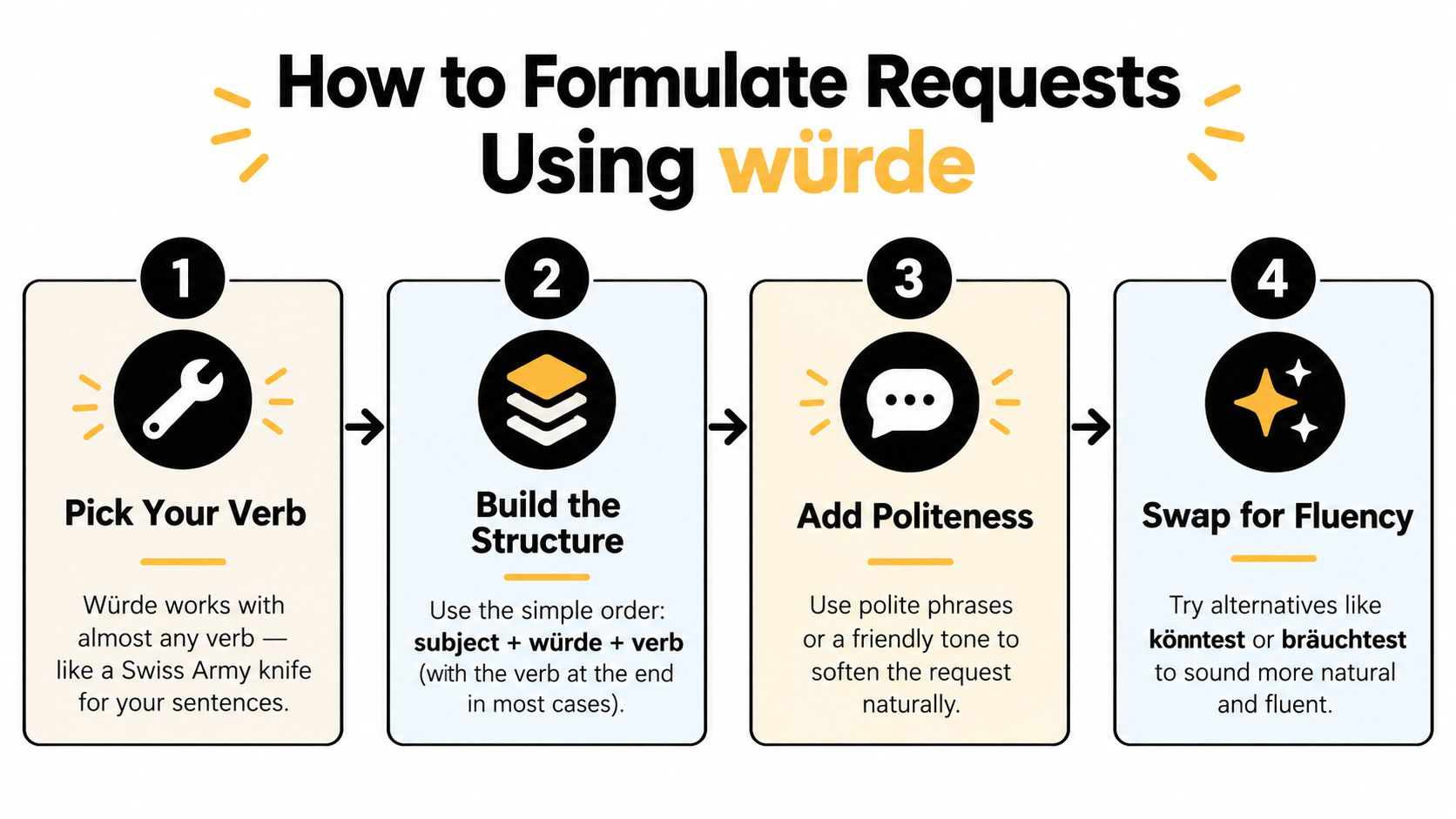
Four steps to build the sentence
1. Choose the main verb.
Start with the action you need. Common verbs include helfen for “help”, wiederholen for “repeat”, warten for “wait”, schicken for “send”, and bringen for “bring”.
2. Select the right form of würde.
For formal Sie, use würden. For informal du, use würdest.
3. Put the request into question order.
In a yes-or-no question, the conjugated verb comes first:
Würden Sie bitte einen Moment warten?
The subject follows:
Würden Sie...
The remaining information comes next, while the infinitive goes to the end.
4. Add the details.
Use mir for “to me”, das for “that”, and bitte to make the request sound more courteous:
Würden Sie mir bitte erklären, wie ich zum Bahnhof komme?
Would you please explain how I can get to the station?
Why the infinitive goes at the end
German main clauses generally place a conjugated verb in the second position, but questions place the conjugated verb first. With würde, the conjugated element is würden or würdest. The action verb remains in its infinitive form at the end.
Break down this sentence:
- Würden is the Konjunktiv II form of werden.
- Sie is the formal subject.
- mir identifies the person receiving help.
- bitte signals courtesy.
- helfen is the infinitive at the end.
Würden Sie mir bitte helfen?
This formula helps when you're nervous. You don't need to improvise the entire sentence at once. Choose the verb, place würden first, add the person and details, then send the infinitive to the end.
Turning wishes into polite statements
Würde also appears in statements about what you would like:
Ich würde gern einen Termin vereinbaren.
I would like to arrange an appointment.
Ich würde gern wissen, ob der Kurs online stattfindet.
I would like to know whether the course takes place online.
The word gern means “gladly” or “with pleasure” and often appears with wishes and preferences. If you're contacting a German-speaking university, company, or service provider, these patterns help you sound purposeful without becoming demanding.
For additional listening practice, use the following video after you've studied the written structure:
Comparing Formal and Informal Politeness Levels
German politeness depends on more than adding bitte. The pronoun tells the listener how formal the relationship is.
Use Sie with strangers, teachers, clients, officials, interviewers, and professional contacts unless they invite you to use du. Use du with friends, family members, children, and familiar peers. The choice changes the verb form:
| Situation | German request | Meaning |
|---|---|---|
| Formal | Würden Sie mir bitte helfen? | Would you please help me? |
| Informal | Würdest du mir bitte helfen? | Would you please help me? |
| Formal ability | Könnten Sie mir bitte helfen? | Could you please help me? |
| Informal ability | Könntest du mir bitte helfen? | Could you please help me? |
The English translations look almost identical, but German listeners notice the relationship immediately. Saying Würdest du to a senior business contact may sound too familiar. Saying Würden Sie to a close friend can sound unnecessarily distant.
Würde and könnte express different ideas
Both forms can soften a request, but they focus on different meanings.
Würden Sie...? focuses more directly on willingness or cooperation:
Würden Sie bitte die Rechnung bringen?
Would you please bring the bill?
Könnten Sie...? focuses on ability or possibility:
Könnten Sie das bitte wiederholen?
Could you please repeat that?
If you didn't hear a lecturer clearly, Könnten Sie das bitte wiederholen? is especially natural because you're asking whether the person can repeat the point. If you need a colleague to complete an action, Würden Sie bitte... can sound more action-oriented.
The difference isn't absolute. Both are polite, and context matters. Your relationship with the listener, the urgency of the request, and the setting all influence the best choice.
Direct, polite, and overly casual
Consider three ways to ask someone to wait:
Warten Sie!
Wait!Warten Sie bitte.
Please wait.Würden Sie bitte einen Moment warten?
Would you please wait a moment?
The first is a command. The second is softened by bitte, but it remains an imperative. The third turns the request into a question and creates more social distance.
A practical guide to the many uses of bitte can help you understand why the word supports politeness but doesn't replace the grammatical structure. See the six uses of bitte in German for examples.
Practical rule: When you're unsure in a professional situation, start with Sie. You can move to du after the other person suggests it.
For learners in Hong Kong, this rule is useful in German-speaking workplaces, hotels, university offices, and official appointments. You can sound respectful without needing an elaborate sentence. Begin with the formal form, keep bitte in a natural position, and choose würde or könnte according to whether you're highlighting willingness or ability.
When to Use Irregular Konjunktiv II Forms
The würde + infinitive pattern is broad, but German doesn't use it for everything. Several high-frequency verbs have established one-word Konjunktiv II forms that sound more natural and should be learned directly.
The most useful forms are:
| Infinitive | Konjunktiv II | Meaning |
|---|---|---|
| sein | wäre | would be |
| haben | hätte | would have |
| können | könnte | could |
| müssen | müsste | would have to |
| dürfen | dürfte | might be allowed to |
| mögen | möchte | would like |
| wissen | wüsste | would know |
These forms are not optional decorations. They are the normal choices in common expressions.
Use established forms for common requests
At a café, hotel, or reception desk, say:
Ich hätte gern einen Termin.
I would like an appointment.
Ich hätte gern einen Kaffee.
I would like a coffee.
Avoid forcing würde into the sentence:
Ich würde haben gern einen Termin.
That version follows the wrong structure and doesn't sound natural. Hätte gern is the established expression.
Modal verbs work in the same way:
Könnten Sie das bitte wiederholen?
Could you please repeat that?
Müssten Sie morgen arbeiten?
Would you have to work tomorrow?
Dürfte ich kurz etwas fragen?
Might I ask something briefly?
A useful distinction is that würden Sie können is usually less natural than könnten Sie. The short modal form already expresses the intended meaning, so German speakers generally prefer it.
A simple decision framework
When you need to choose between würde and an irregular form, ask:
- Is the main verb a common form of sein or haben? Use wäre or hätte.
- Is it a modal verb such as können, müssen, or dürfen? Use könnte, müsste, or dürfte.
- Are you expressing “would like”? Use möchte or the established phrase hätte gern.
- Is it another lexical verb, such as warten, schicken, or wiederholen? Würde + infinitive is a dependable choice.
This is why learners shouldn't treat würde as a universal replacement. It gives you a reliable structure for many verbs, but fluency also requires recognising forms that native speakers use conventionally. This guide to irregular German verbs for Hong Kong students offers further practice with those patterns.
Applying Konjunktiv II for Exams and Careers
A polite request is a small sentence with a large communicative function. In an examination, it shows that you can choose a register, manage an interaction, and respond to another speaker rather than reciting isolated grammar.
For DSE, IGCSE, A-level, IB, or Goethe-Zertifikat tasks, practise transformations such as:
Schicken Sie mir die Unterlagen.
Würden Sie mir bitte die Unterlagen schicken?
Erklären Sie mir den Weg.
Würden Sie mir bitte den Weg erklären?
Wiederholen Sie die Frage.
Könnten Sie bitte die Frage wiederholen?
The point isn't to insert würde into every answer. Examiners and conversation partners need to hear that you can select an appropriate form. Use würde for many action verbs, and use könnte, hätte, wäre, or möchte where those established forms are more idiomatic.
Practise situations, not isolated conjugations
Working adults can make the grammar more memorable by connecting it to tasks they frequently perform:
- University applications: Ich würde gern wissen, ob Sie internationale Bewerbungen akzeptieren.
- Business meetings: Würden Sie bitte den letzten Punkt erklären?
- Travel: Würden Sie mir bitte ein Taxi rufen?
- Visa-related communication: Könnten Sie mir bitte sagen, welche Unterlagen ich brauche?
- Customer service: Würden Sie bitte die Rechnung bringen?
These examples also help parents and students prepare for study abroad in Germany. Someone considering a German-speaking university, a German visa, or an international career needs more than correct verb endings. They need to sound cooperative, clear, and socially aware.
Hong Kong's established learning pathway
German study in Hong Kong has an institutional history that reaches back decades. The Goethe-Institut Hongkong reports that it opened in 1963, has taught German to more than 50,000 people, serves approximately 3,000 course participants annually, and has around 1,500 examination participants each year. Its published course information also states that, from the 2025 HKDSE, Goethe-Zertifikat examinations are the stipulated official German-language examinations recognised by the Hong Kong Examinations and Assessment Authority. The Goethe-Institut Hongkong course information sets out these institutional and examination details.
For adults comparing German lessons Hong Kong providers, cost matters as much as curriculum. The official Continuing Education Fund information allows eligible applicants aged 18 or above to seek reimbursement for approved courses, with a cumulative maximum claim of HK$25,000 within one year after successfully completing a reimbursable course. A Hong Kong university German certificate page describes the commonly stated structure as 80% of the first HK$10,000 and 60% of the remaining HK$15,000, subject to eligibility, attendance, assessment, and claim conditions. The HKU SPACE German certificate information explains those course-funding conditions.
Check the specific course before enrolling. CEF funding isn't automatic for every German programme, and your final out-of-pocket cost depends on eligibility and successful completion.
Mastering German with Expert Guidance in HK
Self-study can help you memorise würden, würdest, and könnten. It's less effective at showing whether your request sounds natural in a particular relationship or setting. A teacher can correct the sentence, explain the social nuance, and make you repeat it until the word order becomes automatic.
For learners who want structured support, the German Cultural Association Hong Kong(GCA) offers German group courses and private lessons for children, teenagers, and adults, delivered in person or online through Zoom. Its programme includes general German, Business German, Travel German, and preparation for Goethe-Zertifikat, TestDaF, IGCSE, A-level, and IB examinations.
Native-speaking teachers are particularly helpful with Konjunktiv II because politeness isn't only a grammar rule. Learners need to hear the difference between a command, a softened imperative, and a natural request. A structured curriculum also makes it easier to revisit würde, könnte, hätte, and wäre at the right stage instead of memorising disconnected examples.
Build a practical Learn German HK routine
Whether you're a parent supporting a teenager, a professional preparing for German-speaking work, or an adult planning to travel, use a repeatable practice cycle:
- Choose a Hong Kong scenario, such as asking for help at a hotel or requesting clarification in class.
- Write the direct version.
- Convert it into a würden Sie or würdest du question.
- Decide whether könnten, hätten, wären, or möchten is more idiomatic.
- Say the final version aloud and change the object or verb.
For independent learners who want another starting point, ChatPal's step-by-step German guide can provide a broader study sequence. Use it alongside speaking practice, not instead of feedback on register and pronunciation.

The most useful result is not just remembering a formula. It's being able to ask a German-speaking colleague for clarification, contact a university professionally, or handle a hotel conversation without sounding abrupt. That confidence comes from accurate grammar, repeated speaking, and guidance on when each form fits.
German Cultural Association Hong Kong(GCA)offers structured German lessons for children, teenagers, adults, and working professionals, with in-person and online options plus preparation for Goethe-Zertifikat, IGCSE, A-level, and IB. Visit German Cultural Association Hong Kong(GCA) to explore the latest course schedule, book a trial class, and practise polite requests with expert guidance.
Konjunktiv II in German: Polite Requests with Würde
German Prepositions: Which Case Does Each One Take? Complete Tables


