.png)
.png)

BLOG

香港德國文化協會
The German Cultural Association
German vs Spanish: Difficulty Compared in Hong Kong
You're choosing between German and Spanish for a reason that matters in Hong Kong, not for fun. A parent wants a language that won't become another abandoned enrichment class. A Form 6 student wants an edge for IB or IGCSE. A professional wants a language that helps with study abroad in Germany or Spain, or a transfer into Europe.
German vs Spanish: Difficulty is the wrong question if you stop at grammar alone. In Hong Kong, the better question is which language is harder to sustain, because motivation, exam pathways, and real-life use matter just as much as the first few chapters of a textbook.
| Factor | German | Spanish |
|---|---|---|
| First impression | Heavier upfront load | Gentler start |
| Grammar | More complex | More accessible |
| Pronunciation | Tougher at the beginning | More regular |
| Writing | More rule-heavy | More predictable |
| Long-term sustainment in Hong Kong | Stronger exam and study-abroad anchors | Easier early wins, fewer local anchors |
| Best fit | Academic, visa, career, Germany-focused plans | Faster conversational payoff, broad global use |
Table of Contents
- Why Hong Kong Learners Are Comparing German and Spanish Right Now
- German vs Spanish difficulty at a glance
Why Hong Kong Learners Are Comparing German and Spanish Right Now
A lot of Hong Kong families are making this decision in very practical settings. It might be a Year 7 child who already has Mandarin and English, a Form 6 student looking at IB or IGCSE options, or a banker who suddenly has a Frankfurt rotation on the horizon. In each case, the question isn't “Which language is prettier?” It's “Which one will still make sense six months from now?”
German and Spanish are both visible in Hong Kong, but they show up differently. German often appears in exam-driven settings, especially for international school students and university-bound learners. Spanish tends to be chosen as a softer elective, a travel language, or a broad international option.
The reason this comparison is so active now is that Hong Kong learners are thinking in terms of outcome, not theory. They want to know whether the language will support school results, university applications, mobility, or work. That makes German vs Spanish: Difficulty a planning question, not a language-purity debate.
Practical rule: If you need a language for a formal endpoint, choose the one with the clearest exam ladder. If you want early conversational momentum, choose the one that feels lighter in the first year.
German has stronger academic and professional signalling in many HK households because of its clear certification pathways, while Spanish often wins on initial comfort. For learners comparing study abroad in Germany or Spain, the decision is even more concrete. German can look harder at the start, but it may be easier to justify and sustain in Hong Kong because the destination and the exam path are obvious.
That's the lens I use with families and professionals here. I don't ask, “Which is harder?” I ask, “Which one will you keep studying long enough to get a return?”
The Seven Dimensions of Difficulty Side by Side
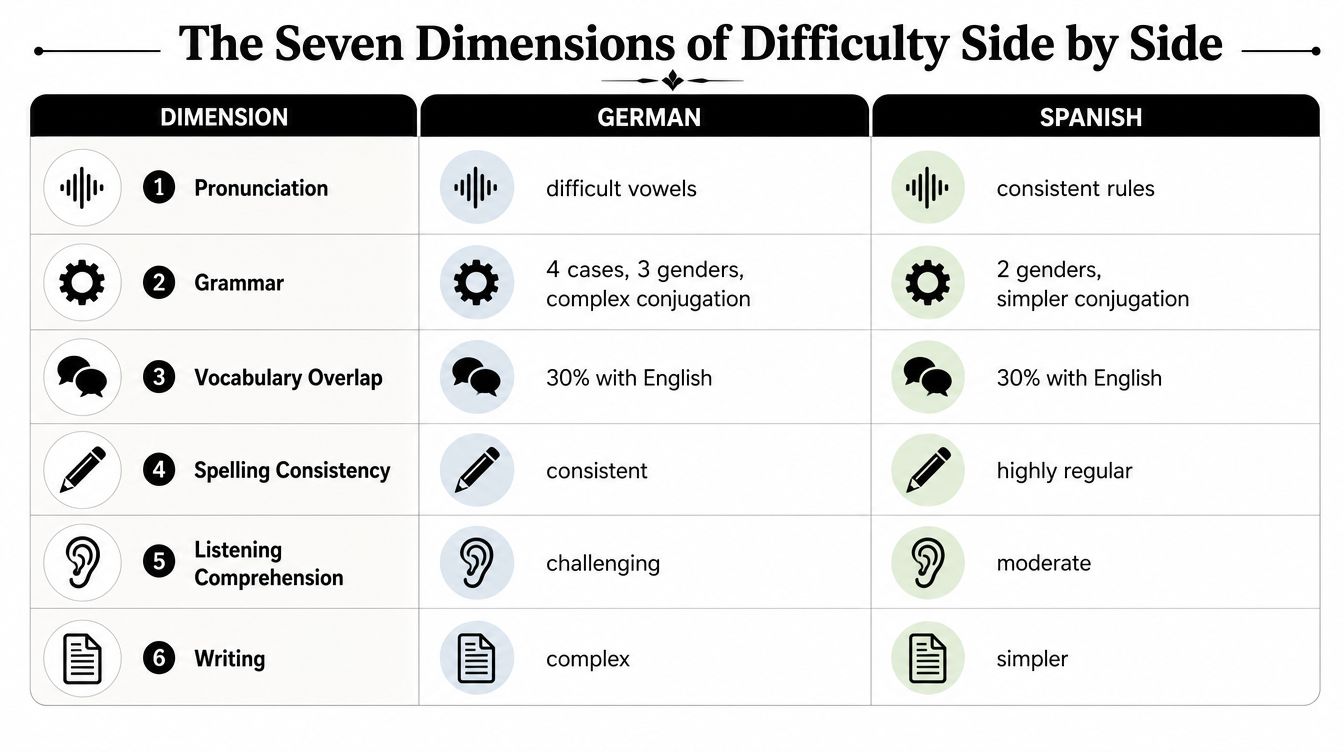
German feels harder because the pain points stack up. Spanish feels easier because the early wins arrive faster and more often. That's the short version, and it matches the broader training-based benchmark from the U.S. Department of State and FSI, where Spanish is treated as Category I at about 600–750 class hours, while German sits at Category II at about 900 class hours. The gap is roughly 150–300 hours for German, which is a real planning difference for HK learners balancing school, work, and family time. CIEE's comparison of Spanish and German and the FSI difficulty overview both point in the same direction.
German vs Spanish difficulty at a glance
| Difficulty dimension | German | Spanish |
|---|---|---|
| Pronunciation | More difficult vowels and sound distinctions | More consistent rules |
| Grammar | Case system, more variable word order, more complex morphology | Simpler structure, no declension system |
| Vocabulary overlap with English | Around 20%–30% similarity with English in one comparative summary | Around 30%–40% similarity with English in the same summary |
| Spelling consistency | Generally consistent, but grammar-heavy | Highly regular, spelling matches sounds more closely |
| Listening comprehension | Harder at first because grammar endings carry meaning | More manageable early on |
| Writing mechanics | More rule-driven and exacting | Easier for most beginners to produce clean sentences |
| Cultural/context load | More explicit rule learning and correction | More intuitive early learning flow |
German grammar is where many Hong Kong learners slow down. The case system, declensions, and more complex verb patterns demand attention. Spanish grammar is still grammar, of course, but it usually doesn't hit learners with the same amount of rule management at the beginning. A comparative overview on CLRN makes that point plainly.
Pronunciation is a different story. Spanish has a gentler start because spelling and sound line up more closely. German can be learned accurately, but the vowels, articles, and word order can make beginners second-guess themselves. That's why many students feel competent sooner in Spanish, even when they're still at a low level.
German asks for more explicit rule-learning. Spanish rewards pattern recognition earlier.
For a broader beginner lens, Verbalane's easy language guide is useful because it frames “easy” in terms of learner background, not just language reputation. That's exactly how you should look at this choice in Hong Kong.
The visual and structural pattern matters too. One analysis notes that German has three genders, plus plural formation rules and a more complex grammatical structure, while Spanish is described as having a more straightforward sound system and grammar. Listen and Learn Australia's comparison aligns with what I see in class, German takes more correction, Spanish gives more usable output sooner.
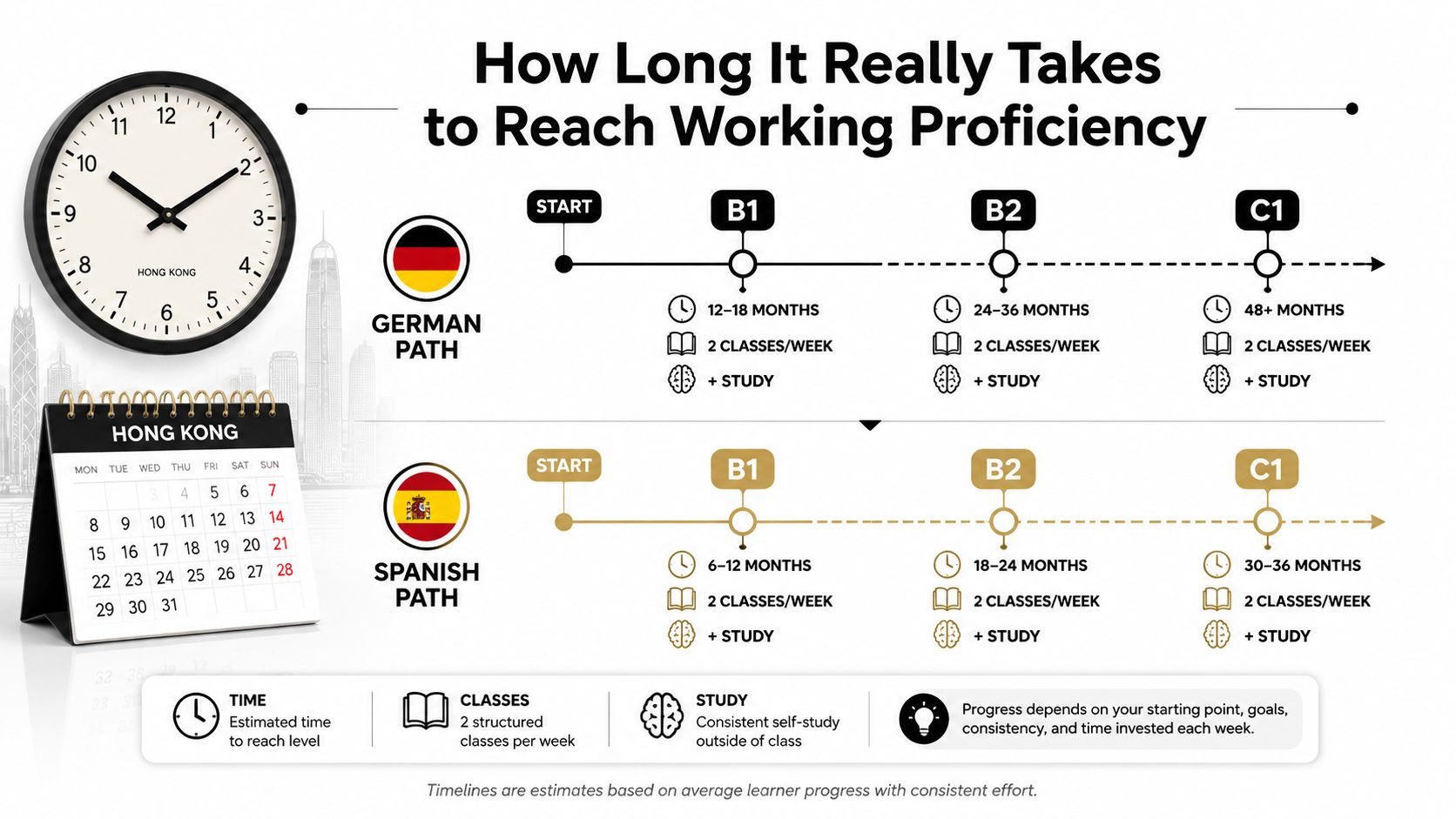
How Long It Really Takes to Reach Working Proficiency
If you are working full-time in Hong Kong, the main question is not which language looks easier on paper. It is which one you can keep up without burning out. Building on the benchmarks above, the practical difference shows up in your weekly schedule, your exam target, and how much repetition you can realistically sustain before work, family, and commute time eat into your study plan.
For a Hong Kong professional on two evening classes a week plus homework, Spanish usually reaches conversational confidence sooner. German needs a longer runway because the early stage asks for more correction and more deliberate review. You can start speaking German relatively early, but it takes longer before your sentences feel stable enough for real use at work or in study.
A realistic HK planning frame
- Spanish A2 to B1: this often fits a first-year plan if you keep pace with class and revise regularly.
- German A2 to B1: this usually needs more time, because case endings and word order keep coming back.
- Spanish B2: this becomes realistic once you have enough listening and speaking repetition in your week.
- German B2: this is the point where many learners finally feel the grammar stop interrupting every sentence.
Straight answer: If you need a visible result fast, Spanish is the better fit. If you can commit for the longer haul, German is manageable, but it demands more patience.
I do not buy the sales pitch that either language becomes easy in a few months. In Hong Kong, that kind of promise backfires because learners plan around the marketing instead of their actual calendar. Set milestones, not fantasies, and you will make better decisions about tuition, self-study, and exam timing.
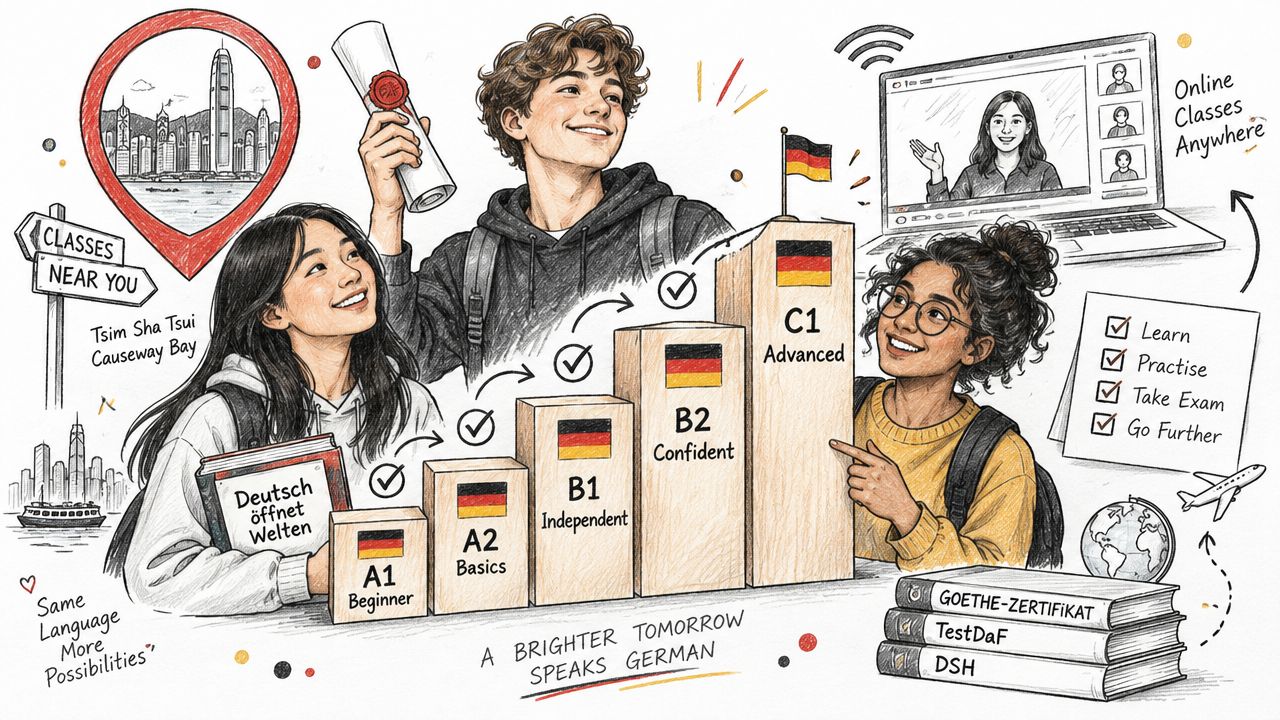
For German learners, a practical ladder is A1 for survival phrases, A2 for basic routine communication, B1 for everyday independence, B2 for solid academic or professional functioning, and C1 for advanced precision. If you want a fuller German timeline, this realistic German learning timeline is worth reading. Spanish follows the same general shape, but the climb usually feels less steep at the beginning, so learners often stay consistent for longer.
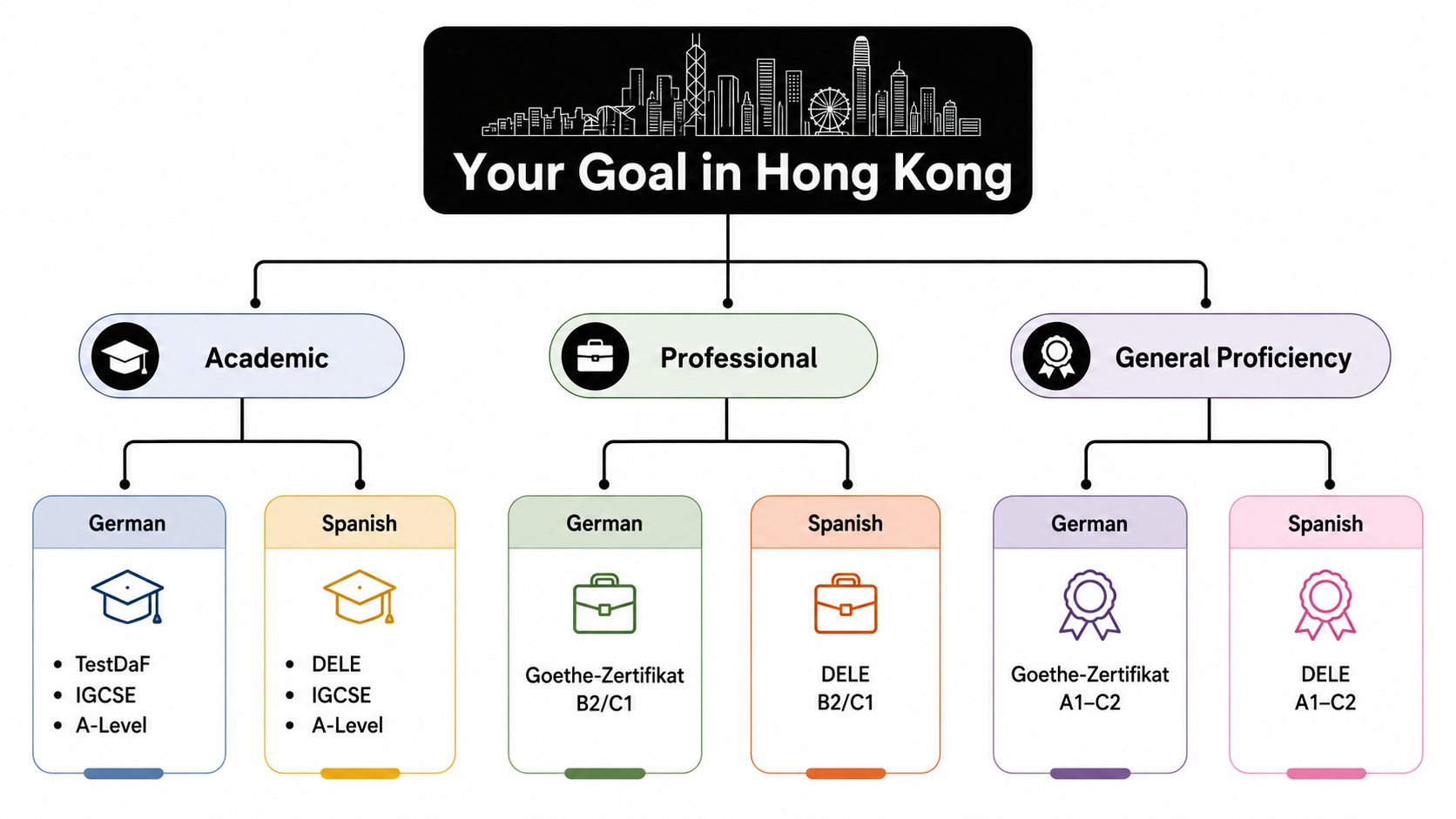
Which Exam Pathway Fits Your Goal in Hong Kong
If you're choosing for a school-age child or a teenager, the exam pathway matters as much as the language itself. In Hong Kong, German often connects neatly to Goethe-Zertifikat, TestDaF, and school-based IGCSE, A-level, and IB tracks. Spanish also has a structured route through DELE and school-level IGCSE, A-level, and IB options, with SIELE for learners who want flexible certification.
The best choice depends on your endpoint, not just your comfort level. If you want German-speaking university admission, European mobility, or scholarship-linked planning, German is usually the more strategic choice. If your priority is faster conversational payoff, broader travel usefulness, or a language that feels easier to keep active, Spanish is the cleaner fit.
The exam-to-goal match is simple.
- Academic route: German for TestDaF, IGCSE, A-level, or IB if your school or university plan points to Germany.
- Academic route: Spanish for DELE, IGCSE, A-level, or IB if your goal is breadth with less grammatical drag.
- Professional route: German for Goethe-Zertifikat B2/C1 when your career touches German-speaking markets.
- Professional route: Spanish for DELE B2/C1 if your role connects to Spanish-speaking or Latin American markets.
- General certification: German Goethe-Zertifikat A1–C2 or Spanish DELE A1–C2 when you want a formal ladder from the start.
Choose the exam that matches your real destination, not the one that sounds more impressive in a conversation.
For families who want a clearer comparison between German exam routes, this Goethe-Zertifikat versus TestDaF guide is a useful reference. It helps separate school progression from university entry, which is where many Hong Kong parents get stuck.
Matching the Language to Your Learner Profile
Children handle German better than many adults expect, but only if the teaching is patient and structured. Their ears absorb pronunciation quickly, so German's sound system isn't usually the main problem at age five to eleven. The difficulty arrives later, when articles, cases, and grammar patterns become unavoidable.
Teens are often a different story. A student preparing for IB or a school-based language track usually benefits from Spanish if the immediate goal is to get fluent in classroom conversation and written production more quickly. German still makes sense if the school pathway or university target justifies the extra load.
Best fit by learner type
- Young children: German works well if the goal is long-term academic development, because they can build the accent early.
- Exam-focused teens: Spanish is often the more efficient route when time is tight and grades matter.
- University-bound students: German wins when the destination is a German-speaking institution or programme.
- Working professionals: German is the stronger pick for DACH-region clients, technical teams, or relocation planning.
- Travel-focused adults: Spanish is usually the quicker practical win unless Germany or Austria is the actual travel plan.
Adults should be blunt with themselves about ROI. If you're in banking, logistics, engineering, or any role that links to Europe, German gives you a more direct return than Spanish. If your work is more internationally spread and you want a language that's easier to keep active socially, Spanish can be the less punishing choice.
If you're looking for a Hong Kong-based option with a structured path, one possibility is German Cultural Association Hong Kong for German classes, which offers German teaching across age groups and formats. For learners who want Spanish comparison points in the city, this Hong Kong Spanish school guide helps you benchmark expectations before enrolling anywhere.
The point is simple. Pick the language that fits your timeline, not the one that flatters your ambition. Ambition matters, but only if you can keep showing up.
The Hong Kong Reality Check Most Comparisons Miss
Most online comparisons ask which language is harder in the abstract. Hong Kong learners need a different question. They need to know which language is harder to sustain when homework, school, work, and commute time all compete for attention.
German often ends up easier to sustain in Hong Kong because the motivation is clearer. School exam pathways, university links, and career or mobility goals give learners a concrete reason to keep going. Spanish can feel easier in the first months, but some learners lose momentum when they don't have a strong local use case.
That's the local difference. A language can be structurally easier and still be harder to maintain in Hong Kong if the student cannot see how it pays off. The reverse is also true. German can feel tougher in the notebook, but more durable in the calendar.
For parents and professionals, this matters more than the usual beginner ranking. A child who knows why they're learning German is more likely to stay with it through the grammar stage. An adult who wants Spanish only because it sounds pleasant often stalls once the novelty fades.
If you want a separate lens on spoken adaptation and real-world translation habits, Klap's translation guide offers a useful reminder that language learning is always tied to output, context, and repeated exposure. That idea applies here too, especially for learners who assume one language will “stick” without a structure behind it.

Choosing Your Path and Getting Started with Confidence
My recommendation is direct. If you're a Hong Kong parent, choose German when the goal is exams, study abroad, or a serious long-term credential. If you're a teen who needs quick confidence for school, Spanish is usually the lighter path. If you're a professional tied to Europe, German is the stronger bet, even though it asks for more patience upfront.
The wrong setup makes German feel harder than it is. A structured curriculum, native-speaking teachers, and a small-group format change that quickly. That's why some learners prefer a dedicated provider like German Cultural Association Hong Kong(GCA), which runs classes in person near Tsim Sha Tsui and Causeway Bay MTR stations, plus Zoom options, with exam preparation for Goethe-Zertifikat, TestDaF, IGCSE, A-level, and IB, along with Business German and Travel German tracks.
What you want next is simple.
- Parents: book a trial class and see whether your child handles the pace.
- Teens: ask for the exam route first, then choose the class.
- Professionals: match your target timeline to the right level, then commit.
Ready to Start Learning?
German Cultural Association Hong Kong(GCA) offers structured German classes for children, teens, adults, and professionals in Hong Kong, with native-speaking teaching and exam-focused pathways. If you're comparing German vs Spanish: Difficulty because you need a practical plan, visit German Cultural Association Hong Kong(GCA) to check the latest course schedule, book a trial class, or speak with an advisor about the right starting point.
Preschool German Classes 2026/27 (Ages 3-6): Small-Group Intake & Trial Lessons
German Courses for Teens 2026/27: Ages 12-18 New Term Classes & Exam Pathways


