.png)
.png)

BLOG

香港德國文化協會
The German Cultural Association
How Long Does It Take to Learn German? A1 to C1 Realistic Timeline: 2026 Guide
A Hong Kong learner starting from zero should plan for about 750 to 900 structured hours to reach C1, which usually works out to roughly 18 months at 10 hours a week or 2.5 to 4 years at 5 hours a week. For most HK adults studying part-time, B1 is a realistic checkpoint in about 8 to 13 months if the schedule stays steady.
If you're a parent weighing whether German fits around school runs, or a professional in Central trying to judge whether evening classes are worth it, that hour count is the number to trust. In Hong Kong, the key question isn't whether German is “hard”, it's whether your weekly routine can support enough consistent study to move from beginner to exam-ready without burning out.
Table of Contents
- Six months for a fast foundation
- Twelve months for strong school or work progress
- Twenty-four months for advanced academic or professional goals
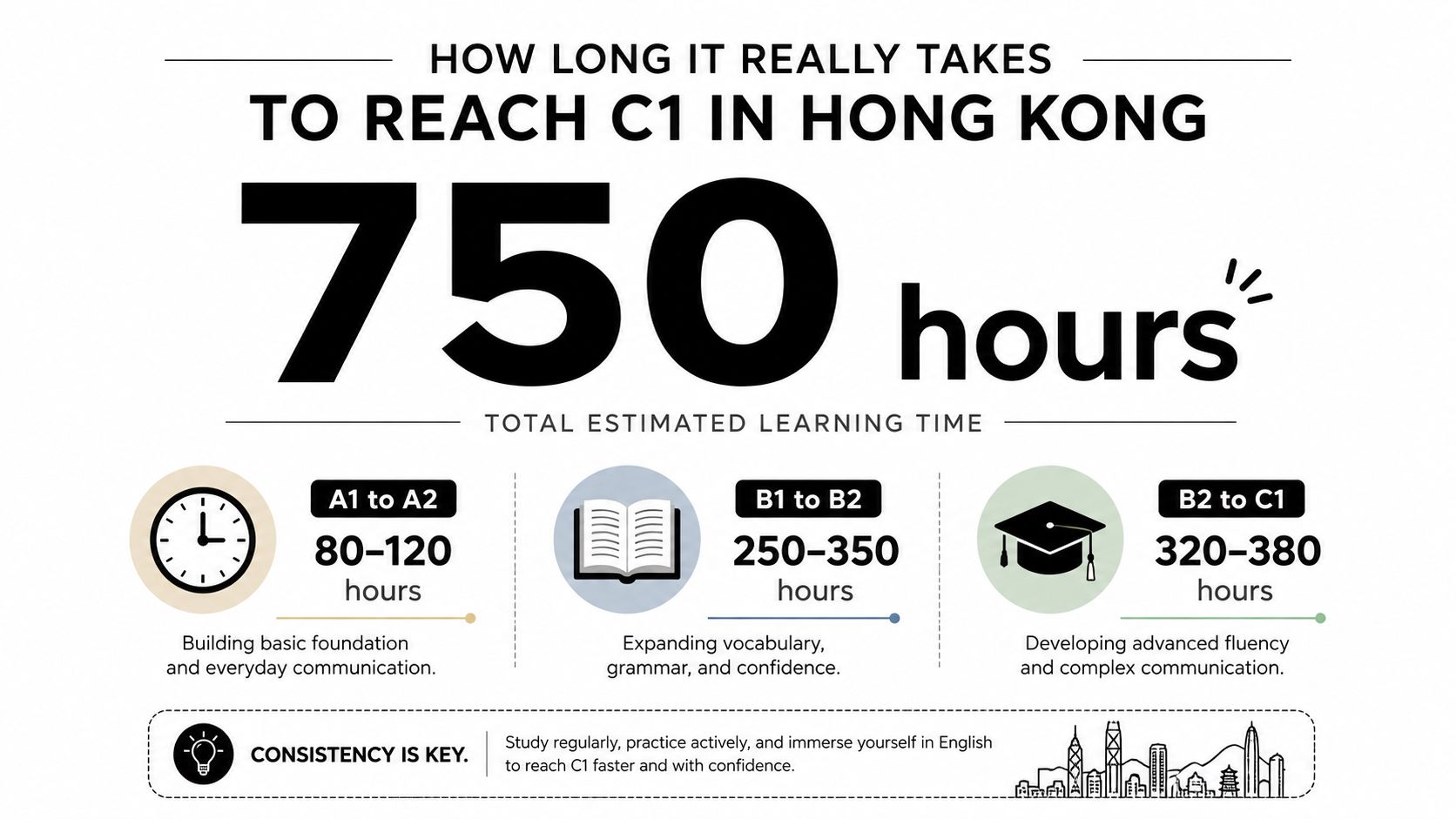
How Long It Really Takes to Reach C1 in Hong Kong
A Hong Kong learner aiming for C1 should think in hours first, months second. The clearest planning number is about 750 to 900 hours of structured German study from zero to C1, with A1 around 100 hours, A2 around 220 hours, B1 around 410 hours, B2 around 640 hours, and C1 around 900 hours total Lenguia.
For most HK adults, that means a part-time routine needs to be realistic, not heroic. At around 5 to 7 hours per week, the path from zero to C1 usually takes about 18 to 30 months. At 10 hours per week, it compresses to roughly 8 to 18 months, depending on your background and how efficiently you study Migaku, LearnOutLive.
The Hong Kong reality behind the numbers
Limited immersion changes the timetable. In Hong Kong, German usually sits inside school, work, or weekend learning, so progress depends on how much guided practice and live output you can fit into a week.
Practical rule: if you can't use German outside class, you need to make class and homework do more of the heavy lifting.
That's why the same target means different things for different people. A teenager preparing for IB, IGCSE, or A-level German is usually chasing a school-grade goal, while an adult may be planning for Goethe-Zertifikat, TestDaF, university admission, or a visa-related requirement.
A useful way to frame the journey is like a school calendar. A1 is the first term, B1 is the point where the subject feels usable, and C1 is the stage where you can handle serious academic or professional demands without constantly translating in your head.
What Each CEFR Level Means
CEFR labels are easy to quote and easy to misunderstand. The practical way to read them is by what you can do in daily life, in exams, and under time pressure.
A1 means you can introduce yourself, ask for simple information, and handle short, predictable exchanges. A2 adds routine tasks, simple descriptions, and more reliable everyday survival skills. B1 is the point where you can sustain conversations about familiar topics and explain opinions without depending on memorised phrases. B2 brings a clear jump in control, with stronger reading, clearer argument, and more flexible speaking. C1 is the stage where nuance, structure, and accuracy matter in longer texts and more demanding conversations.
A simple self-check helps make the levels less abstract.
| Level | Can-do summary | Common Hong Kong milestone |
|---|---|---|
| A1 | Introduce yourself, order food, ask basic questions | Entry point for school learners and adult beginners |
| A2 | Handle routine tasks and simple exchanges | HKDSE Other Language Category A standard aligns around this stage |
| B1 | Hold conversations on familiar topics and describe experiences | HKDSE Other Language Category C pathway and many school milestones |
| B2 | Read more complex texts, speak with more control | Often used for Goethe-Zertifikat upper-level preparation and strong school performance |
| C1 | Write structured essays, follow academic input, express nuance | Typical target for TestDaF, university admission, and professional mobility |
For Hong Kong families, one detail matters a lot. The HKDSE system recognises German as an Other Language subject, and candidates need standards equivalent to A2 for Category A and B1 for Category C, so the move from beginner to intermediate is a concrete school benchmark rather than an abstract idea.
Productive skills start to matter more than passive study. The bottleneck from B2 to C1 is often not vocabulary alone, but grammar control and the ability to manage longer texts without losing structure. For readers who want a practical accessibility example of how language can be turned into usable text, the iScribe Live Transcribe accessibility guide is a useful reminder that clear input and clear output both matter.
Study Hours by Weekly Intensity and What That Means for Your Calendar
The cleanest way to plan German is to decide your weekly intensity first. Once you know that, the calendar usually becomes obvious.
At 5 to 7 hours a week, progress is steady but slow enough that you need patience. At 10 hours a week, part-time learners usually see a much more usable pace. At 15+ hours a week, the timeline shortens, but the effort becomes much harder to sustain alongside work or school.
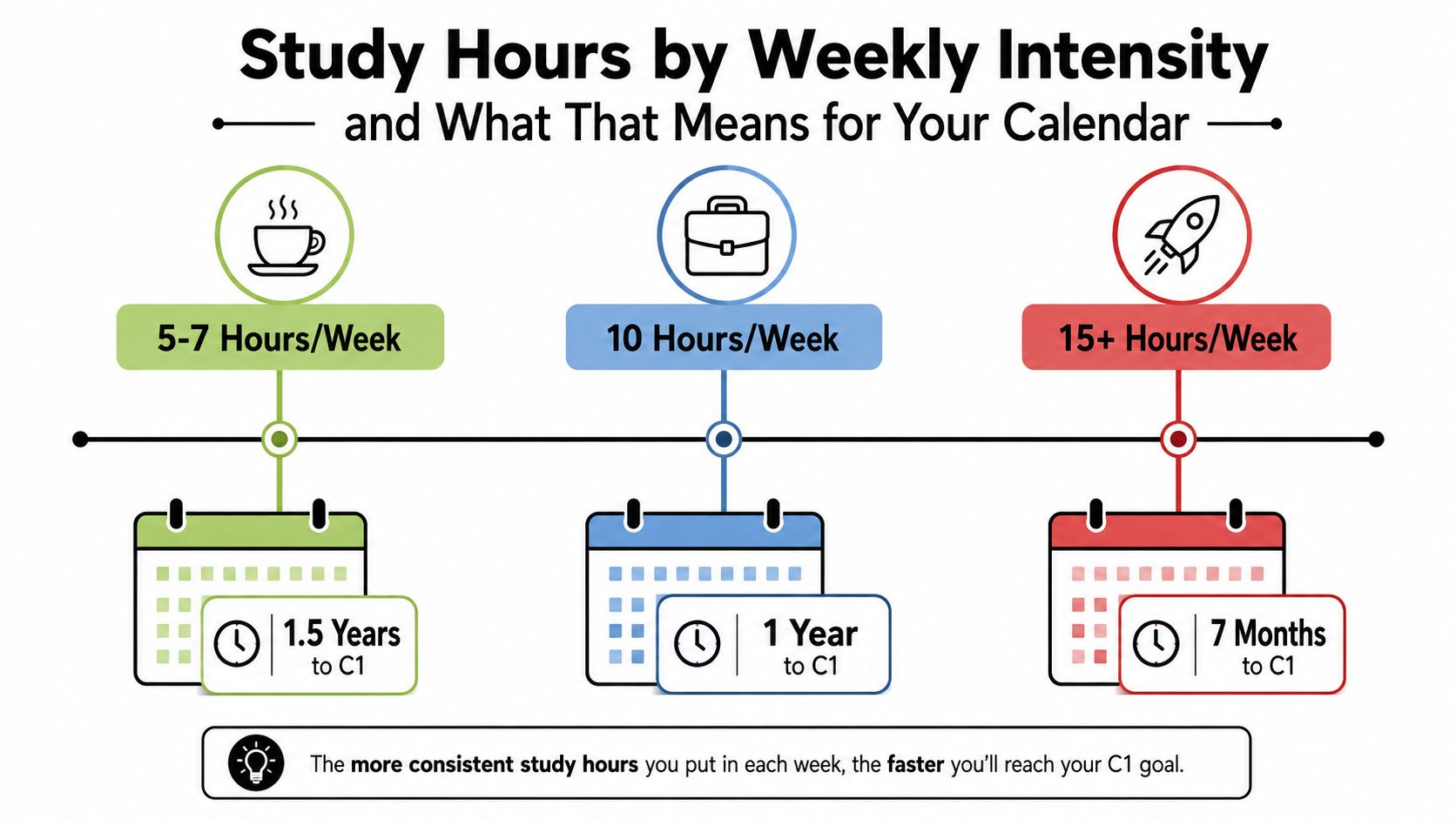
| Weekly intensity | What it usually looks like in HK | Calendar impact |
|---|---|---|
| 5 to 7 hours | Evening classes plus homework, or one weekday block and a weekend session | Roughly 18 to 30 months to C1 |
| 10 hours | A serious part-time routine with regular speaking, writing, and review | Often around 8 to 18 months to C1 |
| 15+ hours | Intensive prep, usually with clear exam pressure | Fastest route, but highest fatigue risk |
A Central-based professional might study one hour before work on weekdays, then add a longer Zoom lesson on Saturday. That gives five weekday hours plus one longer session, which is enough to build momentum if the speaking and writing are checked properly.
Working rule: if your weekly time is fixed, your exam date should be fixed too.
For example, if you want a Goethe-Zertifikat B2 sitting or a school oral exam by a certain term, work backwards from the date. Don't ask only, “How long does German take?” Ask, “How many weeks do I have, and what can I realistically complete in that window?” That simple shift stops people from overcommitting and then disappearing after the first busy month.
One helpful time-management resource for learners juggling work and family is effective study time strategies, especially if your German sessions keep getting pushed aside by commute delays or overtime.
B2 often feels quicker than C1 because everyday progress is visible. C1 feels slower because the gains are subtler, especially in writing and formal speaking. That's not a sign to quit, it's a sign to keep output practice high.
The Hidden Multiplier Most Timelines Ignore
A learner can spend the same number of hours and still end up with a very different result. The hidden difference is immersion access. One person uses German in live conversations, while another only meets it in class, so the pace of progress changes even when the calendar looks the same.
A learner in Germany or in a German-speaking environment hears German all day in shops, on transport, at work, and in ordinary daily exchanges. A learner in Hong Kong has to build that exposure on purpose through speaking partners, structured homework, and teacher correction.
That difference shapes the timeline for C1. For many Hong Kong learners, C1 sits closer to a steady part-time route only when speaking pressure is built in, not just reading and listening practice.
German improves faster when the learner has to produce it, not just recognise it.
A good way to close the gap from Hong Kong is to treat immersion like a fixed appointment, not a bonus. Weekly conversation partners keep pronunciation and recall active, because speech is like a muscle, and it weakens when it is only watched, not used.
Immersion-style homework helps in the same way. Short summaries, voice notes, and dictation force the brain to retrieve words, sentences, and grammar instead of only reviewing them passively.
In-person classes in TST or Causeway Bay can also help with routine. The commute can feel inconvenient, but it creates a stronger study pattern than keeping German as another open tab on Zoom.
Short-stay summer programmes give serious learners a different kind of pressure. They simulate a more German-rich environment without a full move abroad, which matters for learners who need their ears and mouth working under daily use, not just test drills.
The same logic applies to students who are planning how to reach German B2 level before study abroad in Germany/Spain or a later work path in a German-speaking environment. If that is the end goal, the Hong Kong timeline should already include speaking under pressure, because exam knowledge and usable speech do not grow at the same speed.
For learners who want a confidence-building route, build German conversation confidence can be a useful reference point for turning receptive knowledge into usable speech.
Sample 6, 12, and 24 Month Study Plans Tied to Real Exam Goals
A good timeline is only useful if it connects to an exam or milestone. For Hong Kong learners, the best plans are the ones that match school, visa, university, or career pressure.

Six months for a fast foundation
A six-month plan is best for Goethe-Zertifikat A2 or the HKDSE Other Language Category A threshold. It also works for travel learners who need basic speaking skills quickly.
A realistic weekly pattern is 5 to 7 hours, split between one class, short daily review, and one speaking slot. If funding is relevant, some learners should also check whether CEF funding can support the chosen course path before they commit.
Milestone check:
- Month 3: can handle introductions, directions, and daily routines.
- Month 6: can do short conversations, basic writing, and mock listening papers.
If you're aiming at A1 to B2, the internal guide how long does it take to reach German B2 level gives a useful midpoint reference for the jump beyond beginner stage.
Twelve months for strong school or work progress
A twelve-month plan usually targets Goethe-Zertifikat B1 or a strong school performance band in IGCSE or IB. This is the level many Hong Kong secondary students and working adults can sustain without turning German into a second job.
A good structure is 8 to 10 hours a week, with one small-group lesson, one speaking practice, and one written assignment each week. That balance gives enough repetition without making the plan too fragile.
Milestone check:
- Month 3: the learner should already be comfortable with core grammar and short oral exchanges.
- Month 6: can hold familiar conversations and complete a simple timed test.
- Month 9: should start reading longer texts and correcting recurring mistakes.
- Month 12: should be ready for an exam-style simulation with feedback.
Twenty-four months for advanced academic or professional goals
A twenty-four-month plan fits B2 or C1 goals such as TestDaF, university admission, or a corporate posting in the DACH region. This is the path for serious learners who need not just passing familiarity, but control.
A stable schedule here often means 5 to 10 hours a week, plus regular speaking correction. The learner needs output work, not just more input, because the higher levels expose weak grammar, weak structure, and weak recall.
Milestone check:
- Month 3: stable habits and a clear study system.
- Month 6: visible control in everyday conversation.
- Month 12: B1 to B2 bridge work, especially writing and speaking.
- Month 24: exam-ready C1 performance or close to it, depending on immersion.
If you want a format comparison before choosing a path, the next section on school options matters more than the cheapest fee.
What Speeds Up or Slows Down Your Progress
Three Hong Kong learners can work through the same textbook and still end up on different schedules.
A Secondary 4 student aiming for IB German B Standard Level may move faster if they already know another language such as French or Latin. Those learners often spot patterns more quickly and are usually less bothered by grammar drills, which helps in the beginner and middle stages.
A finance professional targeting C1 for a Frankfurt rotation faces a different pressure. Grammar may be manageable, but weekday speaking practice often becomes the bottleneck, because meetings, late finishes, and travel make live output irregular. German only improves well when it is used regularly, the way a piano piece becomes steadier only after repeated practice, not after one long weekend session.
A parent learning alongside a child follows another rhythm again. Progress often depends less on raw hours than on whether the routine survives homework, meals, and family logistics. In Hong Kong, limited immersion outside class can slow that rhythm further, so the same study time produces different results depending on how much German enters daily life.
For learners who want a practical way to increase speaking frequency, build German conversation confidence can help if confidence is the part slowing you down more than grammar. If you also want to compare how structured classes affect pace, this guide to intensive German courses gives a useful reference point.
Quick self-check for your own pace
- Prior language experience: another European language often helps with pattern recognition.
- Age band: younger learners may absorb school input faster, while adults often study more efficiently.
- Weekly intensity: steady weekly work usually matters more than occasional long sessions.
- Class format: output-rich classes reduce the risk of plateauing.
- Immersion access: the less German you hear outside class, the more you need structured speaking time.
A simple way to judge your pace is to look at your calendar, not your intentions. If German only appears in one lesson a week, progress will feel like a school term with long gaps between classes. If it appears in short daily blocks, such as a commute, a lunch break, and one speaking session, the language stays warm in memory instead of cooling off between lessons.
If your plan depends on motivation alone, it usually slips. If it depends on a weekly routine, it survives exams, work trips, and family schedules.
Choosing the Right Format for Your Timeline in Hong Kong
The right format depends on how quickly you need German and how much structure you can tolerate. A learner with a long runway can use flexible classes, but someone facing a school or work deadline usually needs tighter accountability.
Small-group lessons capped at six students suit teenagers preparing for IGCSE or IB, and adults who want regular correction without paying for one-to-one all the time. Private lessons suit professionals with irregular travel, because sessions can focus on exact weaknesses and make faster use of each hour.
Online Zoom classes suit learners in Discovery Bay or the outlying islands who cannot commute every week. In-person classes near Tsim Sha Tsui or Causeway Bay are usually better for students who need the discipline of showing up and speaking live.
If you are comparing structured certificate tracks with drop-in learning, one point matters more than convenience. A clear syllabus reduces drift, especially over a long A1 to C1 journey where motivation naturally rises and falls.
The German Cultural Association Hong Kong also offers a structured curriculum with small-group and private formats, which is useful when a learner needs a clearer exam path than a loose conversation-only class. That matters most for people working toward Goethe-Zertifikat, TestDaF, A-level, or IB targets.
For a broader view of premium versus intensive scheduling decisions, the guide on are intensive German courses worth the money is a good reference point.
A simple fit guide
- Small-group in person: best for secondary students and adults who need accountability.
- Private one-to-one: best for tight deadlines, uneven schedules, or targeted correction.
- Zoom: best when commuting is a real barrier.
- Structured certificate track: best when the learner needs an exam date to stay committed.
For Hong Kong families, the attendance structure matters too. A certificate system that rewards 80 percent attendance gives the learner a built-in reason not to disappear halfway through the term.
Measuring Progress and Your Next Step
Real progress checks should happen every 8 to 12 weeks, not just at exam time. The first check is a can-do self-assessment, where you test whether you can perform the tasks tied to your CEFR level. The second is a timed mock test for Goethe-Zertifikat, TestDaF, IGCSE, or IB papers, because speed and accuracy both matter.
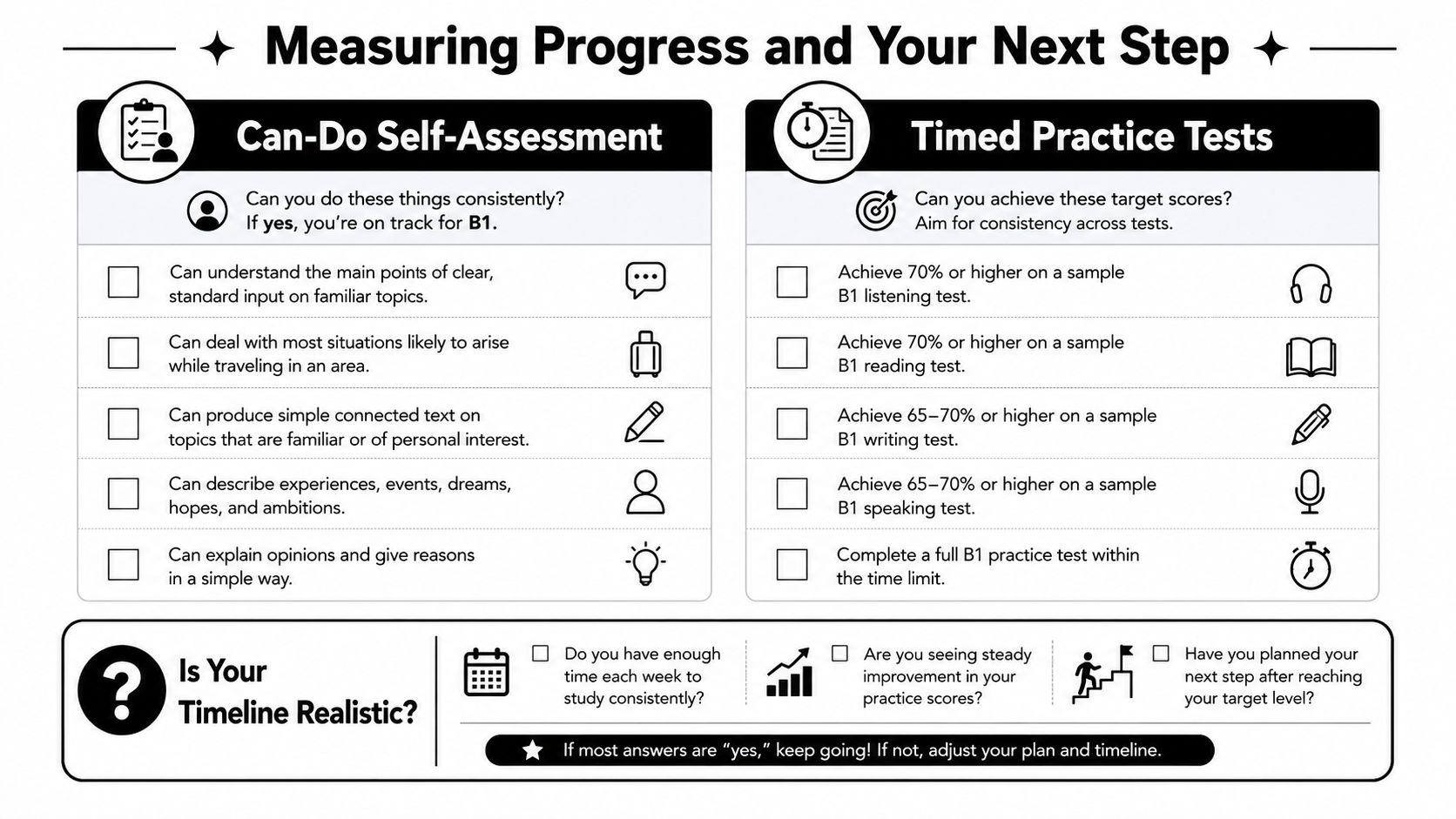
What healthy progress looks like
- Can-do check: you can understand the main point of clear, standard input at your level.
- Practice-test check: your timing improves, and repeated mistakes start shrinking.
- Escalation point: if your B2 speaking still stalls, add a private speaking slot rather than just more worksheets.
For learners who want a quick baseline before choosing a course, the online placement option in free German level tests online helps you judge whether your timeline is too ambitious, too cautious, or about right.
The simplest next step is to book a placement and trial class, then map your weekly hours to a real target date. If you want in-person classes at Tsim Sha Tsui or Causeway Bay, or prefer Zoom, choose the format that matches your commute and your deadline.
If you want a realistic German plan in Hong Kong, the German Cultural Association Hong Kong(GCA) can help you match your current level to the right class format, whether that's small-group, private, in-person, or Zoom. Visit German Cultural Association Hong Kong(GCA) to check the latest course schedule and speak with an advisor about a start date that fits your exam goal.

German Lessons for Kids 2026/27: New School Year Classes for Ages 3-12
German Playgroup Hong Kong 2026/27: New Term Classes for Ages 1-4


