.png)
.png)

BLOG

香港德國文化協會
The German Cultural Association
Best schools to learn Spanish in Hong Kong: A 2026 Guide
Finding the best schools to learn Spanish in Hong Kong can feel overwhelming, but it boils down to matching your goals with the right institution. Whether you're a professional seeking a career advantage, a parent navigating the DSE or IB, or simply passionate about the language, the key is to look beyond the brochure. The top schools are defined by their native-speaking teachers, small class sizes, and a clear focus on official exams like the DELE. This guide will help you identify what truly matters.
Why Hong Kong Is a Premier Hub for Learning Spanish

It’s no secret that the demand for Spanish is skyrocketing in Hong Kong. In a city built on global connections, Spanish is increasingly seen as a superpower for Hong Kongers looking for better career prospects in Europe or opportunities in Spanish-speaking markets. This has turned Hong Kong into a fantastic place to learn a foreign language.
This isn't just a trend; it's a fundamental shift. Online searches for "Spanish course" and related terms have seen exponential growth. Hong Kongers are prioritizing global languages, and in response, the number of dedicated Spanish schools has multiplied.
The Top Spanish Schools in Hong Kong (2026 Rankings)
If you are looking for the best institutions to start or continue your Spanish journey, here are the top language schools leading the way in Hong Kong this year:
The Spanish Cultural Association of Hong Kong
Why it’s #1: Widely regarded as the premier destination for Spanish learners, this association stands out for its highly communicative teaching style, entirely native-speaking faculty, and exceptional track record with exams like the DELE, DSE, IGCSE, and IB. They offer incredibly flexible scheduling, strictly capped small-group classes (averaging 4-6 students), and tailored private tuition, making it the top choice for both ambitious professionals and dedicated students.
Spanish World Hong Kong
Highlight: A strong runner-up, Spanish World is an official DELE examination center. Their curriculum is heavily aligned with the Instituto Cervantes framework, making it a reliable option for those whose primary goal is achieving official certification.
The Spanish Academy
Highlight: Known for its intense, small-group settings. They focus heavily on immersive conversational practice and offer good options for younger learners and teens needing academic support.
University Continuing Education (HKU SPACE / CUHK SCS)
Highlight: Best for learners who prefer a traditional, semester-based academic environment. While classes are larger and less personalized, they provide a structured, theoretical foundation backed by reputable local universities.
What Defines a Top-Tier Spanish School
With so many options, it's crucial to know what separates an average course from a great one. The best institutions are built on a few core principles that ensure high 質素 (quality).
Native-Speaking Instructors: There's no substitute for learning from a native speaker. It’s how you pick up authentic pronunciation, natural phrasing, and the cultural context that textbooks can't teach.
Official Exam Accreditation: When a school is an official exam centre for qualifications like the DELE (Diplomas of Spanish as a Foreign Language), it’s a strong signal. It means their curriculum is built around internationally recognised standards.
Flexible Learning Formats: Life in Hong Kong is busy. The top schools get this, offering a mix of small-group classes, one-on-one tuition, and online learning using advanced 程式 (software) to fit your schedule.
"The real value in learning a language lies in being able to connect with people from different cultures."
This guide is here to help you weigh these factors. Understanding what makes a school stand out is the first step toward mastering a language spoken by over 500 million people worldwide. The process is much like what people go through when they decide to learn German in Hong Kong; it all starts with setting clear goals and finding high-quality instruction.
Comparing Specialist Centres and University Programmes
When you decide to learn Spanish in Hong Kong, you’ll find two main paths: dedicated private language centres and continuing education programmes at universities. They both teach the same subject, but their approach and environment can be worlds apart.
Specialist centres are built for one thing: getting you fluent. They favour an immersive, results-focused style, meaning small classes, native-speaking teachers, and a curriculum focused on official exams like DELE and SIELE. University programmes offer a more traditional, academic journey within a larger, formal structure.
The Specialist Centre Advantage
Think of a specialist Spanish centre as a focused workshop. From day one, the entire experience is designed to get you communicating with confidence and to prepare you efficiently for exams, whether for career advancement or academic credentials like the IB or IGCSE.
This model is a perfect fit if you have a clear objective. Maybe you need Spanish for work, you’re a student facing exams, or you're just eager to hold a real conversation on your next trip. These centres cut straight to the chase with a direct curriculum.
University Programmes: A Formal Approach
Continuing education programmes, like those at HKU SPACE or CUHK SCS, represent a more conventional, academic route. These courses are typically structured around semesters with a fixed syllabus, fitting into the university's established standards.
While you get a reputable education, the focus is often different. You might find yourself in a larger class, and the pace can feel more measured, with a greater emphasis on theory over rapid conversation practice. This path works well for learners who thrive in a traditional academic setting.
The Spanish language scene in Hong Kong has really split. You have specialist centres that build their reputation on small groups—often capped at just 6 students per class—and a sharp focus on exam prep. Then you have the university providers, who prioritise structured lesson hours. If your goal is to speak confidently and pass exams quickly, the evidence points towards the specialist route.
To help you see the differences at a glance, here’s a breakdown.
Specialist Language Centre vs University Programme
| Feature | Specialist Language Centres | University Continuing Education |
|---|---|---|
| Primary Goal | Rapid fluency, exam success (DELE, IB), practical communication. | Structured academic learning, theoretical foundation. |
| Class Size | Small, typically 4-8 students. High interaction. | Larger, often 15-25+ students. Less individual time. |
| Instructors | Almost exclusively native speakers with specific teaching qualifications. | Qualified instructors, but not always native speakers. |
| Curriculum | Flexible and goal-oriented (e.g., exam prep, business Spanish). | Fixed, semester-based syllabus. Broader academic focus. |
| Schedule | Highly flexible: intensive, evening, weekend, and private options. | Rigid semester schedules with set class times. |
| Best For | Goal-oriented learners, professionals, exam candidates (DSE, IB, IGCSE), those seeking immersion. | Students preferring a traditional academic pace, lifelong learners. |
Ultimately, choosing the right environment depends entirely on what you want to achieve.
Key Differentiators to Consider
As you weigh your options, keep these core differences in mind.
Class Size and Interaction: Specialist centres almost always promise small groups. This is fundamental to fostering real interaction and giving you plenty of time to actually speak the language.
Instructor Credentials: Specialist centres make it a rule to hire native speakers who are also trained in teaching their language to foreigners. This is a huge asset for picking up an authentic accent.
Flexibility and Focus: If your schedule is demanding, a specialist school offers far more agility. Their curriculum is streamlined for language acquisition, while a university course might be one piece of a much larger academic puzzle.
Understanding this distinction is crucial. The philosophy behind a specialist centre—its focus on operational excellence and teaching quality—is what drives real results. It’s a principle we live by at the German Cultural Association of Hong Kong, similar to what you'd find at the German Swiss International School (GSIS). To see how we put this into practice, feel free to learn more on our About Us page.
How to Choose Among the Top Spanish Schools
When it comes to learning Spanish in Hong Kong, choosing the right school is the most important decision you'll make. Let's dig into what really separates the top-tier schools from the rest.
This is a side-by-side look at leading centres, comparing them on things that matter most: the quality of the teachers, the classroom feel, their track record with official exams, and their course structure.
Instructor Quality and The Native-Speaker Edge
Your progress hinges on who’s at the front of the classroom. The best Spanish schools in Hong Kong get this, which is why they almost exclusively hire native-speaking instructors with formal teaching qualifications. That's a huge differentiator.
A native speaker gives you access to the living, breathing language. You pick up on authentic pronunciation, modern slang, and cultural context. When you're looking at schools, ask about the teaching team's backgrounds.
Expert Insight: A school's policy of hiring only credentialed, native-speaking teachers says everything about their standards. It shows they're investing in your success and are committed to offering more than just basic grammar drills.
Class Environment: Size, Format, and Your Learning Style
The vibe of your class can make or break your motivation. Specialist schools shine here by deliberately keeping class sizes small, usually capping them at six to eight students. This creates an environment where you get plenty of chances to speak and get direct feedback.
On top of standard small-group classes, the best schools provide a range of formats:
Private Tuition: Perfect for zeroing in on a specific goal.
Semi-Private Classes: A fantastic choice for couples or friends.
Online and Hybrid Options: For busy Hong Kong professionals and students, flexibility is a game-changer.
This chart really clarifies the fundamental difference between learning at a dedicated language centre versus a larger university programme.
As you can see, specialist centres are all about an intensive, goal-oriented approach. This is often far more effective if you have a clear objective.
Official Exam Preparation: DELE, SIELE, and IGCSE
For many learners in Hong Kong—from secondary students to ambitious professionals—the end goal is an official certificate. The top Spanish schools are deeply connected to this world.
DELE (Diplomas of Spanish as a Foreign Language): This is the gold standard of Spanish qualifications. The best schools map their curriculum to the CEFR levels to prepare you for the DELE.
SIELE (International Service for the Evaluation of the Spanish Language): A more modern, computer-based exam that certifies your proficiency for five years, popular with professionals.
IGCSE, A-Level, and IB: Parents looking for academic support for their children should prioritise schools with a proven history of success with these crucial secondary school exams.
Some schools take it a step further by becoming accredited by the Instituto Cervantes and serving as official examination centres. This gives their students a massive advantage.
Curriculum and Teaching Method
A school's teaching philosophy dictates your entire experience. The most effective centres build their curriculum around the Common European Framework of Reference for Languages (CEFR). This provides a clear path from absolute beginner (A1) to fluency (C2).
Of course, the day-to-day experience is also shaped by how well the school is run. A smoothly managed school, often using dedicated language school software, means less time wasted on admin and more focus on high-quality teaching.
When you're comparing your options, think about these tendencies:
Spanish Cultural Association: Well-regarded for its communicative teaching style.
Spanish World Hong Kong: Being an official DELE centre means its curriculum is laser-focused on exam success.
The Spanish Academy: Often gets praise for its intense, small-group settings.
While a solid curriculum is vital, so is flexibility. This is a student-first philosophy we hold dear at GCA. By the way, if you’re curious about other languages, our adults' courses for German are built on these same principles of quality, flexibility, and a focus on real-world results.
Understanding the Cost of Learning Spanish
When you're looking for a Spanish school in Hong Kong, price is a huge factor. But just looking at fees doesn’t give you the full picture. The real question is about value. A higher price might mean smaller classes, top-qualified native teachers, and better exam results.
In Hong Kong, a school's reputation, class size, and official accreditations heavily influence pricing. Small group classes at established centres usually land between HKD 1,200 and HKD 2,500 per month. Semi-private lessons average around HKD 350 per hour per student, while private tuition can run from HKD 550 to HKD 600 per hour. You can find a deeper dive into how these factors play out in the latest guide on this topic.
What's Really Behind Group Class Fees?
Group classes are often the most budget-friendly entry point. But "group" can mean very different things. A class with 15 students will cost less per person than a class with just six.
In a smaller group, the benefits are immediate:
More speaking time: You get more chances to practise and get instant feedback.
Personalised attention: The instructor can get to know your strengths and weaknesses.
Stronger connections: A smaller setting helps build a sense of community.
The true value of a course isn't measured by its hourly rate, but by how quickly you achieve your goals. Investing a bit more for a smaller class often leads to faster progress, saving you money in the long run.
The Premium on Private and Semi-Private Tuition
For anyone with a specific goal and a tight deadline, private or semi-private lessons deliver an incredible return. This is the perfect setup if you're:
Prepping for a high-stakes business presentation in Spanish.
A student cramming for an IB or IGCSE exam.
Someone with a hectic schedule.
Semi-private lessons, shared with one or two others, offer a fantastic middle ground. You still get a highly personalised environment but get to split the cost.
What's Included in the Price Tag?
When you’re comparing fees, always look beyond the classroom hours. The best schools bundle valuable extras into their pricing.
Before you sign up, ask if the fees cover:
All learning materials: Are textbooks and workbooks included?
Access to online platforms: Is there a student portal?
Mock exams and assessments: Regular progress checks are essential.
Flexible rescheduling: A school that lets you reschedule a class without a penalty offers serious real-world value.
A school with a transparent, all-inclusive pricing structure shows they’re committed to your success.
Finding the Right Spanish School for Your Goals
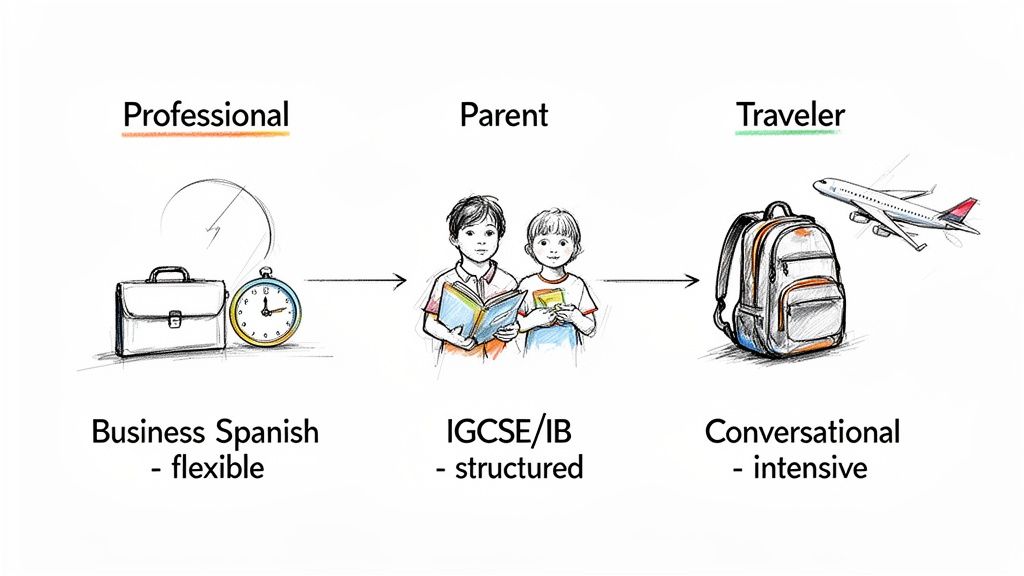
Choosing a Spanish school in Hong Kong isn’t about finding the one "best" centre. It's about finding the right one for you. The ideal school for a teenager cramming for the DSE will be a terrible fit for a finance professional.
Let's look at three common scenarios to help you match your personal goals with the right school.
For the Ambitious Professional
You're a busy executive. Your reason for learning Spanish is strategic: you want to manage international teams or unlock career moves. Your biggest roadblock is a packed schedule.
For you, flexibility and specialisation are everything. The clear winner here is private or semi-private tuition. This format lets you book sessions around your meetings and means the curriculum can be built from the ground up to serve your exact needs.
What you should be looking for:
Corporate Training Experience: Instructors should have a background in teaching business Spanish.
Effortless Scheduling: A user-friendly online system for booking and rescheduling classes is a must.
A Bespoke Curriculum: The school must be able to design lessons around your industry.
For professionals, there's no substitute for targeted, one-on-one instruction. It’s the fastest way to gain practical skills you can use at work tomorrow.
For the Dedicated Parent
Your focus is on your child's academic success. They're tackling major exams like the IGCSE, A-Level, or IB, and you need a school with a proven system to help them secure a top grade. This isn't just about learning a language; it's about acing the test. This is a common concern for 香港德語家長 (Hong Kong German parents) as well.
The most effective path is often a structured small-group class, topped up with occasional private lessons. The group environment provides healthy competition, and one-on-one sessions can iron out specific weak spots before the exam.
What you should be looking for:
A Proven Track Record: Ask for the school's results with IGCSE and IB exams. Reputable centres will be proud to share success rates.
Direct Curriculum Alignment: The syllabus must be designed to cover every component of the exam board.
Exam-Savvy Tutors: Look for instructors with years of experience coaching students for these specific exams.
For the Passionate Traveller
You've got a trip to Spain or South America on the calendar. You want to order tapas confidently and have a real conversation with locals. Your goal is fast conversational fluency, not a certificate.
Your best bet is an intensive small-group course. This immersive setting encourages you to start speaking from day one. You'll quickly build the vocabulary and confidence you need for real-world interactions.
What you should be looking for:
A Communicative Focus: Prioritise schools that get you talking, not just drilling grammar.
Genuinely Small Classes: A group of no more than six students means you'll actually get to speak.
A Taste of the Culture: The best courses teach you about local customs and etiquette, not just words.
A Note on Online Learning
For many students, the classroom is now virtual. If you're considering an online or hybrid model, look at the technology the school uses. A quick look at the best online teaching platforms can give you a sense of what good tech looks like. When a school invests in a quality platform, it shows a commitment to an effective learning experience.
Decision Checklist: Which Spanish School Is Right for You?
Use this checklist to think through your priorities.
| Priority | Key Question to Ask | What to Look For |
|---|---|---|
| Exam Success | What's your track record with IGCSE, IB, or DELE? | Published success rates, exam-specific syllabi, tutors with exam coaching experience. |
| Schedule Flexibility | How easy is it to reschedule a class? | An online booking portal, clear cancellation policies, and ad-hoc class options. |
| Budget & Value | What is the total cost? What’s included? | Transparent pricing, clear cost-per-hour, and trial class options. |
| Learning Style | Do I learn best in a group or one-on-one? | Small group sizes (max 6), availability of private tuition, and flexible pacing. |
| Location & Convenience | Is the centre easy to get to, or is the online platform reliable? | MTR-accessible locations, high-quality video conferencing software. |
| Teaching Quality | Are all teachers native speakers? What are their qualifications? | 100% native-speaker faculty, teaching certifications, and specialisations. |
By weighing these factors, you'll be able to choose a school that will genuinely help you achieve your Spanish language goals.
Frequently Asked Questions
When you're deciding on a Spanish school in Hong Kong, you’ll have a lot of questions. Here’s a rundown of the most common queries we hear.
How Long Does It Really Take to Become Fluent?
Let's be realistic: fluency doesn't happen overnight. For most dedicated learners in our small-group classes, hitting a confident conversational level (CEFR B1) is achievable within 12 to 18 months. This is the point where you can handle everyday chats and travel with ease.
Getting to an advanced level (CEFR C1) is a bigger mountain to climb. You should plan for two to three years of consistent study. Steady and consistent effort will always beat intense but sporadic cramming.
Should I Take the DELE or SIELE Exam for My Career?
Both the DELE and SIELE are heavy-hitters. The "better" one for you comes down to your career goals.
DELE: This is the traditional, life-long diploma. Think of it as the gold standard. It's the perfect choice for academic applications or any role where you need a permanent, highly respected credential.
SIELE: This is the modern, computer-based alternative, with results valid for five years. It's ideal for professionals who need to quickly prove their current Spanish level for a job application.
If you need a permanent diploma for official purposes, go for the DELE. If you need to certify your current proficiency for a job right now, the SIELE is the faster, more practical choice.
What's the Best Age for My Child to Start Learning Spanish?
It's true that young children are like sponges. Starting a child on Spanish between the ages of 4 and 7 is incredibly effective. They soak up the sounds of the language, often developing a near-native accent.
But don't worry if you've missed that window—it's never too late. Older children and teens can achieve fantastic results, especially when they have a clear goal driving them, like preparing for the IGCSE or IB Spanish exams.
Are Private Lessons Actually Worth the Extra Cost?
Private lessons are worth paying the premium for if you:
Have a very specific, time-sensitive goal.
Need to learn industry-specific vocabulary.
Have a hectic schedule that doesn't fit with group classes.
Want to push through a learning plateau quickly.
You're essentially paying for speed and efficiency. For many busy professionals or students with targeted needs, the accelerated progress makes private lessons a smart investment.
Can I Genuinely Learn Spanish with Just a Few Hours a Week?
Yes, you can make real progress with just a few dedicated hours each week. The secret is the quality of that time. A two-hour, interactive session with a native-speaking teacher in a small group will do more for you than five hours on a language app.
The trick is to back up your classes with small, daily habits. Listen to a Spanish podcast on your MTR commute. Review vocabulary with your morning coffee. Consistency always trumps cramming.
Ready to embrace language learning as your superpower? Visit the German Cultural Association of Hong Kong website at https://german.com.hk to view our current course schedules or join as a member and see how our professional, encouraging approach can help you succeed.

Beginner German for Teens: A Starter Roadmap for Ages 12-18
Learn German for Kids: How Children Actually Pick Up a Third Language


