.png)
.png)

BLOG

香港德國文化協會
The German Cultural Association
German Plural Nouns: 8 Essential Patterns Every HK Learner Must Know
You're revising for a Goethe-Zertifikat paper, helping your child with IGCSE German, or trying to write a cleaner business email before a meeting with German-speaking clients. Then a simple noun appears, and the plural changes in a way that feels random. One word adds -e, another adds -er, another doesn't change at all, and a fourth suddenly takes an umlaut.
That's where many Hong Kong learners lose momentum. German plurals don't work like English, and noun gender alone won't save you. In fact, gender is only a weak predictor. One useful example is that 80% of masculine and 75% of neuter nouns add -e, but there are many exceptions, which is exactly why learners get stuck if they rely on a single shortcut instead of pattern training with real examples and repetition (German plural patterns explained).
The fix is practical. Learn the major plural patterns, attach each noun to its article from day one, and practise them in exam-style sentences. That's how we teach serious learners at GCA, especially those preparing for Goethe-Zertifikat, IB, IGCSE, A-level, or future study abroad in Germany.
German Plural Nouns: 8 Essential Patterns Every HK Learner Must Know becomes much easier once you stop asking for one rule and start recognising the core families.
Table of Contents
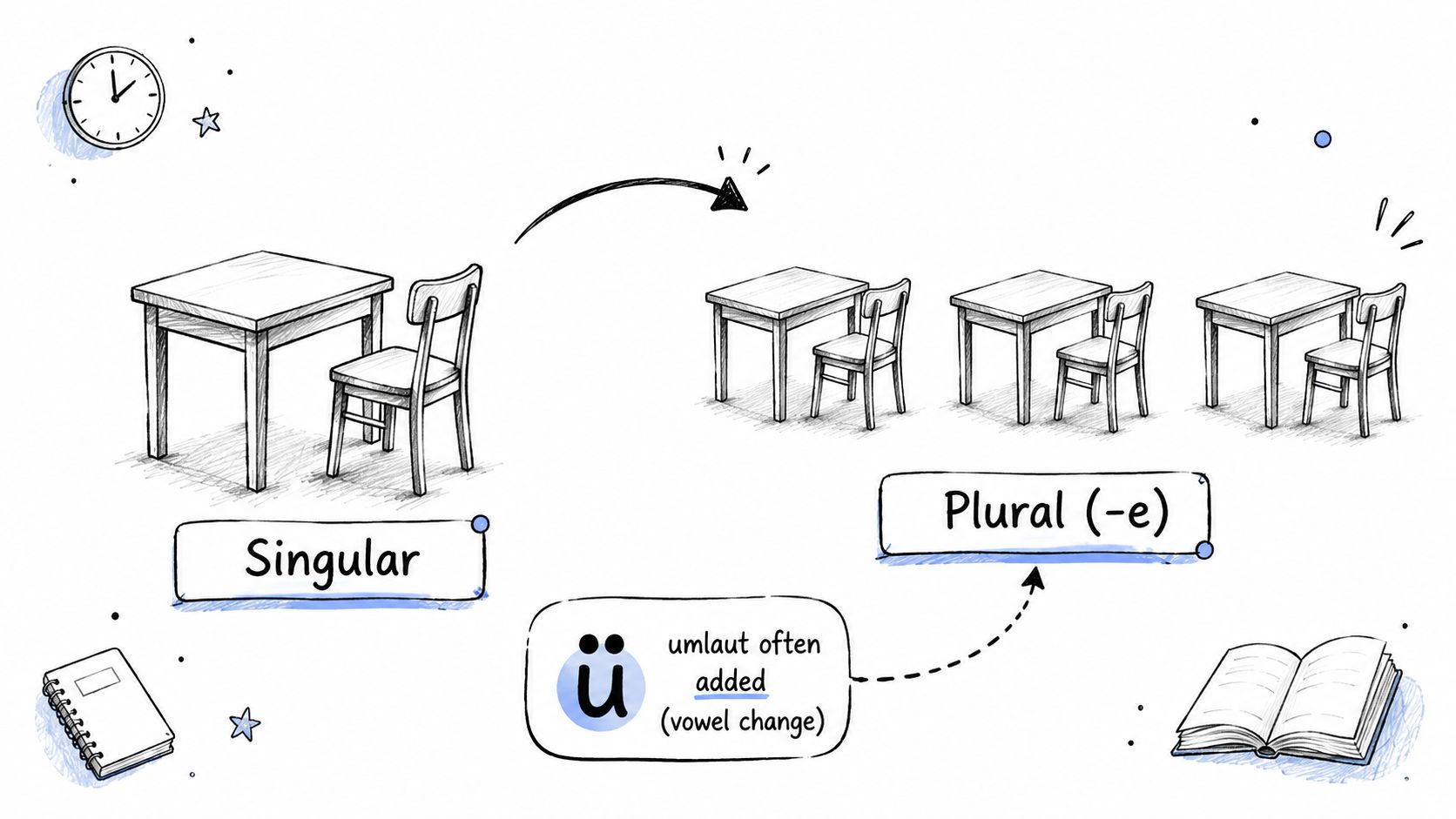
1. Pattern 1 The -e Plural
The -e plural appears again and again in everyday German. If you're studying German lessons in Hong Kong for school exams or adult progression, you'll meet this pattern early and often.
Examples you should know:
- der Stuhl → die Stühle
- der Gast → die Gäste
- der Hund → die Hunde
- die Hand → die Hände
Where HK learners usually go wrong
Many learners memorise only the singular form. That creates trouble later because the plural may need both -e and an umlaut. If you learn Stuhl without der and without Stühle, you've left the job half done.
For ambitious HK learners preparing for Goethe-Zertifikat or school-based assessments, the best habit is simple:
- Learn the article: write der Stuhl, not just Stuhl.
- Learn the plural together: add die Stühle immediately.
- Say it aloud: your ear needs to recognise the vowel change, not just your eyes.
Practical rule: When you learn a noun, store it as a three-part unit: article, singular, plural.
At GCA, our native-speaking teachers drill this through short sentence patterns, not isolated lists. That matters because plurals become more stable when you use them in context, such as Die Gäste warten or Die Hände sind sauber.
Mini practice
Change these into the plural:
- der Gast → ?
- die Hand → ?
- der Hund → ?
Answers:
- die Gäste
- die Hände
- die Hunde
A strong memorisation tip for Learn German HK students is to build flashcards with colour coding. Mark singular vowels in one colour and umlaut changes in another. That's especially useful when you're balancing German with DSE/IB/IGCSE workloads and need faster review.
2. Pattern 2 The -er Plural
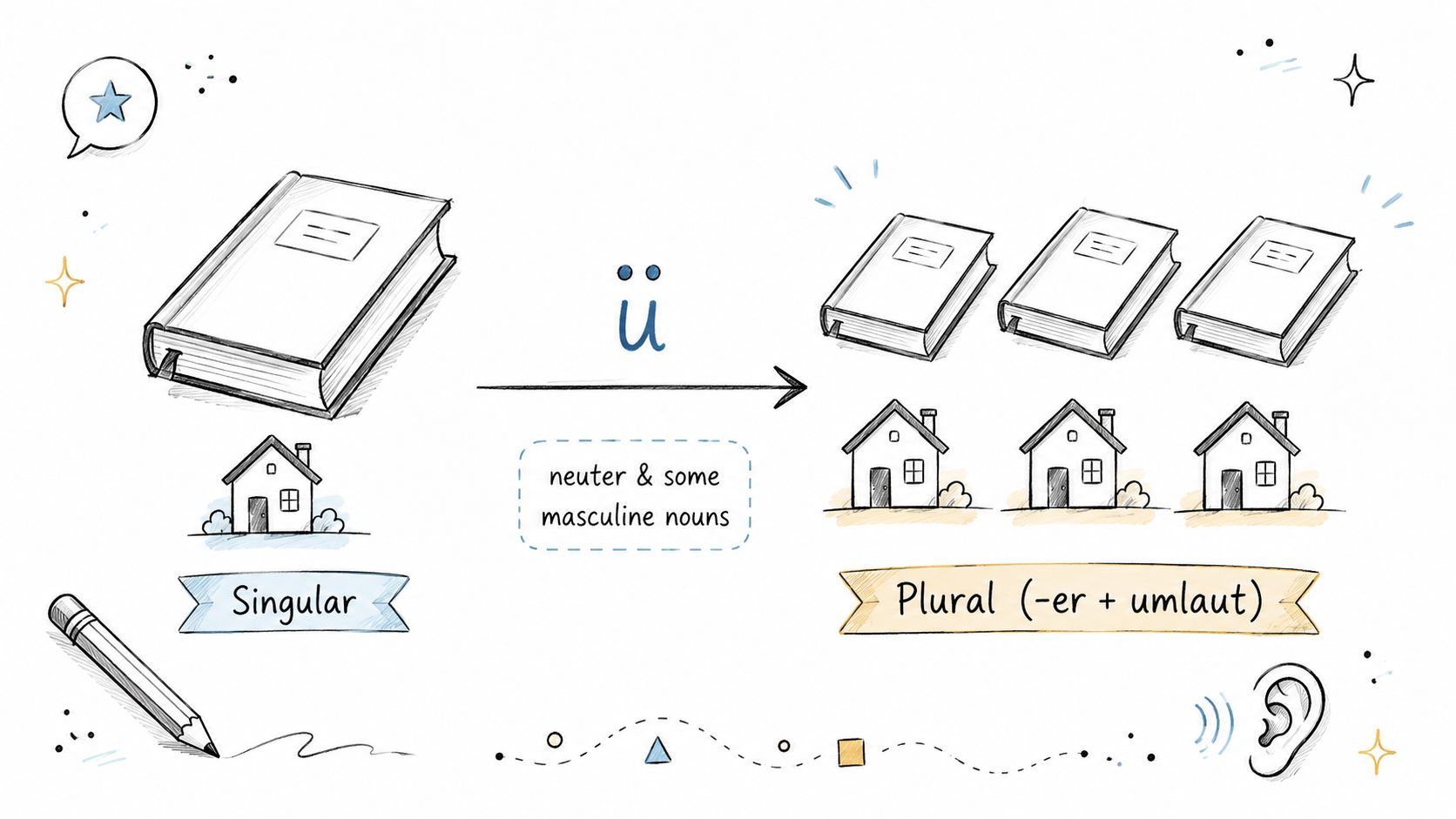
Some plurals don't just add a new ending. They change shape more dramatically. The -er plural is one of those patterns, and it's highly visible in common exam vocabulary.
Examples:
- das Kind → die Kinder
- das Buch → die Bücher
- das Haus → die Häuser
- der Mann → die Männer
Hear the umlaut clearly
This pattern becomes much easier when you train your ear, not just your memory. Buch and Bücher don't only look different. They sound different, and that difference matters in listening papers and real conversation.
If umlauts still feel unstable, work through this German umlauts and ß guide for HK learners. It helps adults and teens who need cleaner pronunciation for oral exams and interviews.
Use this contrast actively:
- das Buch
- die Bücher
Your pronunciation often improves once you stop treating the umlaut as decoration and start hearing it as part of the plural signal.
Mini practice
Turn these into the plural:
- das Haus → ?
- der Mann → ?
- das Kind → ?
Answers:
- die Häuser
- die Männer
- die Kinder
A native-teacher tip from GCA: group these words by sound, not by topic. Put Haus/Häuser, Mann/Männer, Buch/Bücher on the same review page. That helps your brain spot the pattern faster than a random textbook list.
3. Pattern 3 The -(e)n Plural
If you want one plural pattern that gives quick wins, this is it. The -(e)n plural is the most dependable family for many learners, especially with feminine nouns.
Common examples:
- die Frau → die Frauen
- die Schule → die Schulen
- die Frage → die Fragen
- der Student → die Studenten
Why this pattern builds confidence fast
A lot of Hong Kong learners feel German is unpredictable because they see the exceptions first. That's a mistake. Start with the most usable pattern, build accuracy, then expand.
This is also where gender study matters. If your foundation with der, die, das is weak, plural learning becomes slower. That's why serious learners should review gender and noun structure together with this German gender guide for HK learners.
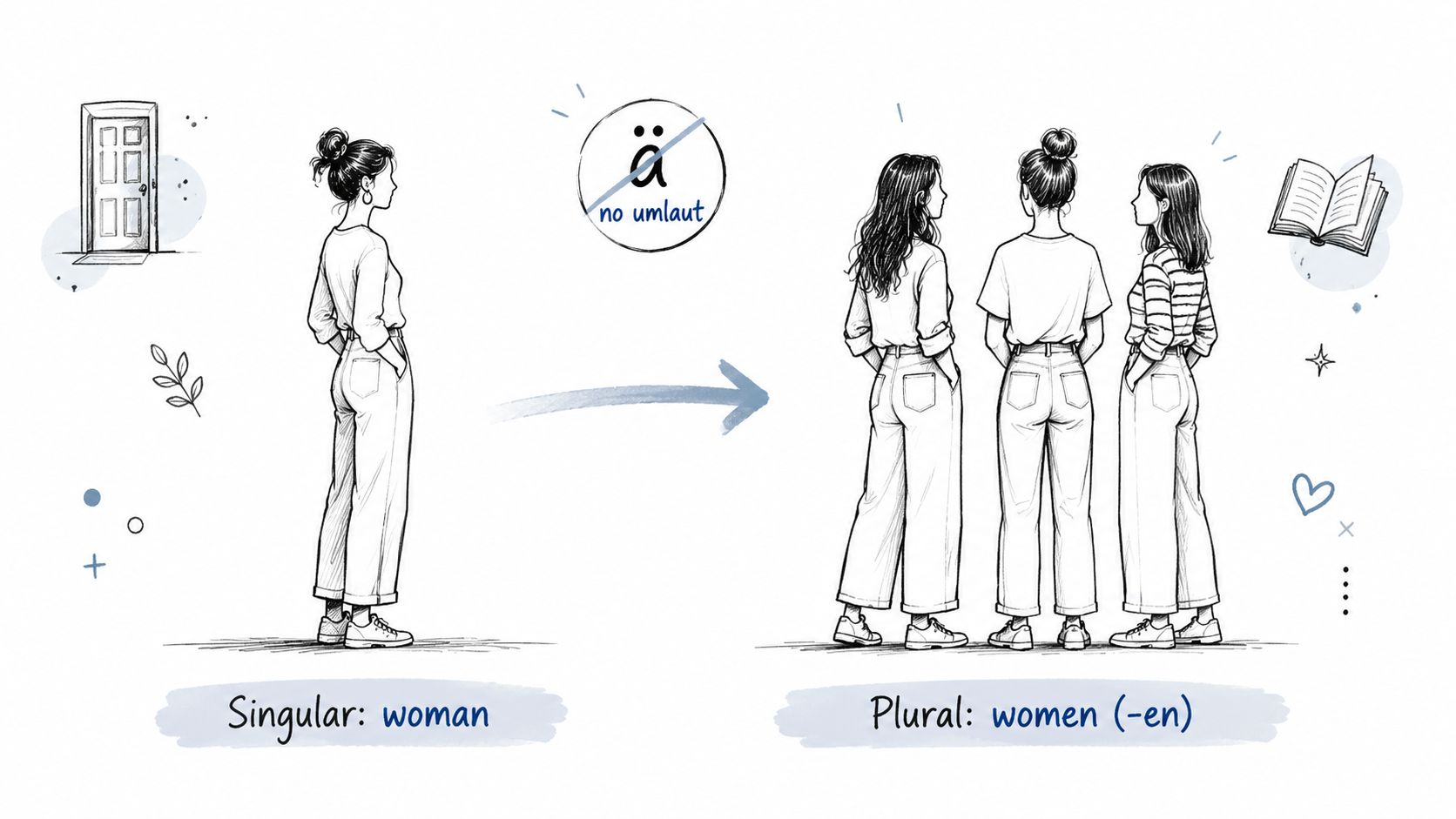
In our structured curriculum at GCA, we practise this pattern in full sentences because it supports both grammar and reading fluency:
- Die Frauen arbeiten.
- Die Schulen sind offen.
- Die Studenten lernen Deutsch.
Mini practice
Write the plural:
- die Schule → ?
- die Frage → ?
- der Student → ?
Answers:
- die Schulen
- die Fragen
- die Studenten
If you're studying for IGCSE, IB, or Goethe-Zertifikat, this pattern deserves early attention because it appears in school, family, and everyday topic sets all the time.
4. Pattern 4 The -s Plural
This is the pattern many English-speaking learners love first because it feels familiar. In German, -s plurals often appear with loanwords, modern vocabulary, and abbreviations.
Examples:
- das Auto → die Autos
- das Hotel → die Hotels
- das Team → die Teams
- der Job → die Jobs
Where you'll meet it in Hong Kong
If you use German for work, travel, or international education planning in Hong Kong, you'll see this pattern in business and urban vocabulary quickly. It's useful in office contexts, presentations, hospitality, and modern media.
For working professionals in HK, this isn't a minor detail. Adults aiming to use German for business and practical communication usually need B1 to B2 CEFR, while university admission in Germany typically requires around C1, which is why structured teaching matters in a city without much ambient German exposure (German learning path for adults in Hong Kong).
Use sentences like:
- Die Teams arbeiten zusammen.
- Die Hotels sind teuer.
- Die Jobs sind interessant.
Modern vocabulary often follows modern plural logic. If the word sounds international, check whether -s is the plural.
Mini practice
Make these plural:
- das Team → ?
- der Job → ?
- das Auto → ?
Answers:
- die Teams
- die Jobs
- die Autos
For business German students at GCA, we practise these in email-style and meeting-style phrases so the vocabulary becomes usable, not just correct.
5. Pattern 5 No Plural Change
Some German nouns look exactly the same in singular and plural. That's why many learners miss them in listening and reading.
Examples:
- das Fenster → die Fenster
- das Zimmer → die Zimmer
- der Lehrer → die Lehrer
- der Computer → die Computer
The article does the heavy lifting
With this pattern, the noun doesn't tell you much by itself. The article and the sentence context do the work. Compare:
- Der Lehrer ist hier.
- Die Lehrer sind hier.
That's a common exam trap. A student sees Lehrer and assumes singular because the word form hasn't changed. But German grammar is signalling number elsewhere.
For families in Hong Kong choosing long-term German study, this is one reason structured instruction beats random worksheets. Market demand has also shifted toward more goal-oriented German pathways. In 2025, schools in the German association FDSV reported stronger revenue, with 100% of member schools offering exam preparation, 73.3% offering university preparation courses, 80% offering language-plus-sports/culture programmes, and 46.7% offering internship courses (German schools and integrated pathways in 2025). Learners increasingly need grammar taught as part of an exam and study plan, not as isolated facts.
Mini practice
Choose singular or plural:
- Die Lehrer arbeiten viel.
- Das Zimmer ist klein.
- Die Computer sind neu.
Answers:
- plural
- singular
- plural
When you practise zero plurals, don't stare at the noun alone. Read the whole sentence.
6. Pattern 6 Umlaut plus No Ending
This pattern is smaller, but it includes words you'll use often. The plural changes through an umlaut, with no extra plural ending added.
Examples:
- der Apfel → die Äpfel
- der Garten → die Gärten
- der Vater → die Väter
- die Mutter → die Mütter
Learn this family as a set
Don't learn these as isolated exceptions. Learn them in semantic groups. Family words belong together. Household and daily-life nouns can go together too.
A strong review set looks like this:
- der Vater → die Väter
- die Mutter → die Mütter
- der Apfel → die Äpfel
- der Garten → die Gärten
This pattern appears early in real conversation. Parents in Hong Kong often meet it quickly when children begin beginner German, and adult learners meet it in simple reading passages and introductions.
Some of the most important German plurals are rare in pattern but frequent in life. Memorise them early.
Mini practice
Write the plural:
- die Mutter → ?
- der Apfel → ?
- der Vater → ?
Answers:
- die Mütter
- die Äpfel
- die Väter
At GCA, our native-speaking teachers often teach these through family description tasks because the context is easy to remember and easy to speak aloud.
7. Pattern 7 The -nen Plural
This pattern matters when you move from basic vocabulary into real social and professional German. Feminine job titles ending in -in usually form the plural with -nen.
Examples:
- die Lehrerin → die Lehrerinnen
- die Ärztin → die Ärztinnen
- die Studentin → die Studentinnen
- die Managerin → die Managerinnen
Why professionals should care
If you're preparing to study abroad in Germany, apply for jobs, or communicate in professional settings, you need to recognise and use these forms correctly. They appear in formal writing, introductions, workplace communication, and contemporary public German.
The formula is clean:
- feminine singular in -in
- plus -nen
- gives the plural
Examples in sentences:
- Die Lehrerinnen sprechen Deutsch.
- Die Studentinnen lernen zusammen.
- Die Managerinnen sind im Meeting.
For HK professionals, this is also part of sounding culturally aware. Correct gendered forms show control, especially in business German or academic contexts.
Mini practice
Change to plural:
- die Ärztin → ?
- die Lehrerin → ?
- die Studentin → ?
Answers:
- die Ärztinnen
- die Lehrerinnen
- die Studentinnen
At GCA, we include these forms in structured speaking practice because learners often understand them when reading but hesitate to produce them in speech.
8. Pattern 8 Mixed and Irregular Plurals
Some plurals don't fit neatly into one beginner-friendly pattern. You still need them, especially if you're planning to study abroad in Germany, apply for visas, or read more formal German.
Examples:
- das Museum → die Museen
- das Praktikum → die Praktika
- das Visum → die Visa
- die Firma → die Firmen
Don't fight irregulars blindly
Irregular plurals become manageable once you categorise them by use. For Hong Kong learners, words linked to education, migration, and work deserve priority.
Start with:
- Praktikum
- Visum
- Museum
- Firma
These show up in real-world German tied to applications, travel, internships, and daily life abroad. If case endings also confuse you once the plural is in place, this guide to dative and genitive for HK beginners helps you organise the next layer of grammar.
There's another reason not to panic about exceptions. Broader language enrollment has dropped in many places, but German remains relatively resilient. Global foreign language enrollment fell 16.6% between 2016 and 2021, and 29.3% from 2009 to 2021, while German held up better than some other European languages. In Hong Kong, schools such as GSIS continue to maintain strong German-language streams linked to the German International Abitur and broader access to German schooling pathways (foreign language enrollment and German resilience). For serious learners, German still offers strong academic value.
Mini practice
Write the plural:
- das Visum → ?
- das Museum → ?
- die Firma → ?
Answers:
- die Visa
- die Museen
- die Firmen
Keep an exceptions notebook. One page for Latin-style forms, one page for everyday irregulars, one page for study-abroad vocabulary. That system works far better than hoping you'll “just remember”.
German Plurals: 8 Essential Patterns Compared
| Pattern | 🔄 Complexity | 💡 Resources / Tips | ⚡ Learning speed | 📊 Expected outcomes | ⭐ Key advantages |
|---|---|---|---|---|---|
| Pattern 1: The -e Plural (with optional Umlaut) | Medium, rule is common but umlaut exceptions exist | Memorize article+plural, flashcards, listening drills | Medium, frequent exposure speeds mastery | Broad coverage (~1/3 of nouns); strong exam relevance | Very common pattern; predictable once noted |
| Pattern 2: The -er Plural (with mandatory Umlaut) | Medium–High, umlaut almost always required | Prioritise top neuter nouns, use audio to hear umlaut | Medium, requires phonetic practice | High accuracy for many neuter exam items | Highly predictable pattern due to consistent umlaut |
| Pattern 3: The -(e)n Plural (The Feminine Default) | Low, highly regular and predictable | Drill feminine nouns, sentence practice, class drills | High, quick to learn and apply | Very large coverage (≈90% of feminine nouns); exam staple | Easiest pattern; big confidence/score boost |
| Pattern 4: The -s Plural (For Loanwords & Abbreviations) | Low, simple suffix with no vowel change | Focus on loanword/business vocab and real texts | Very High, minimal memorization required | Important for modern/business German and media | Straightforward; no umlaut or stem change |
| Pattern 5: No Plural Change (Zero Plural) | Low–Medium, form unchanged but context-dependent | Train to listen/read for article and verb agreement | Medium, recognition depends on context cues | Prevents common exam mistakes on high-frequency words | Simple orthography; common in everyday nouns |
| Pattern 6: Umlaut + No Ending | Low, small set but requires memorization of vowel shifts | Learn family/core nouns; use audio for vowel contrast | High, small list makes quick gains possible | Accurate use of common family and everyday terms | Quick win: few items yield high communicative value |
| Pattern 7: The -nen Plural (Feminine Professionals) | Low, formulaic (‑in → ‑innen) | Practice occupational vocabulary; formal writing drills | High, rule applies consistently to feminine forms | Essential for professional/gender‑inclusive language | Predictable; signals cultural and professional competence |
| Pattern 8: Mixed & Irregular Plurals | High, exceptions must be memorized individually | Keep an "exceptions" journal; advanced reading/listening | Low, slow accumulation through exposure | Necessary for advanced exams (TestDaF, C1/C2) | Crucial for mastery; covers important loanwords and irregulars |
How much does it cost to learn German properly in Hong Kong
A structured German course in Hong Kong can look very different depending on your goal. If you want steady progress, especially for grammar-heavy areas like plurals, article control, and exam writing, a proper curriculum usually saves time and reduces fossilised mistakes.
A concise answer is this: in Hong Kong, a structured German course lasting 2 to 3 months at a large institution starts from HK$4,800, while private schools may charge around HK$300 to HK$800 per hour for small-group or one-to-one lessons, depending on teacher credentials (German course price guide in Hong Kong).
For beginners who want a formal pathway, the HKU SPACE Certificate in German (Introductory) is equivalent to A1 CEFR, requires 70% attendance, includes 120 hours of study across 40 meetings of 3 hours each, and costs HK$9,350 to HK$9,550. It's also eligible for CEF subsidy for qualifying applicants (HKU SPACE German introductory certificate details).
That gives HK learners a clear benchmark. But cost alone shouldn't decide your course choice. Adults, parents, and exam-focused teens usually progress faster when classes are taught by native-speaking teachers with a structured grammar sequence and clear exam preparation support.
Ready to Master German Grammar for Good?
German plurals feel messy at first because learners often meet them as random vocabulary. They stop feeling random when you group them into patterns, attach every noun to its article, and practise them in useful sentences. That's the difference between passive exposure and real control.
For Hong Kong learners, that structure matters even more. You're often studying German alongside school pressure, work deadlines, or a plan to study abroad in Germany. There isn't much ambient exposure in HK, so your course has to do more of the heavy lifting. That's why serious learners usually benefit from a native-led, structured programme rather than fragmented self-study.
If you're a parent, focus on consistency early. Children and teens preparing for IGCSE, IB, Goethe-Zertifikat, or a future German A Level qualification need plural patterns drilled before they become writing errors. If you're an adult learner, tie plural study to your real goal. Business communication, visa preparation, travel, or university planning all use different vocabulary sets, but the same plural logic keeps returning.
At GCA, we teach German grammar the way ambitious learners need it taught. That means:
- Native-speaking teachers: you hear correct pronunciation and plural contrasts from the start.
- Structured curriculum: grammar builds in a logical order instead of appearing as random rules.
- Exam preparation expertise: we support Goethe-Zertifikat and other academic pathways seriously.
- Small-group focus: learners get correction, repetition, and speaking time that generic tutorial models often can't provide.
German Plural Nouns: 8 Essential Patterns Every HK Learner Must Know isn't just a grammar topic. It's a foundation skill. Once you control plurals, your reading becomes clearer, your writing becomes safer, and your speaking becomes more natural.
The best next step is simple. Don't memorise longer lists. Master the core patterns first, then expand through guided practice, dictation, listening, and sentence building. That's how learners in Hong Kong move from confusion to confidence.
If you want expert help from German Cultural Association Hong Kong(GCA), book a trial class or speak with an advisor about the right pathway for your goals. We offer native-led German lessons for adults, teens, and children, with flexible schedules, small-group classes, private lessons, exam preparation, and practical support for learners planning school success, career growth, or study abroad in Germany.
German Accusative Case Explained: When and How to Use Akkusativ

German Small Talk: 30 Phrases for Meeting People and Making Friends


